Home Blog Page 8

XRP Shorts Outgun Longs by 2x at $490M, As Squeeze Corridor Forms from $1.3 to $1.67

0

XRP shorts have increased drastically after the token fell 9% on Sept. 15 following the CLARITY Act’s procedural defeat.

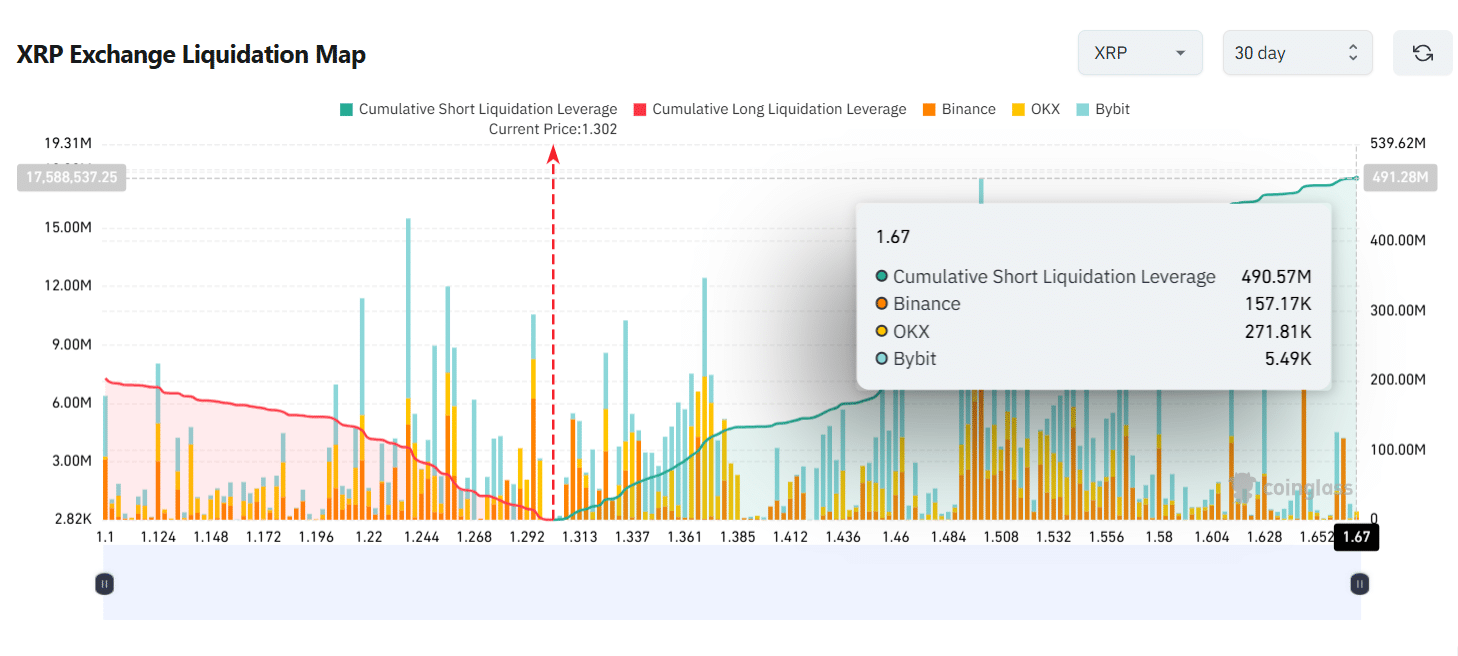
Coinglass data now shows modeled short liquidation leverage at $490 million, more than twice the $203 million in modeled long liquidation leverage. The short structure leaves a potential liquidation corridor between $1.30 and $1.67.

Why XRP Bled the Most

The Senate’s 49-50 procedural vote against the CLARITY Act triggered a much larger decline in XRP than in other major cryptocurrencies. XRP fell from around $1.47 at the start of the session to $1.28, marking a 9% drop in 24 hours and a decline of more than 10% over the week.

Bitcoin fell 3.26% during the same period, while Ethereum declined 4.66%. These figures confirm the stronger selling pressure that XRP faced after the Senate vote. 

XRP’s long connection to the U.S. regulatory discussions could explain the reaction. The token spent years at the center of the SEC’s enforcement case against Ripple, and regulatory developments continue to have a strong effect on its price despite recording a favorable outcome in the lawsuit.

The Senate defeat removed the near-term path toward regulatory clarity provided by the CLARITY Act and increased selling pressure. XRP’s cumulative volume delta also fell to -$10.5 million during the selloff amid strong selling activity.

The $490 Million Short Wall Above $1.30

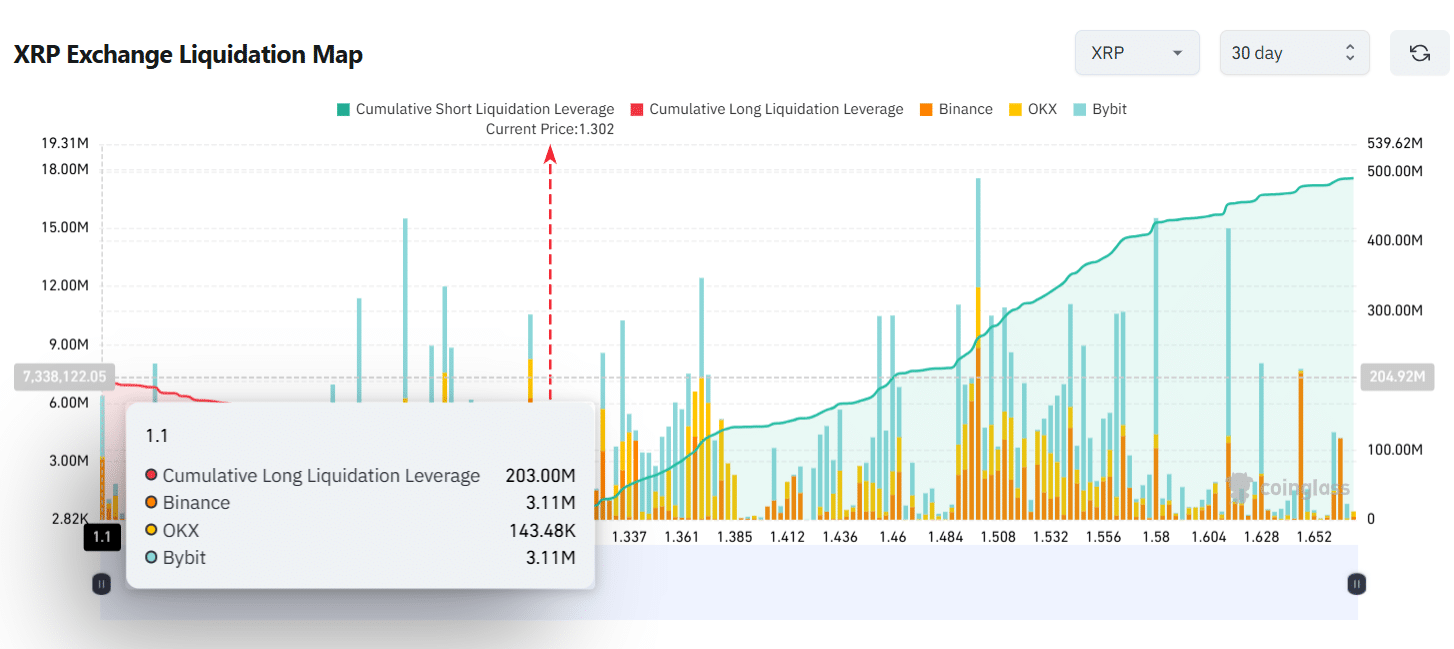
Data from the Coinglass 30-day XRP Exchange Liquidation Map shows much more modeled liquidation leverage skewed toward the short side.

At $1.67, the top of the 30-day XRP range, cumulative short liquidation leverage reaches $490.57 million. This figure shows the total potential short liquidations that could hit the market if XRP moves from the current price of $1.30 to $1.67.
XRP Cumulative Short Liquidation Leverage Coinglass
XRP Cumulative Short Liquidation Leverage | Source: Coinglass

However, specifically at the $1.67 price tick, Binance has $157.17K in short liquidation exposure, while OKX shows $271.81K and Bybit records just $5.49K. The largest individual short liquidation bar reaches around $17.59 million.

Bears have added to these positions since the CLARITY Act setback, expecting XRP’s regulatory sensitivity to keep the price under pressure. The bill’s failure leaves the market dependent on existing SEC and CFTC guidance.

XRP Sees Smaller Long Liquidation Leverage

The long side shows much less modeled liquidation exposure. At $1.10, the bottom of the 30-day chart, cumulative long liquidation leverage stands at $203 million. This represents the potential total long liquidation figure if XRP drops from $1.30 to $1.10.

Meanwhile, at the $1.10 price itself, Binance accounts for $3.11 million in long exposure, while OKX shows $143.48K and Bybit also records $3.11 million.
XRP Cumulative Long Liquidation Leverage Coinglass
XRP Cumulative Long Liquidation Leverage | Source: Coinglass

The largest individual long liquidation bar across the visible range reaches approximately $7.34 million near $1.10. Overall, the modeled long exposure below XRP’s current price remains less than half the short exposure above it.

Where XRP Goes from Here

The $490.57 million in modeled short liquidation leverage above XRP and $203.00 million in long exposure below it create the conditions for a possible short squeeze if the token recovers. 

A move toward the $1.46-$1.50 resistance area could force leveraged shorts on Binance and OKX to close, adding buying pressure to any recovery in regular demand.

XRP also retains several factors that could support its broader structure. The token maintains its commodity classification under joint SEC-CFTC oversight, and five live spot XRP ETFs have recorded $1.7 billion in net inflows. XRP remains about 29% higher over the past 30 days despite the latest decline.

The $1.25 level now stands as an important support area. If XRP holds that level, the potential squeeze corridor between $1.30 and $1.67 remains relevant. However, a break below $1.25 could bring long liquidation levels below $1.20 into focus.

Here’s How the D’CENT Wallet Hacker Drained 2 Million XRP in Two Hours

0

On the afternoon of Sept. 15, 2026, more than 1,500 crypto holders lost their XRP in a major attack that targeted the D’CENT app wallet.

Notably, between 16:29 and 18:34 UTC, a period of just two hours and five minutes, attackers drained 1,552 wallets and took a total of 2,009,321 XRP, worth over $2.8 million at the time. 

All the affected users had at some point used D’CENT, a Korean wallet app and hardware-device maker with a large user base across Asia, the United States, the United Kingdom, and Canada. 

Hours after the event, D’CENT warned users to move their funds immediately. The company said the incident appeared to affect only its software-based App Wallet and not its hardware devices.

How the Attackers Drained 2M XRP

Records reviewed by blockchain analytics resource XRPL.to show that the attack came in two waves and involved automated software. 

The first wave started at 16:29 UTC with a small transfer. Specifically, the attacker moved 9 XRP from a wallet holding 10 XRP into a newly created address. Over the next 14 minutes, the script went through its target list and drained 204 wallets, collecting 19,787 XRP.

However, the script ran into a problem. About 30 seconds into the attack, it tried to empty a wallet holding slightly more than 49,207 XRP but failed. 

This is because, besides the 1 XRP reserve required for each account on the XRP Ledger to maintain as a balance, they also need another 0.2 XRP for each additional object they hold, such as a trust line. 

The script only allowed for the basic 1 XRP reserve. As a result, it could not drain wallets that held trust lines. When the first wave stopped at 16:44, the script had recorded 72 failed attempts.

The attacker then changed tactics. Notably, the automated script paused for 33 minutes, while another tool manually drained the 12 largest wallets on the target list. Each held more than 42,000 XRP. 

The operator moved the funds one wallet at a time, with transfers coming roughly every 10 to 30 seconds, into a second newly created address. By 17:13, that address held 730,954 XRP, more than one-third of the total stolen amount. It has not moved any XRP since then.

At 17:17, the automated attack started again after the attacker fixed the reserve calculation. The updated script accounted for the extra reserve required for every object held by an account. 

This second and much larger wave continued until 18:34. It drained another 1,336 wallets and collected 1,258,563 XRP. The script moved through the wallets at about 17.6 accounts per minute and calculated the required amount correctly in most cases.

The List Was Already in Hand

The order of the targeted wallets shows how the attack was prepared. Interestingly, the attackers did not just look for wallets with the largest XRP balances. Instead, the script moved through the accounts almost in the same order in which they had originally been created.

XRPL.to analysts found a 0.65 correlation between the order of the attacks and wallet creation dates. The correlation between the attack order and wallet balances was only 0.09. 

This suggests that the attackers did not scan the XRP Ledger in real time to find wealthy accounts. They appear to have already had a list of compromised wallets and then worked through that list.

This also suggests that the attackers had access to the private keys before the first transaction took place. The XRP Ledger records show exactly when the funds moved and where they went, but they do not show how the attackers obtained the private keys for the 1,552 wallets.

Looking to Cash Out the XRP

The attackers also started moving the stolen XRP toward exchanges before they finished draining the wallets. At 18:25 UTC, while the second wave was still underway, more than 719,000 XRP moved to a new address. The operators then split the funds into smaller amounts.

This included 11 transfers of 6,000 XRP each to disposable wallets. These wallets then immediately deleted themselves into a laundering hub. The same process continued for about four hours. The first stolen funds reached Binance at 20:18 UTC.

In the early hours of Sept. 16, about 118,400 XRP moved through the Bridgers cross-chain bridge service in 10 separate transactions between 01:48 and 03:07 UTC. By around 05:30 UTC, several cash-out wallets had deleted themselves into a second laundering hub.

Notably, the laundering hub was also not new. It had been created on Aug. 9 through a KuCoin withdrawal and had already processed more than 1.36 million XRP through similar drains. This suggests that the Sept. 15 attack was the operation’s biggest day, not its first.

Who Got Hit, and What’s Still Unknown

The affected wallets largely belonged to users who had been in crypto for several years. Most of the wallets had been created between 2021 and 2023. The youngest wallet on the target list dated to March 2024, and investigators found no newer wallets among the victims.

The wallets also showed links to several exchanges. Binance had originally funded about 15.7% of the affected wallets. South Korean exchanges Coinone, UPbit, and Bithumb collectively activated close to one-quarter of the compromised accounts. This is consistent with D’CENT’s large user base in South Korea.

By Sept. 16, about 1.8 million of the 2 million stolen XRP remained in wallets controlled by the attackers. Only around 236,000 XRP had reached an exchange or bridge. At press time, it remains unclear how the attackers first obtained the private keys.

XRP-Centric Exchange Celebrates 8 Years of Cardano Support, Says ADA Has Been Part of Its Journey

0

Popular XRP-centric cryptocurrency exchange Bitrue is celebrating its eighth anniversary by highlighting its long-standing support for Cardano and ADA.

Although Bitrue has established a strong identity around the XRP ecosystem, the exchange also maintains a longstanding relationship with Cardano.

In its anniversary post, Bitrue said Cardano has been part of its journey “from the very beginning.” The exchange highlighted several milestones involving ADA and the broader Cardano ecosystem since launching in 2018.

Bitrue Highlights Early ADA Support

Bitrue said it listed ADA among the first tradable assets on its platform. It also highlighted its early involvement with Cardano Native Tokens (CNTs), claiming it became the first crypto exchange to list such assets.

Additionally, Bitrue noted that it has participated in the Cardano Summit across multiple years, underscoring its engagement with the ecosystem beyond ADA trading.

The exchange also introduced ADA as a base currency, allowing users to trade other digital assets against ADA rather than restricting the token to conventional quote-currency pairs.

Early Support for Cardano Decentralization

Beyond trading infrastructure, Bitrue said it has supported grassroots initiatives focused on strengthening decentralization within the Cardano ecosystem.

The exchange also pointed to its technical contributions. According to Bitrue, it became the first centralized exchange to develop a Go library supporting Cardano integration.

Together, these milestones highlight Bitrue’s claimed involvement in Cardano across trading support, ecosystem participation, decentralization initiatives, and technical development.

“Eight years of building together, with more still ahead,” Bitrue stated, signaling its intention to continue supporting the Cardano ecosystem.

Bitrue Marks Eight Years in Crypto

The anniversary marks eight years since Bitrue launched in July 2018. During its celebration, the exchange also acknowledged XRP, another asset it supported during its formative years. Bitrue said it has since grown to serve more than 40 million users worldwide.

Meanwhile, the exchange remains an active cryptocurrency trading platform. Bitrue recorded more than $446.82 million in 24-hour trading volume, although ADA accounted for only $977,221 of that figure.

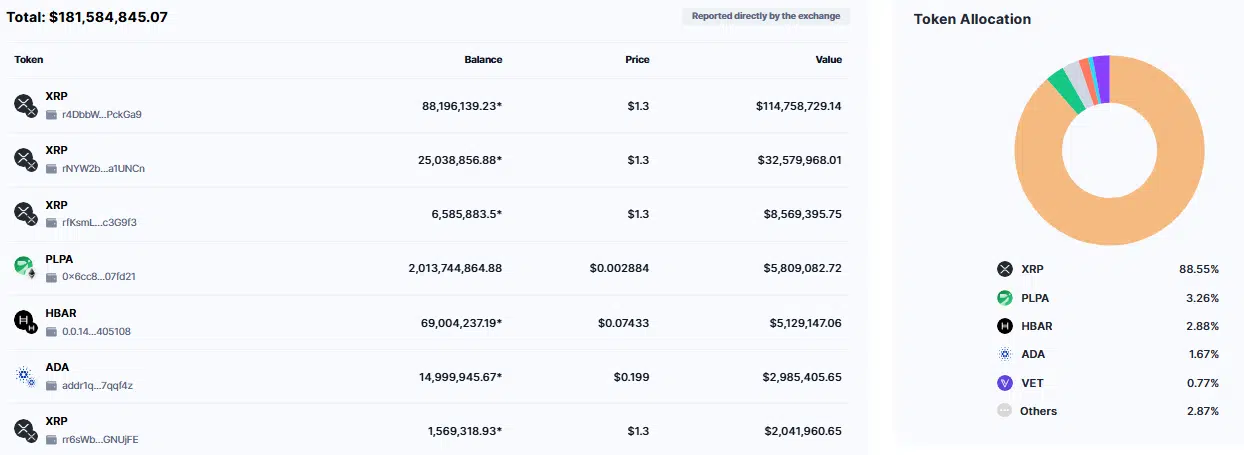
For comparison, ADA’s overall daily trading volume stood at $429.2 million, meaning Bitrue’s ADA volume represented only a small share of the token’s broader market activity. Meanwhile, Bitrue reported $181.58 million worth of digital assets in its reserves, with $2.98 million in ADA, representing 1.67% of its total reserves. By comparison, XRP accounts for 88.55% of the exchange’s reserve allocation. 

Bitrue Crypto Holdings

Here’s Why $1.33 Is Now the Most Critical Level For XRP

0

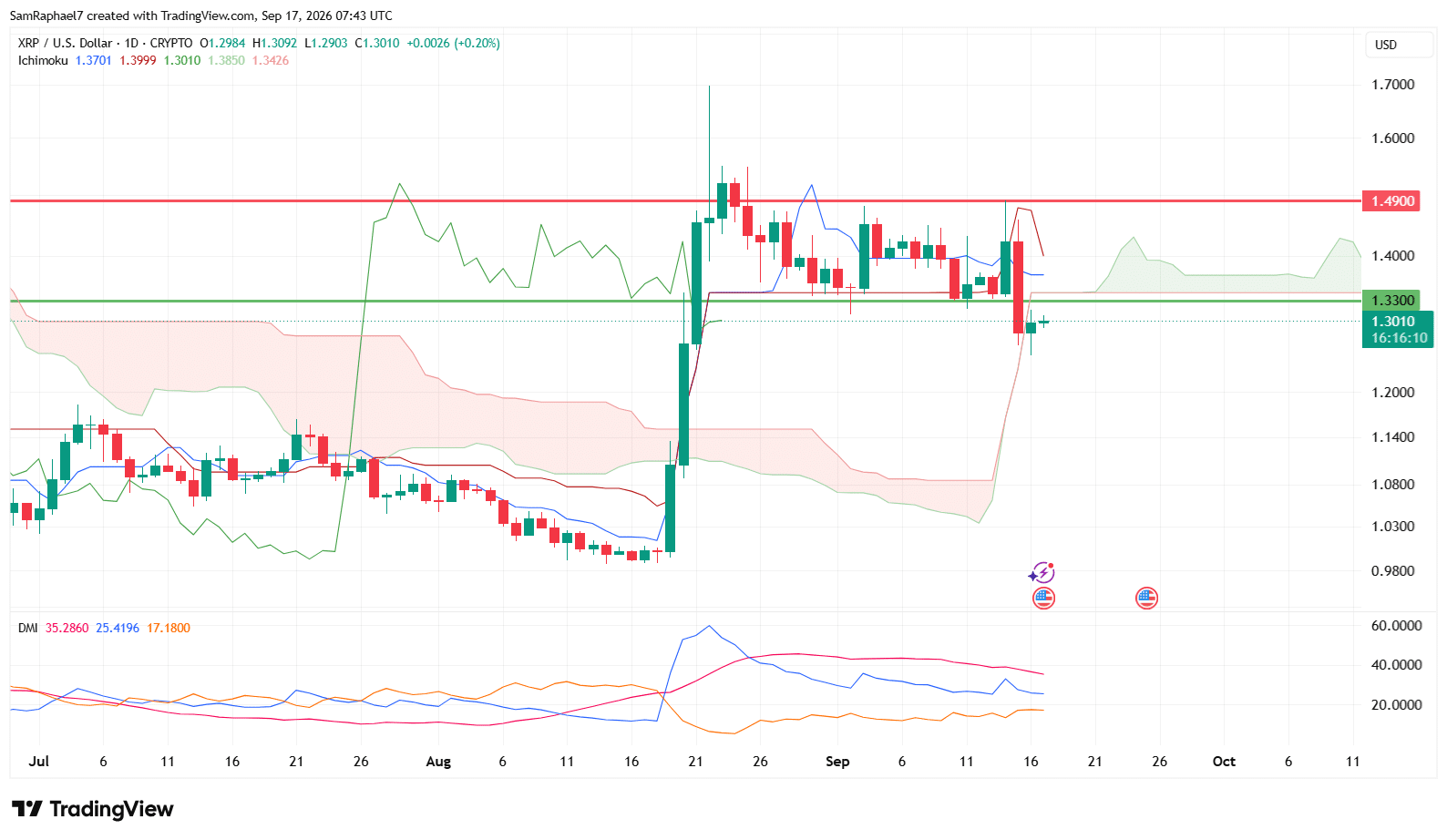
XRP slipped below the Ichimoku Cloud on the back of the latest price crash, flipping the $1.33 level to the most immediate support.

XRP fell 9% on Sept. 15 after the CLARITY Act vote failed, pushing the cryptocurrency below the Ichimoku Cloud on its daily chart. The drop also took XRP below $1.3300, turning an important support level into resistance.

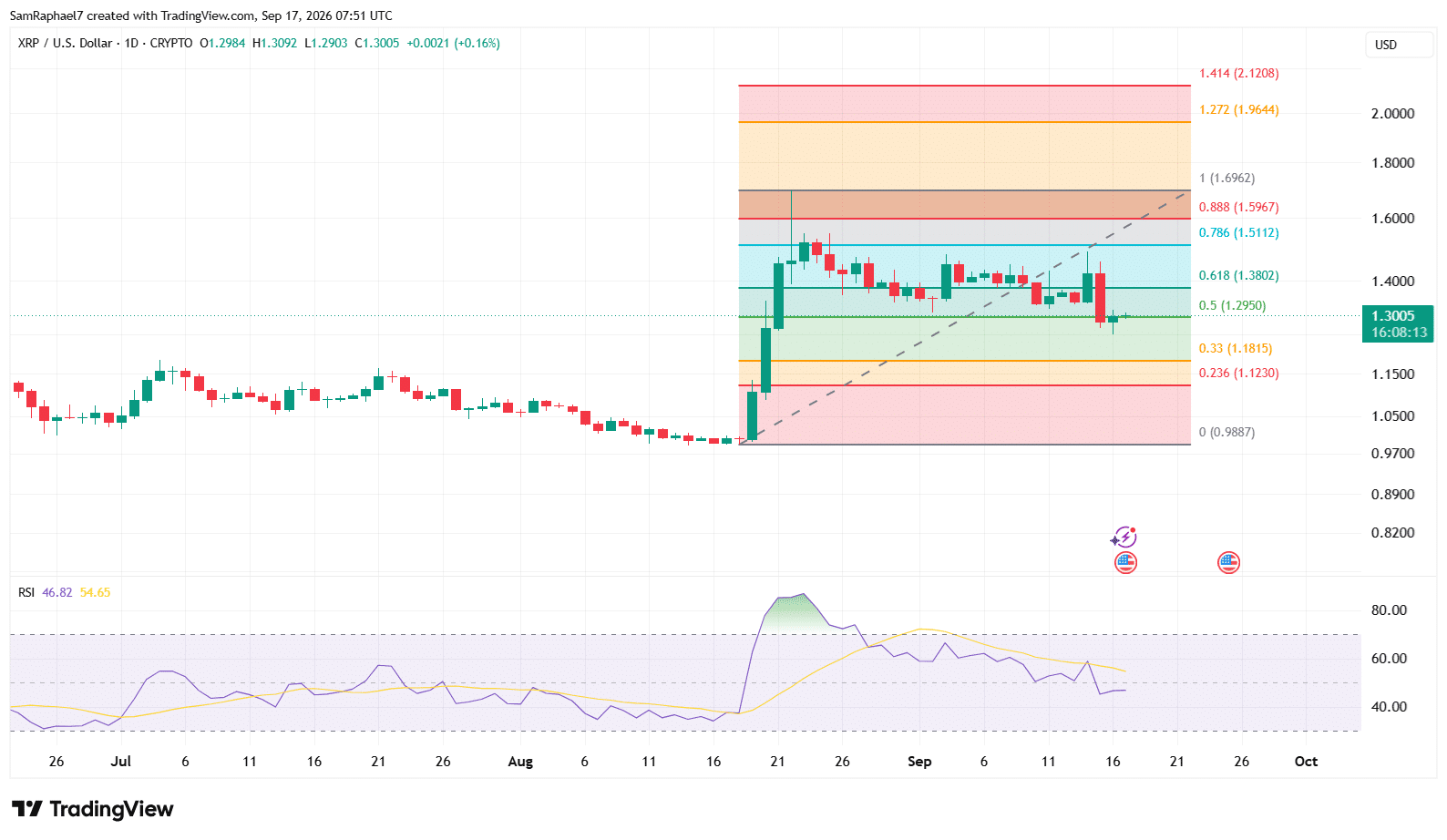
Currently, XRP trades around $1.3010, just above the 0.5 Fibonacci retracement at $1.2950. The sell-off has weakened several parts of XRP’s technical structure, but some indicators still leave room for a possible recovery.

XRP’s September Crash

XRP entered September in a stronger position after its August rally pushed the token out of a long period of consolidation.

The move took XRP above $1.3300, which then became an important support level after it pulled back from the $1.69 high. However, the Sept. 15 failure of the CLARITY Act vote triggered a massive sell-off, sending XRP about 9% lower in one session.

The drop erased weeks of consolidation and pushed XRP below $1.3300. It also weakened several technical structures that had supported the earlier rally. 

By the time of this press, XRP had fallen to around $1.3010 and was trading close to the $1.2950 0.5 Fibonacci level. The next few sessions could help in determining whether XRP can stabilize or face another decline.

XRP Falls Below the Ichimoku Cloud

The Ichimoku Cloud has now become one of the main technical hurdles for XRP. On the daily chart, XRP trades below both cloud boundaries, with Senkou Span A at $1.3850 and Senkou Span B at $1.3426. 

Notably, trading below both levels gives the Ichimoku setup a bearish reading and places the cloud above XRP as resistance.

XRP Ichimoku Cloud
XRP Ichimoku Cloud

The Tenkan-sen also sits above the current price at $1.3701, while the Kijun-sen sits at $1.3999. With XRP around $1.3010, the token remains below both lines. 

This shows that XRP has lost several important short- and medium-term levels. The Kijun-sen at $1.3999 is especially important because XRP needs to recover above it to improve the daily chart’s technical structure.

The future cloud gives a slightly different signal. The projected Kumo is narrowing in the near term and could later twist, meaning the longer-term trend could change if XRP improves. Before that can happen, however, XRP needs to reclaim $1.3426 at Senkou Span B and move back into the cloud.

$1.3300 Becomes XRP’s Key Resistance

The $1.3300 level is now critical because it had served as support after the August breakout. XRP lost that level during the Sept. 15 crash, flipping it from support to resistance. A daily close above $1.3300 would give buyers an important technical level to work with.

Several resistance levels sit above $1.3300. Senkou Span B stands at $1.3426, while Senkou Span A rests at $1.3850 and the Kijun-sen at $1.3999. 

The 0.618 Fibonacci retracement at $1.3802 also falls within this area, creating a resistance zone between about $1.38 and $1.40. Above that, XRP faces major horizontal resistance at $1.4900.

A confirmed daily close above $1.4900 would change the current range structure. For now, though, XRP must first recover the lower resistance levels before $1.4900 becomes a realistic focus.

XRP DMI Shows a Strong Trend but Mixed Pressure

The daily Directional Movement Index gives a mixed view of XRP’s current setup. The Average Directional Index stands at 35.28, above the 25 level commonly used to identify a meaningful trend. This shows that XRP remains in a strong directional market.

Meanwhile, the +DI, which measures bullish pressure, stands at 25.41, while the -DI, which measures bearish pressure, sits at 17.18. With these figures, the +DI remains above the -DI despite the September 15 sell-off.

The -DI rose sharply during the crash but has since stabilized. At the same time, the +DI dropped during the sell-off but has managed to hold its current position. This leaves the DMI picture mixed.

XRP Fibonacci Levels

The Fibonacci retracement drawn from XRP’s August low of $0.9887 to its high of $1.6962 shows the key levels on both sides of the current price. At $1.3010, XRP sits only slightly above the 0.5 Fibonacci retracement at $1.2950.

XRP Fibonacci Levels

A daily close below $1.2950 could bring the next major Fibonacci level at $1.1815 into focus. That level represents the 0.33 retracement. A deeper decline could then expose the 0.236 level at $1.1230. For the current technical structure to hold, buyers need to defend the $1.2950 area.

On the upside, XRP first needs to recover $1.3300 before it can challenge the 0.618 Fibonacci level at $1.3802. Above that, the 0.786 level sits at $1.5112, followed by the 0.888 level at $1.5967. 

The longer-term Fibonacci extension targets stand at $1.9644 and $2.1208, although these levels only become relevant if XRP first breaks convincingly above the $1.6962 August high. For now, $1.3300 remains the key level XRP needs to reclaim after the Sept. 15 breakdown.

Ripple Adds XRP and RLUSD Support to Stripe-Tempo AI Payment Standard

0

Ripple is expanding the XRP Ledger’s role in AI-powered payments by adding support for XRP and RLUSD to the Machine Payments Protocol, an open payment standard developed by Stripe and Tempo.

The integration arrives through version 1.1 of the XRPL AI Starter Kit, giving developers new tools to build AI agents capable of making payments and managing blockchain wallets.

XRP and RLUSD Can Be Used for AI Payments

Through the new integration, AI agents can use XRP and assets issued on the XRP Ledger, including Ripple’s dollar-backed RLUSD stablecoin, to pay for digital services.

Potential use cases include API access, computing resources, data services, and other tools that AI applications may need to purchase automatically.

XRP Payment Channels Support Repeated Transactions

Ripple has also added support for XRP Ledger Payment Channels, allowing AI agents to authorize a series of payments while using a service.

Instead of settling every small payment separately on-chain, multiple payment claims can be created before the final amount is settled on the XRP Ledger. The current Payment Channel implementation is focused on XRP.

Ripple Adds Multi-Chain Wallet Support

The latest update also brings XRP Ledger support to the Open Wallet Standard.

This gives AI applications a standardized way to interact with wallets across different blockchain networks, making it easier for developers to build systems that are not limited to a single chain.

Ripple has also introduced the beta xrpl-mpp-sdk for MPP payments and xrpl-up for easier XRPL development and testing.

The integration does not mean XRP or RLUSD have been added directly to Stripe’s regular payment products. Instead, the XRP Ledger is now supported within MPP, Stripe and Tempo’s open standard for AI-powered payments.

Bitcoin Held $76K Despite the Bad News: Is the Bull Market Back?

0

Bitcoin has stayed above $76,000 despite several negative developments this week.

On September 15, the U.S. Senate voted 50–49 against moving forward with the Clarity Act, which aimed to create clearer rules for crypto.

The next day, the Federal Reserve raised interest rates by 0.25 percentage points to 3.75%–4%. Officials also suggested that another rate hike could happen before the end of 2026. Despite these setbacks, some crypto analysts say Bitcoin’s price is still following a broader bullish trend.

Michael XBT: Bitcoin Held Up Despite Negative News

Trader Michael XBT said Bitcoin had several reasons to fall this week, but it stayed above key support levels. He said traders expected the Clarity Act decision and higher interest rates to push Bitcoin to new lows. 

Instead, Bitcoin held around the $75,000–$76,000 range. Michael XBT described the market as bullish and said he expects Bitcoin to rise significantly.

Bitcoin briefly fell to about $75,060 before recovering above $76,700. The $75,000 level has become an important price level after Bitcoin recently fell from above $82,000.

Bitcoin also stayed relatively strong despite large withdrawals from U.S. spot Bitcoin ETFs. On September 15, the ETFs saw about $450.4 million in outflows, their biggest one-day withdrawal since June 24.

90% Chance BTC Already Bottomed

Meanwhile, Bitcoin analyst Willy Woo said he believes there is a 90% chance that Bitcoin has already reached its lowest point for the bear market. He said Bitcoin is entering the early stages of a bull market as money from long-term investors starts returning to the market.

Woo is focusing more on investor activity and liquidity than on short-term price changes. This suggests he sees the current market as the beginning of a recovery.

“Greatest Bull Market Ever”

Crypto analyst Ansem believes the crypto market is entering a major growth period. He said he expects this could be the biggest bull market in crypto so far. 

He also encouraged investors to stay focused on their long-term views and spread their investments across different assets. Ansem believes crypto will benefit from the growth of the on-chain economy, especially as stablecoins, tokenized assets, and blockchain-based financial systems become more widely used.

He also discussed the impact of AI. If AI does not quickly change the economy, blockchain could still benefit as more money moves on-chain.

MVRV Momentum Signal

Analyst CryptoGoos highlighted another historical indicator, claiming that Bitcoin’s MVRV Momentum Oscillator is moving back above zero. According to the analyst, similar moves occurred in 2012, 2016, 2019 and 2023, periods that were followed by major Bitcoin market expansions.

“Bitcoin is about to enter its expansion phase,” CryptoGoos wrote

Strategic Bitcoin Reserve Bill Adds Another Catalyst

Notably, these bullish commentaries come as U.S. lawmakers advance legislation related to a Strategic Bitcoin Reserve. Two House committees advanced a Bitcoin reserve bill after the Senate failed to advance the Clarity Act. 

AshCrypto pointed to the development as an important counterweight to the regulatory setback, noting that Bitcoin had recovered above $76,000 while Ethereum reclaimed $2,450.

The analyst said Bitcoin needs to hold $76,000 to make another attempt at its 50-week moving average, which AshCrypto views as an important level for the next phase of the market.

$62,000,000 in Shiba Inu Futures Positions Remain Open as Traders Face Fresh Liquidations

0

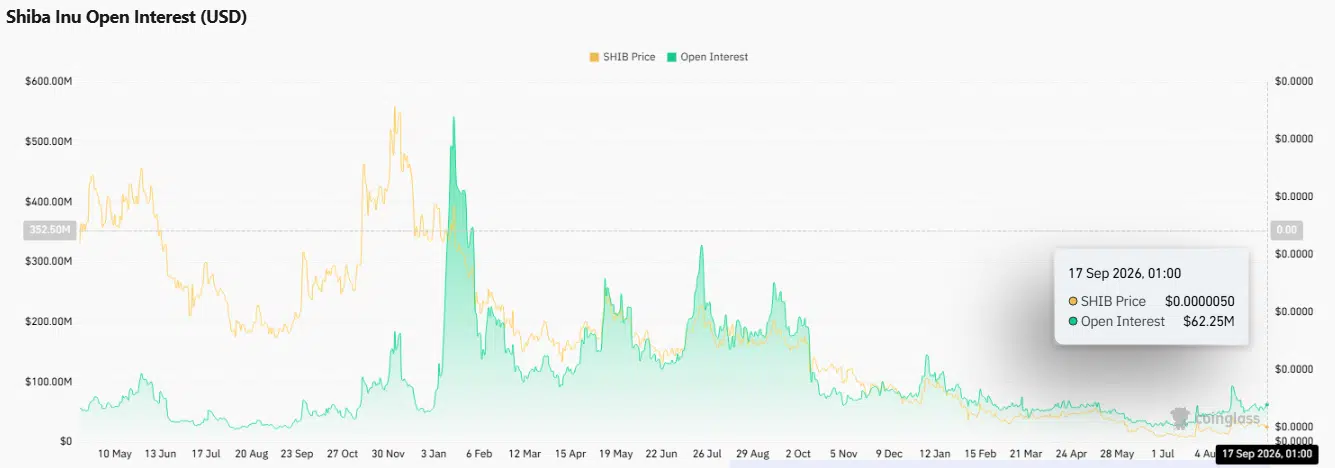
Shiba Inu traders are holding more than $62 million in open futures positions, even as overall derivatives activity remains relatively subdued.

According to CoinGlass data, Shiba Inu’s open interest stood at $62.25 million, while its 24-hour futures volume reached $54.42 million.

As a result, open interest has moved above daily futures turnover, indicating that traders are maintaining a significant amount of leveraged exposure rather than actively rotating those positions through the market. 

Shiba Inu Open Interests
Shiba Inu Open Interest

Futures Trading Dominates SHIB Spot Activity

Meanwhile, the derivatives market currently accounts for much of Shiba Inu’s trading activity.

Notably, Shiba Inu recorded approximately $54.25 million in 24-hour futures volume, compared with roughly $19.99 million in spot volume. Therefore, futures trading was about 2.7 times higher than spot activity.

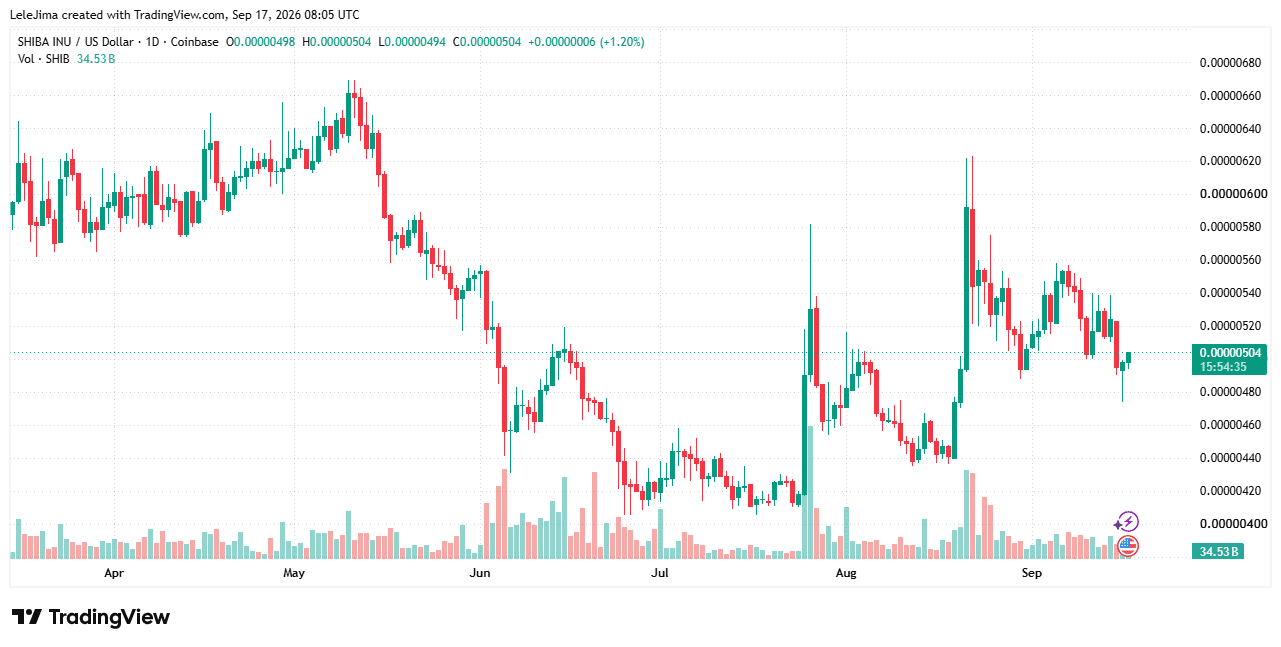
Despite the derivatives-heavy market, SHIB has posted a modest gain. The token climbed 3.99% over the past 24 hours to $0.000005040 at press time. Shiba Inu’s market valuation also increased by the same percentage to approximately $2.96 billion, with SHIB currently ranked as the 29th-biggest crypto in the world. 

SHIBUSD 2026 09 17 09 05 26

Long Traders Account for Most SHIB Liquidations

However, the recent recovery has not prevented leveraged traders, particularly those betting on higher prices, from taking losses.

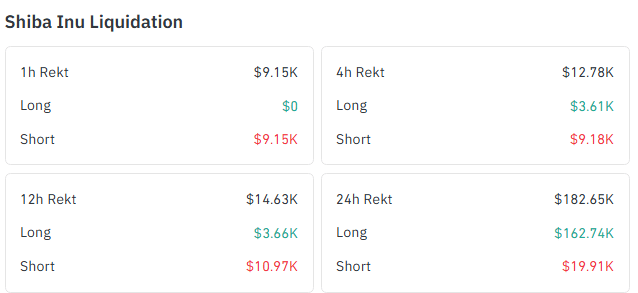
According to data from CoinGlass, a total of 73 SHIB traders recorded $182,650 in liquidations over the past 24 hours. Long positions accounted for most of these losses, with about $162,740 in long positions liquidated, compared with $19,910 in short positions.

This imbalance comes as SHIB remains below its weekly high of $0.0000054. Although the token has recovered nearly 4% over the past day, its earlier decline this week has continued to pressure bullish leveraged positions.

SHIB Liquidation
SHIB Liquidation

249 Billion SHIB Leaves Exchanges Amid Rising Burn Activity

At the same time, exchange flows point to increased SHIB withdrawals, potentially reducing the amount of tokens immediately available for selling on centralized exchanges.

Data from CryptoQuant shows that 249.40 billion SHIB left exchanges, although the total exchange reserve remains above the 87 trillion SHIB mark. The current reserve stands at 87.06 trillion SHIB.

Additionally, SHIB’s burn activity has accelerated sharply. The daily burn rate has jumped 716% over the past 24 hours after the community burned 27.36 million SHIB during that period. Meanwhile, total burns over the past week have reached 118 million SHIB, adding another notable development to the token’s recent market activity. 

“I Would Never Invest in XRP”: Dubai Investor Explains Why

0

Dubai-based investor Royal Kane says he would not invest in XRP at its current price because he believes its large market value leaves less room for growth than smaller cryptocurrencies.

Kane, who says he has been trading crypto since 2016, shared his opinion about XRP on X. “I would never invest in Ripple at this stage because its market cap is already too large,” he wrote, referring to XRP’s market value of about $81 billion.

He also claimed that XRP has no products or revenue and said he prefers smaller cryptocurrencies “with stronger growth potential.”

XRP Still Below Its 2025 Peak

XRP is currently trading at around $1.30, giving it a market value of about $81.9 billion, according to CoinMarketCap. The price is still much lower than its 2025 high of about $3.66. That means XRP is currently around 64.5% below that level.

CoinMarketCap lists XRP’s all-time high as $3.84, while other market observers put its 2025 peak at around $3.66. Meanwhile, XRP has also fallen against Bitcoin. Kane’s chart shows a decline of about 34% in the XRP/BTC ratio over the past year.

XRP yearly performance | CoinMarketCap

XRP Sees Strong Recovery in August

Despite its longer-term decline, XRP gained attention in August after a strong price increase. XRP rose from about $0.98 to $1.70, gaining roughly 72%. It first moved above $1 before climbing further toward $1.70.

However, the rally did not last. XRP gave back much of those gains and ended August at around $1.38, though it still gained about 28% for the month.

XRP remained volatile in September. On September 17, it was trading at around $1.30 and was still about 30% higher than it was 30 days earlier.

Veteran Trader Prefers Smaller Crypto Projects

Kane’s criticism of XRP is mainly about its market value, not its recent price movements. He believes investors looking for bigger percentage gains should consider smaller cryptocurrencies instead of large, established ones. He prefers projects with smaller market values and strong narratives that could attract more buyers.

XRP is already one of the five largest cryptocurrencies by market value, with around 62.9 billion tokens in circulation. Because of this, Kane remains cautious about XRP even after its strong August rally. XRP is now trying to hold around $1.30 after falling from its August high of $1.70.

Fall Below $1 Is Possible

Analyst Casi recently shared a cautious outlook for XRP, noting that it has fallen below the 0.5 Fibonacci level and invalidated the previous $1.78 target.

Casi says XRP needs to reclaim the 0.618 Fibonacci level near $1.65 to regain momentum. Until then, $1.10 is a key support level, with $0.87 potentially coming into focus if the decline deepens.

From the current price, a drop to $0.87 would represent another 33% decline. Combined with the price drop from its 2025 peak, that would amount to a massive 76% drawdown from XRP’s peak.

Cardano Founder Says ADA and XRP Are Truly Commodities, Not Securities

0

Cardano founder Charles Hoskinson has argued that ADA and XRP should be treated as genuine commodities under U.S. crypto regulation.

Hoskinson made the remarks while explaining why the CLARITY Act failed to advance in the U.S. Senate. He focused on what he sees as a fundamental problem with the legislation’s proposed approach to classifying and regulating digital assets.

Hoskinson Questions Broad Commodity Classification

According to him, one of the fundamental problems was the attempt to treat a wide range of digital assets as commodities and place the CFTC at the center of crypto regulation.

He argued that securities and commodities have fundamentally different characteristics and therefore require different regulatory approaches. In his view, the SEC has a larger workforce and broader tools for disclosure and market oversight, while the CFTC traditionally operates as a principles-based commodities regulator.

However, Hoskinson’s criticism does not appear to be directed at the use of commodity regulation for crypto assets generally. Instead, he argued that lawmakers should first establish which digital assets genuinely qualify as commodities and which belong in a separate digital-security category.

Hoskinson Says Cardano and XRP Are Truly Commodities

He specifically identified Bitcoin, Cardano, and XRP as examples of crypto assets that he considers “truly commodities.” 

Hoskinson’s comments also coincide with a significant regulatory development in the United States. Earlier this year, the SEC and CFTC jointly issued an interpretation outlining how different crypto assets could be classified, including as digital commodities, digital securities, or stablecoins. Interestingly, Cardano and XRP were both included in the digital commodities category.

XRP’s Legal Status Adds to Its Distinction

XRP also has a separate legal history that informs its regulatory classification. In July 2023, the U.S. District Court for the Southern District of New York distinguished between XRP itself and the manner in which Ripple sold the token. 

The court did not find XRP itself to be inherently a security. However, it determined that certain institutional sales of XRP constituted securities transactions, while Ripple’s programmatic sales on secondary markets did not constitute unregistered securities sales under the circumstances before the court.

The distinction separates the underlying crypto asset from particular transactions involving that asset.

Cardano’s Regulatory History Has Also Changed

Cardano, meanwhile, previously appeared among the crypto assets identified by the SEC in enforcement actions against major cryptocurrency exchanges.

That regulatory environment later began to change. For example, the SEC dismissed its civil enforcement action against Coinbase in February 2025. 

The SEC’s March 2026 interpretation subsequently established a broader framework for distinguishing digital commodities from other categories of crypto assets.

Hoskinson Calls for International Regulatory Coordination

Meanwhile, Hoskinson also stressed that cryptocurrency regulation cannot focus exclusively on the United States.

Digital assets operate across borders, meaning that regulatory decisions in one jurisdiction can affect participants and businesses elsewhere. Consequently, he argued that the U.S. should pursue reciprocal agreements with other jurisdictions so that different regulatory frameworks can recognize and work with one another.

His broader argument centers on creating clearer distinctions between digital commodities and digital securities while coordinating those rules across jurisdictions. 

Simplify It for XRP: Three Scenarios That Could Define Next XRP Move

0

XRP Price at a Crossroads: Three Key Levels Could Define the Next Major Move.

XRP is trading at an important technical junction on the 4-hour chart, where short-term weakness is developing inside a much larger recovery structure. Rather than reacting to every intraday candle, the chart highlights three broader areas that could determine how XRP’s next substantial move develops.

At the time captured on the chart, XRP is near $1.2875 after failing to maintain its August surge toward the $1.50–$1.55 region. That rejection has pushed price back beneath several intermediate Fibonacci levels, shifting attention toward deeper support.

XRP USD 4H Technical chart

XRP Approaches the First Major Support Zone

The first area to watch is the $1.09–$1.11 zone. This region carries considerable technical confluence. The chart places the macro 0.786 Fibonacci level around $1.085, while another retracement structure identifies approximately $1.091. A horizontal demand zone is also positioned in the same area.

Before XRP reaches that support, however, price must work through the $1.26–$1.24 region, corresponding roughly with the 0.618 and 0.65 retracement levels. The latest candles show selling pressure pushing XRP toward this area, making it the immediate technical battleground.

What Happens if XRP Loses $1.10?

If $1.10 fails to attract sustained demand, the chart identifies a substantially deeper support zone around $0.86–$0.94.

The macro 0.854 retracement sits near $0.862, while $0.94 also corresponds with the previous major August bottoming structure. A move into this region would represent a much deeper retracement of the recent advance and could force the developing impulsive structure to restart from a new low.

This makes the lower green zone particularly significant. It is not simply another minor intraday support; it represents the next major structural area displayed on the chart beneath $1.10.

XRP Bulls Have Another Scenario at $1.63–$1.65

There is also a bullish alternative that would prevent the lower targets from becoming the primary focus.

XRP would first need to recover $1.34, followed by approximately $1.43 and $1.53. The most important overhead region is then $1.63–$1.65, where the chart shows the macro 0.618 resistance and a broad historical supply zone.

A sustained breakout through that ceiling, followed by expansion toward approximately $1.78, would materially change the current structure. In that scenario, a later pullback toward $1.63–$1.65 could become a test of former resistance as support.

That distinction matters: XRP merely touching the resistance zone would not produce the same technical structure as breaking above it and subsequently holding it during a retest.

RSI Shows Short-Term XRP Momentum Under Pressure

Momentum currently remains mixed. The RSI panel shows the faster reading near 35.49, while its accompanying average is around 49.79.

The gap between these readings reflects deteriorating short-term momentum. At the same time, RSI has not yet reached the more extreme readings visible during some of the earlier selloffs displayed on the chart.

That leaves room for price to continue testing lower support before momentum conditions necessarily resemble the previous major exhaustion points.

Latest Five Candles Show Sellers Still Active

The latest five candles reinforce the near-term pressure.

Price has struggled to produce sustained upside bodies following the recent rebound, while the upper wicks around recovery attempts indicate that supply continues to appear when XRP pushes higher. The sharper decline into the latest group of candles further shows that buyers have not yet regained control of the 4-hour structure.

For that to change, XRP would need to begin reclaiming the intermediate Fibonacci levels rather than repeatedly rejecting beneath them.

Wyckoff Structure Points to a Critical Retest

From a Wyckoff perspective, the August rally from roughly $0.94, followed by the rapid expansion toward $1.50, resembles an emergence from a prior accumulation area. The subsequent retracement is now testing whether that advance can develop into a more durable markup structure.

Holding around $1.09 would preserve a stronger higher-low structure relative to the August bottom. Losing that area would shift attention toward the deeper $0.94–$0.86 demand zone, where the broader structure would face a more substantial test.

Three XRP Levels Now Matter Most

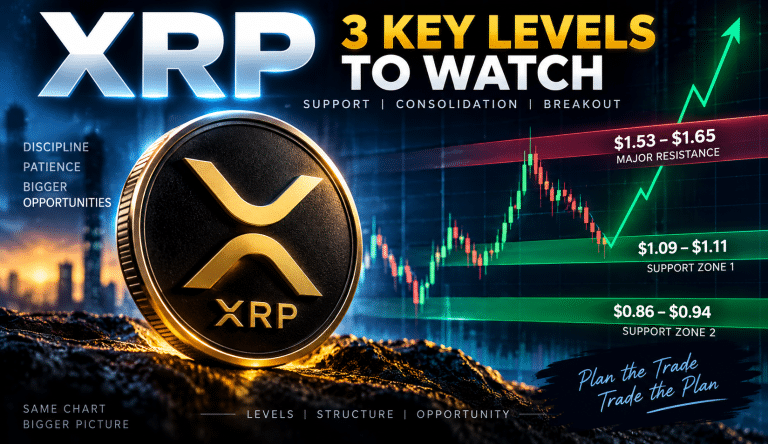
The chart ultimately reduces XRP’s complicated short-term movement to three major reference areas: approximately $1.09–$1.11 as the first macro support, $0.86–$0.94 as deeper structural support, and $1.63–$1.65 as the major resistance zone that would eventually need to transition into support for the bullish structure to strengthen.

At roughly $1.29, XRP remains between those larger technical decision points. The $1.24–$1.26 area is the immediate test, but the larger chart structure is likely to become much clearer when XRP interacts with one of its major macro zones.

Until then, much of the movement between these levels remains consolidation and positioning inside the broader structure.