Home Blog Page 9

Simplify It for XRP: Three Scenarios That Could Define Next XRP Move

0

XRP Price at a Crossroads: Three Key Levels Could Define the Next Major Move.

XRP is trading at an important technical junction on the 4-hour chart, where short-term weakness is developing inside a much larger recovery structure. Rather than reacting to every intraday candle, the chart highlights three broader areas that could determine how XRP’s next substantial move develops.

At the time captured on the chart, XRP is near $1.2875 after failing to maintain its August surge toward the $1.50–$1.55 region. That rejection has pushed price back beneath several intermediate Fibonacci levels, shifting attention toward deeper support.

XRP USD 4H Technical chart

XRP Approaches the First Major Support Zone

The first area to watch is the $1.09–$1.11 zone. This region carries considerable technical confluence. The chart places the macro 0.786 Fibonacci level around $1.085, while another retracement structure identifies approximately $1.091. A horizontal demand zone is also positioned in the same area.

Before XRP reaches that support, however, price must work through the $1.26–$1.24 region, corresponding roughly with the 0.618 and 0.65 retracement levels. The latest candles show selling pressure pushing XRP toward this area, making it the immediate technical battleground.

What Happens if XRP Loses $1.10?

If $1.10 fails to attract sustained demand, the chart identifies a substantially deeper support zone around $0.86–$0.94.

The macro 0.854 retracement sits near $0.862, while $0.94 also corresponds with the previous major August bottoming structure. A move into this region would represent a much deeper retracement of the recent advance and could force the developing impulsive structure to restart from a new low.

This makes the lower green zone particularly significant. It is not simply another minor intraday support; it represents the next major structural area displayed on the chart beneath $1.10.

XRP Bulls Have Another Scenario at $1.63–$1.65

There is also a bullish alternative that would prevent the lower targets from becoming the primary focus.

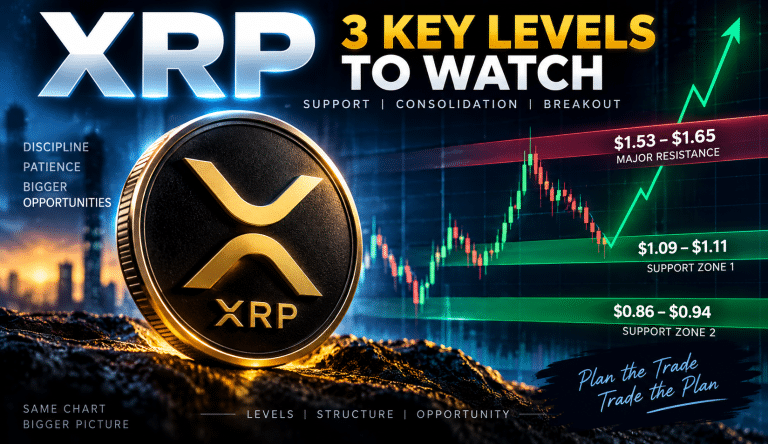
XRP would first need to recover $1.34, followed by approximately $1.43 and $1.53. The most important overhead region is then $1.63–$1.65, where the chart shows the macro 0.618 resistance and a broad historical supply zone.

A sustained breakout through that ceiling, followed by expansion toward approximately $1.78, would materially change the current structure. In that scenario, a later pullback toward $1.63–$1.65 could become a test of former resistance as support.

That distinction matters: XRP merely touching the resistance zone would not produce the same technical structure as breaking above it and subsequently holding it during a retest.

RSI Shows Short-Term XRP Momentum Under Pressure

Momentum currently remains mixed. The RSI panel shows the faster reading near 35.49, while its accompanying average is around 49.79.

The gap between these readings reflects deteriorating short-term momentum. At the same time, RSI has not yet reached the more extreme readings visible during some of the earlier selloffs displayed on the chart.

That leaves room for price to continue testing lower support before momentum conditions necessarily resemble the previous major exhaustion points.

Latest Five Candles Show Sellers Still Active

The latest five candles reinforce the near-term pressure.

Price has struggled to produce sustained upside bodies following the recent rebound, while the upper wicks around recovery attempts indicate that supply continues to appear when XRP pushes higher. The sharper decline into the latest group of candles further shows that buyers have not yet regained control of the 4-hour structure.

For that to change, XRP would need to begin reclaiming the intermediate Fibonacci levels rather than repeatedly rejecting beneath them.

Wyckoff Structure Points to a Critical Retest

From a Wyckoff perspective, the August rally from roughly $0.94, followed by the rapid expansion toward $1.50, resembles an emergence from a prior accumulation area. The subsequent retracement is now testing whether that advance can develop into a more durable markup structure.

Holding around $1.09 would preserve a stronger higher-low structure relative to the August bottom. Losing that area would shift attention toward the deeper $0.94–$0.86 demand zone, where the broader structure would face a more substantial test.

Three XRP Levels Now Matter Most

The chart ultimately reduces XRP’s complicated short-term movement to three major reference areas: approximately $1.09–$1.11 as the first macro support, $0.86–$0.94 as deeper structural support, and $1.63–$1.65 as the major resistance zone that would eventually need to transition into support for the bullish structure to strengthen.

At roughly $1.29, XRP remains between those larger technical decision points. The $1.24–$1.26 area is the immediate test, but the larger chart structure is likely to become much clearer when XRP interacts with one of its major macro zones.

Until then, much of the movement between these levels remains consolidation and positioning inside the broader structure.


XRP Enters New Derivatives Market as Moscow Exchange Expands Crypto Futures Offering

0

Russia’s largest securities marketplace is broadening its cryptocurrency derivatives lineup, with XRP set to become one of five digital assets represented in a new group of perpetual-style futures contracts.

The Moscow Exchange (MOEX) announced that trading will begin on September 22, 2026, covering indices linked to XRP, Bitcoin (BTC), Ethereum (ETH), Solana (SOL), and Tron (TRX). According to the exchange, the products will operate as one-day settlement futures with automatic renewal.

XRP Futures Will Use Cash Settlement

The XRP-linked contract will trade under the code XRPUSDF and reference the exchange’s MOEXXRP index. Although contract values are quoted in U.S. dollars, financial settlement will take place in Russian rubles.

Importantly, investors using these contracts will not receive XRP or any of the other cryptocurrencies represented by the indices. The products are cash-settled derivatives, meaning participants gain exposure to movements in the underlying index without taking possession of the digital asset itself.

Access will also be restricted. MOEX says the contracts are intended only for qualified investors, rather than being made available universally to retail market participants.

Crypto Derivatives Activity on MOEX Continues to Grow

The expansion comes after MOEX introduced its first crypto-linked futures products in the summer of 2025. The exchange says that since then, more than 72,000 qualified investors have participated in cryptocurrency-related futures trading, while cumulative transaction volume has surpassed RUB 600 billion.

That activity provides important context for the addition of XRP, SOL and TRX alongside BTC and ETH. Instead of limiting its derivatives offering to the two largest cryptocurrencies, MOEX is extending index-based exposure to a broader selection of major digital assets.

What the Development Means for XRP

For XRP, the launch creates an additional regulated derivatives venue through which qualified market participants can trade exposure to its price movements. Because the contracts settle financially rather than through XRP delivery, however, trading activity in these futures should not be interpreted as equivalent to direct purchases of XRP on spot exchanges.

The longer-term significance will depend on factors such as trading volume, open interest and participation after the September 22 launch. Still, XRP’s inclusion alongside BTC, ETH, SOL and TRX shows that MOEX is continuing to widen the range of cryptocurrency benchmarks available within its derivatives market.

Cardano Founder Correctly Predicted CLARITY Act Failure, Explains Why It Failed

0

Cardano founder Charles Hoskinson says the U.S. Senate’s failure to advance the Digital Asset Market Clarity Act (CLARITY Act) confirmed his prediction.

For context, during the Senate’s September 15, 2026, procedural vote, the bill fell short of the 60 votes needed to advance. All Democrats and four Republicans voted against the measure.

Following the vote, Hoskinson briefly reiterated his earlier warning, stating, “As predicted.”

He had made the prediction days earlier during his Devs versus Builders livestream, where he argued that the cryptocurrency industry had weakened its political standing by becoming increasingly associated with celebrity-themed tokens, meme coins, and speculative activity.

As a result, Hoskinson argued that the political environment was not conducive to advancing comprehensive crypto legislation. The Senate’s failure to advance the CLARITY Act ultimately aligned with Hoskinson’s prediction, which he said he had consistently made for more than a year.

Hoskinson Explains Why the Bill Failed

In a follow-up livestream, Hoskinson offered a broader explanation for what he believes contributed to the legislation’s failure.

His central argument was that lawmakers tried to address too many complex cryptocurrency issues through a single, wide-ranging bill without first building the bipartisan consensus needed to move it through Congress.

He contrasted that approach with his experience working with lawmakers in Wyoming, where he cited the Stem Cell Freedom Act as an example of legislation that passed both chambers without a single opposing vote. According to him, the difference was extensive consultation, negotiation, and coalition-building before the bill reached the final stage.

Crypto Regulation Requires Broader Consultation

He also criticized the limited consultation with jurisdictions that have already established cryptocurrency regulatory frameworks.

He pointed to Europe, Japan, South Korea, Vietnam, Abu Dhabi, Dubai, Switzerland, the Cayman Islands, the British Virgin Islands and the Crown Dependencies as examples lawmakers could have studied.

In particular, he suggested examining Europe’s Markets in Crypto-Assets (MiCA) regulation alongside frameworks developed by jurisdictions such as the Abu Dhabi Global Market (ADGM).

From his perspective, studying these approaches could have helped lawmakers identify regulatory models that had already been tested elsewhere.

Break Crypto Regulation Into Separate Areas

Moreover, Hoskinson argued that lawmakers should have addressed cryptocurrency regulation in separate components rather than attempting to establish a comprehensive framework in one step.

Those areas could include stablecoins, digital securities, commodities, custody, taxation, and decentralized finance (DeFi). According to him, separating these issues could make it easier for lawmakers to resolve individual regulatory questions and build bipartisan agreement around each area.

Need for Clearer Asset Definitions

Hoskinson also argued that the legislation needed clearer definitions for digital securities and a more modern approach to existing securities laws.

Rather than broadly classifying crypto assets as commodities, he believes lawmakers should establish clearer distinctions between different types of digital assets and determine which regulatory framework should govern each category.

He also questioned whether the Commodity Futures Trading Commission (CFTC) has sufficient personnel, authority, and resources to oversee a cryptocurrency market that could eventually be worth trillions of dollars.

Bipartisan Support Remained Important

Beyond the technical regulatory questions, Hoskinson emphasized the importance of maintaining bipartisan support throughout the legislative process.

He also pointed to political and ethical concerns surrounding crypto activities involving members of the administration, arguing that such issues have become part of the broader debate and made bipartisan consensus more difficult to achieve.

Overall, Hoskinson’s explanation goes beyond the final Senate vote. In his view, the CLARITY Act failed because lawmakers attempted to tackle a broad range of complicated cryptocurrency issues without first establishing sufficient consensus, consultation, and clarity around the individual regulatory questions. 

Cardano (ADA) Market Outlook: How to Track Trends and Start Trading

0

I almost skipped Cardano this week. The price hasn’t moved, still bouncing between 20 and 22 cents, the same as it has for weeks. I didn’t think there was much to say about it until people in my trading group kept bringing it up, asking whether it’s finally going to do something or just keep sitting there doing nothing.

It’s boxed in. Floor around 20 cents, ceiling around 23, bounced off both a few times without breaking either one cleanly. The 20 and 50 day moving averages are basically sitting on top of each other, which some people read as a coiled spring about to pop. Maybe. Or it sits here another month and nobody remembers this article was ever written. Volume hasn’t done anything dramatic either, which tells me most people are content to wait this out rather than force a move one way or the other.

What actually got my attention this week wasn’t the chart at all. One of the exchanges running on Cardano had a fee spike, a real one, well above normal daily volume, the kind of jump that doesn’t happen for no reason. Separately the community voted through a decent chunk of ADA, tens of millions worth, toward liquidity for DeFi apps built on the network.

That’s not the kind of thing that moves a price chart overnight, but it’s the sort of groundwork that tends to matter later even when nobody’s paying attention to it now. There’s also a stablecoin that launched on Midnight, the privacy-focused side of Cardano, built more for the compliance crowd than anyone chasing a quick pump. Institutions tend to care about that kind of thing a lot more than retail traders do, and it’s usually a signal worth filing away even if it doesn’t do anything for the price today.

For the actual current number instead of trusting a few-days-old article, check the ADA price today page. Whatever number I’ve quoted here could already be stale depending on when you’re reading this.

Why I Watch ADA Differently Than Other Coins

ADA doesn’t do the meme coin thing, and honestly that’s part of why I keep watching it even during the boring stretches. It’s not pumping 40% because some account posted a rocket emoji. Compare that to Solana, which can move 15% in an afternoon off nothing more than a new app launching or a wave of social media chatter. Or Ethereum, which mostly reacts to whatever the broader market is doing that day, since it’s tied so closely to overall risk sentiment. XRP has its own thing going, mostly bouncing on legal headlines more than actual usage. ADA, by comparison, moves slower and usually for a reason you can point to, an upgrade, a governance vote, whatever the wider market’s mood happens to be that week.

Slower. Sometimes genuinely boring to watch. But the levels people track, like that $0.20 and $0.23 range, actually mean something because there isn’t a constant flood of hype money running everything over the moment things get interesting. For traders who’d rather work with clean technical levels than chase whatever’s pumping that day, that’s a real advantage even if it doesn’t feel like one on a slow Tuesday.

Getting Set Up If You Actually Want to Trade This

If you’re new to actually trading this rather than just watching from the sidelines, do the boring part first. Learn how your exchange handles margin, fees, and liquidation before you’re sitting in a live trade trying to figure it out with real money already committed. That’s not the fun part of getting started, but it’s the part that actually protects you when a trade moves against you faster than expected.

BTCC does futures specifically, not just spot trading. That means you can go either direction on ADA, betting on that 20-cent floor breaking down just as easily as betting on the 23-cent ceiling finally giving out. Worth reading through how it actually works before funding anything. There’s a guide, How Does BTCC Work, that walks through the account setup and trading flow most people skip past without reading.

It’s also worth checking whatever sign-up bonus is currently running before depositing anywhere. The BTCC Deposit Bonus page lays out the current terms, and it’s worth actually reading the conditions rather than assuming a bonus works the way the headline number suggests.

Where Leverage Actually Bites People

Worth saying plainly since it comes up constantly in my group chat: leverage is where people get hurt on setups like this one, not from being wrong about direction but from being wrong about size. A 5% move against a heavily leveraged position can wipe out margin entirely, sometimes before there’s even time to react to it. Deciding a stop-loss level before entering, not after price has already moved against you, sounds obvious written down, but it’s the single most common thing people skip when they’re excited about a trade idea. Same goes for position sizing. Risking a small, controlled amount on any one trade means one bad call doesn’t take out the whole account, which matters more the longer you plan on doing this.

Where That Leaves Things

None of this tells you which way ADA breaks first, and I genuinely don’t know either. What I do know is I’m watching 20 and 23 cents right now, waiting for an actual close past one of them, not a quick wick that gets bought or sold back within the hour. Everything happening in between those two numbers is just noise as far as I’m concerned, and I’ve stopped trying to trade the noise. It’s cost me more than it’s ever made me. For now, this is a wait-and-confirm setup, not one I’d chase blindly just because it’s been quiet for a while.

85 New XRP Millionaire Wallets Appeared Before the 67% Rally — What Happens Next?

0

XRP wallets holding at least $1 million worth of XRP increased shortly before the coin jumped 67% in August, according to analytics platform Santiment.

Santiment said 85 new wallets holding at least 1 million XRP appeared just two days before XRP rose sharply between August 17 and August 21. This suggests that large XRP holders were buying more before the price increase.

85 New Millionaire XRP Wallets Appeared Before the Breakout

Santiment reported that 85 new wallets holding at least 1 million XRP appeared shortly before XRP’s price jumped 67% between August 17 and August 21.

Wallets holding 1 million XRP or more are a small part of the XRP community, but they can have a big impact on the market because large holders control a significant amount of XRP. When these large holders buy more XRP, they reduce the amount available for trading and increase buying pressure.

XRP Whale Chart by Santiment

Santiment Highlights RLUSD and Institutional Activity on XRPL

Meanwhile, Santiment also pointed to growing activity on the XRP Ledger (XRPL) as another positive development for XRP. The platform highlighted Ripple’s support for an RLUSD credit fund that lends to fintech and payment companies using XRPL.

Santiment also mentioned Ripple’s investments in ZILO and Licuido, which are helping add tokenization, asset transfers, and other financial services to the XRPL network. These developments suggest that XRP’s story is about more than just its price. Growth in stablecoins, lending, and tokenized assets increases the usefulness of the XRP Ledger.

Santiment said that the growth in large XRP wallets, RLUSD activity, and institutional projects support the network through the rest of 2026. However, these developments do not guarantee that XRP’s price will rise, as the cryptocurrency is still affected by overall market conditions and resistance levels.

Analyst Warns XRP Could Fall Toward $1.10

While Santiment pointed to positive developments for XRP, crypto analyst Casi has a more cautious view. Casi said XRP has fallen below an important 0.5 Fibonacci level. This means the analyst’s previous expectation of a possible move toward $1.78 is no longer valid.

For XRP to regain strength, Casi believes it needs to move back above the 0.618 Fibonacci level, around $1.65. Until that happens, the analyst is watching $1.10 as an important support level. Casi says this level becomes a target if XRP’s current price decline continues.

Another level to watch is around $0.87, which will become relevant if the decline gets worse. If XRP starts a new upward trend, the $1.10 level could also be important in showing whether buyers are willing to step in and support the price.

XRP price chart by Casi

In sum, Santiment’s data shows that large XRP holders increased their holdings before the August price jump. However, analyst Casi says XRP may still fall further unless it recovers important price levels.

Free AI Detector: Verify Crypto News and Content Authenticity

0

Cryptocurrency news requires extreme caution because false information spreads rapidly across decentralized networks. Scams flood the crypto space constantly. Fake projects launch daily, and unsuspecting investors lose money to fraud. Automated text tools now produce vast amounts of material that inundate digital platforms. Automated bots craft misleading content, and continuous streams of deceptive articles appear across blogs. Social media channels experience heavy daily spam. Consequently, traders make poor financial decisions based on synthetic posts.

A free AI detector helps you verify content authenticity quickly. You identify suspicious posts immediately. You protect your investments and avoid elaborate crypto schemes. Crypto communities depend heavily on honest information to maintain integrity. Platforms like The Crypto Basic focus on publishing real news because authentic analysis consistently outperforms generated copy. Community trust matters tremendously. Genuine journalism plays a vital role in protecting retail investors.

The Problem with AI in Crypto

Generated crypto content frequently misleads investors across multiple channels. Bot accounts post fabricated news items. Emerging projects use automated writing to build artificial hype. Misleading whitepapers appear effortlessly. Therefore, investment decision processes suffer.

Crypto volatility amplifies the real-world impact of misinformation. A single false post can trigger panic selling. Scammers routinely exploit text generation tech. They circulate fake announcements, clone project websites, deepfake industry leaders, and execute fraudulent schemes.

Top Verification Tools for Crypto Readers

Several specialized platforms allow you to screen suspicious articles, press releases, and community discussions free of charge:

  • GPTZero: This platform analyzes sentence-level variations. It offers quick scoring metrics that help traders evaluate breaking news items instantly.
  • ZeroGPT: Users appreciate its low-friction interface. This tool lets you paste raw text blocks to receive an immediate percentage-based breakdown of synthetic markers.
  • Copyleaks: The software combines structural evaluation with traditional web crawling. Readers identify automated text creation alongside standard online plagiarism in a single scan.
  • Content at Scale: The engine serves publishers and marketing professionals. Editors maintain high standards across large volumes of web copy and project documentation.
  • Hugging Face: Developers provide open-source detection models. Technical users, researchers, and engineers seek clear transparency in text analysis.
  • AI: Media teams use this dedicated publishing scanner. It delivers granular structural reports to maintain strict editorial integrity.

Why Crypto Content Needs Verification

Crypto projects release constant announcements that require independent verification. Press releases, breaking news articles, and social media commentary demand scrutiny. Unverified claims harm financial portfolios.

Influencers frequently publish suspicious material. Bot networks amplify automated posts to engineer pump-and-dump schemes. Crypto exchange updates, official security notices, and DeFi protocol changes demand careful checks. Fake exchange news destroys market trust and fuels phishing attempts.

Strategic Ways You Should Audit Information

You should regularly screen major crypto announcements. Run press releases, project updates, and breaking news through verification platforms. You identify artificial hype before it influences trading decisions when you scan social media posts.

You must evaluate whitepaper authenticity. Run technical documentation and development updates through detection engines. You confirm whether a project possesses genuine technical substance or merely generated fluff.

Real Limitations You Should Know

No verification tool catches everything despite technical utility. Highly sophisticated text can occasionally pass through undetected. False positives occur when software mistakenly flags legitimate human writing.

Crypto-specific jargon frequently confuses analysis engines. Technical terminology, decentralized finance acronyms, and niche community slang sound unusual to standard algorithms. You must apply human interpretation and contextual awareness. Additionally, fast-moving market developments spread rapidly.

Practical Steps to Spot Synthetic Writing

  • Repetitive Rhythm: Sentences maintain identical lengths and rigid structural patterns.
  • Flat Tone: Content lacks genuine emotion. Authors offer exaggerated excitement or forced concern rather than grounded commentary.
  • Generic Language: Articles rely heavily on sweeping claims, broad generalizations, and recycled industry buzzwords. Writers omit deep, original analysis.
  • Unrealistic Promises: Posts emphasize guaranteed financial returns. Creators ignore market risks, disclaimers, or technical limitations.

Protecting Your Crypto Investments

Digital asset protection demands a multi-layered security plan. You must build a strong habit. Check every major announcement carefully. Run suspicious text through two or three verification tools at once. This strategy lets you compare results instantly. You should verify breaking news through trusted outlets like The Crypto Basic. Cross-reference official project code repositories directly. Never rely on a single news outlet.

You need to analyze core project fundamentals on your own. Read technical documentation thoroughly. Inspect source code directly on GitHub. Verify team credentials before you invest any money. Personal critical thinking serves as your strongest armor against crypto scams.

Essential Security Takeaways

Free verification platforms offer vital protection against online misinformation. However, you must treat software as an assistant rather than a final judge. Always combine algorithmic scores with personal judgment. Evaluate broader market context alongside deep project research. Text generation tools advance every day. Consequently, your security habits must evolve continuously to keep your digital portfolio safe.

Bitcoin Bears Stack $4.79B in Shorts All the Way to $83K: Is a Squeeze Incoming?

0

Bitcoin bears have built a large pool of short positions above the current price after the U.S. Senate blocked further progress on the Clarity Act. 

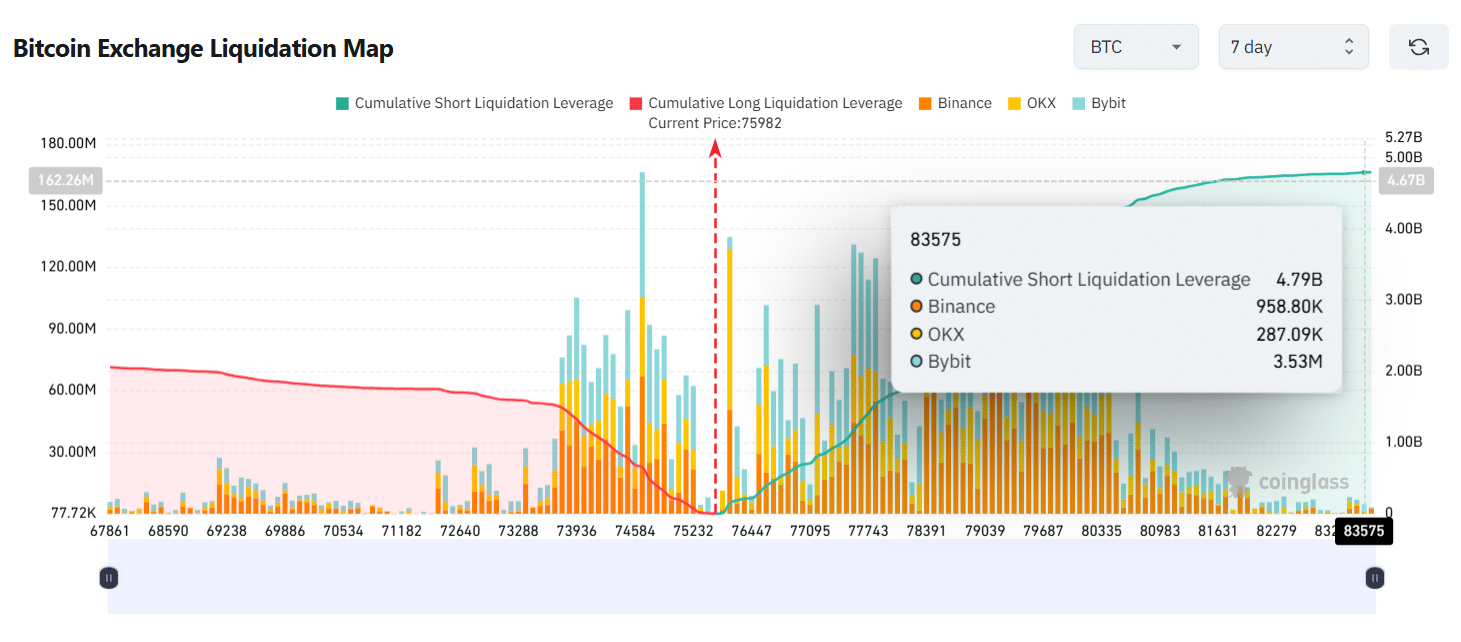
CoinGlass data shows $4.79 billion in short liquidation leverage above $75,982, nearly 2.5x the $2.05 billion in long-side exposure below that level. This could increase the risk of a short squeeze if Bitcoin starts to recover.

The situation comes after a sudden market selloff following the Senate vote. Bitcoin fell toward $75,000 after the Senate rejected the CLARITY Act, while the wider crypto market recorded heavy liquidations.

Bitcoin Crashes After Regulatory Blow

Notably, the U.S. Senate blocked further progress on the Clarity Act on Tuesday, Sept. 15, after lawmakers voted 49-50 against advancing the bill. 

The result left the legislation 11 votes short of the 60-vote threshold needed to proceed. The bill aimed to establish a broad federal regulatory framework for digital assets, making the vote an important event for the crypto market.

Bitcoin fell 4.6% after the vote and dropped below $75,000, while the market recorded about $771 million in total crypto liquidations as traders reacted to the result. 

Crypto-related stocks also came under pressure. Coinbase fell more than 8%, Robinhood dropped more than 3%, and bitcoin treasury company Strategy declined 5% during Tuesday’s session. The wider crypto market fell nearly 3% after losses briefly reached 4.2%.

The $4.79 Billion Short Wall Above Current Price

Bitcoin was trading around $75,982 when the CoinGlass 7-day liquidation map showed a large amount of short liquidation leverage overhead. Specifically, from the current price to $83,575, the Bitcoin market faces an accumulation of $4.79 billion in short liquidation leverage.

Bitcoin Cumulative Short Liquidation Leverage Coinglass
Bitcoin Cumulative Short Liquidation Leverage | Source: Coinglass

At $83,575 alone, Binance showed $958.80K in short liquidation exposure. OKX had another $287.09K, while Bybit recorded $3.53 million at the same price. 

These exchange figures represent the liquidation exposure at $83,575, not the total exposure across the entire range between $75,000 and $83,000. 

However, the cumulative short liquidation leverage from $75,000 to $83,000 reaches $4.79 billion at that price. In simple terms, this represents the amount of short exposure that could face forced closures if Bitcoin continues rising through the range.

The buildup came after Tuesday’s selloff, which has liquidated $174 million in long positions in the past 24 hours, compared with just $37.9 million in shorts. The difference suggests that traders betting on further declines added more short positions after Bitcoin’s drop.

Long Liquidations Face $2B Exposure

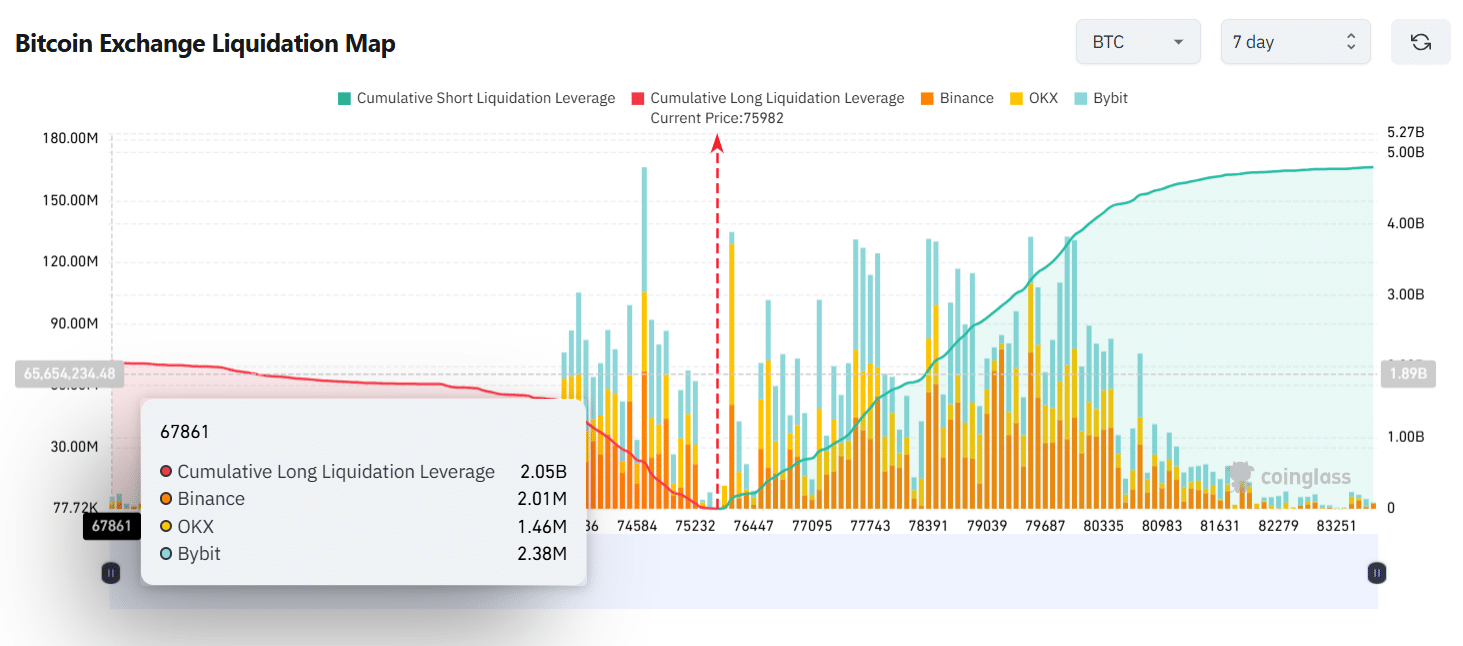
Meanwhile, the long-side liquidation data shows a much smaller amount of leveraged exposure below Bitcoin’s current price. From around $75,000 down to $67,861, which marks the lowest price visible on the seven-day chart, cumulative long liquidation leverage stands at $2.05 billion.

Bitcoin Cumulative Long Liquidation Leverage Coinglass
Bitcoin Cumulative Long Liquidation Leverage | Source: Coinglass

At $67,861 alone, Binance shows $2.01 million in long liquidation exposure, while OKX records $1.46 million and Bybit has $2.38 million. 

Notably, the overall $2.05 billion figure from $75,000 to $67,861 leaves the total downside liquidation exposure at less than half the $4.79 billion in short exposure above the current price.

Why the Structure Could Backfire on Bears

The large gap between short and long liquidation levels could create conditions for a short squeeze. If Bitcoin gets a positive catalyst, such as a softer Federal Reserve tone on Wednesday, a sustained move toward $79,000 could start forcing short sellers to close their positions. 

As these traders buy Bitcoin to exit their shorts, their buying could push the price higher and trigger more short liquidations.

However, there is no guarantee of a revival. Polymarket odds for the CLARITY Act becoming law in 2026 stood at just 17% before the vote and fell further afterward. Bitcoin also faces uncertainty around the Federal Reserve’s rate decision. 

Meanwhile, investors may have to wait until after the midterm elections for meaningful progress on the legislation, with some expectations pushing major legislative action as far back as 2029.

Hyperliquid Whale With 99% Win Rate Adds to $1.36M XRP Long Despite 21% Loss

0

A Grade-S Hyperliquid whale has continued to add to his million-dollar XRP long position despite currently nursing losses due to the recent price crash.

XRP recently collapsed alongside the rest of the crypto market after the U.S. Senate failed to advance the Clarity Act during the much-watched cloture vote. Specifically, the asset crashed 9.81% on Sept. 15, marking its largest intraday drop in seven months.

However, despite XRP facing this steep decline and dropping below $1.30, one Hyperliquid whale boasting a 99.3%-win rate has continued to add to his XRP long position, demonstrating what appears to be firm conviction in the asset’s resilience.

The Initial XRP Long Position

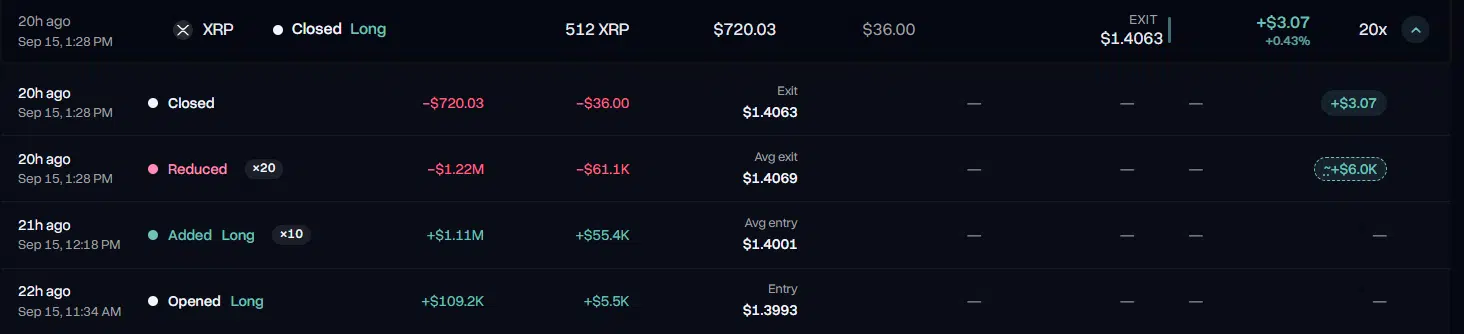
This whale, with address 0xa…566, first opened an initial XRP long position at 10:34 AM UTC on Sept. 15 while XRP was recovering from the drop to $1.38. The whale then added $1.11 million to the position an hour later.

Initial XRP Long
Initial XRP Long

After XRP soared to a local top of $1.45 by 1 PM the same day, the price started correcting as the U.S. Senate failed to advance the Clarity Act, leading to massive selling pressure across the crypto market.

Interestingly, the whale had already reduced his trade and closed the position at a price of $1.40 before the XRP price crash picked up. As a result, he secured a meager $6,000 profit from the trade.

Current XRP Position in Loss

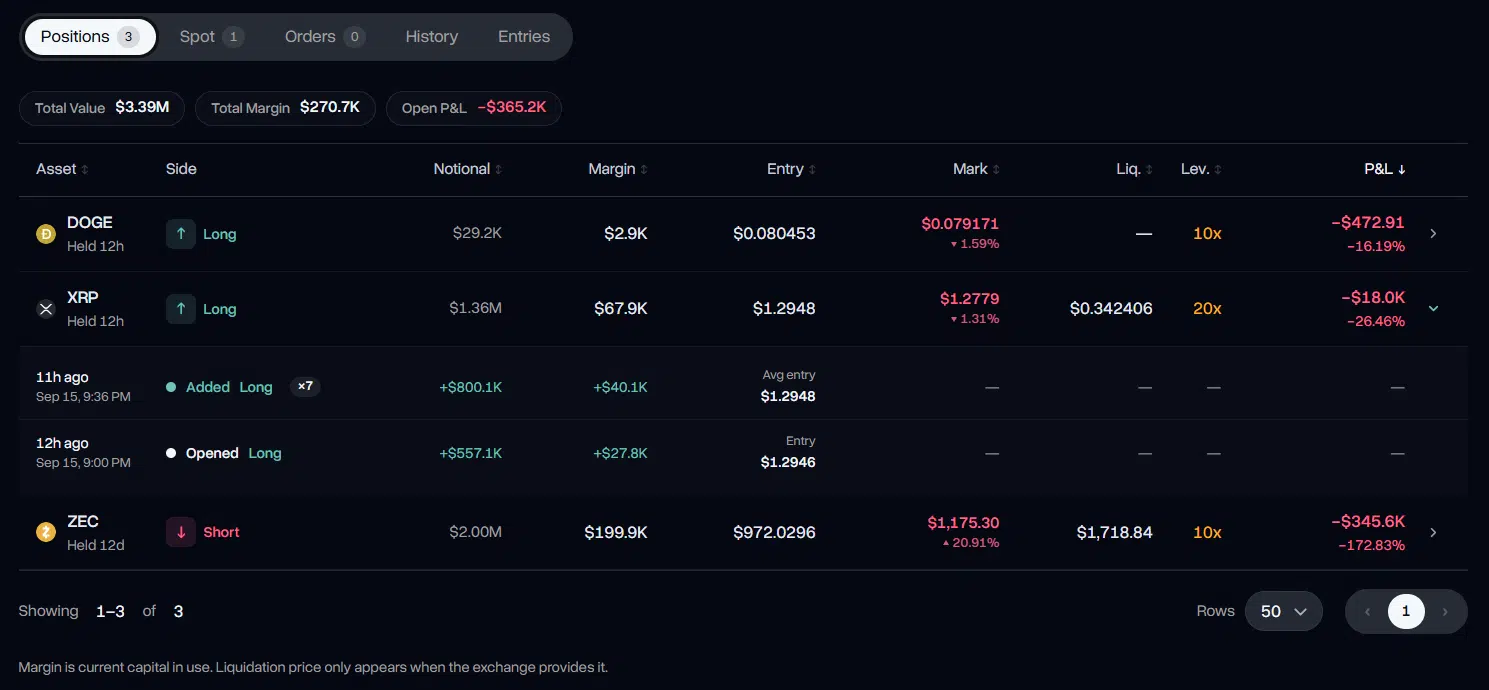
While the market panicked, this whale instead chose the opposite direction. Notably, he again opened an XRP long position worth $557K at 8 PM UTC on Sept. 15, hours into the price crash. The entry for this trade stood at $1.2946. At the time, XRP was already down 9% on the day.

About half an hour later, he increased the position by $800,000 at an entry price of $1.2948 while XRP was still facing massive declines, bringing total notional value to $1.36 million. Since then, the trader has maintained this position, having held for up to 12 hours now. 

Hyperliquid Whale Nursing Loss on XRP Long

However, with XRP collapsing further to the current price of around $1.27, the trader is currently witnessing a massive 26.46% loss on the position, with losses sitting at $18,000 at a 20x leverage. Still, the whale would only suffer a liquidation if XRP collapsed to $0.34, a 73% drop from the current price.

History Shows Promising Results

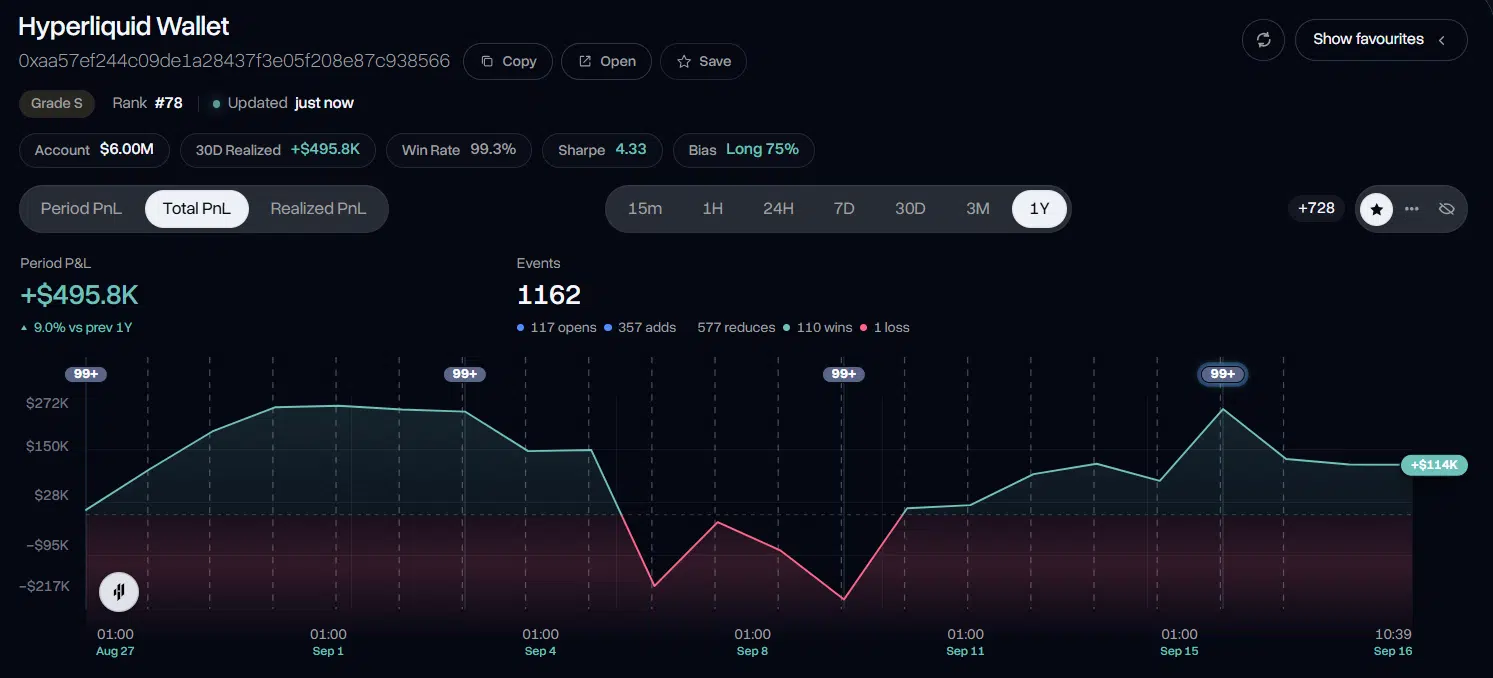
At press time, liquidation appears unlikely unless the market faces a sudden Black Swan event. Interestingly, this whale has not recorded any liquidations in his entire history of 111 trades. Of this figure, he has witnessed 110 wins and just 1 loss, giving him a 99% win rate.

Wallet Overview
Wallet Overview

Further data shows that the account is fairly new, having begun trading on Aug. 27, about three weeks ago. Within this period, he has secured a total profit of $495K, with a Sharpe ratio of 4.33 and a bias sitting at 75% Long.

XRP Ledger Batch Feature Enters Activation as 29 Validators Vote Yes

0

The XRP Ledger’s (XRPL) Batch amendment has received enough validator support and is now in its activation period.

XRPL validator Vet (Hussein Zangana) said 29 of 35 validators voted yes, giving the amendment 82.86% support.

The amendment reached the required 80% support on September 15, 2026. Meanwhile, it must maintain that level for 14 days before going live. If everything stays on track, the Batch amendment will activate on September 29, 2026.

Batch Lets You Combine Up to 8 XRP Ledger Transactions

The Batch feature will let users combine up to eight XRPL transactions into one. This will make it easier for businesses and developers to handle several actions at the same time.

For example, Batch can be used for:

  • Tokenized securities: A security and its payment can happen at the same time.
  • Asset swaps: Users can swap NFTs, MPTs, and other tokens in one operation.
  • Fees: Apps can include service fees together with other transactions.
  • DEX trading: Multiple swaps with different conditions can be combined into one transaction.
  • NFT trading: Users can trade one NFT for another in a single operation.

Essentially, Batch makes complex transactions on the XRPL simpler and more efficient.

Count down on activation on XRP Ledger

Institutional Use Is a Key Benefit

The Batch amendment will be useful for banks and other financial institutions. It will allow institutions to:

  • Trade securities directly with each other.
  • Complete a security and its payment at the same time.
  • Handle over-the-counter (OTC) trades more efficiently.
  • Help developers and financial apps manage payments and fees.

XRPL community member Luke Judges also highlighted Batch as useful for financial markets and app developers. The amendment reached 28 Yes votes before getting the 29th vote needed to enter the activation period.

Lending Is the Next Big Institutional Feature

Vet said his personal roadmap for institutional features is: Batch → P Delegation → Lending v1 + v1.1 → More features

He explained that Batch and P Delegation are being brought back, while Lending v1.1 may add a feature that allows both lending amendments to be voted on together.

Vet called lending the “big one” for institutions because it will bring XRP yield and on-chain lending to the XRPL.

With Batch now in its 14-day activation period, attention is starting to move toward the next features that will expand XRPL for developers, financial institutions, and on-chain finance.

Bitcoin and Gold Correlation Hits Extreme Levels as BTC Looks More Like ‘Digital Gold’

0

Bitcoin and gold are moving together more closely than they have in years. This challenges the usual view that Bitcoin is a riskier asset, while gold is a safe haven.

Adam Livingston, vice president of investments at Strive, pointed out this change on X, noting that Bitcoin and gold have become much more closely correlated across different time periods.

Bitcoin-Gold Correlation Surges

Livingston said Bitcoin and gold had a full-sample correlation of only +0.17 since 2020, meaning the two assets generally moved independently over the period. The yearly figures remained relatively low:

  • 2020: +0.26
  • 2021: +0.01
  • 2022: +0.12
  • 2023: +0.12
  • 2024: +0.14
  • 2025: +0.09
  • 2026 YTD: +0.43

However, the shorter-term readings have climbed much higher. Livingston cited a 30-day correlation of +0.68, a 60-day reading of +0.58, a 90-day correlation of +0.63, and a 252-day correlation of +0.41.

He said the 30-day and 252-day readings were around the 99th percentile of their historical ranges, while the 90-day reading was near the 99.9th percentile.

Bitcoin gold correlation by by Adam Livingston
Bitcoin gold correlation by Adam Livingston

Bitcoin’s “Risk-On” Narrative May Be Changing

Bitcoin has traditionally been seen as a riskier asset, while gold is viewed as a safe-haven asset during inflation, currency worries, or financial uncertainty. But that difference may be changing as Bitcoin and gold are increasingly moving in the same direction.

Livingston suggested that Bitcoin and gold could be seen as “two different exits from the same system” rather than completely opposite investments. This comes as investors continue to watch inflation, interest rates, bond yields and currency movements.

Gold is at around $4,300 per ounce as markets await the Federal Reserve’s latest interest-rate decision. Reuters reported that gold later rose 0.8% to $4,326. Meanwhile, Bitcoin is around $75,800, dipping 2% over the past day.

Bitcoin and Gold Face the Same Macro Challenges

Notably, the strong connection between Bitcoin and gold comes as U.S. Treasury yields have risen sharply, with the 10-year yield briefly topping 5% before falling back. 

Higher yields and a stronger dollar can put pressure on assets like gold that do not pay interest. Bitcoin has also faced selling pressure recently, closing September 15 at around $75,613 after trading above $82,000 earlier in the month.

Meanwhile, the high correlation does not mean Bitcoin and gold will always move together. Correlation simply shows how closely two assets have moved over a certain period. It does not mean one causes the other to move.

But the unusually high correlation suggests that the relationship between Bitcoin and gold has changed significantly in recent months. Some crypto users have pointed to this as a sign that Bitcoin is “finally acting like digital gold.”