Home Blog Page 803

Trump’s Executive Director Reveals the Administration May Buy Bitcoin From Tariff Revenue

0

The tariff dilemma may play in Bitcoin’s favor as the White House discloses that revenue from import duty hikes may fund Bitcoin purchases.

The United States continues to search for budget-neutral ways to expand its stash of Bitcoin, the largest cryptocurrency by market cap. Pro-crypto president Donald Trump disclosed this approach while signing an executive order to create a strategic Bitcoin reserve in March.

Meanwhile, speaking at a White House interview with Anthony Pompliano, Bo Hines revealed a new creative idea that the crypto working group is considering. Hines, who is the executive director of Trump’s council of advisers for digital assets, teased that the recent tariff saga may play in Bitcoin’s favor.

Tariff Revenue to Fund Bitcoin Purchase

Hines stressed that Trump has committed to keeping his promises to make America the Bitcoin superpower. A part of which is to add as much Bitcoin as possible to its existing holdings through budget-neutral ways.

Further, the Trump administration executive noted that new ideas are incoming, including leveraging America’s recent reciprocal tariff boost to fund Bitcoin purchases. Recall that the United States has raised its import tax baseline to 10%, with China currently facing up to 145% following its refusal to come to the negotiation table.

Remarkably, Hines noted that the tariff revenue, which would cost the American taxpayer nothing, is one of the options that the White House crypto working group is considering in its quest to stack sats.

America to Acquire Infinite Amounts of Bitcoin

Meanwhile, Hines highlighted that while Senator Cynthia Lummis’ BITCOIN ACT bill proposes acquiring 1 million BTC over five years, he aims to buy the finite asset infinitely. The White House digital asset executive director stated that there is no specific cap to the number of BTC tokens he wants America to buy.

He likened placing a cap on Bitcoin purchases to doing so with gold. As countries aim to acquire as much of the commodity as they can afford due to its intrinsic value, so does the US plan to tap into its digital version infinitely. The only drawback to this plan is that only 21 million BTC can ever be created, and nearly 95% of the existing supply is already in people’s purses.

Meanwhile, Hines mentioned other ideas the United States is considering, including reevaluating its gold certificates. The proposal, which is already making the rounds in the industry, would see the nation bring its gold valuation up to speed with the current market valuation.

For perspective, the Federal Reserve holds gold at a paper value of $42.22 per ounce, far below its current market valuation. Lummis suggested that revaluing it to its current value of $3,226 would free up capital to divert to Bitcoin purchases.

Could XRP Maintain Its Payment Utility Despite Growing RLUSD Adoption? Pundits Weigh In

Pundits within the XRP community have discussed XRP’s potential to maintain its utility in payments despite the growing adoption of Ripple stablecoin, RLUSD.

The recent launch of RLUSD and its integration into Ripple Payments have triggered concerns among XRP proponents. For context, Ripple launched RLUSD last December and subsequently integrated the stablecoin into its Ripple Payments infrastructure earlier this month.

The integration heightened concerns that RLUSD could replace XRP, which Ripple often leverages as a bridge currency. Interestingly, RLUSD has continued to grow, now boasting a market cap of $294 million as the 12th largest stablecoin.

XRP Still Holds Utility in Autobridging

Amid the discussions around its potential to replace XRP, prominent figures, including WrathofKahneman (WOK) and Daniel Keller, CTO of Eminence, an XRPL node operator, recently weighed in.

WOK, a respected figure in the XRP community, sought to address the concerns about RLUSD reducing XRP’s relevance. He argued that the conversation often lacks nuance. Notably, he admitted that stablecoins like RLUSD may appeal to users for direct transfers due to their price stability and guaranteed value. 

However, WOK stressed that XRP has a function behind the scenes through a process called autobridging. When no direct trading path exists between RLUSD and another currency, such as the euro, the XRPL automatically uses XRP to carry out the transaction. 

WOK explained that this mechanism ensures XRP remains a crucial liquidity provider, even for stablecoin transactions. He stressed that XRP and RLUSD serve complementary purposes, not competing ones, and urged the community to understand the XRPL’s mechanics.

Argument Against Autobridging’s Practical Use Case

Daniel Keller responded but with a bit of skepticism around the concept of autobridging. Notably, he appreciated WOK’s commentary but argued that in practice, autobridging’s real-world impact is overstated.

Keller pointed out that users can often exchange assets directly, bypassing the need for XRP as an intermediary. He suggested that autobridging primarily applies to IOUs, tokens issued on the XRPL representing other assets but has limited practical use. 

Instead, Keller advocated for an embrace of the emerging RLUSD, championing its strengths as a low-cost, reliable stablecoin backed by a trusted issuer. He cautioned against overcomplicating the narrative around XRP’s role, calling some claims exaggerated.

In response, WOK asked Keller to elaborate on his perspective around autobridging. To further clarify his view, Keller described a hypothetical scenario where two obscure tokens lack a direct trading pair. 

In theory, XRP could bridge the gap for this scenario, allowing both parties to complete their trade easily through the XRPL’s decentralized exchange. The ledger would handle the complexity, using XRP’s liquidity to ensure smooth execution. 

Keller admitted that this concept is brilliant but argued that it rarely plays out in practice. He noted that substantial trades typically occur in well-established markets with direct pairs, reducing the need for autobridging. 

Can XRP Maintain Its Utility?

The Eminence CTO referenced the XRPL’s documentation, which states how autobridging boosts liquidity by using XRP as an intermediary when direct trades are less cost-effective. 

For example, a trader swapping British pounds for Brazilian reais might benefit from XRP bridging the transaction if the direct market lacks depth. Yet, Keller maintained that such cases are edge scenarios, not the norm. 

Meanwhile, Ripple CTO David Schwartz had earlier addressed these growing concerns. Last October, before the launch of RLUSD, he confirmed that XRP would still maintain its utility as the only asset for transaction payment on the XRPL. He also spotlighted its use case in autobridging. Ripple President Monica Long also assured in October 2024 that the firm would use XRP and RLUSD for payments complementarily.

Shiba Inu Provides New Details About Its Karma Reputation System, Highlights Process of Earning Points

0

The ecosystem team behind Shiba Inu has shed light on the recently launched Karma System, an initiative aiming to capture true user engagement. 

Recall that the team recently launched the beta version of the highly anticipated Karma System on Shibarium’s testnet, Puppynet. Shiba Inu has explained how the initiative works through one of its developers, Kaal Dhairya. 

According to Dhairya, Karma functions like a gamified system in which players earn experience points (XP) for completing specific tasks. Similarly, the system tracks community members’ activities within the Shiba Inu ecosystem, rewarding them with Karma Points to enhance their reputation. 

Rationale Behind Karma Launch 

Notably, the team also provided insights about Karma in the 74th edition of The Shib Magazine. It portrayed Karma as transitioning away from superficial metrics like social media likes and follows to capture true user engagement. 

The system aims to foster trust and transparency within the Shiba Inu ecosystem. It also marks a shift from merely holding Shiba Inu ecosystem tokens–SHIB, BONE, LEASH, and TREAT–to rewarding users for actively participating in major activities. 

This includes initiating DeFi moves on ShibaSwap and transacting within the Shibarium blockchain using ecosystem tokens. 

The Shiba Inu Karma System tracks these activities and rewards users with points based on every contribution. These points are not just numbers with no relevance. They help to measure users’ engagement, solidify their standing in the community, and unlock potential rewards. 

How to Earn Karma Points 

It is worth noting that the Karma System is still in beta. Hence, the mainnet version may modify how users can earn points. The magazine highlighted three ways users can earn Karma Points. 

Active Participation on ShibaSwap is one way users can increase engagement and boost their Karma scores. Some key Karma-generating actions on ShibaSwap include creating new token pairs, providing liquidity to ShibaSwap pools, staking and adding new tokens, swapping tokens, and validating stakes. 

The second way to earn Karma Points is to engage in wallet activity, where users can initiate transactions using Shiba Inu ecosystem tokens. This focuses on swapping, sending, and receiving tokens like LEASH, TREAT, BONE, and SHIB. 

Lastly, users can earn Karma Points for active community engagement. This revolves around engaging in constructive discussions and supporting other users within the ecosystem. 

Benefits of Karma Points 

Users will unlock several benefits, bestowing real influence, upon amassing Karma Points through meaningful engagement within the ecosystem. 

Higher Karma Points translate to higher voting power, potentially giving the user major influence in future community governance proposals. Obtaining high points also gives users greater visibility within the community. 

With high Karma scores, users would gain access to exclusive features and tools, including increased proposal limits. 

Karma Levels 

Since Karma works like a gamified system, users progress through different tiers when accumulating more points. Under the current beta structure, there are seven tiers, each signifying milestones in activity. 

The first level in the Karma hierarchy is called Pup and is designed for users with 10 – 50 points. At this level, users will only have a voting power of x1.0. 

The second tier is named Young Mutt, which also gives users a x1.0 voting power. This level is reserved for users with 50 – 100 points. 

Graduated Shiba and Shib Apprentice are the third and fourth tiers for users with 100 – 500 points and 500 – 1,000 points, respectively. While Graduated Shiba gives users a voting power of x1.2, the Shib Apprentice offers a voting power of x1.4. 

The fifth and sixth Karma levels are Aspiring Grandshiba and Grandshiba, which are reserved for users with 1,000 -5,000 points and 5,000 – 10,000 points, respectively. Users at these levels will receive voting powers of x1.6 and x1.8, as well as other benefits like increased drafts and proposals. 

The ultimate level is the Dogo Master, which gives users access to x2.0 voting power, 20 proposals, and 50 drafts. This level is reserved for users with over 10,000 Karma Points. 

Here’s What a $100K Investment in XRP Four Years Ago Is Worth—Compared to Bitcoin

Vandell Aljarrah, co-founder of Black Swan Capitalist, recently drew public attention to the astonishing wealth potential of XRP compared to Bitcoin.

Aljarrah emphasized that an investment of $100,000 in XRP at $0.25 would now be worth $856,000, as XRP trades today at $2.14. That’s a massive 756% return, which, according to Aljarrah, outperforms traditional hedge funds and even Bitcoin over the same period.

How XRP Beat Bitcoin Investment in Four Years

Notably, XRP last traded at $0.25 just over four years ago, in January 2021. At the time, a $100,000 investment could have bought 400,000 XRP tokens. However, today, the same amount of capital would only be able to procure just under 50,000 XRP tokens.

Over the course of this four-year period, XRP’s price—while largely trading under $1—later climbed as high as $3.34 in January 2025. At that peak, holders of 400,000 tokens, who got their tokens for $100,000, would have seen their portfolio valued at $1.33 million.

Meanwhile, investors who favored Bitcoin during the same time recorded less substantial gains. For context, in January 2021, Bitcoin traded above $32,000. With $100,000, an investor could have bought approximately 3.125 BTC.

As of today, with Bitcoin trading at $85,781, that portfolio would be worth around $268,000. At Bitcoin’s all-time high of $109,114 in January, it would have peaked at approximately $341,000.

Essentially, during this investment period of less than half a decade, XRP’s ROI outperformed Bitcoin’s by nearly $1 million when comparing their respective peak valuations.

“Expect More Upsides for XRP”

Aljarrah also emphasized that XRP achieved these gains “without a blow-off top.” This suggests that XRP hasn’t yet reached a speculative price peak, often seen in market cycles, but has registered a return that far outpaces both Bitcoin and hedge funds.

Furthermore, he noted that this surge occurred without the impact of real-world utility. Notably, this implies that XRP could still have substantial room to grow once its practical applications and use cases are factored into its valuation.

Essentially, Aljarrah’s comments suggest this could be just the beginning for XRP. Other community pundits, such as Edoardo Farina, share a similar perspective. Farina has even argued that a $20 XRP price point could be the start of its uptrend.

According to him, he is aware of what is coming for XRP. Ambitious XRP supporters are looking ahead to a future where the token not only enters double-digit territory but potentially climbs into the triple digits and beyond.

On the other hand, critics continue to warn against exaggerated expectations for XRP. Some are even calling for massive short positions, betting against popular bullish calls on the asset.

Finance Analyst Shows How XRP Price Could Hit $15 with ETF Inflows Using Market Cap Multiplier

0

A notable financial analyst and market commentator uses the market cap multiplier to show how XRP ETF inflows could push prices to double digits.

As XRP exchange-traded funds (ETFs) gain traction in 2025, finance analyst Zach Rector has recently presented an ambitious prediction, confidently suggesting that XRP could climb to $15 due to massive inflows from these products. 

JPMorgan’s $4 to $8B XRP ETF Inflows

Notably, he based his analysis on a market cap multiplier model. Rector’s commentary comes when industry leaders are more confident around the prospect of an XRP ETF, with Ripple CEO predicting at least one product could launch in H2 2025. 

Interestingly, the analyst built his argument around projections from JPMorgan. For context, JPMorgan estimated earlier this year that XRP ETFs could witness around $4 billion to $8 billion in inflow within their first year.

Rector opted to be cautious by focusing on the lower $4 billion figure but argued that it could trigger an outsized market cap increase. He used his market cap multiplier model to drive the analysis, which measures how inflows could amplify an asset’s valuation. 

XRP’s Market Cap Multiplier

According to Rector, the market cap multiplier is essentially just the change in the crypto asset’s market cap divided by its netflow, whether positive or negative. 

Interestingly, this multiplier effect has had an impact on XRP price on several occasions. For instance, Rector pointed to a recent moment on April 12, 2025, when XRP’s market cap soared by $7.74 billion in just eight hours, fueled by a mere $12.87 million in inflows. 

Remarkably, this occurrence translated to a massive 601x multiplier. In simple terms, this essentially indicates that XRP’s market cap increased by 601 times, leading to an extra $601 for every $1 that entered into the market.

However, for his analysis, Rector scaled back to a 200x multiplier to stay conservative. Also, he chose to leverage the lower end of JPMorgan’s $4 billion XRP ETF inflow estimate. Now, with a 200x multiplier, a $4 billion inflow would result in XRP’s market cap swelling by $800 billion. 

XRP Price with $4B ETF Inflow and 200x Market Cap Multiplier

Meanwhile, XRP’s market cap currently sits at $125 billion at press time, with a price trading around $2.15. If this current market valuation increases by the estimated $800 billion, this leads to a resulting market cap of $925 billion.

Further, Rector considered an XRP circulating supply of 60 billion tokens, 2 billion higher than the current figure of 58 billion XRP. Considering a market cap of $925 billion for XRP and a circulating supply of 60 billion, this brings XRP to a price of $15.

Despite the bullish projection, which expects the XRP price to increase 597% from current levels, Rector admitted that his model had blind spots. Notable, it overlooks futures markets and trading on the XRP Ledger’s decentralized exchange, which could boost inflows further. 

Prospects of an XRP ETF Launch

Meanwhile, this projection dovetails with a broader wave of optimism. Over the past few months, nine firms, including Bitwise, Franklin Templeton, Grayscale, WisdomTree, 21Shares, Invesco, Ark Invest, VanEck, and Canary Capital, have filed for spot XRP ETFs with the SEC. 

The agency recently acknowledged these applications, and with Ripple’s legal settlement anticipated in 2025, optimism about approval by year-end has risen. Currently, Polymarket odds of approval this year stand at 78%. 

XRP ETF Approval Odds
XRP ETF Approval Odds | Polymarket

Further, the debut of Teucrium Investment Advisors’ 2x leveraged XRP ETF on NYSE Arca this month was a major milestone, though spot ETFs remain in limbo. Globally, Brazil approved a spot XRP ETF in March 2025, setting a precedent for other markets.

Still, there could be challenges. Particularly, Ethereum ETFs’ lackluster inflows, with only $2.28 billion inflows since July 2024, suggest other altcoin ETFs might underwhelm. Regulatory delays could also stall progress. However, if JPMorgan’s inflow estimates materialize, Rector’s $15 target feels within reach.

Top Analyst Says Ethereum Comeback to All-Time High Could Fuel Dramatic 7x Gains for XRP, Dogecoin, Cardano

Widely followed crypto commentator Alex Becker has asserted that an Ethereum rally to new peaks could ignite a dramatic surge for altcoins like Cardano, XRP, and Dogecoin.

Becker expressed this sentiment in a recent live video, where he commented on Ethereum’s price performance and the broader altcoin market. His commentary focused on how Ethereum could kickstart the long-awaited “altcoin season,” rewarding investors after a challenging period.

Notably, Ethereum is up 4.2% today, trading at $1,670, a 10% gain over the past week. This positive momentum comes after Ethereum recently touched a multi-year low of $1,386.

However, Ethereum appears to be on a fast recovery track. It has rebounded over 20% in the past five days and now trades near $1,700. Still, at its current level, Ethereum remains at a steep 50% discount compared to its price at the start of 2025.

Ethereum Now Offers a Massive Risk-Reward Ratio, 90% Odds to Break ATH

Meanwhile, the leading altcoin is still trading 65% below its all-time high of $4,892. To reach this peak, Ethereum would need to more than double from current levels.

Despite the uphill climb, Becker confidently argued that Ethereum has a 90% chance of rallying back to its all-time high. To emphasize his conviction, he challenged viewers to return in three years and mock him if Ethereum doesn’t surpass its previous peak.

Becker emphasized that his bullish stance stems from the widespread skepticism surrounding Ethereum, with many calling it “dead.”

As a result, he’s taking a contrarian approach, saying ETH is oversold and current prices present a strong opportunity for risk-tolerant investors.

He added that the worst-case scenario for Ethereum is a drop to $500, in which case he would lose 50% of his investment. However, if his bet plays out, he believes he could achieve a 5x return.

ETH Comeback Could Fuel XRP, Dogecoin, and ADA

Becker also believes Ethereum’s resurgence could extend to other major altcoins. According to him, coins just below ETH could “go nuts” in what he expects to be an explosive rally.

He highlighted several altcoins he believes could perform remarkably. They include Cardano (ADA), XRP, Dogecoin (DOGE), SUI, Avalanche (AVAX), and Solana (SOL).

Still, he offered a stern warning about investing in crypto, calling it inherently risky. However, for those willing to take the risk, he believes these highlighted coins could be promising long-term holds.

Potential Gains for XRP, SOL, and DOGE

In terms of potential upside, Becker claimed Ethereum could easily deliver a 4x return from its current level. In an ultra-bullish scenario, he believes ETH could reach as high as $10,000.

For XRP, he predicted it might even outperform Ethereum slightly, possibly offering 25%–50% higher gains if it begins to close the gap in market cap.

As for other top altcoins like BNB, Solana, Dogecoin, and Cardano, Becker argued that these are the projects where investors might see 5x to 7x returns if the market shifts into full risk-on mode.

Glassnode Reveals What Happened as Mantra’s OM Token Crashed 98%

Blockchain surveillance platform Glassnode has revealed events that occurred on-chain, leading to the crash of Mantra’s OM token.

In a recent commentary, blockchain analytics platform Glassnode presented important information around the dramatic collapse of Mantra’s OM token, which nosedived 98% on April 13, 2025, in under an hour. 

While the crash has already triggered massive losses for investors, Glassnode’s latest report highlights what happened behind the scenes using behavioral metrics such as exchange flows, holder concentration, realized capitalization, and user activity.

Price Collapse and Exchange Behavior

According to Glassnode’s data, OM’s price dropped sharply below the $1 mark within a few hours, leading to panic across the market. 

Interestingly, the platform found no major token inflows to centralized exchanges before the collapse, suggesting that the initial crash was not preceded by whales or insiders trying to offload positions en masse.

Instead, the most significant exchange inflow spike came after the price had already tumbled. Specifically, approximately 38 million OM tokens were moved to exchanges around 08:20 UTC on April 14, with the price sitting at $0.71. 

This pattern strongly indicates a reactionary wave of panic selling, likely from retail investors or opportunistic traders seeking to offload or trade during the volatility.

On the other hand, exchange outflows surged shortly after OM hit its bottom. Glassnode interprets this behavior as potentially resulting from users withdrawing tokens post-liquidation, taking advantage of cheap buys, or exchanges minimizing exposure due to liquidity risk.

OM Exchange Outflows

Shifting Holder Concentration and Realized Cap Movements

Before the crash, the percentage of OM supply held by the top 1% dropped modestly, from around 96.4% to 95.6%. Glassnode stressed that while this dip isn’t record-breaking, it is significant, given the token’s extremely concentrated supply structure. 

Importantly, this metric excludes known team, contract, and centralized exchange wallets, implying that either large non-team holders redistributed their tokens or that liquidation events forcibly dispersed holdings.

This slight reduction in concentration might reflect growing unease among big players or signals of internal rebalancing, but it wasn’t enough to trigger early red flags, making the crash more difficult to anticipate.

Further, OM’s realized capitalization, a measure of the aggregate cost basis of all holders, plummeted by $740 million (20%) between April 13, 18:30 UTC and April 14, 03:10 UTC. This kind of value loss, especially within a short window, shows signs of large-scale liquidations or forced selling. 

OM Realized Cap
OM Realized Cap

Notably, the sharp reset of the cost basis suggests that holders were exiting at losses en masse, confirming that the event was more than just a typical correction.

Network Activity Spikes and LTH Movements

Meanwhile, Glassnode confirmed that a massive increase in on-chain activity accompanied the price collapse. Transfers of OM tokens skyrocketed, hitting a peak of 1,400 transactions within 10 minutes. Before this, activity had remained relatively flat, and it tapered off shortly after the peak.

OM Number of Transfers

Similarly, the number of active addresses surged during the crash, topping out at 574. This indicates that the panic was not limited to a handful of addresses but rather a broad set of participants across the network. Such a widespread reaction points to the idea of a systemic shock rather than a coordinated dump by a few wallets.

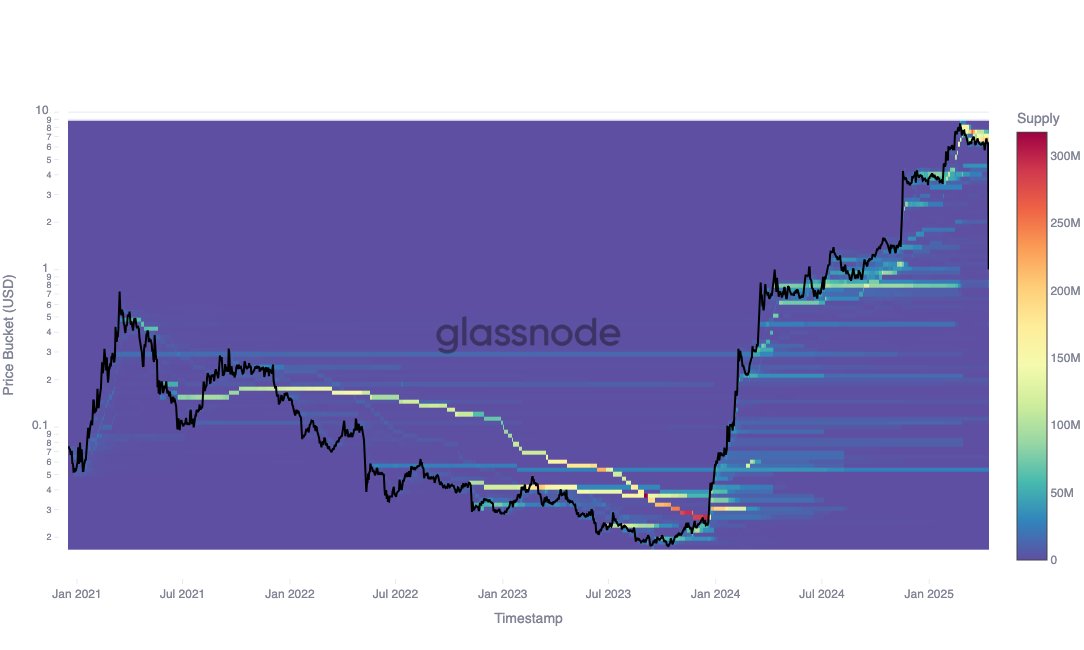
Also, Glassnode’s Cost Basis Distribution analysis revealed that early holders who accumulated tokens in 2022 at prices as low as $0.05 likely did not trigger the crash. 

The largest concentration of OM holdings remains from more recent acquisition zones, particularly around the $6.66 mark. This suggests that long-term holders may have sat out the chaos while newer investors took the hardest hits.

OM Cost Basis Distribution

Broader Context

Prior to the crash, some analysts had raised red flags over OM’s tokenomics, especially its extreme supply concentration. 

Allegations surfaced that a group known as the “Kabal team” may have dumped tokens, though those claims remain unverified. Additionally, OM’s earlier vertical rally had already raised suspicions about sustainability. For instance, OM initially spiked 4,260% from $0.0240 to $1.0465 in April 2024.

Essentially, Glassnode’s breakdown suggests this was not the work of a single actor but a network-wide drop of confidence and liquidity. Meanwhile, OM has recovered slightly but still remains 88% down in the past 24 hours, currently trading for $0.6890.

Bitcoin Whales Have Been Accumulating Even as Price Slid, Here’s Why

0

Data shows that Bitcoin whales with 1,000-10,000 BTC have been accumulating despite price dips. 

Bitcoin has shown minimal changes in price this new week, with a slight 0.9% increase, bringing the asset’s value just under $85,000. Despite the subtle daily fluctuations, Bitcoin has surged by 12.7% over the past week.

As of now, its market capitalization has crossed $1.68 trillion, and its dominance in the crypto space continues to rise. Amid this, analysts are focusing on whale behavior, specifically the activities of large Bitcoin holders, to understand market dynamics.

Whale Accumulation is Surging

One key aspect to observe is the accumulation patterns of Bitcoin whales—addresses holding between 1,000 and 10,000 BTC. Market analyst Miles Deutscher’s chart reveals that this group has steadily increased its Bitcoin holdings since 2024, even as the price fluctuated. 

This trend, seen in periods of both price surges and declines, suggests that whales are taking advantage of price dips to acquire more Bitcoin. 

For example, as Bitcoin’s price fell to $60,000 in October 2024, the total whale balance surged toward 3.37 million BTC. However, this balance saw a rapid drop as Bitcoin’s price recovered above $60,000, suggesting that these investors were cashing in on their gains.

They resumed accumulation in November 2024 amid the U.S. elections. However, as BTC crossed $100K in December, these whales sold. More recently, in April 2025, as the price dipped below $80,000, the accumulation has resumed, with their balance reaching 3.475 million BTC.

Despite market pullbacks, these large holders appear to be consistently accumulating, suggesting a long-term strategy. If past patterns are any guide, they are likely to continue accumulating until Bitcoin recovers, looking to reduce their holdings when prices hit new heights in a profit-taking scheme.

Retail Investors Pull Back During Uncertainty

Amid the price consolidation, the behavior of smaller investors also provides important insights. Data from IntoTheBlock’s Historical Concentration chart reveals a shift in ownership dynamics during the recent consolidation in the market. Over the past 30 days, whale ownership has remained stable, with no significant changes in holdings. 

Bitcoin Historical Concentration | IntoTheBlock

Investor ownership has risen by 2.74%, indicating increased accumulation by institutional or large investors. On the other hand, retail investors have shown a slight decrease, with retail ownership falling by 0.24%.

This suggests that while large holders and investors remain stable, retail investors may be retreating from the market or selling off their positions during periods of price uncertainty. Deutscher confirmed that large whales tend to cop these tokens sold by retail investors during the panic season.

Hodler Activity and Market Sentiment

Further evidence of shifting investor behavior comes from the Addresses by Time Held data from IntoTheBlock. The data indicates that Bitcoin holders who have maintained their positions for over a year (Hodlers) have increased their ownership by 1.61%. 

Bitcoin Addresses by Time Held | IntoTheBlock

Conversely, holders who have held Bitcoin for less than a year (Cruisers) saw a 1.85% decline in ownership, and traders with holdings for less than 1 month decreased their positions by 9.82%. 

In tandem with these trends, Bitcoin’s derivatives market has seen increased activity. According to Coinglass, long positions in Bitcoin have risen, with the long/short ratio hitting 1.0338, indicating more market participants are betting on a price increase. 

Further, open interest has surged to $57.91 billion, signaling strong participation in anticipation of a potential breakout.

Tether CEO Ardoino Says USDT on Bitcoin Lightning Network Is a Natural Evolution Amid Proposed Integration

Tether’s CEO, Paolo Ardoino, has insisted that USDT on Bitcoin Lightning remains the best amid plans to integrate the stablecoin on the network.

Ardoino views USDT’s availability on the Bitcoin network as a return to its natural habitat, sharing a brief history between the duo. Furthermore, he stressed why Bitcoin Lightning is the best for USDT large-scale transactions, highlighting its strength over other blockchains.

USDT Soon Coming to the Bitcoin Lightning Network

In an interview with Scott Melker, the Wolf of All Streets host, he confirmed that the Tether stablecoin will soon become available on the Bitcoin network through its layer 2 Lightning network. Notably, he mentioned USDT’s roots from the chain, stating that the stablecoin issuers built its protocol as an Omni-layer on the Bitcoin network.

However, the issuer has expanded beyond the network, stopping USDT’s issuance on Omni, the chain where it minted its first USDT, due to low demand. Nonetheless, the stablecoin would soon return to the Bitcoin network with the teased integration.

Meanwhile, the statement follows an initial January 30 announcement of the collaboration. The Crypto Basic reported that the Lightning Lab announced a partnership with Tether to integrate USDT on the blockchain powered by Taproot Assets.

Ardoino Highlights Lightning’s Advantage Over Other Layer 2s

Ardoino noted that Bitcoin Lightning is the best place to conduct large-scale transactions using the USDT token. He cited reasons such as single-share state and limited network validators as major setbacks of other L2s compared with Lightning.

For context, he stated that some layer 2 networks, especially on Ethereum, have few or no validators on the chain, making transactions difficult. However, the peer-to-peer Bitcoin Lightning uses nodes to process transactions, making them readily available.

Additionally, the Tether CEO emphasized the decentralized nature of Bitcoin Lightning compared to other chains.

Since the network leverages payment channels to make on-chain and off-chain transactions, users of an existing channel can maintain anonymity, unlike Ethereum L2’s single-share state, where every validator has access to all individual data on the blockchain.

Meanwhile, Melker noted that all other innovations built on other chains are slowly returning to Bitcoin. This narrative is seen with Cardano EMURGO’s collaboration to allow Bitcoin network users access to decentralized finance (DeFi) and smart contract features through the BOS Grail bridge.

Bitcoin and Ethereum Lead $795M Outflows from Crypto Investment Products

0

Over the past week, the market saw its third consecutive week of outflows, totaling $795 million, with Bitcoin and Ethereum leading the flows. 

Per the latest report from CoinShares, the negative sentiment, which has persisted since early February, is mainly attributed to the ongoing global tariff issues. 

These factors have led to record outflows of $7.2 billion, significantly reducing the year’s positive inflows to just $165 million. 

Despite this trend, a late-week price rebound brought some relief. Total assets under management (AuM) rose by 8% to $130 billion following President Trump’s temporary reversal of tariffs.

Bitcoin and Ethereum See Large Outflows

Bitcoin (BTC) experienced the most considerable outflows among major cryptos, with a weekly outflow of $751 million. The total month-to-date (MTD) outflows for BTC stand at $890 million, but year-to-date (YTD) flows are still positive at $545 million. With an AuM of $112.96 billion, Bitcoin remains a dominant player in the investment market.

Ethereum (ETH) also saw outflows, totaling $37.6 million last week. However, the MTD outflows for Ethereum were slightly higher at $89.1 million. Despite the outflows, Ethereum’s YTD flows are still positive at $241 million, with an AuM of $7.84 billion. 

XRP Buck the Outflow Trend

Meanwhile, Solana (SOL) saw a relatively smaller decrease, with weekly outflows totaling $5.1 million. The month-to-date flows were slightly lower, standing at $6.2 million. However, YTD flows for Solana are still positive at $79 million, and the crypto has an AuM of $1.08 billion.

On the other hand, XRP bucked the negative trend, seeing inflows of $3.4 million last week. The MTD inflows were $1.5 million, and the YTD flows stood at $176 million, bringing its AuM to $883 million. This represents a stark contrast to the outflow trends seen in other major cryptos.

Regional Flow Differences 

Regionally, the U.S. was the largest contributor to outflows, with a weekly total of $763 million and an MTD outflow of $924 million. Other countries, including Hong Kong, Switzerland, and Sweden, also experienced negative flows. 

Switzerland saw the largest YTD outflow at $375 million. However, localized interest in crypto investment remains strong in countries like Canada, Brazil, and Australia, with these regions experiencing small positive weekly and MTD flows. Canada saw the most inflows, attracting $2.1 million last week.