Home Blog Page 808

Major Tech Firm Janover Acquires $4.6M Solana as Part of New Strategy

0

Software firm Janover made its first move under its newly introduced digital asset treasury strategy by purchasing $4.6 million Solana (SOL). 

According to Janover’s blog post, the company will immediately begin staking its SOL holdings as part of this new strategy. This move supports the Solana network and allows Janover to generate revenue from its investment.

The company’s management emphasized that this step marks the first capital deployment from its recently completed $42 million financing round. Per the announcement, the decision highlights Janover’s strategy to invest at a time when market conditions offer potential for significant returns.

CEO Joseph Onorati explained that the purchase aligns with the company’s objective to be the most efficient and transparent platform for accumulating crypto assets in the public markets.

Board Approves Crypto Asset Strategy

On April 4, 2025, Janover’s Board of Directors formally approved a new treasury policy that lays the groundwork for accumulating crypto assets over the long term. Solana was chosen as the first asset for this initiative.

In addition to acquiring and staking Solana, Janover plans to operate one or more Solana validators. This will allow the company to further participate in securing the Solana network while simultaneously earning rewards that can be reinvested into its treasury.

The company’s leadership sees this as an important step toward scaling its operations while maintaining an efficient capital deployment strategy.

Industry Shifts and Solana’s Growing Appeal

Meanwhile, Janover’s decision to invest in Solana aligns with growing interest from other major players in the finance sector. Notably, BlackRock recently expanded its $1.7 billion BUIDL fund to include Solana, while PayPal and Venmo announced their plans to add support for the network in the coming weeks. 

These developments indicate that Solana’s ecosystem is gaining traction among traditional finance and fintech entities. It further validates Janover’s move as it positions itself for future growth in the blockchain space.

Ethereum Eyes $2,000 Breakout Amid Aggressive Whale Accumulation

Crypto whales are buying the dip, adding over $16M in ETH across strategic wallets. Ethereum’s bullish reversal eyes $2,000, with a long-term target of $4,000.

As the crypto market mirrors a minor recovery in the global market, altcoins are on the verge of a major comeback. The largest altcoin, Ethereum, is currently floating above the $1,500 mark.

Ethereum is nearing a potential trendline breakout and targeting the $2,000 level. Will this trigger a new bullish trend for Ethereum?

Crypto Whales Buy Another Dip in Ethereum

Amid the recent increase in ETH price volatility, multiple large holders are accumulating ETH. In the latest price trend, a newly created wallet accumulated 9,610 ETH tokens worth $14.54 million.

Initially, with a withdrawal of 5,000 ETH from Kraken, the entity acquired 7 million USDS on Spark as a borrowed amount, using ETH as collateral. With the borrowed funds, the entity added an additional 4,600 ETH tokens at an average price of $1,518.

This layered approach to acquiring ETH highlights strong confidence in the asset.

Additionally, a mysterious group known as the “7 Siblings” in the crypto market is making significant bets on ETH.

The group has been exchanging MKR tokens to increase its ETH holdings. Over the past 48 hours, it swapped 1,611 MKR tokens for ETH, increasing its position by 1,364 ETH, worth nearly $2 million.

BlackRock’s ETHA Marks First Day of Inflow Since February 13

Despite growing interest from crypto whales, institutional confidence in Ethereum has been lagging. On April 10, U.S. Ethereum spot ETFs recorded an outflow of $38.79 million.

This marked the third consecutive day of net outflows, following $11.19 million on April 9. Fidelity saw an outflow of $36.01 million on April 10, while VanEck, Bitwise, and Grayscale registered outflows of less than $5 million each.

However, BlackRock saw an inflow of $6.43 million for the first time since February 13. The remaining four Ethereum ETFs recorded net-zero outflows on April 10.

Ethereum ETFs
Ethereum ETFs

ETH Analysis Points to Potential Channel Breakout Rally

As large investors accumulate Ethereum, the short-term recovery will likely push the price past the local resistance trendline, reigniting positive cycles within a larger falling-channel pattern.

Supporting the likelihood of a positive reversal, technical indicators are signaling a potential shift. The MACD and signal lines are approaching a positive crossover from a negative trajectory.

Ethereum Price Chart

At the same time, bearish momentum is declining. The RSI is bouncing back from the oversold region, surpassing its 14-day SMA, indicating the emergence of new bullish momentum and a possible uptrend.

Based on Fibonacci levels, the positive cycle within the parallel channel will likely challenge the 23.60% retracement level, which aligns with the $2,000 psychological mark.

Optimistically, the channel breakout rally could propel Ethereum back to the $4,000 levels. On the downside, key support remains near the psychological mark of $1,500, followed by the $1,400 horizontal level.

Can SUI Stage $2.91 Breakout as Network Activity Surges?

Bullish momentum is building in SUI as the price targets a breakout at $2.35. Can strong network growth and stablecoin activities support a rally toward $2.91?

As Bitcoin encounters a minor roadblock in its recent bullish turnaround, altcoins are experiencing a similar slight slowdown. However, amidst these conditions, the SUI token shows signs of a bullish reversal, testing a falling wedge pattern but struggling to maintain momentum.

The SUI token is currently trading at $2.16, reflecting a 2.60% intraday recovery. Will this lead to a breakout above the psychological resistance level of $3?

SUI Price Analysis Suggests $2.35 Breakout

On the daily chart, the SUI price trend shows a failure to surpass the 50% Fibonacci level near the $3 mark. The price retraced to test the previously broken resistance-turned-support trend line of the falling wedge pattern.

After a lower price rejection, SUI’s price is now attempting a bullish comeback, eyeing the 61.80% Fibonacci retracement level at $2.3514.

With an intraday recovery of 2.60%, SUI gradually gains bullish momentum. The post-retest reversal is also reflected in the MACD and signal lines, which show a bullish crossover.

SUI Price Chart
SUI Price Chart

SUI Network Growth Lays the Foundation for the Next Bull Run

In Q1 2025, Bitcoin finance on the SUI network significantly increased. Liquid staking via Lombard’s LBTC has helped boost the network’s BTC assets.

Notably, 10% of SUI’s total value locked (TVL) comprises BTC assets, including WBTC, LBTC, and STBTC. However, after peaking strongly, the TVL has taken a noticeable dip.

According to a tweet by SUI, the Q1 average TVL stands at $1.51 billion, with a peak of $2.08 billion. The volume has increased by 4.47% quarter-to-quarter, reaching $25.5 billion.

Moreover, the stablecoin supply on the SUI network has surged. The supply of stablecoins on SUI has recently surpassed that of Optimism. Currently, the stablecoin supply on SUI stands at $721 million, compared to Optimism’s $684 million.

Conclusion

Based on the Fibonacci levels and the improving SUI network, bulls will likely push SUI past the 61.80% retracement level at $2.35. This could set the stage for a rally toward the 50% Fibonacci level at approximately $2.91.

On the downside, crucial support for SUI remains at the 78.60% level, near $1.55.

Shiba Inu: Shibarium Records Only $17K Daily Volume as Trading Activity Declines

0

Activities on Shiba Inu blockchain Shibarium, particularly its trading volume, significantly lag behind other networks like Polygon and Base.   

Shiba Inu’s Layer-2 blockchain, Shibarium, has experienced exponential growth since August 2023, when it launched on the mainnet. Notably, it has processed over 1.04 billion transactions, positioning itself as an established blockchain. Also, nearly 200 million blockchain wallets have interacted with Shibarium since its mainnet launch. 

While these milestones are commendable, fresh data from DexScreener suggests that Shibarium is seeing low daily trading volume compared to other Layer-2 blockchains like Base and Polygon. 

Shiba Inu Shibarium Low Daily Volume 

At press time, Shibarium boasts a 24-hour volume of about $17,000 across all decentralized exchanges (DEXs) on the L2 blockchain. The volume came from a total transaction of 11,025. 

Shibarium DEX Volume

At the moment, WoofSwap ranks as the top-performing decentralized exchange on Shibarium. This DEX has a daily volume of about $8,300. 

WoofSwap is closely followed by Shiba Inu’s native DEX, ShibaSwap, which has a 24-hour volume of $5,400. ChewySwap and MarSwap follow suit, with daily trading volumes of $1,600 and $102, respectively. 

Punkswap and Chibbex have seen paltry volumes of $20 and $6, respectively. Other Shibarium-based decentralized exchanges, including DogSwap, Woof, and LeetSwap, have less than $10 combined in daily trading volume. According to data from DexScreener, the volumes across these DEXes bring the total to around $17,000. 

Polygon and Base Volumes 

In comparison, established L2 blockchains like Base and Polygon have registered daily volumes running into hundreds of millions of dollars. 

Coinbase’s Base network, which launched around the same time as Shibarium in August 2023, currently has a 24-hour volume of $726.1 million. Polygon, on the other hand, has recorded a daily trading volume of $70.9 million. 

Essentially, Shibarium’s daily volume of $17,000 pales significantly compared to the figures seen on Base and Polygon. The $17,000 volume is more akin to the transaction size of a whale than an active blockchain’s total daily volume.

For context, many whales have spent millions of dollars in a single transaction to acquire Shiba Inu’s native token, SHIB. An unknown Shiba Inu whale recently withdrew about 220 billion SHIB, worth around $4.63 million, from Binance.

The limited trading volume on Shibarium raises concerns about its ability to compete with established blockchains. This low volume suggests a decline in DeFi activity or a lack of interest from developers in the platform.

Overall, it appears that Shibarium is struggling to attract liquidity compared to most established blockchains.

Top Analyst Projects Here’s How Dogecoin Price Could Surge 364% to $0.67

0

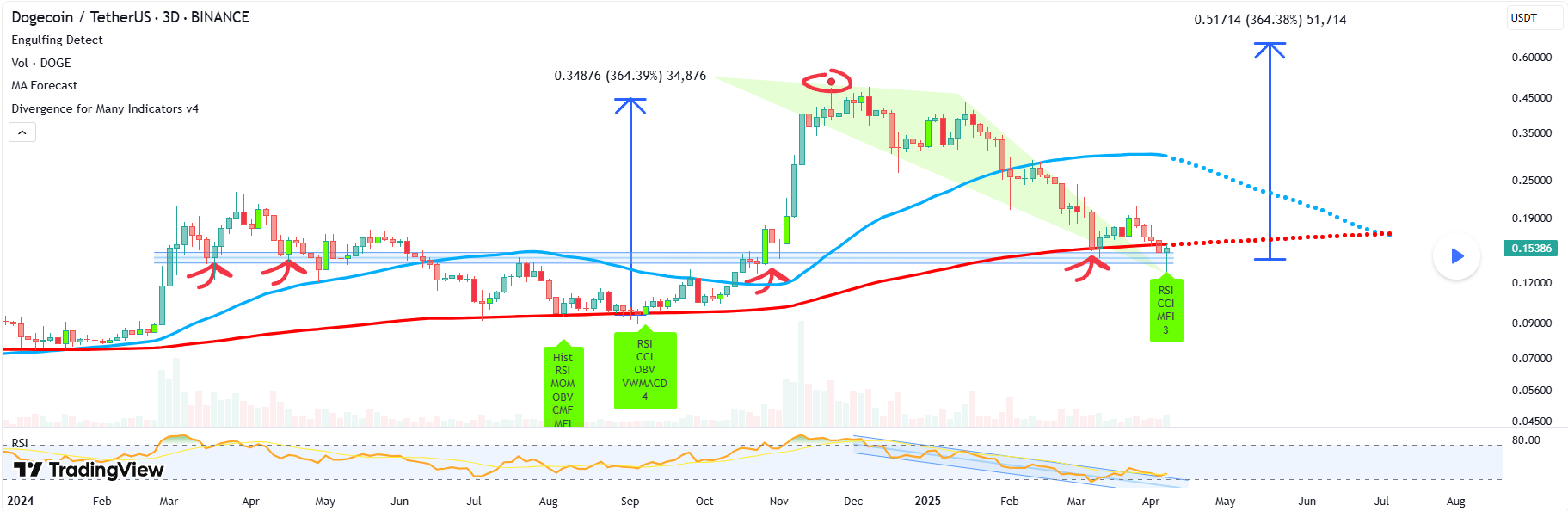
A notable TradingView analyst projects a 364% Dogecoin rally, citing historical patterns and RSI resistance breakout.

Dogecoin’s recent market activity points to increased volatility as short-term price fluctuations continue to unsettle investors. The asset recorded a notable decline from April 5 to April 7, reaching a low of $0.13. Although it recovered slightly on April 10, the price fell again to $0.14 before briefly rebounding to $0.15.

The memecoin’s performance indicators reflect this short-term bearish trend, with a 7-day drop of 5.8%, a 14-day loss of 13.8%, and a 30-day decline of 6.9%. Despite these negative metrics, technical analysts suggest that Dogecoin might be approaching a pivotal inflection point, potentially priming for a major price move.

Technical Setup Signals Possible Upside

A TradingView analyst, with the label without_worries, shares a technical formation based on a 3-day candlestick chart that resembles a breakout structure observed in earlier price surges. He notes a confluence of indicators, including support at historical resistance levels and a breakout in both price action and RSI resistance.

Dogecoin Price Prediction

In addition, the chart shows bullish divergence patterns, which, according to the analyst, mirror conditions preceding previous upward trends.

Notably, the same analyst predicted earlier that DOGE could witness a crash when prices were high. This thesis was validated when Dogecoin dropped 70% to the $0.2 level in February. 

He now sees potential for an extended upside of over 364%, targeting a long-term price of around $0.67 if current signals evolve into a sustained trend. He also encourages buying dip, especially now that there is blood on the street.

Support at $0.14 Remains Critical 

Meanwhile, another analyst, MonoCoinSignal, in a separate assessment, underlines Dogecoin’s relative stability during broader market declines. His report, published Monday, observes that Dogecoin registered a modest 0.11% increase even as the global crypto market lost 4.4% in value. This, he argues, reflects the asset’s resilience under current market pressure.

Despite that, MonoCoinSignal emphasizes that mixed momentum persists. He notes that while whale accumulation continues to support a bullish outlook, macroeconomic concerns—especially related to Donald Trump’s ongoing trade policy shifts—may limit near-term price growth. He identifies $0.14 as a critical support level, warning that any sustained break below could reverse recent gains.

Short-Term Resistance at $0.15

In terms of immediate price action, the path to $0.16 remains contingent on Dogecoin breaking the $0.15 resistance with a strong trading volume.

MonoCoinSignal states that a confirmed move beyond $0.16 could set the stage for further gains, potentially allowing DOGE to revisit the $0.20 mark.

Shiba Inu Reaching $1, Prominent Bitcoin Pundit Breaks Down The Odds

Prominent early Bitcoin adopter Davinci Jeremie has weighed in on the prospect of Shiba Inu ever reaching the $1 price level.

In its five years of existence, Shiba Inu has seen its price eliminate as many as five leading zeros, reaching its current state with four zeros at a price of $0.00001200. While optimism remains high about its potential to cancel more zeros and inch closer to the unit value, major skepticism surrounds the asset’s potential limits.

Now, Jeremie, a well-known Bitcoin advocate and Shiba Inu bull, has joined the conversation. In a tweet, he completely dismissed the notion of Shiba Inu ever reaching $1. His primary point of disagreement is the potential market cap Shiba Inu could wield at such a price point.

Impracticality of $1 for Shiba Inu

Jeremie emphasized that Shiba Inu’s market cap would be approximately $600 trillion at $1. He stressed that such a valuation is impractical for a meme-inspired coin like SHIB. He noted that a $600 trillion market cap for an asset would make it the greatest financial asset in human history.

For context, gold, the most valuable asset today, has a market cap of $20 trillion. Meanwhile, the market cap of 10,463 companies globally has a collective value of only $104 trillion. Also, the entire crypto market’s cap is $2.6 trillion. 

Shiba Inu’s current market cap is $6.44 billion, less than 1% of the crypto market, which casts serious doubt on its potential to reach a trillion-dollar valuation, much less the $600 trillion threshold.

Notably, Telegaon analysts have suggested that Shiba Inu could reach $1 by 2050. However, doubts remain whether this timeline would be sufficient to reach that value, especially if its supply remains unchanged.

Mathematically, Shiba Inu needs to grow 8,333,233% to reach $1. Notably, reports indicate that Shiba Inu experienced an extraordinary 150,000,000% surge between August 2020 and October 2021. This was possible due to its humble beginnings with an initial market cap of just a few hundred dollars, unlike today, where it is now a billion-dollar asset.

SHIB Could Still Do Well This Season, But Not “Crazy Well”

Despite the skepticism surrounding Shiba Inu’s ability to see another astronomical price growth, Jeremie acknowledged that SHIB could still do well in this cycle. However, according to him, the coin will not do “crazy well” as it did in the last cycle.

Notably, Shiba Inu has been a major victim of the ongoing market sell-off. Just four months into the new year, its price has tanked by 43%. This movement has completely erased all its one-year gains, which now stand at a discouraging 57% loss for holders.

Flare to Introduce XRP Programmability and DeFi with Imminent FXRP Launch

0

Layer 1 network Flare has proposed the launch of XRPFi, which will bring DeFi functionalities like staking, lending, and borrowing to XRP holders.

The Flare team announced the move on April 10, teasing the ploy to DeFi-hungry XRP holders. The integration will bring decentralized finance features to XRP enthusiasts, allowing them to earn incentives on their stash beyond the asset’s price performance.

Flare to Bring DeFi Functionalities to XRP

In an X post, Flare teased the launch of FXRP for XRP holders, a pool that brings decentralized features to enthusiasts. The team noted that the XRPFi initiative would bring programmability and purpose to XRP, bearing yields through DeFi-related activities.

With the integration, holding XRP will bring rewards beyond its price action. Users will earn extra incentives by staking and lending their stash at predetermined rates. Furthermore, it will provide borrowing and trading options for participants.

Notably, Flare had earlier disclosed plans to incorporate XRP holders into its broadening DeFi ecosystem. In March, Hugo Philion, the protocol’s co-founder, announced that they would roll out low-risk staking opportunities, offering passive income to users who hold XRP.

Notably, this incorporation within the Flare ecosystem will unlock yields for over $116 billion worth of XRP. Recall that the DeFi functionalities native to the XRP Ledger are largely limited, a narrative Ripple looks to change with the imminent new programmability.

Flare’s Expanding DeFi Ecosystem

Meanwhile, DeFi on the Flare ecosystem continues to expand, with the total value locked across the ecosystem exceeding $76 million. Remarkably, the network debuted decentralized finance functionalities in July 2024 with the SparkDEX deployment.

Interestingly, the Clearpool TPOOL has claimed a considerable part of the TVL, accounting for 38.03% of all funds locked in on Flare’s DeFi pool. Currently holding $29.1 million, the TPOOL offers investors borrowing and lending services with real-world assets as collateral.

Meanwhile, the Sceptre Liquid and Kinetic pools are also notable protocols in Flare’s ecosystem. They offer users liquid staking and lending services, attracting $17.2 million and $11.48 million, respectively.

Flare DeFi Ecosystem Breakout

Nonetheless, market enthusiasts believe XRP’s integration will extensively boost Flare’s DeFi ecosystem. The upcoming development has excited proponents of the XRP ecosystem, looking to expand their holdings beyond the XRP Ledger.

Here’s How Much Shiba Inu You Need to Hold to Gain $1M if SHIB Hits $0.00009 or $0.0005, Based on Current Price of $0.00001196

0

The recent Shiba Inu price collapse presents opportunities for investors to procure SHIH with lower capital as they await significant gains.

For context, SHIB has witnessed intense selling pressure since March 26, after it claimed a high of $0.00001566. Since then, the meme coin has witnessed multiple large intraday losses, culminating in a 24% collapse over the past two weeks.

Accumulation Amid Shiba Inu Price Downturn 

However, this downturn is not unique to Shiba Inu, as the global financial market has also witnessed a bloodbath, with the global crypto market losing over $280 billion in valuation since March 26. SHIB is just one of the multiple victims of this market-wide crash.

Nonetheless, despite the turbulence, most investors have seized the opportunity to accumulate more Shiba Inu tokens at lower prices. 

Particularly, data from IntoTheBlock indicates that while investors (holding between 0.1% and 1% of Shiba Inu supply) have reduced their holdings, whales (holding over 1% of SHIB’s supply) and retail (holding less than 0.1% of the supply) have been adding to their balances since March 26 when the Shiba Inu price downturn began.

Notably, on March 26, whales held a cumulative balance of 575.11 trillion SHIB, representing 58.41% of SHIB’s total supply. Meanwhile, retail addresses had a balance of 253.36 trillion tokens, about 25.73% of the supply. 

However, recent data suggests whales now hold 575.81 trillion SHIB, having added 700 billion tokens since March 26. Similarly, retail wallets now hold a balance of 254.84 trillion tokens, indicating that they have accumulated a whopping 1.48 trillion SHIB since the market turbulence began.

Accumulation Amid Shiba Inu Price Downturn IntoTheBlock
Accumulation Amid Shiba Inu Price Downturn | IntoTheBlock

How Much SHIB You Need to Make $1M at $0.00009 and $0.00005 Price Targets

One of the major motivations behind this accumulation spree is the confidence that Shiba Inu could reach loftier targets following a recovery. Last October, The Crypto Basic confirmed that Changelly analysts expect SHIB to reach $0.00009 in late 2028. Moreover, in May 2024, analyst Big Mike suggested Shiba Inu could hit $0.0005.

Notably, several investors have held onto the belief that their SHIB investments could someday reach the coveted $1 million mark. For an investment to hit $1 million when Shiba Inu price claims $0.00009, the investor must hold 11.11 billion tokens. However, at the $0.0005 price, such an investor must hold just 2 billion tokens.

With Shiba Inu price currently trading at $0.00001196, investors with such ambition can amass the required tokens for less. For instance, they can procure the 11.11 billion SHIB for $132,888. If Shiba Inu price hits $0.00009, this $132,888 investment would grow to $1 million.

Meanwhile, those expecting Shiba Inu to claim $0.0005 can purchase 2 billion tokens for just $23,920. If Shiba Inu price increases 4,080% to hit $0.0005, this lowly $23,920 investment would yield $1 million. However, these returns depend on SHIB’s ability to reach these ambitious targets, which is not a guarantee.

US SEC Settles Another Lawsuit, Agrees Helium Did Not Sell Securities

0

Nova Labs, the founding team behind the Helium Network, has confirmed that the U.S. SEC has agreed to dismiss its civil lawsuit alleging the sale of unregistered securities.

According to a blog post today, the dismissal, filed with prejudice, prevents the SEC from refiling the same charges. This decision affirms that Helium-compatible hardware and the distribution of HNT, IoT, and MOBILE tokens are not securities under current SEC guidance.

Regulatory Case Ends with Dismissal

For context, the SEC originally filed the lawsuit in January 2025, during the final days of the previous administration. According to Nova Labs, the Commission accused the company of various claims. They include claims that its IoT Hotspots lacked real functionality and that the project’s coverage map was misleading.

Meanwhile, Nova Labs CEO Amir Haleem publicly denied the allegations. Haleem argued that the Commission had pursued the case without substantive evidence.

Notably, the SEC dropped its claims with prejudice, a legal term that means the case is closed definitively and cannot be refiled.

This legal resolution removes lingering ambiguity for decentralized physical infrastructure networks (DePIN) that use token-based models for incentivizing network growth.

According to Nova Labs, the decision offers assurance that selling network-building hardware and issuing tokens does not, by default, meet the SEC’s criteria for securities. Nova Labs remarks:

“With this chapter closed, Helium and the community can move forward confidently, accelerating the adoption and real-world innovation in decentralized wireless and crypto-backed infrastructure.”

Clarity Emerges in Crypto Sector

Furthermore, the dismissal suggests a shift in regulatory posture under the current SEC leadership, which Nova Labs acknowledged in its public communications.

This development also coincides with recent actions by the SEC under the new administration. Since President Donald Trump’s return to office, the Commission has ended lawsuits involving major crypto exchanges, including Coinbase and Kraken. In addition, it is currently in settlement talks with Ripple.

XRP Support at $1.61 Triggers Golden Ratio Theories, with Past Projections Targeting $16.18

0

XRP price found support at a level some community members believe aligns with the golden ratio of 1.618, triggering speculative theories.

XRP’s recent pullback to the $1.61 level on April 7 has renewed discussions around the golden ratio among community members and analysts, as some claim the price point carries mathematical importance.

The decline came during a broader market downturn, due to a global financial market slump triggered by a tariff-related announcement from U.S. President Donald Trump.

XRP’s $1.61 Support Triggers Golden Ratio Theories

Interestingly, certain XRP proponents, including members of the NFA Research Group, pointed to the drop to $1.61 as a symbolic alignment with the golden ratio of 1.618. They interpreted the market reaction as a potentially meaningful signal. 

In particular, NFA Research Group asserted that XRP had touched a precise low of $1.618 on April 7. However, this claim is not 100% accurate, according to data from leading exchanges. 

Notably, available records show XRP hit $1.6118 on Bitstamp, $1.6106 on Coinbase, and $1.6134 on Binance. This shows no leading trading platform reflected the exact 1.618 mark. Nonetheless, proponents of the theory argue that the $1.61 figure is still symbolically relevant to the golden ratio concept.

Previous XRP Golden Ratio Suggestions

For context, this fascination with the mathematical relationship goes beyond this recent event. In a disclosure last December, the NFA Research Group shared an elaborate sequence of dates and figures that they claim bolster their theory. 

They claimed XRP reached its all-time high on Jan. 6, 2018, a date that could be rewritten numerically as 1.6.18. Further, they also pointed to XRP’s trading debut on Aug. 2, 2013, at roughly $0.00589. From this starting point, they noted that exactly 1,618 days later, XRP reached its peak on Jan. 6, 2018. 

Furthermore, the group stated that another 1,618 days after that peak, XRP hit a low on June 12, 2022. To them, this repetition of the golden ratio interval in days presented additional evidence of a deeper pattern.

However, a closer investigation into these claims reveals a few inaccuracies. Notably, market data confirms that XRP did not peak on Jan. 6, 2018. Instead, the token hit its all-time high two days earlier, on Jan. 4, across all major exchanges. 

Additionally, the claim that June 12, 2022 marked the bottom of XRP’s 2021 bull cycle does not hold up. While the asset did touch $0.3393 on that date, it eventually fell further to $0.2870 on June 18, which is now recognized as the cycle’s actual bottom.

XRP Now Targeting $16.18?

Meanwhile, besides the NFA Research Group, other market analysts have highlighted the golden ratio in relation to XRP’s price movements. One such analyst, Saul, introduced a concept in August 2024 that he called “The Golden Ratio Theory.” 

At the time, XRP was trading around $0.5834. Saul identified a price of $0.38249 as the “golden bottom” and projected a multi-tiered rally toward golden ratio-based targets. His forecasts aimed first at $1.618, then at $16.18, and ultimately at $161.8.

Saul’s initial target of $1.618 materialized during the rally in Q4 2024, as XRP surged past this level. Following this milestone, he emphasized that the $16.18 level was now the next goal. 

Currently, XRP hovers around $1.99 battling to reclaim the $2 threshold. A move to Saul’s next target would require an increase of over 700% from current levels.