Home Blog Page 809

Bitcoin Targets $84K Amid Highest Whale Growth in Seven Weeks

Despite institutional outflows, whale activity has surged to a multi-month high, fueling hopes for a Bitcoin rally above $84,000.

Bitcoin recently retested the $78,350 support zone following an unexpected dip in U.S. inflation to 2.4%, below the forecasted 2.6%. This lower inflation reading failed to sustain the prior bullish momentum, especially after a 90-day pause in global tariffs.

Currently, Bitcoin has rebounded to around $80,000, signaling a potential short-term recovery. Could this uptrend push the price beyond the $84,000 mark once again? Let’s dive into the analysis.

Bitcoin Price Analysis

On the 4-hour chart, Bitcoin recently broke down from a symmetrical triangle pattern, triggered by a bearish shift following the U.S. announcement of increased global tariffs.

However, a 90-day pause in the tariff implementation led to a double-bottom reversal from $74,892. Following the rebound, Bitcoin climbed back to the broken triangle pattern near $83,500. Yet, strong rejection at higher levels pulled the price back down to the $78,350 horizontal support.

Bitcoin Price Chart
Bitcoin Price Chart

At present, Bitcoin is consolidating between $78,350 and the overhead resistance at $81,595. The double-bottom reversal has also sparked bullish momentum in technical indicators.

The MACD lines are nearing a bullish crossover into positive territory, accompanied by fresh bullish histogram bars. The super trend indicator has also turned positive, with a new bullish signal emerging at the $75,654 baseline.

Whales Accumulate More Bitcoin

As the market anticipates a relatively stable 90-day window before any new tariff developments, large investors appear to be aggressively accumulating Bitcoin. According to a recent tweet from Santiment, whale and shark activity has reached its highest point since February 20.

In the past 24 hours alone, the number of wallets holding more than 10 BTC increased by 132, bringing the total to 152,000. Meanwhile, wallets holding less than 10 BTC now number 54.69 million.

Additionally, according to CryptoQuant, wallets holding between 1,000 and 10,000 BTC now hold a balance of 3.49 million BTC—above their 30-day moving average of 4.36 million BTC. This metric excludes exchange and mining pool wallets, reinforcing the narrative of growing demand from large investors.


Bitcoin ETFs See Continued Outflows

Despite bullish on-chain signals, institutional sentiment remains weak. On April 10, U.S. Bitcoin spot ETFs recorded net outflows totaling $149.66 million—marking the sixth straight day of withdrawals.

Among the 12 ETFs, Grayscale Mini Bitcoin Trust led with $9.87 million in outflows. Fidelity followed with $74.63 million, while Grayscale Bitcoin Trust saw $44.63 million in outflows.

ARK 21Shares and Bitwise reported smaller outflows of $12.69 million and $10.82 million, respectively. Franklin and Invesco recorded outflows under $10 million. The remaining five ETFs posted net-zero flows.

Bitcoin ETFs
Bitcoin ETFs

Bulls Begin to Resurface in Bitcoin Futures

Despite ongoing volatility, Bitcoin futures data shows a slight increase in long positions. According to Coinglass, long positions now make up 50.8% of the market, nudging the long/short ratio to 1.035.

Although this ratio suggests near-neutral sentiment, the increase in long positions from 49.45% in the past 12 hours points to a potential bullish shift.

Conclusion

With rising demand from whales and large investors and renewed momentum in the derivatives market, Bitcoin is showing signs of a short-term bullish revival. A breakout above $81,595 could open the door for another attempt at the $84,000 psychological barrier.

On the downside, the key support levels to watch remain at $78,350, followed by the double-bottom base at $74,892.

21Shares Joins Race to Launch Spot Dogecoin ETF in U.S.

0

Zurich-based asset manager 21Shares has joined the race to introduce a spot-based exchange-traded fund (ETF) tied to Dogecoin (DOGE). 

According to an S-1 filing recently submitted to the SEC, the spot ETF will mirror Dogecoin’s performance. Notably, 21Shares characterized the Dogecoin ETF as a passive investment that does not seek to generate returns for investors via leverage or derivatives. The ETF will hold actual Dogecoin, which will be valued based on the pricing index. 

Coinbase Custody Trust Company will hold Dogecoin in custody for the ETF, while 21Shares will serve as its sponsor. 

Other Key Details Remain Unknown 

The filing did not disclose what exchange 21Shares spot Dogecoin ETF will list and trade on. However, if the asset manager decides where shares of the ETF will trade, the exchange will submit a 19b-4 filing. This would make 21Shares application for a Dogecoin ETF official, potentially tying the SEC to an approval timeline.  

Currently, the ticker, trustee, and management fee of 21Shares DOGE ETF were not stated in the preliminary prospectus. 

House of Doge to Provide Special Services 

Dogecoin Foundation’s corporate arm, House of Doge, will act as a service provider for the ETF. Specifically, it would provide licensing, marketing, strategy, and related services. 

Recall that 21Shares recently partnered with the House of Doge to introduce a Dogecoin ETP endorsed by the Dogecoin Foundation. The ETP will trade under the ticker DOGE on the SIX Swiss Exchange with a 2.5% management fee. 

Shortly after launching the DOGE ETP, 21Shares extended its partnership with the House of Doge for the potential launch of its spot Dogecoin ETF in the United States. 

DOGE ETF Race Intensifies 

Following 21Shares’ S-1 application, three asset managers are seeking to launch spot DOGE ETFs in the U.S. Grayscale and Bitwise were the first to file with the SEC for spot DOGE ETFs. 

Both Grayscale and Bitwise are seeking to launch shares of their Dogecoin ETFs on NYSE Arca. The exchange has already submitted 19b-4 filings for both funds. As previously reported, the SEC acknowledged the Grayscale 19b-4 filing in February, taking the application closer to approval. 

Should the SEC approve the Dogecoin ETF, it could contribute to DOGE’s evolution beyond its meme coin origin. It has been evolving beyond its meme origin, with top industry stakeholders like Robinhood CEO Vladimir Tenev backing the coin to become the currency of the internet. 

Interestingly, DOGE also aligns with the name of a U.S. federal agency, the Department of Government Efficiency (D.O.G.E.). The agency, led by Tesla CEO Elon Musk, aims to help the U.S. government cut federal spending by eliminating fraud and waste. 

Bitcoin Sees Largest Single-day Inflow to Accumulation Addresses: Here’s What It Means

0

Bitcoin experienced an extraordinary surge in accumulation activity, marked by the largest single-day inflow into accumulation addresses in over three years. 

Notably, a sudden shift for Bitcoin price occurred on April 9, 2025, just as President Trump announced a temporary 90-day pause on tariffs affecting several nations. 

The decision significantly impacted crypto markets, with Bitcoin prices fluctuating from below $75,000 earlier in the week to a recovery, although still below the $85,000 mark. Consequently, data from on-chain analytics platforms revealed strong signals of renewed buying from large holders during this period.

Record Inflows Align with Accumulation Patterns

On April 9, CryptoQuant recorded a major transfer of 48,575 BTC into accumulation addresses — totaling approximately $3.6 billion. This marks the largest single-day inflow since February 1, 2022, when a similar dollar-value movement of nearly 95,000 BTC occurred. 

Interestingly, both events took place during significant macroeconomic shifts, with BTC prices around $38,400 in 2022 and roughly $76,000 this time. According to CryptoQuant analysis, this indicates strategic behavior from accumulation wallets.

Lately, CryptoQuant has observed smaller and consistent inflows to these addresses. However, the recent inflow followed a sell-off linked to the renewed tariff tensions with China. The affected price zone triggered a wave of buying activity, indicating that accumulation addresses continued to act decisively during price corrections.

Ultimately, the CryptoQuant analysis notes that when accumulation addresses move with such aggressiveness, it is worth paying attention.

Large Holders Inflow and Wallet Behavior 

Meanwhile, IntoTheBlock’s data supported a parallel trend among large holders. Over the last 90 days, inflows into large BTC wallets increased by +20,906.63%, signaling a sustained accumulation trend. 

This momentum remained strong over the past seven days, with a +1514.51% surge in inflows, even after the earlier sell-off. In contrast, the 30-day inflow saw a -66.45% drop, often interpreted as a short-term pause before renewed interest — consistent with the sharp weekly rebound.

Further analysis from IntoTheBlock shows that long-term holders increased their balances by +1.54% despite market swings, suggesting they remained unfazed. At the same time, short-term traders — often seen as speculative participants — rose by +4.31%, hinting at a return of trading activity. In contrast, cruiser wallets, which hold assets for one to twelve months, dropped by -3.60%, indicating possible asset rotation.

Mid-Range Wallets Reflect Broader Confidence

Additional insights from CryptoQuant highlighted rising demand from wallets holding between 1,000 and 10,000 BTC. These wallets, typically not associated with exchanges or miners, are considered influential due to their historical impact on market dynamics. 

On April 9, the number of such wallets increased at a pace faster than their 30-day average, reinforcing the trend of accumulation. Currently, Bitcoin trades for $81,014, down 0.63% over the past 24 hours.

Donald Trump Approves Repulsion of IRS Crypto Tax Rule Introduced by the Biden Administration

0

President Donald Trump has taken another step towards regulatory clarity after signing resolutions to repeal an anti-decentralization IRS crypto tax bill.

A White House statement disclosed that the pro-Bitcoin US president signed off on Thursday on repulsing the controversial IRS crypto tax bill. Notably, he gave his approval after Congress voted in favor of tossing the rule implemented by the Joe Biden administration late into its tenure.

New IRS Crypto Tax Law Meets Early End

For context, the Internal Revenue Service (IRS) announced in December that it has implemented a new crypto tax regulation extending to decentralized finance exchanges or “custodial brokers.” The updated guideline mandates that they operate like traditional Wall Street brokers and report user trading activities to the federal tax law enforcement agency.

The anti-decentralization tax law required that DeFi exchanges issue Form 1099 tax forms to customers to report nonemployment incomes from activities like trading and gambling and submit them to the IRS. Meanwhile, given the operation dynamics of DeFi firms, which operate without intermediaries and look to maintain decentralization, abiding by such rules raises concerns among industry leaders.

Senator Ted Cruz and Representative Mike Carey introduced a joint motion to repeal the rule earlier in the year, which the crypto industry saw as a last-minute effort by the former administration to extend its regulatory tyranny over the digital asset industry. Interestingly, the motion has now passed both chambers of Congress, receiving bipartisan support.

It bears mentioning that the IRS has been in the spotlight lately, primarily due to its handling of tax-related issues with the crypto industry. In early January, Representative Earl Buddy Carter proposed a bill to abolish the tax agency and simply tax payments in the US.

Trump Gives Presidential Support to Nullify IRS Crypto Bill

Furthermore, Trump indented his signatures on Thursday, ensuring the bill met its early end. Notably, the approval was expected, considering the White House has already supported the congressional disapproval of the bill in a March 4 statement.

Moreover, President Trump and his pro-Bitcoin appointees have abolished several rules that defeat the aim of making America the crypto capital of the world.

For perspective, the US Securities and Exchange Commission had earlier repealed Staff Accounting Bulletin 121 (SAB 121) under acting chair Mark T. Uyeda, which has encouraged banks to meddle freely with the cryptocurrency industry.

FTX’s Sam Bankman-Fried Reassigned to Notorious Federal Prison in California

0

Sam Bankman-Fried, founder of the now-defunct FTX exchange, has been reassigned to a medium-security federal prison in California.

According to details from the U.S. Bureau of Prisons, Bankman-Fried is currently incarcerated at Federal Correctional Institution Victorville Medium II. This is a facility that inmates and analysts alike recognize for its high levels of internal violence and politically charged inmate environment.

Transition to Victorville 

The 32-year-old former crypto executive was previously detained at the Metropolitan Detention Center in Brooklyn for over 18 months, when he also requested a stay for his appeal.

In March 2025, following a controversial interview with Tucker Carlson, authorities transferred him to a federal transfer center in Oklahoma. That temporary placement lasted two weeks before his relocation to Victorville.

For context, Bankman-Fried was convicted and sentenced to 25 years in prison. Prosecutors described his actions as one of the most significant fraud cases in American financial history. The collapse of his crypto exchange, FTX, ignited broad discussions across the financial industry, particularly on regulatory gaps in digital asset markets.

Dangerous Conditions at Victorville Facility

FCI Victorville Medium II is widely known within the prison system for its rigid inmate hierarchy and violent climate. Former inmates describe it as a facility where survival often depends on joining racially segregated inmate groups called “cars.”

These groups serve as a form of protection, and inmates without such affiliations face heightened risks of assault or exclusion.

The prison environment reportedly offers no haven for certain vulnerable populations. Individuals identified as sex offenders, informants, or LGBT inmates are considered unwelcome and are frequently subjected to intimidation or violence.

Staff behavior has also come under scrutiny, with claims that personnel sometimes provide sensitive documents to inmate leaders, potentially endangering those with unfavorable classifications.

Historical incidents further underscore the institution’s volatility. In 2017 alone, multiple prison guards suffered injuries in separate attacks. That same year, the warden was reportedly stabbed by an inmate, requiring extensive medical treatment.

Other past events include inmate disruptions that prompted full lockdowns and hospitalizations.

Legal Push for Presidential Pardon 

Meanwhile, Bankman-Fried’s parents have been working since early 2025 to obtain a presidential pardon. Joseph Bankman and Barbara Fried, both professors at Stanford Law School, are reported to have consulted with lawyers and contacts in President Donald Trump’s network.

Their initiative follows Trump’s clemency for Silk Road operator Ross Ulbricht, a move that sparked renewed interest in pardons among high-profile white-collar offenders.

Bloomberg reported that the Bankman-Fried family is seeking clemency on the grounds that the imposed sentence was overly severe.

The former executive maintains that a substantial portion of FTX customer funds were eventually recovered and argues that market downturns contributed heavily to the exchange’s collapse.

In parallel, Ryan Salame, a former FTX executive sentenced to seven and a half years for campaign-related offenses, is reportedly exploring similar legal options.

Top Analyst Says It’s Best Time to Short XRP, Urges Investors to Reconsider Buying

Crypto analyst Koroush AK, who boasts over eight years of market experience, has warned XRP traders considering long positions on the asset.

In a recent analysis, he noted that XRP’s bearish momentum is intensifying, urging market participants to reassess their risk exposure.

He shared a daily XRP chart displaying what resembles a descending or falling wedge characterized by aggressive lower highs and expanding volatility. Currently trading around $1.94, XRP faces immediate resistance near the $2.06 mark. According to Koroush, this zone could lure in premature buyers before another leg down.

Deeper Risk Ahead

Koroush emphasized that “the gradient of the shift in trend” is growing steeper, pointing out that failed rallies and consistent lower highs at key levels present stronger opportunities for short positions rather than long ones. This implies that market sentiment remains bearish, with any rallies more likely to face rejection than follow-through.

XRP chart by Koroush AK

Indeed, XRP has struggled to sustain bullish momentum. After briefly touching $1.60 on Monday, it rebounded to just above $2 in the following days, only to dip again. As of press time, XRP is hovering around $1.94.

Market watchers like Koroush AK interpret these price movements as signs of underlying weakness. He suggests that short positions may offer better risk-reward setups in the short term while waiting for a potential major rebound. Notably, several other analysts share this bearish outlook.

One such voice is analyst Cole Garner, who recently urged traders to short XRP and “thank him later,” expressing strong conviction in the asset’s bearish trend.

Another analyst, Crashius Clay, argues that XRP is significantly overvalued and lacks the market conditions and retail buying pressure to sustain higher prices. He warns of significant downside risk with a market cap exceeding $100 billion and limited support.

Drawing comparisons to Shiba Inu’s dramatic price collapse, Clay considers XRP to be one of the most inflated assets ripe for devaluation. He recently disclosed a $1 million short position on XRP, which he claims remains profitable.

XRP Support Levels to Watch

Koroush AK’s chart suggests that if XRP fails to hold above the $2.06 resistance level, it may revisit support zones at $1.56 and $1.30. These levels could offer potential bounce opportunities. However, if the downtrend deepens, even these supports may break. Some market commentators have even predicted a drop toward the $1 level.

Essentially, these analysts argue that the current market conditions are not favorable for bullish speculation on XRP. Instead, disciplined traders may find more promising setups by shorting failed rallies at resistance levels.

SEC Confirms Ongoing Negotiations to Resolve Ripple Lawsuit, Asks Court to Pause Appeals

0

Ripple Labs and the U.S. SEC have filed a joint motion to pause their appeal and cross-appeal for 60 days. 

The parties jointly filed the motion yesterday, noting that they both reached an agreement-in-principle to resolve the multi-year lawsuit.


Agreement Terms

As previously reported, Ripple disclosed that the SEC agreed to drop its appeal unconditionally. In response, the crypto payments company announced the dismissal of its cross-appeal. 

According to Ripple, the SEC agreed to accept a reduced fine of $50 million instead of Judge Torres’s initial order of $125 million. Additionally, the SEC agreed to dismiss the permanent injunction the court imposed on Ripple’s future XRP sales. 

Before yesterday’s filing, the SEC had not issued a statement confirming whether the parties reached such an agreement. However, the commission has now filed a joint motion alongside Ripple to pause the appeal and cross-appeal for 60 days. 

Reason for the Stay

According to the parties, the SEC commissioners require sufficient time to consider whether to approve the agreement. If approved, Ripple and the SEC will seek an indicative ruling from New York District Judge Analisa Torres. 

In addition, they noted that pausing the appeals would save judicial and party resources. This eliminates unnecessary litigation while negotiations are ongoing behind the scenes. 

Further, the motion argued that the pause would not harm the appealing parties as they jointly agreed to the move. 

SEC to Issue Status Report Within 60 Days 

Notably, the SEC will issue a status report to the court within 60 days of the stay order. The report will provide an update on the SEC commissioners’ decision on the agreement. With the joint motion for a stay filed on April 10, the SEC must issue this report on or before June 9, 2025. 

For context, the SEC commissioners often deliberate on whether to settle with a party during its internal closed-door meetings. Since Ripple announced the dismissal of the appeal and cross-appeals, the SEC has had three closed-door meetings. 

Is SEC Waiting for Atkins’s Confirmation Before Settling with Ripple? 

Despite the three closed-door sessions, the commissioners have not approved the appeal dismissal decision. Some commentators have speculated that the SEC could be waiting for the Senate to confirm Paul Atkins as the commission’s permanent chair. 

Earlier this week, the Senate confirmed Atkins as the SEC permanent chair under Donald Trump’s administration. Consequently, the next step will involve the Senate sending Atkin’s confirmation to the White House. Afterward, the president will sign off on it before Atkins is officially sworn in as the permanent SEC chair. 

The timeline for these next steps remains uncertain. However, it remains to be seen whether the SEC commissioners will approve its agreement with Ripple to drop the appeal and cross-appeal without Atkins’ participation. 

Ripple Won’t File Brief on April 16 

Meanwhile, following the decision to pause the appeals, Ripple will no longer file its reply brief. The company was expected to file its reply brief on April 16 in response to the SEC opening appeal brief submitted in mid-January. 

With the parties negotiating a settlement and asking to pause the appeals, Ripple does not need to file this reply brief. Defense lawyer James Filan confirmed this in his remark on the new develement. 

Here’s Predicted XRP Price If XRPL Handles 10% of Hidden Road’s Volume at $1B Daily or $300B+ Annually

0

XRP price could witness a substantial spike if the XRP Ledger (XRPL) handles only 10% of broker firm Hidden Road’s daily transactions.

Notably, Ripple recently acquired prime brokerage firm Hidden Road for $1.25 billion, a move that could impact the future of the XRP Ledger and XRP itself.

XRPL Could Handle a Fraction of Hidden Road’s Volume 

Speaking on the importance of the acquisition, Ripple CTO David Schwartz stressed that it marks a turning point for the XRPL. According to him, Hidden Road clears over $10 billion in daily liquidity and processes more than 50 million transactions each day.

These settlements, mostly delayed by up to 24 hours, could now move to the faster, blockchain-based XRPL. In turn, this development could bring massive efficiency and utility to the financial space and also benefit the blockchain network and its native token.

In response to Schwartz’s comments, media figure and crypto analyst Zach Rector broke down what this move could look like. Essentially, he considered scenarios where 10%, 30%, and 50% of Hidden Road’s daily flows – equivalent to $1 billion, $3 billion, and $5 billion respectively – migrated to the XRPL.

According to Rector’s analysis, if just $1 billion of liquidity were routed through XRPL each day, this would translate to over $300 billion annually. He highlighted that critics once saw this figure as exaggeration. However, it is now becoming a practical benchmark.

However, should the XRPL start processing these figures in daily volume, the impact on XRP price remains unclear. To ascertain this, The Crypto Basic consulted ChatGPT, an AI-powered language model. 

XRP Price if the XRPL Handles $1B in Daily Volume

The chatbot presented a hypothetical utility scenario where XRP serves as a bridge asset or collateral within XRPL transactions. Assuming that 10% of the $1 billion XRPL daily volume, about $100 million, requires XRP liquidity, the system would need roughly 50 million XRP daily (at a token price of $2) to support those settlements.

XRP Price Prediction ChatGPT
XRP Price Prediction | ChatGPT

In this scenario, the chatbot explained that as the system uses XRP more frequently in institutional settlements, demand would rise. Over time, liquidity providers and institutions may begin holding XRP in reserve to ensure fast transaction processing. 

For instance, if institutions set aside 5 billion XRP for operational purposes, the effective circulating supply would decrease. This reduced float could create upward pressure on XRP’s price, especially if daily demand continues to climb.

XRP Price Predictiion ChatGPT 2
XRP Price Prediction | ChatGPT

The AI projected that if XRP demand reaches $100 million daily and supply is constrained due to reserve holdings, the price could gradually adjust upward. Buyers might be willing to pay higher prices, like $3 to $5, to secure access to XRP liquidity pools. 

With higher volumes and deeper institutional integration, prices could rise even further. For example, $200 million in daily demand and 5 billion XRP in reserves might push XRP price toward $5–$10. Meanwhile, at $500 million daily demand, the price could even exceed $10, potentially reaching the $10–$20+ range.

XRP Price Prediction ChatGPT 3
XRP Price Prediction | ChatGPT

Here’s How Many Wallets Hold 1 XRP or More As XRP Network Grows Stronger

While XRP has faced massive sell pressure recently, the price decline has not dampened confidence, as network growth shows no signs of slowing.

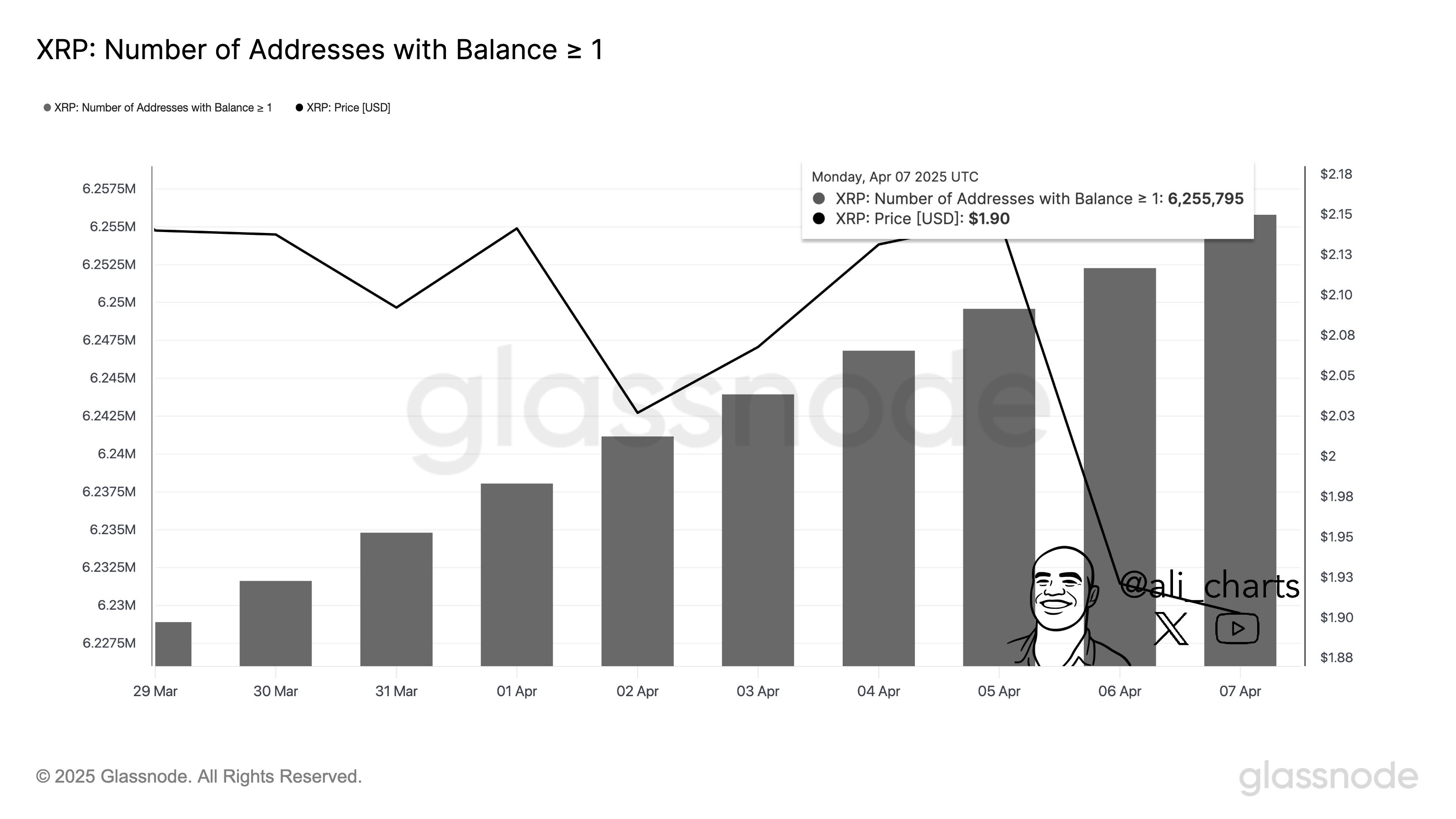
According to on-chain data from Glassnode, the number of XRP addresses holding at least 1 XRP has reached an all-time high of 6,255,795 as of April 7, 2025.

Signs of Strength Amid Dipping Prices

This milestone comes despite XRP’s price dipping from over $2.10 to $1.60 this week. This highlights a divergence between XRP’s short-term market volatility and long-term user adoption.

Market analyst Ali Martinez cited the data as a sign of strength, noting that the XRPL network continues to grow stronger despite recent volatility. The chart he shared shows a steady rise in wallet growth over the past weeks amid long-term holders’ optimism.

Image

Broader Spectrum of XRP Holders

While this data points to a new record in holders of at least 1 XRP, the number of wallets with a non-zero balance of XRP is also maintaining an uptrend.

In particular, data from the XRP Rich List shows that as of the start of the year, the total number of active XRP wallets was around 5.839 million. As of press time, that number has increased to 6.366 million, reflecting an addition of over 527,000 new XRP wallets this year.

Meanwhile, as of January 2024, the figure was 4.9 million, as reported by The Crypto Basic. The current count of non-zero balance XRP addresses indicates that 1.466 million new XRP wallets have joined the network over the past year.

The increase in unique addresses suggests growing interest in XRP from new participants amid speculation around future utility, ETF potential, and continued developments in Ripple’s global partnerships.

While the price faces short-term headwinds, the expanding user base could lay the groundwork for stronger price action in the future, as seen in the last quarter of 2024 leading into the new year.

Santiment chart showing previous correlation in XRP price and wallet growth

The majority of XRP Wallets Are Small Holders

Meanwhile, the majority of XRP wallets belong to small holders. Specifically, 2.639 million addresses hold only 0 to 20 XRP tokens, while another 2.518 million wallets hold between 20 and 500 XRP tokens.

These tiers of investors make up an astonishing 5.125 million wallets, or 81% of the total count of active XRP holders.

Analyst Says XRP Entering Grinding Stage Within Falling Wedge Pattern, Targets $4 Upon Breakout

0

A prominent analyst says XRP is shifting from the boredom phase to the grinding stage within its daily falling wedge pattern.

The market strategist disclosed this in his latest commentary, identifying a falling wedge formation on the daily XRP chart which points to a potential bullish reversal. 

In his latest analysis, EGRAG noted the transition from what he previously labeled the “boredom phase” into what he now calls the “grinding phase.” Notably, this grinding phase features extended consolidation and repeated tests of lower support levels within the wedge pattern.

XRP Falling Wedge

The falling wedge identified by EGRAG began forming in mid-January 2025, shortly after XRP retraced from its seven-year high of $3.40. This correction laid the foundation for the current pattern, which has persisted for about three months. 

The chart structure features two descending yellow trendlines: the upper line serves as the resistance level, while the lower line acts as critical support. Currently, this support lies near the $1.40 mark, a price level XRP has not yet breached during its correction.

At present, XRP trades around $1.99, locked in a struggle to reclaim and sustain the psychologically significant $2 threshold. Despite this battle, EGRAG believes the token remains within the boundaries of the falling wedge and could continue to experience bearish pressure for the next few months. 

XRP Falling Wedge EGRAG Crypto
XRP Falling Wedge | EGRAG Crypto

His projections suggest that XRP might revisit the lower yellow trendline support multiple times during this consolidation period. However, he believes the altcoin will repeatedly respect this support, eventually leading to an upward breakout.

Notably, he emphasized the importance of maintaining the structural integrity of the wedge. According to him, if XRP loses the yellow trendline support, this will severely compromise the bullish thesis, suggesting a breakdown could significantly derail the outlook.

However, he remains optimistic that XRP will continue respecting this level and ultimately complete the wedge formation.

XRP Paths Point to $4 Upon Breakout

EGRAG outlines two potential paths for XRP within the wedge. One path, highlighted in yellow on the chart, suggests a prolonged consolidation phase before an eventual upward breakout.

Meanwhile, the other, in blue, indicates a steeper but shorter-term descent that could expedite the breakout process. Despite the differences in trajectory, both paths converge toward the same bullish outcome: a breakout that propels XRP to a price target of $4.

According to EGRAG’s projections, the breakout may not occur immediately. The current grinding phase could stretch across several more months, especially if XRP follows the yellow path. This would mean an extended period of subdued price action and oscillation below the $2 mark. 

However, should the blue trajectory play out, the breakout could come a month sooner, allowing XRP to reach the $4 target more quickly. With XRP currently trading for $1.99, the asset is down 2.8% this morning. This comes after an impressive 14.2% intraday spike yesterday.