Home Blog Page 82

Cardano Active Addresses and Social Dominance Increase

0

The Cardano ecosystem is attracting renewed attention even as ADA continues to hover near its weakest price levels in years. 

While prices remain under pressure, fresh on-chain data shows that Cardano user activity and community discussion have accelerated. Intelligence platform Santiment highlighted this in an X post, pointing out that this setup has previously preceded short-term price recoveries.

Network Activity Climbs as Attention Returns

The recent Santiment network metrics analysis indicates that daily active addresses have climbed to approximately 29,025. At the same time, Cardano’s share of overall cryptocurrency discussions has risen to around 0.33%. 

Cardano On-Chain Activity and Social Discussion Spike/Santiment

Interestingly, the increase marks the second major spike in both indicators this month, despite ADA remaining close to price levels last seen in December 2020. The asset trades at $0.144, as persistent weakness has ensured that prices continue to lose key support levels.

The latest data shows that more users are interacting with the Cardano network even as sentiment across the broader market remains cautious. Notably, the sharp increase in both active addresses and social dominance have appeared amid the heightened uncertainty surrounding the ADA ecosystem.

It comes after several weeks of intense governance debates, treasury funding disagreements, and recent comments from Cardano founder Charles Hoskinson. While they are negative and have driven FUD, these debates have brought the project back into focus.

What Played Out Around Cardano Treasury Funding

In May, the Cardano Foundation’s request for 7.8 million ADA to fund the yearly flagship summit in Singapore did not pass. The proposal received 65.21% of all votes, below the 66.67% stake-weight threshold for approval. This led the Foundation to cancel the convention for this year.

Another request from a major Cardano stakeholder also stalled. The Input Output Global (IOG) requested 32.9 million ADA in funding for research, network scaling, and upgrades around quantum resistance. While some passed, Cardano DReps cast an abstention vote on others, calling them unnecessary treasury spending.

Hoskinson criticized this move, claiming that such decisions set Cardano backwards and it risks losing its core science roots. As the argument escalated, he disclosed that he is stepping away from the network for a while and warned that more native projects could fail this year.

Previous Spikes Preceded Relief Moves

The current combination of rising on-chain activity and elevated social engagement has appeared twice before in recent months. In both cases, ADA experienced modest relief rallies shortly after these indicators reached similar levels.

For context, Cardano experienced mild growth in April as the social dominance rose close to 0.43% and active addresses climbed above 21,700. A similar scenario played out in early June when the governance debate was at its peak. Daily active addresses spiked above 30,000 and social dominance above 0.33%, with price rebounding 28%.

Notably, that pattern does not guarantee the same outcome this time, but it suggests that periods of extreme pessimism have previously coincided with renewed buying interest after heavy selling.

David Schwartz’s 1988 Patent Has Nothing to Do With XRP, Former Ripple Director Says

A post in the XRP community has claimed XRP was created in 1988, far ahead of Bitcoin. 

The post cited a U.S. patent filed by Ripple’s former Chief Technology Officer, David Schwartz, years before Bitcoin existed. However, former Ripple director Matt Hamilton and XRPL validator Vet rejected the claim. They said the patent has no connection to XRP or blockchain technology.

Patent Is Unrelated to XRP

The discussion began after X user “Crypto Dyl News” shared an image of U.S. Patent No. 5,025,369. The patent was originally filed in 1988 by David Schwartz for a distributed computer system. The post claimed the patent proved XRP existed before Bitcoin and described XRP as “the oldest digital asset.”

Meanwhile, ex-Ripple developer Matt Hamilton dismissed the claim, saying the patent has nothing to do with XRP. He stressed that Bitcoin predates XRP and that the patent does not represent the origins of either the XRP Ledger or the XRP cryptocurrency.

XRPL Validator Explains the Difference

XRPL validator Vet also challenged the viral claim. He explained that the 1988 patent focuses on distributed computing, not distributed ledger technology.

Notably, the invention describes methods for distributing computational tasks across multiple computers. That is fundamentally different from blockchain networks, which rely on consensus mechanisms and shared ledger states.

Vet added that XRP was created much later and “definitely after Bitcoin.”

More Technical Context

Several other community members echoed the clarification. Jamie Williamson said the 1988 patent reflected David Schwartz’s early work in distributed computing. He noted that it predates the emergence of tokenized ledgers by decades.

Jeremy Bouchard also made a similar point. He said the patent discusses distributed processing but does not include the defining features of modern distributed ledger technology. These include cryptographic consensus, an append-only ledger, and synchronized ledger replication across network participants.

Together, the responses emphasized that while Schwartz contributed to distributed computing research long before blockchain became mainstream, those innovations should not be mistaken for the creation of XRP or the XRP Ledger.

Community Reactions
Community Reactions

XRP Price Frustration Returns

Meanwhile, the debate also sparked discussion about XRP’s market performance. One commenter shifted the conversation away from the patent controversy. The user remarked that, more than three decades after the 1988 patent, XRP is still priced “like a stablecoin.”

The comment expressed frustration that the token has struggled to deliver sustained price gains despite Ripple’s technological progress and expanding ecosystem.

Notably, XRP has lost 21% of its value over the past month and lost 43% since the start of the year. However, this decline is not unique to XRP, as the overall crypto industry is in a bear market.

XRP Whale Suffers $28,000,000 Liquidation as Token Slides Toward $1

0

A major XRP whale has suffered one of the largest XRP liquidations in recent weeks after the token plunged toward $1.00.

Data from Hyperbot shows that the whale, identified by wallet address 0xf79, lost $28.2 million in XRP long positions as a broader market sell-off pushed prices below key liquidation thresholds. The trader also suffered liquidation on a separate Bitcoin position, bringing total forced liquidations to approximately $75 million.

Whale Positioned Aggressively for an XRP Recovery

The trader began building XRP long positions on June 23 through Hyperliquid when XRP traded around $1.11 per token. Instead of opening a single large trade, the whale spread exposure across multiple positions while using leverage of around 10x in an apparent attempt to manage risk. 

Trading records reveal two major XRP positions:

  • 5,584,639 XRP with a liquidation price of $1.0194
  • 22,338,560 XRP with a liquidation price of $1.0092

Combined, the positions represented nearly 28 million XRP, valued at more than $28 million before liquidation occurred.

XRP Decline Triggered Consecutive Liquidations

As selling pressure intensified across the market, XRP fell from approximately $1.11 to around $1.0090, placing the asset directly within the whale’s liquidation range. Once XRP reached $1.0194, the exchange automatically closed the first position, liquidating 5.58 million XRP.

However, the decline continued. As XRP slipped further toward $1.0091, the larger position containing 22.33 million XRP also hit its liquidation threshold and was forcibly closed.

At the same time, the trader’s leveraged Bitcoin positions unraveled, resulting in an additional $47.5 million in losses. Consequently, the whale’s total recent liquidation losses climbed to roughly $75 million. 

Whale XRP Liquidation

The latest wave of liquidations pushed the trader’s cumulative losses to an estimated $8.2 million, leaving only about $1.6 million in the account. Notably, the liquidations occurred amid a wider crypto market downturn that triggered heavy losses across leveraged traders.

Crypto Market Records Over $1 Billion in Liquidations

Over the last 24 hours, the crypto market recorded more than $1.07 billion in liquidations. Long positions accounted for $842 million of those losses, while short positions represented about $223 million.

XRP alone contributed nearly $43.96 million in liquidated positions. Of that figure, $43.12 million came from longs, while short liquidations totaled approximately $841,900.

Total Crypto Liquidations

Despite the heavy liquidations, XRP has staged a modest rebound. The token has climbed back to approximately $1.03 and is currently up 4.71% over the past 24 hours, suggesting buyers have begun stepping back into the market following the sharp sell-off.

XRP Perpetual-Spot Volume Imbalance Drops Toward Neutral

0

The XRP Perpetual-Spot Volume Imbalance has dropped toward a reading near neutral, and this could impact how the XRP price moves in the near term.

XRP has collapsed 43% since the beginning of the year, as the downtrend that began in Q4 2025 lingers. Prices recently fell to $1.02, bringing the token back to the important psychological support level at $1.

The ongoing downtrend has led to several sharp sell-offs throughout 2026. However, the latest market data suggests that extreme price swings may not occur in the near term. Specifically, Binance’s Perpetual-Spot Volume Imbalance indicator shows that market activity has moved toward a more neutral state.

XRP Volume Imbalance Data Indicates More Balanced Conditions

The data confirms that perpetual futures continue to account for a large share of market activity. However, current readings show that speculative trading has cooled compared to earlier months.

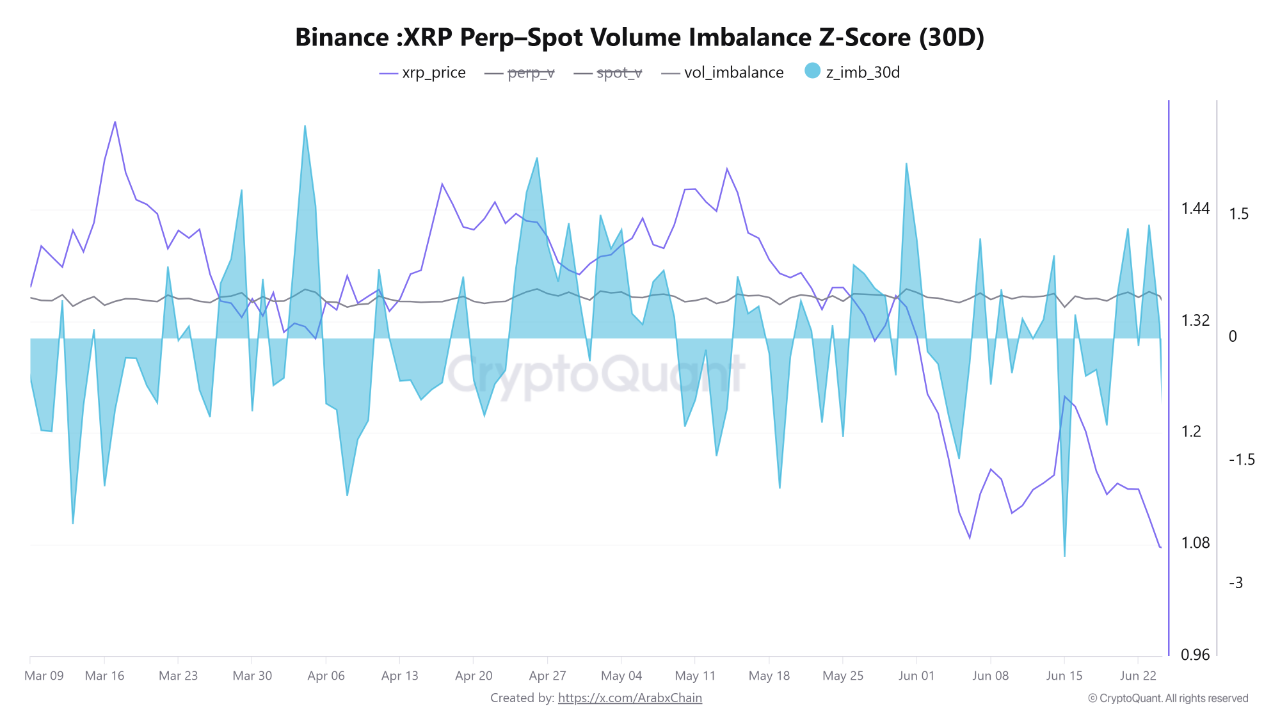
For the uninitiated, Binance’s Volume Imbalance indicator measures the difference between trading volumes in the perpetual futures market and the spot market. According to the latest figures, the Volume Imbalance currently stands at about 0.51, while the 30-day Z-Score is around 0.17.

These figures show that although perpetual trading remains stronger than spot trading, the gap between the two markets is still within the normal range seen over the past month.

The indicator has fluctuated between positive and negative levels in recent months as investor interest in derivatives changed. During XRP’s price rallies in April and May, perpetual trading volumes rose massively, widening the difference between futures and spot market activity on several occasions.

The XRP Perp-Spot Imbalance

Meanwhile, as XRP later entered a downtrend and speculative activity slowed, the imbalance gradually narrowed. This brought the 30-day Z-Score back closer to zero and shows a more balanced market environment.

Neutral Z-Score Could Reduce Volatility Risks for XRP 

Also, the 30-day Z-Score having a reading close to zero means that the present level of perpetual market dominance is still in line with the average activity recorded during the past 30 days. In other words, XRP’s derivatives trading remains active, but it is not unusually high.

This suggests that the market is not experiencing excessive speculation. For context, such excessive speculation tends to increase the risk of sudden price swings and large liquidation events. Since leveraged positions do not appear overly crowded, the chances of sharp moves caused by forced liquidations may remain lower for now.

However, the data does not indicate that trader interest is falling. Notably, market participants continue to stay active, indicating that investors remain engaged with XRP despite its prolonged decline.

XRP Could Drop to $0.8 Before a Recovery

Meanwhile, some market analysts believe XRP could still move lower before finding a bottom. For instance, Celal Küçüker recently revisited a chart scenario that he sees as one of the most likely outcomes. Notably, he expects XRP to bottom between $0.86 and $0.87.

According to him, this projection aligns with a broader Bitcoin scenario that could see BTC decline to around $54,000. Küçüker also believes XRP could eventually rise to between $8 and $9, representing gains of roughly 10x from current levels.

XRP 1W Chart Celal Kucuker
XRP 1W Chart | Celal Kucuker

Another analyst, Chart Nerd, mentioned historical price behavior involving XRP’s two-week 200 Exponential Moving Average (EMA). He noted that during the 2022 bear market, XRP fell 23% below its 2-week 200 EMA before finally reaching a market bottom.

In 2026, XRP’s 2-week 200 EMA currently sits near $1.02, close to the asset’s present trading price. Based on the previous cycle, Chart Nerd suggested that XRP could still experience one final decline in the coming weeks, potentially falling to around $0.80 before completing its bottoming process.

Dogecoin Now in a Critical Situation as 9-Year Support Breaks for First Time in History

0

Dogecoin may have entered a critical situation amid the current downturn, as the price breaks below a long-term support trendline for the first time since 2017.

Dogecoin, the largest meme coin by market cap, has struggled since Q4 2025, when the ongoing downtrend began. After collapsing by 62.8% last year, 2025, DOGE has extended its losses with a 34.4% drop this year so far, having slumped 23% in June 2026 alone. 

Since October 2025, Dogecoin has only recorded one monthly gain, when it rose 15.4% in April 2026. Within this period, it has witnessed seven monthly losses. Amid this downturn, data suggests DOGE is now in a critical situation, as it slips below a long-term support trendline.

Dogecoin’s Crucial Long-Term Support

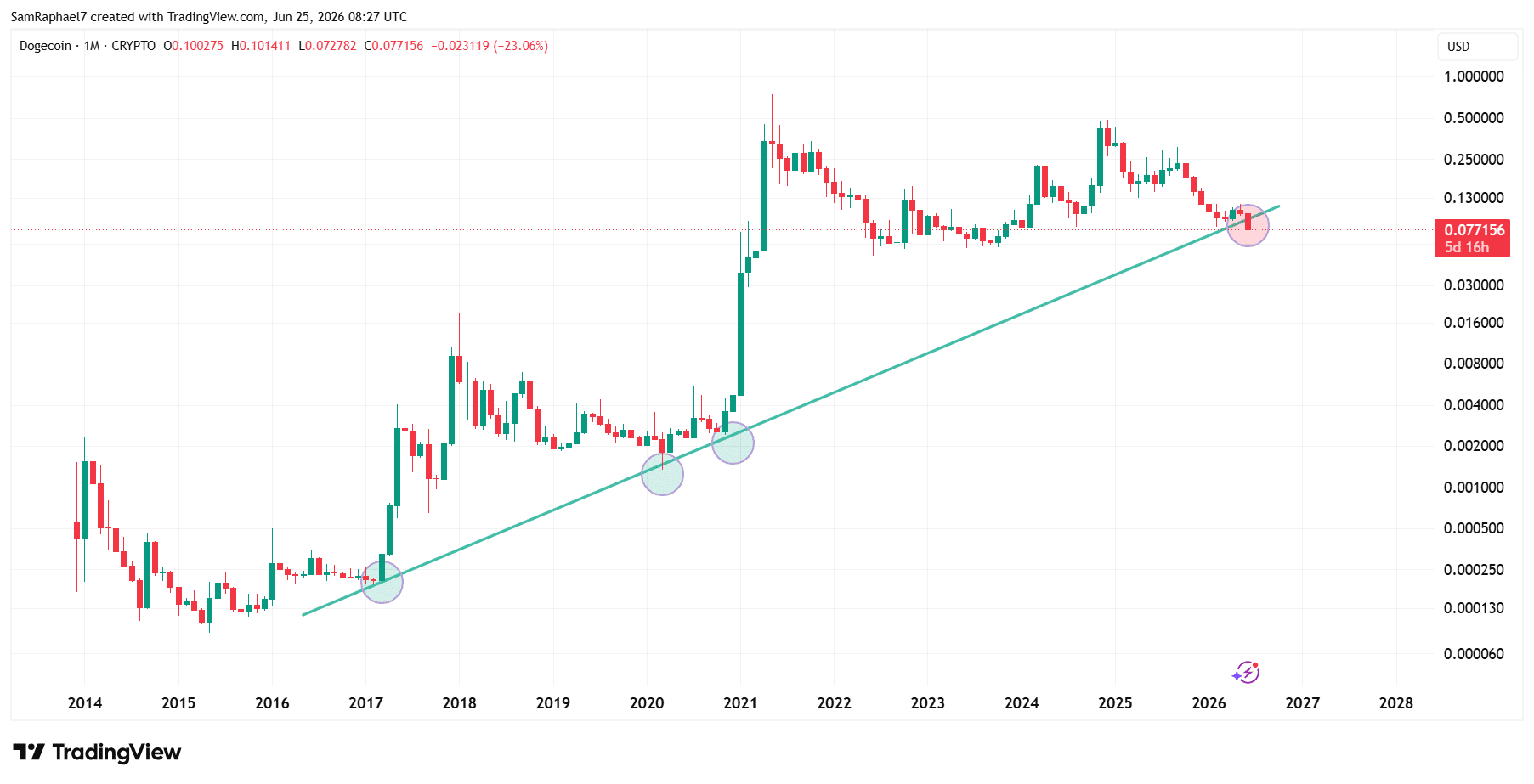
Specifically, data from the 1-month chart shows that Dogecoin features a long-term rising support trendline that has acted as the meme coin’s last line of defense since 2017, cushioning against steeper drops and serving as a launchpad point.

Each time Dogecoin retested this trendline and recovered, it was followed by a remarkable expansion that led to massive gains. 

Dogecoin Rising Support Trendline

For instance, when the DOGE price collapsed to $0.000201 in March 2017, this coincided with a retest of the trendline. From here, the meme coin soared to a high of $0.0187 by January 2018, representing an over 9,200% increase in less than a year.

Dogecoin again retested the trendline twice in 2020, first at $0.001344 in March and then at $0.002400 in November. After it found support here, another rally ensued, pushing the price to the current all-time high of $0.7390 by May 2021. 

Dogecoin Slips Below Crucial Support Trendline

Since reaching $0.7390 in May 2021, Dogecoin has struggled. After soaring to $0.48 on the back of the market-wide upsurge triggered by President Donald Trump’s victory, DOGE pulled back and consolidated until the ongoing downtrend picked up in October 2025.

The meme coin has since continued to collapse, recently retesting the support trendline amid the crash this month. Interestingly, Dogecoin failed to hold above the trendline this time, eventually breaking below it for the first time since 2017. 

DOGE now sits in a critical position, having lost its structural support, as steeper declines could play out from here. If the broader crypto market witnesses another round of selling pressure while Dogecoin remains below this trendline, the meme coin could eventually revisit the early 2021 lows around $0.029.

DOGE Must Reclaim $0.088

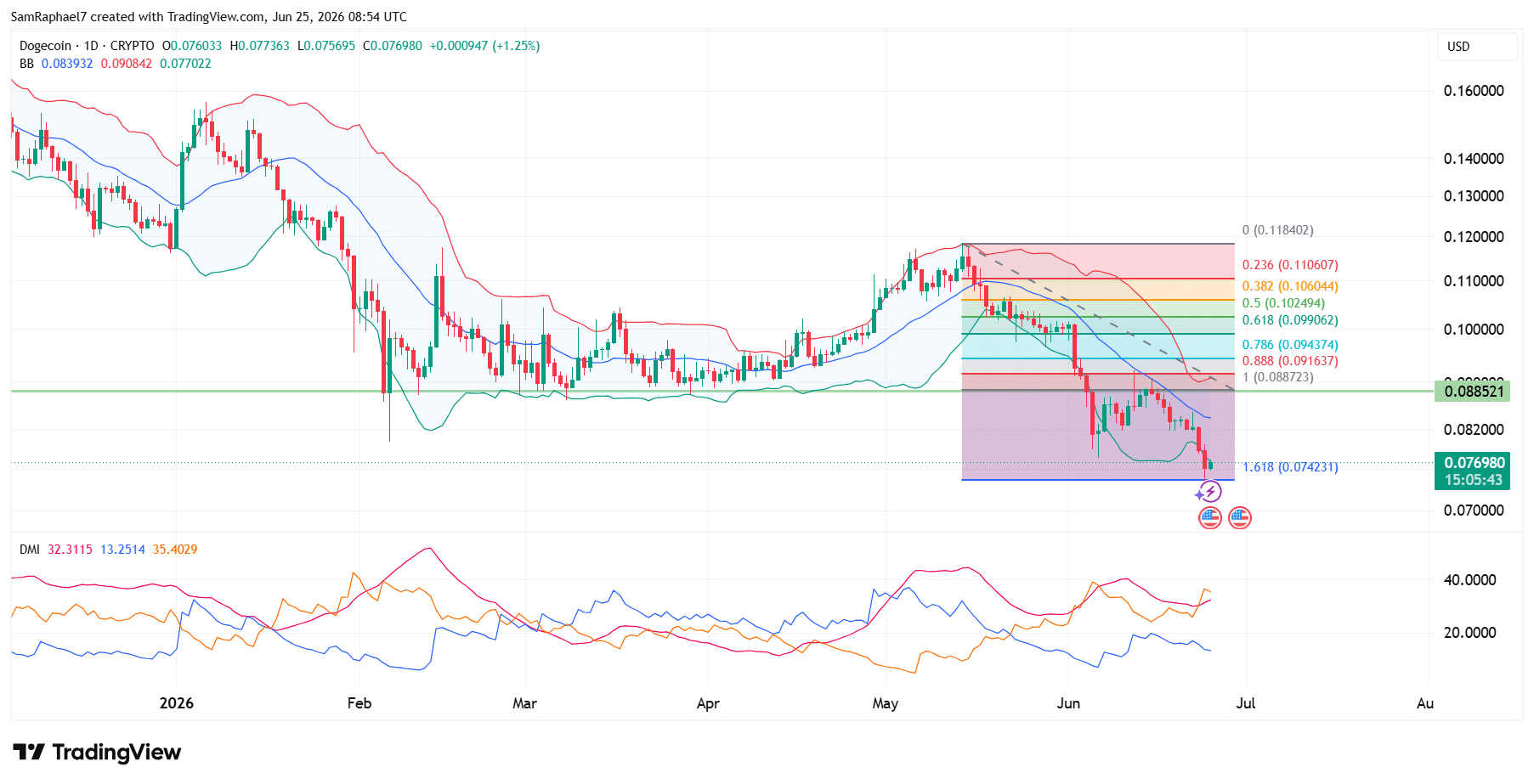
Meanwhile, further data from the daily chart shows that Dogecoin has also lost an important support level around $0.088, which acted as a potent defense during the February 2026 crash. This area also presented a cushion when selling pressure ravaged the market from late February to March.

DOGE Near Term Price Action

DOGE eventually crashed below this support area on June 4. When it attempted to recover above it two weeks later, it faced a roadblock. This confirms that the $0.088 mark, which acted as support from February to March, has now flipped to resistance.

Notably, the price level aligns with the Fibonacci 1 area, confirming its importance. Currently trading for $0.076, if Dogecoin can reclaim the $0.088 area, this could translate to a recovery back above the crucial support trendline on the 1-month chart. However, the asset must first rebound above the middle Bollinger Band at $0.084.

Two Cardano Zones on the Radar Amid Struggles to Find Price Floor

0

Two price levels stand out for Cardano as possible bottom areas, as its price persistently drops below key supports to lower levels.

At press time, Cardano (ADA) trades for $0.148, down 5% this week. Notably, the cryptocurrency has been under sustained pressure since the broader market decline began late last year. 

Since Bitcoin peaked at $126,200 in October 2025, it has dragged altcoins downward with it. Notably, Cardano has been one of the worst-performing large-cap cryptos in the ongoing corrective phase, dropping 85% from its August 2025 high of $1.02.

Meanwhile, the current price action suggests the search for a definitive bottom continues to elude Cardano. With bears still in control, chart analysis has highlighted two major price zones to watch for a possible price floor.

Cardano Falls Below Another Support

On the 4-hour chart, ADA has broken another support level. On Wednesday, it dropped below the $1.48 lower timeframe support as the broader crypto market reacted to Strategy’s MSTR stock dropping below $100.

Cardano dipped to a low of $0.139 before bulls stepped in. Currently, the asset is retesting this support. A daily close below it could confirm the breakdown, which holds bearish implications for the coin.

Notably, this is the second support that ADA is breaching in a few days. On June 23, the altcoin broke below the $0.159-$0.164 support zone, a level that had previously acted as a short-term floor. Cardano entered this range on June 18 and has since consolidated within it before breaking below on Tuesday.

Cardano 4H Chart
Cardano 4H Chart

The persistent support breakdown keeps the prevailing bearish structure intact. When prices continue to break below support areas, it suggests weakness. Further, it opens the door to deeper retracements.

Potential Cardano Bottom Zones

Nonetheless, Cardano has already depleted substantially from prior highs. As such, analysts are closely monitoring where the price could possibly find a durable bottom despite signals that bears are still on top. Based on the current Fibonacci extension structure, two support areas are now attracting attention.

The first sits near $0.136, aligning with the 3.618 Fibonacci extension level. If selling pressure continues, this could become the next area where buyers attempt to slow the decline and form a base. Cardano would have to fall 8.7% to reach this level

Below that, the second major level comes in around $0.127, corresponding with the 4.236 Fibonacci extension. This marks a deeper support zone and would take ADA to the December 2020 lows, where prices rebounded sharply.

Notably, while these levels provide potential areas, there is no confirmation that Cardano would reach its floor there. A separate analysis places the target at $0.10, and another suggests the bottom would happen this month, highlighting the uncertainty due to unstable market conditions.

In the meantime, the trend remains lower, as Cardano has not shown a convincing reversal signal.

Dogecoin Price Outlook: Can DOGE Hold Key Support After Dogechain Shutdown?

The shutdown of Dogechain, a Layer-2 network built around Dogecoin, has renewed discussion around the meme coin’s price outlook.

Users are now rushing to withdraw bridged assets before the network goes offline. While the closure does not affect the Dogecoin blockchain itself, it removes one of the ecosystem’s most visible scaling projects. The development could also weigh on investor sentiment in the near term.

Dogechain Sets 60-Day Withdrawal Deadline

Dogechain has confirmed it will cease operations and has given users about 60 days to bridge or withdraw their assets.

After the deadline, the network and its bridge infrastructure will be permanently shut down. Users who fail to move their funds could lose access to bridged DOGE and other assets held on the network.

The announcement has raised concerns among holders with funds still locked in the Dogechain ecosystem.

Dogecoin Network Continues Uninterrupted

Despite the shutdown, the Dogecoin blockchain remains fully operational. Dogechain was built as a separate Layer-2 network to bring smart contracts and decentralized applications to Dogecoin users. Its closure does not affect the security, functionality, or stability of the main network.

However, the loss of a prominent ecosystem project removes a growth narrative often cited by Dogecoin supporters.

Trading Activity Remains Strong

Dogecoin continues to rank among the most actively traded cryptocurrencies. Major exchanges, including Binance, OKX, Bybit, and MEXC, still record substantial DOGE trading volumes. Specifically, over the past day, DOGE saw trading volume of $1 billion, making it the ninth most-traded asset in the market.

This suggests liquidity remains strong despite the Dogechain shutdown. So, closure of a single ecosystem project does not immediately threaten Dogecoin’s status as the largest meme coin by market capitalization.

DOGE ETFs Struggle to Attract Capital

Notably, several spot Dogecoin ETF products are now available in the United States. These include offerings from Grayscale, 21Shares, and Bitwise.

However, investor demand has remained limited. Net inflows since launch have been relatively small compared with Dogecoin’s overall market value. Specifically, DOGE ETFs have only seen $12.64 million in cumulative inflows since their launch in November 2025. For comparison, during this time, XRP ETFs attracted over $1.4 billion in inflows. 

In other words, DOGE ETFs have expanded access for traditional investors, but meaningful institutional participation has yet to emerge.

Dogecoin ETF Data: SoSoValue

Technical Picture Remains Weak

From a technical standpoint, Dogecoin remains under pressure. DOGE continues to trade below several key moving averages, which is a bearish signal. Momentum indicators are approaching oversold levels, but there is still no confirmed trend reversal.

Traders are closely monitoring support around $0.075 to assess whether buyers can defend the level. Several important price zones to watch include:

  • Support: $0.0712-$0.0754
  • Resistance: $0.0815-$0.0889
  • Bearish breakdown zone: Below $0.0700

A sustained move above resistance could improve market sentiment. Conversely, a break below support may trigger further selling pressure.

Dogecoin Chart| TradingView

Dogecoin Still Leads the Meme Coin Market

Despite ongoing challenges, Dogecoin remains the largest meme cryptocurrency by market capitalization with over $13 billion.

The asset continues to benefit from strong brand recognition, deep liquidity, and a large global community. While newer meme coins offer additional features and ecosystem developments, Dogecoin’s appeal remains rooted in its established market presence and broad retail awareness.

XRP Ledger Validators Issue Warning Over Fake JPYSC Tokens

Members of the XRP community are warning users to be cautious of scam tokens claiming to represent JPYSC on the XRP Ledger.

This comes as Japan’s financial giant, SBI Holdings, officially launched JPYSC, a trust-bank-backed yen stablecoin. The development sparked speculation about whether JPYSC could be issued on XRPL.

Warning Over Fake JPYSC Tokens

XRPL validator Vet (Hussein Zangana) cautioned users that JPYSC has not been publicly announced for issuance on the XRP Ledger. So, any token currently using the JPYSC ticker on XRPL should be treated as suspicious.

The warning comes as scammers may try to exploit excitement surrounding the stablecoin. SBI’s long-standing relationship with Ripple and the XRP ecosystem has fueled expectations that JPYSC could interact with XRPL.

Another XRP community member said they have established monitoring systems to track new trustlines from known SBI addresses. The goal is to identify any legitimate issuance activity if it occurs in the future.

JPYSC Launches Within SBI VC Trade

Notably, JPYSC went live on June 24 as a trust-type yen stablecoin issued by SBI Shinsei Trust Bank and distributed through SBI VC Trade. The stablecoin was developed jointly with Startale Group and is currently available only to SBI VC Trade account holders.

Unlike many stablecoins operating under Japan’s money transfer regulations, JPYSC is structured as a trust-bank-backed electronic payment instrument. SBI says this framework removes the ¥1 million transaction cap that applies to certain payment products. 

For now, JPYSC remains confined to SBI VC Trade accounts. Users cannot withdraw it to external wallets or public blockchains.

SBI Preparing for Public Blockchain Expansion

Although transfers are currently restricted, SBI said the technical and operational groundwork for public blockchain circulation has already been completed.

The company stated that once regulatory requirements and tax frameworks are finalized and approved, it plans to enable domestic and international circulation of JPYSC on public blockchain networks.

SBI did not specify which blockchain networks will support JPYSC after the public rollout. As a result, XRP Ledger supporters continue to speculate about a possible future integration.

Because no network has been officially confirmed, community members are urging users to verify issuer addresses before interacting with any token claiming to represent JPYSC.

SBI Targets On-Chain Finance and Tokenization

SBI described JPYSC as part of an effort to connect traditional finance with blockchain-based markets. The company outlined several planned use cases once public-chain deployment begins, including:

  • On-chain foreign exchange markets involving yen and dollar stablecoins
  • Institutional lending and borrowing
  • Settlement of tokenized real-world assets (RWAs)
  • Retail and merchant payments
  • Cross-border remittances
  • OTC and institutional crypto trading

SBI Chairman and CEO Yoshitaka Kitao said the migration of financial services onto blockchain networks is “irreversible”. He described JPYSC as an important step toward building Japan’s on-chain financial infrastructure.

Meanwhile, Sota Watanabe said preparations for external wallet transfers and public-chain circulation are already complete. According to Watanabe, the remaining obstacles are primarily regulatory and tax-related.

For XRP investors, the launch has attracted attention because of SBI’s close ties to Ripple. However, no official announcement has linked JPYSC to the XRP Ledger so far. 

Ripple’s RLUSD Enters Japan as Electronic Payment Instrument Through SBI Partnership

0

Ripple has announced that, through a collaboration with SBI, the RLUSD stablecoin is now officially available in Japan after gaining regulatory approval.

In a tweet, Ripple revealed that the Japan Financial Services Agency (JFSA) has greenlighted the availability of RLUSD in Japan as a Type 4 Electronic Payment Instrument. The category is intended for foreign-issued stablecoins that meet the regulatory standards required by Japanese law.

RLUSD Enters Japan

Notably, Japan’s crypto scene is one of the most strictly regulated in the world. RLUSD entered the market starting June 24, the announcement stated. This further bolsters the stablecoin’s credibility and commendable regulatory compliance policy.

The launch comes in collaboration with SBI Holdings, a major Japanese financial institution and a long-term Ripple partner. Ripple will offer RLUSD to retail and institutional clients through the VCTRADE platform.

The VCTRADE exchange is a platform run by SBI VC Trade, the crypto arm of the SBI Group. It offers clients select crypto assets like Bitcoin and Ethereum.

RLUSD Live Only on Ethereum

Ripple noted the RLUSD stablecoin will serve as a “bridge for payments, tokenization, and collateral management.” RLUSD is pegged to the US dollar, offering SBI clients and the broader Japanese market stability while moving their assets on-chain compared to traditional digital assets, which experience price changes.

Further details of the launch show that the VCTRADE platform will only accept deposits from RLUSD in Ethereum. For the uninitiated, RLUSD is native to both the XRP Ledger and the Ethereum network, each sharing an almost equal market cap at $792 million.

RLUSD Market Cap on XRP Ledger and Ethereum/RWA.xyz

However, SBI VC Trades only supports RLUSD on Ethereum, with plans to expand its range of supported networks in the future. Additionally, the maximum cap for RLUSD on the platform is $6,200 per transaction, which is roughly 1 million yen.

Excerpt from SBI VC Trade RLUSD Announcement

A $1.7 Billion Asset

According to Ripple, RLUSD has a market cap of $1.7 billion, a feat it achieved since launching in December 2024. The stablecoin achieved this amid the growing demand for “regulated, enterprise-ready” Ripple added.

Despite this, RLUSD accounts for just a small fraction of the broader stablecoin market, which has a valuation exceeding $316 billion, per CoinMarketCap. The Ripple-affiliated stablecoin ranks 8th by market cap, well below Tether’s USDT and Circle’s USDC. The two dominate the sector, with valuations of $186.3 billion and $73.8 billion, respectively.

With RLUSD’s reach further expanded with the Japan launch, whether the large gap in valuation compared to USDT and USDC closes remains to be seen. However, this gives it a fighting chance.

Cardano Founder Sympathizes With SecondFi Victims, Says Some Users May Have Lost All Their ADA

0

Cardano founder Charles Hoskinson expressed sympathy for affected users and acknowledged the emotional toll of the losses.

Speaking during a livestream yesterday, Hoskinson apologized to both the victims and the broader Cardano community over the unfortunate breach at SecondFi (formerly Yoroi Wallet), which resulted in the theft of 16 million ADA.

According to him, many victims may have lost most or all of their ADA holdings, making the financial and emotional consequences severe regardless of the overall value involved. 

Hoskinson Reflects on Previous Crypto Hacks

Hoskinson described the incident as an unfortunate reality of the cryptocurrency industry, noting that security breaches have occurred throughout the sector’s history.

Drawing on more than 15 years of experience in crypto, he said he has witnessed numerous hacks and exploits across multiple blockchain ecosystems.

The Cardano founder also revealed that he personally suffered losses during the August 2022 Nomad Bridge exploit, an incident that caused an estimated $20 million to $30 million in losses for Cardano users.

Although attackers never breached Cardano’s base blockchain during the Nomad Bridge exploit, the incident still affected the ecosystem by disrupting bridge-wrapped assets on Ethereum.

Hoskinson noted that a large portion of the stolen funds was recovered. However, he emphasized that the attack highlighted the persistent risks associated with digital assets.

SecondFi Contains Damage

Meanwhile, the SecondFi breach marks another painful chapter for the Cardano ecosystem.

The team behind the non-custodial neo-finance platform disclosed that attackers stole 16 million ADA from 374 wallets during the incident. In response, the company moved swiftly to prevent additional losses by transferring 129 million ADA to an independent third-party custodian.

SecondFi has since launched a special audit and deployed a security patch to address the vulnerability. The company has also begun a compensation process for affected users while warning customers not to enter their recovery phrases into any other Cardano-related wallets. 

Hoskinson Insists Cardano Remains Secure

Despite the scale of the incident, Hoskinson reassured ADA holders that the breach affects only SecondFi and not the broader Cardano network.

He emphasized that attackers did not hack Cardano itself and reiterated that the incident was an application-specific issue involving SecondFi rather than a failure of the Cardano protocol.

The development comes amid rising concerns within the Cardano ecosystem, fueled by governance disputes, the shutdown of TapTools, and the departure of key contributors. Adding to the pressure, ADA has remained in bearish territory, with the token currently trading at $0.1493, down 95.18% from its previous all-time high of $3.10.