Home Blog Page 892

NYSE Arca Files for a Bitwise Dogecoin ETF with the US SEC

0

Asset manager Bitwise is the latest contender for a Dogecoin ETF after the NYSE Arca submitted a 19b-4 application to the US SEC.

Bitwise, a prominent asset manager with over $12 billion worth of client assets, is officially  moving ahead with its Dogecoin Trust. On Monday, the NYSE Arca, a New York Stock Exchange (NYSE) subsidiary, filed a 19b-4 form with the US Securities and Exchange Commission on behalf of Bitwise.

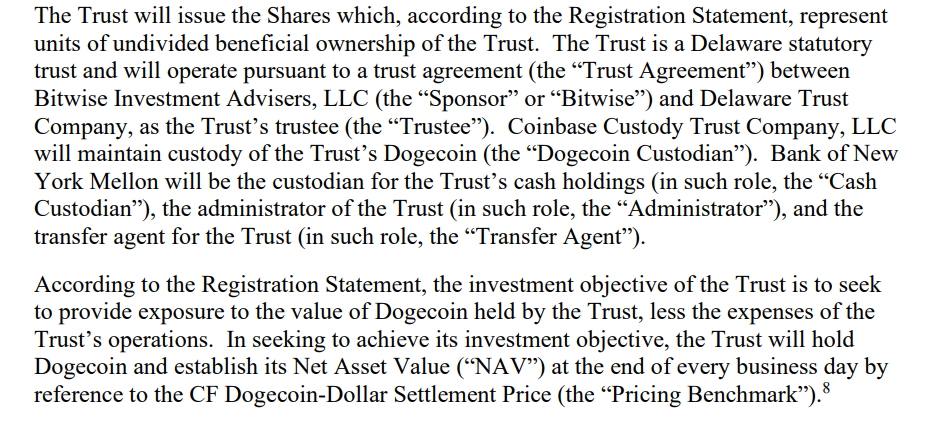
The NYSE Arca submitted the rule change request to list and trade shares of the Bitwise Dogecoin ETF. This traditional investment vehicle would track Dogecoin’s performance using the CF Dogecoin-Dollar Settlement Price as a benchmark and provide alternative exposure to institutions and retailers.
Bitwise Dogecoin ETF

Bitwise Officially Request Rule Change

Bitwise has taken preliminary steps prior to Monday’s filing amid growing institutional demand for Dogecoin, the largest meme coin by market cap. First, the asset manager registered the Bitwise Dogecoin ETF with the CSC Delaware Trust Company.

Then, Bitwise submitted an S-1 filing through NYSE to the US SEC seeking to provide the investment vehicle to its clients. Notably, these two steps, though progressive, do not constitute an official intent for the asset manager’s rule change ploy.

As a result, the NYSE filed the 19b-4 application with the Wall Street securities watchdog on Monday, seeking to list the Bitwise Dogecoin Trust. According to the filing, Coinbase will be the exchange custodian of the Dogecoin Trust, while leading custodian bank BNY Mellon will follow through on cash holdings.

Meanwhile, the NYSE classified the fund as a commodity-based trust share, aligning with the SEC’s disposition toward Dogecoin. Recall that the regulator mentioned earlier that meme coins are not securities and do not fall under its purview.

Dogecoin ETF Gaining Momentum

Interestingly, the Monday filing makes it the third Dogecoin ETF on the SEC’s table. A year ago, asset managers would have deemed such a product far-fetched under the Gary Gensler-led administration.

However, the easing regulatory environment has spurred a barricade of altcoin ETFs with meme coins in the mix. Prominent asset manager Grayscale has filed for and has seen its application for a Dogecoin ETF acknowledged by the US SEC.

Meanwhile, market watchers have grown increasingly confident that the SEC would approve an altcoin spot ETF this year, with the Litecoin, Hedera, and Dogecoin ETFs leading the race.

Bitcoin to $73K Before Final Leg Up to $170K: Analyst Unveils Bold Timeline to Watch

0

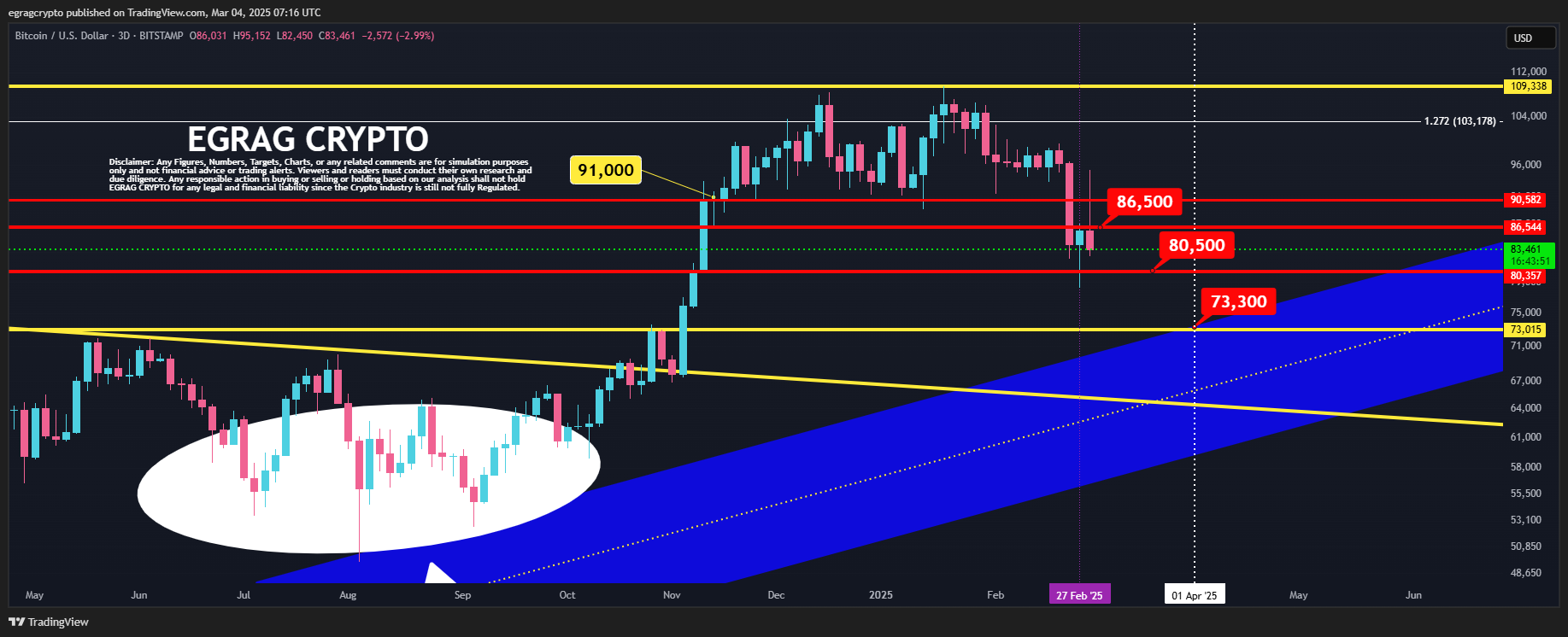
A new projection from crypto analyst EGRAG suggests that Bitcoin (BTC) might tumble to $73,000 before its next major leg up. 

The prognosis, revealed in a recent tweet, underlines important technical signals signaling potential short-term loss before a renewed rise.

Bitcoin Potential Drop to $73K: A Bearish Signal?

On the three-day chart, Bitcoin is presently forming a Bearish Engulfing Candle, per EGRAG. This technical pattern indicates that downward pressure may increase and is frequently seen as a reversal signal.

The analyst notes that Bitcoin may first reach $80,500 before testing $73,000 in the vicinity of this channel in early April, citing the blue channel as a key predictor of the cryptocurrency’s long-term trend.

While acknowledging the dangers of making snap decisions, the tweet stresses how crucial it is to monitor these chart patterns in order to gain insight into Bitcoin’s future. 

A bearish engulfing candle is a technical pattern that traders watch for signs of trend reversals. It develops when a giant bearish candle completely consumes the previous bullish candle. 

Interestingly, this pattern is currently playing out. Over the weekend, Bitcoin took a giant leap from lows at $78,000 to $95,000. However, at press time, Bitcoin is undergoing a major price correction. Its price has crashed significantly from its Sunday peak to as low as $83,100 today. 

Image
Bitcoin chart by Egrag

Market Sentiment and Outlook for 2025

Despite the potential for a short-term decline, EGRAG is optimistic about the general direction of Bitcoin. Following this retracement, the expert predicts that Bitcoin may begin its last leg up, which might result in new all-time highs.

In an earlier commentary, he suggested Bitcoin could rally to $170K after the projected dip. An analyst on Binance also shares this sentiment. He suggested that Bitcoin may touch $185,000 by the end of 2025 and hit $150,000 in the first half of the year. 

Similarly, Tom Lee of Fundstrat previously predicted that Bitcoin would “do better than $150,000 this year,” suggesting a cycle peak beyond $150K

Lee’s earlier estimates indicate that Bitcoin may even reach $200,000–$250,000 in 2025. These long-term goals support the notion that Bitcoin is still in a solid uptrend despite brief declines, even though short-term volatility may push it down to $73,000 before it rises again.

Cardano Founder Rehashes Offer to “Fix Up” Dogecoin for X Payments

0

Cardano founder Charles Hoskinson courts the Dogecoin community again.

When Tesla CEO and Dogecoin champion Elon Musk bought X (then Twitter), Cardano founder Charles Hoskinson was quick to court the doggy-themed memecoin community.

Perhaps in an attempt to front-run speculation of potential integration of the memecoin with the social media network, he offered to make it suitable for payments on the platform, albeit as a Cardano sidechain.

This initial overture devolved after a heated exchange with Dogecoin creator Billy Markus. But Hoskinson appears to be back at it again as Musk’s X payments goal begins to take shape. This time, he has dropped the talk of making the network a Cardano sidechain, at least for now.

Try, Try Again

Cardano founder Charles Hoskinson is courting the Dogecoin community again. 

In a series of X posts on Tuesday, March 4, the Cardano founder has offered to “fix up” the Dogecoin network and make DOGE “the standard currency of X.”

In his most seductive tone yet, Hoskinson teased the Dogecoin community with the potential of being the blockchain rails for X’s AI model Grok and low-cost payments for tipping posts.

“Come on Dogecoin, you know you want a little retrofit. Little bit of sharded useful proof of work to run that expensive Grok. Some state channels for ultra low cost payments for tipping X posts. Some full secure smart contracts running on eutxo,” the Cardano founder wrote, adding a GIF with the caption, “I can fix that.”

To sweeten the deal, Hoskinson noted that he would even “throw in some quantum resistance,” adding, “Just tell me how you like it (hashes or lattices).”

“Dogey Style”

Unlike the last time, Hoskinson’s Dogecoin advances have not sparked a heated exchange. Far from it, the Dogecoin team has offered the Cardano founder a chance to woo the community formally.

Responding to Hoskinson, the official Dogecoin X account quipped that the only way the Cardano founder could advance his cause was “Dogey style,” referring to a community-led effort. As such, the team welcomed him to present his proposal to network operators.

X Payments on the Horizon

Hoskinson’s latest effort to court the Dogecoin community over a potential integration with X comes as the platform has disclosed that its payments service will launch later this year, unveiling Visa as its first partner in January.

Despite the speculation over the years, X has not disclosed any interest in using crypto or DOGE in this financial service vertical. However, this could have been due to the U.S.’s uncertain crypto regulatory landscape, which the pro-crypto President Donald Trump administration looks set to change.

The Dogecoin community has long fantasized about a potential X integration amid the potential to revolutionize adoption, which could bolster the asset’s price.

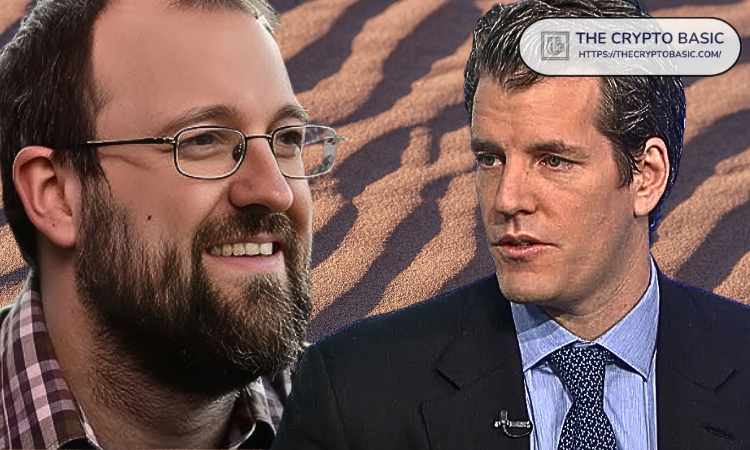
Cardano Founder Challenges Gemini’s Winklevoss Over US Crypto Reserve Asset Selection Criteria

0

Cardano founder Charles Hoskinson has called out critics for failing to define the benchmark for selecting cryptocurrencies for the U.S. digital asset reserve.

The crypto community has had mixed reactions since former U.S. President Donald Trump announced plans to move forward with the country’s strategic crypto reserve.

Interestingly, Trump opted for a multi-asset reserve, indicating that the initiative will support five cryptos: ADA, XRP, BTC, SOL, and ETH. 

Tyler Winklevoss Disagrees With Multi-asset Reserve

While most crypto enthusiasts commended the initiative, others frowned at the government’s decision to include XRP, ADA, ETH, and SOL in the reserve. Notably, Tyler Winklevoss, the co-founder of Gemini, emphasized that these altcoins are unsuitable for a digital asset reserve. 

He opined that a potential reserve asset must function like ‘hard money’ and be a store of value akin to gold. According to him, Bitcoin is the only asset that meets this standard.

Additionally, Tyler stressed that even though Gemini supports the trading of most crypto assets named in the reserve, he believes they do not meet the criteria for inclusion in the reserve. 

In response, Cardano founder Hoskinson emphasized that most critics have not explicitly defined the criteria for what constitutes hard money or qualifies for inclusion in the U.S. crypto reserve. 

This suggests that while most critics like Tyler demand a high standard, no explicitly defined benchmark for selection has been agreed upon. 

Hoskinson Defending Trump’s Crypto Reserve Decision 

Hoskinson has been defending Trump’s decision to include altcoins, like ADA and XRP, in the reserve. As previously reported, he schooled crypto skeptic Peter Schiff on why Trump supported XRP for the initiative. 

According to him, Trump named XRP as part of the U.S. crypto reserve due to its technology, community support, and resilience. He also urged the altcoin community to educate Bitcoin proponents and other critics who spread false narratives about the assets included in the reserve.

Notably, Eli Nagar, the CEO of Bitcoin mining company Braiins, noted that the U.S. government wants to spend taxpayers’ money on altcoins, which he labeled ‘sh**coin.’ 

Nagar claimed that Ripple can dump XRP anytime because it controls the supply. At the same time, he argued that Solana’s network is unstable, alleging that insiders hold most of the SOL. 

The Bitcoin proponent added that the Cardano team influences the ecosystem’s decisions, not users. For Ethereum, Nagar claimed that the network can be easily censored. 

In response, Hoskinson described these claims as completely false and called on his followers to educate Nagar and dispel these misconceptions.

Cardano Community Urges Gemini to List ADA

Meanwhile, Gemini has yet to list ADA for trading. Following the inclusion of ADA among the supported crypto reserve assets, the Cardano community, including Hoskinson, called on the exchange to list the coin as it now has the backing of the United States government. However, Gemini has not responded to this growing demand. 

Arthur Hayes Remains Bullish on Bitcoin, Predicts $70K as Worst-Case Bottom

0

Renowned crypto analyst and former BitMEX CEO Arthur Hayes has reiterated his optimistic view on Bitcoin (BTC), saying that the current bull cycle is still in place. 

The falling U.S. Treasury General Account (TGA) is a crucial sign of growing liquidity in financial markets, which Hayes said will help Bitcoin’s upward trend in a recent essay.

Bitcoin Worst-Case Scenario: $70,000 Bottom

Amid the ongoing bearish market, Hayes stressed that Bitcoin’s worst-case scenario would be a retest of the previous cycle’s all-time high at $70,000. Notably, the price of Bitcoin has plummeted by 10%, revisiting lows at $83K.

His assurance is based on his conviction that riskier assets like Bitcoin will profit from the U.S. government’s diminishing cash reserves, which will indirectly inject liquidity into financial markets. 

Hayes’ study supports his previous predictions, in which he states that rising dollar liquidity would cause the market to peak in March 2025. Traders who keep a careful eye on the macroeconomic variables affecting the price movement of Bitcoin will find resonance in this viewpoint.

Despite his optimism, his approach is still cautious. Hayes said he would be “nibbling on dips” rather than utilizing leverage, implying a methodical strategy for building up Bitcoin amid pullbacks. His strategy reflects an institutional trend in which large investors choose spot purchases over leveraged wagers.

BTC Position and Institutional Confidence

At press time, Bitcoin trades at $83,219, threatening to breach lower levels amid the market-wide sell-off. It continues to be the most popular cryptocurrency, with a current market value of $1.73 trillion.

An article by TheCryptoBasic recently highlighted Fundstrat’s Tom Lee predicting that Bitcoin could surpass $150,000 in 2025, citing increasing institutional adoption. Despite Bitcoin’s February price dip, Lee remains confident that the asset is still on track for major gains.

Lee’s outlook aligns with other analysts, including Bitwise and Standard Chartered, who foresee Bitcoin reaching $200,000 this year.

FTX Unloads 3.03M Solana Worth $432.5M as Customer Repayment Gains Momentum

0

The defunct crypto exchange FTX has unstaked and unloaded millions of Solana into multiple wallets as customer repayment gains momentum.

Solana has corrected a staggering 17% in the past 24 hours, the largest among crypto assets in the top 7 ranking by market cap. Although this follows a broader market sideways trend, FTX’s on-chain activity may have contributed to this capitulation.

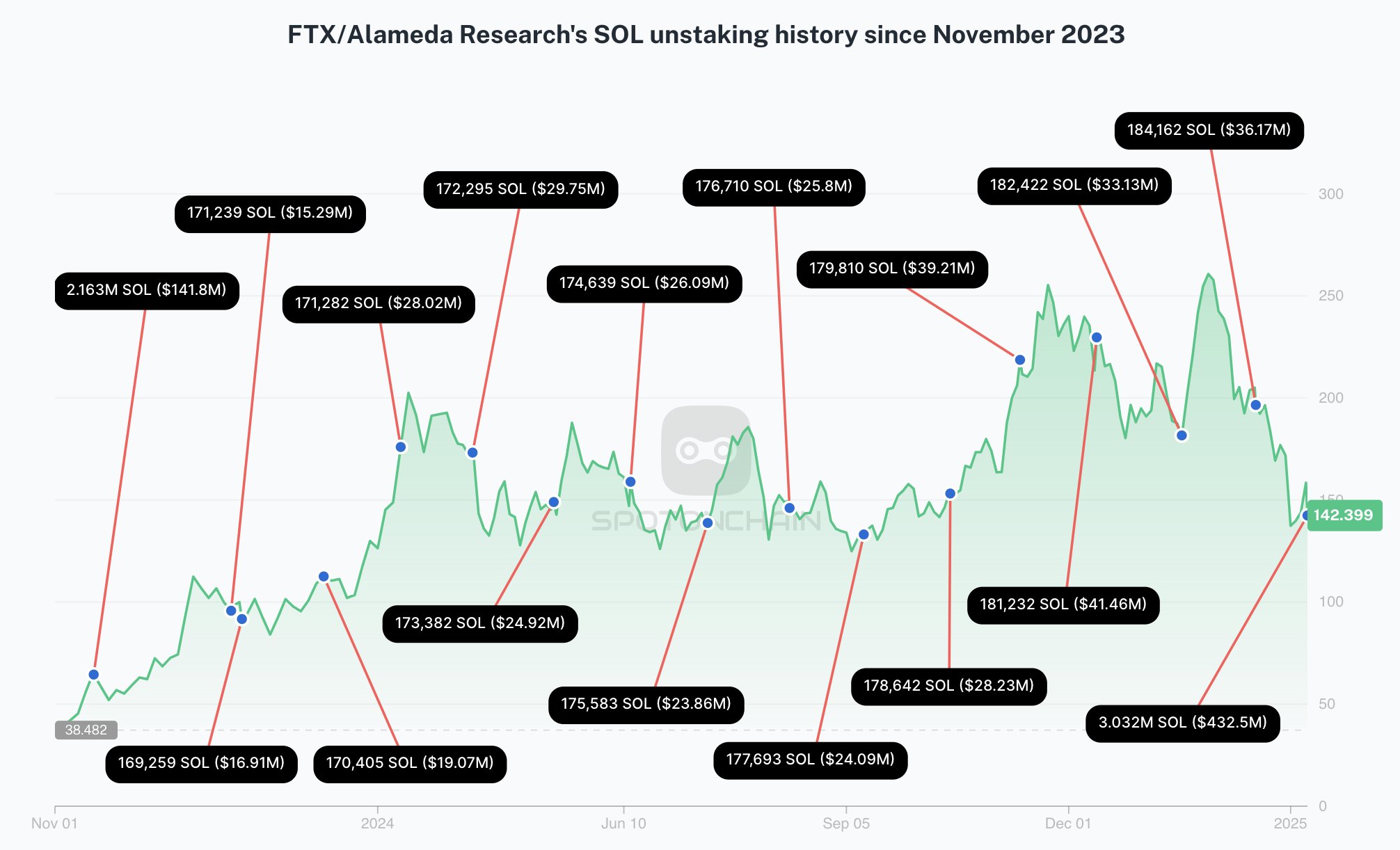
Data from the on-chain analytical firm Spot On Chain shows that the insolvent FTX unloaded a substantial amount of Solana late Monday. Specifically, an address FTX/Alameda leverages for staking activities has unlocked 3.03 million SOL ($432.5 million) and shifted them to multiple wallets.

Defunct Exchange Piles on to Solana’s Circulating Supply

Spot On Chain confirmed the recent transaction. The wallet unstaked the tokens and moved them to about 37 different addresses for a possible shift to exchanges Coinbase and Binance.

Further analysis shows that among the recipient wallets, address “CVjsf5” received the most SOL. FTX transferred 892,800 SOL, worth $127.8 million, to the wallet, which has a history of moving received Solana to the crypto exchange Coinbase.

Meanwhile, the recent on-chain activity follows the FTX bankruptcy estate’s disclosure that it would unlock 11.2 million SOL in March. The unlocked Solana was for companies that bought the asset at an auction after the US-based exchange’s November 2022 demise.

Notably, the bankruptcy estate would use proceeds from the sales to repay customers affected by its insolvency over two years ago. The exchange began repaying users under $50,000 in mid-February and has paid over $1.2 billion thus far.

FTX Unstakes 7.83M SOL ($986M) Since 2023

The Solana ecosystem was FTX’s business partner while it was operational, ensuring the exchange stacked large amounts of the token. Following its bankruptcy, the Sam Bankman-Fried-owned trading platform has taken to incessantly dumping SOL in its ploy of making creditors whole.

Spot On Chain highlighted that the exchange has unstaked 7.83 million SOL ($986 million) at an average price of $125.8 per coin. Notably, this substantial amount of Solana has ended up in exchanges like Coinbase and Binance.


FTX/Alameda Unstake HistoryMeanwhile, while SOL has responded negatively in the short term to these incessant unlocks, the asset has shown resilience. The sixth-largest cryptocurrency by market cap recently surged to an all-time high of $295 on January 19 amid a broader market bullish momentum.

In the meantime, Solana trades at $136.23, down 28% year-to-date.

Shiba Inu Team Suggests BONE Could Follow Cardano and XRP Path to Growth

0

Shiba Inu content marketer Lucie has given community members assurance about the long-term prospects of BONE, drawing from XRP and Cardano.

Amid the Shibarium gas token’s underperformance and low adoption, Lucie encouraged investors to exercise patience in her tweet. She compared BONE to Cardano (ADA) and XRP, which saw extended periods of stagnation before experiencing significant growth.

Historical Path of Cardano and XRP

Lucie’s remark draws attention to a significant historical trend in cryptocurrency markets: early-stage cryptocurrencies frequently endure protracted flat trading periods before gaining widespread acceptance and seeing price spikes.

Notably, Cardano debuted in 2017 with a $600 million market valuation and a token price of $0.02. However, data from market tracking resources shows ADA’s market capitalization has increased to $23.427 billion today, indicating its long-term growth despite early stalling.

Likewise, XRP began trading around $0.10 per token in 2012, but it experienced drops in the years that followed before rising again in 2014. At some point, XRP’s price reached a historic low of $0.002802.

Meanwhile, its current price of $2.34 and market capitalization of $135.71 billion demonstrate its long-term growth despite early stagnation. 

Instead of focusing solely on short-term price movements, these examples serve as case studies for long-term holders who believe in a project’s fundamentals.

BONE’s Current Position and Future Outlook

With a market valuation of $63.39 million and a 24-hour trading volume of $5.96 million, BONE is trading at $0.2536 as of today. In the last 24 hours, the token has declined by 9.83%. Over the past week, it has dropped 6.69%.

Despite recent setbacks, Shibarium’s expanding adoption could serve as a catalyst for future growth.

Although opinions are still divided, Lucie emphasizes that investors in solid cryptocurrency projects have traditionally benefited from patience. Long-term holders of BONE may benefit greatly if it takes a similar course to that of Cardano or XRP. 

Lucie’s analogy aligns with a common cryptocurrency strategy: identifying undervalued assets with strong fundamentals before they gain widespread use. While it’s uncertain if BONE will replicate this success, history suggests that long-term perseverance can be rewarding.

This reinforces Lucie’s belief that sustained patience with Shiba Inu ecosystem tokens like BONE could yield significant rewards.

Saylor Changes Stance on XRP and Cardano, Says Their Inclusion in US Reserve Ploy Bullish for Bitcoin and Crypto

0

Strategy chairman Michael Saylor has taken a unique stand on US President Donald Trump’s addition of XRP and Cardano to the national crypto reserve proposition.

In an interview with CNBC yesterday, the Bitcoin maximalist surprisingly nodded to a non-Bitcoin-only US crypto reserve. Despite repeatedly preaching that there is no second-best asset after the flagship crypto asset, he describes the adoption as bullish for Bitcoin and the entire US crypto industry.

Saylor Backs XRP and Cardano Addition

On Sunday, Trump announced for the first time that the national crypto stockpile, once a solely Bitcoin game, would include four other assets. He confirmed growing speculations of a made-in-America crypto reserve, adding Ethereum, XRP, Solana, and Cardano to the assets in the reserve.

Meanwhile, Saylor has suggested that Trump’s adoption of a liberal economic policy for digital assets is bullish for Bitcoin regardless. The Strategy executive chairman insisted that what mattered the most was America’s progressive policies towards adopting digital assets, which he speculated would be worth $100 trillion to the country.

It bears mentioning that Saylor’s approval of a multi-coin reserve goes against his initial stance on other digital assets. For context, he once called XRP an unregistered security and lauded the US Securities and Exchange Commission’s (SEC) clampdown on the asset and other altcoins.

However, his changing tone might reflect a sudden realization of XRP’s roles in the US crypto sector. Nonetheless, this narrative remains speculative.

Widespread Criticism of a Multi-Coin Reserve

Despite the bullish momentum that emanated from the announcement, key industry leaders still feel that pairing Bitcoin with altcoins in the national reserve is futile. Notably, most of the backlash hinges on the purported centralized nature of the other assets, particularly because they have issuers.

For context, Gemini co-founder Tyler Winklevoss argued yesterday that XRP, Solana, and Cardano do not meet the requirements of a crypto strategic reserve. According to him, Bitcoin is the only asset that is suitable for such a massive enterprise at the moment.

Furthermore, crypto critic Peter Schiff acknowledged Bitcoin’s digital gold properties on a rare occasion but questioned XRP’s inclusion in the US crypto reserve proposal. Meanwhile, Cardano founder Charles Hoskinson has since responded to Schiff’s roar.

Ripple V SEC: Former White House Official Says SEC Has Dropped Ripple Case

0

Anthony Scaramucci, a former White House Director of Communications, suggests that the SEC has dropped its case against Ripple. 

Scaramucci made this bold assertion during a recent Wolf of All Streets podcast interview. During the interview, Scaramucci and the podcast host, Scott Melker, talked about Donald Trump’s pro-crypto plans as well as the regulatory framework of the industry. 

SEC Drops Ripple Lawsuit? 

They also discussed other events, particularly the SEC’s decision to drop its case against crypto-related businesses. Notably, Melker highlighted some of the legal actions the SEC has dropped, which include ConsenSys, Gemini, Uniswap, Coinbase, and Robinhood. 

However, Scaramuci interjected, suggesting he should add Ripple to the list. In response, Melker echoed, “Yeah, that’s right,” implying that the SEC may have dropped the Ripple lawsuit. 

Despite this claim, the SEC has yet to officially announce its decision on the Ripple lawsuit, as the case continues to linger in the Court of Appeals for the Second Circuit. 

This comes as the SEC pauses and dismisses cases against top crypto businesses, including Binance and Kraken. Even though the SEC charged Ripple as early as December 2020, the case is still ongoing. 

Only Factor Delaying Ripple Case

Legal experts suggest that the July 2023 ruling complicates the SEC’s ability to dismiss the Ripple lawsuit. It should be recalled that the Judge ruled that Ripple’s programmatic sales and other distributions of XRP were not securities. However, she found that Ripple violated the law through its initial sales to institutional investors. 

The following year, the Judge slammed a $125 million fine against Ripple for this violation and subsequently imposed an injunction that prevented the company from selling to institutional investors without the SEC’s consent. 

In a recent X thread, Attorney Jeremy Hogan, a Partner at Hogan & Hogan law firm, identified the injunction as the major reason why the SEC has yet to drop the appeal. He emphasized the difficulty in overturning the appeal, noting that such an action could extend the case to April or May 2025. 

He dismissed the possibility of Ripple overturning the appeal through Rule 60 of the Federal Rules of Civil Procedure. According to him, the only way Ripple can overturn this judgment is to collaborate with the SEC to submit a “carefully worded motion.” 

Here’s Why Selling XRP Now Is Like Selling Shares of Berkshire Hathaway in Its Early Days

A bold comparison is making waves in the crypto space, suggesting that selling XRP now could be like selling Berkshire Hathaway shares before the company became a financial powerhouse.

Wealth mentor Linda Jones recently shared this perspective, likening XRP’s current stage to the early days of Warren Buffett’s Berkshire Hathaway. She emphasized that XRP is not just another speculative asset but a digital currency with a strong use case in cross-border payments.

“XRP is not a meme coin. It’s not just another crypto,” Jones asserted. She urged investors to exercise patience amid temporary price fluctuations. According to her, selling now would be akin to missing out on the massive returns Berkshire Hathaway shareholders eventually enjoyed.

XRP Growth Trajectory and Market Sentiment

XRP has faced years of price swings, regulatory challenges, and fluctuating investor sentiment. However, recent market trends indicate growing optimism.

The token is currently trading at $2.20, marking a 350% gain in six months. Amid this surge, XRP remains 34% below its all-time high, leaving room for further appreciation.

Jones believes that XRP’s fundamental role in global finance could lead to exponential growth, much like how Berkshire Hathaway’s value unfolded over time. She has suggested that someday in the future, XRP could be $100 per coin.

Lessons from Berkshire Hathaway’s Success

Berkshire Hathaway is now one of the most successful investment firms in history, yet many early investors failed to recognize its long-term potential. According to TradingView data, those who held onto their shares witnessed an extraordinary 316,230% return.

Jones’ analogy suggests that XRP holders who remain patient could find themselves in a similar position in the future. The idea that XRP could mirror the success of legacy investment giants is widespread in the XRP community. If XRP is able to follow Berkshire Hathaway and rises by 316,230%, its price would be approximately $6,957.06 per XRP. Some market analysts have even compared XRP to FANG stocks and predicted potential gains of up to 8,000%.

Essentially, these perspectives offer food for thought. They emphasize that selling XRP now might mean missing out on the kind of financial opportunity that only comes around once in a lifetime.