Home Blog Page 909

Is Bitcoin Ready for a Bullish Breakout? Key Indicator Holds the Answer

0

Amid the ongoing bearish market, the Bitcoin short-term holder profitability is facing a key test once again.

Bitcoin’s short-term holder spent output profit ratio (STH-SOPR) is hovering around the breakeven level of 1.0, according to the latest data from Glassnode. Historically, this threshold has acted as a momentum confirmation point. Specifically, a successful break above 1.0 signals renewed bullish strength, while failure often leads to renewed selling pressure.

The last time Bitcoin’s STH-SOPR broke above 1.0 was in early January. However, the subsequent Bitcoin rally was short-lived, indicating weak conviction among short-term holders. Now, with the metric testing this level again, all eyes are on whether BTC can sustain a move higher.

At press time, Bitcoin is hovering at $95,500, down 1% over the past day. At this price, its 30-day performance shows a significant 9% decline.

Assessing Bitcoin Probability for a Breakout

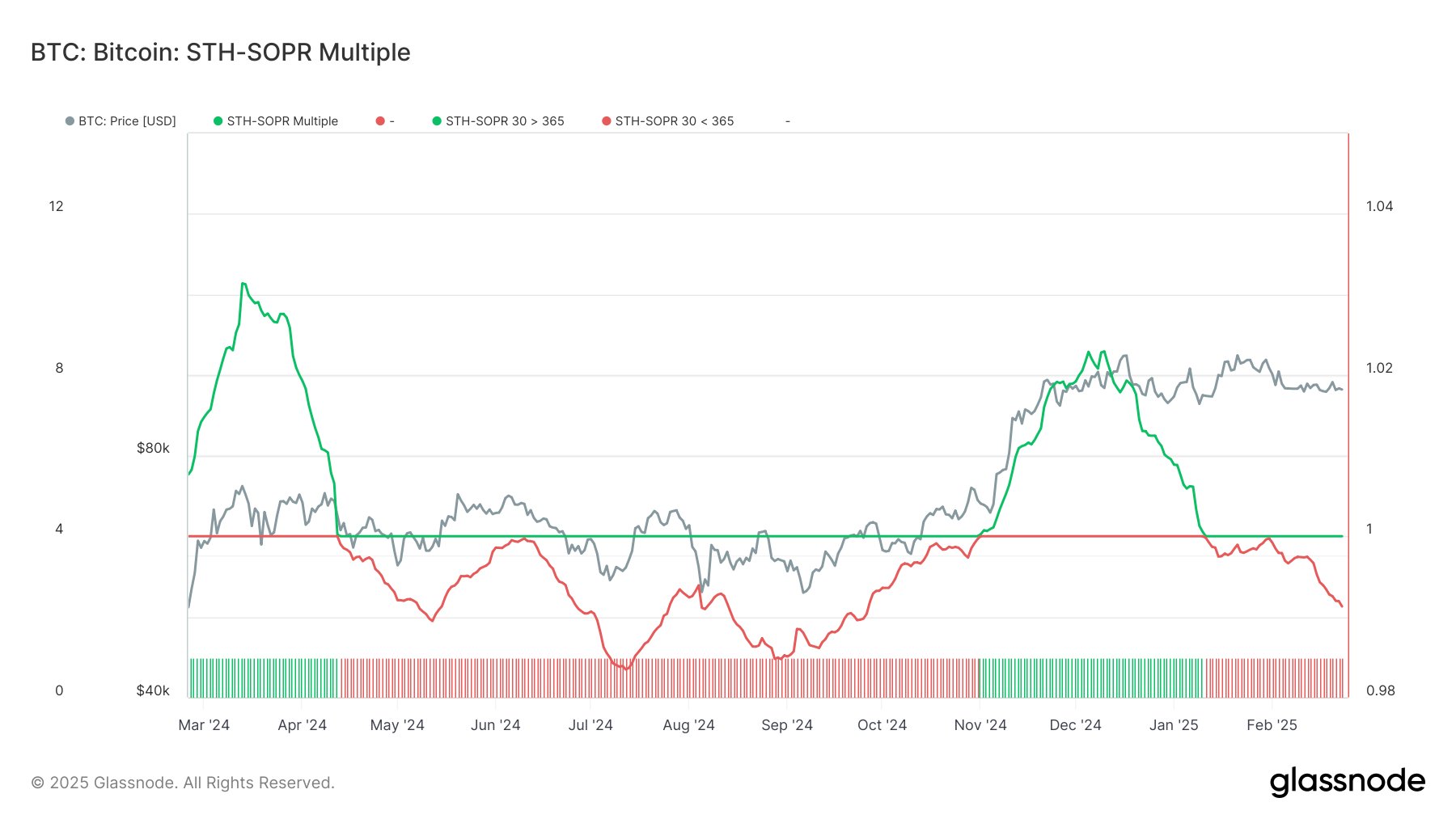
To gauge the likelihood of a successful reclaim of the 1.0 level, Glassnode analysts turn to the short-term holders’ SOPR Multiple. This metric compares Bitcoin’s short-term profitability trends.

Currently, the multiple is in the red zone, suggesting that short-term holders have been realizing more losses recently. This adds downside risk, as holders facing losses are more likely to sell, increasing supply pressure in the market.

Furthermore, Glassnode emphasized that with the STH-SOPR Multiple showing negative momentum and the STH-SOPR struggling at breakeven, the probability of rejection at 1.0 appears elevated.
Image
Bitcoin STH-SOPR Multiple in the red zone

Essentially, if BTC fails to break through, it could trigger another wave of sell pressure, reinforcing the short-term bearish outlook. On the other hand, a successful reclaim would signal a shift in profitability and the potential for bullish continuation. For now, Bitcoin remains at a critical decision point.

Bitcoin Remains Bullish Regardless of Short-Term Market Direction

In a separate commentary, CryptoQuant CEO Ki Young Ju reassured that Bitcoin’s bull market remains intact despite potential threats of major dips. He highlighted key “realized price” levels for different Bitcoin holders, such as ETFs at $89K, Binance traders at $59K, and miners at $57K.

Historically, falling below the miners’ $57K level has signaled the start of bear markets. Meanwhile, with Bitcoin trading above $95K, a drop to $57K is unlikely, with formidable support above this region. Accordingly, Young Ju reassured that a 30% dip in Bitcoin price should not be a major concern.

Shiba Inu L2 Shibarium Wallets Jump Nearly 500% in a Week to 55M+: Here’s What Is Happening

0

Amid relatively quiet market conditions, a key metric for the Shiba Inu layer-2 network Shibarium is exploding, raising questions about what is going on.

Specifically, over the past week, the number of wallet addresses on the Shiba Inu-focused Ethereum Layer 2 has jumped over 490% from about 9.4 million on Monday, February 17, to over 55.7 million at the time of writing on Monday, February 24.

The feat is made more interesting by the fact that other key Shibarium metrics have remained low within the period. For one, new transactions on the network have plummeted over 90% in the last week and remain at record lows. Specifically, new transactions fell from over 4 million to around 50,000 at the time of writing.

At the same time, Shibarium’s TVL has remained flat at around $2 million after crashing from above $6 million in December 2024.

So, what’s going on?

Chiikawa 

The recent spike in Shibarium wallet addresses appears linked to activity surrounding a memecoin project called Chiikawa (CHIKA) inspired by the anime of the same name. Notably, Shibarium wallet addresses have grown alongside the number of holders of CHIKA, which is around 54.4 million at the time of writing.

CHIKA appears to have been created by WOOF, a Shibarium-based decentralized exchange, specifically to onboard users to Shibarium.

“This is an introduction to the innovative contract: Aims to add 160 million holders to Shibarium,” the project wrote in an X post on February 16, sharing the contract address for the token.

Unlike recent memecoin projects, Chiikawa has a minting mechanism that allows anyone to create a wallet and mint up to 1 billion tokens. However, its uniqueness doesn’t end there, as 20% of the amount minted by any user is randomly airdropped to 160 others. 

While this Shibarium activity does not appear to have any direct implications on the price of ecosystem tokens, including SHIB, a new influx of users can be positive in the long term.

Strategy (MicroStrategy) Inches Toward 500K Bitcoin Milestone After Fresh $2 Billion Buy

0

Self-described Bitcoin treasury firm Strategy, formerly MicroStrategy, is inching towards a major milestone in its Bitcoin acquisition strategy.

On Monday, February 24, Strategy announced the purchase of 20,356 BTC for about $1.99 billion at an average price of $97,514 per Bitcoin, bringing its total holdings within a hair’s breadth of 500,000 BTC at 499,096 BTC. The firm procured the assets for approximately $33.1 billion at an average price of $66,357 per coin.

At current prices of about $95,600, Strategy’s stash is worth $47.8 billion, representing a paper profit of $14.7 billion or about 44%.

The firm’s latest Bitcoin purchase follows the completion of a $2 billion 0% senior convertible note offering announced last week. The notes, which are due in 2030, offer buyers the option to buy an additional $300 million worth of notes before February 27.

As The Crypto Basic reported, big-name banks like Barclays, Citigroup, Goldman Sachs, and Morgan Stanley facilitated this latest capital raise.

The firm has ramped up its Bitcoin acquisition strategy in recent months, announcing plans to raise $42 billion to buy Bitcoin over the next three years.

In line with this plan, it has already purchased 52,696 BTC worth over $5 billion year-to-date (YTD), with new buys announced almost weekly.

Strategy’s ramped-up Bitcoin purchases come despite a lingering tax concern that could force it to pay billions on its holdings come 2026.

Meanwhile, demand for the company’s shares also shows no signs of waning despite this tax risk and ongoing debates about the sustainability of the strategy. In perhaps the biggest case highlighting this, at least 12 U.S. state public funds have reported holdings in the firm.

XRP Rival Now in Pole Position After Nasdaq Files 19b-4 for HBAR ETF With SEC.

0

Nasdaq has submitted a 19b-4 filing for a Hedera spot ETF on behalf of Canary Capital, increasing its chances of approval.

Litecoin’s position as the most probable altcoin exchange-traded fund (ETF) to receive regulatory approval faces intense competition from Hedera. This is because prominent stock exchange Nasdaq has just filed a rule change request for the Hedera spot ETF with the US Securities and Exchange Commission (SEC).

On Monday, Nasdaq submitted a 19b-4 with the US SEC for Canary Capital, one of the newest asset managers. The investment product aims to provide alternative exposure to Hedera, the 16th largest cryptocurrency by market cap.

New Filing Echoes Progress

Bloomberg’s senior ETF analyst Eric Balchunas confirmed the application in a tweet today. He suggested that the recent filing echoes a smooth approval process between Nasdaq, Canary, and the US SEC.

Balchunas highlighted that the filing shows that Nasdaq has made significant progress with the US SEC, reiterating the growing probability of its approval. Notably, today’s application came just three days after Nasdaq submitted an amended S-1 form for the product with the securities watchdog.

Meanwhile, the 19b-4 application decimates earlier concerns that Nasdaq filed the S-1 form without an initial request for a rule change. Furthermore, it sets the chances of a Canary Hederal spot ETF in the same cadre with Litecoin’s.

Odds of an HBAR and Litecoin ETFs Surge

With the application, Balchuanas has suggested that Litecoin and Hedera-based ETFs are now the most likely to get regulatory approval among other altcoins. This comes after the market expert stated in an earlier analysis that the chances the HBAR ETF will launch this year were insignificant.

Furthermore, the progress suggests that the ETF may launch earlier than ETFs of prominent assets like XRP and Solana. Regardless, following the recent acknowledgements from the US SEC, the chances of approval for the XRP and SOL ETFs remain relatively high.

Meanwhile, Hedera has reacted positively to the recent development, surging over 7% in an hour. At the time of writing, HBAR trades at $0.224, with its market cap nearing $10 billion.

Expert Says Dogecoin Targets 19,533% to $45 if History Repeats

0

A prominent market analyst has predicted a stupendous price pump for Dogecoin this bull cycle.

Market expert Dima Potts made the lofty call in an X post on Feb. 23, citing cyclical repetition. He suggested that Dogecoin, the largest meme coin by market cap, would defy its current bearish momentum for a staggering 19,533% uptrend.

For this to happen, Dogecoin would first have to regain bullish momentum. The leading meme coin has struggled recently amid a broader market correction, retracing over 52% from its December high of $0.4846.

Amid this poor run of form, the token has posted severe retracements in five of the last six weeks. However, Potts remains optimistic that DOGE will rebound from current struggles and surge to at least $10 this cycle.

Dogecoin Eyes Rebound from “Never Miss Zone”

Potts identified that Dogecoin’s recent price action has seen it trend toward the “never miss zone,” from which the token has historically rebounded. Notably, the asset surged from this area after a consolidation phase in the 2017 and 2021 cycles.

Furthermore, the wave-like indicator aligns with Dogecoin’s cyclical 1,442-day pattern. The pointer shows that the prominent meme coin has completed each cycle in 206 weeks, with the last concluding on May 7, 2021.

Meanwhile, with the cycle already 1,388 days in, Potts suggested that Dogecoin would soon enter the second phase of its cyclical parabolic expansion. He also identified the expected peak point for the imminent bullish phase, with an accompanying chart suggesting an almost 1,636% surge close to $4.

Dogecoin to $45 Prediction/Dima Potts

$45: Dogecoin’s Ultimate Target

After the phase two pump, the analyst speculates that there would be a brief retracement before the final push to the cycle’s ultimate target. Citing the historical pattern of the wave-like indicator, Potts believes Dogecoin would follow the line to a peak price of $45.

Meanwhile, the prominent market watcher highlighted that DOGE has consistently crossed the red vertical line, as shown in the chart in the last two cycles. As a result, he expects a repeat this cycle, aligning with the $45 price prediction.

Furthermore, Potts stated that the period in which Dogecoin reaches the level above the red line will determine the timing of this cycle’s peak. Nonetheless, he believes the leading meme coin to closely follow its historical pattern or outperform it, citing technological advancement, growing adoption, and emerging institutional traction.

While technical analysis suggests a likely rebound to higher prices, on-chain metrics indicate otherwise. Whale activities on the Dogecoin ecosystem have reached new lows, with just 66 large transactions and 60,000 active addresses per day.

Dogecoin users would have to correct this trend to increase the chances of a near-term price upsurge. In the meantime, DOGE trades at $0.2325, down over 4% in the past 24 hours.

Shiba Inu Faces Key Test as Support Levels Shift Below $0.000015

0

As Shiba Inu continues to be at the mercy of the bears, analyst Ali Martinez has identified the token’s next support level after it lost a key price point.

Shiba Inu’s price has fallen below $0.000015, signaling a critical phase for the dog-themed meme coin. At the time of writing, SHIB is trading at $0.00001479, reflecting a 5.32% decline in the last 24 hours. Over the past week, It has dipped by 7%.

Amid this persistent decline, Martinez has pointed out key levels to monitor as SHIB navigates this downturn.

Shiba Inu Price History and Key Levels

In a tweet, Martinez shared a historical chart of Shiba Inu. According to the graph, SHIB’s price movement has followed a distinct pattern over the years. From late 2021 to early 2022, SHIB saw a sharp peak followed by a rapid decline.

Throughout 2022 and 2023, SHIB entered a prolonged consolidation phase, fluctuating within a defined range. However, a breakout attempt in late 2023 to early 2024 failed, leading to a retest and subsequent breakdown.

In the latest downturn, Martinez highlighted that SHIB has lost a crucial support level. His chart shows the next major support zones at $0.000011 and $0.000008, which could determine the memecoin’s next move.

Contrasting Analyst Predictions

While some analysts foresee continued struggles for SHIB, others anticipate a potential recovery. Notably, analyst Javon Marks has identified a possible formation of an inverse head and shoulders pattern. 

If this pattern completes, it could push SHIB toward the $0.000081 level. This scenario would represent a 400% increase from the current price, a development that could attract renewed interest in the asset.

AI-Based Predictions on SHIB Future

Separately, OpenAI’s ChatGPT recently provided possible scenarios for SHIB’s future price movement. The chatbot considered historical price patterns, market cycles, and ecosystem developments.

One scenario suggests that SHIB could reclaim its all-time high between 2028 and 2030 if growth remains gradual without another major hype cycle.

However, in a strong bull market, where Bitcoin trades between $150,000 and $200,000, SHIB could reach its previous peak between 2025 and 2026.

If speculative hype, token burns, and buying pressure combine with bullish market conditions, SHIB could reclaim its all-time high before 2025 ends.

Hoskinson Describes How Cardano Could Unlock $2T in Bitcoin DeFi

0

Cardano founder Charles Hoskinson has discussed how the Cardano network could play a role in Bitcoin DeFi, unlocking $2 trillion in assets. 

Hoskinson highlighted this during a conversation on the Mr. M Podcast, in which he appeared alongside early Bitcoin adopter Davinci Jeremie. The Cardano founder explained how Bitcoin holders could access decentralized finance opportunities without leaving the Bitcoin ecosystem.

Cardano Presents a Solution for Bitcoin DeFi

Hoskinson noted that Bitcoin DeFi could become a major sector. “So Bitcoin DeFi is going to be a huge category because it’s like $2 trillion of assets are waking up,” the Cardano founder remarked.

He emphasized that Bitcoin’s vast market value currently lacks total value locked (TVL) in DeFi applications. According to him, Bitcoin holders want yield and new financial tools. Interestingly, Cardano’s infrastructure presents a solution, particularly through Babel fees. 

For context, Babel fees allow users to pay transaction fees using the native asset instead of ADA. If Bitcoin is wrapped on Cardano, users can pay fees in Bitcoin rather than needing ADA, making the experience seamless. 

He compared this process to using a credit card abroad, where transactions occur in one currency but are settled in another.

Midnight Can Help

Additionally, Hoskinson highlighted that Bitcoin DeFi and the Midnight project are both launching this year. He had previously suggested that Midnight would make Cardano multichain. According to him, the innovation would increase transaction volume and user engagement. 

As a result, more projects may integrate with Cardano. He compared the current blockchain landscape to islands, suggesting that increased interoperability will transform these isolated ecosystems into a more connected environment, similar to Florida’s connection to the mainland.

“You know, we have a dedicated group of people that that’s all they do for these types of integration so that, you know, island stuff will go away. It’ll become more like Florida. And it’s now connected to a greater whole and more and more people will come in,” the Cardano founder said.

Hoskinson: Cardano Borrows From Bitcoin 

Meanwhile, Hoskinson further stressed that Cardano borrows several principles from Bitcoin. These include deflationary monetary policies, a fixed supply, the UTXO transaction model, and elements of proof-of-stake that resemble Bitcoin’s proof-of-work mechanism.

With the Cardano network incorporating these principles, it looks to provide a familiar yet enhanced experience for Bitcoin users entering DeFi.

Meanwhile, Hoskinson also outlined the broader vision for Cardano’s role in blockchain adoption. For the network to thrive, it must attract more daily and monthly active users, increase transaction volume, and gain trust from regulatory bodies. 

He believes that as Cardano expands into niche markets like Bitcoin DeFi, industry leaders such as MetaMask will seek integration opportunities. This, in turn, could drive exponential growth in TVL, user activity, and transaction volume over the next two to three years.

Hoskinson predicted: “I think probably in the next 24, 36 months, we’ll continue to see exponential improvements in the TVL, in the user count, transaction volume.”

Cardano to $10: Analyst Describes How ADA Can Realistically Hit This Target

0

A prominent Cardano permabull has shared how he believes ADA could realistically reach the two-digit price goal.

Dan Gambardello, a well-known crypto analyst, recently laid out his vision for Cardano (ADA) reaching the $10 mark. He believes this target is achievable based on historical price patterns, market cycles, and the ongoing growth within the Cardano ecosystem. 

Cardano Historical Performance and Market Cycles

In his latest video analysis, Gambardello stressed that Cardano has demonstrated strong growth in previous bull cycles. The analyst noted that for instance, in the last market cycle, ADA surged from a $4 billion–$5 billion market cap to over $100 billion.

Historical market data confirms this disclosure. Particularly, Cardano had a market cap of $1.22 billion at the start of March 2020. Interestingly, this figure surged to $101.17 billion by September 2021, coinciding with ADA’s all-time high price. This marked an 8,236% rise in valuation within 19 months.

Cardano Market Cap Surge

Notably, Gambardello emphasized that many investors doubted Cardano’s ability to reach that valuation, but it ultimately did. He sees a similar setup forming in the current market cycle, with Cardano positioned for another major rally.

According to his analysis, the current market structure is similar to previous consolidation phases before explosive growth. 

For context, ADA is down about 40% from its recent high, and Gambardello sees this as a normal retracement within an overall bullish trajectory. He believes investors should focus on long-term market cycles rather than short-term fluctuations.

Indicators Supporting a $10 ADA

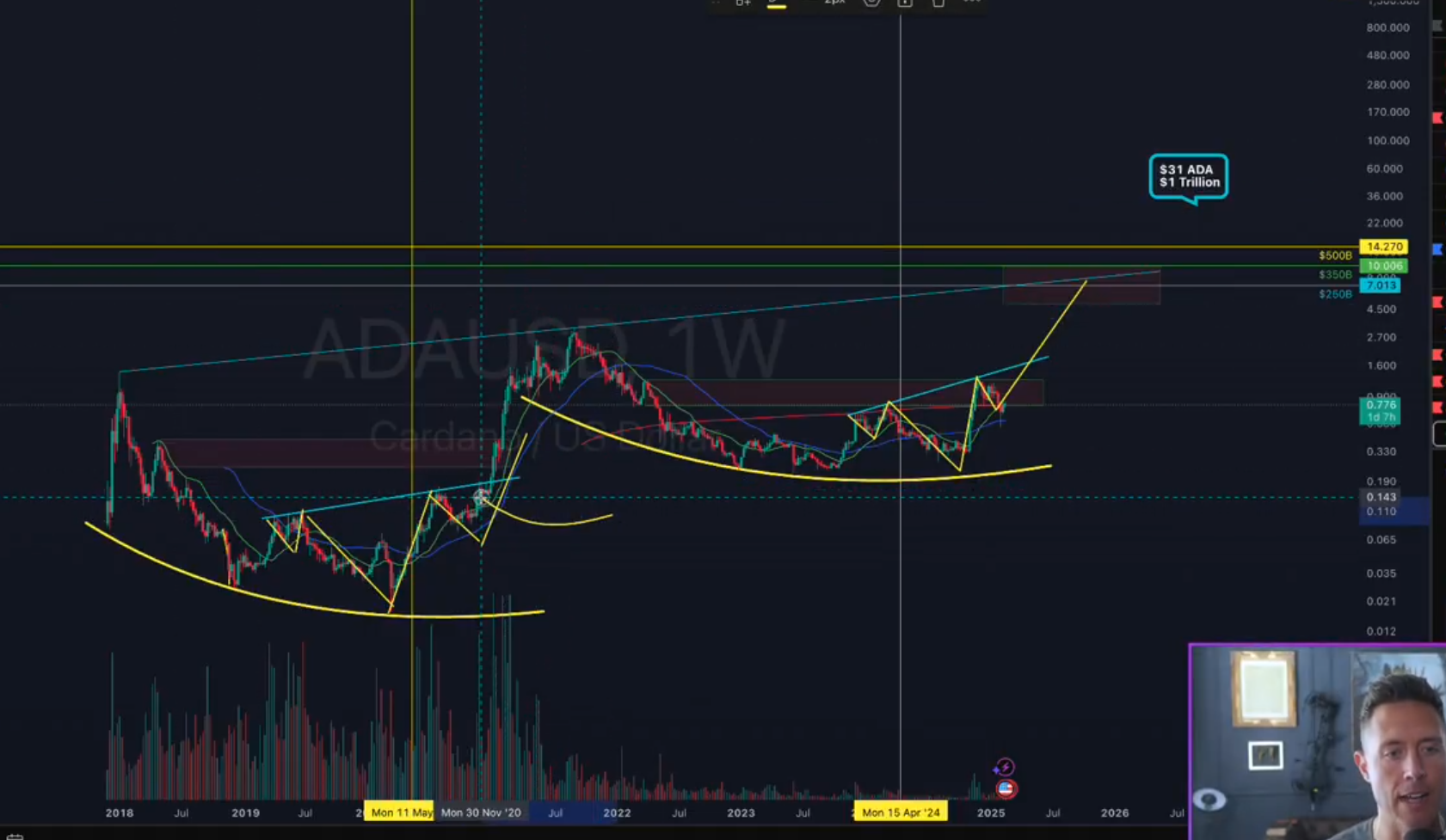
Speaking further, Gambardello identified several chart patterns that indicate bullish potential for Cardano. One of the primary indicators is the inverse head and shoulders pattern on the weekly chart. 

Notably, Cardano appears to have begun forming this structure from early December 2023, after its drop from the $0.6 mark and subsequent recovery. When Cardano formed a similar structure last cycle, its breakout resulted in a massive upsurge. If confirmed, another breakout could lead to a major uptrend for ADA.

Potential ADA Inverse Head and Shoulders

Gambardello also pointed to Cardano’s position relative to key moving averages. Currently trading for $0.7459, ADA is now between the 20-week MA and the 200-week MA, which has historically been a major accumulation zone before massive price surges. 

Additionally, the analyst tracks a Fibonacci retracement from the previous cycle’s swing low to its peak. This Fibonacci level aligns closely with his previously defined “bull market doors.” Notably, this confirms the idea that ADA is in a prime position for a breakout.

Cardano Ecosystem Growth and Institutional Interest

Besides the technical indicators, Gambardello highlighted fundamental factors that could drive Cardano’s long-term value. He noted that ADA is more bullish than in the last cycle. For one, the network has evolved massively since the last cycle, now featuring a thriving DeFi ecosystem, smart contracts, and increased adoption. 

Particularly, Cardano welcomed the Plomin upgrade last month, which introduced full decentralized governance. Citing these developments, Gambardello pointed out that Cardano is one of the most decentralized and secure blockchains, making it well-suited for institutional investment.

He also mentioned the recent inclusion of ADA in Bitwise’s top 10 crypto index. While this is already a bullish signal, he believes the real catalyst will be ADA’s potential inclusion in spot ETFs. Notably, Grayscale filed for a Cardano ETF earlier this month. Gambardello compared this stage of Cardano’s growth to the early days of tech stocks receiving ETF exposure.

Market Cap Projections and Realistic Price Targets

Currently, Cardano changes hands at $0.7459. It bears mentioning that for the token to reach $10, its market cap would need to hit around $350 billion. Gambardello argues this is realistic when compared to Ethereum’s performance in the previous cycle. 

Specifically, Ethereum’s market cap exceeded $500 billion at its peak, and he believes Cardano has the potential to follow a similar trajectory given its strong fundamentals.

His broader target range for this cycle is between $5 and $10, with an upper possibility of $14 if momentum accelerates. He emphasizes that this is not a baseless prediction but rather a projection based on historical patterns and current market trends.

Bitcoin Risks Prolonged Consolidation as Sentiment Weakens: CryptoQuant

0

It might take a while longer for Bitcoin and the broader crypto markets to establish a clear direction.

This is according to a recent CryptoQuant report released on Sunday, February 23. In it, CryptoQuant analyst “Avacado onchain” wrote that the leading digital asset, which has been stuck in a price range between $90,000 and $106,000 over the past few weeks, risked a months-long consolidation similar to the one it began in March 2024.

For context, Bitcoin went through a roughly seven-month consolidation phase from March 2024 through October 2024 before resuming its uptrend on excitement about the U.S. election and President Donald Trump’s victory.

Avacado onchain argued that Bitcoin could be kicking off a similar market phase, citing declining network activity as a signal of weak market sentiment.

For example, Bitcoin active addresses have dropped from recent peaks of over 1.1 million to near the 900,000-mark. At the same time, the transaction count on the network has plummeted over 46% from over 650,000 to nearly 350,000. 

Bitcoin active addresses chart
Bitcoin active addresses chart. CryptoQuant

Another factor highlighted by the analyst was a drop in positive netflows into exchange-traded funds.

Avacado onchain attributed the weakening market sentiment to a lack of concrete results from Trump’s pro-crypto agenda and geopolitical uncertainty in the wake of trade war fears.

“Since previous bullish narratives have already been priced in, further upside momentum will require either the resolution of uncertainties or new bullish catalysts,” they surmised.

But while Avacado_onchain is warning of the possibility of long sideways movement, at least one prominent trader has suggested that a Bitcoin breakout is imminent.

On Friday, February 21, veteran trader Peter Brandt suggested that February 24 through February 26 could offer insights on Bitcoin’s next move, citing internal symmetry in the price range.

In the meantime, Bitcoin is exchanging hands around the $96,000 price point.

Document Saying Ripple Will Retain 25% of XRP Supply No Longer Relevant

0

Over the past 24 hours, a highly followed XRP community member has stirred confusion with a decade-old document from Ripple, the payments firm founded by the developers of the XRP Ledger.

In an X post on Sunday, February 23, “Xaif” claimed to have an important update for XRP holders, citing a document from Ripple.

“CRAZY UPDATE XRP,” the post started before adding, “Ripple announced that 25% of XRP will be Retained by them! This is great for Sustainability in the future.”

Xaif argued that this supposed Ripple move was bullish for XRP, asserting it was equivalent to burning 25% of the supply.

However, as several community members, including former Ripple Principal Developer Advocate Matt Hamilton, have highlighted, the document cited by Xaif is from 2014 and is no longer relevant.

Specifically, the excerpt is from a November 2014 document Ripple used to highlight its value proposition to finance professionals. However, it came long before XRP was eventually escrowed and no longer reflects the project’s tokenomics.

XRP’s Tokenomics 

In reality, in 2017, Ripple decided to lock up 55% of the 100 billion XRP supply in escrow with the XRP Ledger programmatically designed to release 1 billion of these escrowed tokens monthly. A portion of the unlocked tokens is sold to partners, including exchange-traded products and trusts, and the remaining is locked up again in escrow.

Through this model, Ripple controls the amount of new XRP that can be brought into circulation. However, it has also attracted centralization arguments and criticism from the broader crypto community, with some asserting that the model is simply designed for Ripple to enrich itself at the expense of XRP holders.

The amount XRP held by Ripple in escrow has reduced to 38 billion coins, or about 38% of the supply as of December 31, 2024, per Ripple’s Q4 2024 market report. Meanwhile, XRP’s circulating supply sits at 57.88 billion coins.