Home Blog Page 910

Expert Shares Why XRP Has the Potential to Pass $100 Soon

0

Armando Pantoja, a widely-followed XRP community pundit, recently discussed the transformative potential of XRP in the face of a global financial revolution.

According to Pantoja, a full-scale transformation is taking place across the world’s financial systems due to innovations in financial technology. Now, with legacy banking institutions rapidly adopting fintech solutions, Pantoja believes XRP will become an important aspect of the growing digital finance scene.

He emphasized how the adoption of ISO 20022 standards and the integration of Ripple’s technology could make XRP “the first cryptocurrency” to successfully break into global finance on a scale far surpassing traditional systems.

The End of SWIFT and the Rise of Ripple

Pantoja pointed to the upcoming obsolescence of the SWIFT banking system, historically used for cross-border payments, as one of the major driving forces behind XRP’s potential rise.

Meanwhile, the Ripple Payments service, which uses XRP, is rapidly gaining traction as a solution to the inefficiencies in SWIFT’s infrastructure. Pantoja stressed that the seamless, low-cost transactions by XRP make it an ideal candidate to replace outdated banking systems.

“The combination of Ripple, the XRPL blockchain, and the growing adoption of ISO 20022 will eventually create a perfect storm that could leave SWIFT and other traditional banking networks in the dust,” Pantoja explained.

In his view, this seismic shift will drive XRP to new heights as it becomes an integral component of the world’s financial infrastructure.

A Once-in-a-Generation Opportunity

To back this bold view, Pantoja cited expert discussions highlighting that the financial markets are on the edge of a monumental shift. “We’re about to see massive changes in the $23 trillion world of big finance,” the experts say.

In parallel, the experts highlight that traditional banking stocks are declining, while fintech stocks have soared as much as 272% over the last three years. They stressed that the coming digital transformation of the financial world will open doors for massive profits. However, this would only benefit those who invest before the masses catch on.

“Most people won’t even hear about this shift until it’s too late,” the experts said, “Just like with any world-changing investment story, those who get in early will reap the rewards.”

XRP Path to $100

Based on the bold views of experts, Pantoja stressed that the path to XRP reaching $100 is clear. Emphasizing the significance, he highlighted that early XRP buyers could see themselves becoming millionaires in the future.

“XRP is on the verge of creating hundreds of thousands of millionaires,” Pantoja stated.

Pantoja arguing for $100 with expert discussion
Pantoja arguing for $100 with experts’ discussion

As of today, XRP is an asset worth $2.49. The journey to $100 demands a 3,916% price surge. However, many in the crypto community have criticized Pantoja’s latest price prediction for XRP.

X user Yancy argued that the XRP prices Pantoja is now throwing around are wild. He noted that he had previously given “conservative” estimates of $20 to $25. However, in more recent statements, Pantoja calls for “insane figures” between $100 and $1,000. Yancy finds this shift concerning.

“Ridiculous, do you know the market cap when that happens?” asked X user WizardX.

For context, XRP’s full market cap would be at $10 trillion with a unit price of $100 per token. Critics often use this required market size to dismiss such bold predictions.

Dogecoin Falls as Network Activity Declines: Is $0.20 Next?

Dogecoin crashes below $0.24 and marks a triangle breakdown. Will the supply surge plunge DOGE prices below $0.20?

Amid the sudden surge of bearish sentiment in the crypto market, Dogecoin marks a breakdown rally. Crashing under the $0.24 crucial support level, the DOGE price trend brings a bearish conclusion to the descending triangle pattern.

With the falling prices, Dogecoin’s network witnesses a sharp decline in activity. Is Dogecoin about to crash under the $0.20 psychological support?

Dogecoin Confirms Triangle Breakdown

In the 4-hour price chart, Dogecoin revealed a strong resistance trend line, keeping the bearish trend intact. With multiple overhead resistances, Dogecoin finally broke under the $0.2341 support level.

Dogecoin Price Chart

With a new 7-day low at $0.22644, Dogecoin has marked a descending triangle pattern breakdown. Amid the increased selling pressure, the MACD and signal lines have witnessed a sharp downtick with a surge of negative histograms.

Hence, the momentum indicator suggests an increase in bearish momentum. As per the pivot levels, the meme coin price is hanging at the S1 support pivot level at $0.22836, with a 4-hour candle close underneath the S1 support level.

The downfall is expected to potentially continue to the S3 support level at $0.19361. This will mark a crash and bring Dogecoin back under the $0.20 psychological mark after a two-month bullish momentum.

Network Activity Plummets: A Sign of Weakening Demand?

Supporting the downside scenario, crypto analyst Ali Martinez points out that Dogecoin’s network activity has dropped to its lowest level in months, reaching figures not seen since October 2024.

There were only 66 whale transactions, with fewer than 60,000 active addresses per day.

As network activity slows, the market price is expected to fall due to the declining demand on the network.

Dogecoin Network Activity

Bullish Hopes: Could DOGE Stage Another Explosive Rally?

Despite the technical signals indicating a selling opportunity, some traders remain optimistic. According to Trader Tardigrade, an analyst on X, Dogecoin is completing its fourth falling wedge pattern.

The first breakout resulted in an 88% surge in the last quarter of 2023. The second wedge breakout in early November saw a 208% price jump. Finally, the third wedge breakout in the last quarter of 2024 led to a 445% surge, propelling Dogecoin close to $0.50.

Currently, Dogecoin is at the crucial support level of the fourth falling wedge pattern. If this pattern plays out as expected, a breakout could trigger a significant rally, potentially pushing Dogecoin past the $0.50 mark.

Dogecoin Chart
Trader Tardigrade Dogecoin chart

Bitcoin Under Pressure: Will BTC Defend the $94k Support?

Bitcoin is back under $96,000 as the crypto market starts the week on a bearish note. Is a downfall to $90k imminent this week?

Last week, Bitcoin faced massive fluctuations, with a 7-day low at $93,340 and a high at $99,508. Despite the massive fluctuation, BTC concluded the week at $96,262, with a surge of 0.14%.

Meanwhile, the uncertainty in the BTC price trend takes a bearish shift at the start of this week. With an intraday fall of 0.57%, Bitcoin trades at a market price of $95,714.

Furthermore, last week’s cumulative weekly flow in the Bitcoin ETF remained negative. Amid such conditions, will Bitcoin sustain above its crucial support near the $94,000 mark, or is a downfall imminent?

Bearish Pressure Intensifies on Daily Chart

In the daily chart, the BTC price trend reveals a significant bearish influence that dominates the price trend. Currently, Bitcoin is above the $95,000 mark after rejection from the overhead trend line.

Bitcoin Price Chart
Bitcoin Price Chart

Along with the overhead trend line, the crucial supply zone near the $98,500 and the 50% Fibonacci level influences the quick turnaround. With short-term sustenance near the $95,000 mark, the BTC price trend hints at a potential comeback.

Supporting bullish chances, the money flow index reveals a surge in inflow as it takes a bounce back from the oversold region. Currently, BTC prices show a 0.26% surge in the past four hours, with multiple low-price rejections near the $95,000 mark.

BTC is likely to rechallenge the 38.20% Fibonacci level at $96,703. If a bullish breakout occurs, the uptrend will first rechallenge the overhead trend line, resulting in four bearish reversals.

A successful breakout could push BTC toward the $98,500 supply zone near the 50% Fibonacci level.

Conversely, a breakdown of local support at the $95,000 mark will test the 23.60% Fibonacci level at $94,393. Further, it will increase the chances of a quick revisit to the $90k psychological support.

Bitcoin ETFs Witness Massive Outflows

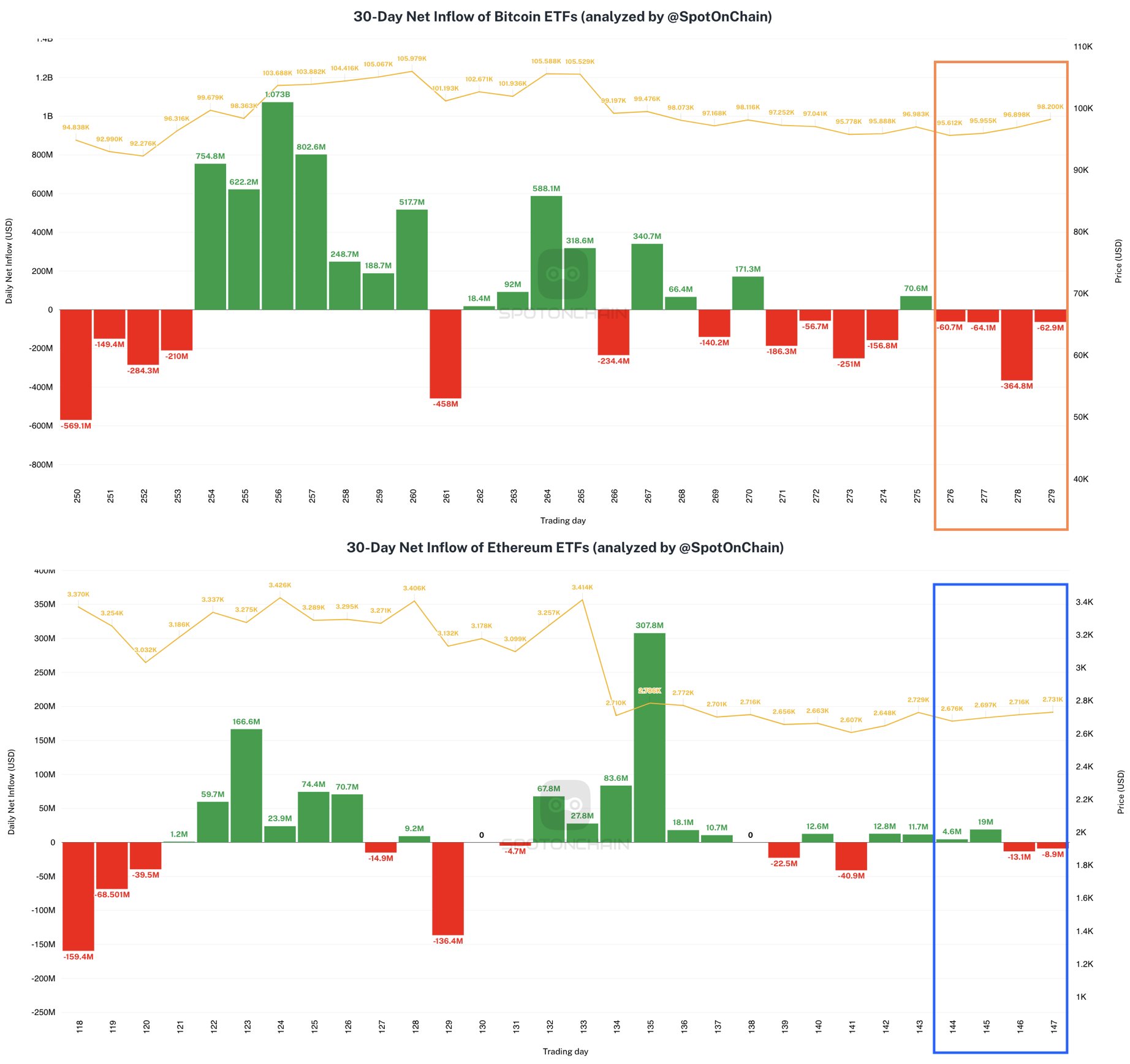
According to a recent tweet by SpotOnChain, U.S. spot Bitcoin ETFs saw a massive outflow of $552.5 million last week. There were outflows on all four trading days, during which BTC prices dropped by nearly 8%.

This decline resulted in a weekly Doji candle, indicating market uncertainty.

Image

Will March Trigger a Bullish Comeback for Bitcoin?

Despite the ongoing downfall, Bitcoin’s price will likely make a bullish comeback next month. As per Coinglass, over the past four years, Bitcoin recorded significant returns in March.

Bitcoin Monthly Returns

If the bullish trend continues, the upcoming month could witness a bullish spree with a breakout of the 50% Fibonacci level. A breakout above the 50% Fibonacci level could open doors for further gains, targeting the 78.60% Fibonacci level at $103,393 and the supply zone near the $108,000 mark.

Montana House Says No to Bitcoin as State Reserve Asset

0

Montana’s House of Representatives has voted against a proposal to designate Bitcoin as a state reserve asset.

This decision contrasts with Utah’s ongoing efforts to establish a Bitcoin reserve while Texas has held its first public hearing on the matter.

Concerns Over Investment Risks

Last Friday, Montana’s House decisively rejected House Bill No. 429, which aimed to create a special revenue account for investments in precious metals, stablecoins, and digital assets.

The proposal stipulated that eligible digital assets should have maintained an average market capitalization of over $750 billion in the past year, effectively positioning Bitcoin as a prime candidate.

However, the bill faced strong opposition, particularly over concerns about the speculative nature and volatility of digital assets. Lawmakers were wary of exposing taxpayer funds to what they viewed as risky investments.

They argued that safeguarding public money was paramount and that digital assets did not offer sufficient stability or security to justify the risk.

Despite the opposition, some proponents of the bill argued that diversifying state investments could generate higher returns and enhance purchasing power. They contended that traditional bonds, while safer, offered lower yields, potentially diminishing the value of public funds over time.

Nonetheless, the majority of lawmakers prioritized caution, leading to the bill’s defeat by a 41-59 vote.

Utah Advances Bitcoin Reserve Bill

While Montana took a cautious stance, Utah is moving forward with its Bitcoin reserve initiative. As of February 19, the Blockchain and Digital Innovation Amendments bill (H.B. 230) was halfway through the legislative process after advancing to the state’s Senate Revenue and Taxation Committee.

Introduced on January 21, 2025, the bill has gained significant momentum. It secured bipartisan support with an 8-1 vote in the House of Representatives.

If approved, Utah could become one of the first states to officially incorporate Bitcoin into its financial reserves. In turn, the development could set a trend for other states to follow.

Texas Bitcoin Reserve Hearing

Texas is also exploring the possibility of creating a state-backed Bitcoin reserve. On February 18, the state had its first public hearing to discuss the establishment of a Strategic Bitcoin Reserve (SBR).

The hearing was to provide a platform for policymakers to deliberate on the potential benefits and risks of investing in digital assets as part of the state’s financial strategy.

If the proposal gains traction, Texas could join the ranks of states actively incorporating Bitcoin into their investment portfolios.

Bybit Applauds as Pump.fun Blocks Sketchy Memecoins Tied to Hackers

0

Crypto exchange Bybit has applauded Solana Foundation chairman Lily Liu and memecoin deployer Pump.fun for blocking tokens tied to the Bybit hackers.

In an X post, Bybit’s official handle applauded Liu and the Pump.fun team for their efforts in preventing North Korean hackers from laundering money through the protocol. The exchange lauded the move, noting it was an instance of proactive security measures.

Hackers Attempt Laundering Funds Through Pump.fun

Notably, with all centralized exchanges on the watch for inflows related to the multiple addresses Bybit hacker Lazarus Group split the funds into, the notorious gang has tried a new approach: meme coin deployment.

An address tied to the hack moved $1.08 million in USDC to “0x3639,” which bridged the tokens to SOL. After multiple transfers in an attempt to cover its tracks, the address finally split about 106,000 USDC among ten Solana wallets and started meme coin deployment.

One of the addresses, “5STkQy,” moved 60 SOL to the Solana wallet “9Gu8v6” and created a token QinShihuang (500000) yesterday. A report shows the asset traded over $26 million before the Pump.fun team swung into action and blocked the token.

At the time of writing, the address “9Gu8v6” holds 80.55 SOL (approximately $13,000). The Pump.fun team has also removed all tokens deployed by the address.

Bybit Hackers Solana Transactions

Aside from Pump.fun, other firms have also assisted in blocking hackers from laundering funds. Tether’s Paolo Ardoino tweeted that the stablecoin issuer had frozen 181,000 USDT tied to Bybit hackers.

Bybit CEO Shows Gratitude to a United Crypto Industry

Meanwhile, Bybit CEO Ben Zhou has expressed heartfelt gratitude to the crypto industry for rallying around the exchange during the turbulent times. He stated that the support showed strength in unity, asserting the sector can only grow bigger from here.

His post mentioned notable crypto exchanges like Bitget, MEXC, and Pionex. The CEO also applauded other firms like Tether, Solana, Ton Network, and SosoValue.

Moreover, Zhou disclosed that the massive support has seen Bybit refill its Ethereum stash. He revealed today that the exchange had replaced the $1.46 billion worth of Ether hacked on Friday, and the client’s assets are now 100% backed 1:1.

This came from OTC purchases, whale wallet supports, and exchange loans. For context, on Saturday, Bybit received over 88,000 ETH ($239 million) from Bitget and Binance as liquidity support to cushion the growing withdrawal requests at the time.

Pundit Says Can’t Imagine Being Dumb Enough Not to Hold XRP Right Now

0

A widely followed pundit in the XRP community, Digital Asset Investor (DAI), has sparked fresh discussions about the importance of holding XRP now more than ever.

In a tweet, DAI reminded the crypto community that the Ripple lawsuit could end at any moment. He pointed out that it has been ongoing for over four years, and settlement is imminent. “I can’t imagine being dumb not to hold XRP right now,” he said.

His comments reflect the growing anticipation surrounding the conclusion of Ripple’s ongoing legal battle with the U.S. SEC. Many believe the outcome could trigger a significant price rally for XRP, as the case has historically impacted XRP’s price.

The hope for the case to end soon comes from the improving regulatory stance of the SEC under the new administration. The SEC recently paused its litigation against Binance amid the activities of the newly formed SEC crypto task force, which is overseeing, among other matters, pending litigations.

In addition, the agency dropped its case against Coinbase. Many believe a similar gesture could apply to Ripple’s lawsuit as well. As a result, anticipation about an imminent end runs high in the XRP community, as they see it as a major bullish factor for XRP’s price.

Regarding how XRP’s price could react to news of the lawsuit settlement, DAI turned to Elon Musk’s Grok AI for insight into potential market reactions.

Grok proposed a scenario in which XRP’s price could see a reaction similar to the initial announcement of the lawsuit back in December 2020.

XRP Could Mirror Its 2020 SEC Reaction—But in Reverse

On December 22, 2020, when the SEC accused Ripple of selling XRP as an unregistered security, XRP’s price plummeted from around $0.50 to $0.17. This marked a sharp 66% drop due to uncertainty, fear, and delistings by major exchanges.

Accordingly, Grok suggested that if the legal battle, which is currently in appeals, ends in Ripple’s favor, the market could react in reverse.

With XRP currently trading around $2.50, a 66% increase would push its price to approximately $4.15 in the short term. Notably, this price would mark a new all-time high for XRP, which has been trading below its initial peak for seven years, partly due to the lawsuit.

Meanwhile, other market commentators like Edward Farina and Alex Clay have even argued for a $10 price for XRP post-Ripple lawsuit victory. Given the promising prospects, commentators like DAI believe fading XRP at this time is not a smart move.

Dogecoin Sees Record Low Activity: Just 66 Whale Transactions and Fewer Than 60K Active Addresses – Can DOGE Rebound?

0

The price of Dogecoin struggles to maintain a bullish rally amid falling active addresses, lower whale transactions, and reduced user engagement.

Dogecoin (DOGE) has extended its decline, currently trading around $0.2329, reflecting a 4.77% drop in the past 24 hours. This new dip worsens its weekly performance, now at an 11.57% decline. This ongoing slump comes as the cryptocurrency struggles to maintain investor interest and activity within its ecosystem. 

After peaking in late 2024, DOGE’s price trajectory has shown a consistent downward trend, with temporary spikes quickly giving way to further drops. The persistent decline raises concerns about Dogecoin’s market stability and future growth potential.

Declining Dogecoin User Activity 

One of the key indicators of Dogecoin’s declining momentum is the significant drop in daily active addresses. Market data shows daily active addresses have fallen below 60,000 per day, marking the lowest level since October 2024. 

This decrease suggests reduced user engagement and waning interest in the cryptocurrency. Additionally, transaction volume in USD has also declined, mirroring the drop in active addresses and DOGE’s price. While transaction volume previously spiked during price peaks, it has gradually diminished.

Image
Santiment chart of declining Dogecoin activity by Ali Martinez

Reduced Whale Transactions

Another critical factor contributing to Dogecoin’s sluggish performance is the decline in whale transactions exceeding $1 million. The current whale transaction count has dropped to just 66 per day, significantly lower than the frequency observed during previous price surges. 

This reduction suggests that large holders are now less active in the market, potentially impacting volatility and price support. Historically, whale transactions have played a crucial role in influencing crypto price movements.

Shifting Holder Dynamics 

Data on Dogecoin balances by time held reveals further insights into shifting market dynamics. There has been a recent 2.67% decrease, a significant drop of 11.81%, and a notable increase of 107.45% in different holding categories. 

Dogecoin Balance by Time Held Chart

This trend reflects a decrease in medium-term holders and a rise in short-term traders, aligning with the overall decline in whale transactions and active addresses. 

Breakout on the Horizon?

Despite the ongoing downtrend, an analyst remains optimistic about Dogecoin’s future. Pseudonymous analyst Trader Tardigrade recently described DOGE’s current consolidation as a “Boring Phase,” likening it to a stagnation period in 2017 that eventually led to a nearly 15-fold price surge.

 According to historical patterns, DOGE could experience a significant breakout exceeding $1.30 after March 2025. However, this optimistic outlook hinges on renewed interest and increased activity within the ecosystem.

Bybit CEO Says Exchange Has Fully Recovered From $1.46B Ethereum Hack

0

Bybit CEO Ben Zhou has disclosed that the exchange has closed the Ethereum gap created by the $1.4 billion hack on Saturday.

The Friday hack saw prominent crypto exchange Bybit lose $1.46 billion worth of Ethereum. While the exchange has yet to recuperate the funds from North Korea’s Lazarus Group, it appears to have refilled its Ethereum stash.

CEO Ben Zhou revealed in a tweet today that Bybit has closed the gap the hack created on its Ethereum stash. He further disclosed that all client assets are now fully backed 1:1 on the exchange.

Bybit Made Whole on Ethereum Reserve

Zhou’s tweet came in response to a Lookonchain tweet showing that Bybit has received Ethereum tokens worth nearly the amount it lost during the Friday hack. 

According to on-chain data, Lookonchain shows that Bybit has received 446,870 ETH ($1.23 billion). The leading crypto exchange realized the tokens through whale support, loans, and Ether purchases.

Bybit Ethereum Inflows Since Hack/Lookonchain

Meanwhile, an earlier analysis reveals that Bybit has been stacking Ethereum through the OTC market, with Lookonchain showing the exchange has acquired 266,694 ETH ($742 million) through the means.

Furthermore, a previous report from The Crypto Basic confirmed that trading platforms Bitget and MEXC, along with other whale wallets, sent over 88,000 ETH ($239 million) to Bybit about 24 hours after the hack.

Funds on The Move as Bybit Offers 10% Bounty

Meanwhile, the Bybit hackers have started laundering the stolen Ethereum. Blockchain security firm PeckShield disclosed that multiple addresses connected to the exploiter have been laundering Ethereum through exchange eXch.

Hacker Ethereum Flow to eXch

Notably, the trading platform has denied the claims, noting it has no involvement with North Korea’s Lazarus Group and that the exchange had not facilitated any laundering attempt by the notorious hacker.

Nonetheless, stablecoin issuer Tether has frozen an account reportedly an address linked to the hack. CEO Paolo Ardoino tweeted that the issuer froze 181,000 USDT tied to the exploiters.

Bybit CEO Zhou has disclosed a bounty for any entity that aids in recovering stolen funds. The derivative platform will reward cybersecurity experts with 10% of any retrieved funds through relevant information or expertise.

Here’s How XRP Could Hit $30,000 if Ripple Handles $30T in Daily Transactions

0

The latest beta version of Grok, xAI’s advanced AI model, recently analyzed XRP price potentials if Ripple handles up to $30 trillion in daily transactions.

Notably, the assessment came on the back of a question posed by Majeed, Saudi Arabian XRP community figure. The question centered on what XRP’s price would need to be if Ripple managed $30 trillion in daily transactions while releasing 1 billion XRP per month from escrow. 

For context, Ripple typically releases 1 billion XRP monthly but only retains 200 million tokens after re-locking 800 million. Meanwhile, speculations around XRP’s potential price explosion should Ripple’s payment service expand have dominated the scene, leading to the recent query from Majeed.

To ascertain the extent of this explosion if Ripple handles $30 trillion in daily transactions, the AI used economic principles to break down the price calculation, leading to a value of $30,000 per XRP under certain conditions.

Grok’s XRP Price Analysis

At the start, Grok sought to fully understand the scenario’s major details. First, it confirmed that the first parameter confirms that Ripple’s payment offering would need to process $30 trillion in transactions every day. 

Additionally, Ripple unlocks 1 billion XRP from escrow each month. However, with these parameters, the challenge was to determine what price per XRP would be necessary to support such a massive volume.

To keep calculations consistent, Grok expanded the transaction volume to a monthly basis. With 30 days in a month, the total transactions would amount to $900 trillion monthly, considering the $30 trillion per day figure.

Quantity Theory of Money

Now, to determine XRP’s necessary price, Grok used an economic concept known as the Quantity Theory of Money. This theory states that transaction volume equals the total money supply multiplied by the number of times each unit of money is used within a period.

Applying this to XRP, Grok defined the Transaction Volume to be $900 trillion per month. Further, it noted that the Money Supply is the number of XRP available for transactions. Then, Velocity represents how many times each XRP is used monthly

Rearranging the equation, Grok set the price per XRP as the transaction volume divided by the product of money supply and velocity.

Calculating XRP Price

Assuming that the one billion XRP released each month was the main supply facilitating transactions, Grok used this number for the calculation. Next, it estimated XRP’s velocity, which depends on how often each token is used.

If each XRP was used once per day, its monthly velocity would be 30. Using these values, Grok divided the total transaction volume by the product of money supply and velocity. This calculation resulted in a price of $30,000 per XRP.

However, recognizing that XRP is designed for fast settlements, Grok explored scenarios where each token was used multiple times daily. If each XRP circulated 10 times per day, this would increase the velocity to 300 per month. Using this updated velocity, XRP’s calculated price would drop to $3,000.

Another way to adjust the valuation is by considering the total circulating supply of XRP rather than just the one billion released monthly. If the full circulating supply is used, estimated at 50 billion XRP, the price would decrease. Under this assumption, XRP would need to be valued at $600 per token to handle the transaction volume.

For another approach, Grok recalculated based on daily figures. Assuming one billion XRP was available for transactions each day rather than per month, and velocity remained at 10 uses per day, the price would still need to be $3,000 per XRP to meet the daily $30 trillion demand.

However, most XRP community members have dismissed the more ambitious $30,000 price, suggesting it is unrealistic. These individuals argue that a rally to a range of $100 to $1,000 is more realistic. Further, the $30 trillion daily transaction is highly improbable. Currently, XRP changes hands at $2.56.

Will SOL’s Latest Milestone Cause A Major Price Surge In 2025?

0

Solana has just achieved a major milestone 12 months of uninterrupted uptime—and this boosted confidence in its reliability and long-term growth. We’ll talk more about its network upgrades and how they could impact SOL’s price movement in a minute.

We’ll also talk about PlutoChain ($PLUTO), a next-gen Layer-2 solution that could tackle Bitcoin’s slow transactions and high fees. Could Solana surge past $350 while PlutoChain potentially transforms Bitcoin’s scalability? Let’s break it down.

Can Solana’s Latest Breakthrough Push SOL Past $350 in 2025?

At the moment, Solana is trading at around $189.23, down 2.8% in the last 24 hours. During this time, its price has ranged between $188.76 and $195.90. The 24-hour trading volume is currently around $2.18 billion.

Solana has hit a major milestone one full year of uninterrupted network uptime. Now, after 12 months of smooth operation, it’s clear that Solana has made major improvements to its infrastructure.

In late 2024, revenue from applications running on the network soared by over 200%, thanks to popular projects like Pump.fun, Photon, and Raydium. More activity on the network means more demand for SOL. Moving on to the predictions, Alex Ferraro says that Solana will either round out its current bottom or dip to $180 before surging to $400 in the next bullish move.

Sheldon The Sniper takes it even further and says that Solana will break its all-time high, with potential targets between $500 and $600 in the next rally.

PlutoChain ($PLUTO): The Layer-2 Upgrade That Could Fix Bitcoin’s Speed, Cut Fees, and Unlock New Possibilities

Bitcoin is the original cryptocurrency, but it’s far from perfect. Slow transactions, high fees, and congestion have made it difficult to use for everyday payments. 

Waiting 10 minutes or more for a block to confirm isn’t practical, especially when fees spike due to network demand. Whether it’s microtransactions, cross-border payments, or simple transfers, Bitcoin still has major usability issues that hold it back. Fortunately, PlutoChain ($PLUTO) brings a Layer-2 solution that could process transactions off the main Bitcoin blockchain, reduce congestion, and speed up confirmations. With block times of just two seconds, Bitcoin could finally become fast enough for real-world use, which could make it easier to send money, buy goods, or settle payments instantly.

Another big advantage is lower fees. Bitcoin’s transaction costs often make small payments too expensive. PlutoChain could slash these costs and make BTC transfers more affordable for individuals and businesses. But PlutoChain isn’t just about payments. With Ethereum Virtual Machine (EVM) compatibility, it could allow developers to build DeFi apps, NFTs, and smart contracts directly on Bitcoin’s network something that wasn’t possible before.

PlutoChain has shown it can handle heavy traffic by successfully processing over 43,200 transactions in a single day during its test phase. To prove how secure and reliable its platform is, PlutoChain has already undergone comprehensive audits from SolidProof, QuillAudits, and Assure DeFi. It also follows international regulations and undergoes routine security tests.

Beyond that, PlutoChain introduces decentralized governance and lets users propose and vote on upgrades and features. 

The Bottom Line

Solana’s upgrades and growing adoption have put it in a strong position, so a move past $350 might be possible in 2025. 

As Solana gains momentum, PlutoChain ($PLUTO) is working to make Bitcoin faster and more affordable. By improving transaction speed and cutting fees, it could help Bitcoin become more practical for everyday use. Both projects are pushing the blockchain industry in their own way, but PlutoChain’s innovative approach might make it the one to watch.

Disclaimer: This Press release article is provided by the Client. The Client is solely responsible for this page’s content, quality, accuracy, products, advertising, or other materials. Readers should conduct their own research before taking any actions related to the material available on this page. The Crypto Basic is not responsible for the accuracy of info and any damage or loss caused or alleged to be caused by the use of or reliance on any content, goods, or services mentioned in this press release article.

Please note that The Crypto Basic does not endorse or support any content or product on this page. We strongly advise readers to conduct their own research before acting on any information presented here and assume full responsibility for their decisions. This article should not be considered investment advice.