Home Blog Page 99

These Key Metrics Suggest Bitcoin Is Nearing a Bottom: Anthony Pompliano

0

Popular American investor Anthony Pompliano has highlighted several indicators suggesting that Bitcoin may be nearing the bottom of the current bear market.

Speaking in an interview on CNBC’s Squawk Box, Pompliano discussed Bitcoin’s recent decline, which briefly pushed the asset to around $59,000 last week. Interestingly, he argued that the premier cryptocurrency is approaching its market bottom, highlighting some factors to support his view. 

Why Bitcoin Bottom is Near 

According to Pompliano, the current downturn has been less severe than previous bear market cycles. He stated that past Bitcoin bear markets have often erased 80% or more of the asset’s value. In contrast, the current cycle has seen Bitcoin fall by roughly 50% from its all-time high of $126,198.

He attributed this relatively moderate decline to increasing institutional participation in the market. As more institutional investors enter the space, they help absorb volatility and create a stabilizing effect that reduces the severity of market drawdowns. 

Pompliano also pointed to on-chain data as another reason for optimism. Citing analyst Benjamin Cowen, he noted that a larger share of Bitcoin is currently held at a loss than at a profit.

Historically, such conditions have coincided with the final stages of bear markets. As a result, Pompliano believes the current environment could present a favorable accumulation opportunity for long-term investors seeking exposure at lower prices.

Ali Martinez Highlights Additional Bottom Signals

Meanwhile, crypto analyst Ali Martinez echoed a similar outlook, arguing that Bitcoin is approaching a market bottom after falling from nearly $83,000 to $59,000 in 30 days.

According to Martinez, long-term holders fueled the decline by moving and selling approximately 54,000 BTC over two weeks. This increase in supply added significant downward pressure to Bitcoin’s price.

Martinez further revealed that 10.46 million BTC are currently being held at a loss. Consequently, the “supply in loss” metric has climbed above the critical 10-million threshold.

Historically, readings above this level have aligned with macro market bottoms and have often preceded major recoveries. Therefore, Martinez views the current data as another indication that Bitcoin could be nearing a turning point.

MVRV Bands Point to Key Accumulation Zone

In addition, Martinez highlighted Bitcoin’s MVRV pricing bands as an important valuation tool. He noted that previous accumulation phases developed when Bitcoin traded between the 1.0 and 0.8 MVRV bands.

Based on current market conditions, those levels correspond to a price range between approximately $54,000 and $43,000, which Martinez considers a potential accumulation zone for long-term investors.

Despite recovering above the $62,000 level, Bitcoin remains in bearish territory. At press time, the leading cryptocurrency was trading at $62,024, down 0.79% over the past 24 hours and 7.05% over the past week. However, market activity remains elevated, with daily trading volume rising 19.42% to $37.32 billion. 
XRP Approaching Its Largest Buying Zone in 8 Years: A Rebound Could Target $13

0

XRP is nearing a major buying zone that has held its price for over 8 years, and a rebound targets a rally to unprecedented prices.

XRP has spent much of the past 11 months pulling back from its July 2025 peak. At its current price of $1.10, the coin has now dropped 70% from the all-time high near $3.66.

However, a technical analysis from Ali Martinez suggests XRP may be approaching a level that has repeatedly attracted buyers during previous market cycles. According to his recent analysis, XRP is revisiting an ascending support trendline that has defined its bottom for over 8 years.

XRP Near a Long-Term Support Zone

The analyst highlighted a rising support, which dates back to May 2017, as XRP’s largest buying zone over the last decade. Each time it has reached this trendline, a strong rebound usually follows, a record that reinforces its importance to the asset’s price direction.

XRP first touched this trendline in March 2020, when its price dropped to $0.10. The price rebounded towards the $3 resistance, peaking at $1.96 in April 2021. The last touch was in July 2024, with the coin bottoming at $0.38. A recovery ensued, this time pushing the coin to a new all-time high of $3.66.

Now, XRP appears to be moving toward the same region once again. Martinez identified that this trendline support aligns with the price range between $0.70 and $0.90. Currently at $1.10, the asset sits 36% to 18% away from the support range.

XRP Monthly Chart Analysis/Ali Martinez

Rather than focusing on short-term price swings, the analyst emphasized XRP’s broader market structure. The asset remains above a support line that has guided its long-term trajectory for over eight years. He noted that as long as that structure remains intact, the current decline would be a mere support retest.

If the historical pattern persists, Martinez believes the zone could present a rare opportunity for holders to buy cheap for the next leg up.

Can XRP Rebound Toward $13?

The chart also outlines several upside targets should support hold and buying pressure return.

According to data, the first major resistance sits near $3.32, a level that previously capped XRP during a previous rally. A move to this level marks a 202% growth. From the support at $0.70 and $0.90, it represents a 374% to 269% increase.

Also, Martinez highlighted that if XRP finally breaks above the 8-year resistance of $3.32, further upside could follow. 

The chart shows two macro targets in this scenario: one at $8.37 and the other at $13.57. Notably, each would mark a new all-time high for XRP, representing a 661% to 1,133% surge from the current price.

Interestingly, $13 is a common price target for XRP among analysts. One of those sharing this projection is EGRAG Crypto, which sees the coin reaching the new all-time high, citing a Bifrost Bridge formation.

XRP Whale Selling Pressure May Be Cooling as Binance Inflows Decline, CryptoQuant Says

The XRP pullback since last year may not be the result of heavy whale selling.

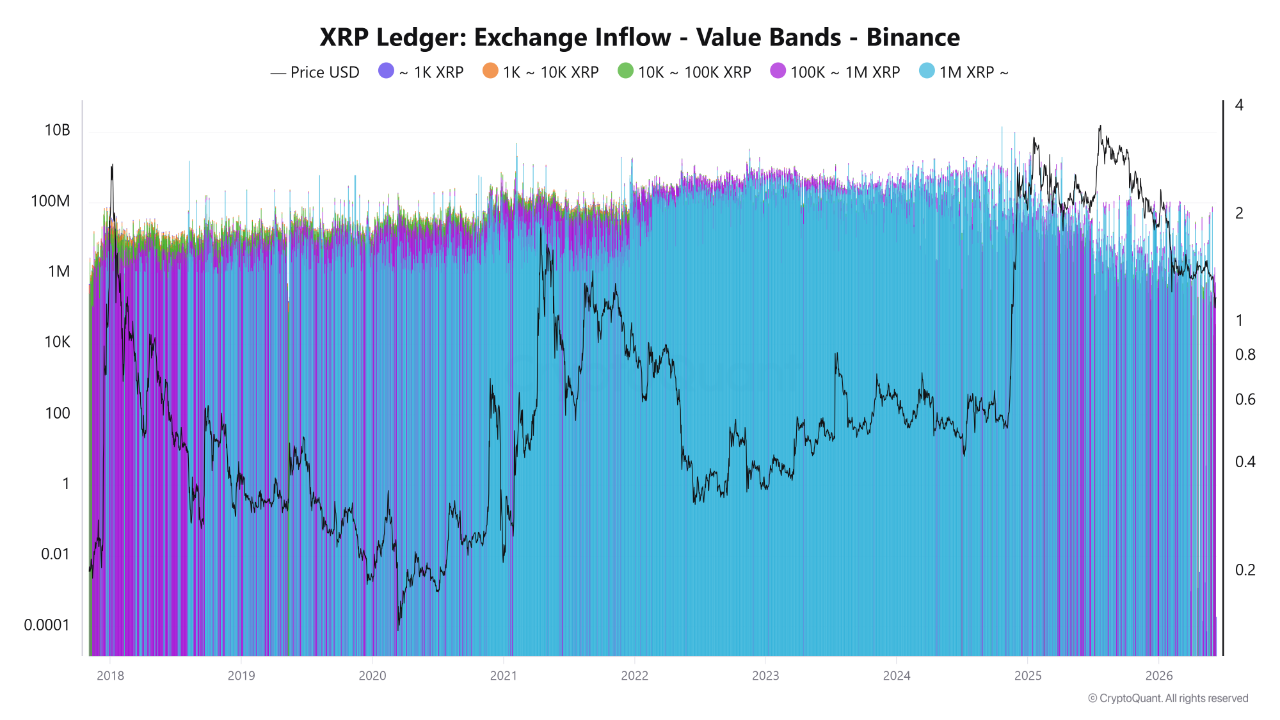
CryptoQuant contributor PelinayPA shared this view in a recent on-chain analysis. The analyst argued that declining XRP inflows to Binance suggest that large holders are becoming less willing to move tokens to exchanges. This could reduce selling pressure and support market stability.

Whale Activity on Binance Has Slowed

According to the analysis, transfers of more than 1 million XRP have historically accounted for a large share of XRP inflows to Binance. Between 2021 and 2025, these large transactions remained consistently high. This trend indicated active participation by whales and institutional investors.

However, the pattern has changed. After peaking in 2025, transfers of more than 1 million XRP to Binance began to decline. This drop has continued as XRP price retreated from highs above $3. Notably, the price has since fallen to $1.01 as of June.

The analyst noted that large exchange inflows typically imply selling activity. Investors usually move assets to trading platforms when preparing to sell.

No Evidence of Heavy Whale Selling

PelinayPA pointed out that previous major XRP downturns were preceded by sharp increases in exchange inflows. These spikes were especially visible in the 100,000–1 million XRP and 1 million+ XRP transfer categories.

So far, no similar surge has appeared in the current data. This suggests that whales are not engaging in widespread profit-taking despite XRP’s recent decline.

The analyst added that lower exchange inflows since the XRP ETF approval indicate growing confidence among large holders. In other words, fewer whales appear willing to liquidate their positions.

Recent Weakness May Have Other Causes

Rather than whale selling, the recent XRP correction may be due to leverage liquidations and broader weakness across the crypto market. Historically, severe bear markets are accompanied by large spikes in exchange inflows as investors rush to exit positions.

Current on-chain data does not show this type of behavior. As a result, the analyst believes XRP’s market structure remains relatively healthy.

Lower Exchange Supply Could Support Recovery

If Binance inflows remain low, the amount of XRP available for sale on exchanges could continue to shrink. Combined with stronger demand, reduced exchange supply creates more favorable conditions for a price recovery.

According to the analysis, keeping 1 million+ XRP inflows at subdued levels would help preserve the current market structure. It could also improve XRP’s chances of revisiting the $1.80–$2.00 range in the future.

At press time, XRP is trading at $1.10, down 4.4% over the past day and 15% over the past week.

Early Dogecoin Developer Explains Why DOGE Could Become a Top-Five Crypto by 2026 end

0

Prominent Dogecoin developer BuildrJ has outlined a detailed case for why DOGE could become a top-five cryptocurrency before the end of 2026.

In an X article titled “Wen $1?”, BuildrJ argued that Dogecoin’s prolonged price stagnation does not stem from weak demand, but from structural limitations within its ecosystem. Specifically, he believes the network lacks a native on-chain economy capable of retaining capital and compounding value over time.

Decentralization Remains Dogecoin’s Greatest Strength

According to BuildrJ, Dogecoin differs fundamentally from most modern crypto projects. He noted that the cryptocurrency launched in 2013 without venture capital (VC) backing, pre-mined allocations, or insider token distributions.

He argued that Dogecoin grew organically through community support rather than corporate fundraising structures. In his view, this history makes DOGE one of the most decentralized digital currencies in the industry.

Dogecoin Struggling to Attain a Sustained Breakout

Despite its decentralization, BuildrJ acknowledged that Dogecoin continues to struggle to achieve a sustained breakout. He attributed this challenge to the network’s lack of smart-contract functionality and a native on-chain economy. Consequently, Dogecoin cannot currently support decentralized finance (DeFi), applications, or other blockchain-based services that help retain liquidity and generate economic activity.

BuildrJ described Dogecoin as a value-transfer network rather than a self-sustaining digital economy. Under this structure, investor attention and capital flow into DOGE but eventually leave the ecosystem through centralized exchanges and stablecoins, limiting long-term value creation for the network and its holders.

Highlighting the disparity, BuildrJ compared Dogecoin with Solana and Ethereum in terms of their total value locked (TVL). While Ethereum and Solana support $36.62 billion and $4.77 billion in total value locked, respectively, Dogecoin’s TVL remains virtually nonexistent despite maintaining a market capitalization of more than $14 billion.

Why BuildrJ Sees a Top-Five Future for Dogecoin

BuildrJ argued that Dogecoin already commands a multi-billion-dollar valuation based largely on brand recognition, cultural relevance, and community loyalty. Therefore, he believes introducing meaningful utility could significantly strengthen its value proposition.

Moreover, BuildrJ suggested that Dogecoin only needs a functional native economy where users can transact, deploy applications, and participate in DeFi-style activities.

According to him, stronger on-chain activity would increase transaction volume, attract liquidity, encourage developer participation, and ultimately support higher valuations.

Within that framework, BuildrJ contended that a market capitalization of around $40 billion—a level that could potentially secure a top-five ranking under certain market conditions—should be viewed as a realistic revaluation rather than an unrealistic moonshot.

Dogecoin’s Path to $40B 

For context, Solana currently ranks as the fifth-largest non-stablecoin cryptocurrency with a market capitalization of approximately $37.08 billion. To reach a $40 billion valuation, Dogecoin would need to grow roughly 180.7% from its current market cap of $14.25 billion, pushing its price from about $0.08369 to $0.2349. 

This projection assumes that Solana and the broader crypto market remain relatively stable while Dogecoin experiences significant growth. However, investors should note that this does not guarantee an imminent rally. The token continues to face bearish pressure, having dropped 2.93% over the past day and 11.3% over the past week. 

“This Space Would be Worse off Without Cardano,” Flare Co-founder Supports Hoskinson’s Return

0

The Flare co-founder has welcomed Hoskinson on his return, suggesting that the crypto space would be worse off without Cardano.

Following Cardano founder Charles Hoskinson’s brief break from public activities and his return a few days later, Flare co-founder Hugo Philion has welcomed him back despite their recent public disagreements.

Flare Co-founder Says the Industry Benefits from Hoskinson’s Presence

Shortly after Hoskinson became active again on X, Philion shared a message expressing support for his return. 

While the two blockchain leaders have recently clashed over issues related to XRP and Bitcoin interoperability, Philion stressed that he still values Hoskinson’s contribution to the crypto industry.

The Flare co-founder explained that he had disagreed with Hoskinson over what he saw as unnecessary duplication of work involving XRP and Bitcoin interoperability.

To him, networks already have access to these capabilities through FXRP and FBTC using Layer-Zero. Despite the disagreement that ensued from his opinion, he recently admitted that the industry remains better with Hoskinson than without him.

Flare Cofounder on X

According to Philion, the crypto space would be worse off without Hoskinson, Cardano, and Midnight.

The Disagreement That Put Both Founders at Odds

Philion’s remarks came not long after a public exchange with Hoskinson over decentralized finance and Bitcoin-focused blockchain development.

The disagreement emerged early last month when Hoskinson promoted Cardano’s efforts to make Bitcoin programmable through smart contracts. The goal is to allow Bitcoin holders to access DeFi applications, generate yield, and use a range of financial services.

In response, Philion suggested that Flare was already providing the proper solution. He then compared Flare’s progress with Cardano’s. The Flare Labs CEO pointed out that Cardano launched in 2017, giving it nearly a six-year head start over Flare, which launched in 2023. 

Despite the advantage, DeFi Llama data showed that Flare had around $159 million in total value locked at the time, while Cardano held around $132 million during the same period.

He argued that Cardano had spent years trying to follow a strategy that Flare had already built around data oracles, FAssets such as FXRP and FBTC, and a unified DeFi layer designed to support XRP, Bitcoin, XLM, real-world assets, and stablecoins. 

Hoskinson downplayed the criticism. He suggested that attacking Cardano was an outdated way to gain attention and implied that the comments merely aimed to garner publicity.

Why Hoskinson Took a Break

The exchange happened shortly before Hoskinson announced a temporary step back from public engagement.

On June 3, he posted a brief message on X saying he was taking a break and would return later. The announcement followed a video in which he openly discussed several challenges facing the Cardano ecosystem.

Hoskinson’s announcement came during a broader market downturn and was followed by a sharp decline in ADA.

The token fell around 10% shortly after his post and briefly dropped below $0.20 for the first time in more than five years. As market weakness continued, ADA later fell below $0.15.

However, Hoskinson moved to clear up speculation. During a livestream on June 4, he explained that he was not leaving Cardano. Instead, he said he was simply stepping back from videos, interviews, and frequent activity on X while taking time to reflect. 

By June 8, Hoskinson had returned to X. He hosted a broadcast focused on his view that Cardano remains the only ecosystem capable of “running the world.” His return prompted Philion’s message of support.

Dormant Cardano Wallets’ Activity Just Printed a Major Reversal Signal

0

Long-dormant Cardano wallets begin moving ADA tokens again after staying away for a while, rekindling hopes of an imminent price rebound.

Fresh data from market intelligence platform Santiment highlighted this unusual activity across key age-based metrics. In a June 10 tweet, it suggested that older ADA holdings are becoming active after an extended period of inactivity.

This is notable because it comes at a time when sentiment around Cardano (ADA) remains uncertain. Recent selling pressure has pushed ADA toward lower levels, with the asset dipping over 87% from its bull cycle high of $1.32.

Amid this downturn, recent on-chain activity is telling a positive story. Instead of continued dormancy, older ADA coins are suddenly changing hands, a development that often signals a behavioral change among long-term holders. While the signals do not guarantee a price rebound, Santiment noted that they have historically appeared around periods of price reversal.

Dormant Cardano Holders Show Signs of Life

According to the Santiment data, Cardano’s Mean Dollar Invested Age had been rising steadily for some time now. For the uninitiated, this metric tracks the average age of capital held across ADA wallets and generally increases when coins remain dormant.

An accompanying chart shows the indicator climbing consistently from early May until the first week of June. However, that trend recently paused for the first time in five weeks.

Cardano Dormant Wallets Start Moving/Santiment

At the same time, the Age Consumed metric registered several major spikes between June 4 and 9. The largest surge occurred on June 9, marking the strongest spike since April.

Notably, “Age Consumed” measures how many tokens were moved and how long they have been held before moving. The metric increases sharply when dormant holdings suddenly start moving.

Santiment noted that the combination of these two developments is significant because it suggests long-term holders are becoming active again after months of relative inactivity. The recent price capitulation is motivating them to start moving their stash again.

What the Cardano On-Chain Metrics Are Signaling

Interestingly, the chart highlights multiple clusters of Age Consumed spikes during the recent decline. Several large bursts appeared between June 4 and June 5 as ADA continued moving lower. Another even larger spike emerged on June 9.

Historically, periods where Age Consumed rises sharply while Mean Dollar Invested Age stalls or declines have often coincided with shifts in market direction.

According to the analysis, the logic is relatively straightforward. When older holders begin moving coins after extended periods of inactivity, it signals that dormant supply is re-entering circulation. In some cases, this reflects distribution. In others, it marks repositioning ahead of changing market conditions.

What makes the current setup noteworthy is that the spikes arrived immediately after a sharp ADA correction. Santiment specifically noted that the recent surge in dormant wallet activity occurred as prices weakened, suggesting the decline may have prompted long-term participants to react.

While that does not automatically translate into bullish momentum, Santiment noted that it could spark a price rebound for the blue-chip cryptocurrency.

16 million ADA Leaves Exchanges, Reinforcing Bullish Narrative

Coinglass’ Cardano spot flow data further suggests that market participants are positioning massively in anticipation of a price rebound. Over the past 24 hours, approximately 16 million worth of ADA has left exchanges to self-custody wallets, signaling accumulation.

Per the data, Cardano spot inflows stood at $30 million, while outflows were $32.62 million, producing a net exchange flow of -$2.54 million. When converted at the current price of $0.16, it amounts to nearly 16 million ADA.

Cardano Spot Flow/Coinglass

Such large amounts of Cardano leaving exchanges support the narrative that wallets are buying the dip, reinforcing their confidence in the asset’s near- and long-term trajectory.

Dogecoin Holders With More Than 1,000 DOGE Rank Among Top 10% of Wallets as Price Falls

A new snapshot of Dogecoin wallet distribution shows that holding more than 1,000 DOGE is enough to place an investor among the top 10% of Dogecoin wallet addresses by balance.

The observation was highlighted by Dogecoin community member Namtoshi Dogemoto. He shared updated data on X on how DOGE is distributed across wallet addresses.

Most Wallets Hold Less Than 1,000 DOGE

According to distribution data dated June 9, 2026, more than 8.2 million Dogecoin addresses hold between 0.1 and 1 DOGE. Another 1.51 million addresses hold between 1 and 10 DOGE.

Addresses with between 100 and 1,000 DOGE account for about 12.34% of all wallets. The number of addresses drops sharply above the 1,000 DOGE mark.

Only 6.89% of wallets hold between 1,000 and 10,000 DOGE. Another 2.27% hold between 10,000 and 100,000 DOGE.

Based on the data, wallets holding more than 1,000 DOGE make up roughly 9.63% of all Dogecoin addresses. That means anyone with more than 1,000 DOGE ranks within the top 10% of holders by wallet balance.

Large Holders Continue to Dominate Supply

Although most wallets contain relatively small amounts of DOGE, a small number of large holders control a significant share of the supply. The data shows:

  • 653 wallets hold between 10 million and 100 million DOGE.
  • 135 wallets hold between 100 million and 1 billion DOGE.
  • 10 wallets hold between 1 billion and 10 billion DOGE.
  • Just 3 wallets hold between 10 billion and 100 billion DOGE.

Those three largest addresses alone control about 51.69 billion DOGE, equal to roughly 33.43% of the total supply.

Meanwhile, wallets holding between 100 million and 1 billion DOGE collectively account for another 23.01% of all DOGE in circulation.

Image

What Could 1,000 DOGE Be Worth?

At Dogecoin’s current price of $0.0838, 1,000 DOGE is worth about $83.80. If DOGE returns to previously discussed price levels, the value could increase significantly.

For instance, at a price of $0.50, 1,000 DOGE will be worth $500, and at its all-time high, the value will reach $737.60. 

For larger holders:

DOGE Holdings Current Value At $0.50 At $0.7376 At $1
10,000 DOGE $838 $5,000 $7,376 $10,000
100,000 DOGE $8,380 $50,000 $73,760 $100,000
1,000,000 DOGE $83,800 $500,000 $737,600 $1 million

These figures help explain why some long-term investors continue accumulating DOGE despite recent market weakness.

DOGE Extends Weekly Decline

Dogecoin has remained under pressure alongside the cryptocurrency market. According to CoinMarketCap data, DOGE is down 3.13% over the past 24 hours. 

The meme coin has also fallen 11% over the past seven days, 23% over the last month, and 29% since the beginning of the year. The recent decline comes amid the ongoing bear market and Bitcoin-led selling pressure. 

Has XRP Finally Bottomed? What Chart Data Says About a Potential Reversal

0

Analysts and traders continue to assess whether the recent XRP price crash finally marked the token’s bottom, anticipating a reversal.

XRP recently recorded its biggest decline of the year as the broader crypto market came under new selling pressure. On June 6, the token dropped to a new yearly low of $1.05 before recovering slightly. At the time of analysis, XRP was trading around $1.11.

The massive decline has led to renewed discussions among market observers about whether XRP had finally reached its bottom in the months-long correction.

Key Levels That Could Decide XRP’s Next Move

In a recent analysis, market commentator Casi noted that XRP had found support at the major 0.786 macro retracement level around $1.09 before bouncing higher. After the rebound, the token moved up to a local 0.382 retracement level, which she identified as point A. This sits around $1.17.

Casi believes XRP is now finishing what appears to be a Wave B correction. She noted that the target for this B wave sits at the 0.5 retracement level near $1.12, a level that XRP has managed to hold so far.

She noted that if the current rebound develops into a standard ABC corrective pattern, XRP should remain above the $1.12 area and gradually move toward the next resistance level at $1.25.

XRP 1h Chart Casi
XRP 1h Chart | Casi

According to her, the $1.25 zone is especially important because it marks the upper range of where the current Wave 4 relief rally could extend while still allowing for a final Wave 5 decline. In this scenario, XRP could eventually fall toward the $0.90 support area before completing the larger correction.

Bullish and Bearish Outcomes for XRP

Casi said the market’s behavior over the coming days could provide clearer direction. In her bullish scenario, XRP continues holding above $1.12, breaks through nearby resistance levels, and gains enough momentum to push higher.

According to her, a move above $1.30 is a major sign of strength. She noted that a rally toward $1.65 would significantly reduce the likelihood of another drop to the $0.90 region, making a final Wave 5 decline far less necessary.

However, the analyst also shared a bearish possibility. In this case, XRP would rise toward the $1.25 resistance area but fail to break above it. If sellers step in at that level, the token could reverse course and fall below the 0.786 support level at $1.09.

Should that happen, Casi believes XRP could continue lower toward the $0.90 zone, completing what she described as the broader macro Wave 2 correction.

For now, she advises traders to watch how XRP reacts around the $1.12 support level and the $1.25 resistance level over the next one to two days. According to her, the price action around those areas should help determine whether the market has already formed a bottom or if one final downward move still lies ahead.

One More Low May Still Be Ahead

Meanwhile, Tara, another analyst, pointed out that XRP has already reached its target resistance level around $1.17. However, she noted that Bitcoin has yet to reach its own target.

According to Tara, Bitcoin’s next move could still influence XRP in the short term. She suggested that if Bitcoin climbs toward the $66,300 level, XRP could see additional upward movement and potentially reach the $1.20 resistance area.

XRP 1D Chart Tara
XRP 1D Chart | Tara

Despite this possibility, Tara warned that traders should pay close attention to whether XRP can move above $1.17 during the current rebound. If the token fails to set a new high above that level, the projected Wave 5 target could remain in play.

In this scenario, Tara noted that the Wave 5 0.618 extension aligns closely with the broader 0.786 macro support level at $0.88. As a result, she believes XRP could still make one more move lower before the current correction fully ends, suggesting that the final bottom may not yet be in place.

XRP Rich List Threshold Falls as Just 2,155 XRP Secures Top 10% Status

0

As XRP recovers from recent lows, the amount of XRP required to rank among the network’s wealthiest holders continues to decline.

Prominent community figures, including Zach Rector and Adam, have highlighted the shrinking thresholds needed to join the XRP Rich List. According to the Rich List data, investors currently need just 2,155.59 XRP to rank among the top 10% of all XRP holders.

Notably, the XRP Ledger currently hosts 7.91 million accounts, yet only 790,900 wallets hold at least 2,155.59 XRP. At XRP’s current price of $1.11, acquiring that amount would cost approximately $2,392. 

Top 5%, 1%, and 0.1% Thresholds 

The data also reveals that investors need about 7,507 XRP to enter the top 5%, 45,002 XRP to reach the top 1%, and more than 279,000 XRP to break into the top 0.1%. Currently, around 395,450 wallets, 79,090 wallets, and 7,909 wallets meet the thresholds for the top 5%, 1%, and 0.1%, respectively. 

In the highest tier, only 791 wallets hold more than 3.83 million XRP, placing them in the top 0.01% of all accounts. 

Image

XRP Rich List Threshold Shrinks 

Notably, these thresholds have fallen considerably since February 2026. At that time, investors needed approximately 2,231 XRP to enter the top 10%. Today, that figure has dropped by about 3.4% to 2,155 XRP. 

Likewise, the requirements for the top 5% and top 1% have declined from roughly 7,745 XRP and 46,426 XRP in February to 7,507 XRP and 45,002 XRP, respectively.

The latest figures come as XRP attempts to recover from a broader market downturn. The cryptocurrency fell to a low of $1.05 on June 6, 2026, before rebounding above $1.18 yesterday, on June 9. It has since retraced to around $1.11 at press time. 

An Opportunity? 

Meanwhile, many investors view the recent weakness as an opportunity to accumulate more XRP and improve their standing on the Rich List ahead of a potential rally. Several market analysts have projected significantly higher prices for XRP, with some forecasting a move toward $10.

If XRP were to reach that level, a holder with 2,155 XRP—currently enough to rank in the top 10%—would see the value of their holdings increase to $21,550, representing a gain of nearly 800% from current levels.

Despite growing optimism and ambitious price targets, there is no guarantee that XRP will achieve such gains. As a result, investors should view these projections as speculative scenarios rather than certain outcomes. 

If Dogecoin Falls Further, Here Are Support Levels to Watch

0

As Dogecoin continues to look weak amid a broader market downtrend, here are key Dogecoin support levels to watch closely.

Notably, Dogecoin (DOGE) has slid further this week, dropping 3% since Sunday. Despite a strong start to the week, prices have begun to trend south again, joining the rest of the cryptocurrency market.

The crypto market cap dropped 2.9% in the past 24 hours to $2.12 trillion, following Bitcoin’s 3% correction to $61,400 and DOGE’s 3.3% dip to $0.0836 over the past 24 hours.

Meanwhile, the Tuesday correction is not limited to the crypto sector alone. Major financial assets like gold, silver, oil, and US equity also bled on uncertainties around the US-Iran peace talks.

Dogecoin at Key Weekly Support

Currently, Dogecoin sits around the $0.075 weekly support, an area that has triggered major rebounds in the past. The token has not lost this demand zone since early 2024, despite facing several price crashes.

Analysts also see the current level as an extreme opportunity zone for accumulation. With DOGE enduring a prolonged correction and prices now near levels where it has recovered from in the past, many see the current price as a bargain. Moreover, the upside reward is growing more appealing than the downward risk, further supporting the view that the current price level looks cheap.

However, bears are still in full control of the market. Prices are still forming lower highs and remain below key momentum indicators, leaving the chances of further downtrends alive. Should the current support break and Dogecoin trend lower, here are the supports to watch.

Dogecoin Support Levels to Watch

The closest major support to watch is the $0.062-$0.53 range. Notably, DOGE has not lost this support since breaking above in March 2021.

Dogecoin 1W Chart Showing Next Major Support

The token bottomed around this support during the 2022 bear market, forming the foundation for the last bull market. Interestingly, the last time the meme coin visited this area was in October 2023 when it dumped to $0.0567. From there, it bounced by an impressive 753% to $0.484 in December 2024.

DOGE would have to drop by 26% to 37% from the current market price to reach this major weekly support at $0.062-$0.053.

Losing this level places Dogecoin in serious risk of a much larger correction. The next support after this is $0.0413, where the token bottomed in February 2021. Reaching this level would see the meme coin lose over 50% of its current value.

DOGE On-Chain Data

In the meantime, sentiment around Dogecoin remains negative, as market participants appear to be losing interest in the asset. This has been reflected in its on-chain metrics.

Derivative interest has faded, with futures flow dropping over the past 24 hours. Futures inflow of $396 million is lower than the outflow of $427.5 million, showing that more traders closed their open positions than opened new ones.

Dogecoin Futures Flow/Coinglass

Open interest has also dropped 3% to $1 billion, confirming this trend. At the same time, trading volume has declined by 5% in the past 24 hours, as market activity cools off.