Home Blog Page 10

Hyperliquid Whale With 99% Win Rate Adds to $1.36M XRP Long Despite 21% Loss

0

A Grade-S Hyperliquid whale has continued to add to his million-dollar XRP long position despite currently nursing losses due to the recent price crash.

XRP recently collapsed alongside the rest of the crypto market after the U.S. Senate failed to advance the Clarity Act during the much-watched cloture vote. Specifically, the asset crashed 9.81% on Sept. 15, marking its largest intraday drop in seven months.

However, despite XRP facing this steep decline and dropping below $1.30, one Hyperliquid whale boasting a 99.3%-win rate has continued to add to his XRP long position, demonstrating what appears to be firm conviction in the asset’s resilience.

The Initial XRP Long Position

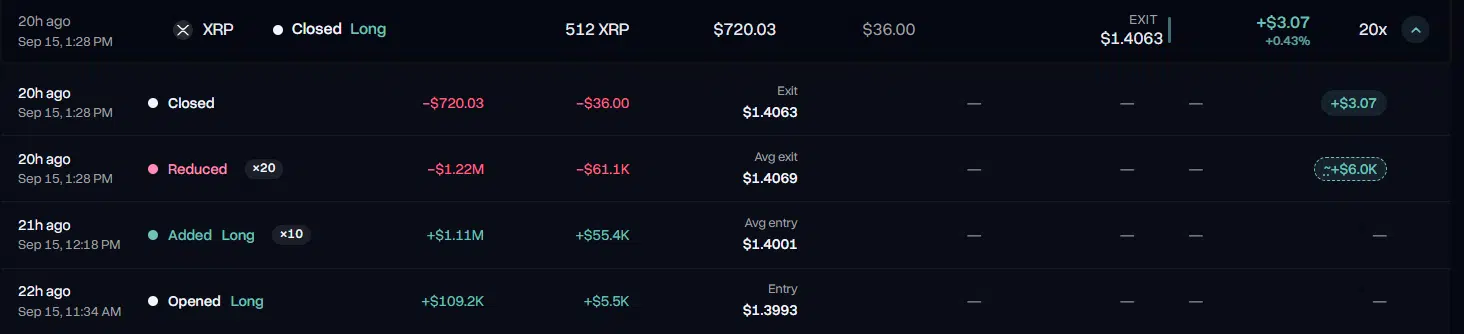
This whale, with address 0xa…566, first opened an initial XRP long position at 10:34 AM UTC on Sept. 15 while XRP was recovering from the drop to $1.38. The whale then added $1.11 million to the position an hour later.
Initial XRP Long
Initial XRP Long

After XRP soared to a local top of $1.45 by 1 PM the same day, the price started correcting as the U.S. Senate failed to advance the Clarity Act, leading to massive selling pressure across the crypto market.

Interestingly, the whale had already reduced his trade and closed the position at a price of $1.40 before the XRP price crash picked up. As a result, he secured a meager $6,000 profit from the trade.

Current XRP Position in Loss

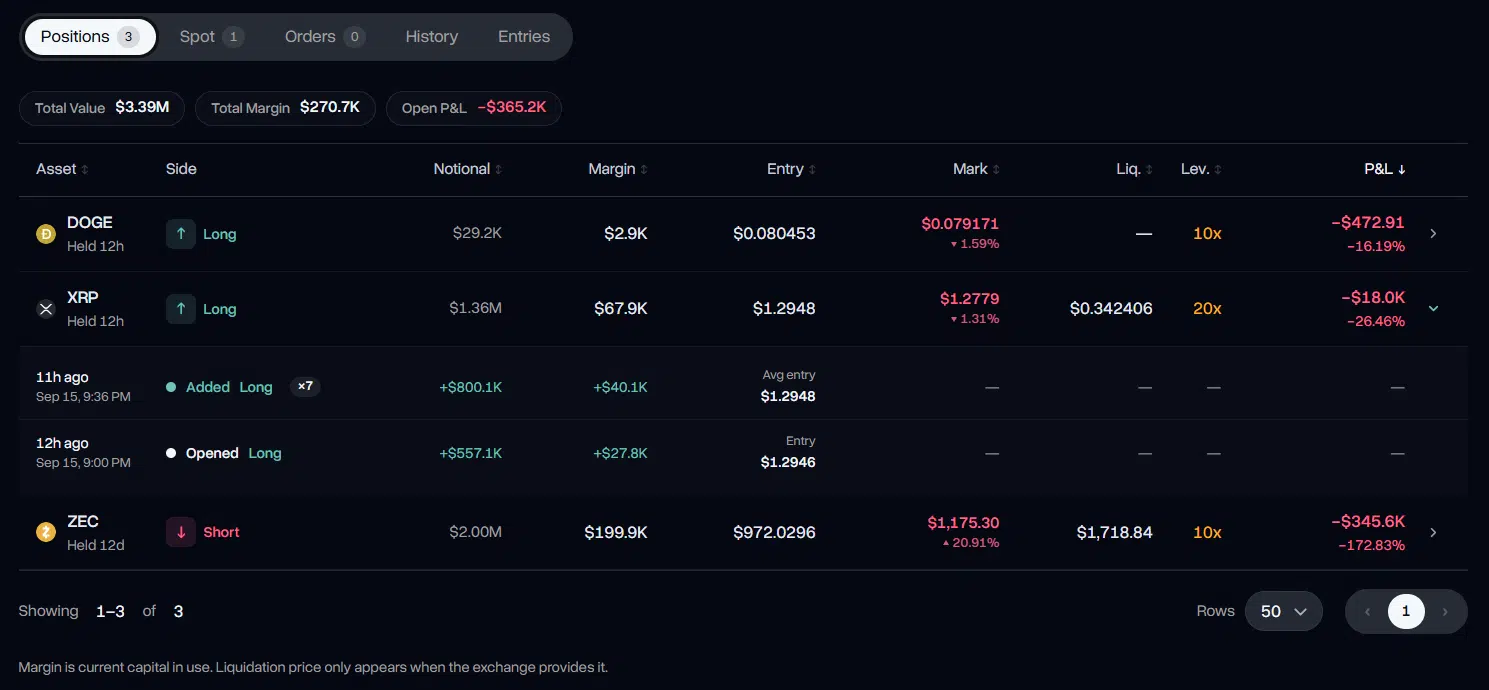
While the market panicked, this whale instead chose the opposite direction. Notably, he again opened an XRP long position worth $557K at 8 PM UTC on Sept. 15, hours into the price crash. The entry for this trade stood at $1.2946. At the time, XRP was already down 9% on the day.

About half an hour later, he increased the position by $800,000 at an entry price of $1.2948 while XRP was still facing massive declines, bringing total notional value to $1.36 million. Since then, the trader has maintained this position, having held for up to 12 hours now. 
Hyperliquid Whale Nursing Loss on XRP Long

However, with XRP collapsing further to the current price of around $1.27, the trader is currently witnessing a massive 26.46% loss on the position, with losses sitting at $18,000 at a 20x leverage. Still, the whale would only suffer a liquidation if XRP collapsed to $0.34, a 73% drop from the current price.

History Shows Promising Results

At press time, liquidation appears unlikely unless the market faces a sudden Black Swan event. Interestingly, this whale has not recorded any liquidations in his entire history of 111 trades. Of this figure, he has witnessed 110 wins and just 1 loss, giving him a 99% win rate.
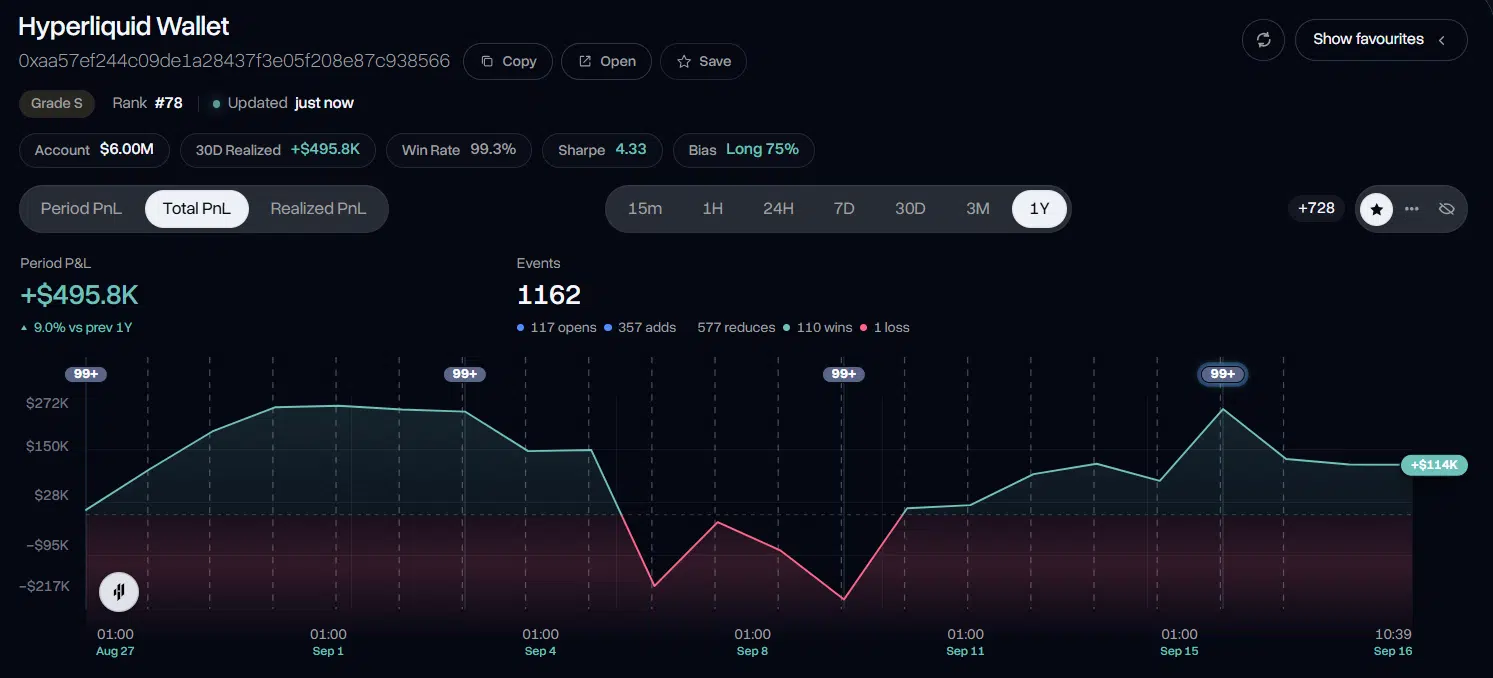
Wallet Overview
Wallet Overview

Further data shows that the account is fairly new, having begun trading on Aug. 27, about three weeks ago. Within this period, he has secured a total profit of $495K, with a Sharpe ratio of 4.33 and a bias sitting at 75% Long.

XRP Ledger Batch Feature Enters Activation as 29 Validators Vote Yes

0

The XRP Ledger’s (XRPL) Batch amendment has received enough validator support and is now in its activation period.

XRPL validator Vet (Hussein Zangana) said 29 of 35 validators voted yes, giving the amendment 82.86% support.

The amendment reached the required 80% support on September 15, 2026. Meanwhile, it must maintain that level for 14 days before going live. If everything stays on track, the Batch amendment will activate on September 29, 2026.

Batch Lets You Combine Up to 8 XRP Ledger Transactions

The Batch feature will let users combine up to eight XRPL transactions into one. This will make it easier for businesses and developers to handle several actions at the same time.

For example, Batch can be used for:

  • Tokenized securities: A security and its payment can happen at the same time.
  • Asset swaps: Users can swap NFTs, MPTs, and other tokens in one operation.
  • Fees: Apps can include service fees together with other transactions.
  • DEX trading: Multiple swaps with different conditions can be combined into one transaction.
  • NFT trading: Users can trade one NFT for another in a single operation.

Essentially, Batch makes complex transactions on the XRPL simpler and more efficient.

Count down on activation on XRP Ledger

Institutional Use Is a Key Benefit

The Batch amendment will be useful for banks and other financial institutions. It will allow institutions to:

  • Trade securities directly with each other.
  • Complete a security and its payment at the same time.
  • Handle over-the-counter (OTC) trades more efficiently.
  • Help developers and financial apps manage payments and fees.

XRPL community member Luke Judges also highlighted Batch as useful for financial markets and app developers. The amendment reached 28 Yes votes before getting the 29th vote needed to enter the activation period.

Lending Is the Next Big Institutional Feature

Vet said his personal roadmap for institutional features is: Batch → P Delegation → Lending v1 + v1.1 → More features

He explained that Batch and P Delegation are being brought back, while Lending v1.1 may add a feature that allows both lending amendments to be voted on together.

Vet called lending the “big one” for institutions because it will bring XRP yield and on-chain lending to the XRPL.

With Batch now in its 14-day activation period, attention is starting to move toward the next features that will expand XRPL for developers, financial institutions, and on-chain finance.

Bitcoin and Gold Correlation Hits Extreme Levels as BTC Looks More Like ‘Digital Gold’

0

Bitcoin and gold are moving together more closely than they have in years. This challenges the usual view that Bitcoin is a riskier asset, while gold is a safe haven.

Adam Livingston, vice president of investments at Strive, pointed out this change on X, noting that Bitcoin and gold have become much more closely correlated across different time periods.

Bitcoin-Gold Correlation Surges

Livingston said Bitcoin and gold had a full-sample correlation of only +0.17 since 2020, meaning the two assets generally moved independently over the period. The yearly figures remained relatively low:

  • 2020: +0.26
  • 2021: +0.01
  • 2022: +0.12
  • 2023: +0.12
  • 2024: +0.14
  • 2025: +0.09
  • 2026 YTD: +0.43

However, the shorter-term readings have climbed much higher. Livingston cited a 30-day correlation of +0.68, a 60-day reading of +0.58, a 90-day correlation of +0.63, and a 252-day correlation of +0.41.

He said the 30-day and 252-day readings were around the 99th percentile of their historical ranges, while the 90-day reading was near the 99.9th percentile.

Bitcoin gold correlation by by Adam Livingston
Bitcoin gold correlation by Adam Livingston

Bitcoin’s “Risk-On” Narrative May Be Changing

Bitcoin has traditionally been seen as a riskier asset, while gold is viewed as a safe-haven asset during inflation, currency worries, or financial uncertainty. But that difference may be changing as Bitcoin and gold are increasingly moving in the same direction.

Livingston suggested that Bitcoin and gold could be seen as “two different exits from the same system” rather than completely opposite investments. This comes as investors continue to watch inflation, interest rates, bond yields and currency movements.

Gold is at around $4,300 per ounce as markets await the Federal Reserve’s latest interest-rate decision. Reuters reported that gold later rose 0.8% to $4,326. Meanwhile, Bitcoin is around $75,800, dipping 2% over the past day.

Bitcoin and Gold Face the Same Macro Challenges

Notably, the strong connection between Bitcoin and gold comes as U.S. Treasury yields have risen sharply, with the 10-year yield briefly topping 5% before falling back. 

Higher yields and a stronger dollar can put pressure on assets like gold that do not pay interest. Bitcoin has also faced selling pressure recently, closing September 15 at around $75,613 after trading above $82,000 earlier in the month.

Meanwhile, the high correlation does not mean Bitcoin and gold will always move together. Correlation simply shows how closely two assets have moved over a certain period. It does not mean one causes the other to move.

But the unusually high correlation suggests that the relationship between Bitcoin and gold has changed significantly in recent months. Some crypto users have pointed to this as a sign that Bitcoin is “finally acting like digital gold.”

XRP CVD Plunges to -10.575M as Sudden Sell-Off Hits Market

0

The XRP spot CVD has collapsed amid heavy selling pressure after the U.S. Senate failed to advance the CLARITY Act through a key cloture vote. 

For context, XRP fell more than 10% from around $1.40, and its spot Cumulative Volume Delta (CVD) on Bybit dropped to -10.575 million. 

In addition, the broader crypto market also fell after the result. Notably, the total crypto market cap lost $88 billion on Sept. 15, marking its biggest intraday decline since early June 2026. 

Bitcoin dropped 3.26% to below $76,000, while Ethereum fell 4.66% to $2,300. Meanwhile, XRP ended the day down 9.81%, marking its largest daily decline since the 19% crash on Feb. 5.

Clarity Act Fails to Advance in Senate

For context, the U.S. Senate held its cloture vote on the Clarity Act on Sept. 15. The bill required about 60 votes to move forward to formal debate, but only 50 senators voted in favor, and 49 voted against it. 

The result stopped the legislation from moving ahead and dealt a major setback to efforts to establish a broader federal framework for digital assets in 2026.

Senator Thom Tillis changed his vote from yes to no at the last moment. Other Republicans, including Senators Josh Hawley, Susan Collins, and Jerry Moran, also did not support the bill. 

Republican leaders had continued changing the bill in the final days to gain more Democratic support. The latest changes included new ethics rules aimed at stopping senior government officials from profiting from crypto ventures. 

However, those changes did not produce enough votes. The legislation had already gone through more than 120 changes to address Democratic concerns, while the crypto industry had spent large funds supporting the effort.

XRP CVD Shows Sharp Selling Shift

XRP’s spot order flow switched directions immediately after the vote. Before the result, the XRP chart on Bybit showed CVD at 6.512 million. This reading confirmed that aggressive buyers had been active and had pushed net spot buying up ahead of the vote.

XRP CVD Crashes
XRP CVD Crashes

Interestingly, the metric later fell to -10.575 million almost immediately, creating a swing of more than 17 million in cumulative delta within hours. As CVD measures the difference between aggressive buying and selling volume, the sudden decline shows that sellers began hitting bids much more aggressively.

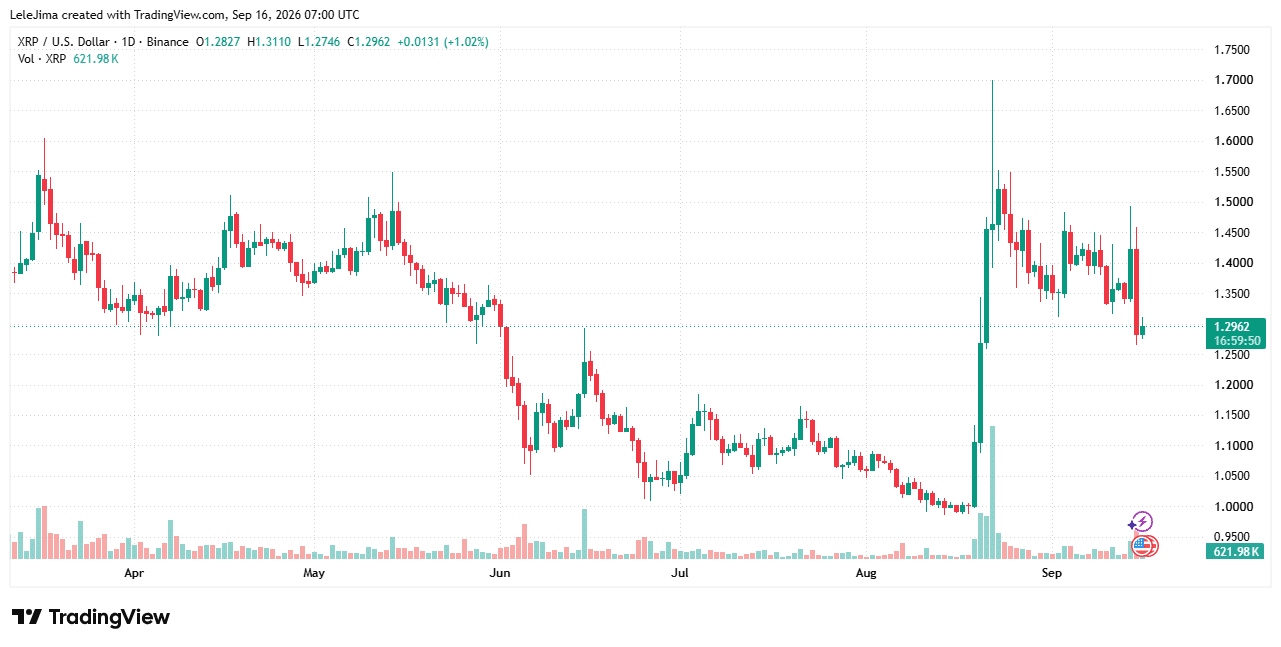
Notably, XRP traded near $1.40 before the vote but then lost more than 10% before finding some support. The price has since recovered slightly, rising 0.76% today to around $1.29 at press time.

$1.20 and $1.00 Remain Important Levels

The Sept. 15 decline has left XRP in a weaker short-term position. Although the token has started to recover slightly, its CVD remains deeply negative. A continued decline in CVD would show that aggressive sellers remain active, but a recovery toward positive territory would point to a return of stronger spot buying.

The next major support area to watch sits around $1.20. If XRP fails to hold this level, the $1.00 psychological support could come back into focus. The market also faces another potential source of volatility on Sept. 16 as the Federal Reserve announces its interest-rate decision.

At the time of the analysis, markets had priced roughly a 60% chance of a 25-basis-point rate hike. This potential macro pressure comes just one day after the Clarity Act vote.

Here Is the Only Reason Why XRP Is Falling Sharply Today

0

XRP has posted a sharper decline than most major cryptocurrencies over the past 24 hours, with its price falling below the $1.30 threshold.

The broader crypto market also came under heavy selling pressure after the U.S. Senate failed to advance the Digital Asset Market Clarity Act, commonly known as the CLARITY Act.

XRP Records the Largest Drop Among Top Cryptocurrencies

The Senate’s final cloture vote on the motion to proceed to the CLARITY Act (H.R. 3633) ended with 49 senators voting in favor and 50 voting against. As a result, the bill failed to secure the 60 votes needed to move forward to formal debate.

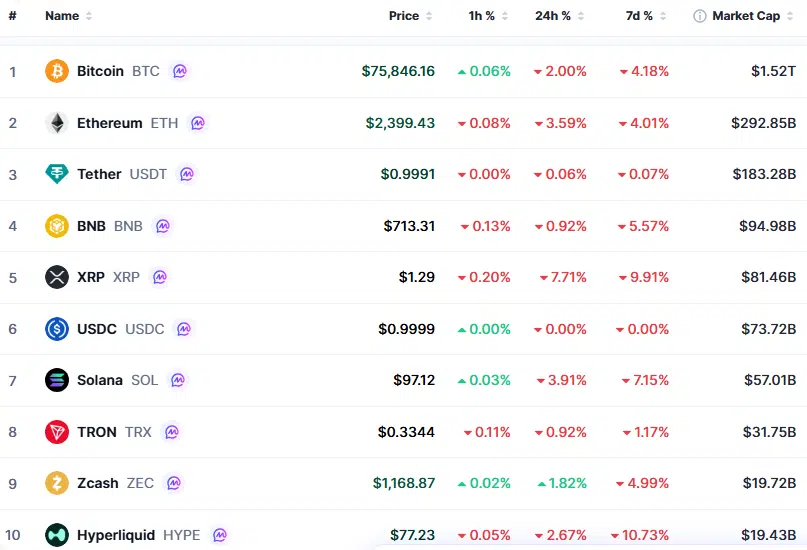
XRP sold off alongside the broader market following the vote. However, the token’s decline was considerably steeper than that of several other leading cryptocurrencies. Among the top 10 cryptocurrencies by market cap, XRP recorded the largest 24-hour decline, falling 7.71%. Solana followed, down 3.91% over the same period. 

Crypto Market Performance

Before the Senate vote, XRP traded at around $1.40. The token later fell to $1.29, leaving it with a market cap of roughly $81.34 billion and making it the fifth-largest cryptocurrency by market value. 

XRPUSD 2026 09 16 08 00 11

XRP Already Has Significant Legal Clarity

XRP’s sharper decline has sparked debate across the crypto community, particularly because the token already enjoys significant legal clarity in the United States.

During the SEC v. Ripple lawsuit, a federal court determined that XRP itself is not a security. Therefore, XRP does not necessarily rely on the CLARITY Act to settle the basic question of whether the token itself constitutes a security.

That distinction raises an important question: If XRP already has substantial legal clarity, why did its price fall more sharply after the Senate blocked the legislation? 

Why XRP Dropped Sharply 

One possible explanation is that XRP could still benefit significantly from broader crypto legislation, even without needing the bill to establish its own legal status.

The CLARITY Act aims to create a wider regulatory framework for digital assets in the United States. Its potential impact, therefore, goes beyond determining whether individual cryptocurrencies qualify as securities.

For XRP, clearer rules across the broader digital-asset market could reduce uncertainty for institutions and financial companies entering the sector. This is relevant as institutional interest in XRP and its underlying technology continues to grow.

The dynamic could help explain XRP’s larger immediate decline compared with several other major cryptocurrencies. Investors may have anticipated that comprehensive U.S. crypto legislation would improve the regulatory environment for digital assets and make it easier for institutions to participate in the market.

Consequently, the Senate setback may have removed, at least temporarily, a potential catalyst for broader institutional participation. That could have contributed to the heavier selling pressure seen in XRP.

What Happens If the CLARITY Act Advances Later?

The latest decline does not, by itself, determine how XRP will respond if the CLARITY Act advances in the future.

Nonetheless, the reaction highlights the distinction between legal clarity for XRP itself and regulatory clarity for the broader crypto market. If lawmakers eventually advance the legislation and it provides the regulatory certainty sought by investors and institutions, XRP could benefit from an improved market environment. 

However, this remains speculative, as XRP’s performance will depend on broader market conditions, investor positioning, institutional demand, and other factors. 

Grayscale Says Senate Failure to Advance CLARITY Act Won’t Stop U.S. Crypto Policy Progress

0

Grayscale has responded to the U.S. Senate’s failure to advance the Digital Asset Market Clarity Act, saying the setback will not stop progress toward clearer cryptocurrency regulations.

The crypto industry experienced a setback on September 15 after the U.S. Senate failed to advance the CLARITY Act in a procedural vote. The measure needed 60 votes to overcome a filibuster but received only 49 votes in favor and 50 against. Notably, four Republicans joined Democrats in voting against advancing the legislation.

Grayscale Reacts 

Following the vote, Grayscale acknowledged that the outcome was not what it had hoped for. However, the company pointed to the ongoing work of the Securities and Exchange Commission (SEC) and Commodity Futures Trading Commission (CFTC) as evidence that U.S. crypto policy continues to develop.

“The industry continues to make remarkable progress through the ongoing work of regulators like the SEC and CFTC,” Grayscale remarked.

Moreover, Grayscale reaffirmed its commitment to working with policymakers and regulators to establish clearer and more comprehensive rules for digital assets. The asset manager said it expects U.S. crypto policy to continue maturing despite the legislative setback.

SEC and CFTC Continue Regulatory Efforts

Meanwhile, the SEC and CFTC have taken several steps toward developing a clearer regulatory framework for digital assets.

In March, the two agencies issued a joint interpretation addressing how federal securities laws apply to certain crypto assets and transactions. The framework established categories including digital commodities, digital collectibles, digital tools, stablecoins, and digital securities. During the exercise, several crypto assets, including XRP, were classified as digital commodities

The CFTC said the interpretation was designed to provide greater clarity on how crypto assets should be treated under the agencies’ respective laws.

However, agency action differs from legislation passed by Congress. The joint interpretation represents regulatory guidance rather than a comprehensive statute, so its application can change with future regulatory actions and court decisions.

The SEC also advanced crypto-specific rulemaking in August through its proposed Regulation Crypto Assets framework. The proposal includes a $5 million exemption over four years and a separate exemption for qualifying offerings of up to $75 million within 12 months.

Additionally, the proposal would establish a conditional safe harbor from the definition of an investment contract once qualifying managerial activities have permanently ceased.

Although Grayscale highlighted the regulatory progress made by the SEC and CFTC, the Senate vote underscores that the industry has yet to secure the broader statutory framework envisioned by the CLARITY Act. 

XRP Whale Transactions Pull $165M+ from Exchanges, Highest Since February

0

XRP whale transactions recently pulled out more than $165 million from exchanges, marking the largest intraday figure since late February. 

While the XRP price has continued to face selling pressure from the bears after hitting the $1.69 high in late August, on-chain data indicates that whale transactions have become rather dominant on exchanges, skewing more toward withdrawals.

Binance Leads as XRP Whale Outflow Hits 7-Month High of $165M

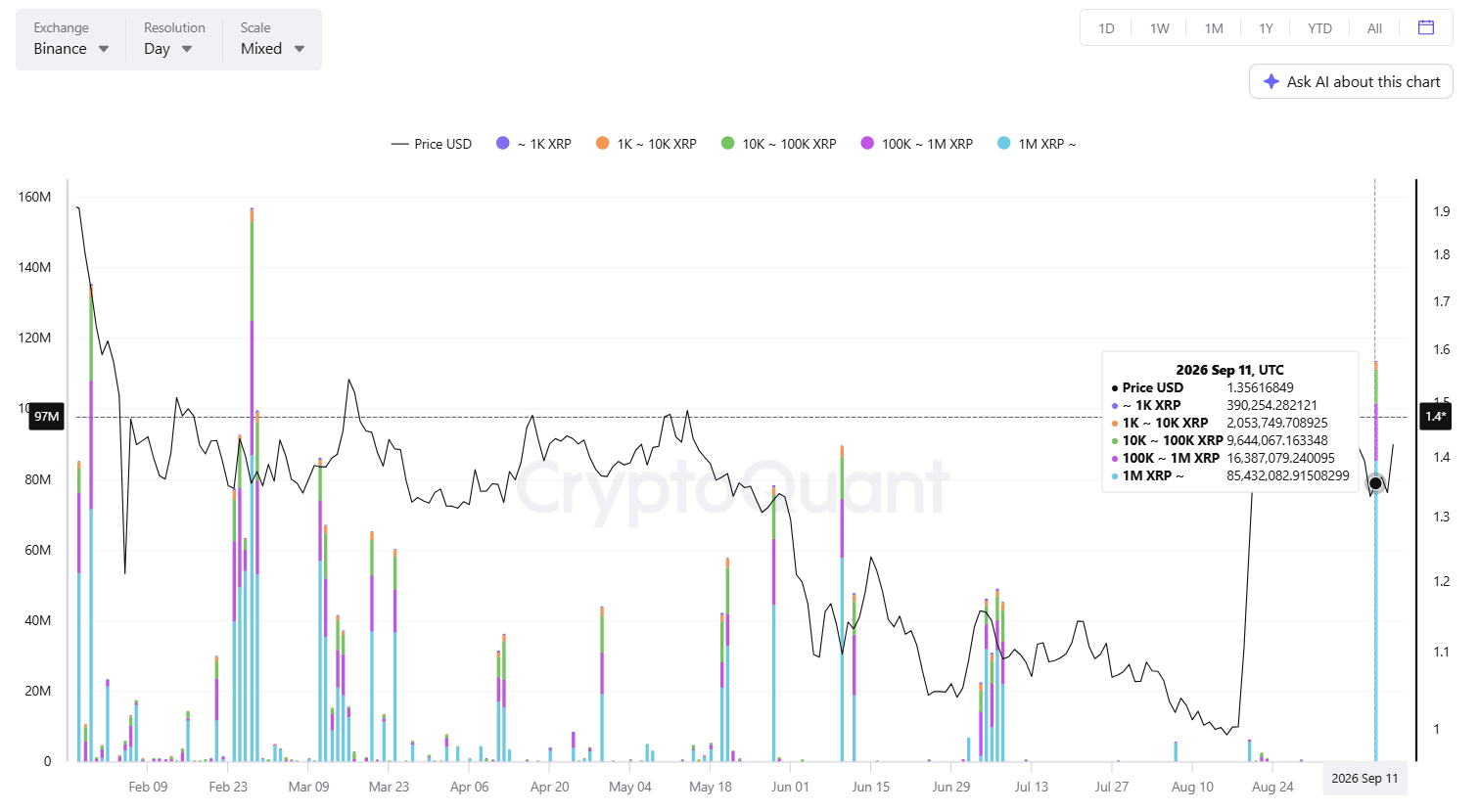
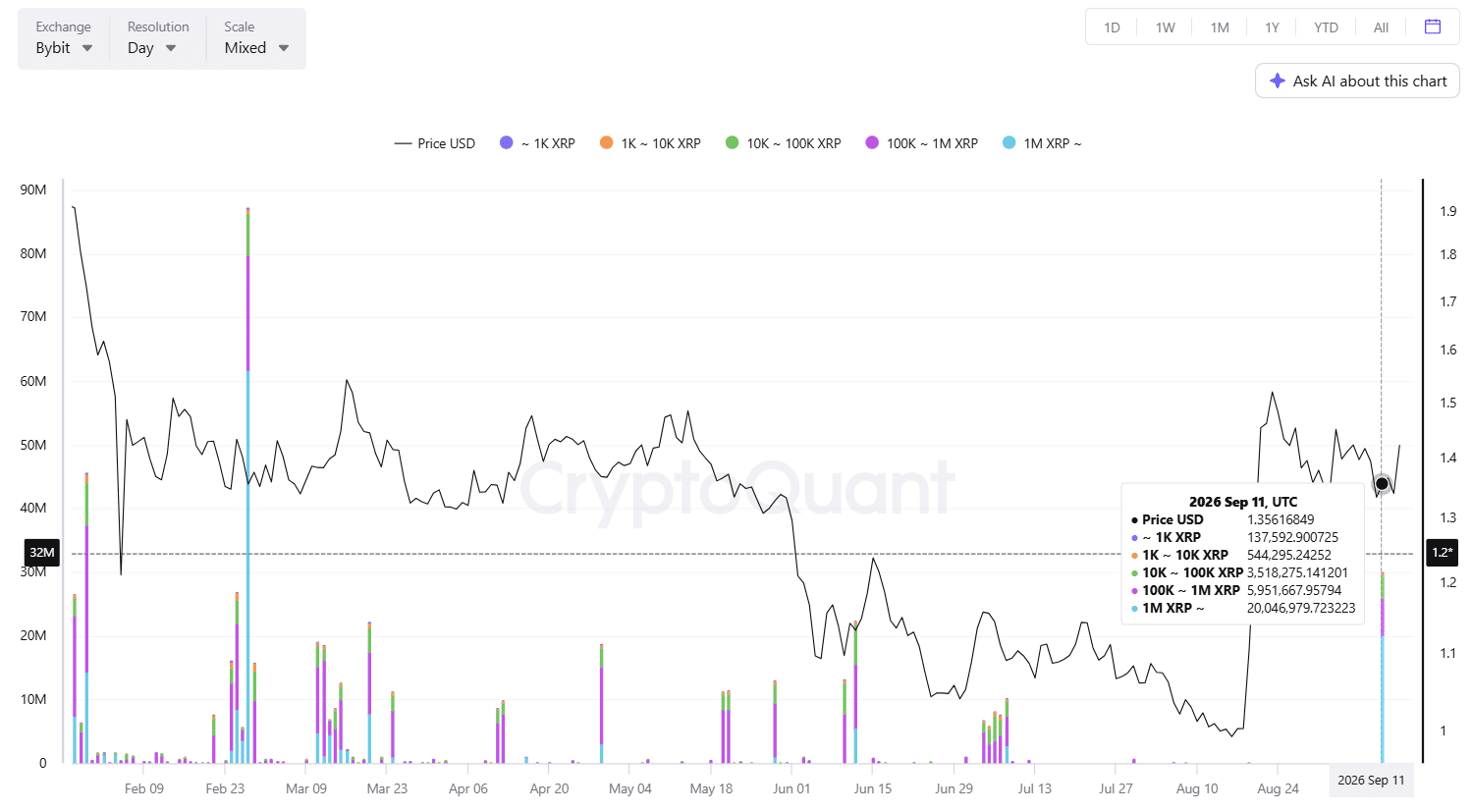
According to data sourced by CryptoQuant, a leading on-chain analytics resource, whale transactions worth 1 million XRP and above moved more than $165 million from top exchanges such as Binance, Bybit, OKX, and Upbit on Sept. 11. 

Notably, this represents the highest intraday withdrawal figure linked to these transactions since late February. As expected, most of this volume came from Binance, which witnessed outflows worth 85.4 million XRP or $115 million that day. This accounted for nearly 70% of the total figure recorded across all exchanges.

XRP Exchange Outflow from Binance CryptoQuant
XRP Exchange Outflow from Binance | Source: CryptoQuant

Interestingly, Binance also recorded large outflows from transactions involving smaller amounts. Specifically, the exchange saw transactions worth 100,000 to 1 million XRP pull out 16.38 million XRP valued at $22 million. Meanwhile, transactions involving 10,000 to 100,000 XRP moved 9.6 million XRP from the exchange. 

OKX, Bybit and Upbit See Similar XRP Outflows

While Binance saw most of the whale outflows, other exchanges, including Bybit, OKX, Bithumb, and Korea’s largest exchange Upbit, also recorded similarly large withdrawals. 

Notably, Bybit came in second on the list, with transactions worth 1 million XRP and above pulling out a little above 20 million tokens valued at $27 million from the trading platform. In addition, those worth 100,000 to 1 million XRP withdrew nearly 6 million XRP, while transactions involving 10,000 to 100,000 tokens pulled out 3.5 million XRP.

XRP Exchange Outflow from Bybit CryptoQuant
XRP Exchange Outflow from Bybit | Source: CryptoQuant

As for OKX, the exchange saw withdrawals worth 7 million XRP, or $9.45 million, from whale transactions valued at 1 million XRP and above. Meanwhile, transactions worth between 10,000 and 1 million tokens withdrew a combined 5.38 million XRP on Sept. 11. 

Upbit saw less dramatic withdrawals than others, but whale transactions involving 1 million XRP and above still pulled out 6.1 million tokens worth $9.15 million from the platform. In addition, a combined 6.78 million XRP flowed out from transactions worth between 1,000 and 1 million tokens. Meanwhile, Bithumb’s whale withdrawals stood at 4 million XRP. 

How Could This Impact the XRP Price?

Interestingly, XRP’s price saw a sharp intraday upswing to $1.43 amid these withdrawals, before pulling back sharply to close Sept. 11 at $1.35. Despite the sudden correction, XRP closed the day with a 1.64% increase, breaking what would have been a 3-day losing streak. 

Such large withdrawals typically support an asset’s price action by reducing selling pressure on the respective exchanges, especially if the traders involved pulled their balances to cold wallets for long-term storage. However, it’s not always this straightforward. 

Moreover, on-chain data further indicates that whale inflow transactions also spiked on Sept. 11 across multiple exchanges. Nonetheless, withdrawals, worth more than $165 million in XRP, largely outpaced these deposits.

Here’s XRP Price to Overtake Bitcoin as Predicted by Ripple ex-CTO

0

XRP needs to reach a strong double-digit price to overtake Bitcoin in market value, based on David Schwartz’s prediction that XRP will grow faster than BTC.

Schwartz, Ripple’s former CTO, recently said he believes XRP will one day surpass Bitcoin. But he doesn’t think this will happen because Bitcoin crashes.

Instead, he believes XRP will grow faster than Bitcoin as the overall crypto market continues to expand. This raises an important question: How high would XRP price need to go to close the current market-cap gap with Bitcoin?

XRP Price Would Need a Huge Market Cap

XRP is currently around $1.4, giving it a market value of about $88 billion. Bitcoin is around $77,200, with a market value of $1.55 trillion.

That means Bitcoin’s market cap is about 18 times bigger than XRP’s. For XRP to overtake Bitcoin, its market value needs to grow by trillions of dollars.

For example, if Bitcoin reaches a $3 trillion market cap, XRP needs to move above $3 trillion to become the biggest cryptocurrency. With about 62.74 billion XRP in circulation, a $3.1 trillion market cap puts XRP at around $49.40 per coin.

That means XRP needs to rise about 35 times from its current price of $1.38.

Bitcoin Will Keep Rising Too

Meanwhile, the $50 XRP price is not a fixed target for overtaking Bitcoin. It depends on how high Bitcoin’s price rises when XRP attempts to pass it.

For example, if Bitcoin reaches a $3 trillion market cap, its price will be around $150,000 based on its current supply. If Bitcoin rises even higher, XRP needs to reach an even higher market cap to overtake it.

That makes Schwartz’s prediction very ambitious. XRP needs to grow much faster than Bitcoin for a long time, even while Bitcoin continues to rise. Schwartz believes this will happen if the overall crypto market grows rapidly.

Why Schwartz Thinks XRP Will Grow Faster Than Bitcoin

Schwartz believes XRP will grow faster than Bitcoin because of what the XRP Ledger can do. He believes the XRP Ledger offers features that Bitcoin does not.

So, Schwartz does not expect people to simply leave Bitcoin and move to XRP. Instead, he sees the crypto market growing much larger, with XRP taking a bigger share of that growth.

In this scenario, Bitcoin remains highly valuable while XRP grows much faster.

XRP Still Has a Long Way to $50

If XRP reaches $50, its market value will be about $3.14 trillion based on the current supply. That puts XRP ahead of Bitcoin if Bitcoin’s market value remains around $3 trillion.

But if Bitcoin keeps rising, XRP needs to reach an even higher market value to overtake it. Schwartz has not given a timeline for XRP to overtake Bitcoin, and he has not said that XRP will reach $50.

The $50 price is only an example of what XRP would be worth if Bitcoin has a $3 trillion market cap. For now, XRP remains far behind Bitcoin in both price and market value.

Cardano: Midnight Surpasses 2 Billion NIGHT Redemptions as Final Thaw Period Begins

0

The Midnight Foundation has announced a major milestone in the NIGHT token redemption process, with users now redeeming 2 billion NIGHT tokens.

According to the announcement, users have redeemed 2 billion NIGHT tokens since the redemption process began in December 2025. 

For context, more than 170,000 wallets across eight blockchains, including Cardano and the XRP Ledger, claimed 3.5 billion NIGHT between August 5 and October 20, 2025, during the Glacier Drop phase. Subsequently, the Scavenger Mine phase distributed another 1 billion NIGHT, bringing total claimed allocations to 4.5 billion NIGHT

NIGHT Redemption 

Although the redemption process commenced last year, recipients could not access their entire allocations immediately. Instead, the redemption process uses a thawing mechanism that allows users to redeem their NIGHT across four periods.

So far, three thawing periods have been completed. The fourth and final period began on September 6, 2026, and is scheduled to end on December 4, 2026.

With 2 billion NIGHT now redeemed, around 2.5 billion NIGHT remain available for redemption before the December 4 deadline. 

2 Billion NIGHT Reedemed
2 Billion NIGHT Reedemed 

90-Day Grace Period Follows Final Thaw

After the December 4 deadline, Midnight will begin a 90-day grace period. During this period, users can continue claiming their fully thawed NIGHT tokens through the official Midnight Redemption Portal or supported wallet applications.

Once the grace period ends, Midnight will shut down the Redemption Portal’s front end and backend APIs. NIGHT serves as the native utility token of Midnight, the privacy-focused blockchain ecosystem built on Cardano.

Midnight Mainnet Surpasses 145,000 Transactions

Meanwhile, Midnight continues to record activity across its network. According to Midnight Explorer, the mainnet has processed more than 145,000 transactions, while the preprod testnet has recorded over 604,000 transactions.

The number of NIGHT holders within the Cardano ecosystem has also surpassed 86,600, reaching 86,653 holders.

At press time, NIGHT was trading at $0.02034, representing a 0.8% decline over the past 24 hours. Its market cap has fallen to $338.17 million, down significantly from the more than $1 billion valuation it reached shortly after launch.

Despite the decline, NIGHT ranks as the 99th-largest crypto globally, while its 24-hour trading volume has increased 10.83% to $10.28 million. 

US House Crypto Tax Bill Leaves Mining, Staking Rewards Taxable Before Sale

0

The US House Ways and Means Committee will review a broad digital asset tax package that excludes a key proposal sought by crypto miners and stakers.

The 114-page Digital Asset Tax Certainty Act, H.R. 10357, does not include a provision that would delay taxes on newly created tokens until they are sold. The committee published the bill Monday ahead of a markup scheduled for Wednesday.

That approach differs from the Tax Clarity for Mining and Staking Act, which Representative Mike Carey introduced in June. His proposal would allow taxpayers to decide when to recognize mining and staking rewards as income.

One option would tax tokens when they are received. The other would treat them more like property created by the taxpayer, with tax due upon sale. 

Leaving that provision out means staking and mining rewards would generally remain taxable once recipients receive or control them. This could create a tax obligation before recipients convert the tokens into cash.

Industry groups have pushed Congress to change that treatment. The Blockchain Association, Crypto Council for Innovation and Digital Chamber previously backed Carey’s legislation as introduced.

They argued that taxing rewards before a sale can create liquidity difficulties for miners and stakers. The groups also opposed a proposed amendment that would have capped the tax deferral period at five years.

Bill Retains Broader Crypto Tax Provisions

Although the reward-deferral proposal is absent, H.R. 10357 retains several measures affecting mining, staking and other digital asset activity. 

The legislation would classify income earned from blockchain validation as ordinary income. It would also establish rules for determining whether that income is sourced within or outside the United States.

Investment trusts that qualify under the bill could stake digital assets while retaining their trust status.

The package also proposes relief for small blockchain-related payments. Using crypto for transaction or network fees of $10 or less would not require taxpayers to recognize a gain or loss.

Additional provisions cover dollar-linked stablecoins and digital asset lending. Eligible US dollar stablecoins would receive specialized tax treatment, while qualifying crypto loans could avoid being treated as taxable sales.

The bill would also bring digital assets within constructive-sale and wash-sale rules while introducing simplified accounting methods for widely traded crypto assets.

Another measure would establish an optional disclosure process through which taxpayers could address earlier digital asset tax violations.

Earlier in June, the committee circulated seven crypto tax proposals before holding a hearing on digital asset taxation. The drafts covered stablecoin taxation, mining and staking, as well as efforts to reduce reporting burdens tied to crypto transactions.

The House tax debate is unfolding alongside a broader push to establish US rules for digital assets. The Senate is separately considering whether to advance the CLARITY Act, which addresses how the SEC and CFTC would divide oversight of the crypto market.