Home Blog Page 11

US House Crypto Tax Bill Leaves Mining, Staking Rewards Taxable Before Sale

0

The US House Ways and Means Committee will review a broad digital asset tax package that excludes a key proposal sought by crypto miners and stakers.

The 114-page Digital Asset Tax Certainty Act, H.R. 10357, does not include a provision that would delay taxes on newly created tokens until they are sold. The committee published the bill Monday ahead of a markup scheduled for Wednesday.

That approach differs from the Tax Clarity for Mining and Staking Act, which Representative Mike Carey introduced in June. His proposal would allow taxpayers to decide when to recognize mining and staking rewards as income.

One option would tax tokens when they are received. The other would treat them more like property created by the taxpayer, with tax due upon sale. 

Leaving that provision out means staking and mining rewards would generally remain taxable once recipients receive or control them. This could create a tax obligation before recipients convert the tokens into cash.

Industry groups have pushed Congress to change that treatment. The Blockchain Association, Crypto Council for Innovation and Digital Chamber previously backed Carey’s legislation as introduced.

They argued that taxing rewards before a sale can create liquidity difficulties for miners and stakers. The groups also opposed a proposed amendment that would have capped the tax deferral period at five years.

Bill Retains Broader Crypto Tax Provisions

Although the reward-deferral proposal is absent, H.R. 10357 retains several measures affecting mining, staking and other digital asset activity. 

The legislation would classify income earned from blockchain validation as ordinary income. It would also establish rules for determining whether that income is sourced within or outside the United States.

Investment trusts that qualify under the bill could stake digital assets while retaining their trust status.

The package also proposes relief for small blockchain-related payments. Using crypto for transaction or network fees of $10 or less would not require taxpayers to recognize a gain or loss.

Additional provisions cover dollar-linked stablecoins and digital asset lending. Eligible US dollar stablecoins would receive specialized tax treatment, while qualifying crypto loans could avoid being treated as taxable sales.

The bill would also bring digital assets within constructive-sale and wash-sale rules while introducing simplified accounting methods for widely traded crypto assets.

Another measure would establish an optional disclosure process through which taxpayers could address earlier digital asset tax violations.

Earlier in June, the committee circulated seven crypto tax proposals before holding a hearing on digital asset taxation. The drafts covered stablecoin taxation, mining and staking, as well as efforts to reduce reporting burdens tied to crypto transactions.

The House tax debate is unfolding alongside a broader push to establish US rules for digital assets. The Senate is separately considering whether to advance the CLARITY Act, which addresses how the SEC and CFTC would divide oversight of the crypto market.
XRP Sees $4.6B Liquidity Turnover as Open Interest Slides

0

XRP derivatives activity has weakened on exchanges, even though XRP is still trading well above its August lows. Meanwhile, rising liquidity on Binance suggests more market activity.

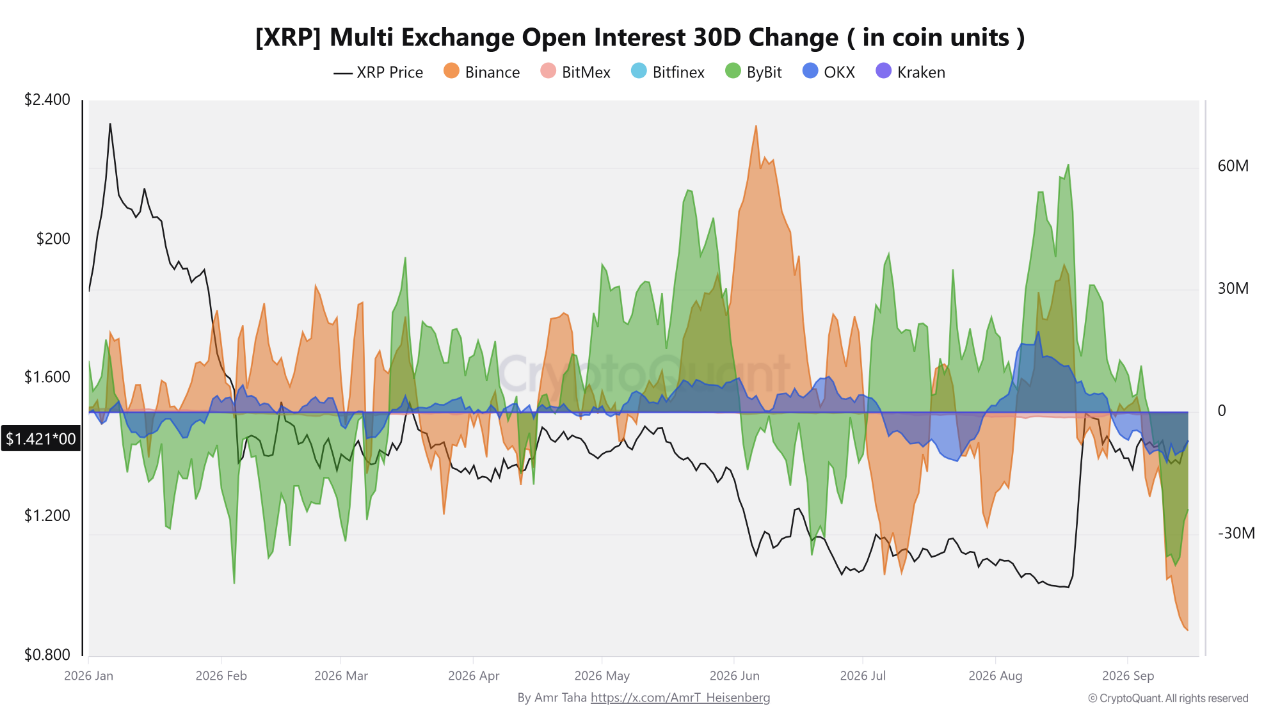
CryptoQuant author Amr Taha said XRP’s open interest on Bybit changed sharply from growing in August to falling in September.

XRP Open Interest Falls on Bybit

On August 18, XRP open interest on Bybit had increased by about 61 million XRP over the previous 30 days. 

By September 12, it had dropped to -37.5 million XRP. That’s a swing of about 98.5 million XRP in just 25 days, showing that open positions fell sharply.

Meanwhile, XRP’s price moved higher. It rose from about $1.00 on August 18 to $1.37 on September 12, a gain of roughly 36%.

This shows a clear difference between XRP’s price and derivatives activity. While XRP’s price increased by more than a third, the amount of open derivatives positions fell significantly. A similar trend is also visible on Binance.

Binance Open Interest Falls Further

Taha said Binance’s XRP open interest fell to about -53 million XRP on September 15, compared with around -39 million XRP on July 10. This means open interest was about 14 million XRP lower than in July.

At the same time, XRP was trading near $1.42, about 42% higher than its August 18 price. This shows that XRP’s price has stayed strong even as open positions on major exchanges have fallen.

However, the data does not show whether traders were closing long or short positions. So, the drop in open interest alone does not mean XRP is bullish or bearish.

XRP Liquidity on Binance Hits Six-Month High

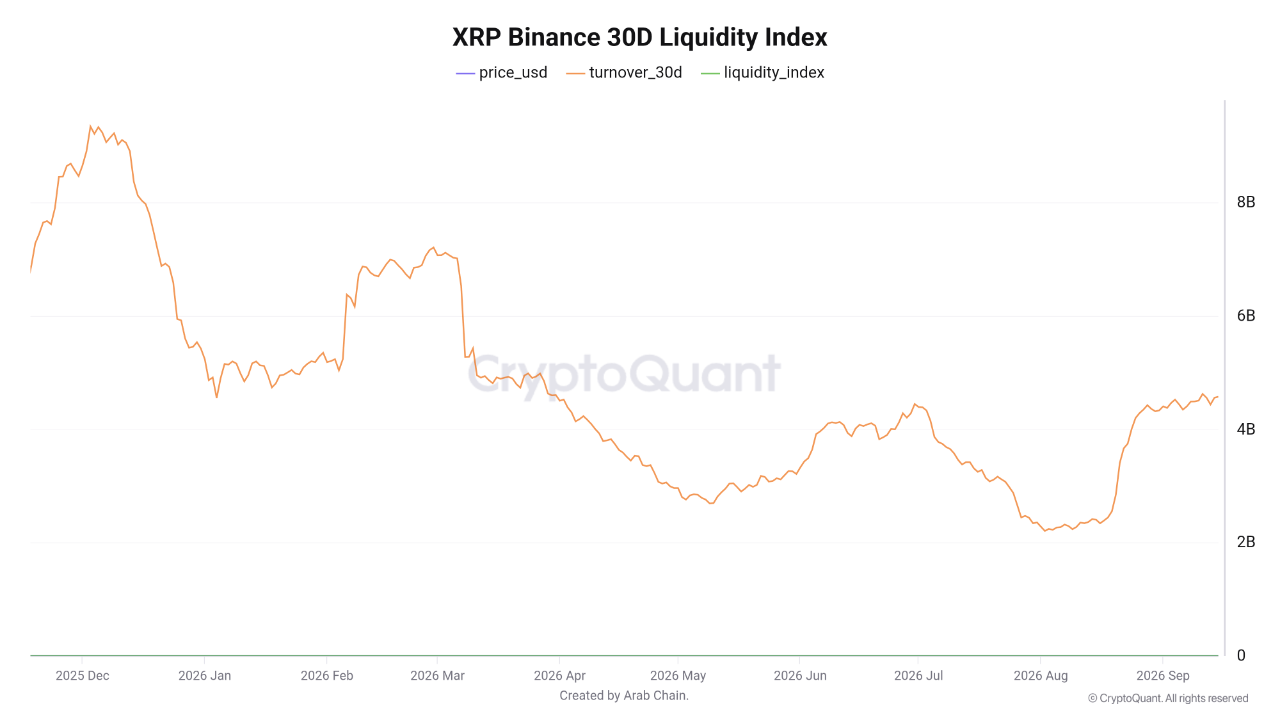
While XRP open interest has fallen, liquidity on Binance has improved sharply. CryptoQuant author Arab Chain said XRP’s 30-day liquidity turnover on Binance has risen to about $4.6 billion. The liquidity index also reached 0.0675, its highest level in about six months.

Liquidity was weaker in July and August, when turnover fell to around $2 billion–$3 billion. It has since recovered as more XRP has moved through Binance.

Higher liquidity means traders can buy or sell larger amounts with less impact on XRP’s price. However, rising liquidity does not necessarily mean XRP is becoming more bullish. The figure includes both buying and selling activity, as well as deposits and withdrawals.

XRP Binance Liquidity chart

XRP Market Shows Mixed Signals

XRP’s market data is sending mixed signals. On one hand, XRP is trading much higher than in August, and liquidity on Binance has reached a six-month high. On the other hand, open interest has fallen sharply on both Bybit and Binance.

This means XRP’s price has risen even as the amount of outstanding derivatives positions has decreased, while spot-market activity has increased.

Overall, stronger liquidity and lower derivatives activity give XRP a mixed market outlook as traders watch whether its recent gains can continue.

XRP Liquidity Index Hits 6-Month Peak: Possible Impact on Price

0

Activity in the XRP market on Binance is picking up, with data showing that the 30-day XRP Liquidity Index has reached its highest level in about six months.

The rise comes after several months of weaker activity and indicates that the market may be witnessing more movement. Specifically, the 30-day liquidity turnover has risen to about $4.6 billion, while the liquidity index has reached roughly 0.0675.

For the uninitiated, the liquidity index shows how easily traders can buy or sell an asset without causing a large change in its price. A higher reading usually means more activity, including greater XRP deposits, withdrawals, and trading flows through Binance’s order books. 

Notably, the 30-day liquidity index measures how quickly XRP changes hands compared with the amount held on the exchange. As a result, a rise in the metric suggests that traders are becoming more active.

XRP Market Recovers From July and August Slump

The increase follows a drop in activity during July and August, when 30-day turnover fell to between $2 billion and $3 billion. During this period, the broader crypto market remained weak, while XRP traded close to the $1 level.

XRP Liquidity Index | Source: CryptoQuant

XRP still finished August with a gain of about 28.5%, making it the token’s strongest August performance since 2021. Spot U.S. XRP ETF products also supported the recovery, attracting $153.55 million in inflows during the month.

Market activity has continued to improve in September. On Sept. 11, more than 91 million XRP moved into Binance, while over 113 million XRP moved out. Both figures marked their largest single-day levels in six months. 

Withdrawals exceeded deposits by around 22.7 million XRP, but Binance’s total XRP holdings increased by only 0.43% over the week. This suggests broader market activity, not an actual increase in either selling or accumulation.

Binance Open Interest Also Recovers

XRP’s derivatives market has also started to recover. Binance’s seven-day change in open interest improved from -27% on Aug. 29 to 1% by Sept. 6. Open interest then averaged about $476.7 million, up just 0.23% from the previous week.

The numbers show that traders have gradually returned to the market after the quieter summer period. However, the small weekly increase also suggests that the recovery is still measured and does not yet indicate a strong market trend.

What Higher Liquidity Could Mean for the XRP Price

Currently, XRP trades at approximately $1.40, keeping it above both its 20-day EMA at $1.37 and 200-day EMA at $1.33 on the daily chart. Its RSI stands at 55.92, which puts the indicator above the midpoint while keeping it below overbought levels.

A higher liquidity index does not necessarily mean that XRP will rise. However, it shows that the market can handle larger buy and sell orders with less impact on price. 

If buying pressure increases, deeper liquidity could help XRP move higher in a more stable way. If sellers take control, however, the same liquidity could also allow a larger decline without the extreme price swings typically recorded by thin markets.

The sudden movement on Sept. 11 also needs some caution. Large deposits and withdrawals can indicate real trading activity, but they may also come from internal wallet transfers or market-maker rebalancing. 

There is currently no confirmation that either explanation caused the spike. Meanwhile, easing funding rates and liquidations on both sides of the market suggest that XRP may remain range-bound in the near term instead of entering a clear trend.

Ark Invest Sells $40 Million in Bitcoin ETF, Trims Circle and Coinbase as Crypto Stocks Rally

0

Ark Invest reduced several major crypto-linked positions on Monday as digital asset stocks moved higher. The firm’s biggest disclosed sale involved its ARK 21Shares Bitcoin ETF, followed by reductions in Circle and Coinbase.

According to Ark’s latest trade disclosure, the firm sold 1,528,953 ARKB shares, a position worth about $40 million at Monday’s closing price. The fund nevertheless ended the session higher, closing at $26.19, up 2.22%.

Ark also cut its exposure to Circle Internet Group, selling 142,350 shares across two funds for roughly $13.8 million. Circle shares closed at $97.42 after gaining 7.53% during the session.

The firm made another sizable reduction in Coinbase, selling 36,628 shares of the crypto exchange valued at about $7 million. Coinbase finished Monday at $191.45, rising 9.24%.

Ark’s three largest disclosed reductions were therefore all in assets that finished the session higher. The selling also extended beyond those major crypto-linked positions.

Ark Also Trims Bitmine and Bullish Positions

Ark sold 153,881 shares of Bitmine Immersion Technologies, according to the disclosed trades. The transaction was valued at about $3.96 million, while Bitmine closed at $25.76, up 2.92% on the day.

The firm also sold 18,280 Bullish shares worth about $687,693. Bullish closed at $37.62, up 7.12% on the day.

Taken together, the trades show Ark reducing several crypto-related positions during a strong market session. The moves fit the firm’s active portfolio strategy, under which it regularly adjusts holdings as share prices and portfolio weightings change.

Ark also limits individual holdings within its ETFs, with no single position allowed to exceed 10% of a fund’s portfolio. The rule helps reduce concentration risk and preserve diversification.

Clarity Act Expectations Provide Broader Market Context

Ark’s portfolio changes came as sentiment toward crypto-linked stocks strengthened, with investors also watching renewed legislative activity in Washington after Congress returned from its August recess.

Senate Republicans released a final draft of the Digital Asset Market Structure Clarity Act on Monday. The revised version incorporated several Democratic requests, including changes related to ethics and other issues that Donald Trump had previously agreed to.

Expectations around the legislation initially improved after the draft emerged, with Polymarket odds of the Clarity Act becoming law climbing to 35% before later falling to 19%. The reversal indicated that significant uncertainty remained despite the renewed legislative activity.

The next key step is a procedural cloture vote scheduled for Tuesday at 2:15 p.m. ET, with 60 votes required for the measure to advance. For crypto markets, the vote could influence expectations around the bill’s progress, while Ark’s latest trades show the firm continuing to rebalance as crypto-related assets move higher.

Balancer Proposes Wind-Down, $9M-Plus Treasury Could Go to BAL Holders

0

Balancer is moving closer to a possible shutdown after its restructuring failed to produce a sustainable revenue recovery.

The decentralized exchange has proposed an orderly wind-down that could return more than $9 million in treasury assets to BAL holders.

Balancer Labs CEO Marcus Hardt submitted the proposal on the protocol’s governance forum, saying the business continued to struggle after a major exploit weakened confidence and made user growth more difficult. The proposed closure still requires approval from BAL holders, with a Snapshot vote scheduled for Sept. 25 through Sept. 29.

Revenue Weakness Puts Pressure on Balancer

The latest proposal follows an earlier attempt to keep Balancer operating with a leaner structure.

Balancer Labs shut down in March 2026, but the protocol continued under a reduced operating model. That restructuring helped lower costs and allowed the team to deliver previously promised products. However, those savings were not matched by stronger revenue.

According to Hardt’s proposal, most protocol income still comes from Balancer v2. Meanwhile, v3 has not generated enough revenue to replace the older version’s contribution.

Hardt made a similar point in comments posted on X, saying the technology performed as intended but commercial demand remained too weak. Revenue figures cited from DefiLlama illustrate the scale of that problem.

Balancer generated about $1.13 million in protocol revenue during October 2025. In November, that figure fell sharply to roughly $371,000 following an exploit involving composable stable pools on Balancer’s older v2 system. The original report estimated the incident’s losses at $128 million.

Revenue failed to recover during 2026. According to the cited DefiLlama figures, monthly protocol revenue fell to $56,781 in August.

Hardt said the November 2025 exploit played a significant role in that weakness, even though the affected pools belonged to the legacy v2 architecture rather than Balancer v3. Notably, he said the reputational impact extended beyond the compromised system and continued to shape perceptions of the broader Balancer brand.

He later acknowledged on X that he had underestimated how long the exploit would weigh on adoption. 

With revenue still under pressure, Balancer is weighing whether staying operational could leave tokenholders with less value in the end.

Proposed Shutdown Would Happen in Stages

Under the proposed plan, Balancer would begin scaling down operations next month.

The first step would be ending new business development, while liquidity providers would have until Oct. 30 to prepare their exits. After that, pools with pause functionality would move into withdrawal-only mode, allowing users to remove funds while normal activity stops.

Pools that cannot be paused would continue operating. However, protocol fees would be reduced to zero wherever the underlying contracts permit that change.

The transition would enter another phase from Nov. 1. At that point, Balancer would maintain only the infrastructure needed to support withdrawals, while the decentralized autonomous organization, or DAO, would begin winding down.

A smaller team would remain in place to manage the process and support the final stages of closure. To cover those costs, the proposal sets aside up to $400,000 for wind-down expenses.

Hardt argued that continuing under the current model would gradually consume the remaining treasury. In his view, further spending would delay rather than change the likely outcome, making the preservation of treasury assets for BAL holders an important consideration.

Accordingly, the plan would distribute the remaining assets to tokenholders after paying all wind-down costs.

BAL Holders Could Receive Remaining Treasury Assets 

If BAL holders approve the plan, Balancer would distribute its remaining treasury based on each holder’s proportional ownership.

The first distribution is scheduled for May 2027, when holders would burn their BAL tokens to receive their share of the treasury assets.

The process would not end with that initial distribution. A second round would return any unused wind-down funds and assets left unclaimed after the first distribution, followed by a final sweep six months later.

Before any of those steps can begin, however, the community must approve the shutdown through Snapshot.

If the proposal is rejected, Balancer would remain under its existing operating structure.

The Sept. 25-29 vote will therefore determine whether Balancer proceeds with an organized closure or continues operating despite its persistent revenue challenges.

CLARITY Act 2026 Passage Odds Fall to 16% as Senate Ethics Fight Deepens

0

The CLARITY Act’s Polymarket probability of becoming law in 2026 dropped to 16% on Monday amid Senate Democratic resistance to Republicans’ revised ethics terms, with Democratic negotiators also working on a counterproposal.

Traders had pushed the probability to 35% after Republicans circulated revised legislation containing broader ethics provisions. The optimism faded as Democratic negotiators raised objections to the changes, threatening Republicans’ effort to secure the 60 votes needed to advance the measure. 

Senator Mark Warner, one of the Democrats negotiating the legislation, reportedly rejected the revised ethics language as not “near enough.” Politico’s Jasper Goodman later reported, citing three people familiar with the matter, that Democrats began working on their own proposal Monday and subsequently sent it to Republicans.

Tuesday’s procedural vote is the next major test for the legislation. If it fails, it could delay further progress on the bill, which would set the division of US crypto-market oversight between the SEC and CFTC.

Democrats Push Back on Revised Ethics Terms

Punchbowl News’ Brendan Pedersen reported that Senator Raphael Warnock opposed advancing the bill while what Warnock described as opportunities for corruption “in real time” remained unaddressed.

Pedersen said Senator Ruben Gallego also criticized the Republican ethics language as leaving “much to be desired” and intended to develop an alternative proposal.

In a separate report, Pedersen said Senate Banking Committee staff for Senator Elizabeth Warren circulated talking points asserting that a determination by White House ethics officials could override the proposed enforcement mechanism for state attorneys general.

Democratic support is not uniform, however. Politico reported that Senator Kirsten Gillibrand has privately lobbied colleagues to back the procedural vote.

Republican Senator Cynthia Lummis portrayed the GOP concessions as exhausted, saying Trump had accepted two significant ethics provisions and there was “nothing left to give” Democrats.

A coalition of 18 state attorneys general is also opposing the measure, adding another source of resistance.

Tribal and Banking Groups Raise Separate Objections

The Indian Gaming Association urged tribes to lobby senators against the bill. The national tribal gaming group said the decentralized-finance revisions still failed to resolve prediction-market concerns in Indian Country.

It wants the legislation to expressly preserve tribal and state gaming laws, including the Indian Gaming Regulatory Act, against preemption under federal commodities law.

Eight banking trade groups said the revisions still permit stablecoin reward arrangements that effectively resemble interest on deposits. In the groups’ view, community banks could suffer substantial deposit outflows before the proposed regulatory “circuit breaker” was triggered.

Industry Groups Rally Behind CLARITY Act

The crypto sector has taken the opposite position, calling for Senate support.

Blockchain Association CEO Summer Mersinger called on every senator to support the measure, saying Monday that the crypto industry had already made significant concessions to secure bipartisan backing.

Mersinger said passage would strengthen regulatory clarity and consumer safeguards, curb illicit activity, and make it less likely that crypto employment, developers, and innovation migrate abroad.

Top Hong Kong Exchange to Cease Operations With 442,792,693,142 Shiba Inu in Reserves

0

Popular Hong Kong-based exchange CoinEx has announced plans to cease operations and begin an orderly wind-down, with the exchange still holding a substantial amount of Shiba Inu in its reserves.

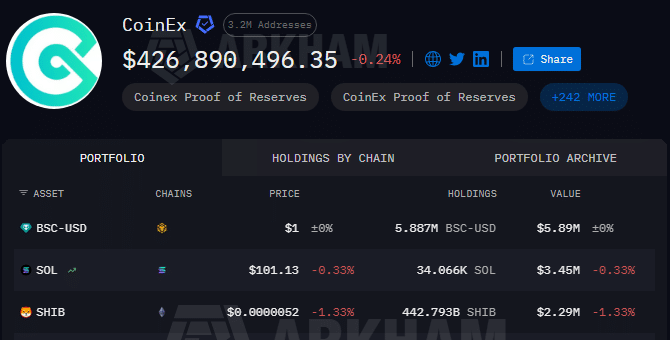
According to data from Arkham Intelligence, CoinEx held 442,792,693,142 (442.793 billion) Shiba Inu in the hours leading up to press time. At SHIB’s current price of around $0.0000052, the holdings are worth $2.29 million, making Shiba Inu the 10th-largest asset in CoinEx’s portfolio.

CoinEx Shiba Inu Holdings

The size of CoinEx’s remaining SHIB holdings is notable given the exchange’s long history with the token. CoinEx was among the early centralized exchanges to list SHIB and its ecosystem token BONE, adding support for the token in May 2021 as Shiba Inu expanded rapidly across cryptocurrency trading platforms.

CoinEx’s SHIB Holdings Have Declines

However, CoinEx’s SHIB holdings have fallen considerably since then. In December 2022, the exchange held approximately 1.69 trillion SHIB in its reserves.

Therefore, its current balance of 442.793 billion SHIB represents a 73% reduction from those levels. Despite the decline, CoinEx has continued to maintain meaningful exposure to Shiba Inu and has promoted the token through various campaigns over the years, including highlighting SHIB among the strongest weekly performers.

Besides Shiba Inu, CoinEx also holds major assets such as Bitcoin, Ethereum, Dogecoin, USDT, and Solana.

CoinEx Sets December 22 Closure Date

The development comes as CoinEx prepares to permanently shut down its exchange operations. In an announcement today, the exchange cited the prolonged cryptocurrency market downturn, declining trading volumes and liquidity, rising regulatory requirements, increasing compliance costs, and operational uncertainties as factors behind the decision.

CoinEx also assured users that their assets remain fully backed, stating that its reserve ratio exceeds 100%. Under the announced schedule, CoinEx will stop new registrations and several trading services on September 15. 

Non-spot services will end on September 22, while spot trading will cease on September 29. However, the exchange will keep withdrawals available until December 22, 2026, when it will officially cease operations.

CEO Comments 

In a separate statement, CoinEx CEO and founder Haipo Yang disclosed that the exchange will buy back CET at its initial listing price of $0.005 per token with no quantity limit, giving holders a clear exit as the exchange winds down.

The founder also revealed that he considered selling CoinEx but ultimately rejected the idea, arguing that users had entrusted their assets to the platform based on their trust in him. Instead, he chose what he described as a clean and responsible closure that allows users to withdraw their funds, employees to receive a dignified farewell, and CET holders to receive a final resolution. 

XRP Eyes $2.20 as Ripple CEO Says “Now Is Time to Vote Yes” on CLARITY Act

0

XRP price could rally soon as Ripple CEO Brad Garlinghouse is urging U.S. senators to approve the CLARITY Act, saying the latest version includes important compromises.

His comments came after Treasury Secretary Scott Bessent also backed the bill and pointed to changes meant to protect community banks from losing deposits because of stablecoins.

The Senate will hold a procedural vote on the CLARITY Act today, September 15. Notably, the bill needs at least 60 votes to move forward.

Garlinghouse Urges Senators to Vote Yes

Garlinghouse said the latest version of the CLARITY Act is more than just a compromise. He said lawmakers made important changes to reach an agreement. He urged senators to support the bill instead of waiting for a perfect version.

“Perfect can’t be the enemy of good,” he said. Garlinghouse also told senators that the changes made during negotiations were significant and worth supporting.

“The world is watching and voters are watching. Now is the time to vote yes,” he said.

His comments came after Senate Republicans released a revised version of the bill with 126 changes requested by Democrats. The changes cover areas including ethics, digital asset regulation, decentralized finance, banking and enforcement.

Bessent Highlights Protections for Community Banks

Bessent said the CLARITY Act will help the U.S. stay competitive in digital assets while protecting traditional banks. He said the bill would give him more power to act if stablecoins cause people to move their money out of community banks.

Bessent said he would use these powers if stablecoins start creating risks for community banks, which he called important to the U.S. economy.

Community banks have warned that the growth of stablecoins could pull deposits away from traditional banks and reduce their ability to lend money.

Bessent also said the CLARITY Act is part of the administration’s plan to make the U.S. a leader in digital assets, following the passage of the GENIUS Act, which regulates stablecoins.

Analyst Sees XRP Resistance Before $2.20

As lawmakers prepare to vote, XRP traders are watching to see how the market reacts if the CLARITY Act moves forward. Analyst Casi said XRP has been trading below a key resistance level for several weeks while holding the 0.5 Fibonacci level. This may give XRP room to move higher.

Casi sees $1.74–$1.78 as a possible short-term target. However, XRP may struggle to break through this area. If XRP reaches this range and gets rejected, the price will see a short-term pullback. Casi said this would not necessarily end XRP’s larger recovery.

The analyst said the key level to watch is $1.65. If XRP breaks above it and stays there, the outlook improves. If it fails, XRP falls toward $1.09 or $0.87.

Casi also sees a longer-term target above $2, with a possible move toward $2.20. Another analysis puts the target around $2.02 and identifies $1.74–$1.78 as the main resistance zone.

Image

XRP Recovers Ahead of Senate Vote

XRP has recovered from its recent drop as traders prepare for the Senate’s vote on the CLARITY Act. CoinMarketCap data showed XRP trading around $1.40, up about 1% over 24 hours. The token has also recovered over the past week and remains up about 40% over the past month.

If the CLARITY Act moves forward, it could give XRP another boost. However, traders are watching $1.65 and $1.74–$1.78 as key levels before expecting XRP to move toward $2 or higher.

CoinEx to Shut Down After Nine Years, Most Services to End Sept. 29

0

Crypto exchange CoinEx will close after nine years of operation, blaming a prolonged market downturn, weaker trading activity, and growing pressure from regulation and compliance obligations.

The Seychelles-based platform will stop taking new registrations on Sept. 15 and plans to discontinue most exchange services by Sept. 29. Withdrawals will remain available until Dec. 22, giving users nearly three months after the main shutdown to remove their assets. 

Market Weakness and Rising Compliance Burden Drive Exit

CoinEx attributed its decision partly to a tougher regulatory environment and rising compliance costs. The exchange also pointed to an extended market slump that had reduced trading volumes and liquidity across the industry, making conditions increasingly challenging.

Founder and CEO Haipo Yang said the risks involved in operating a crypto trading platform had become increasingly difficult to manage and ultimately influenced the decision to close.

“After much reflection, I have come to accept a hard truth,” Yang wrote on X, adding that security and compliance risks had become progressively harder to manage.

Yang said he had seriously considered selling CoinEx but decided that closing the platform was preferable because he wanted a “clean ending.”

He acknowledged that the exchange had fallen short of his original ambitions despite serving millions of users over its nine-year history. Yang said his priority in winding down the business was to ensure customers could recover all of their holdings while providing employees with what he described as a dignified departure.

CoinEx Sets Withdrawal and Custody Deadlines

CoinEx said assets remaining on the platform after Sept. 29 could be converted into USDT. Any USDT left unclaimed after Dec. 22 will be transferred to an independent custodian, which will charge a monthly fee equal to 5% of the initial balance. Users can recover those funds through the custodian until Aug. 22, 2028.

CoinEx Faced Regulatory Scrutiny Before Closure

TRM Labs alleged in a report released earlier in 2026 that CoinEx had processed flows exceeding $3.8 billion linked to Iranian entities over a period beginning in 2019. According to TRM Labs, the transactions involved Nobitex and other sanctioned counterparties.

CoinEx had served customers across over 200 countries and regions. It exited the U.S. in 2023 after settling a lawsuit brought by the New York Attorney General, which accused the company of lacking the registration required to operate.

Hoskinson Says Cardano Cannot Succeed Without Embracing Midnight and Other Major Ecosystem Projects

0

Cardano founder Charles Hoskinson has urged the community to embrace projects such as Midnight, arguing that the blockchain’s long-term success depends on the applications built on its infrastructure.

Hoskinson made the remarks during his recent livestream, titled “Devs versus Builders,” where he addressed criticism surrounding Midnight and its recent strategic changes. He stressed that the privacy-focused blockchain should not be viewed as a competitor or separate venture. Instead, he described Midnight as a major project built within the broader Cardano ecosystem.

Cardano’s Value Depends on the Projects Built on It

According to Hoskinson, Cardano’s purpose extends beyond serving as a smart contract platform or facilitating ADA transactions. He argued that the network creates greater value when developers use its infrastructure to build applications that attract real users, customers, and economic activity.

He pointed to existing Cardano projects, including SNEK, DexHunter, and SundaeSwap, as examples of applications the community has generally embraced. However, he questioned why some community members appear resistant to Midnight despite its scale and growing prominence within the ecosystem.

Moreover, Hoskinson warned that pushing back against successful projects could discourage other developers from building on Cardano.

“If Cardano is going to succeed, Cardano needs to embrace the projects that make it succeed,” Hoskinson remarked. 

Hoskinson Calls for a More Welcoming Ecosystem

Against this backdrop, Hoskinson argued that the Cardano community must foster an environment that encourages projects to grow rather than criticizing them for becoming too successful or prominent.

He suggested that the community should not treat Midnight differently simply because it has emerged as one of the largest and most significant projects associated with Cardano. Instead, projects that build on Cardano and expand its reach should strengthen the ecosystem’s overall value. 

At the same time, Hoskinson emphasized that Midnight must also meet users where they are. In particular, he urged the project to prioritize simplicity, universality, and low-cost operations. According to him, technological improvements alone cannot overcome cultural challenges within an ecosystem.

Hoskinson Urges the Cardano Foundation to Promote Midnight

Meanwhile, Hoskinson also called on the Cardano Foundation to publicly support Midnight and give greater visibility to its developments.

He questioned why the Foundation would not actively promote Midnight, which he described as the largest project built on Cardano, noting that other major blockchain ecosystems regularly highlight significant applications and projects within their networks.

Furthermore, Hoskinson criticized what he viewed as an imbalance in public messaging. According to him, negative developments surrounding Midnight tend to attract attention, while positive milestones, including partnerships and other progress, receive less visibility.

Midnight’s Success Could Strengthen Cardano

Ultimately, Hoskinson framed Midnight’s success as closely tied to Cardano’s broader growth. In his view, the ecosystem cannot thrive merely by operating blockchain infrastructure; it must also support the projects that use that infrastructure to deliver products and services.

He also reiterated his commitment to Cardano’s long-term success. Although he said he has the option to step away and retire, Hoskinson stressed that he remains involved because he believes the work is far from finished.