Home Blog Page 1209

Here’s How Bitcoin Price Could Be Affected by the Decrease in US Treasury Bill Yields

0

Bitcoin enters the scene as the relationship between government bond yields and prices of risk assets like gold continue to follow historical trends. 

A decrease in the 13-week U.S. Treasury yield often leads to rising prices for assets like gold. Now, Bitcoin is also coming into the spotlight due to its potential to behave similarly to gold during periods of economic uncertainty. 

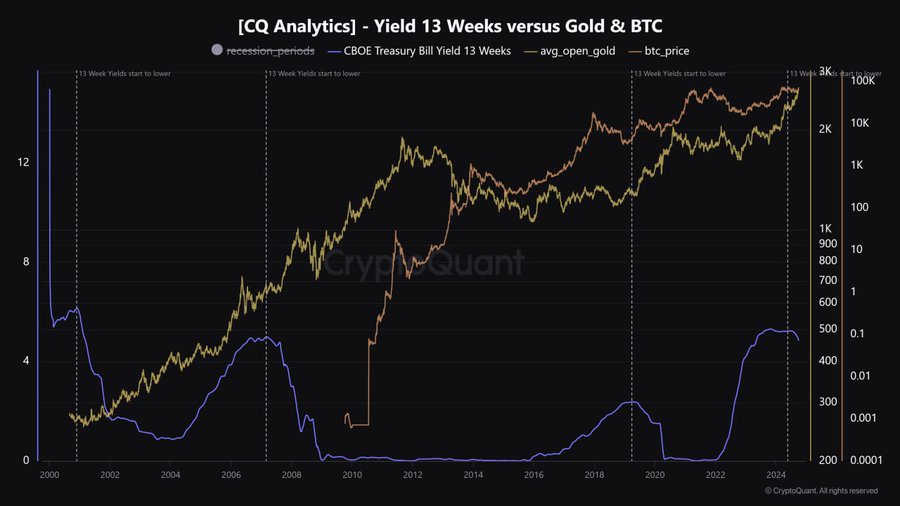
CryptoQuant, a leading crypto analytics resource, recently discussed the possible impact of the latest drop in the 13-week Treasury yield, citing correlations from historical data.

A Historical Perspective

In 2008, during a time of financial distress and monetary easing, the 13-week Treasury yield began to fall significantly. As a result, investors sought refuge in safe-haven assets like gold. 

The precious metal climbed from approximately $590 per ounce in 2008 to nearly $1,900 by 2011, as noted by CryptoQuant. This rise occurred as interest rates dropped, making bonds less attractive and pushing capital toward non-yielding assets that perform well during inflation or economic uncertainty.
CryptoQuant
CryptoQuant

Now, this year, the market is witnessing a similar scenario. Treasury yields are on the decline once again, and gold prices have risen from $2,000 to around $2,700 per ounce. 

Meanwhile, the CryptoQuant report argues that Bitcoin, often referred to as “digital gold,” could also benefit from these economic conditions. Most market participants see the premier crypto as a store of value, particularly in times of monetary easing, inflation, and currency depreciation.

Bitcoin has been gaining popularity as an alternative to traditional safe-haven assets like gold. As Treasury yields decline, Bitcoin may attract more capital as investors seek alternatives to low-yielding bonds and traditional assets. 

Bitcoin Current Market Conditions

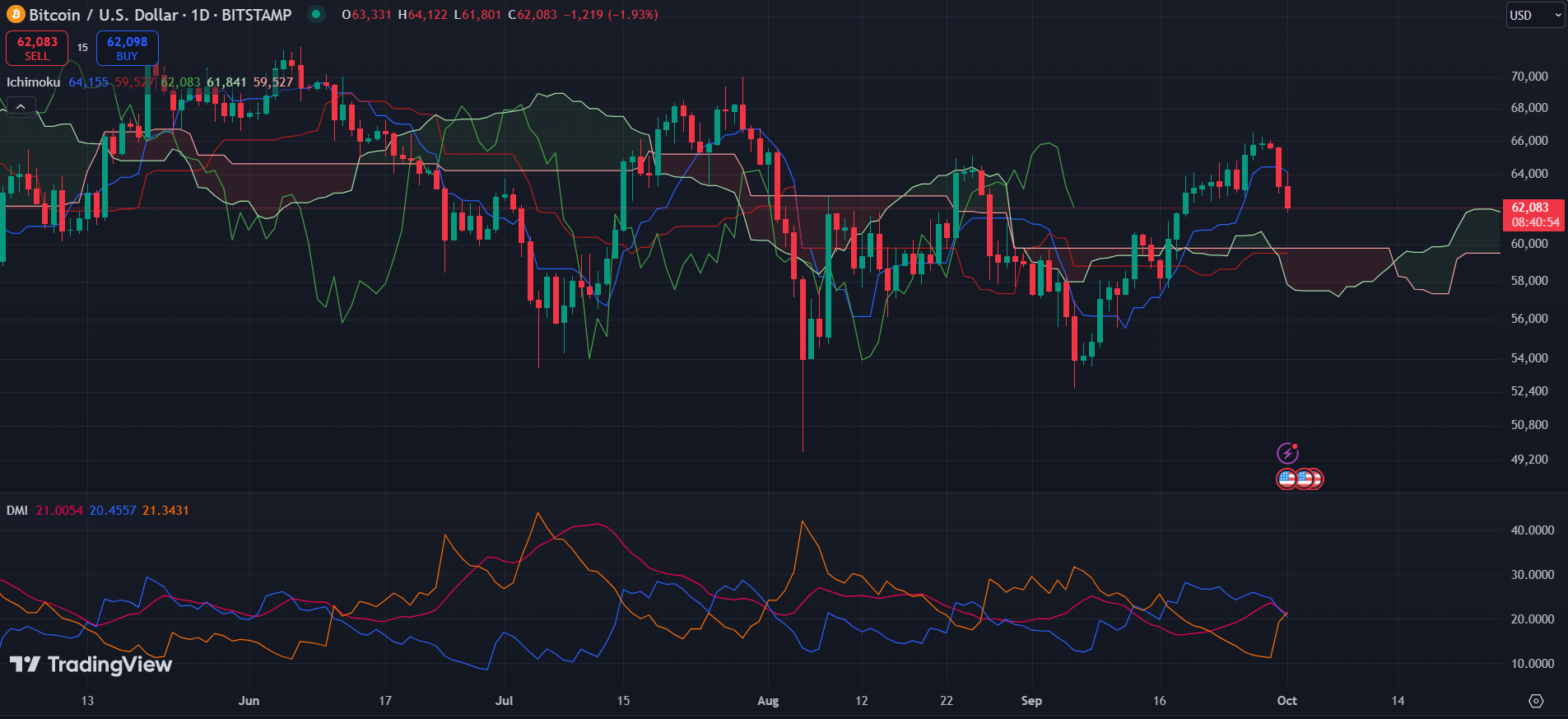
In the short-term, Bitcoin is facing a roadblock in its recovery, with prices slipping for three consecutive days. On Sept. 29, the firstborn crypto asset started its pullback, and the trend has persisted, with Bitcoin currently trading at $62,083.

On the daily DMI, the +DI is at 20.45 but is trending downward. This indicates weakening bullish momentum. Meanwhile, the -DI stands at 21.00 but is also sloping downward, suggesting that sellers are losing strength. 
Bitcoin 1D Chart
Bitcoin 1D Chart

The Average Directional Index (ADX), which measures the strength of the prevailing trend, is currently at 21.34. This relatively low value suggests that the ongoing trend—whether bullish or bearish—is not particularly strong at this moment.

Further, Bitcoin is currently trading below the Conversion Line (Tenkan-sen) of the Ichimoku Cloud at $64,155 but above the Base Line (Kijun-sen) at $59,527. This reveals that while Bitcoin’s short-term momentum has weakened, it is still holding above a key support level (the Base Line). 

Additionally, Bitcoin is above the Lagging Span A at $61,841, which means it is still in bullish territory, but the upside potential seems limited for now.
Dogecoin Sees 19,630 New Addresses Created in One Day Amid Price Pump

0

Recent data shows a notable surge in Dogecoin’s network activity, signaling increased adoption of the meme coin.

According to information shared on X by Ali Martinez, both new and active addresses have increased significantly in the past few days. The most striking observation is the rise in new Dogecoin addresses.

As of September 30, approximately 19,630 new addresses were created, contributing to a remarkable 72.29% growth in new Dogecoin wallets over the past week. This surge comes at a time when the meme coin is seeing a significant bull run.

Image

This uptick points to increased network participation, especially among new users engaging with Dogecoin for the first time. Between mid-August and early September, the growth rate was gradual, but by late September, the surge became more pronounced.

Active addresses, representing the addresses involved in transactions, followed a similarly positive trend. Over the past seven days, there was a 37.23% increase in active addresses, further supporting the observation of heightened activity on the Dogecoin network.

The rise in transaction volume, particularly around mid-September, coincided with visible peaks in Dogecoin’s price fluctuations. 

Distribution of Holdings 

Further data reveals growth across all Dogecoin address tiers. Notably, addresses holding between 0 and 100 DOGE make up a significant portion of the network, totaling 4.77 million addresses. This segment saw a 0.33% increase in the last 30 days, indicating a steady influx of new users holding small amounts of DOGE.

Mid-tier holders, those with 1,000 to 10,000 DOGE, experienced a 0.32% increase, while the 10,000 to 100,000 DOGE range recorded a 0.82% rise, suggesting accumulation by smaller retail investors.

Doge Addresses by Holding IntoTheBlock

Larger holders, particularly those with between 100,000 and 1 million DOGE, saw a 1.04% increase, reflecting growing confidence among significant players.

The most substantial growth occurred in the 100 million to 1 billion DOGE range, which experienced a 3.03% increase, indicating accumulation by the largest entities.

Dogecoin’s Price Pump

Alongside the network growth, Dogecoin’s price has also seen upward momentum. As of late September, Dogecoin broke through the $0.111 resistance level, reaching $0.12, a price level not seen in over two months. 

Market commentators have noted that Dogecoin is on track for further growth, with the next key resistance expected at $0.15.

Cardano-Native USDA Stablecoin Launch Secured by BitGo Partnership

0

BitGo partners with Anzens to provide custody for USDA, the Cardano-native stablecoin.

BitGo, a qualified custodian in the digital asset space, has announced its collaboration with Anzens, the issuer of USDA, to custody the Cardano-native stablecoin.

According to a recent press release, this partnership aims to enhance the security and functionality of the USDA stablecoin protocol. BitGo Trust, a leader in digital asset custody, brings its expertise to help integrate advanced financial infrastructure into the USDA framework.

Collaboration between BitGo and Anzens

The technical integration between BitGo Trust, Anzens Inc., and EMURGO—the technology provider behind the Anzens platform—underscores the joint aim of developing a secure stablecoin solution on the Cardano blockchain. 

The collaboration ensures streamlined and compliant processes for minting, burning, and providing custodial services. BitGo’s role supports the overall security and efficiency of USDA, aligning with Anzens’ mission to bridge traditional finance and crypto ecosystems.

By collaborating with BitGo, Anzens benefits from the infrastructure that supports segregated accounts. This allows users to maintain individual accounts, ensuring their funds are kept separate from company assets. 

EMURGO’s Role

EMURGO plays an important role in this collaboration as the technology provider for Anzens. The company has highlighted the importance of native stablecoins on the Cardano blockchain.

According to EMURGO, native stablecoins like USDA are critical to unlocking the potential of decentralized finance (DeFi) applications on the platform. This integration of fiat-backed stablecoins addresses the volatility that often challenges crypto projects, providing stability to developers building on the Cardano network.

The launch of USDA will not only secure a reliable stablecoin for users but will also expand the ecosystem by attracting institutional investors and enterprises. 

Driving Growth in Cardano’s DeFi

The introduction of USDA follows the launch of DJED, another algorithmic stablecoin on Cardano. Per a previous report, the availability of multiple stablecoins, including USDA, will help reduce concerns about crypto market volatility. 

This is especially beneficial for users and developers utilizing DeFi tools on Cardano, who can avoid the risks associated with liquidations due to price fluctuations. Stablecoins like USDA are also expected to streamline payment systems.

BlackRock Exec Says Ethereum ETFs Will Take Time to Match Bitcoin

0

Robert Mitchnick, the head of digital assets at BlackRock, noted that trading volumes and inflows from its Ethereum spot exchange-traded fund are relatively low compared to Bitcoin’s and may continue that way.

In an appearance at the Messari Mainnet conference, Mitchnick stated that this disparity was evident due to its clients’ lack of clarity on the Ethereum investment vehicle. He noted that the concept around Bitcoin, its properties, and its utility was easier to grasp than Ethereum’s, hence the increased adoption.

Adoption Will Take Time: BlackRock Exec

While lauding the impressive feat that the iShare Ethereum Trust (ETHA) has achieved, Mitchnick asserted that the fund will need more time to catch up with the iShare Bitcoin Trust (IBIT) in terms of trading volume and inflows.

The BlackRock exec noted that ETHA has made an impressive market debut compared to most other ETFs. He said the fund’s quick feet to $1 billion assets under management (AUM) were not menial, as it takes some ETFs “several years” to achieve such feet.

Furthermore, Mitchnick stated that BlackRock is working on closing the adoption gap between the Ethereum and Bitcoin funds. The exec buttressed further on the asset manager’s plans, revealing it has committed to enlightening clients on the Ethereum investment product.

Ethereun’s Underperformance Compared to Bitcoin

The Bitcoin spot ETFs made a remarkable market debut in January amidst pent-up demand for the funds. According to an earlier report, the Bitcoin products recorded a trading volume of over $4 billion on their first trading day.

Despite outflows from the Grayscale Bitcoin Trust (GBTC), the Bitcoin products reached $2 billion AUM in 15 days. Notably, these incessant inflows continued for months, with the funds buying a record $1.05 billion worth of Bitcoin in a single day in March.

At the time of writing, the Bitcoin spot ETFs record a cumulative net inflow of $18.8 billion and a total net asset of $59 billion. Notably, the renewed inflows from BlackRock and Ark Invest aided the funds’ resurgence.

Conversely, the nine Ethereum spot ETFs have recorded a cumulative net outflow of $523 million. Despite encouraging inflows from the ETHA, notable outflows from the Grayscale Ethereum Trust (ETHE) have ensured that the funds have seen more outflows than inflows.

For context, the ETHE has sold $2.918 billion in Ethereum since its inception in July, fully neutralizing the $1.15 billion inflow from BlackRock’s ETHA.

Shiba Inu: Robinhood Users Can Now Deposit and Withdraw SHIB in Europe

0

Online brokerage platform Robinhood expands its crypto services in Europe by introducing crypto transfer, allowing its customers to send and receive assets such as Shiba Inu (SHIB).

Robinhood announced the development today in a press release, emphasizing that it has enabled crypto transfers for users in Europe.

The service, introduced in response to huge customer demand, allows users to transfer Shiba Inu and more than 20 crypto assets to and from exchanges and other external wallets. 

Other supported tokens include Bitcoin (BTC), Ethereum (ETH), USD Coin (USDC), Dogecoin (DOGE), dogwifhat (WIF), and Pepe (PEPE). 

Reacting, Robinhood Crypto General Manager Johann Kerbrat said the introduction of crypto transfers simplifies self-custody and provides a straightforward approach to accessing the decentralized finance (DeFi) space. 

Additionally, Kerbrat believes the service gives users more control over their assets while delivering the reliable and low-cost experience they expect.  

Robinhood Adds Crypto Transfer in Europe After Huge Demand

The development comes a year after Robinhood expanded its crypto service to Europe due to rising regulatory challenges in the U.S. At the time, Robinhood only allowed its European users to buy and sell supported assets on its trading platform. 

However, for over a year, Robinhood’s European customers could not move their crypto assets to and from external wallets and exchanges. For instance, customers residing in supported European countries could not send their assets from Robinhood to external wallets like Metamask.

This prompted users to demand that Robinhood add the transfer feature to its crypto services. Responding to users’ demands, Robinhood introduced the transfer feature today. 

Requirements to Enable Crypto Transfer 

Despite Robinhood introducing crypto transfer, the feature will not be automatically available to all European customers. Users who wish to transfer assets, like SHIB, to and from Robinhood must first verify their identity. 

Additionally, users must enable two-factor authentication (2FA) on their accounts. Afterward, Robinhood could take four—five days to review users’ information. If they comply with the necessary requirements, Robinhood will enable the crypto transfer feature. 

Sending and Receiving Shiba Inu on Robinhood 

To send Shiba Inu on Robinhood, users must locate the ‘crypto’s detail page,’ click send, select SHIB, input the amount they wish to send, paste the recipient blockchain address, review, and submit the transaction. 

Receiving Shiba Inu and other tokens on Robinhood uses almost the same procedures. Click the ‘Receive’ button on the crypto detail page, copy Shiba Inu’s address, and paste it into the wallet or exchange app. 

Since Robinhood supports Shiba Inu as an ERC-20 token, it could take approximately 6 minutes or 30 confirmations for the funds to be credited into users’ accounts.  

Top Trader Predicts 61% Crash for Cardano to $0.15, Calls for Massive ADA Short

0

A widely followed crypto trader warns of a potential 61% crash for Cardano (ADA) to $0.15, urging investors to consider shorting despite recent gains.

Cardano reclaimed the $0.40 region a few days ago amid the broader bull run in the crypto market. ADA benefited from the buoyant market, hitting $0.4147, a price point it last traded at in July, marking a two-month high.

However, despite Cardano’s impressive price action at the end of September, some market analysts continue to urge participants to short ADA. They warn that the bulls have not returned yet.

Analyst Looking for 61% Crash in Cardano

For instance, market watcher RayTrader on TradingView recently updated his analysis of ADA, emphasizing a bearish outlook for the coin. He recognized Cardano’s successful entry into the $0.40 range on September 26. However, RayTrader disclosed that he still expects a consequential price drop, forecasting a decline to between $0.16 and $0.15 before a potential shift to a bull market.

For context, ADA is trading at $0.3846 at the time of reporting. Crashing to $0.15 would represent a substantial capital loss of approximately 61% for today’s investors. Cardano last traded in this range in December 2020 before rallying to an all-time high of $3.10 in September 2021.

This means that, even after ADA declined significantly during the bear market of 2022 and 2023, its price did not reach the $0.15 level. Yet, despite the present broader bull market sentiment, RayTrader firmly believes a crash in this region is possible.

“Good Sign” to Continue Shorting ADA

RayTrader updated his initial bearish outlook shortly, stating that Cardano’s recent fall below the $0.40 level was a “good sign” to short the coin. He outlined a more immediate short target of $0.25.

Following the broader market downturn on Monday, when ADA slipped to $0.3718, RayTrader reiterated that this development is another good sign for short sellers to hold their positions, noting that there is a long way to go before reaching the $0.15 level.

The bearish analyst suggested that those satisfied with accrued profits from shorting ADA may choose to liquidate their positions along the way, but he believes more profit could be made with patience until the $0.15 target is hit. He argues that reaching this level would signal the bottom from which a significant bull run could commence for Cardano.

While RayTrader remains significantly bearish on ADA, other market analysts hold a bullish outlook. Citing historical patterns, they project that the coin could reach as high as $10 in this bull season.

VeChain at a Crossroads: Eyes on $0.030 Amid Breakout Prospects

With a failed bullish cycle seeking redemption near the 50-day EMA, can VeChain (VET) achieve a breakout?

During the bearish phase, the price of VeChain dropped from $0.051 to $0.019, marking a significant decline of 61.15% between March 3 and September 7. However, following a broader market recovery, VeChain is back in play, challenging its overhead resistance trend line.

Currently, the price has dipped back to the 50-day EMA, maintaining hopes for a breakout. Will the broader market recovery fuel VeChain’s potential breakout?

VeChain Crosses $0.023

On the daily chart, VeChain’s price action indicates a continuing downtrend. This bearish phase began with a rejection near the psychological $0.050 mark, leading to a downturn from $0.051.

This increasing bearish pressure has created both primary and secondary resistance trend lines, resulting in a bearish alignment among the crucial daily EMAs. At present, the 50, 100, and 200-day EMAs exhibit a bearish configuration.

VeChain price Chart
VeChain price Chart

Moreover, changes in underlying dynamics have formed a declining support trend line, completing a falling channel pattern. Based on Fibonacci levels, the recent bullish cycle from $0.0199 tested the overhead resistance trend line close to the 73.60% Fibonacci level at $0.02736.

The 23.60% Fibonacci level, located just below the 200-day EMA, adds to this confluence of resistance. The high selling pressure around these crucial resistance levels caused the recent bullish cycle to falter. Specifically, it resulted in a drop below the 100-day EMA, a 5.56% decline on Monday.

VeChain Breakout Chances

Despite the recent drop, VeChain has managed to maintain its position at the 50-day EMA, experiencing an intraday increase of 2.52%. Currently trading at $0.0249, it has formed a bullish piercing candle.

The possibility of a breakout remains as the altcoin holds above this dynamic support. A bullish rally above the 23.60% Fibonacci level could challenge the primary resistance trend line above $0.030. Conversely, critical support levels for VeChain are positioned at $0.02378 and $0.020.

FOX Journalist Analyzes Regulatory Implications as Deadline for SEC Appeal in the Ripple Case Looms

0

The deadline for the US Securities and Exchange Commission (SEC) to appeal the ruling in its case against Ripple is set for October 7.

With the deadline drawing closer, FOX Business journalist Eleanor Terrett has analyzed the case’s pros and cons and stated the likely implications if the SEC fails to appeal.

In a post on Tuesday, Terrett cited sources alleging that the likelihood of an appeal is high, considering the effect the outcome of the case would have on crypto regulation in the United States.

For context, Judge Analisa Torres handed Ripple a partial victory over the SEC after ruling that the sales of XRP to secondary users do not constitute an investment contract. Meanwhile, for Ripple’s violation, the judge ordered the firm to pay a $125 million fine instead of the $2 billion intended by the plaintiff.

SEC Likely to Appeal

Per the Tuesday post, Terrett cited a disclosure from former SEC lawyer Marc Powers that the securities watchdog would likely appeal the August 7 ruling. Powers noted that the SEC will appeal the case considering its implications on crypto regulation in the US.

The former SEC lawyer stated that the agency and its crypto-skeptic boss, Gary Gensler, would look to avert the two-edged regulation that Judge Torres’ ruling will bring to the sector. He also noted that the SEC would not want the programmatic sales ruling to stand.

Notably, an SEC attorney shared the same view with the Powers. In a court session in January, the legal representative stated that they disagreed with Judge Torres’ segregation of primary and secondary investors. According to the lawyer, whether it is sold to institutions or retailers, it is the same XRP.

It bears mentioning that the SEC tried to appeal the programmatic sales ruling immediately, but the court denied the motion. Judge Torres stated that the securities regulator could only contend the verdict after the final declaration. 

Case Outcome to Likely Influence Other Lawsuit

Terrett noted that the ruling’s outcome would likely influence other SEC legal battles. Proceedings on the SEC’s lawsuit against Binance, Coinbase, and Kraken for offering unregistered securities are still ongoing, and the exchanges are closely monitoring the Ripple vs. SEC case.

Should the SEC not appeal the Ripple case, these exchanges could cite the ruling in their legal dealings with the regulator. Notably, Terraform already tried the approach but failed to make headway.

Appeal, A Waste of Resources

Meanwhile, Jeremy Hogan, a partner at Hogan and Hogan, feels the SEC appeal would be a waste of resources. He stated that the agency should not focus on winning on a single asset in a broad sector.

Hogan stated that the best way to dissolve the programmatic sales ruling was to stick it to Coinbase and Binance. He noted that the case against the two exchanges better addressed the issue of secondary sales and is “more relevant to the current enforcement priorities.”

Notably, despite heightened suggestions that the SEC will appeal the case, Ripple’s Chief Legal Officer Stuart Alderoty maintains that the case is over. He further stated that the slim chances of victory in the Appeals Court meant the US top regulator would not successfully overturn the ruling.

Analyst Says Solana Likely to Pump to $220 as Key Indicators Align

0

A notable analyst forecasts a potential 40% surge for Solana, citing key technical indicators aligning for a bullish breakout.

Despite a broader market correction, Solana has continued its upward momentum, posting a 2% gain today.  The latest developments have caught the attention of an analyst named RichRangatang, who is now pointing to potential bullish movements in the near future.

According to his latest observation, shared on TradingView, Solana is showing promising signs of breaking through a key resistance level that could signal a substantial price surge.

Indicators Point to a Potential Breakout

RichRangatang has observed key technical indicators on Solana’s weekly chart, highlighting the convergence between the RSI and RSI-MA14, as well as the MACD crossing the signal line. According to him, these indicators often precede bullish momentum.

Solana 1-Week Chart
Solana 1-Week Chart

Solana’s price action, which has followed a pattern of market runs over the past year, now appears ready to test the top resistance trendline. RichRangatang predicts that if the price successfully breaks this resistance, it could result in a new leg up, potentially leading to a new all-time high for Solana.

If Solana plays out as expected, the price could target the $220 range, according to the analysis. Trading at $157, this target would amount to a substantial gain of 40% for current investors.

Other Analysts Set More Ambitious Targets

While RichRangatang suggests a moderate price target, other analysts foresee a more optimistic scenario. Market analyst InvestingScope has set a speculative target of $5,000 for Solana, predicting a parabolic breakout.

This outlook comes amidst a market-wide rebound, with Solana having rebounded by 22% from its monthly lows. While this target is ambitious, an analyst has argued that SOL previously saw an astronomic growth of 51,500%.  

Ecosystem Tokens Show Growth

Beyond Solana’s price performance, its ecosystem tokens have also displayed remarkable growth. According to data from Solana Daily, various tokens within the Solana ecosystem, including DeFi and decentralized exchange tokens, have seen significant market cap increases. 

The CROWN token, associated with the Photo Finish platform, recorded a 103% rise, while Metaplex’s MPLX token grew by 55%, reaching a market cap of $462 million. These performances demonstrate the broader success of the Solana network as it continues to expand its influence across multiple sectors in Q3 of 2024.

Solana Q3 Sees CROWN, MPLX Lead Market Cap Growth Across the Ecosystem

0

Solana-based tokens have shown impressive growth in Q3 of 2024, marking a strong performance across the ecosystem. 

According to Solana Daily, various tokens across decentralized finance (DeFi), decentralized exchanges (DEX), and other blockchain sectors experienced massive market cap growth. The platform highlighted that Solana continues to expand its influence in the blockchain space, with several tokens seeing notable increases in value during this period.

Tokens Leading Market Growth

Among the top performers, CROWN, the native token of the Photo Finish platform, saw a market cap increase of 103%, reaching $110 million. Metaplex’s token, MPLX, followed with a 55% growth, bringing its market cap to $462 million. 

Other tokens, such as DRIFT, which powers the Drift BET, rose by 42%, reaching $157 million in market cap. Similarly, Wormhole’s W token increased by 45%, with a total market cap of $786 million.

Additionally, io.net’s IO token grew by 38%, with a market cap of $202 million, while GMT token expanded by 37%, reaching a market cap of $456 million. Pyth Network’s PYTH token saw a 32% growth, reaching $1.3 billion in market cap, showing the strength of oracles in the ecosystem.

The Render Network’s RENDER token also performed well, growing by 27%, as it reached a market cap of $2.6 billion.

Expansion of the Solana Ecosystem

Beyond token growth, the broader Solana ecosystem saw several key developments. For instance, Solana Daily reported that the total value locked (TVL) in Solana’s DeFi protocols surged to $5.48 billion. 

Moreover, notable partnerships were established, such as PayPal allowing U.S. business customers to buy, sell, hold, and transfer cryptocurrencies. Jupiter Terminal v3 also launched, enhancing token routing and selection for decentralized applications (dApps) on Solana.

Meanwhile, Layer3, the consumer attention layer, announced its expansion to Solana in October, further strengthening the ecosystem’s reach.

Several projects have also migrated to Solana, including Unlonely, which moved from Base. In addition, Binance launched SOL Surge. Google Cloud’s partnership with Solana Labs helped bolster the network’s expanding infrastructure.

Surging DEX Volume Leaves Ethereum Behind

Further data from September 30 reveals that Solana’s decentralized exchange (DEX) volume saw a remarkable 45.74% increase during the last week of September, processing over $7.87 billion in trades.

In contrast, Ethereum’s DEX volume grew by just 1.3% during the same period, showcasing the rapid pace of Solana’s growth in the decentralized finance space.