Home Blog Page 1211

Shiba Inu Sees 360% Spike in Large Transactions as Big Traders Step In

0

Shiba Inu experiences a notable surge in whale activity, with large transactions driving liquidity.

Recent data from Santiment has revealed a significant rise in whale activity among top cryptocurrencies, with Shiba Inu (SHIB) emerging as a key performer. This increase has drawn attention due to the notable whale transaction count, which surged by 360.18% for transactions exceeding $100,000.

Sentiment Commentary / Santiment
Santiment

Despite this jump, SHIB’s market price has experienced a decline over the same period. Shiba Inu’s whale activity places it ahead of several top cryptocurrencies by percentage rise in whale transactions. It follows only Injective (INJ) and Wrapped Bitcoin (WBTC), which saw rises of 456% and 421%, respectively. 

In contrast, other cryptocurrencies such as MakerDAO’s DAI, PEPE, and Tether’s USDT saw comparatively smaller rises in whale activity, trailing behind SHIB.

Whales Dominate Shiba Inu Transactions

While whale activity surged, SHIB’s price dropped by 1% over the past day, trading at $0.000018. In contrast, over the last week, SHIB has experienced an uptrend, showing a consistent price increase as well as increased transaction volume. SHIB’s daily trading volume remained robust at $573.54 million, registering a 5.65% rise.

Notably, data from IntoTheBlock has confirmed that high-activity addresses have contributed to the influx of the transaction count. These addresses, representing 41.73% of SHIB’s total whale accounts, have been actively driving liquidity and contributing to market movement. In contrast, low-activity whale addresses represent a smaller portion, ranging between 1.17% and 3.89%.

SHIB Address Activity / IntoTheBlock
Shiba Inu Address Activity / IntoTheBlock

The data also show that the majority of retail investor addresses exhibit low activity, with the highest percentages ranging between 0.82% and 0.95%. They particularly demonstrate lower engagement in comparison to the whales.

Continued Optimism for Shiba Inu

Elsewhere, a market analyst recently predicted that Shiba Inu might experience a price surge in October, spurred by increased trading optimism. This period, often referred to as “Uptober” by cryptocurrency traders, has historically seen upward trends in the market. 

SHIB KNIGHT has identified potential price targets for Shiba Inu ranging from $0.00002148 to $0.00002421. Despite the recent price decline, SHIB’s whale activity and market sentiment suggest a potentially strong performance in the coming month.

Ripple Insider Reveals How RLUSD Will Boost XRP

0

A former Ripple employee has provided detailed insights on how Ripple’s upcoming RLUSD stablecoin will benefit XRP rather than harm it.

This insight was shared in a conversation with Tony Edward, the host of the Thinking Crypto podcast. Notably, this Ripple alum was part of the team that developed Ripple’s On-Demand Liquidity (ODL) product, now known as Ripple Payments.

RLUSD Will Be Paired with XRP for Greater Liquidity

The former employee revealed they have long advocated for Ripple to launch a stablecoin. When asked whether RLUSD could negatively impact XRP, they suggested quite the opposite.

According to their insights, the stablecoin is expected to be paired with XRP, benefiting from greater liquidity, as XRP is tradable on virtually all crypto exchanges globally.

Moreover, the connection between XRP and RLUSD is expected to help stabilize the stablecoin, preventing de-pegging issues that have challenged other stablecoins. The former Ripple insider emphasized that RLUSD will unlock new opportunities in forex and other financial sectors.

Concerns About RLUSD Arrival

Notably, crypto community members who argue that RLUSD’s arrival will negatively impact XRP often theorize that Ripple is moving away from XRP for cross-border payment processes to a stablecoin alternative. They believe RLUSD aims to usurp XRP’s position in Ripple’s payment network.

However, reputable figures in the XRP community, including top executives at Ripple, have reiterated that RLUSD would benefit XRP rather than harm it. Ripple CTO David Schwartz emphasized this perspective during the 2024 XRP Ledger Apex summit.

He explained that the evolution of DeFi has highlighted the importance of stablecoins. They serve essential functions like pricing and trading while avoiding market exposure. 

Schwartz noted that different asset classes are needed for effective DeFi participation and emphasized that liquidity in trading favors XRP. He stated that introducing RLUSD will enhance use cases rather than diminish XRP’s utility.

Ripple CEO Brad Garlinghouse echoed this sentiment, stating that RLUSD will complement the XRP ecosystem by providing better liquidity and on-ramps, ultimately supporting the growth of XRP. This counters concerns that RLUSD would undermine XRP’s existing functions.

XRP Army Reacts

In response to a recent comment by a former Ripple employee, members of the XRP community expressed their agreement. Vet, an XRPL validator, stated that RLUSD is a net benefit for the XRP Ledger, noting that anything contrary to this is merely FUD.

Also, Vet acknowledged that having RLUSD sooner would have been preferable. However, he pointed out that it’s easy to say that in hindsight. Another commenter remarked that this issue has long been settled and that a former Ripple employee does not need to clarify it.

RLUSD Will Not Take XRP to $1,000: XRPL Validator

0

Vet, an outspoken XRPL validator, has again debunked speculations that the RLUSD could push XRP to a four-digit figure, given new developments.

The XRP community figure made the latest disclosure in a post on X amid circulations of a decentralized exchange (DEX) offer on the XRP Ledger involving an unrealistic exchange rate between XRP and the upcoming Ripple stablecoin (RLUSD).

The XRP to RLUSD Offer

For context, an address created an RLUSD DEX Offer on the XRPL on Sept. 26 at 05:57 UTC as the beta testing phase of the stablecoin project continues. However, the individual behind the transaction sought to receive more RLUSD for less XRP.

On-chain data from XRPScan confirms that the address offered 5.911 XRP for 5,911 RLUSD, essentially $5,911. For this offer to be fulfilled, whoever satisfies it would be exchanging XRP at a price of $1,000 per token. 

This development could fuel the ongoing speculation that XRP might be heading toward $1,000 on account of the RLUSD launch. The Crypto Basic recently called attention to speculations from an XRP community member that XRP could hit $1 million in the unlikely event that 1 RLUSD equals 1 drop of XRP.

Vet immediately nipped growing XRP to $1,000 speculation in the bud by quickly stressing that the strange DEX Offer does not mean the RLUSD stablecoin would be pushing XRP to a four-digit figure. He noted that the transaction was merely a DEX Offer, which anyone could make on the XRPL.

Why an XRPL DEX Offer Means Little

For the uninitiated, A DEX Offer on the XRP Ledger is a request for trade where a market participant proposes to buy or sell a specific amount of one crypto asset for another one at a set exchange rate.

Any individual can place a DEX Offer on the XRPL, including extreme offers like valuing XRP at $1,000. However, for the trade to actually occur, someone else would need to willingly accept the terms, agreeing to exchange 5,911 RLUSD for only 5.911 XRP. If no one agrees, the offer remains unfulfilled.

Notably, this offer could be a speculative play or just an arbitrary price someone chose. It will sit on the order book until someone finds it valuable or the person who posted it cancels it. For such an exchange to happen, both parties need to believe in the terms.

Vet said no reasonable individual would agree to sell nearly 6,000 RLUSD, equivalent to $6,000, for 6 XRP (currently worth $3.72 against prevailing rates). The dUNL validator noted that even if someone else accepts this rate, it would only be for this offer, possibly as an effort to fuel the ongoing speculations.

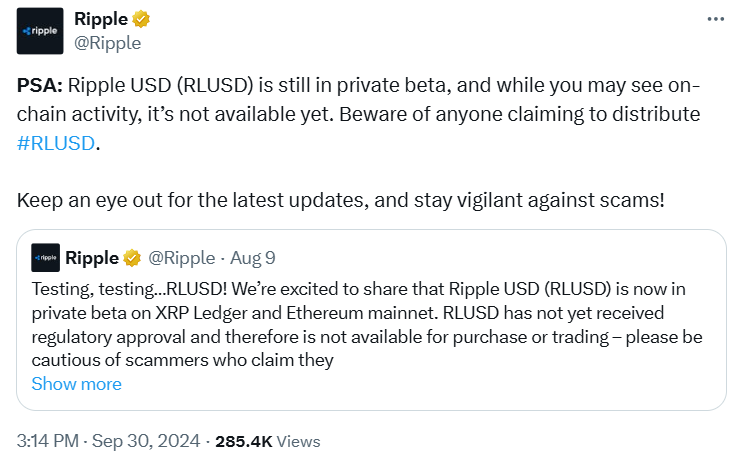
He seized the opportunity to further reiterate that the RLUSD project is not yet live. For context, several bad actors have leveraged the beta testing phase to deceive unsuspecting users, claiming that the RLUSD is now live. Ripple also debunked these claims in a recent post. 

Ripple on X
Ripple on X

Ripple Unlocks 1B XRP From Escrow in October as Price Slumps 4.26%

0

In a routine procedure, San Francisco-based payments company Ripple has witnessed the unlocking of 1 billion XRP tokens from escrow. 

The development, which occurred in the early hours of today, saw the company’s escrow wallets release 1 billion XRP, valued at $621.78 million, across three transactions. 

Transaction Details 

Data from Whale Alert shows that the escrow system first unlocked 500 million XRP ($310.64 million) today at 02:53 UTC. Six minutes later, the second escrow release, containing 400 million XRP ($248.88 million), was executed. 

Afterward, the Ripple escrow system unlocked the last batch of XRP for October, featuring 100 million tokens worth $62.24 million. This transaction was executed at exactly 03:00 UTC, bringing Ripple’s total XRP unlock for October to 1 billion XRP. 

It bears mentioning that all three transactions were initiated by OffEscrowerOfDai, a blockchain account frequently associated with Ripple’s monthly XRP unlocks. 

Ripple Expected to Re-Lock 800M XRP in Escrow 

Meanwhile, Ripple is expected to re-lock most of the funds back in escrow as part of the usual procedure. Notably, the company typically re-locks 80%, or 800 million XRP, in escrow after releasing 1 billion tokens on the first day of each month. 

The Crypto Basic reported that Ripple followed this pattern last month during its September escrow release, unlocking 1 billion XRP and re-locking 80% of the funds in escrow. The retained 200 million XRP might have been used to advance the company’s businesses. 

Interestingly, this transaction coincided with the timeline for the company’s payment of $125 million to the SEC following its violation of federal securities laws. 

Many community members then speculated that Ripple could sell the 200 million XRP to pay the fine. 

XRP Plunges 4.26% in 24 Hours 

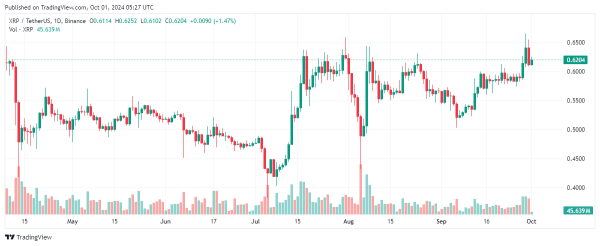
In the meantime, XRP is trading at $0.6203, down 4.26% over the past 24 hours. Conversely, XRP is up 5.26% in the past seven days and 11.09% in the monthly charts. 

XRPUSDT 2024 10 01 06 27 10
XRP 1D Chart

It remains unlikely that Ripple’s recent XRP unlocks affected the token’s performance in the past 24 hours, as the broader crypto market has also seen huge corrections within the same timeframe. 

Expert Predicts Hestia Line to Push XRP to $17 or $27

0

Popular market analyst EGRAG predicts a massive price surge for XRP, identifying patterns that may propel it to two-digit figures.

He disclosed this in a recent report, while analyzing the monthly XRP chart. The prediction centers around what EGRAG refers to as the “Hestia Line,” an important support level that he believes could serve as a springboard for an upward push.

The Role of the Hestia Line in XRP Price Action

The analyst noted that the Hestia Line represents a rising support trendline that has been acting as a foundation for XRP’s price. Notably, it assumed this role especially after the failure of another key level, the Phobos Line.

According to EGRAG, while the Phobos Line was initially expected to hold strong and guide the price upward, the bears eventually broke it. This breakdown occurred in January 2024, leading to the identification of the Hestia Line as the next major level to watch.

The analyst sees the Hestia Line as a symbol of stability and potential growth, likening it to the flame of Hestia, the Greek goddess of the hearth. Technically, the line presents a strong base from which XRP could rise, particularly as the price appears to have stabilized above it.

XRP’s Ascending Triangle

EGRAG’s chart also identifies an ascending triangle that started taking shape in January 2018. Several analysts have identified this triangle, with a top economist recently stressing that XRP has not yet broken above it. The chart from EGRAG also confirms that XRP remains within the triangle.

Image

Interestingly, the Hestia Line forms the bottom of the ascending triangle, while a line the analyst calls the “Troposphere Line” forms the top. As the Hestia Line presents support, a breakout above the Troposphere Line could signal a substantial price increase. 

The analyst provides two potential price targets based on this pattern. The more conservative estimate suggests a rise to $17, assuming the measured move starts from the Hestia Line. However, if XRP follows the traditional ascending triangle breakout method, the asset could rally as high as $27.

Notably, EGRAG noted that he plans to focus on the less ambitious $17 target. However, for the $27 goal to come into play, XRP would first need to recover the previous support from the Phobos Line by breaking above the $0.90 psychological resistance. 

From this level, it would then need to target $1.3 to record a standard breach of the Troposphere Line. At the time of writing, XRP currently changes hands at $0.6228, down 3.59% over the past 24 hours despite a 6.41% gain in the last week. A rise to $17 would require a 2,629% increase, while the $27 target would demand a 4,235% spike.

Crypto Wizard Says XRP Turbo Candle Inbound, Cites Likely 210% Price Pump

0

A widely followed market observer, Crypto Wizard, has highlighted that XRP’s turbo candle is inbound, indicating the potential for the asset to break a three-year high in the short term.

At the time of the post, XRP had just reclaimed the $0.63 level after having traded in the $0.58 range two days earlier. XRP’s move back into the $0.60 region sparked significant attention in the crypto community, enabling it to climb even higher.

In particular, XRP has since hit $0.66, a threshold it last traded at in March when XRP set a yearly high above $0.74. This commendable price action over the weekend has given confidence to analysts like Crypto Wizard that higher price points are in sight.

XRP Likely to Pump by 210% to $2

In the chart accompanying the update, this analyst depicted the potential path XRP could take next. He forecasted XRP engineering a strong, tall green candle, where its price could pump as high as $2 soon.

The chart highlighted a previous occurrence during the last bull season. Looking at XRP on the monthly timeframe, the chart pattern depicted a towering rally to $1.96 in 2021 before the momentum waned. He sees a repeat of that.

At press time, XRP is back in the $0.645 range, given the ongoing retracement in the broader crypto market. Reaching $2 would require a growth of 210% from the current price level, amounting to a 2X return for current holders.

Analyst Expecting $1.5M Profit from XRP at $2

Other market analysts, like Michael XBT, a Bitcoin investor since 2014, agreed with Crypto Wizard’s view about XRP’s outlook. Responding to the post, he shared a GIF suggesting XRP would be “printing money” continuously for holders in the coming days.

In August, Michael disclosed that he expects to net as much as $1.5 million in profit from his XRP position should the asset reach $2. In recent comments, he cautioned XRP holders against selling their holdings, emphasizing that after holding for seven years, it would be unwise to sell right before a breakout.

He believes XRP is just starting to surge, and those who sell now risk missing out on significant gains ahead.

With The Tokenization Of Cloud Computing, Everyone Can Invest In The Growth Of AI

0

For retail investors looking to invest in the cloud computing market, they could be forgiven for thinking that it’s an opportunity that has already passed them by. These days, the world’s top cloud infrastructure providers – Amazon Web Services, Microsoft Corp. and Google Cloud – are among the world’s richest publicly traded companies, valued at millions of dollars.

This trio of companies is commonly referred to as the “Big Three” in the public cloud market, and they use their enormous existing cloud infrastructure and their bottomless pit of financial resources to maintain their dominance of it. Should any potential upstart arrive on the scene, such as a novel cloud computing startup, they’ll immediately invest in that company, long before it goes public.

A good example of this can be seen in the AI industry, where startups like OpenAI and Anthropic have emerged as two of the leading lights with powerful AI models like GPT-4o and Claude. In the case of OpenAI, one of its earliest investors was none other than Microsoft, which famously pumped $10 billion into it back in January 2023, shortly after the debut of ChatGPT. Similarly, Anthropic is backed by a number of high-profile venture capital firms, including Google’s VC arm.

Retail investors don’t get to participate in these opportunities. During the early stage of the typical startup’s life, before it goes public and lists its shares on the public stock exchange, the only people who can invest in them are “accredited investors” owned by extremely high net-worth individuals.

However, with the rise of decentralized cloud computing, retail investors may finally have an opportunity to bet on what has long been one of the most lucrative segments of the wider tech industry.

What is Decentralized Cloud Computing?

The integration of blockchain in cloud computing is a logical shift given that these networks live on what is essentially cloud infrastructure. Blockchains are decentralized networks made up of hundreds and sometimes even thousands of independent yet interconnected nodes – basically individual computers and servers – that are scattered around the world. In the case of Bitcoin, for example, it’s estimated that there are around 18,900 active nodes all running the same blockchain, with roughly 1,900 in the U.S., 1,300 in Germany and several hundred in countries like France, Japan, Netherlands, Canada, the UK and Switzerland, according to Bitnodes.io.

Within decentralized networks, the nodes collectively act in the same way as a centralized data center, aggregating their storage to create a single, much larger computing resource. They all work together to perform computing tasks, with a portion of each workload distributed to specific nodes within the network. The advantages of decentralized networks include greater privacy, more reliability and lower costs, though they also face some unique challenges not associated with centralized data centers.

Unlike their centralized counterparts, decentralized cloud networks are built on an alternative business model where users pay to access computing resources using digital tokens. In turn, those who participate in these networks by contributing resources can earn tokens for doing so. These tokens are the key that opens the door to retail investors.

Who Is Building Decentralized Clouds?

One of the leading decentralized cloud computing projects is Cudos Network, which is at the forefront of efforts to create “artificial general intelligence” or AGI systems that can think for themselves and teach themselves new skills.

The creation of AGI will require access to vast amounts of computing power in order to process the enormous datasets required to train their underlying models. Unfortunately, it is not really feasible to meet the computation requirements through centralized cloud providers, due to the high costs involved.

Cudos provides an alternative with its decentralized cloud network, which tokenizes access to both the computing power and the underlying storage resources needed for AGI workloads. The great thing about Cudos is that anyone can join its network by linking their computer to it and donating resources. These resources are then matched with real-world applications that need the computing power they provide. In return, participants earn the platform’s native token, CUDOS, which is a cryptocurrency that’s also required to pay for access to the network’s resources.

Besides AI, any other kind of application can run on the Cudos network, including scientific research, graphic design, machine learning algorithms, games and more.

A similar service to Cudos is provided by Io.net, which was established in 2022 as a decentralized GPU network aimed at supporting AI workloads. Io.net makes use of the same open-source libraries that are used by OpenAI to distribute ChatGPT training across more than 300,000 GPUs and CPUs. It’s built on the Solana blockchain, which is known for having much faster and lower cost transactions than the Ethereum or Bitcoin blockchains. Access to the network is based on a similar model of tokenization, where users must pay in cryptocurrency, with the revenue distributed among network participants.

Doing something slightly different is Render Network, which has built a global rendering system for immersive computing workloads. One of Render’s major customers is Apple Inc., which is using the network to power its Octane X 3D software for creating Hollywood-style CGI and 3D virtual reality worlds. In addition, Render also supports generative AI models for image generation, such as Stability AI’s Stable Diffusion model.

Advantages

The advantages of decentralized networks include lower costs, greater privacy and more reliability, though they also face some unique challenges not associated with centralized data centers. The lower costs stem from the fact that decentralization removes the middleman from the equation. Moreover, overheads such as rent, labor and electricity costs are reduced, as they are spread across the individual network nodes.

According to Ben Goertzel, a renowned computer scientist, AI researcher and the founder and Chief Executive Officer of SingularityNET, there is likely to be lots of demand for decentralized networks in the coming years, as many startups and small developer teams are unable to pay the premiums associated with AWS, Azure and Google Cloud.

“In some ways they offer a great service, but they come at quite the premium if you just look at the hardware firepower you’re getting and not the actual services you’re getting,” Goertzel said. “So we can offer a much more economical solution because of decentralization and also because of the way we’ve set up the software. There’s a lot of upside we can offer to customers.”

By tokenizing access to the cloud, it’s possible for projects like Cudos and Render to distribute cloud resources over a much more varied range of hosts, with a model that’s more accessible and liquid for both customers and those who want to invest.

One of the most revolutionary aspects of data center tokenization is that the compute economy, which has traditionally always been an illiquid asset only available to elite investors, becomes much more accessible and tradable. The ability to invest in this economy is open to every investor, large and small, regardless of their financial resources. Tokenization enables what’s called “fractional ownership”, where computing power can be broken down into more affordable chunks that anyone can afford. A good example of this is DcentAI, which has created a blockchain-based GPU cloud for AI developers, where anyone can buy and sell fractions of its cloud-based resources.

The emergence of the tokenized data center will pave the way for DeFi investors to access a previously restricted segment of the technology markets, namely cloud-based GPUs, which is expected to grow at a compound annual growth rate of 33.2% per year through 2029. In addition, it also provides cloud startups with an alternative funding model to traditional venture capital investments.

Challenges

As promising as data center tokenization sounds, this nascent industry will need to overcome a number of challenges if it’s to become a truly viable option for retail investors. For one thing, the rules and regulations around tokenization are still very unclear, with no standardized legal framework in place to govern digital assets. There’s a distinct lack of clarity over the legal status of digital assets, for example, which creates uncertainty over the safety of such investments.

This lack of regulation is one of the main reasons why the model has yet to gain broad acceptance in financial markets, despite being around in other sectors for a number of years already. For instance, tokenized real estate is not a new concept, yet very few real estate investments are made this way.

An Enticing Opportunity

Still, the potential of tokenization is clear, not only in the data center and cloud computing, but in almost every market. Almost everyone is expecting explosive growth in the AI industry over the next few years, which can help to increase the allure of investing in tokenized data center resources.

Given that retail investors have no other way to participate in the growth of this industry, tokenization represents what may well be the only way for the broader public to invest in the infrastructure that supports our AI-driven future.


CryptoQuant CEO Says “I’m Sorry Bears” as Bitcoin Still in Bull Cycle

0

Bitcoin enthusiasts and traders have recently seen a flicker of hope despite ongoing selloffs, as hints of a resumption of the bull run emerge.

CryptoQuant CEO Ki Young Ju has pointed out that Bitcoin remains in the middle of a bull cycle, based on key data from a growth rate difference chart. 

This chart, which tracks the relationship between Bitcoin’s market capitalization and its realized capitalization, signals that Bitcoin is still in a phase of growth. The current trend reveals that the market cap is rising faster than the realized cap, a key indicator of a bull market.

Historical Cycles and Growth Patterns

The growth rate difference chart highlights clear trends from Bitcoin’s past bull and bear cycles, beginning with the 2013-2015 period. In 2013, a sharp increase in market cap initiated a bull market, which was later followed by a steep correction in 2014, marking a bear market phase.

This pattern repeated between 2016 and 2018, with a new bull cycle starting in 2016, peaking at the end of 2017, and then declining throughout 2018 into bear territory. Notably, each period of market cap growth was followed by a corresponding correction, as seen with the fluctuations between the green (bull) and red (bear) zones on Young Ju’s chart.

In the 2019-2021 period, another recovery began, propelling Bitcoin into new heights in 2021. However, the subsequent decline in 2022, exacerbated by rising inflation and broader market corrections, brought Bitcoin back into a bear cycle. The growth rate difference shifted into the red zone, indicating a prolonged bear market phase.

New Bull Cycle Post 2023

Entering 2023, the chart indicates a reversal of the bearish trend as Bitcoin’s market cap begins to outpace its realized cap once again. This shift into the green zone suggests the start of another bull cycle. 

Recall Young Ju’s statement in May that such growth patterns typically last around two years, suggesting that if the current trend holds, the bull market may extend into 2025.

Unusual September Performance

Interestingly, 2024 has also marked a departure from Bitcoin’s usual performance in September, a month historically associated with price drops. In contrast, Bitcoin has posted a rise of over 10% this September, defying expectations.

Market analyst Ali Martinez noted that when Bitcoin ends September with a positive candlestick, it has often paved the way for substantial gains in the following months. 

For instance, Bitcoin saw significant gains in October 2015 and 2016 following strong performances in September, with increases of 33.49% and 14.71%, respectively. This year’s positive September performance could similarly signal more gains as the market continues to grow, particularly as Bitcoin remains in the middle of its current bull cycle.

Japanese Yen Depreciation Drives Japan Company to Purchase Bitcoin, Ethereum, and Solana

0

Remixpoint, a publicly listed company in Japan, splashes about $5.25 million to purchase four major cryptocurrencies, such as Bitcoin (BTC), Ethereum (ETH), Avalanche (AVAX), and Solana (SOL).  

Specifically, Remixpoint purchased 64.4 Bitcoin, 2,260.5 Solana, 130.1 Ethereum, and 12,269.9 Avalanche. According to a recent report confirming the purchase, the company claimed it spent around .2 million (600 million Japanese Yen) to acquire the BTC. In addition, Remixpoint committed about $350,000 (50 million Yen) each to purchase Avalanche, Ethereum, and Solana. 

$10.5M Allotted for Crypto Purchases 

Notably, Remixpoint acquired the assets on September 27. The move comes a day after the company revealed plans to purchase digital currencies worth $10.5 million (1.5 billion Yen). 

Of the total amount, Remixpoint, whose stock is listed on the Tokyo Stock Exchange (TSE), planned to prioritize investments in Bitcoin, with nearly $8.4 million (1.2 billion Yen) marked for the purchase of BTC. 

However, around $700,000 (100 million Yen) each was earmarked to acquire Solana, Ethereum, and Avalanche. From the $10.5 million total figure, Remixpoint has already made its first crypto acquisition, totaling around $5.25 million. 

The company plans to purchase another $5.25 million worth of BTC, SOL, ETH, and AVAX by the end of the year, based on market conditions. Remixpoint’s acquisition of crypto is part of the company’s efforts to diversify its investments and optimize its cash management strategies. 

Furthermore, the company acquired cryptos to mitigate the risk of Japanese Yen depreciation on its balance sheet. 

Japanese Yen Weakens 

For context, the Japanese Yen has plummeted heavily since the beginning of the year, plunging more than any of the G10 nations’ currencies.

In May, analysts at Goldman Sachs projected that the currency would remain weak in the coming months, forecasting that the situation might worsen if the U.S. Federal Reserve introduces fewer interest rate cuts.  

Four months after the prediction, the yen plunged to a year-to-date low of 140.61 in the dollar. The currency has witnessed a slight recovery and is currently valued at 143.06 to the dollar.

Given Yen’s heavy depreciation, Remixpoint chose to acquire Bitcoin, Avalanche, Solana, and Ethereum to limit its exposure to the currency.

Besides Remixpoint, other Japanese-based companies have also turned to cryptos to shield themselves from the country’s economic instabilities. Earlier this year, Japanese-based Metaplanet leveraged Microstrategy’s Bitcoin investment strategy to cushion the effect of yen’s devaluation. In May, the company acquired 19.87 BTC, which is currently valued at $1.27 million. 

Remixpoint Shares Surge 

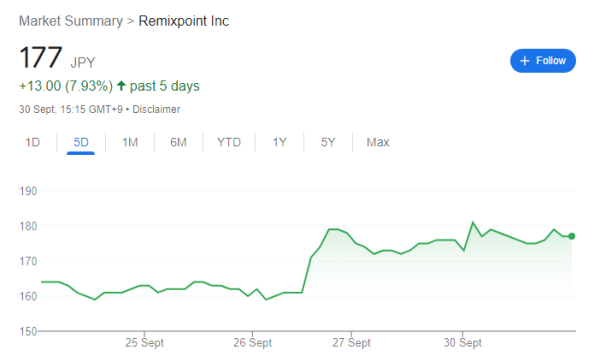
Meanwhile, Remixpoint’s crypto acquisition had a positive impact on its share prices. The share, which traded between 159 and 164 JPY for the most part of last week, surged to 179 JPY immediately after Remixpoint announced plans to purchase cryptos on September 26. 

It subsequently rose to 181 JPY earlier today before retracing to 177 JPY in the hours leading up to press time. 

Remixpoint shares
Remixpoint shares

Cardano and Solana Set to Witness Large Token Unlocks in October

0

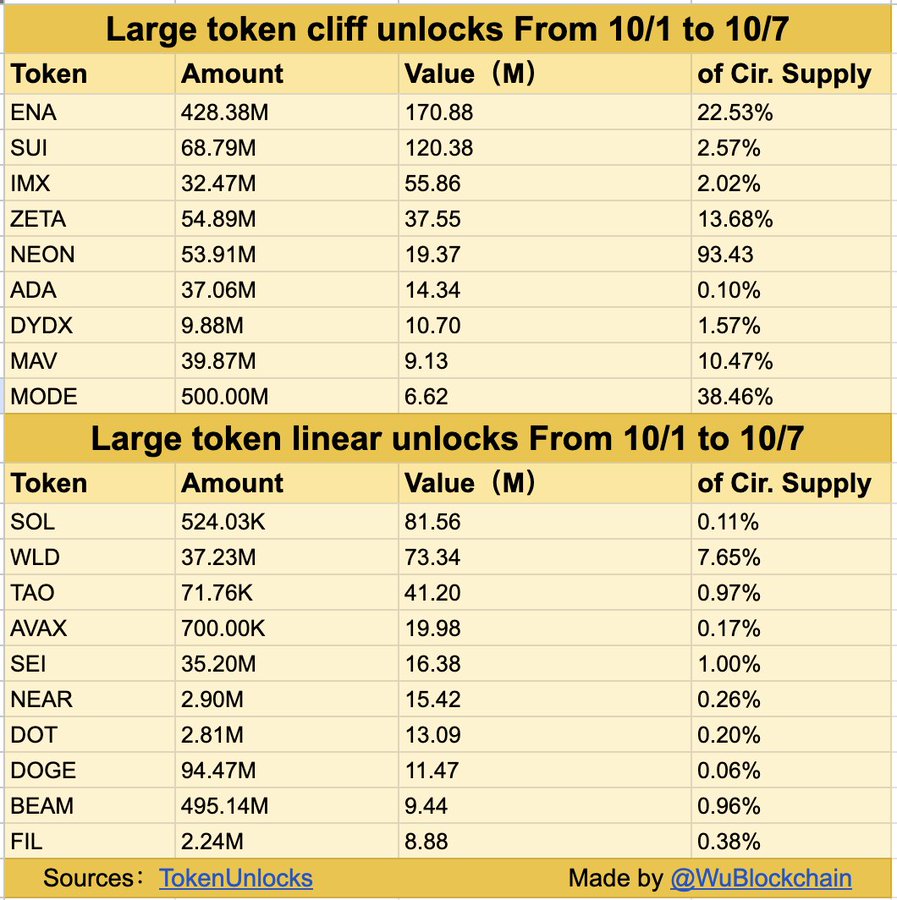
In early October, crucial token unlocks are scheduled for both the Cardano (ADA) and Solana (SOL) ecosystems, triggering attention from market participants. 

According to a disclosure from blockchain reporter Colin Wu, Cardano will unlock approximately 37.06 million tokens worth $14.34 million, which constitutes a small fraction (0.10%) of its circulating supply. 

Meanwhile, Solana is preparing for a much larger unlock of 524.03 million tokens, valued at $81.56 million, accounting for 0.11% of its supply.

Although these percentages may seem minimal, they could have implications for the market. In Cardano’s case, the unlock is unlikely to cause drastic price volatility, given the relatively small portion of circulating supply involved. 

Token Unlocks
Token Unlocks

Previous Token Unlock Trends

Solana and Cardano have each had several notable token unlock events in the past. For Solana, a significant unlock occurred in July 2022, when 27.62 million tokens were added to the circulating supply, marking a 7% increase. 

This was part of its yearly inflationary mechanism that seeks to gradually reduce the inflation rate until it stabilizes at 1.5%. 

By July 2023, Solana’s circulating supply had grown to around 422.32 million tokens, and similar unlocks are expected annually until 2027. These token unlocks are part of Solana’s designed growth to sustain its ecosystem while maintaining a steady inflation rate. 

However, questions about transparency, especially regarding tokens held by the Solana Foundation and early investors, have raised some concerns in the community.

On the other hand, Cardano has had a more conservative tokenomics model. Historically, its unlock events have not been as frequent or as large as those of Solana. 

Since its launch in 2015, Cardano has followed a more deliberate and slow release of tokens, with major unlocks tied to the project’s various development phases. 

Other Token Unlock Schedules

Other notable token unlocks happening in early October include Aptos (APT), which will see 34.09 million tokens worth approximately $134.42 million released, accounting for about 4.54% of its circulating supply. 

Immutable X (IMX) will unlock 32.47 million tokens, with a value of $55.86 million, representing 2.02% of its circulating supply. Sui (SUI) will unlock 68.79 million tokens valued at $120.38 million, constituting 2.57% of its circulating supply. 

For Avalanche (AVAX), the scheduled unlock involves 700,000 tokens, amounting to $19.98 million. Additionally, DYDX will unlock 9.88 million tokens, valued at $10.70 million, while Mode will see a massive 500 million tokens unlocked, though with a lower value of $6.62 million. 

Lastly, NEAR Protocol (NEAR) will unlock 2.9 million tokens valued at $15.42 million, representing 0.26% of its circulating supply.