Home Blog Page 1241

EMURGO and Zilliqa Forge Alliance to Boost Cardano Web3 Integration and Governance

0

EMURGO partners with Zilliqa to enhance blockchain interoperability, liquidity, and governance, leveraging Cardano’s Web3 technologies.

EMURGO, a blockchain technology company known for its role in driving the adoption of Cardano, has announced a significant partnership with Zilliqa Group.

Zilliqa, a Web3 and metaverse venture builder, specializes in supporting luxury and entertainment sectors using advanced Web3 technologies, including its own Zilliqa blockchain.

Focus on Interoperability and Liquidity

This collaboration between EMURGO and Zilliqa Group goes beyond improving network interoperability. Both companies have emphasized enhancing the security of their networks by developing more robust, compatible liquidity channels.

The aim is to enable seamless user experiences for developers and users across the Cardano and Zilliqa ecosystems. 

In addition, Zilliqa will integrate several Web3 tools offered by EMURGO, such as stablecoins and headless wallet development. These tools will facilitate the tokenization of assets on Zilliqa, adding more utility to its platform.

Community Participation And Zilliqa 2.0

A key element of this partnership involves Zilliqa’s participation in Cardano’s governance initiative through Intersect, a community-led initiative.

Zilliqa will contribute to shaping the governance of Cardano’s ecosystem by actively participating in decision-making processes within Intersect. This move will give Zilliqa a say in how Cardano’s community-driven governance model evolves.

As Zilliqa looks forward to launching its much-anticipated Zilliqa 2.0, the partnership with EMURGO is expected to provide a timely boost. The Zilliqa 2.0 upgrade aims to bring key improvements, such as faster transaction finality and more flexible customization options for users.

Zilliqa continues to expand its ecosystem, with up to 68 million transactions and over 4 million wallets.

It is worth noting that EMURGO is a founding member of the Cardano blockchain network. The company focuses on accelerating the commercial growth of the Cardano ecosystem through strategic partnerships and investments.

The latest alliance with the Zilliqa group aligns with the broader objective of unlocking the Cardano ecosystem’s vast potential.
Cardano’s Ongoing Development and Progress

In parallel, Cardano’s recent development report highlighted significant updates related to scaling, governance, and ongoing projects within its ecosystem.

Cardano now supports 1,373 active projects, with over 1.33 million delegated wallets and 10.36 million native tokens.

In addition to these developments, 165,546 token policies are currently active on the Cardano network, ensuring that governance and asset control mechanisms are well-established.

XRP Added as Payment Option Via Surfy In South Korea

0

Prospective crypto payment solution Surfy has integrated XRP into its payment options, allowing users to buy and sell real-world assets using the XRP Ledger native token.

The XRP Ledger ecosystem has taken another giant leap with the integration of Surfy, boosting the network’s utility. The Korean-based payment solution added XRP to the list of payment options that users could leverage to purchase items from its registered merchants.

Paying for Coffee With XRP

The XRP Ledger showed its payment prowess in a closed beta test in Gangnam District of Seoul during the Korea Blockchain Week (KBW) earlier in September. The Surfy team launched a test version of its payment solution in Cafe Valer, a coffee shop in the region, allowing users to make payments using XRP.

The Surfy payment debut recorded success as users were able to pay for their coffees in a fast and seamless manner. The breakthrough emphasized the ease at which payments could be made using XRP.

Although Surfy’s payment platform is still in its testing phase, it has gained traction among cafes in Korea. Like most payment solutions, Surfy provides registered merchants with a quick response (QR) code that users can scan to remit funds in XRP to the shop owner.

However, Surfy’s founder and CEO, Jongheon Sung, stated in a section at the XRP Ledger Zone during the September 4 KBW that the payment solution has distinguished itself by integrating peer-to-peer (P2P) payment options without any connection with traditional payment networks.


Scalable XRPL Ecosystem

Sung stated that the Surfy team chose to build on the XRP Ledger due to the network’s profound scalability. The network’s scalability capacity means it has a throughput of about 3,400 transactions per second (TPS) and settles transactions in 3-5 seconds.

The XRPL’s excellence in low-cost and swift payments has been the essence behind Ripple’s use of the network for cross-border settlement. The XRPL’s unique transactional acumen comes from its use of the Ripple Protocol Consensus Algorithm (RPCA), an algorithmic consensus that allows validators to confirm transactions in real-time.

Notably, the XRPL network is taking on new forms to enhance its scalability and utility. Ripple announced earlier in the month that it was introducing a new token standard to the blockchain to amplify its support for real-world assets (RWAs). The imminent launch of the RLUSD stablecoin has also been tipped to boost institutional adoption of the XRPL ecosystem.

NEAR Token Eyes $6: Will Fresh Bull Cycle Drive Breakout from Descending Channel?

With a fresh bull cycle taking an early start, will Near Protocol’s native token, NEAR, break a falling channel to hit $6?

The daily chart for the NEAR token shows a prolonged descending channel pattern characterized by a series of lower highs and a strong resistance trendline, suggesting a bearish trend for the altcoin.

Despite this, with the crypto market poised for a bullish reversal, NEAR is currently finding support at the $3.49 level. If the token manages to break through the trendline, could it rise to $6?

Channel Breakout Attempts by NEAR Token

Currently, the NEAR price maintains crucial support at $3.49 and challenges the overhead trendline. As the price increasingly interacts with this trendline, the likelihood of a breakout improves.

Recently, a failed bullish attempt to break the trendline saw NEAR drop by 2.26% on Saturday, from $4.28 to $4.19. This downtrend continued, with the price falling to $3.87 over three days, forming a three black crows pattern and resulting in a 9.54% decline.

NEAR Price Chart
NEAR Price Chart

However, undermining the bearish clutch, the NEAR token is back in action with an intraday gain of 3.84% from the opening price of $3.87. Currently, it is trading at $4.28, creating a bullish engulfing candle and teasing a fresh bullish cycle within the falling channel pattern. 

The MACD indicator, under the influence of the three black crow pattern, shows the MACD and signal line on the verge of a bearish crossover. However, the intraday gain avoids a negative crossover and teases a potential upside continuation. 

Meanwhile, the RSI line reveals an uptick and stands at 48.14. It is taking support from the 14-day simple moving average and is ready to surpass the halfway line.

Bullish Targets For NEAR Protocol

As the uptrend commences before approaching the critical support level of $3.49, the likelihood of a breakout rises with increasing trend momentum. According to Fibonacci levels, the next key resistance points are at 23.60% and 38.20%, corresponding to $4.62 and $5.32.

In the short term, this suggests a potential upside to $5.32, representing a 32% gain. Conversely, the $3.49 support remains robust, with a declining support trendline serving as a secondary defense.

Justin Sun Touts Tron as “Solana Killer,” Citing $60B Liquidity Advantage

0

Justin Sun, the founder of Tron, believes the blockchain can now be succinctly described as a “Solana killer.” 

Sun expressed this perspective during a recent interview with Altcoin Daily. His statements emphasize Tron’s ambition to dominate the meme coin space, outperforming other blockchains in key areas such as liquidity, transaction speed, and security. 

Tron’s Competitive Edge 

In the interview hosted by Austin Arnold, Sun compared Tron to other prominent blockchains, particularly Solana and Ethereum.

According to Sun, Tron offers faster and cheaper transactions than Ethereum while remaining resistant to issues like Maximal Extractable Value (MEV), which can affect transaction fairness.

Tron’s scalability and efficient infrastructure provide a significant advantage, particularly when compared to Solana, which Sun sees as Tron’s direct competitor.

Sun further expanded on this by likening Tron to Android, offering users a flexible and open-source experience while comparing Ethereum to Apple’s more closed ecosystem. According to him, Tron’s lower costs and liquidity have attracted many users, especially those involved in meme coin trading.

Meme Coins and Stablecoins on Tron

Sun stressed that meme coins have become an integral part of Tron’s growth strategy. Many users are shifting from Solana to Tron due to its superior liquidity, making it the current trendy meme coin platform.

Tron has seen significant growth in its meme coin activity over the last seven weeks, boasting over $522 million in market cap. Sun attributes this to the platform’s ability to resist front-running attacks and higher liquidity.

Stressing Tron’s liquidity, Sun noted that Tron holds approximately $60 billion in stablecoin assets compared to Solana’s $1 billion.

This dominance has positioned Tron as a preferred platform for global payments, especially in countries with volatile currencies, such as Argentina and Nigeria. 

A Roadmap to Growth and Decentralization

Sun remains optimistic about Tron’s future, particularly in the meme coin space, where he expects rapid growth over the next few years. He believes that Tron’s decentralized network, governed by various validators such as Binance and Google Cloud, offers a solid foundation for further adoption.

With over 240 million addresses on the network, Tron aims to reach 1 billion addresses by expanding its stablecoin payments and meme coin offerings.

Notably, the Tron founder has boldly predicted that the valuation of meme coins on Tron is on track to the $1 billion milestone. 

The community has responded enthusiastically, speculating which meme coins will contribute to this growth. Sun has emphasized the importance of community-driven efforts, which he believes are central to the success of meme coins.

Shiba Inu Burn Rate Stays at 0% Despite This Hefty Burn

0

Shiba Inu burn rate remains at 0% despite an anonymous user incinerating 25 million SHIB tokens in a single transaction. 

As usual, Shibburn, a community-driven burn tracker for Shiba Inu, reported the incineration of 25 million SHIB tokens. The tracking platform indexed the transaction yesterday, emphasizing that the 25 million SHIB tokens were sent to Shiba Inu’s official dead wallet.

Notably, the accompanying data shows that an untagged address initiated the burn on September 16 at 18:10 (UTC). With Shiba Inu priced at $0.00001328 per token, the dollar equivalent of the 25 million SHIB tokens were worth $332 at press time. 

Details About the User 

While the user’s identity remains unknown, data from Etherscan shows that the address initially received these funds from one of Coinbase’s wallets, Coinbase 2, on November 19, 2022. Since receiving this fund, the wallet’s owner has interacted with several crypto-related projects, including Uniswap.  

Furthermore, Etherscan data shows that the wallet has been dormant since February 21, 2024, exactly 208 days ago. Interestingly, the user came out of this multi-month hibernation to burn SHIB. 

Notably, the wallet’s owner first sent 53,839 SHIB to Shiba Inu’s official dead wallet yesterday at 17:28 (UTC). An hour later, the user burned the 25 million SHIB in a single transaction. At press time, the wallet still holds 28,785,541 (28.78 million) SHIB tokens worth $381.98. 

Burn Rate Stays at 0% as 32.6M SHIB Tokens Burns  

Meanwhile, the Shiba Inu community has observed the incineration of 32,606,836 (32.6 million) SHIB over the past 24 hours. These tokens were permanently removed from circulation through seven transactions. 

Besides the 25 million SHIB, other significant burns that took place within the past day include the incineration of 5 million and 2 million SHIB tokens, respectively. 

Despite these hefty incinerations, Shiba Inu’s burn rate was 0% in the hours leading to press time. Data from Shibburn’s platform and tweet suggested that the burn rate of the leading dog-themed token was neutral at 0%. This could be a glitch.

Team Addresses Growing Demand for SHIB Supply Reduction, Proposes a Solution 

Overall, the total amount of Shiba Inu burned since the token’s inception is 410.72 trillion SHIB. Nonetheless, Shiba Inu still has a hefty supply of 589.27 trillion. 

Several community members believe Shiba Inu’s hefty supply is the reason why SHIB has performed below expectations. Consequently, they urged the ecosystem team to reduce the supply in any way necessary. 

Addressing this request, Shiba Inu’s marketing specialist, Lucie, emphasized that the cryptocurrency’s devs cannot alter SHIB’s supply because they cannot access the keys. According to Lucie, Shiba Inu’s pseudonymous founder, Ryoshi, destroyed SHIB’s keys to rid the token of any central authority. 

However, she suggested that the community can drastically reduce SHIB’s supply through burns powered by Shibarium, Shiba Inu’s L2 blockchain. Notably, Lucie recommended that an epic system be in place to attract many users to Shibarium. 

According to her, as more users leverage Shibarium for transactions, more fees will be obtained to burn SHIB. The team, which already burned over 56 billion SHIB via Shibarium, simplified this process following the launch of ShibTorch, an automated burn portal.

With all Shiba Inu-related projects expected to transition to Shibarium, the L2 network could record increased transaction volume, leading to a surge in SHIB burns. 

Donald Trump-Inspired World Liberty Financial Launches

0

The long-anticipated details of the Trump-inspired World Liberty Financial were unveiled late Monday on an X space livestream.

The X livestream, which hosted over 830,000 participants, saw the team unveil the details of the decentralized finance (DeFi) project. The founders released information about World Liberty Financial, including who could buy the tokens the protocol would release and how the tokens would be allotted.

Details of the Protocol

Although the Monday livestream didn’t shed much light on the project’s operations, it unveiled the team’s decision to offer tokens to eligible investors. One of the founders of World Liberty Financial and popular crypto influencer Zak Folkman, revealed the tokenomics of the project’s non-transferable governance token, WLFI.

Folkman read from a pre-written statement that 63% of WLFI’s total supply would be set aside for public purchase, 17% of the token would be used to reward users, and 20% of the governance token would be allocated to the team behind the project. Notably, the details didn’t contain the total supply of WLFI.

The founder also revealed that the project would not offer venture capital firms the privilege of a presale or early buy into the token. Folkman insinuated that all public tokens would be available to users with equal opportunities.

It bears mentioning that the tokenomics squashed an earlier report of foul play from the protocol’s team. Speculations made the round that the protocol allocated 70% of the WLFI token to the team, raising concerns over the credibility of the DeFi endeavor.

The operations of World Liberty Financial remain officially unknown. However, an earlier report revealed that the team intends to offer users crypto lending, borrowing, and trading services. Eric Trump also teased that the project was like a digital real estate tipped to disrupt the traditional financial system.

Regulatory Barriers to Limit Participation

Part of the revelation on Monday was that US citizens have limited access to the WLFI governance token. Folkman noted that the regulatory unclarity in the US had forced their hands on the decision. As a result, only accredited investors could purchase the token.

He noted that although the WLFI token was not a security, the approach was imperative to avert loggerheads with the US Securities and Exchange Commission. Folkman added that non-US investors would also see a similar impediment to laws applicable in their region.

WLFI will be offered as a Registration D token under the US SEC. This category of assets could be sold to investors without prior registration with the regulator as long as certain parameters are kept in place.

Trump Taunts the US SEC

Trump didn’t mince words while analyzing the impediments of the unclear regulation in the US on the reserved offering of the WLFI token. He frowned at the securities watchdog’s persistent clampdown on the crypto industry and indicated his interest in making a difference.

“We’re going to make our country greater than ever before, and you’re going to be happy, and you’re going to love your crypto,” Trump said.

Trump also discussed his initial skepticism over the crypto sector, mentioning that his sons played a part in the change of heart. He also stated that he reconsidered his initial stance when proceeds from the sales of his Trump-trademarked non-fungible token collections were paid in crypto.

Expert Analyst Says Fed Policy Shifts Could Push Bitcoin to $200K

0

As the Federal Reserve prepares for potential shifts in monetary policy, the cryptocurrency market is closely watching its influence, particularly on Bitcoin. 

Market sentiment, which has been subdued for much of the past six months, could experience renewed interest depending on the Federal Reserve’s actions.

Bitcoin’s price trends are expected to respond significantly to these developments, with some analysts predicting major moves in Q4 2023 and into 2025.

Current Market Sentiment 

Per a recent interview by Altcoin Daily, Dennis Liu, a renowned analyst and Youtuber said he believes that the current low point is an opportunity to reignite excitement around Bitcoin, much like the market rally seen in early 2023.

According to him, Bitcoin’s cyclical nature, which has historically been aligned with the global money supply, is crucial in this analysis. Similar patterns emerged during the 2017 and 2021 bull cycles, which coincided with the expansion of the money supply (M2).

The analyst suggests that this trend may continue in the upcoming cycle, with institutional players also playing a critical role in Bitcoin’s price movement, especially with the launch of the Bitcoin ETFs.

Macroeconomic Factors Shaping the Forecast

The Federal Reserve’s potential interest rate cuts, forecasted to occur over the next several meetings, could set the stage for economic recovery. This recovery is crucial, as Bitcoin’s price has historically shown strong correlation with traditional markets, such as the S&P 500. 

The recovery of the S&P 500 after rate cuts has typically taken 3 to 6 months. This timing raises the question of whether the market will experience a soft or hard landing, further affecting Bitcoin’s performance.

If the market stabilizes, Liu expects Bitcoin to reach $100,000 in 2024-2025, with the forecasts suggesting a possible high of $200,000 by the end of 2025. This would be underpinned by a total market capitalization of $4 to $5 trillion.

Diverse Market Perspectives 

While some analysts are bullish on Bitcoin’s long-term potential, others have issued cautionary notes. Economist Peter Schiff has warned of a potential downturn for Bitcoin, citing a triple-top formation on the charts.

He predicts that Bitcoin could fall to around $42,000 in the short term. Schiff also compared Bitcoin’s performance against gold, maintaining his view that gold is the superior store of value. His forecasts suggest further downward pressure on Bitcoin before any recovery.

Analyst Expects Shiba Inu Push to $0.000081 As SHIB Retains Falling Wedge Breakout Despite Correction

0

Shiba Inu holds above a falling wedge pattern it recently broke despite the steep correction amid broader market turbulence.

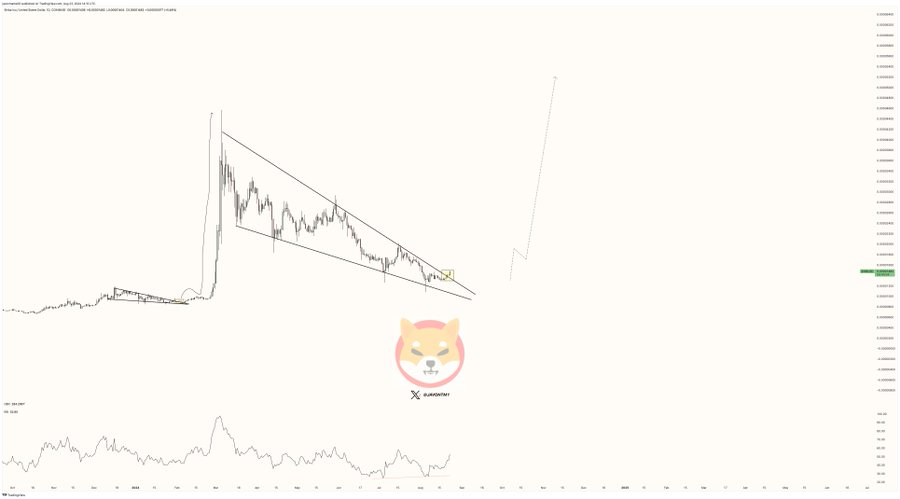
As a result of this bullish resilience, market participants now expect an explosive move upward once the correction ends. Notably, Javon Marks, a market analyst, called attention to this resilience in an updated analysis, projecting the potential direction of Shiba Inu’s price.

Initial Analysis: Shiba Inu Breakout

For context, Marks first highlighted the breakout in his earlier report on Aug. 23. According to him, SHIB had at the time successfully broken out of the falling wedge pattern, a development that signaled a shift from a bearish to a bullish trend. 

Shiba Inu Falling Wedge Breakout

In his assessment, he called attention to the importance of this breakout, suggesting that the move could trigger a substantial rally toward a price target of $0.000081. Interestingly, this target represents a possible upside of over 432%.

The initial chart showed that the breakout occurred on Aug. 20 after a series of price increases. Shiba Inu’s price surged, reaching a high of $0.00001439 on August 22, followed by another spike that pushed the asset to a peak of $0.00001612 on Aug. 24. 

Marks has expressed optimism that the price action represented only the early stages of a more significant rally. Despite the bullish breakout, SHIB experienced a slight pullback from Aug. 25, which is typical after such movements. 

SHIB Retains Breakout

Most recently, Marks revisited his analysis amid the ongoing correction. However, he maintained the bullish outlook, confirming that Shiba Inu has retained its falling wedge breakout despite the retracement. The meme coin has used the upper trendline of the falling wedge as support.

According to him, the $0.000081 target, representing a 432% increase, remains intact. For the uninitiated, the falling wedge pattern suggests that the bearish momentum from the retracement which began in mid-March is waning, and buyers are beginning to take control.

For context, Shiba Inu reached a yearly high of $0.000045 in March 2024 before plunging into the current downtrend. The asset’s decline led to the formation of the falling wedge, characterized by lower highs and lower lows. After hitting a low point, SHIB gradually regained strength, with the falling wedge breakout acting as a pivotal moment.

Although the broader cryptocurrency market has faced challenges recently, including macroeconomic factors and market volatility, Marks remains confident in SHIB’s potential. At press time, Shiba Inu changes hands at $0.00001327, up by a meager 0.32% over the last 24 hours.

XRP Glitch: User Pays 25,922 XRP in Fee to Transfer only 0.15 XRP to Coincheck

0

An unknown crypto user pays a hefty fee to send a tiny fraction of XRP to the popular crypto exchange Coincheck.

Prominent XRP Ledger (XRPL) dUNL validator Vet called the public’s attention to the transaction yesterday.

Transaction Details

According to Vet, the unknown user accidentally paid 26,000 XRP, valued at $15,288 at the time of writing, to move 0.15 XRP ($0.088). The XRPL dUNL operator disclosed that he spotted the transaction after conducting an advance search on XRPScan. 

Vet attached a screenshot of the transaction, confirming the incident. Per the data, the transaction occurred at 10:32 a.m. (UTC) on August 31, 2024. The 0.15 XRP was sent to a blockchain address registered on the Japanese-based crypto exchange Coincheck. Specifically, the unknown user paid exactly 25,922.7 XRP ($15,242) in fees to send these tokens.

Reason Behind the Expensive Mistake

The strange transaction stirred a major discussion within the XRP community, with some members eager to know what led to such a costly mistake.

Explaining, Vet speculated that this bizarre hefty fee could have emanated from a bug in a developer’s script due to a bad code. However, the validator explained that non-custodial wallets like Xaman or Coinbase could have avoided such an expensive mistake.

A Shift from the Norm

The incident goes against what is obtainable in the crypto space. Notably, crypto-related transaction costs are known to be less expensive compared to traditional financial systems.

Moreover, transactions on the XRP Ledger are relatively cheaper than those across other blockchains. For context, an average transaction on the XRPL costs about $0.0002. This suggests that the user who paid 25,922.7 XRP for a 0.15 XRP transaction made an overpayment of 7,620,999,900%.

Transactions of this sort usually occur due to an oversight, when the sender mistakes the massive fee for the amount they intended to send, but this is unlikely to be the case here. Notably, as a result of mistakes like this, crypto users are encouraged to double-check transaction details, including recipient address and fees, before proceeding with the transaction.

Nonetheless, many still fall victim to these errors. Last month, an Ethereum user paid 34.62 ETH, worth $92,504, to send a meager 0.87 ETH ($2,324).

Two years ago, another unknown user made an expensive mistake by paying 121.56 ETH ($157,764) in fees to transfer 183 ETH ($237,502).

Ripple Chairman Chris Larsen Moves 50M XRP for the First Time in 11 Years

0

A wallet belonging to Ripple Chairman Chris Larsen moves 50 million XRP to a new unidentified address.

Interestingly, the recent transaction marked the first notable outbound transfer from the wallet for the first time since its creation. Notably, this wallet was created in the early days of the XRPL and funded with a whopping 500 million XRP in February 2013, representing part of the XRP allocations to the Ripple Chairman.

Since then, the wallet has failed to move any of the tokens, only transferring out 1 XRP in December 2017. However, most recently, whale tracking resource Whale Alert indexed the latest substantial outflow from the address last night.

Details of the XRP Transaction

On-chain data confirms that this transaction occurred on Sept. 16, at 23:17 UTC, involving exactly 50 million XRP worth $29.12 million at the time. Interestingly, the assets moved to rao…gzS, an unknown address created specifically for this transfer. 

Considering the nature of the transaction and the fact that this wallet had retained its tokens since inception, speculation arose regarding the possibility of another hack. However, The Crypto Basic can confirm that this is unlikely.

Recall that similar fund movements involving another one of Larsen’s wallets occurred in February. Nonetheless, these transfers were the product of a hacking incident that stole millions in XRP from the Ripple Chairman’s wallet, as confirmed by The Crypto Basic. The hackers siphoned over 212 million XRP.

Internal Fund Movement

However, on-chain data suggests the latest fund movement might have been authorized by Larsen himself. Notably, the sending wallet in question was responsible for the activation of the recipient wallet rao…gzS. 

After activating the address with 10 XRP at 23:11, the Larsen wallet then moved the 50 million XRP to the address. At the reporting time, the recipient address has held onto the tokens, further dispelling concerns of an exploit.

With the possibility of a hack out of the way, the purpose of the transaction remains open to multiple speculations. Some proponents lightheartedly suggested that the funds could be used to support the Kamala Harris campaign. However, this remains speculative.

For context, The Crypto Basic reported two weeks back that the Ripple Chairman was one of 88 business executives who revealed support for Harris in her presidential ambition. Larsen became the second top crypto executive to publicly back Harris following an endorsement from Uphold co-founder J.P. Theriot.