Home Blog Page 1657

Shiba Inu Team Shares Latest Update on Shib Name Service

0

Popular domain name startup D3 Global and Shiba Inu marketing lead Lucie have provided a fresh update regarding the recently introduced .shib internet domain name.

In a tweet yesterday, D3 shared a link to a platform where Shiba Inu holders can sign up for early access and secure their own .shib names that could be resolved in the global domain name systems (DNS).

The announcement stated that the ShibArmy should prepare themselves to acquire their official interoperable digital identity through the acquisition of a SHIB Name Token. This new digital identity is being offered in partnership with Shib.

Notably, Shiba Inu marketing lead Lucie also called the attention of community members to the update.

How to Sign Up for Early Access

Shiba Inu holders are required to visit the D3 platform to pre-register for early access. Upon visiting the website, click on the “Save Your Spot” button on the page and input your email address.

D3 will send a login link to your email, which will expire in just 30 minutes. You can use the link to search for available .shib names. If the chosen name is available, click the “Remind me when Early Access begins” button to finalize the process.

Shiba Inu Partners D3

The recent update comes over a week after Shiba Inu and D3 entered into a strategic partnership to launch DNS alternatives for the SHIB community. 

Following the partnership, Shiba Inu can apply for the .shib top-level domain (TLD) during the upcoming application window of the Internet Corporation for Assigned Names and Numbers (ICANN).

For context, a TLD is the last portion of a domain name, which comes after the dot on any website. Certain examples include .org, .com, .biz, and .net.

Interestingly, Shiba Inu is seeking to have its own unique TLD dubbed .shib. The move makes Shiba Inu one of the first Web3 protocols to apply for its TLD.

Applying for a TLD has proven to be a daunting task over the years, as the process requires ICANN’s approval and community support. However, Shiba Inu has indicated plans to apply in the next ICANN application window.

Notably, the move is part of Shiba Inu’s push towards giving a unique identity to its projects. Recall that in November, Shiba Inu introduced the Shib Name Service (SNS), a solution it plans to use to introduce digital identity verification for all products within its ecosystem.

Following its partnership with D3, Shiba Inu’s SNS will be transitioned into the D3 infrastructure.

PancakeSwap: BNB Chain and Ethereum Trading Volumes Hits ATH

0

Decentralized exchange PancakeSwap has seen its two biggest supported blockchains, BNB Chain and Ethereum, print All-Time Highs (ATH) in trading volumes.

PancakeSwap announced the milestone on X, highlighting that the feat is one of the most remarkable ones since the launch of its V3 engine. PancakeSwap V3 embodies a more innovative decentralized exchange protocol than V2.

Some of the important upgrades made to the PancakeSwap V3 engine are the speed and cost of transactions as well as maximizing fee returns for Liquidity Pool (LP) providers.

The BNB Chain and Ethereum trading volume milestones prove how well both LP providers and users generally use the trading platform.

The BNB Chain and Ethereum Performance Data

According to the PancakeSwap V3 info page, the TVL of the BNB Chain protocol comes in at $299.32 million, while the trading volume from December 1 to 29 is $7.67 billion. 

Notably, Wrapped BNB (WBNB) has the biggest 24-hour trading volume, worth $436.26 million, with the top 3 slots also involving Tether (USDT) at a volume of $423.92 million, and PancakeSwap Token (CAKE) at $48.63 million.

The figures on record for the Ethereum protocol are relatively smaller but still quite impressive. The TVL comes in at $58.58 million, while the monthly trading volume sits at $737.95 million.

Wrapped Ethereum (WETH) is the token with the biggest liquidity on the PancakeSwap-based ETH chain, while Tether (USDT) and USD Coin (USDC) make up the top 3 most embraced tokens.

PancakeSwap Setting Stage for More Embrace

In an industry where competition blares hot, PancakeSwap has been making one crucial move to make its ecosystem as attractive as possible through its burn CAKE burn program. 

As reported earlier by The Crypto Basic, PancakeSwap has unveiled its plans to reduce its native token’s supply from 750 million to 450 million, a move that could spark more massive growth for CAKE as demand might, in the long term, exceed supply.

This CAKE burn revelation complements the other related efforts that the decentralized trading platform has been implementing over time. Overall, the attractiveness of CAKE is a good catalyst that may draw more users into the PancakeSwap ecosystem.

SEC Records Major Victory in Terra Case, As Court Finds LUNA and UST as Securities

0

The United States Securities and Exchange Commission (SEC) has secured a major victory in its legal tussle against TerraForm Labs (Terra) and its founder, Do Kwon.

According to a court order yesterday, U.S. District Judge Jed Rakoff ruled that Terra and its founder, Do Kwon, violated federal laws by offering and selling two unregistered securities, TerraUSD (UST) and LUNA.

SEC Sues Terra and Kwon

Following the collapse of the Terra ecosystem that wiped out over $40 billion last year, the SEC alleged in a February 2023 filing that the company offered and sold four crypto assets that constitute unregistered securities.

The SEC also alleged that Terra effected transactions in security-based swaps by maintaining the Mirror Protocol, a solution that enables users to mint mAssets. It bears mentioning that these blockchain-based assets mirror real-world assets using on-chain exchange prices.

Furthermore, the commission also leveled fraud charges against Terra and its founder, stating that the duo orchestrated a fraudulent scheme.

Court’s Verdict

In a 71-page summary judgment released yesterday, Judge Rakoff sided with the SEC that LUNA and UST constitute unregistered securities.

The court’s decision on UST and LUNA’s securities status was backed by a previous comment from Kwon, who told LUNA investors to “sit back and watch him kick a**.”

According to Judge Rakoff, the statement implies that LUNA investors can invest their money in a common enterprise and expect profit based on Terra and its founder’s efforts.

In what is considered a partial victory for the defendants, the judge denied the SEC claims that Terra illegally offered and sold security-based swaps.

In addition, Judge Rakoff denied the parties’ motion for summary judgment regarding the fraud claims. Consequently, the fraudulent charges have been scheduled for a jury trial by next month.

Meanwhile, Judge Rakoff denied the defendant’s motion to exclude the testimonies of two SEC experts, Dr. Matthew Edman and Dr. Bruce Mizrach. Similarly, the court also denied the SEC’s motion to exclude one of Terra’s experts’ testimonies, Dr. Terrence Hendershott.

The court noted that it would address the remedies issue once the forthcoming trial had been resolved.

Following the ruling, a Terra spokesperson commented on the decision, stating that the company disagrees with the verdict and would do everything to defend the SEC’s fraudulent claims at trial.

However, the spokesperson did not indicate whether the company will appeal other parts of the summary judgment decision.

SEC Enforcement Agenda Receives Major Boosts

The Terra decision could further bolster the SEC’s enforcement agenda in the crypto industry. Recall that the regulator suffered a major defeat against Ripple in July when a New York federal judge declared that XRP is not a security.

At the time, Judge Rakoff denied Terra’s attempt to use the Ripple ruling as a defense to argue that its tokens do not constitute securities. The contradictory ruling sparked a major debate, with top securities lawyers speculating that the court would grant summary judgment in favor of the SEC.

Interestingly, the court handed the SEC a weapon to enable it to continue its regulation by enforcement agenda in the crypto space.

Since the SEC charged Terra with offering four assets as unregistered securities, the commission has also given the securities tag to various crypto assets, including ADA and SOL.

Notably, the SEC could label more tokens as securities in the future while citing the Terra ruling to support its claim.

Forbes Says This Huge Unexpected Bank Flip Will Trigger XRP Price Movement

0

Forbes believes the price of XRP is set for influence with the lifted restrictions on banks’ crypto transactions in Nigeria.

XRP tops the list of prominent digital assets yet to engineer a sensational trajectory amid the unfolding bull market. Data indicates that XRP has maintained a consistent price range for 30 days without surpassing the $0.6 threshold.

However, Forbes senior contributor Billy Bambrough has argued the trend is about the change with a pivotal development from the apex bank of Nigeria, a country with one of the highest crypto adoption rates.

XRP Set for Impact Amid Lifted Restriction on Banks’ Crypto Handling

In particular, Forbes’ Bambrough cited that the Central Bank of Nigeria (CBN) has reversed its position on cryptocurrency, directing banks to ignore its 2021 prohibition on crypto transactions. 

The directive was outlined in a circular dated December 22, with reference number FPR/DIR/PUB/CIR/002/003. Haruna Mustafa, the Director of CBN’s Financial Policy and Regulation Department, endorsed it. 

Forbes has stated that Nigeria’s decision to lift restrictions on banks’ crypto transactions could substantially impact the price of XRP. Specifically, Bambrough noted the CBN’s reversal of its ban on commercial banks delivering services to crypto exchanges has the potential influence on major cryptocurrencies, with XRP taking center stage.

“This is big news,” exclaimed Jeremy Allaire, CEO of USDC stablecoin issuing company Circle, highlighting the magnitude of the decision.

Furthermore, Bambrough highlighted that despite the previous ban, Nigeria has witnessed a sharp increase in crypto usage. In particular, a Chainalysis report from September revealed that Nigeria’s volume of crypto transactions surged by 9% year-over-year. It reached $56.7 billion between last year and this year.

This outcome solidified the country’s position as one of the world’s leading adopters of blockchain technology. 

According to the Forbes contributor, economic challenges, such as currency devaluation and rising inflation, have fueled interest in Bitcoin and other cryptocurrencies in Nigeria.

Moyo Sodipo, co-founder of the Nigeria-based crypto exchange Busha, explained:

“People are constantly looking for opportunities to hedge against the devaluation of the naira and the persistent economic decline since Covid.”

Ultimately, Bambrough believes the lifted restrictions will further accelerate the growth of the crypto market in Nigeria.

Ripple Partner SBI Launches Joint Venture SBI XDC Network APAC with TradeFinex

0

SBI Holdings, a prominent Japanese financial services firm and partner of Ripple, has revealed a partnership with TradeFinex, a company based in the UAE specializing in the XDC Network.


Together, they’ve established SBI XDC Network APAC Co., a collaborative initiative with the goal of advancing the utilization of XDC Network’s blockchain technology across the Asia-Pacific region, with a specific focus on enhancing trade finance and facilitating cross-border payments.

XDC Network employs smart contracts to tokenize and digitize tangible assets like bonds and trade documents. This approach streamlines global trade operations. Additionally, the network provides a hybrid blockchain usable in both private and public settings.

SBI Holdings has been a steadfast advocate of XDC Network, which is evident in its crypto exchange subsidiary SBI VC Trade, which formed a partnership with XDC Network in May. As the exclusive supporter of XDC tokens in Japan, SBI Holdings has extended diverse services related to XDC to cater to its customer base.

This new collaboration aims to combine the expertise and networks of SBI Holdings and TradeFinex to broaden the applications of the XDC Network in Asia-Pacific.

The joint venture will offer marketing and business development assistance to XDC Network, along with support for exchanges seeking to support XDC tokens.

The venture, headquartered in Tokyo with a capital of 300 million yen, is spearheaded by Tomohiko Kondo, who is also the president of SBI VC Trade as representative director. Other directors include Tadashi Yoshida, who oversees XDC Network in Japan, and Taku Tashiro.

SBI XDC Network APAC Launches PoC

The company has recently embarked on a proof of concept (PoC) aimed at integrating Corda, a blockchain platform offered by IMPEL GLOBAL, with Corda Bridge. This Corda Bridge service facilitates seamless connectivity between Corda and XDC Network.

The objective of the PoC is to showcase the effectiveness and seamless nature of employing the XDC Network for international payments in B2B transactions, especially in international trade. This demonstration aims to highlight the advantages of traditional fiat currency payments.

Being a long-term partner of Ripple, SBI Group formed a similar collaboration with the San Francisco-based technology company in 2016 to launch SBI Ripple Asia.

Over time, SBI has consistently demonstrated its commitment to supporting Ripple, which is evident in recent initiatives aimed at strengthening their enduring partnership.

Despite its ongoing collaboration with Ripple, the Japanese financial services giant continues to broaden its presence in the digital asset scene by engaging other crypto-focused entities.

SBI Group is working to establish a strong position within the crypto industry, and these partnerships are steps toward realizing this objective.

Ripple Gives Specific Timeline to End XRP Selling From Escrow

0

In its latest quarterly report on XRP holdings, Ripple provided a timeline indicating when it might finalize the public release of XRP into the open market.

In the report, Ripple noted that it voluntarily provides an update concerning its XRP holdings in the spirit of transparency, covering updates on the XRP Ledger, relevant announcements, and market trends from the preceding quarter.

Ripple underscored the importance of proactive communication and transparency as essential elements of responsible stakeholding. 

When Ripple Could End XRP Release

In the third quarter XRP market report, Ripple disclosed details regarding its XRP holdings. It encompassed the XRP balance as of each quarter’s initial and final days. These holdings are categorized into two groups. 

The first category includes XRP housed in Ripple’s corporate accounts, constituting balances that can be utilized at discretion for operational needs.

In contrast, the second category involves XRP tokens held in Ripple’s escrow wallets. Notably, these XRP tokens within the escrow wallets remain inaccessible to the company.

The report shows that as of the end of September, XRP in Ripple’s spendable balance was 5,258,162,324 (5.25 billion) tokens. Meanwhile, 41,300,000,005 (41 billion) XRP tokens existed in the inaccessible wallet.

It is public knowledge that the escrow releases one billion XRP monthly to Ripple, and the payment company, in turn, sells a portion of the unlocked XRP. For instance, The Crypto Basic has uncovered that Ripple sold 892 million XRP through July, August, and September.

Taking into account its XRP balance, Ripple has estimated that the approximately 40 billion escrowed XRP tokens will be released in the next 42 months. This timeline suggests a date in early 2027.

Ripple XRP release timeline
Ripple XRP Release Timeline

However, Ripple has a tradition of reinstating the overwhelming majority of the released XRP into the escrow account.

For instance, Ripple has locked back 800 million each month from August. This trend implies it could take longer than the projected 42 months for the Ripple monthly XRP escrow unlock to cease. 

Meanwhile, crypto community members have expressed concerns about Ripple’s delayed pattern in its XRP unlock. They interpret it as Ripple asking XRP holders to continue funding the company for more extended periods.

Shibarium Achieves Massive New Milestone in Shiba Inu Ecosystem

0

The Shiba Inu ecosystem has recently achieved a monumental milestone through its Layer-2 (L2) scaling solution, Shibarium.

Shibarium made headlines a few hours ago after its total transaction count surpassed the 200 million mark, suggesting a widespread adoption of the L2 network.

Shiba Inu’s marketing lead, Lucie, also confirmed the development in a tweet.

Barely a few hours after Shibarium’s total transactions hit the 200M mark, the figure has now skyrocketed to around 206,883,713 (206.88 million), according to Shibariumscan.io data.

The development comes weeks after Shibarium successfully processed 100 million transactions. At the time, Shiba Inu’s lead developer, Shytoshi Kusama, described the achievement as a “moonstone” and not just a milestone.

Although Kusama has not yet reacted to the latest feat, it is expected that the lead developer could use another catchy phrase to describe the 200M transaction achievement. The tremendous growth of Shibarium’s total transactions signifies a widespread adoption of the popular L2 network.

Shibarium Gains Momentum

Recall that Shibarium had a slow start, boasting only a few thousand daily transactions in its early phase. As of November 23, Shibarium had processed only 4M transactions despite launching on August 16.

Not deterred by Shibarium’s slow adoption, the team worked behind the scenes to bolster the network’s usage. These efforts ultimately paid off this month, as daily transactions on Shibarium hovered between 5 million and 8 million.

On-chain data shows that Shibarium has recorded an impressive 7.85M daily transactions, highlighting the network’s ability to handle large transaction volumes efficiently. 

Meanwhile, Shibarium has successfully minted 2,347,395 (2.34 million) blocks, with an average block time of 5.0 seconds. The network’s cumulative contracts stand at 14,528, which includes 1,151 verified contracts. 

Here Are Top 5 Shiba Inu Holders Other Than Exchanges and Burn Address

0

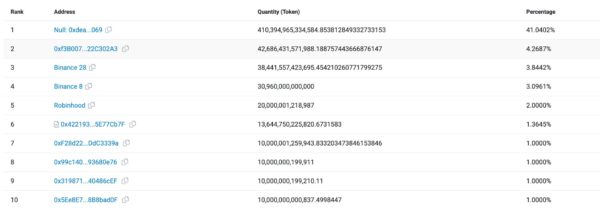
The top five Shiba Inu (SHIB) holders, excluding exchanges and the famous dead wallet, control around 7% of the cryptocurrency’s total supply.

With over 1.36 million holders, SHIB is one of the most widely held cryptocurrencies. Yet a significant percentage of the token is held by a few addresses, with the top hundred holders controlling around 79% of the total supply.

However, this article focuses on the top five holders, excluding exchanges and the token’s burn wallet, which holds over 41% of the total supply. Filtering these options reveals that Shiba Inu’s total supply may not be as concentrated as it seems. 

For instance, the top five addresses, minus exchanges and the dead wallet, control only around 7% of the total supply, a decent figure when compared to other cryptocurrencies. Let’s take a closer to the top five SHIB holders.

SHIB Rich List
Shiba Inu Rich List

The Top Five Addresses Holding SHIB

The largest individual SHIB holder is an address with the 0xf3B007 initials. At the time of writing, this address holds around 42.6 trillion SHIB (approximately $426 million) or roughly 4.26% of the token’s supply. 

Although on-chain data does not reveal the person behind the wallet, its owner appears linked to Crypto.com, as the address holds over $445 million worth of Cronos Coin at the time of writing.

Interestingly, the address also holds a large number of other meme coins, including Dogeelon (ELON), Pepe (PEPE), and Floki (FLOKI).

Coming in second place is a contract address with the 0x4221 initials. The contract holds around 1.36% of the total SHIB supply, or 1.36 trillion SHIB ($136 million). This contract is speculated to be controlled by the on-chain trader as they occasionally receive and transfer SHIB, perhaps to boost their holdings.

Completing the top five are three individual addresses that hold 1% of the SHIB supply, respectively. The address with the initials 0xF28d2 received a significant amount of its SHIB holdings in November 2021, less than a week after SHIB reached its all-time high of $0.00008845 in late October that year. 

The fourth largest individual SHIB holder (0x99c1) also received their holdings a few days after SHIB hit its all-time high.

The address received around 1 trillion SHIB tokens on November 2, 2021. The assets are worth $108 million at today’s prices. Notably, if the transaction represented a new purchase, then the holder may be sitting in significant losses, having put in around $800 million in November 2021.

Completing the top five is yet another address that received its SHIB holding near the cryptocurrency’s all-time high. The address, which has the initials 0x3198, received 1% of Shiba Inu’s maximum supply on November 2, 2021, and has since held onto the assets.

Meanwhile, a common theme across SHIB’s largest individual holding addresses is long-term intent. The addresses have held on through one of the cryptocurrency market’s bear markets, evidently betting on the SHIB price bouncing back in the future.

At the time of writing, SHIB is trading at $0.00001084. The latest price means the asset has now closed above the $0.000010 mark for ten consecutive days, its longest stint above that price level in several weeks.

Why Ethereum’s Smart Contracts Are One of Its Best Features

0

Blockchain has emerged as a game-changing technology, disrupting numerous industries by providing a decentralized and safe solution for making transactions. One of the most common uses of blockchain is implementing smart contracts. But what are they, and how do they work? First of all, smart contracts have everything to do with Ethereum, the 2nd leading digital asset in the crypto market which you can buy on the Binance platform. Ethereum was also the one to bring the concept of automation to life and shape the future of blockchain technology.

To be fair, trying to make sense of blockchain and all its related aspects can feel like an attempt to solve a Rubik’s cube in a room with no light – it’s truly daunting. If this concept is too complicated for you, we’re here to shine a light on smart contracts to help you grasp everything from how it functions to its benefits and the industries making the most of this new and appealing tech advancement.

Breaking Down the Concept of Smart Contracts

If you are familiar with the blockchain space, you may have heard about smart contracts before. But what are they, really? If you’re associating them with paper contracts – but smarter- you’re not wrong. Simply put, Ethereum smart contracts run on the Ethereum blockchain and are self-executing. This means that the terms of the agreement are written into code, executing automatically once specific conditions have been met. Smart contracts not only eliminate the need for an intermediary, but they also leave no room for misinterpretation. Since smart contracts automate contract execution, they save time and reduce the risk of human mistakes, making them ideal for different industries, including supply chain management, banking, and real estate.

Some examples of Ethereum smart contracts include:

  • Decentralized Autonomous Organizations (DAOs). As the name suggests, these are companies run by smart contracts, operating based on rules written into the contract.
  • Decentralized Exchanges (DEXes). They are platforms that allow you to trade digital assets without requiring an intermediary.The smart contract is like a trusty referee that ensures everyone plays fair.
  • Initial Coin Offerings (ICOs). You can think of ICOs as fundraisers – except that you don’t sell car washes or cookies but cryptocurrencies. The smart contract’s role is to manage the sale to ensure all parties get their fair share.

The Incredible Advantages of Ethereum Smart Contracts

Ethereum smart contracts provide numerous benefits to individuals and businesses alike. They decrease transaction costs while boosting efficiency, as an intermediary is no longer needed. The smart contract does the entire job, acting like an efficient personal assistant who doesn’t make any errors. Due to their self-executing nature, smart contracts ensure that the agreement terms are enforced automatically, boosting transaction transparency and security.

One of smart contracts’ highlights is the element of trust. Since they ensure prompt execution of transactions based on specified conditions, the possibilities for error, manipulation or human bias are significantly lower.

More than 70% of executives see smart contracts as an innovative tool that will shape the future of business. Moreover, the market for DeFi apps built on the Ethereum blockchain has risen exponentially in only a few years, showing the potential of smart contracts to revolutionize how companies operate.

Sectors That Are Making the Most of Ethereum Smart Contracts

Ethereum smart contracts are used in different industries, including supply chain, real estate, gaming, FinTech, banking, etc. Smart contracts offer efficient solutions to these businesses, allowing them to operate as efficiently as possible. For instance, smart contracts streamline payroll processing in the HR sector, resulting in accurate and timely salary disbursement according to predefined conditions, including company policies and work hours. The technology of smart contracts can also benefit the recruitment process by encoding the terms of employment offers, thus resulting in transparent and seamless job acceptance processes.

Healthcare is another sector where smart contracts are making their mark. By streamlining patient data management, smart contracts allow authorized healthcare providers to access essential information safely and promptly. Healthcare gains enormously from including blockchain smart contracts, and one of the most notable benefits is the potential to revolutionize clinical trial conduct. This is achieved by recording trial data safely and ensuring the results’ integrity and transparency.

The gaming industry is also going through a transformation due to smart contracts that enhance players’ experiences and enable more autonomy by providing ownership of in-game assets represented by NFTs (non-fungible tokens). Smart contracts technology encourages fair play through the enforcement of game rules and governance of randomized events in an auditable and transparent way. Moreover, they enable play-to-earn models, which are an innovative monetization tool. Through their programmable nature, smart contracts blend digital activities with visible economic perks, automating the distribution of real-life rewards related to in-game actions.

Are There Any Limitations in Adopting Smart Contracts?

As much as we’d like to say smart contracts are perfect, that’s far from true. Although understanding how Ethereum smart contracts work unlocks many benefits, discussing the limitations is also imperative. Smart contracts are just like a coin – they have two different sides, and one of them is not so bright. Firstly, immutability is one of smart contracts’ main characteristics, meaning that once you create a contract, it is impossible to change it in any way. It’s like writing words in wet cement – they remain there forever. Well, the same applies to smart contracts, potentially representing a problem if conditions change or an error is made. Another limitation of smart contracts is associated with the legal framework. There are still many locations around the world where smart contracts’ legality is still ambiguous. It’s like exploring an unknown territory without any ideas of what could happen along the way.

Moreover, the issue of privacy is also major. Think of it as living in a house that has glass walls – although it may look great, everyone can see inside, invading your privacy. And no, we aren’t talking metaphorically – your privacy is actually compromised due to Ethereum smart contracts transparency. Although it is perceived as a good thing -which it is, as it enhances trust – transparency allows all network users to see what you’re doing, which is less than ideal.

Looking Towards the Future

As reports show, the global smart contract market will reach $1.4 billion two years from now, an increase of 25.2% from 2020. There’s no doubt that Ethereum smart contracts hold great potential in the future, so we can expect to see further adoption, expansion of DApps, emergence of new use cases, and so on. Overall, we can expect Ethereum smart contracts to experience further development in the years to come.


Optimism (OP) Hits New ATH, Targets 62% Surge to $6

0

Optimism (OP) continues to trade within an ascending parallel channel since its launch last May, with market veteran Ali Martinez recently forecasting a looming 62% price rally to $6 following a new ATH above $4.

Ali revealed this in a post on X, as he recently presented an Optimism price chart on the three-day timeframe. OP’s price performance since May 2022 has elicited mixed reactions from market participants. 

OP dropped 71% to an all-time low of $0.396 in mid-June 2022. This collapse was partly triggered by the Terra implosion of last May. However, Optimism immediately staged a comeback, surpassing previous highs and rallying 466% to $2.243 in August 2022.

A retracement ensued following the 466% upsurge, leading to a massive drop to $0.634. After the drop, OP staged another rally to $3.290 this February. The asset had been caught in the grasp of the bears before the recent recovery campaign.

Optimism Within Ascending Channel

Amid the occasional turbulence and price upswings, data from Ali’s chart suggests that Optimism has continued to trade within an ascending parallel channel since last May. This trend suggests that the token has been recording higher highs and higher lows since then. 

Optimism OP 3D Chart EGRAG Crypto
Optimism OP 3D Chart | EGRAG Crypto

The analyst emphasized that OP is now in price discovery mode. When a token is in this mode, it means that the market is actively determining its value. During this phase, there may be increased volatility as buyers and sellers assess the token’s worth based on various factors.

Ali stressed that the prevalent ascending parallel channel continues to determine OP’s price movements. This trend suggests that the token could sustain its upward momentum. 

OP Hits New ATH, Targets $6

Amid the latest uptrend, which began in October amid the recent market-wide resurgence, OP has broken above the middle boundary of the ascending parallel channel. This bullish momentum has resulted in a new all-time high of $4.13, recorded yesterday.

Ali believes Optimism could now be eyeing the channel’s upper boundary as its price pushes up. The analyst foresees sustenance of the uptrend, setting a target of $6 for the token, which would mark a 62% rally and a new all-time high.

OP has held above the $3.698 support in the short term despite a recent collapse from $4.13. The crypto asset is 4% down today as selling pressure mounts. Optimism now commands the 15th largest 24-hour trade volume, as volume surges 30% to $970,055,817.