Home Blog Page 1789

XRP Holder Poses Five Challenging Questions to Ripple’s CTO That Everyone Wants Answered

0

Following back-to-back court victories, the XRP community has raised questions on whether Ripple can now onboard U.S. partners.

Ripple’s quest to gain regulatory clarity for XRP has recently achieved remarkable success. In July, a U.S. district court judge, Analisa Torres, ruled that secondary XRP sales do not constitute securities transactions, making XRP the only crypto asset outside of Bitcoin to have such clarity.

Earlier this week, Judge Torres upheld the July decision, denying the United States Securities and Exchange Commission (SEC) the right to appeal until a final ruling on other matters raised in the court case.

In view of the recent wins, a concerned XRP holder with the X handle, Mr. XRP, has raised questions on whether the cryptocurrency has seen some adoption from U.S. institutions since the July court verdict.

Has XRP Adoption Taken Off In the US?

The SEC’s allegations that XRP is a security has largely put off companies wanting to adopt Ripple’s technology, with crypto exchange even delisting the asset at some point.

However, in the aftermath of the courts declaring XRP a non-security when traded in secondary markets, many U.S.-based exchanges, including Coinbase, have relisted XRP. 

But not much is known about the institutional side of things. Mr. B XRP sought to get clarity on that angle of XRP adoption, with four questions requiring a response from Ripple’s Chief Technology Officer (CTO), David Schwartz.

Firstly, the XRP enthusiast asked whether any U.S. financial institution has adopted XRP since the July ruling.

Second, he wanted answers on whether the more recent decision to deny the SEC’s appeal finally opens up opportunities for these institutions.

Mr. XRP also queried whether organizations have the mandate to announce to the public if and when they adopt XRP for payment flows and how far off such adoption news might be if there isn’t any.

On a slightly humorous note, Mr. XRP also asked when Ripple’s CTO would be getting an XRP tattoo. Ripple CEO Brad Garlinghouse already wears one as a show of long-term commitment to the project.

It remains to be seen whether Ripple’s CTO will respond to the most recent questions about institutional XRP adoption in the United States.

From Web2 To Web3: Solutions For A Seamless Transition

0

The Web2 space is facing a wide range of challenges such as achieving scalability, maintaining optimal performance, and avoiding technical issues from negatively impacting user experience (UX).

In order to address these challenges, application developers are working on interactive Web3 platform interfaces. According to industry professionals, outdated business-to-consumer (B2C) services will not be able to solve all the issues facing business clients. That’s why it’s important to look ahead now and try to take preventive measures so that consumers are offered a seamless experience.

At present, there are several unique issues, which can be as simple as account management needing multiple users to gain access to the company assets. While there are a number of projects working on this requirement, firms such as AAG have adopted an innovative approach to solve this problem.

Web3 Is Becoming More Accessible with Secure, Intuitive Services

In addition to catering to these requirements, the Web3 experience can be further enhanced by the elimination of private keys and seed phrases. Although the industry has made some technical advancements in these areas, there’s still a lot of work to be done. Despite the fact that crypto-purists find many highly technical features quite appealing, it is very important to offer mainstream users more user-friendly ways to access Web3 platforms.

In fact, the lack of availability of intuitive Web3 platforms has contributed to many security breaches. There are several crypto service providers such as AAG that are focused on developing highly-secure Regtech solutions such as n-Factor authentication. By leveraging advanced authentication mechanisms, even novice crypto users stand a better chance at being protected from malicious online activities.

For the Web3 economy to gain mainstream adoption, there should also be a seamless user experience, where people are not expected to learn highly complex or technical concepts just to access basic crypto services. According to industry experts, only essential user flows should be presented by default, so that the end-user does not get overwhelmed and discouraged from using Web3 tools.

Moreover, any advanced or highly sophisticated flows that are not essential to mainstream users and their activities should be available but not shown by default, according to design experts. By greatly simplifying and streamlining the user interface, it will become a lot easier to onboard many more users to Web3 platforms.

It should also help with preventing costly and unintended user mistakes as well as scams, which have become quite prevalent in the Internet age. For these reasons, infrastructure providers such as AAG have implemented solutions that effectively prevent users from accidentally engaging with fraudulent sites and dApps where the opportunity for phishing and hacks can occur. AAG has also created software that regularly warns users of the risks for certain actions.

These types of services and features are essential, as Web3 platforms now require robust levels of security. For the most part, these innovative workflows have mainly been exclusive to enterprise vaults but are now available to nearly every user.

Adoption of Web3 Will Require Seamless Transition Away from Web2

It’s no secret that these core technologies and security features are approaching mainstream adoption. In fact, Opera, the web innovator with users worldwide, has introduced Minipay — a web3 payments wallet. It’s specifically designed for the fast-paced Internet economy, offering instant financial transactions.

With large web browsers like Opera integrating seamless Web3 solutions, it’s evident that these platforms require the support of advanced infrastructure which can be provided by companies like AAG.

Like any other transformative technology, Web3 is experiencing the typical growing pains and this is expected to coincide with Web2 adoption. Given these developments, it’s clear to see that mainstream users are looking for platforms that require little or no specialized technical knowledge. And the typical B2C services aren’t going to adequately address all the different problems of business customers. That’s why it’s vital to plan carefully for the future and try to identify potential issues before they occur. This approach can help save considerable time and resources in the long-term.

By solving account management requirements and providing a high level of security, Web3 platforms will be able to establish a solid foundation. A growing number of service providers are working in this space to provide viable solutions to the most pressing Web3 challenges.

For instance, Movement Labs is focused on increasing the adoption and development of Move, a smart contract development language with embedded safeguards protecting against attack vectors such as reentrancy that cost Web3 users billions of dollars.

In most cases, the development teams provide a SDK (software development kit), which may offer secure environments directly to blockchain ecosystems. By design, these tools offer a modular, scalable, and composable blockchain architecture developed to combine performance with ease of access.

While the end-user need not concern themselves with these technical details, it’s still necessary for all users to have a basic understanding of what Web3 has to offer and how it can be leveraged to benefit individuals and businesses. In a nutshell, the new Internet economy provides an extensive range of tools to make our lives easier. But this is only helpful if we are aware of the key features of the different digital tools being offered in the market. By harnessing the benefits of the best Web3 tools, consumers will be in a better position to take advantage of the opportunities presented by the digital economy.


PayPal Stablecoin PYUSD Hits All-Time High Valuation Amid Fresh Minting Move

0

PYUSD hits a $94,396,540 market cap two months after launch following the minting of $50M tokens.

In a recent tweet, Julio Moreno, the Head of Research at the prominent data analytic firm CryptoQuant, spotlighted exciting developments about the recently launched PayPal stablecoin based on the Ethereum network, PYUSD.

Moreno highlighted that PYUSD has achieved an unprecedented milestone by reaching an all-time high market valuation of nearly $100 million. In particular, the researcher mentioned that PYUSD now boasts a market share of $94,396,540.

PYUSD All-time High Market Cap

Furthermore, Moreno disclosed that the significant surge in PYUSD’s market cap followed the minting of $50 million of the stablecoins on September 29. 

The destination of the Friday-minted PYUSD added another twist to the development. According to Moreno, the freshly created tokens were transferred to a wallet of a centralized exchange. Specifically, the recipient address was the prominent crypto exchange Crypto.com, one of the few trading platforms that have listed PYUSD.

Additionally, Moreno’s tweet included a chart illustrating PYUSD’s supply over time. It indicated the stablecoin has maintained a steady increase in its supply since its August debut.

PYUSD In the Market

According to data from the crypto tracking platform CoinMarketCap, PYUSD’s market cap ranks it at 243 among the most prominent cryptocurrencies. PYUSD’s trading volume saw a 53.66% uptick compared to the value obtainable in the past day. Market participants bought and sold $5,242,794 PYUSD in the last 24 hours.

Notably, the top-rated centralized exchanges that have listed PYUSD include Coinbase, Kraken, KuCoin, Bybit, and Gate.io. However, Gemini and the largest crypto exchange, Binance, are among the notable platforms yet to support PYUSD.

The PayPal stablecoin debuted on August 7, 2023, to work alongside PayPal’s existing crypto payments. The Crypto Basic reported that PayPal users can move PYUSD from their account to external addresses or swap to other stablecoin, crypto, or fiat currencies. 

Bitcoin Historical Growth Trend Shows 1,309 BTC Equaled $1 Fourteen Years Ago

0

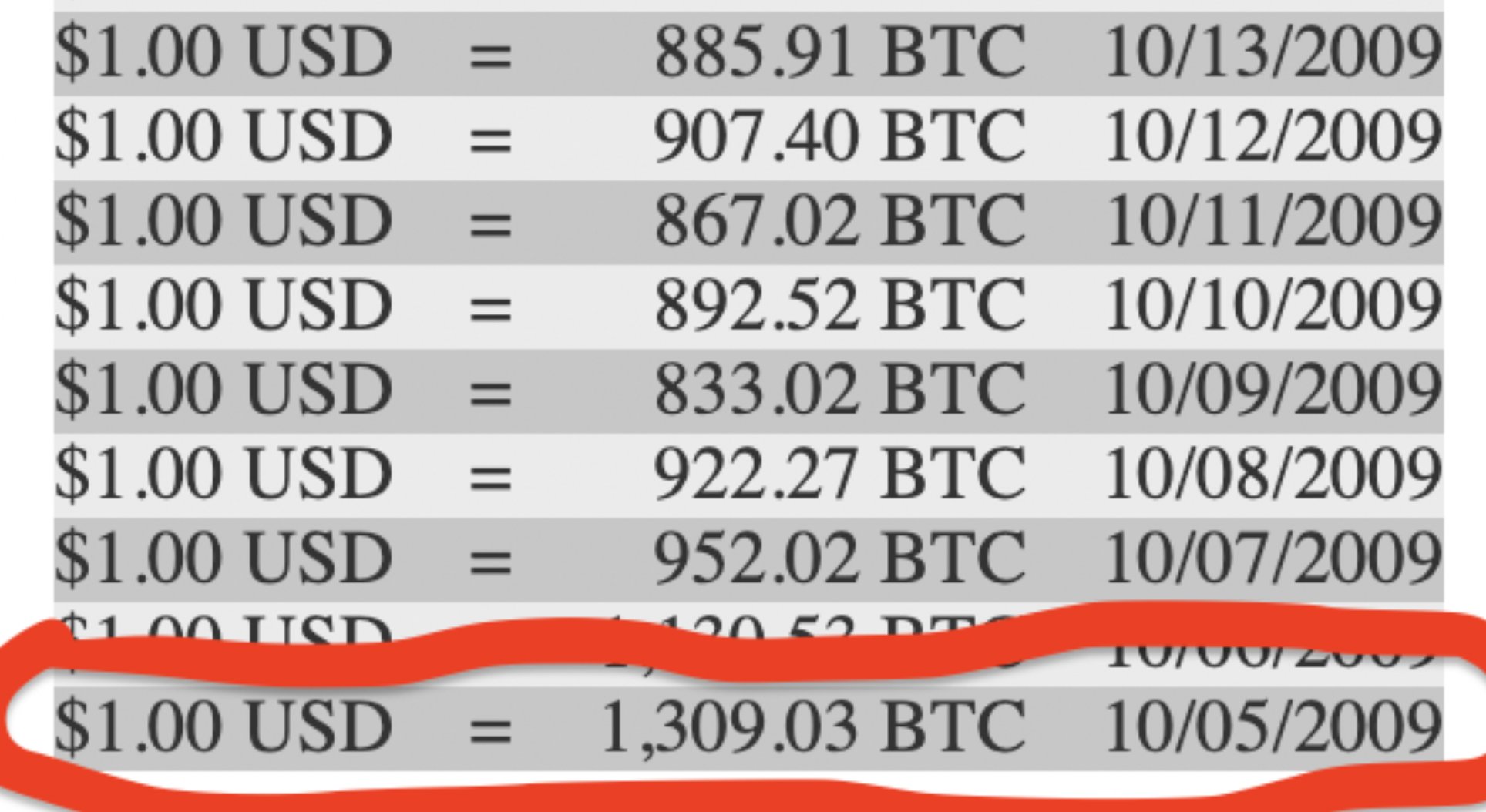
Today, October 5, marks an anniversary in the history of Bitcoin (BTC) in which a total of 1,309.03 BTC units equaled $1.

The notification was brought to the fore by Pete Rizzo, a Forbes contributor and self-proclaimed Bitcoin historian. Rizzo attached a chart to his post showing how the asset’s price grew on different days in October 2009.

History of Bitcoin as a Wealth Builder

Notably, as of October 5, 2009, $1 amounted to 1,309.03 BTC tokens. At this rate, 1 BTC was worth $0.0007639. However, the asset skyrocketed in the following days, hitting $0.001128 per BTC on October 13, 2009. With the October 13 rate, $1 amounted to 885.91 BTC tokens.


Adding context to the data, Rizzo noted that the digital currency celebrated today was worth literally $0 back in 2009. It has printed more than 3.6 billion percent at current price levels since then.

For further context, a $1 investment in Bitcoin on October 5, 2009, will yield an approximate return of $36.27 million. This massive price growth peaked in November 2021 when the cryptocurrency soared to its All-Time High (ATH) price above $69,000. Since then, the coin has been on a steady reversal.

Over a decade, Bitcoin has become a revered asset class many investors place their bets on. While individual or retail buyers first fueled its recognition, top institutions now know its worth and invest heavily in its accumulation.

One such institution is MicroStrategy, a business intelligence and software firm accumulating Bitcoin since August 2021. MicroStrategy remains a crucial model for other firms as its total BTC holdings have now exceeded 158,245 BTC, which makes up 0.754% of the Bitcoin supply.

Projections for More Price Growths

With the possibility shown by RIZZO on how far Bitcoin has come, many industry leaders are even more optimistic that there is more upside for the digital asset. 

Besides Binance CEO Changpeng ‘CZ’ Zhao, who predicted that it could take Bitcoin 2 years to retest its ATH, several analysts are more optimistic, with calls ranging from $1 million according to Ark Invest Founder Cathie Wood to more than $75,000 by the end of this year per a profiled Bitcoin price prediction table.

Avalanche Sees Record 577K Daily Txns Triggered by New Social Platform Stars Arena

0

Avalanche recently recorded nearly 577K transactions in a single day, marking the highest value since May, amid the emergence of Stars Arena, a new social platform.

Blockchain reporter Colin Wu first called attention to the development. Wu confirmed that Avalanche recorded 577,000 daily transactions on Oct. 4, fueled by a growing interest in Stars Arena, a blockchain-based social protocol taking inspiration from friend.tech.

According to Wu, Stars Arena had recorded a massive 454,000 transactions over the last 24 hours. In addition, active addresses associated with the social application had surged to 12,000 within the same timeframe.

However, amid the growing interest in the platform, these figures have increased since the disclosure. Per current data provided by Artemis, Stars Arena now boasts 476,124 transactions over the past 24 hours, with an impressive 21% one-day increase.

Star Arena on Avalanche Metrics 025321
Star Arena Metrics

In addition, active addresses have skyrocketed by 63.71% in the past day, reaching 12,139. Interestingly, Stars Arena has contributed to most of the gas usage on Avalanche, with $22,470 worth of gas.

Further data from Artemis substantiates Wu’s disclosure regarding the record transactions on Avalanche. Notably, daily transactions on Avalanche have increased since late September, soaring from 143.17K on Sept. 23 to 576.57K on Oct. 4.

Avalanche Daily Transactions

Daily active addresses on the Avalanche blockchain have also surged since the last week of September. These addresses rose to 41.77K on Oct. 4, marking the highest figure witnessed on the network since Aug. 31.

Avalanche Daily Active Addresses

Stars Arena’s Emergence

Stars Arena emerged in late September as a social hub where users can express their interests through content creation. Like other SocialFi platforms, it offers tokens (STAR) as rewards, which users can utilize for premium perks or trade on various exchanges. 

Since its inception less than a month ago, Stars Arena, initially launched as StarShares on Avalanche, has been making waves, amassing a transaction volume exceeding $1.7 million as of Oct. 4.

DappRadar’s data highlights its position as the leader in unique active wallets on the Avalanche network, backed by $1.33 million in transaction volume and a substantial smart contracts balance of $1.06 million.

Stars Arena is the latest in a long line of a newly emerging class of blockchain-based protocols called SocialFi platforms. These protocols include the Solana-based Friendzy, friend.tech from Base and Arbitrum’s PostTech.

Ripple Wins UK ‘Most Prestigious’ Payment Award

0

Ripple won big at the prestigious Pay360 Awards, adding to its most recent accolades.

Blockchain payments company Ripple received a prestigious award at the recently concluded PAY360 Awards events held in the United Kingdom. The award recognized Ripple as having the best use of digital currencies and assets in financial services. 

Sendi Young, Managing Director of Ripple’s European operations, acknowledged the award. She labeled the PAY360 Award as the most prestigious payment award in the United Kingdom and congratulated Team Ripple for the win.


The latest PAY360 Awards mark the 16th edition of the event, which welcomes senior executives from across 950 companies in the UK payments scene. This year’s edition was sponsored by payment giant Mastercard and received over 300 nominations across different tracks.

However, Ripple excelled on the blockchain front alongside Fireblocks, which was also recognized as the best blockchain infrastructure provider. Other notable winners include Visa (best financial crime prevention solution) and Yemen-based Al-Amal Microfinance Bank (AMB), which won the award for best financial inclusion payments initiative.

One of the perks of winning the PAY360 Award is access to an extensive marketing campaign aimed to reach 250,000 payment professionals. Ripple hopes to leverage this opportunity to introduce its technology to other leaders in the payments industry and secure valuable partnerships.

Ripple on a Winning Spree

Ripple’s latest recognition at the PAY360 award adds to a period of serial wins both in legal courts and outside. Earlier this week, U.S. District Court Judge Analisa Torres ruled in favor of Ripple by denying an interlocutory appeal filed by the United States Securities and Exchange Commission (SEC) in an ongoing lawsuit.

Meanwhile, The Crypto Basic reported earlier today that Ripple also landed two awards at the Future Digital Awards for Fintech and Payments 2023. The company was recognized for its contributions to the global payments landscape, including central bank digital currencies (CBDCs).

How Ripple Ranks High with 78% Employee Participation in Social Impact

0

Ripple has doubled down on using crypto for good, with a recent report highlighting how the company motivates employees to make a social impact.

Blockchain payments company Ripple has extensively fostered a strong giving and social impact culture among employees.

A recent in-depth study by Ripple partner Deed demonstrates how Ripple achieved a significant milestone of having 78% of employee participation in giving and volunteering programs.

Ripple’s high employee participation in such activities is noteworthy for several reasons. Notably, a report from the Chief Executives for Corporate Purpose’s (CECP) annual “Giving in Numbers” shows that the current rate of participation in such activities hovers around 17%. Ripple’s latest score on such activities represents more than five times the average participation rate.

Besides, Ripple is also facing a nearly three-year legal battle with the United States Securities and Exchange Commission (SEC), a lawsuit that could potentially hinder the company’s participation in social impact activities.

Yet, Ripple has continued to give back to social causes and encourage employees to do the same. The company reportedly matches up to $1,000 yearly in donations made by any of its employees.


Additionally, Ripple has partnered with several non-profit organizations for community-building events, tapping into a collection of over two million such organizations available on the Deed platform.

Ripple’s Crisis Response Fosters Employee Engagement

Beyond its basic commitments to social impact, Deed’s latest report reveals that Ripple is “also generous with its philanthropic support for partners and in global moments of crisis.” 

The blockchain company donated $1 million to aid relief efforts in Turkey and Syria in the wake of a devastating earthquake. Ripple further commits to matching employee donations of up to 200% during moments of crisis, another incentive that encourages participation in such social causes.

Meanwhile, Ripple’s approach to crisis response mirrors similar efforts by other leading companies within the crypto industry. Binance pledged $3M in donations to aid users affected by the recent crisis in Morocco.

Shiba Inu Lead Urges Bad Idea AI Team to Advance “Secret” AI Initiatives for SHIB

0

Shytoshi Kusama, the mysterious leader of the Shiba Inu development team, has sparked excitement and anticipation within the SHIB community with a recent remark.

In particular, Kusama hinted at some secretive artificial intelligence (AI) venture in partnership with the Bad Idea AI team. He gave hints about the secretive SHIB-AI initiatives in a recent comment on the Bad Idea AI Telegram group.

The Bad Idea AI crew took to X to share a screenshot of Kusama’s statement with the Shiba Inu community.

Shiba Inu Secret AI Initiatives

In the Telegram group, Kusama extended pleasantries to MrLightspeed and other prominent Bad Idea AI team members. His greeting remark included a note urging them to advance developments in both the secret and public AI initiatives for Shiba Inu.

The statement read:

“Great meeting with MrLightspeed and some key members of the Bad Ai Team to push forward on the secret and not so secret ai initiatives for Shib.”

Moreover, Kusama appreciated the Bad Idea AI team’s hard work and dedication to the Shiba Inu AI endeavors in the pipeline. Also, Lucie, Shiba Inu’s content marketer, posted Kusama’s comment on her X account. 

“When Shytoshi Kusama visited the Bad Idea AI Telegram, even the bears paused their hibernation to see what’s up,” she exclaimed.

Community Reacts 

It is worth mentioning that the precise details of these undertakings remain concealed, sparking speculation among the SHIB Army. 

An X user pseudonymously named John Wick remarked on the update: “The transparency and communication from the BAD team create trust and confidence.”

Another X user commented: “It’s great to see BAD [team] working [in hand]. Looking forward to non-SHIB updates as well.”

Meanwhile, some other X users expressed skepticism about the AI project under development. They argue the Shiba Inu team could be considering unveiling a new token or a project that would not fruitfully contribute to Shiba Inu token burns.

Ripple Lands Two Awards for Fintech and CBDC Innovation

0

Blockchain startup Ripple recently won two prestigious awards at the Future Digital Awards for Fintech & Payments 2023

The San Francisco-based blockchain startup has scored another win, adding its recent legal success against the United States Securities and Exchange Commission (SEC). This time, the victory is outside of the legal courts, with Ripple winning two awards at the Future Digital Awards for Fintech and Payments 2023.

Organized by Juniper Research, the award recognizes companies contributing to the future of fintech and digital payments, a niche where Ripple’s technology is hugely beneficial. Other leading companies such as Amazon, IBM, and Stripe have featured as winners in previous Future Digital Award events, making it a prestigious event.

Following a rigorous selection process at this year’s awards, Ripple landed two awards, namely: Sustainability in Fintech Innovation of the Year, Platinum Award, and Platinum Award for CBDC Innovation. Notably, Ripple and embedded payments solution Marqeta are the only companies to claim more than a single prize at this year’s awards.

Ripple Recognized for Payments and CBDC Innovation

Juniper’s latest awards recognized Ripple’s contributions to building sustainable payment solutions. Specifically, Ripple won the award due to its U.S. Dollar-backed Palau Stablecoin (PSC). Running on the carbon-neutral XRP Ledger means the stablecoin is highly sustainable while offering additional benefits such as privacy, near-instant settlements, and cheap transfer fees. 

Meanwhile, the CBDC Innovation Award acknowledged Ripple’s innovation in the field of tokenized digital currencies. Announced in May, Ripple’s CBDC platform allows central banks and governments to issue their own digital currencies. The solution has already been muted for adoption in CBDC pilot projects in Colombia, Hong Kong, and Montenegro.

Industry recognition, especially for CBDC development, is not a new feat for Ripple. Back in July, The Crypto Basic reported that Ripple won its first CBDC Award as the best sustainability initiative for digital currency.

Deaton Dismisses Claims that He Has Insider Information About Ethereum ICO 

0

Pro-XRP lawyer John Deaton has dismissed a widespread claim that he has insider information about Ethereum’s (ETH) initial coin offering (ICO).

Attorney John Deaton, a lawyer representing over 75K XRP holders in the SEC v. Ripple lawsuit, has taken to the X platform to refute claims about his knowledge of Ethereum ICO.

Nerayoff Puts Ethereum ICO in the Spotlight

For context, Ethereum’s ICO has been in the spotlight in the past few weeks. Last month, popular crypto advisor Steven Nerayoff attracted the attention of the broader crypto community after he disclosed the challenge of ascertaining the actual number of investors that participated in ETH ICO.

Nerayoff also made other claims, including the fact that he was targeted due to his knowledge of ETH’s early sales. After a series of discussions, Attorney Deaton pointed out that he had seen receipts proving some of Nerayoff’s claims.

He also disclosed plans to bring Nerayoff on Crypto-Law TV to discuss the matter.

Deaton Refutes Claims

In a recent exchange, an XRP enthusiast said Attorney Deaton has the receipts backing the claims made by Nerayoff. However, Deaton refuted this claim, stating that he has only commented on the issue based on the receipts he has seen.

“People should not jump to conclusions that that means I’ve seen everything being referenced by everyone,” he warned.

Deaton referred to one of the receipts he saw, which proves that Nerayoff is an essential part of the Ethereum team. He added that the receipt contradicts previous claims made by Ethereum’s founders, Joseph Lubin and Vitalik Buterin, that Nerayoff’s role was insignificant.

No One Can Identify Ethereum Disguised Whales 

Furthermore, Attorney Deaton said nobody knows the true identity of “Ethereum disguised whales” because KYC/AML rules were not required during the cryptocurrency’s early sales.

He shared a link to an old audio of Lubin allegedly assuring investors that Ethereum will not require “a real-world identity” during ETH ICO.

“A person can buy from any number of different identities. We may limit the unit size of a sale just to make it easier to disguise,” Deaton shared an excerpt of the audio.

Deaton Says He Has No Insider Information

Meanwhile, Deaton stated that he does not have any insider information. However, the lawyer highlighted five vital points he deduced from the audio.

Per Deaton, there is no disguised whale list from the Ethereum ICO. He added that having a list will defeat the purpose of being a disguised whale.

He noted that investors participated in ETH early sales using only email addresses. According to him, many of these addresses were created explicitly for the ICO.

In addition, Deaton speculated that no reputable law firm recommended the process of the ICO.

“Whatever note Joe had in his pocket before the ICO would not have recommended the course of action described in the audio tape,” he added.

Furthermore, Deaton said the only way to know the true identity of whales that received ETH during the ICO is to investigate the owners of the email addresses.

Lastly, he said if Lubin’s audio is accurate, it implies that William Hinman, former director of SEC’s Corporation of Finance, missed or ignored details about ETH ICO during his deposition in the SEC v. Ripple lawsuit.