Home Blog Page 1805

Shiba Inu Needs to Break 5-Week Downtrend to Reclaim $0.000008

0

Shiba Inu (SHIB) has been locked in a battle to reclaim the psychological level of $0.000008 since it slipped below it, with this goal persistently challenged by a 5-week downtrend.

SHIB surrendered the $0.000008 point to the bears on Sept. 1. September has seen Shiba Inu’s valiant attempts to regain this price point thwarted by persistent bearish pressure, resulting in a continuous descent.

The downward spiral for SHIB began as far back as Aug. 18, following a drop from the $0.00000876 high. This descent has led to a discernible downtrend characterized by a clear trendline. 

Shiba Inu Downward Trendline
Shiba Inu Downward Trendline | TradingView

Shiba Inu‘s latest attempt to break above this downward slope was on Sept. 23, when the asset soared to $0.00000768. However, the bears mounted fierce opposition at the price point, effectively thwarting this move.

Notably, the key to reclaiming the coveted $0.000008 level hinges on Shiba Inu’s ability to surpass the trendline. A successful breach would bring Shiba Inu face-to-face with its next hurdle at $0.00000801, located at the Fib level of 0.236. Beyond this point, a more substantial resistance awaits at $0.00000864.

Shiba Inu Fib
Fibonacci Levels | TradingView

However, the bulls should not allow attempts at breaking this trendline to leave them defenseless. To safeguard against further declines and sustain the $0.000007 psychological support, Shiba Inu must maintain a price level above $0.00000699. 

Developments within the Shiba Inu ecosystem and the overall direction of the broader cryptocurrency market could play a vital role in determining the asset’s next direction from here.

Shiba Inu Technicals

Shiba Inu’s technicals send mixed signals. The daily Relative Strength Index (RSI), represented in purple, paints a picture of recent bearish pressure. With a current value of 41.24, the RSI suggests that Shiba Inu is moving towards oversold territories. 

Shiba Inu RSI
Shiba Inu Daily RSI | TradingView

However, the RSI-based Moving Average (MA), depicted in yellow, offers some optimism, trending gradually upward at 40.29. This suggests some positive momentum for the asset.

Examining the Exponential Moving Averages (EMAs), we find that Shiba Inu’s current price rests below the 50-day EMA at $0.00000781 and the 200-day EMA at $0.00000883. 

Shiba Inu EMAs 2
Shiba Inu EMAs | TradingView

The 50-day EMA represents a shorter trend, while the 200-day EMA signifies a longer trend. Shiba Inu’s current position in relation to the EMAs suggests it is currently facing bearish pressure on both short and long-term fronts.

Shiba Inu is changing hands at $0.00000726, down 1.64% over the past 24 hours. Volatility for the asset has dropped, with a massive 38% decline in 24-hour trade volume to the current figure of $84 million.

MicroStrategy Adds 5,445 Bitcoin, Now Owns 0.754% of BTC Supply

0

Michael Saylor’s MicroStrategy has increased its BTC exposure, bringing the company’s total holdings to 0.754% of Bitcoin’s total supply.

U.S.-based software company MicroStrategy revealed in a Monday filing with the United States Securities and Exchange Commission (SEC) that it has purchased an additional 5,445 BTC (approximately $147.3 million).

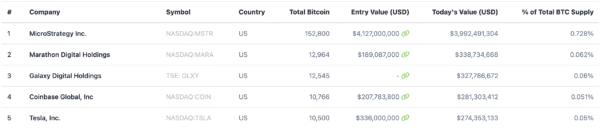
The latest purchase brings the company’s Bitcoin portfolio 158,245 BTC (roughly $4.1 billion), strengthening its position as the largest corporate Bitcoin holder. 

However, the company’s BTC holding is still posting $500 million in unrealized losses, given Bitcoin’s current market price of around $26,080. MicroStrategy acquired its total 158,245 BTC at an average of $29,582 per BTC (approximately $4.6 billion).


MicroStrategy Now Owns 0.75% of Bitcoin Supply

Since incorporating Bitcoin alongside its corporate strategy, MicroStrategy has only grown with its exposure to the leading crypto asset. The latest purchase means the company owns an estimated 0.754% of Bitcoin’s 21 million coin supply.

Data from Coingecko also shows that MicroStrategy is far ahead of any public company with Bitcoin on their balance sheet. Bitcoin miner Marathon is MicroStrategy’s closest rival, with 12,964 BTC (approximately. $338 million) in its purse, with Galaxy Digital, Coinbase, and Tesla rounding off a list of the top five public U.S. companies holding BTC.

Corporate Bitcoin Holders

MicroStrategy Remains Bullish on BTC

Since coming onto the scene in August 2020, MicroStrategy and its chairman, Michael Saylor, have been resolute in their decision to make Bitcoin a core component of their business operations.

Despite critics claiming the strategy would drive MicroStrategy out of business, the company has only stacked more bitcoins amid a broader crypto market downturn.

Michael Saylor has publicly expressed a conviction that countries, banks, and conventional finance would eventually want exposure to BTC as the asset class matures.

The MicroStrategy executive has also spearheaded a crusade to drive corporate Bitcoin adoption, even stepping down as the company’s CEO to focus on the mission.

“Downfall of Crypto King:” BBC Set to Release SBF Documentary

0

The British Broadcasting Corporation (BBC) will release SBF’s documentary later today, a series that will examine the rise and fall of FTX.

The British Broadcasting Corporation (BBC) is set to release the highly anticipated documentary on FTX founder Sam Bankman-Fried (SBF).

SBF Documentary 

Dubbed the “Downfall of the Crypto King,” the documentary examined the rise and fall of FTX- a crypto exchange SBF boasted would help take crypto to the mainstream.

According to the documentary’s synopsis, BBC described SBF as a mop-haired, nerdy math genius who embarked on a mission to transform the crypto world.

However, things did not go his way, as the former FTX CEO ended up being “the biggest loser” currently “facing the prospect of a lengthy prison sentence,” BBC noted.

Following a series of interviews and research with SBF’s former employees and associates, BBC is set to release the 90-minute documentary today, September 25, on its iPlayer.

Furthermore, the documentary highlights how the crypto community ignored the numerous red flags associated with FTX due to SBF’s charitable deeds, scruffy looks, and massive hype.

FTX Collapse and SBF Upcoming Trial

It is worth noting that the collapse of FTX was felt by the entire world of crypto, as prices of various assets plummeted heavily. FTX collapsed in November 2022, leaving over a million users in huge losses.

As a result, the team behind the firm filed for Chapter 11 bankruptcy protection. A month after FTX’s collapse, SBF was arrested and charged with fraud and money laundering by the Justice Department.

Additionally, the SEC and CFTC also filed charges against the former CEO of FTX, a company once valued at around $40B. At press time, SBF is facing seven charges. However, he pleaded not guilty to all charges.

It bears mentioning that his trial is scheduled to begin next month, on October 3, in a federal courtroom in Manhattan. Before then, a final pretrial conference could take place this week, with Judge Lewis Kaplan expected to outline the duration of the trial and other issues related to the case.

SBF will remain in jail throughout the duration of the trial, as his attempt to be released on bail was recently denied by an appeals court.

Tether ToS Change Triggers Concerns About USDT Redemption in Singapore, Tether CTO Dispels FUD

0

Tether CTO Dispels USDT Redemption FUD, Claims Singapore Has Been a Prohibited Region for Three Years.

Cake Group CEO questions USDT redemption in Singapore; Tether CTO dispels FUD, clarifying historical context and prohibited regions.

In a recent tweet, Julian Hosp, the Chief Executive Officer of Cake DeFi Group, expressed uncertainty about the possibility of redeeming the Tether USD (USDT) stablecoin into fiat currency.

He attributed this uncertainty to a supposedly recent change in Tether’s Terms of Service (ToS) that affected users in Singapore. In his words:

“I won’t be able to tell you if redeeming USDT into USD is actually possible due to being in Singapore, which was a recent change to the Tether ToS from one day to another.

Moreover, Hosp reached his conclusion after communicating with Tether’s compliance team in a recent email. He attached a screenshot of the email response to the tweet. 

Based on the response, the Tether compliance team noted they cannot onboard Cake DeFi as a customer. The team cited that crypto shareholders residing in Singapore can no longer be their customers. 

“Accordingly, your account verification will be restricted; you will not be permitted to be issued or redeem from the platform,” the statement read in part.

The Cake Group CEO found Tether’s service change “interesting.” According to him, the change was made “from one day to another” without much notice. Hosp’s tweet attracted significant attention from the crypto community as it created an air of fear, uncertainty, and doubt (FUD).

Tether CTO Dispels FUD

Paolo Ardoino, Tether’s Chief Technology Officer (CTO), weighed in on the matter and urged caution amid the growing FUD. Ardoino pointed out the importance of verifying information before making sweeping statements.

Specifically, he stressed the need for crypto enthusiasts to take a closer look at historical data, particularly web archives, to understand the situation better. 

The Tether CTO argued that the disputed service change was not recent. His tweet suggested that Singapore has been a prohibited region for at least three years. 

Besides, Singapore is not the only country in the prohibited region. According to the shared link, the listing includes Cuba, Iran, Pakistan, the Democratic People’s Republic of Korea (North Korea), the Government of Venezuela, Syria, and Crimea.

Pundit Asserts Ripple Execs Might Have Created Bitcoin, Cites Historical Docs

0

Edward Farina, XRP community figure and Head of Social Adoption at XRP Healthcare, recently asserted that Ripple executives might have created Bitcoin, citing historical documents.

Farina made this bold assertion while commenting on a previous report from The Crypto Basic on Ripple CTO David Schwartz’s 1988 patent for a system with a concept similar to the XRP Ledger (XRPL).

Edward Farina highlighted the 1988 patent, which predates Bitcoin itself. Notably, Schwartz filed for this patent under the entity David Schwartz Enterprises, Inc. 20 years before Bitcoin’s pseudonymous founder, Satoshi Nakamoto, proposed the idea of Bitcoin.

Note that the XRP Ledger launched four years after Bitcoin, mirroring the core blockchain concept of the Bitcoin network. The ledger has perfected payment principles in some ways in which the Bitcoin network fell short.

Farina believes the present Ripple executives, such as CTO David Schwartz, had initially developed Bitcoin to test how a payment system would work before moving on to launch the XRP Ledger.

Reasons Behind This Assertion

One of the factors behind Farina’s claims is a publication supposedly released by Satoshi Nakamoto. Interestingly, in 2019, two books surfaced on Amazon, credited to Nakamoto. The title of one of these books is “Wave and Ripple Design Book.”

Farina’s logic builds on the mention of “Ripple” in this book supposedly authored by Nakamoto. However, it remains uncertain whether these books came from the Bitcoin creator, given the number of people claiming to be him.

While not mentioned by Farina, another possible trigger of the assertion that Ripple execs might have created Bitcoin is that Nakamoto commented on RipplePay, the first Ripple payment system designed by Ryan Fugger, the brain behind the original XRPL concept.

Fugger’s RipplePay also predates Bitcoin, having been launched in 2005. David Schwartz recently confirmed that Nakamoto did talk about RipplePay. An unconfirmed disclosure suggests that the Bitcoin creator admired the concept.

Recall that the XRPL’s architects, including Schwartz, built on the RipplePay idea by Fugger. According to David, the XRP Ledger only differs from the original RipplePay system because it uses a native token, XRP.

These facts and the relationship between these ideas have resulted in some proponents besides Farina speculating that the developers of the XRPL might have been behind Bitcoin. However, these developers, including Schwartz, have never personally made such claims.

Shiba Inu Team Says “Those Who Vanished Will Surely Return”

0

As the crypto market prepares for a potential bull run, Shiba Inu marketing lead has expressed optimism that all those who left the SHIB ecosystem will return.

The price of Shiba Inu (SHIB) has struggled amid bearish market conditions that have plagued the overall market in the past two years. However, optimism is finally growing among investors that a change in market trends is on the horizon. 

Shiba Inu’s lead marketing strategist, Lucie, is the latest to express such confidence in a tweet that highlighted the importance of “staying positive” even as the crypto market struggles. One reason for confidence, according to Lucie, is that the SHIB community can look forward to “upcoming updates” about the project.

Without giving away much information, the SHIB marketing strategist expressed awe at the work being done by fellow team members Shytoshi Kusama and Kaal Dhairya. While being less active on X, Lucie acknowledged that “their dedication to work without distractions is truly inspiring.”


Beyond the progress being made behind the scenes by the development team, SHIB’s marketing lead also had some subtle remarks. The comments were largely targeted towards community members who have been less supportive of Shiba Inu in the wake of poor market conditions. 

“Those Who Vanished Will Surely Return,” Says Lucie

The price of Shiba Inu (SHIB) is currently at $0.000007269, representing a 91% decline from its all-time high in 2021, based on CoinMarketCap data. The massive decline in value has pushed away several investors despite key developments, such as the launch of the Shibarium network and increased activity on the Ethereum-based layer-2 network.

However, Lucie teases a conversation with a friend as a reason to believe that many who have abandoned SHIB will come back when market conditions flip bullish. The SHIB marketing lead concurred with a friend’s sentiment, saying:

“My friend made a great point: as the bull run picks up, those who vanished will surely return.”

The SHIB community will hope that the return of former supporters will come sooner rather than later. As Lucie had shared in an earlier update, the project’s strength lies in its community, putting it in a fine position to succeed during the next bull market.

Satoshi Nakamoto’s Praise for Ripple Surfaces Amid Bitcoin Maxi’s XRP Criticism

0

The XRP community recently spotlighted Bitcoin creator Satoshi Nakamoto’s commendation of Ripple in 2009 amid sustained XRP criticisms from Max Keiser.

While the renowned Bitcoin maximalist Max Keiser continues to deride XRP, proponents of the digital asset have unearthed a statement favoring Ripple from Satoshi Nakamoto.

In multiple posts on the X platform recently, Max Keiser mocked that XRP is a centralized cryptocurrency. One of his statements was that people investing in XRP are wasting their funds on what he believes is meaningless. 

According to the Bitcoin maximalist, “A fortune in a centralized fiat-shitcoin like XRP is meaningless.”

In response to Keiser’s statement, a notable XRP influencer highlighted a comment the founder of Bitcoin made about Ripple fourteen years ago. Satoshi’s remark read in part:

“Ripple is interesting in that it’s the only other system that does something with trust besides concentrate it into a central server.”

Did Satoshi Commend Ripple [XRP]?

Notably, the pro-XRP influencer spotlighted Satoshi’s statement to show Keiser that while he loved Bitcoin and hated XRP, the founder of Bitcoin praised the Ripple protocol. 

It is worth clarifying that the comment from Satoshi came three years before XRP Ledger (XRPL) went live. Specifically, Satoshi commented in 2009 about the original Ripple protocol dubbed ‘RipplePay.’ 

Besides, the authenticity of Satoshi’s comment on Ripple is debatable. A site that published the statement in 2009 stated:

“As with all private emails, there are limits on our ability to verify the trustworthiness of the material, but the consensus is that these emails are accurate and do not contradict anything else Satoshi wrote.”

It is also worth mentioning that the concept behind Ripple Lab started much earlier than 2012. According to Wikipedia sources, Ripple started 2004 with Ryan Fugger, a prominent software engineer.

Moreover, in a similar conversation thread, Ripple’s CTO David Schwartz confirmed that Saotshi did comment on RipplePay. He emphasized that RipplePay was the original Ripple system, and that the XRPL is only different from it due to the use of XRP as a native token.

Shiba Inu: Shibburn Commences Development of New SHIB-Focused Blockchain 

0

Shib Association shares latest update, saying that it has started developing a new blockchain that will focus exclusively on SHIB. 

Shib Association has shared its latest updates regarding the operations and upcoming developments of its blockchain. 

For context, Shib Association is a new initiative launched by the community-driven Shiba Inu burn tracker ‘Shibburn.’ Notably, Shibburn introduced the association last month, stating that it would facilitate SHIB’s growth via the launch of significant developments, utilities, and innovative solutions. 

The association said it will create a dedicated blockchain exclusively focused on SHIB. It noted that the network will not support any other Shiba Inu ecosystem tokens. 

Development of SHIB-Focused Blockchain Begins 

In a lengthy X post, Alex of Shibburn said the Shib Association team has already mapped out the blockchain’s architecture, adding that development has begun. 

Alex mentioned that his old friend, a former employee of Google, will “get things started with the blockchain and have it ready for GitHub.” 

He noted that some developers have contacted him and are willing to contribute to the blockchain. 

“This modern blockchain will be an open-source project and follow the Proof-of-Participation consensus model. A repository on Github will be available soon where anyone can contribute,” he added. 

Other Updates Regarding the Blockchain

Like Shibarium, Alex stated that the upcoming blockchain will also burn SHIB. However, he did not reveal how the tokens would be burned. 

Furthermore, the Shib Association will not have a dedicated Telegram or Discord channel. It noted that the only platform where the community can interact with each other is via a page on X, which will be created later this week. 

Shib Association also plans on launching its website and has already registered two domains in that regard. 

Alex warned that the blockchain does not have any native token other than SHIB, adding that the team does not plan on launching a new token in the future. 

In the meantime, Alex’s sister will manage the official X account of the Shib Association, and she will keep the community updated going forward.  

Shibburn-Affiliated Blockchain and Shibarium Difference 

It is worth noting that the upcoming blockchain is different from Shibarium, Shiba Inu’s official L2 scaling network. 

While Shibarium uses BONE as its official gas token, users of the upcoming Shib Association network would pay transaction fees with SHIB. 

Shib Association did not disclose whether the blockchain will be a fork of Shibarium or any prominent blockchain. Meanwhile, the team plans to share more updates about the project in the near future.  

XIN Falls As Mixin Network Sees Record-Breaking Hack

0

Popular Asia-focused blockchain Mixin Network suffers massive hack linked to centralized database provider.

In what is evidently the biggest crypto hack this year so far, Mixin Network has confirmed a security breach with approximately $200 million in assets stolen.

Mixin Network is popular within the Asian crypto space, labeling itself a “free, lightning fast & decentralized network for transferring digital assets.” The network also supports the creation of decentralized applications and allows cheap and near-instant transfers.

Mixin reported Monday that its cloud-based service provider was hacked on September 23. This exploit led to the loss of a significant amount of assets on the mainnet.

The project has temporarily suspended deposits and withdrawals and also contacted Google and blockchain security company SlowMist to assist with investigations.

Mixin Network will resume deposits and withdrawals after confirming and fixing the vulnerabilities, although transfers on the network are currently not impacted by the hack.

According to the Mixin Network team’s update, deliberations remain ongoing on how to deal with the lost assets. However, the project pledged to do its best to “minimize the losses” for users in the wake of the incident.


The Mixin Network hack now tops the list of cryptocurrency-related hacks since the turn of the year.

Until now, Euler Finance’s $197 million hack in March topped the leaderboard for crypto hacks in 2023. Other recent hacks include CoinEX’s $54 million loss and Curve Finance’s $47 million incident. 

Mixin Hack Linked to Centralization Risks

Mixin’s preliminary report on the incident and its allusion to a breach on its “cloud-based service provider” suggests that the hack is linked to storing its private keys on a centralized server.

Such an approach evidently undermines the ethos that underpins public blockchain networks, as the crypto community on X (formerly Twitter) was quick to point out following the hack.

Meanwhile, the Mixin Network security breach has expectedly impacted the price of the project’s native token, XIN. Following the Sept. 23 incident, XIN’s price has dropped 11%, according to data on Coingecko.

XIN Price Chart
XIN Price Chart

Similarly, Mixin Explorer shows that the total value of assets locked (TVL) on the network has dropped in the past 48 hours. The DeFi-centric metric declined from over $1.04 billion before the hack to $900 million at the time of writing.

Ripple CTO: XRP at Higher Prices Is a Better Vehicle for Payments

0

Ripple CTO David Schwartz believed XRP would be a more efficient payment vehicle by hitting higher prices and commanding better liquidity.

Prominent XRP influencer Crypto Eri recently spotlighted a statement from Ripple’s Chief Technology Officer, David Schwartz, about XRP’s price when used for facilitating large cross-border payments.

Crypto Eri quoted Schwartz’s reply to a question on Quora about institutions supposedly seeking XRP’s price to remain low for payment transactions. She highlighted the view that “Higher prices tend to correlate with higher liquidity, which means cheaper payments.”

Higher Prices Correlate with Higher Liquidity

In particular, a questioner raised concerns about banks adopting Ripple and its implications for the XRP market price. Schwartz provided a detailed explanation concerning the underlying process.

He argued that the idea of banks wanting to keep XRP’s price low would not hinder mainstream adoption. Schwartz emphasized that the XRP required for a $1 million payment would always be at least $1 million.

Contrary to the notion that lower prices would be more favorable, he stated that higher prices correlated with increased liquidity, resulting in cheaper transactions. The Ripple CTO illustrated this point by drawing a comparison to Bitcoin.

He highlighted that using Bitcoin as an intermediary currency for a $1 million transaction when its price was low, such as $100, would create significant price fluctuations. Such fluctuations would occur due to the absence of much liquidity when acquiring the necessary Bitcoin and converting it into the recipient’s local currency.

“… trying to buy enough Bitcoin to buy the house, you’d push the price up significantly. And when the recipient tried to convert those bitcoins into their local currency, they’d push the price down significantly.”

Schwartz explained that the situation would render Bitcoin impractical for high-value transactions. However, where Bitcoin has surpassed $26,000 in the current market, Schwartz noted it becomes feasible to transact large sums without causing significant market disruptions.

According to Schwartz, the possibility is due to the higher price, which requires a smaller fraction of the total asset for such transactions. Schwartz believes a similar principle plays out with XRP.

In sum, when XRP is priced higher, it would serve as a more effective tool for handling high-value payments as fewer units of the digital asset would be required.