Home Blog Page 1804

Ripple CTO Highlights What Validators Do for XRPL

0

Amid growing interest in the XRP Ledger (XRPL), Ripple CTO David Schwartz clarifies validators’ roles on the decentralized network.

Ripple’s Chief Technology Officer (CTO) David Schwartz has presented a clear overview of the role validators play on XRP Ledger. The XRP Ledger (XRPL) is a blockchain network that uses XRP as a native currency and supports the development of decentralized applications.

Launched in June 2012, XRPL operates a Federated Consensus model, which requires validators to agree on ordering transactions on the network.

However, similar to most blockchains, users can also run a node to send transactions and verify the state of the ledger. There are currently 118 validators on the network, with 681 nodes, according to XRPL.org.

David Schwartz’s latest expose breaks down the relationship between nodes and validators on XRPL. It mentioned, among other things, that an individual node does not need validators to “tell it what transactions are valid.”


Relationship between nodes and validators on XRPL

According to the Ripple CTO, the only problem nodes cannot solve on XRPL is the double-spend dilemma which is handled by validators on the network. The double spend problem, which was originally solved by Bitcoin’s technology but advanced by more recent systems such as XRPL, provides a way to detect fraudulent transactions on the network.

Commenting on how someone can try to cheat the network, David Schwartz wrote, “Someone can submit two equally-good, but conflicting, transactions to the network, and you need some way to agree on which one of them to permit and which to reject.”

XRPL validators follow carefully outlined system rules to distinguish such transactions, and once done, honest nodes will stay in agreement. They can thus distinguish which address holds what assets and avoid getting confused by conflicting transactions.

Meanwhile, validators on XRPL play additional roles, including activating network features by upgrading to the latest XRPL software.

David Schwartz clarified that validators “cannot force nodes” to adopt features they do not want. This factor means that nodes on XRPL also contribute to the network’s decentralization since they reserve the right to choose whether or not they would accept some implementations approved by validators.

XRPL Sees Growing Interest

The work of nodes and validators under the hood helps power XRPL and enable developers to build user-facing applications. In recent times, XRPL has seen an influx of user interest, especially with the emergence of decentralized finance (DeFi) apps on the network.

This month alone, two new DEXes have launched on the XRPL testnet, seeking to allow users the option to exchange XRPL-based assets. These exchanges seek to tap into a new upgrade that will enable native automated market-making (AMM) on XRPL for the first time.

HSBC Customers Can Now Pay Mortgage Bills with Shiba Inu, XRP

0

In a recent tweet, FCF Pay, a prominent crypto payment processor, made an exciting announcement for HSBC customers holding XRP and Shiba Inu (SHIB).

Specifically, the platform announced that HSBC users can now pay their mortgage bills and loans using various cryptocurrencies through the FCF Pay platform.

The statement read:

“We are delighted to announce that HSBC users are eligible to pay their mortgage bills and loans with cryptocurrencies through FCF Pay.” 

Paying Loans with Shiba Inu and XRP

The notification implies customers of the global banking giant HSBC can now leverage the growing popularity of digital assets for their banking needs.

The tweet further revealed the variety of cryptocurrencies tenable for mortgage bill payments via the FCF Pay portal. These include XRP, SHIB, Bitcoin (BTC), Ethereum (ETH), and Dogecoin (DOGE). The platform confirmed that more digital assets are equally supported for the service. 

According to FCF Pay’s bill payment portal, the repayment process for the mortgage requires just three procedures. It involves selecting a payee, adding the billing information, and sending the crypto payment.

FCF Pay claims to execute the underground processes for the payment delivery within 48 hours. The crypto payment processor charges 2% of the bill and a statutory $3 fee. FCF Pay users would see the payment transaction on their bank statements within two business days.

Per the disclosure, FCF Pay supports all crypto wallets, including centralized exchanges. Besides, it confirmed that it does not connect with users’ crypto wallets. “We don’t connect to your wallet, so your wallet is kept safe,” FCF Pay stated.

It is worth mentioning that FCF Pay’s crypto payment service is currently limited to residents of the United States. Meanwhile, it disclosed its intention to support other jurisdictions in the future.

Notably, the support for XRP and Shiba Inu on mortgage payments follows the firm’s recent notification for a similar service. Specifically, The Crypto Basic reported that Texans can now leverage Shiba Inu for energy bills.

Analysts Predict Shiba Inu to Surpass $0.0001 By This Time

0

Telegaon, a popular crypto analytical platform, forecasts that SHIB would surge above $0.0001 in 2027, adding that the token would hit an average price of $0.000153 in the same year.

Like most crypto assets, the ongoing bear market has largely affected Shiba Inu. The crypto is currently trading at $0.00000727, down 91.54% from its all-time high (ATH) of $0.00008616, according to CoinGecko data.

Investors’ hope of seeing a major SHIB rally following the mainnet launch of Shibarium was dashed. Instead of a rally, the price of SHIB dipped heavily after the launch of the L2 blockchain.

Following SHIB’s recent performance, many investors believe it would be a daunting task for the asset to reach its previous ATH and potentially surge to $0.0001.

SHIB to Eliminate Two Zeroes By 2027

Interestingly, popular on-chain metrics price prediction platform Telegaon recently forecasted that SHIB would eliminate two zeroes from its price by 2027.

According to Telegaon, SHIB will change hands at an average price of $0.000153 in 2027. In the same year, the prediction platform forecasted that SHIB would hit a high of $0.000198.

For SHIB to reach $0.000153 in 2027, the asset would have to rally 2,104% from its current price of $0.00000727.

Per Telegaon’s prediction, SHIB might continue to trade with three zeroes until the end of 2030.

Telegaon Says SHIB Will Surpass 1-Cent Dream By 2040

Furthermore, the analysts at Telegaon painted a more rosy picture for SHIB’s price by 2040.

Notably, Telegaon predicted that SHIB could trade at a minimum price of $0.054, over 400% above the one-cent dream for Shiba Inu. It also speculated that SHIB’s average price by 2040 would be around $0.076.

Meanwhile, Telegaon gave a more conservative prediction for SHIB by the end of 2023. It noted that SHIB may eliminate a zero from its price, rallying to an average price of $0.0000239 by year ending.

Investors See Burns as Catalyst for SHIB Rally

Telegaon’s prediction for SHIB may seem enticing to investors. However, some may doubt the possibility of SHIB achieving the feat, given its current circulating supply.

The ongoing burn efforts have not done justice to SHIB’s whopping circulating supply. Although over 410.65 trillion SHIB have been burned so far, the token’s circulating supply still stands at around 589.32 trillion.

Several enthusiasts believe that the Shiba Inu team must burn a huge chunk of SHIB’s supply before the asset can surpass its previous ATH.

Shibarium is seen as the appropriate solution to facilitate burns. The Shiba Inu team is expected to use a part of Shibarium’s transaction fees to buy and burn SHIB.

However, the team has not yet released an official update on how much has been generated for Shibarium-powered SHIB burns.

As reported earlier, Shibburn estimates that Shibarium would need to process 5 quadrillion transactions to incinerate $25K worth of SHIB.

Millionaire Trader Teases XRP Army with a Lamborghini after Holding XRP for 6 Years

0

XRP investors Rob Art and King Doggo share humorous anecdotes about their XRP investments, reminding enthusiasts to temper expectations with market factors.

Renowned crypto aficionado Rob Art, who has been deeply involved in the crypto space since 2016 and has achieved millionaire status, took to X to tease the XRP community.

The Lamborghini Tease

In the tweet, Rob conveyed that he had reached a significant milestone after six years of consistently holding and amassing XRP. 

He noted that his XRP investment has now allowed him to indulge in a simple pleasure, such as buying a coffee, all while witnessing the proud owner of a stunning green Lamborghini drive away. 

Accompanying Rob’s post was a picture of the exotic car. The tweet attracted significant engagement from the community, given that it poked fun at the XRP community. 

“After 6 years of holding and accumulating XRP, I am finally able to buy a coffee and watch the proud owner of this Lamborghini drive away,” Rob teased.

Rob’s message cracked up the community. Yet, some expressed a view that their longing for owning a Lamborghini through their XRP investments would come to pass.

XRP Retirement Plan

In a similar conversation, another XRP enthusiast recounted a similarly humorous event with his XRP investment through the past five years.

Specifically, King Doggo, the founder of The Alpha Husky Club, an NFT project on the XRP Ledger (XRPL), shared a candid reflection on his XRP journey.

In the tweet, he recounted how, back in 2018, he had invested in XRP with the hopeful expectation of retiring within the same year.

However, fast forward to 2023, King Doggo humorously remarked that, instead, he and his colleagues find themselves on the verge of completing a law degree due to the persistent exposure to the legal technicalities from the SEC vs. Ripple lawsuit.

King Doggo’s tweet serves as a humorous anecdote, highlighting the unforeseen circumstances that could bug anticipation. Additionally, he cited the protracted Ripple lawsuit as one of the unexpected turns of events for XRP enthusiasts.

Notably, the XRP Army reacted to King Doggo’s tweet, with many expressing optimism about their eventual compensation for holding XRP.

Experts Advise Caution as XRP Nears First Death Cross Since 2021

0

XRP is in a critical position, prompting experts to caution investors as the asset inches closer to creating its first death cross in over a year. 

Two prominent yet pseudonymous crypto accounts, Lord Crypto and CryptoBusy, recently took to X to highlight XRP’s delicate position. 

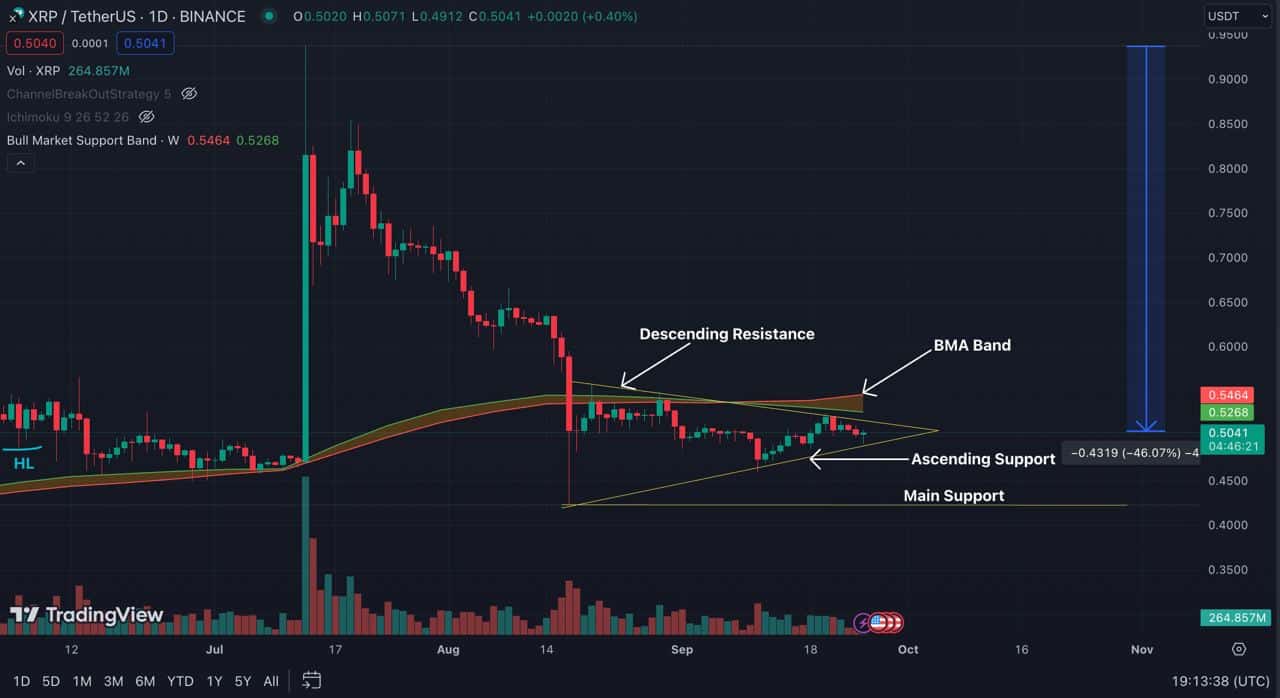
Lord Crypto’s commentary pointed out that XRP has experienced a substantial price decline, losing nearly 50% of its value since the rally from the lawsuit victory. Notably, XRP is 46% down from the high of $0.9380 in July.

The analyst drew attention to the BMA Band, noting that the 20-week SMA (red) has crossed above the 21-week SMA (green). Following the flip, both SMAs have continued to drift apart, suggesting further downward pressure in the absence of bullish news or catalysts.

XRP BMA Band
XRP Daily Chart | Lord Crypto

The accompanying chart showed that XRP has encountered persistent descending resistance levels since mid-August, a pattern that ensued amid the correction from the $0.9380 high.

Notably, as XRP attempts to rise, it faces resistance at lower values, making it progressively harder for the asset to achieve higher price points. Conversely, the chart shows that XRP’s support points have been rising, preventing higher price drops.

However, the analyst singled out a main support level at $0.42. Lord Crypto noted that unless new positive developments or news emerge, XRP may be prone to experiencing another decline, potentially approaching the main support level at $0.42.

XRP in a Symmetrical Triangle

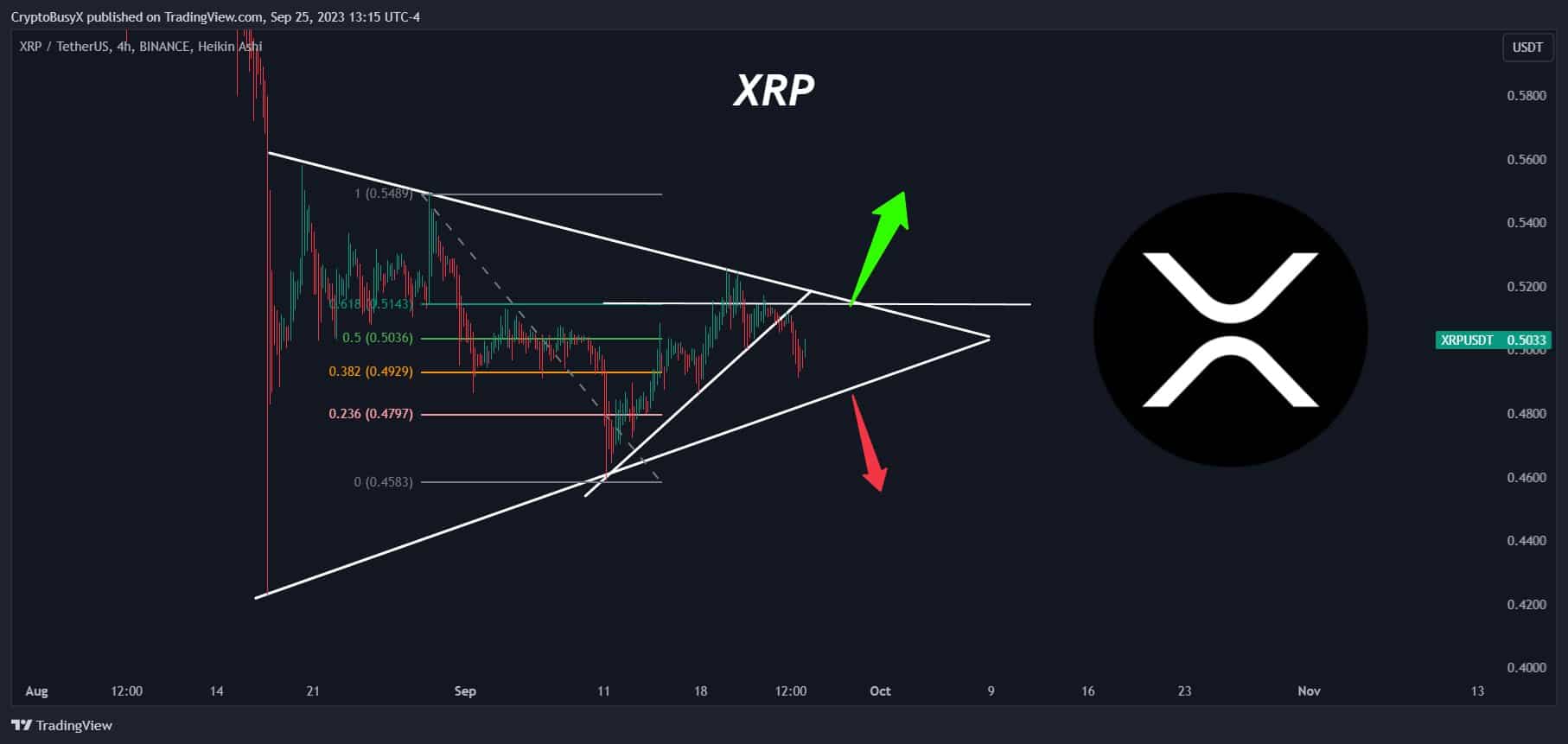
CryptoBusy, a crypto-focused media and analytical account, highlighted the formation of a symmetrical triangle on XRP’s daily chart. This pattern, which started taking shape in mid-August, is characterized by converging trendlines. 

XRP Symmetrical Triangle 2
XRP 4H Chart | CryptoBusy

When XRP is within such a triangle, it often signifies indecision in the market. Neither buyers nor sellers have gained full control, leading to uncertainty. Within this context, CryptoBusy advises caution for XRP traders. 

The Crypto Basic called attention to this pattern in a previous analysis. The symmetrical triangle suggests that the market is in flux, making it challenging to predict the cryptocurrency’s immediate direction. 

This lack of clarity implies that trading XRP at this juncture may be best suited for short-term strategies like scalping or intraday trading, where traders can capitalize on smaller price fluctuations.

XRP’s Impending Death Cross

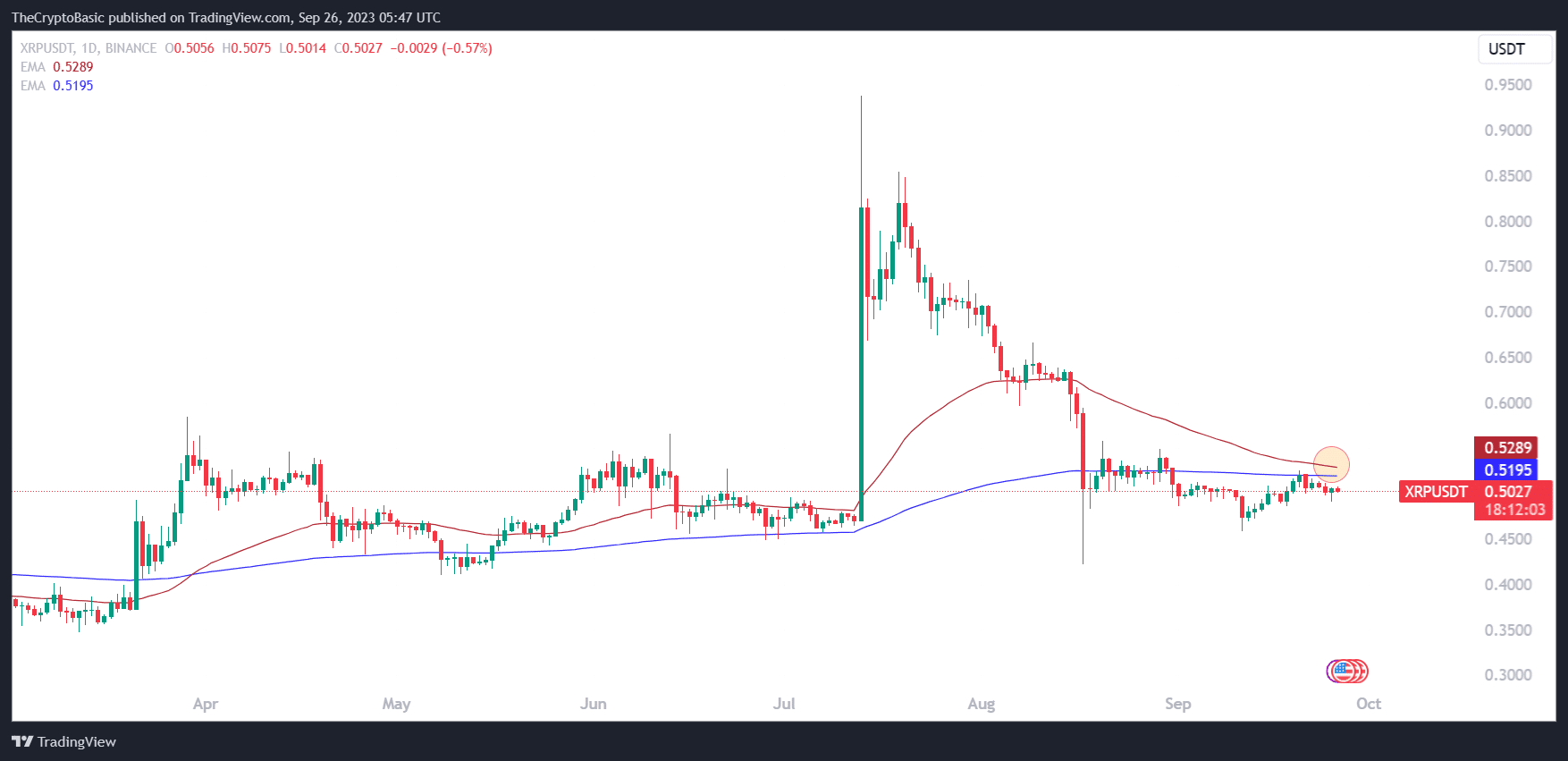
One of the most crucial patterns on the daily chart is the potential formation of a death cross. A death cross occurs when a shorter-term moving average, in this case, the 50-day EMA, crosses below a longer-term moving average, the 200-day EMA. 

The last time XRP experienced a death cross was in December 2021. After the 50-day EMA crossed below the 200-day EMA on Dec. 17, 2021, XRP witnessed a substantial decline. It tumbled from a high of $1.016 to a low of $0.5489 on Jan. 22, 2022. This marked a 46% drop in one month.

With the 50-day EMA ($0.5289) nearing a potential cross below the 200-day EMA ($0.5195), XRP is again at risk of encountering a death cross. This metric adds to the prevailing bearish sentiment.

XRP Death Cross 080422
XRP Impending Death Cross

XRP trades for $0.5027, below the 50-day EMA ($0.5289) and the 200-day EMA ($0.5195). This position below the short and long trend moving averages compounds this bearish sentiment. 

To mitigate further losses, XRP bulls must vigorously defend $0.50. Should this level give way, the next significant support lies at $0.4908. Falling below this support would bring the $0.4801 price point into focus, followed by $0.4694.

SEC Challenges Celsius Decision to Repay Customers Through Coinbase

0

The U.S. SEC has raised concerns about a move that would see Coinbase help bankrupt crypto lender Celsius distribute funds to affected customers.

The United States Securities and Exchange Commission (SEC) has opposed a new restructuring proposal submitted by bankrupt cryptocurrency lending platform Celsius. At the core of the matter is an agreement that Celsius has in place with crypto exchange Coinbase. 

Termed the “Coinbase Agreements,” the deal would see Coinbase act as a “Distribution Agent,” assisting Celsius in distributing cryptocurrencies recovered from its ongoing liquidation process. However, the SEC has stepped in to oppose the deal, citing its ongoing case with Coinbase.

Recall that on June 6, the SEC filed a lawsuit against Coinbase. The regulator alleged that the crypto exchange operated as an unlicensed securities exchange and that its staking products constituted securities under US laws. 

The SEC, in its latest filing, also claims that the Celsius restructuring plan, if approved, would allow Coinbase to offer the same brokerage services for which it is in a lawsuit with the regulator.

The SEC argues that although Celsius debtors claim that they “do not intend for Coinbase to provide brokerage services [to the debtors],” the wording in the Coinbase Agreements is contrary. The agency claims the agreement could allow Coinbase extend beyond being just a distributor.

Additionally, the SEC alleged an additional agreement between Coinbase and Celsius that the firm has not made available to the SEC staff. The SEC wants the undisclosed agreement or any new agreement that clarifies Coinbase’s role in the Celsius restructuring plan to be presented to the regulatory agency and the bankruptcy court.

Coinbase Responds to Address Newly Raised Issues

Following the SEC’s latest filing, Coinbase’s chief legal officer, Paul Grewal, took to X (formerly Twitter) to clarify the company’s next line of action. 

Coinbase looks “forward to addressing [the SEC arguments] with the bankruptcy court and undertaking [its] important role to make Celsius customers whole,” Paul Grewal said in a tweet later retweeted by Coinbase CEO Brian Armstrong.

Meanwhile, Coinbase in August filed a motion to dismiss the initial SEC lawsuit against the company. Coinbase’s primary argument is that the exchange does not offer investment contracts, as alleged by the US securities regulator.

Texas Residents Can Now Pay With Shiba Inu For Solar Panel Bills

0

FCF Pay has partnered with Chariot Energy in a groundbreaking move that allows Texas residents to pay their solar panel bills with cryptos like Shiba Inu.

Top blockchain payment system FCF Pay has introduced a new solution that enables Texas residents to pay their solar energy bills using Shiba Inu.

To make this a reality, FCF Pay partnered with Chariot Energy, a solar energy company based in Houston, Texas. In a tweet yesterday, FCF Pay referred to Chariot Energy as one of the many companies that offer green energy.

According to the announcement, Chariot Energy will enable Texas residents to pay their solar panel bills with crypto like Shiba Inu via the FCF payment system.

Steps to Pay Solar Energy Bills With Shiba Inu

Notably, Shiba Inu holders can pay their solar energy bills at Chariot by following three basic steps. Firstly, users need to select Chariot Energy as the payee.

Secondly, Texas-based Shiba Inu holders will be required to fill in their billing information, such as names, residential addresses, and emails.

Lastly, users must confirm their details and send payments. After sending payments, FCF Pay will complete the remaining process, and payments will be sent to Chariot Energy in less than 48 hours, the company said.

In a subsequent tweet, FCF Pay clarified that the solution is only available in Texas. Additionally, the blockchain payment company mentioned that people residing outside Texas can also pay their solar energy bills using its virtual crypto card.

Chariot Energy is a solar energy company based in Houston, Texas. The company provides people’s homes and offices with electricity sourced from renewable energy.

FCF Pay Supports Shiba Inu

FCF Pay has continued to expand its support for Shiba Inu. FCF’s support for Shiba Inu dates back to April 2022, when it first integrated SHIB into its list of supported crypto assets.

The company did not stop there. It also added support for other Shiba Inu ecosystem tokens, including BONE and LEASH.

Since integrating Shiba Inu ecosystem tokens into its payment system, FCF Pay has rolled out numerous solutions that enable Shiba Inu holders to pay bills across their favorite merchants.

Earlier this month, FCF introduced a new service that allows Shiba Inu holders to manage their finances effectively.

Shiba Inu Adoption Soars Amid Bear Market

Meanwhile, despite the negative impacts of the bear market, Shiba Inu has continued to record widespread adoption, especially as a payment method.

As reported earlier, leading crypto exchange Binance unveiled a new product dubbed Send Cash, making Shiba Inu payments available in nine Latin American countries.

Shiba Inu-themed Food Store To Create Food Tracking Tool

0

Shiba Inu-themed food store Welly is developing blockchain-based food tracking technology that could revolutionize the industry.

@PB5, a business developer and a team member to Welly, the pioneering NFT project that offers fast-food store rewards backed by Shiba Inu, has provided updates on their underground endeavor. 

In a recent tweet, @PB5 revealed that the project is actively engaged in several key areas of development. However, he provided an update on two of the most crucial areas for the community.


Building A Tech to Track Fast Food

Among the significant focuses, the Shiba Inu-themed project is actively working on altering its metadata. The Welly admin acknowledged that the endeavor will require considerable time to complete. 

In parallel, @PB5 noted that the project’s primary focus lies in creating advanced blockchain-based technology to track food items.

According to the admin, the innovative tracking system is envisioned to apply to traditional brick-and-mortar stores and vending machines, representing a versatile solution with broad potential. 

“Our main focus is on creating a cool tech to track food on the blockchain. This could work for both regular stores and vending machines,” the Welly representative remarked.

Notably, the implications of the stated technological advancement extend far beyond Welly itself, potentially benefiting restaurant managers globally. @PB5 highlighted that Welly aims to introduce a transformative element to the food industry, promising to reshape how food transactions are monitored and managed.

According to him, “It’s a game-changer that can help lots of restaurateurs worldwide over time.”

In light of the ambitious goals, @PB5 urged the community not to underestimate the potential impact of Welly within the crypto and food industries.

In June, The Crypto Basic reported Welly’s strategic expansion plans to establish two additional fast food stores. Also, the team initiated renovation efforts for its existing store in Naples, Italy. It commenced with the refurbishment of the kitchen and storefront. 

Notably, the move got the attention of Shytoshi Kusama, the Shiba Inu team lead. Kusama took to X to praise the Shiba Inu-themed fast-food business. 

Ethereum Insider Says ‘Hinman’s Speech Shall Live in Infamy’ As SEC is Hiding More Than Motives

0

Steven Nerayoff, an early Ethereum adviser, comments on Hinman’s June 14, 2018, remark, saying that the date of the infamous speech shall live in infamy.

Steven Nerayoff, a prominent cryptocurrency adviser and advocate, has made a shocking allegation regarding the infamous speech by William Hinman, former director of SEC’s Corporation Finance.

In a recent X post, popular XRP community member @digitalassetbuy shared a document relating to a meeting held at the SEC that allegedly birthed the controversial Hinman speech.

According to the document, a meeting was scheduled on March 28, 2018, between some top crypto stakeholders and SEC’s Corporation Finance staff.

Notably, @digitalassetbuy described the meeting as the presentation that gave Ethereum the free pass speech. Recall that Hinman declared Ethereum and Bitcoin as non-securities during his infamous speech on June 14, 2018.

The speech, which has stirred major debate since the beginning of the SEC v. Ripple lawsuit, is described by many as the “Ethereum free pass.”

Date of Hinman’s Speech Shall Live in Infamy

Reacting to @digitalassetbuy’s tweet, Nerayoff stated that the date of Hinman’s speech “shall live in infamy.” Nerayoff, an early Ethereum adviser, noted that the main motive behind Hinman’s infamous speech is being concealed.

“Wait until you see what else happened this day to silence me & cover up their sin(s),” he added.

He said, “They’re hiding more than the motives behind the speech…”

It is worth mentioning that the FBI charged Nerayoff with alleged extortion in 2019. However, the authorities dropped the case in May 2023.

Four months after the case was withdrawn, Nerayoff alleged that the FBI targeted him due to his knowledge of Ethereum ICO. He noted that the plot also involved other top government agencies, including the SEC and the Justice Department.

Empower Oversight Seeks Crypto Communication From SEC’s Clayton Tenure

Meanwhile, debate regarding Hinman’s speech was ignited within the crypto community following Empower Oversight’s recent FOIA request. 

Per an announcement yesterday, Empower Oversight said it had submitted a new FOIA seeking communications between former SEC chair Jay Clayton and others regarding crypto. 

Empower Oversight’s new FOIA submission is focused on the SEC’s improper handling of crypto enforcement during Clayton’s tenure. 

“The request stems from Clayton’s statements regarding Bitcoin and other senior officials’ statements on Ether suggesting that they were not securities subject to SEC enforcement jurisdiction, only to have the SEC file suit as Clayton was leaving the agency against Ripple related to another cryptocurrency, XRP, alleging that it was a security,” an excerpt of the announcement read.

Furthermore, Empower Oversight mentioned that Clayton later joined One River Management, a hedge fund focused on Bitcoin and Ethereum, after he left the SEC.

XRP Enthusiasts React to Empower Oversight’s New FOIA

Expectedly, the development stirred reactions, with XRP enthusiasts raising issues regarding potential corruption within the SEC.

Commenting on the development, pro-XRP lawyer Bill Morgan said Empower Oversight gave a “perfect summary” of Clayton’s conflict of interest.

In addition, Attorney John Deaton, the lawyer representing thousands of XRP holders in the Ripple lawsuit, pointed out that Clayton was the only SEC commissioner who read the draft of Hinman’s speech before it was given at Yahoo Finance’s All Market Summit.

According to Deaton, Hinman never sent a copy of the “biggest speech in the crypto industry” to SEC commissioner Hester Peirce, popularly called “Crypto-Mom.”

Xumm to Use CTID Feature in XRP Ledger v1.12 for Easy Transaction Identification

0

Xumm, the self-custodial XRP Ledger-based wallet developed by XRPL Labs, is set to leverage the CTID feature introduced with the latest XRPL version, rippled 1.12.

Wietse Wind, Xumm developer and founder of XRPL Labs, shared this news on X. He revealed that with the upcoming Xumm version 2.6, expected in a few weeks, users would benefit from the CTID feature when using a network explorer or sharing its link.

CTID, or Concise Transaction Identifier, is a leap forward in transaction identification on the XRPL. Wind explained that CTID is substantially shorter than a transaction hash and includes the essential network ID information. 

This compact identifier enables Xumm to select the proper explorer and network with pinpoint accuracy for each transaction. It’s a step towards making XRPL transactions more accessible and user-friendly. 

In addition, Wind confirmed that Bithomp, one of the most prominent XRPL explorers, is already fully compatible with the CTID feature. 

He clarified that CTID is more than just for reporting purposes. It’s a unique reference to a transaction, offering an alternative to the old, lengthy transaction hash, which lacked network information.

A community member questioned the possibility of Automated Market Makers (AMMs) on Xumm. Note that the XRPL is expecting an AMM feature upon the completion of governance voting.

Wind assured the community that Xumm seeks to be feature-complete with regard to signing. As a result, they intend to add AMM signing in the future, aligning with their policy of keeping Xumm simple while allowing easy integration of AMM-specialized platforms.

What is CTID?

Wind’s announcement built upon earlier remarks by Tequ, an XRPL developer. Tequ provided context for the CTID feature, explaining that it was proposed by Richard Holland, Hooks developer and CTO at XRPL Labs, and Ryan Molley, the founder of Crossmark.

Tequ confirmed that the CTID feature came with rippled 1.12.0. According to him, it ushers a standardized approach to how transactions are uniquely defined across various XRPL-based networks.

CTID consists of four components: an initial “C,” a ledger index, a transaction index, and a network ID. These components, represented in hexadecimal form, combine to form a transaction ID of 16 characters. An example is C4EF514900120000.

Including the network ID in CTID eliminates the risk of collisions between multiple networks, ensuring precise transaction identification.

Identifying a transaction required knowledge of its hash value, which lacked network details. CTID addresses this issue by providing a short, network-inclusive identifier. 

This feature streamlines transaction information retrieval for wallets and makes XRPL transactions more accessible to users. The CTID feature is one of the exciting features introduced with the latest XRPL version, rippled 1.12, alongside Clawback and AMM.