Home Blog Page 1904

Ripple CLO says Further Court Proceedings To Come As XRP Sales to Institutional Investors Constitute Securities

0

Despite declaring XRP as a non-security, the court finds that Ripple’s past sales to institutional investors constitute an unregistered security offering.

Judge Analisa Torres, the presiding judge of the SEC v. Ripple lawsuit, has finally issued the much-anticipated ruling after nearly three years of legal battle.

The judge’s judge’s decision is seen as a mixed ruling, as each party won and lost some aspects of the case. While Judge Torres ruled that XRP itself is not a security, she concluded that Ripple’s XRP sales to institutional investors constituted an unregistered security offering.

Yesterday, Ripple’s General Counsel Stuart Alderoty confirmed that the court found the company’s XRP sales to institutional clients as an investment contract.

These institutional investors bought XRP directly from Ripple in the past, worth $728.9 million. Notably, the amount is lower than the $1.3 billion filed in SEC’s original complaint.

Rationale Behind the Decision

According to the ruling, Ripple’s XRP sales to institutional investors were deemed unregistered securities due to an agreement by these investors to lock up their coins for a specific period.

In this context, these XRP coins can’t be regarded as anything other than a speculative investment within the lock-up period.

Furthermore, the ruling highlighted investment contracts showing that these investors purchased XRP for resell purposes. Moreover, the court ruled that these institutional clients bought XRP hoping to make profits based on Ripple’s efforts. Per the ruling, Ripple’s sales to institutional clients satisfy all prongs of the Howey test.

Further Court Proceedings to Come

Meanwhile, Ripple’s chief legal officer (CLO) noted that there will be further court proceedings on the issue.

“… There will be further court proceedings only on these institutional sales per the Court’s order.”

XRP Trading Starts on Coinbase, Gemini, Kraken, CryptoCom, Bitstamp, & BitGo As XRP Makes a Comeback in US

XRP triumphantly returns to US markets as major exchanges resume trading after the court ruling, sparking a 77% surge in value.

XRP is returning triumphantly to the US markets following the recent court ruling that confirmed it as a non-security. This landmark decision has prompted several major exchanges to swiftly announce the resumption of XRP trading, much to the delight of the crypto community.

XRP on Coinbase

Notably, the leading US-based exchange, Coinbase, has also resumed trading for XRP, declaring the victory against the US regulator as a win for Ripple, the industry, and builders.


XRP on Gemini 

Gemini, one of the leading crypto exchanges, took to Twitter to express its intention to explore the listing of XRP for spot and derivatives trading. The announcement reflected the exchange’s confidence in the court ruling and recognition of XRP’s renewed status.


XRP on Crypto.com 

Crypto.com, a prominent crypto platform, also joined the celebration, heralding the return of XRP to the United States. It announced that XRP trading is now available on the Crypto.com App, allowing users to buy and trade XRP with various fiat currencies, including USD, EUR, GBP, and more.


XRP on Bitstamp

Bitstamp, another well-known exchange, enthusiastically welcomed back XRP, expressing its excitement through a tweet. It announced that XRP trading is now available for US customers, enabling them to buy, sell, and trade XRP on the Bitstamp USA platform.


XRP on Kraken 

Also, Kraken, a reputable crypto exchange, wasted no time offering XRP trading to its US customers. While the exchange noted that XRP would be tradable against all fiat currency and the pairs of Bitcoin (BTC), Ethereum (ETH), and USDT, it stated that the app trading would commence after meeting sufficient liquidity requirements.


XRP on BitGo

BitGo, a trusted custodian and digital asset platform, also joined the voices celebrating XRP’s return. It congratulated Ripple and its team for this significant achievement and announced that XRP trading is now live on BitGo Prime.


With XRP reclaiming its position on prominent platforms, the digital asset has soared by over 77% in the last 24 hours, as The Crypto Basic reported.

South Korean Exchange Leads in XRP Trading, with $2.5B in 24-Hour Volume

0

Amid the massive renewal in XRP trading activity, South Korea’s largest exchange Upbit leads in 24-hour trading volume, commanding $2.5 billion.

XRP’s victory in the Ripple vs. SEC lawsuit has expectedly triggered a massive influx of trading activity as the market sees a renewal of interest. Amid this uptick in activity, South Korea’s largest exchange Upbit has recorded the largest 24-hour trade volume, towering above all other exchanges, including Binance.

Colin Wu, a reputable blockchain reporter, first called public attention to the bullish development in a tweet today. According to Wu, this confirms that South Korean investors have made massive contributions to the recent XRP rally.

It is essential to note that the renewal of investors’ interest catalyzed a rapid surge in XRP’s trade volume. As of July 13, XRP’s 24-hour volume was $613.5 million. However, trade volume has surged to the current value of $13.58 billion. This represents a 2,114% increase.

At the time of Wu’s disclosure, the reporter revealed that XRP trade volume on Upbit stood at $2.1 billion over 24 hours, while Binance had a trade 24-hour volume of $1.7 billion. However, current data suggest a more impressive figure.

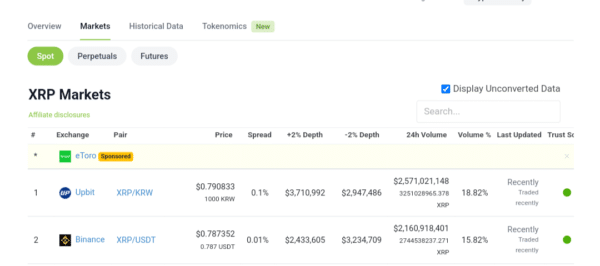
Per data from CoinGecko, Upbit’s 24-hour trade volume for XRP is currently $2.57 billion for the XRP/KRW pair. This figure represents 18.82% of the global trade volume for XRP across all exchanges.

XRP Volume Upbit and Binance
CoinGecko

The XRP trade volume on Binance has also surged to $2.16 billion for the XRP/USDT pair. This value represents 15.82% of the global XRP trade volume of $13.58 billion. Notably, Binance also commands trade volume from other XRP pairs, including XRP/BUSD, XRP/TRY, and XRP/EUR.

XRP Secures Victory

The surge in trade activity comes a few hours after Judge Torres ruled that XRP is not a security, as previously reported by The Crypto Basic. The Judge also ruled on the SEC’s allegations against Ripple and its executives on sales of XRP.

While Judge Torres ruled that Ripple’s institutional sales of XRP constituted an investment contract, she noted that programmatic sales, Chris Larson’s and Brad Garlinghouse’s sales, and other distributions do not constitute investment contracts.

The XRP victory elicited a wave of euphoria within the XRP community and the broader crypto space. Investors trooped into XRP as it secured a position as the only regulated crypto asset. As a result, XRP rallied 30% in less than 3 hours.

Due to the massive trade activity, the Uphold faced issues as it could not handle all the load. Exchanges such as Coinbase and Kraken swiftly relisted the asset after over two years. XRP sustained its rally, surging by 77% to a one-year high of $0.82. XRP is currently trading for $0.79, up 68% over the last 24 hours despite a modest drop in momentum.

Court Rules XRP, XRP Sales By Executives, XRP Sales On Exchanges As Non-Security

0

Ripple General Counsel Clarifies Court’s Ruling, Says XRP Sales By Execs Aren’t Securities.

Ripple’s General Counsel has shed light on Judge Torres’ ruling, saying the company’s execs’ XRP sales and other XRP distributions are not securities.

Stuart Alderoty, Ripple’s General Counsel, has taken to Twitter to clarify the ruling by Judge Analisa Torres in the company’s lawsuit against the SEC. 

After a protracted legal battle lasting two and a half years, Judge Torres issued her decision.

Although Judge Torres clarified that XRP is not a security, crypto community members seemed confused about her decision on other aspects of the case. 

Alderoty Provides Clarity

In a Twitter thread yesterday, Alderoty, who described the judge’s ruling as a huge win, said the court’s decision implies that XRP is not a security.


The prominent Ripple legal counsel also noted that as a matter of law, XRP sales on secondary markets, including exchanges, are not also securities. 

Notably, Alderoty said the judge also declared XRP sales by Ripple’s executives- Brad Garlinghouse and Chris Larsen- as non-securities. 

Furthermore, Alderoty noted that the judge also declared other XRP distributions by Ripple to XRPL developers, employees, and charities as non-securities.

Per Alderoty, the only part of the XRP transaction Judge Torres ruled to be an investment contract is Ripple’s past direct XRP sales to institutional clients. Alderoty noted that, according to yesterday’s order, there would be further court proceedings only on these past direct XRP sales to institutional clients.

Meanwhile, Alderoty thanked Ripple’s legal team members for their efforts throughout the lawsuit.

“The Judge’s decision affirms so much of what this industry is fighting for and shows that the SEC does not have unbounded jurisdiction over crypto,” Alderoty added.

Ripple CEO Reacts

As expected, Alderoty’s comment stirred reactions from top crypto stakeholders, including Ripple CEO Brad Garlinghouse. In a tweet yesterday, Garlinghouse pointed to Alderoty’s tweet as a recap of the judge’s ruling. 

Ripple CEO hopes that Alderoty’s analysis will address the confusion regarding the ruling.


Breaking: Coinbase to Relist XRP, XRP up 77% as it Reclaims $0.82

0

Coinbase has finally decided to relist XRP following the landmark ruling from Judge Torres on the Ripple case which stated that XRP is not a security.

In a major development for the market, Coinbase, one of the leading cryptocurrency exchanges, has announced its decision to relist XRP (XRP) on its platform. 

This decision comes after Judge Analisa Torres ruled that XRP is not a security in the ongoing legal battle between Ripple and the U.S. Securities and Exchange Commission (SEC). The news has already had a significant impact on the price of XRP, which surged by a staggering 77%, reaching $0.8.

Coinbase took to Twitter to make the much-anticipated announcement, stating, “Coinbase will re-enable trading for XRP (XRP) on the XRP network. Do not send this asset over other networks or your funds may be lost.” 

The exchange also clarified that transfers for XRP will only be available on Coinbase within jurisdictions where trading is supported. Trading for XRP is expected to commence later today, subject to the fulfillment of liquidity conditions.

To ensure a smooth transition, Coinbase plans to launch trading for XRP in phases. Once a sufficient supply of the asset is established, trading pairs including XRP/USD, XRP/USDT, and XRP/EUR will be made available. However, it is important to note that support for XRP may face restrictions in some regions.

Coinbase’s decision to relist XRP comes after it delisted the cryptocurrency in response to the SEC’s charges that the asset is an unregistered security. The ruling by Judge Analisa Torres has provided a legal clarity that XRP itself is not a security, leading Coinbase to reverse its previous stance.

The market has responded positively to Coinbase’s announcement, with XRP witnessing a remarkable price surge of 77% within hours of the news. The cryptocurrency has managed to reclaim the $0.82 price level, its highest point since April 2022.

XRP Trading to Start Soon

Following the favorable reception of the initial announcement, Coinbase further disclosed that listing will come sooner. According to the exchange, it will re-enable XRP trading on or after 13:45 (PT) or 20:45 (UTC) today, assuming liquidity conditions are met. 

Paul Grewal, Coinbase’s Chief Legal Officer, emphasized that the exchange has evaluated the ruling from Judge Torres and decided that it is time to relist the asset. 

Recall that Grewal noted in March that Coinbase would still need to assess the legal conditions surrounding the ruling before relisting XRP even if the asset gains victory in the lawsuit. Gemini, another crypto exchange that delisted XRP, also revealed that it is exploring relisting the asset.

Ripple CEO Says XRP is a Digital Token & Not Security is Most Important Part Of Final Decision

Ripple CEO Brad Garlinghouse celebrates as XRP secures victory against SEC, marking a significant milestone for the asset and the crypto industry.

In a momentous turn of events, Brad Garlinghouse, the CEO of Ripple, took to Twitter to express his jubilation following the recent victory XRP secured against the US Securities and Exchange Commission (SEC).

“We said in Dec 2020 that we were on the right side of the law and will be on the right side of history,” Brad proclaimed in the crypto community, thanking all those who contributed to the favorable decision, which he believed would benefit crypto innovation throughout the United States.


The Ripple CEO hinted at future developments and playfully suggested organizing a celebratory event.

XRP Is Now A Matter of Law, Not Trial

In a follow-up post, Garlinghouse highlighted a crucial aspect of the ruling, stating that XRP, as a digital token, does not embody the requirements of an investment contract. He regarded this as a matter of law, making it clear that the question of XRP’s status as a security was no longer up for trial.


The statements from the Ripple CEO struck a chord with the XRP community, who have stood united throughout the tumultuous journey.

One prominent community member emphasized the collective resilience displayed in the face of adversity. He noted that while others had ridiculed and attacked XRP, the community now had the satisfaction of knowing that XRP is officially recognized as not being a security.

Notably, the ruling, which has sent shockwaves through the crypto community, has provided a much-expected boost for XRP and its supporters, with the asset gaining over 30% in the last 24 hours.

XRP Wins Against SEC, Rallies 30%, Becomes Only Crypto With Regulatory Clarity in US

0

The final ruling for the SEC vs. Ripple lawsuit has officially come, declaring that most of Ripple’s sales of XRP did not constitute an investment contract.

Following an enduring and protracted legal battle spanning two and a half years, the U.S. SEC and Ripple have at long last obtained a verdict regarding the legal dispute concerning the classification of XRP. Recall that the SEC alleged that Ripple sold XRP as an unregistered security.

Judge Torres’ final ruling stems from motions for summary judgment filed by both parties, seeking to resolve the case without a trial based on facts and the law. 

Conclusively, the judge rules that XRP in itself is not a security, but a digital token. This is in line with the argument presented by John Deaton. The ruling essentially makes XRP the ONLY crypto asset that has gone through trial and received full regulatory clarity.

Image Source: https://twitter.com/CryptoLawUS/status/1679525596961882113?

The judge further rules on the sale of XRP by Ripple. This ruling is divided into four parts, each addressing different types of XRP sales or distributions by Ripple and its executives.

Programmatic Sales: These pertain to the sale of XRP through open market channels, such as online platforms or brokers. In relation to this, the judge ruled in favor of Ripple’s motion for summary judgment, concurring that these sales were not classified as securities offerings and did not contravene the law.

Other Distributions: These encompass the distribution of XRP for various intentions, such as incentives, donations, or grants. In this aspect as well, the judge upheld Ripple’s motion for summary judgment, concurring that these distributions were not considered securities offerings and did not breach any legal provisions.

Larsen’s and Garlinghouse’s sales: These are sales of XRP by Ripple executives Chris Larsen and Brad Garlinghouse. The judge also granted Ripple’s motion for summary judgment on these sales, meaning that she agreed with Ripple that these sales were not securities offerings and did not violate the law.

Institutional Sales: These refer to the transactions involving the sale of XRP to major investors or institutions, including hedge funds, banks, or exchanges. In this regard, the judge sided with the SEC’s motion for summary judgment, affirming that these sales were unregistered securities offerings and infringed upon the law.

In summary, the ruling means that the judge found that only some of Ripple’s XRP sales were illegal securities offerings, while most of them were legal commodity trades. 

XRP Rallies 30%

This is a mixed outcome for both parties, as neither side got everything they wanted. The case is not over yet, as there may be appeals or further proceedings to determine the damages or penalties for illegal sales. 

The court failed to address whether secondary sales of XRP are a security or not. “Whether a secondary market sale constitutes an offer or sale of an investment contract would depend on the totality of circumstances and the economic reality of that specific contract, transaction, or scheme,” Judge Torres ruled. She then referred to the the lawsuits involving Telegram and LBRY

Following the ruling, XRP has rallied by 30%, finally reclaiming the $0.60 price point for the first time this year due to massive demand. The asset has broken above numerous resistance points, currently trading for $0.6046 as of press time.

Charles Hoskinson Says Algorand Should Become a Cardano Sidechain, ALGO Community Reacts

0

Several members of the Algorand community mock Charles Hoskinson for saying Algorand should consider becoming a sidechain of Cardano.

In a recent issue, Cardano founder Charles Hoskinson got entangled with members of the Algorand community following a Wednesday comment he made. This resulted in several mockery gestures being thrown at the ADA token creator.

Following a Twitter broadcast hosted by Algorand’s Chief Technology Officer (CTO) John Woods, Hoskinson was compelled to throw a jab at the ALGO project. The CEO at Input Output Global (IOG) taunted that Algorand should consider becoming a part of Cardano as a sidechain, sarcastically adding that he is always ready to help the ALGO team.

He said: “It might be prudent for Algorand to consider becoming a sidechain of Cardano. Always here to help.” For context, any separate blockchain connected via a two-way peg to another blockchain called a parent chain or mainnet is dubbed a sidechain. 


Algorand Community Reacts

Reacting to this, several Algorand community members blasted Hoskinson and the Cardano blockchain. Among those who attacked Hoskinson was the Algorand France community, who ridiculed the personality of the  IOG Chief by depicting Hoskinson as an aged man in a meme. The meme read, “It’s time to go to sleep, Charles.”


Woods also commented in the discussion, implying that Cardano would benefit more if such ridiculous sidechain development occurred. “You know sidechains help parent scale, right?” Woods said. Another user submitted that Hoskinson was not joking about supporting the Algorand project. Another suggested that “sidechain” be renamed to “partner chain” so that one network doesn’t appear inferior.

Hoskinson Stays Quiet

It bears noting that Hoskinson’s comment came sequel to some berating remarks earlier made by Algorand CTO John Woods during a Wednesday broadcast.

Notably, Woods talked down the staking mechanism adopted by the delegated proof of stake (DPos) Cardano blockchain in a bid to hail Algorand. According to Woods, Cardano’s staking approach is not completely decentralized compared to the mechanism adopted on the Algorand network.

While Hoskinson offered no response to these inciting remarks from some members of the Algorand community, it bears noting that the IOG Chief recently heralded the staking protocol of Cardano. As reported, he revealed that all his ADA holdings are staked, unlike Vitalik Buterin, who said he can only stake a small portion of his ETH holding because of the safety issues on the Ethereum staking protocol. 

US Government Moves Over 9K BTC To 101 Addresses

0

The U.S. government recently moved 9,825 Bitcoin tokens from three wallets holding confiscated funds linked to the defunct online market Silk Road.

The U.S. government has transferred 9,825 Bitcoin (BTC) tokens, worth about $297 million, from three wallets that held some of the confiscated funds from Silk Road, the notorious online black market shut down in 2013.

According to Spot-on-Chain, a blockchain data surveillance platform, the massive movement of bitcoins involved two separate transactions.

The first transaction moved 8,200 BTC valued at $248 million to a new address. Then it divided them equally among 101 recipient addresses, each receiving 79.2 tokens.

In the second transaction, the government divided 1,625 BTC ($49.24 million) into two fresh wallets, with one getting 1,118.73 BTC ($33.87 million) and the other getting 506.55 BTC ($15.34 million). These wallets have not made any more moves.

These assets came from Silk Road, a web market that ran on the dark net and let users trade illicit products and services using Bitcoin as a payment means.

Notably, the latest fund movements come barely four months after the U.S. government dumped 9,861 BTC linked to Silk Road in March. The assets, worth $216 million then, were part of over 50,000 BTC confiscated by the government last November.

Per Nov. 7, 2022, release from the U.S. Attorney’s Office for the Southern District of New York; the government seized the 50,000 BTC tokens from devices belonging to James Zhong in November 2021. A year later, Zhong pleaded guilty to unlawfully procuring the assets on Silk Road back in 2012.

The Silk Road Saga

Using the alias DPR, Ross Ulbricht started Silk Road in February 2011. The site soon became a hotspot for illegal acts, such as selling drugs, cyberattacks, washing money, and contract killing.

But U.S. officials also noticed Silk Road’s fame and started a joint-agency probe to find and capture Ulbricht and his partners. They stormed Ulbricht’s flat in San Francisco and took him in on accusations of leading a crime syndicate in October 2013. They also confiscated his computer and closed the Silk Road site.

The U.S. government auctioned off 29,656 BTC confiscated from Silk Road’s servers in July 2014. In November 2020, the government seized another batch of BTC, worth about $1 billion at the time, from a wallet that allegedly belonged to Ulbricht or a Silk Road hacker. 

Each time the government moves Bitcoin assets linked to Silk Road, concerns emerge among market participants. A large-scale dump of these assets will likely impact the crypto market. As of press time, it remains unclear what the government plans to do with the recently-moved tokens.

MATIC Volume Up 55% as Polygon Labs Unveils Technical Upgrade to Migrate MATIC to POL

Polygon proposes upgrading MATIC tokens to POL, with hyperproductive features offering multiple roles and rewards for validators.

Polygon Labs, the development and growth team behind Polygon Networks, has announced an exciting proposal to upgrade MATIC tokens. In a recent tweet, it unveiled the next technical proposal, which involves introducing POL as the upgraded token of the Polygon blockchain.


The team at Polygon Labs envisions POL as the next-generation native token specifically invented to secure, align, and foster the growth of the Polygon ecosystem. It released a short video showcasing the impressive features POL comes with.

MATIC Community Has to Decide First

Notably, Polygon stated the upgrade to the POL token would not come automatically unless the community of MATIC holders reached a consensus to adopt the update. After reaching the agreement, the migration is expected to start in a few months, with MATIC investors migrating their tokens in a one-to-one ratio to POL.

According to the official statement, this migration would ensure that only one native token, POL, remains, eliminating the existence of two separate tokens. Interestingly, the conversion to POL requires merely sending MATIC to the upgrading smart contract, which instantly replaces the corresponding amount of POL.

Additionally, according to the official blog post from Polygon, MATIC investors would have at least four years to carry out the upgrade.

POL Outsmarts BTC and ETH

Speaking about what makes POL special, Polygon Labs draws a parallel with Bitcoin’s BTC, arguing that BTC has been a successful yet unproductive coin since its investors cannot actively participate in the protocol and be awarded for their involvement.

On the other hand, the team highlighted Ethereum’s ETH is a fruitful coin, allowing holders to become validators and receive fees. It contented that POL, as the third generation of native assets, is a hyperproductive token that combines the benefits of both BTC and ETH.


It revealed that while holders can become validators earning profits, they will have the ability to validate multiple chains and the option for chains to offer multiple roles, each associated with its own set of rewards, to validators.

Increased Interest in MATIC

According to data from CoinMarketCap, MATIC, the current native token of the Polygon Network, has seen a cumulative seven-day growth of over 15%. Additionally, its 24-hour trading volume stands at $476,593,308, representing a 55.67% increase from the past day.

While MATIC currently trades at $0.7586, the surge comes amid the merger performances of most of the top ten major cryptocurrencies.