Home Blog Page 1974

Ripple Ends the Week with 5 Major Wins: Details

0

Amid a series of developments, Ripple is closing the week with five major wins across several areas, including the SEC lawsuit.

Ripple had a successful week with notable progress in various areas, including the SEC lawsuit and expansion objectives. From scoring a major victory in the ongoing legal dispute to making headlines for its expansion into the crypto custody industry, the technology firm witnessed a series of favorable developments this week.

Hinman Docs to be Released

The earliest of these developments involved a landmark ruling from Judge Analisa Torres in the Ripple vs. SEC case, as previously reported by The Crypto Basic. On May 16, Judge Torres rendered a series of rulings in the lawsuit, which included the rejection of the SEC’s request to seal Hinman’s documents.

The judge emphasized the potential significance of the documents for the court’s forthcoming decision, establishing a pivotal precedent. This landmark ruling ultimately granted Ripple the authorization to make the documents publicly accessible. The ruling came after months of several attempts from the SEC to keep the documents sealed. 

Ripple Acquires Metaco

Shortly after Judge Torres’ rulings, Ripple publicly announced its acquisition of Metaco, a Swiss-based company focused on digital asset custody and tokenization. The acquisition, valued at $250 million, signified Ripple’s strategic expansion into the crypto custody and tokenization industry.

Ripple Unveils its CBDC Platform

On May 18, Ripple announced unveiled its innovative Central Bank Digital Currency (CBDC) platform. This platform is designed to assist central banks and financial institutions in creating their own digital currencies, further establishing Ripple’s role as a facilitator in the CBDC realm.

The CBDC platform, which underwent a pilot phase in March 2021, is developed using the same technology as the XRP Ledger. Ripple’s CTO, David Schwartz, confirmed that the platform offers the flexibility to incorporate and interact with XRP. However, the use of XRP is completely optional for the institutions seeking to build with the platform.

Honors at the Digital Currency Awards

In addition to the previously mentioned developments, Ripple also secured two major honors at the just-concluded 2023 Digital Currency Awards. The Silicon Valley company won the award for the Best Sustainability Initiative, while James Wallis, its VP for CBDCs, emerged as the winner for the Digital Currency Leader of the Year award. 

Warren Jenson Joins the Team

The latest notable development for Ripple came as an expansion of its team. The firm announced on May 19 that Warren Jenson would be joining its Board and also appointed as the Chair of the Audit Committee. With a notable financial background as the former CFO of Electronic Arts and Amazon, Jenson brings valuable expertise to Ripple’s board.

SEC vs. Ripple: Pro-XRP Attorney Says Hinman Docs Are Coming, Dispels Settlement Rumors

0

Deaton believes Hinman’s docs will be made public despite recent settlement rumors. 

CryptoLaw founder attorney John E. Deaton has joined XRP community members to comment on the joint request filed by the SEC and Ripple regarding the filing of public, redacted versions of summary judgment materials and accompanying exhibits, including the drafts of William Hinman’s 2018 speech. 

For context, the parties filed a joint letter yesterday asking for a one-week extension to enable them to file public, redacted versions of the cross-motion for summary judgment and other exhibits like Hinman’s documents. 

Although the request covers the cross-motion for summary judgment, XRP community members were more concerned about the drafts of Hinman’s speech. 

Defense lawyer and former federal prosecutor James K. Filan previously disclosed that Hinman’s docs would be released publicly on June 6, 2023. However, the request for an extension has now shifted the deadline to June 13, 2023. 

Deaton Doesn’t Think a Settlement Is Coming 

Based on the development, many XRP community members asserted that the delay suggests that both SEC and Ripple are planning to discuss the terms of a settlement. 

However, attorney Deaton, who has closely followed the lawsuit between the SEC and Ripple, does not think Hinman’s documents would give birth to a settlement. 

“If the Hinman emails were going to lead to a settlement, it would’ve been before they turned them over to Ripple,” said Deaton. 

According to Deaton, the SEC had already accepted the fact that the drafts of Hinman’s speech would eventually be made public. He reminded XRP enthusiasts that Forbes Contributor Roslyn Layton previously intervened in the case to enable public access to Hinman’s documents. 

Furthermore, Judge Analisa Torres also stated that “her motion was moot because the documents must be made public.” 

The pro-XRP lawyer asserted that the SEC only filed a joint request for a one-week extension because many documents need to be redacted in accordance with Judge Torres’ sealing order. He expressed confidence that the documents are coming and will be made public. 

Deaton Says He’ll Celebrate “Being Wrong”

However, the prominent cryptocurrency advocate hopes he is wrong, and the delay in releasing Hinman’s docs leads to a settlement. Deaton said he would celebrate “being wrong.” 

“I know many people hope I’m wrong b/c they want this over. I’ve been wrong before, and I hope I’m wrong now. Hell, I’ll jump up and celebrate being wrong. But Gensler is moving forward full steam. How can he agree #XRP is not a security but sue Coinbase claiming the others are?” said Deaton. 

Real World Assets Will Blur The Line Between DeFi & TradFi

0

The financial system is on the verge of a radical overhaul as two irresistible trends rapidly converge. Decentralized finance is slowly pushing beyond its cryptocurrency-based roots into the real world. At the same time, traditional markets are moving closer to crypto through concepts like asset tokenization. It’s a paradigm shift that promises to evolve DeFi and TradFi until they become all but indistinguishable from one another.

In this brave new world of finance, capital markets will no longer be managed by human oversight. Instead, they’ll be automated by smart contracts in an investment environment that’s far more open and democratic than the one that exists today.

It’s 2035 and FutureKash is a hypothetical startup in Nigeria’s fintech scene, seeking to raise capital to fund the expansion of its payment app in neighboring Ghana. In a matter of minutes, it’s able to raise $250,000, but this money doesn’t come from traditional investors such as VCs. Instead, it issues a tokenized bond on the blockchain. This token is packaged along with hundreds of others created by various African fintech startups and programmatically sold within various capital pools. The tokens are priced in USDC, a stablecoin that’s pegged 1:1 with the U.S. dollar.

FutureKash’s finances are visible on chain 24/7 just like those of every other borrower in the pool. It’s a fully transparent process anyone can see. As the company’s revenue grows and its profit rises, the value of its token gains accordingly. Its loan terms are automatically modified based on the change in credit risk. Investors will receive real-time alerts on their positions, with immediate notification in case the health of a loan deteriorates, allowing them to react and adjust their level of exposure. But FutureKash is growing fast and it remains one of the safest bets, with its on-chain credit score enabling it to borrow at a rate of just 6%, compared to the 13% market average for other African fintech startups.

This is the miracle of smart contract-powered capital markets in the future. In just a few short years, investment banks, VCs and trustees have become all but irrelevant.

A Better Way To Ledger Real World Assets

This transformation of capital markets will be brought to fruition by the ability to tokenize real world assets (RWAs) such as bonds, stocks, invoices, real estate and more. As blockchain emerges as the standard trading venue for financial instruments of every kind, assets that do not live on-chain will become a rarity.

The tokenization of RWAs refers to physical and financial assets that are represented on the blockchain as digital tokens. The advantage of doing so is that these assets can then be traded with much greater ease, with reduced costs thanks to the automated nature of smart contracts, and immediate settlement. It will be an open and transparent process that creates new markets through fractionalized ownership, vastly improving liquidity in markets that were traditionally always illiquid.

DeFi is creating a new standard for the future of asset exchange, in the same way that the internet gave us a superior medium for exchanging text, images and videos. The markets for bonds, stocks and real estate and more are on the precipice of a revolutionary change.

We can draw a comparison with RWA tokenization now and the emergence of securitization back in the 1990s. The conversion of loans into securities is really just a protocol for the origination, packaging and distribution of risk. It introduced a new standard for assets to conform too in areas such as risk and duration, and it massively boosted liquidity in areas such as institutionalized mortgages, and consumer and corporate loans, leading to lower capital costs for borrowers.

Building The Infrastructure For On-Chain Capital

The transformation of capital markets is a slow and iterative process that won’t happen overnight. The infrastructure for tokenization remains nascent, and liquidity for RWAs is still minimal. But the potential of this new infrastructure is high enough that there’s a strong incentive to build it.

That explains why the DeFi sector is growing so rapidly, as various players vie with one another to create the framework to support a revolution in capital markets.

The infrastructure required to empower direct investment in RWAs is offered by Creditcoin, which directly connects DeFi investors to tokenized junior tranche debt opportunities. Its focus is on providing fintech lenders in emerging markets with capital to extend credit to businesses and individuals in emerging markets. Lending partners use the Creditcoin blockchain to record every transaction, creating an immutable record that allows borrowers to build superior credit ratings over time. In this way, it provides transparency in its due diligence process when evaluating fintech lending partners. To date, it has facilitated more than three million RWA transactions.

MakerDAO protocol is one of the most recognizable names in DeFi, building the technology for borrowing, savings and a U.S. dollar-pegged stablecoin called DAI on the Ethereum blockchain. Originally focused on crypto markets, it is actively working on diversifying its offerings to establish new revenue streams. For instance, it partnered with Huntingdon Valley Bank to bridge RWAs that serve as collateral when borrowing DAI. It’s also working with Block Tower to fund $220 million worth of RWAs through Centrifuge.

Another emerging player is Maple Finance, which recently distanced itself from uncollateralized lending following a highly publicized default on one of its loans. It’s now leaning much more heavily on RWAs, eliminating the over-collateralization threshold for borrowers who possess assets that can back their debt.

Little-known Ondo Finance is catering to investors that need to shield themselves from crypto’s volatility and earn sustainable returns with two tokenized funds – the Ondo Short-Term US Government Bond Fund and the Ondo Short-Term Investment Grade Bond Fund. The first invests in short-term US treasuries through the Blackrock US Treasuries ETF, while the latter provides access to investment-grade corporate bonds through the PIMCO Enhanced Short Maturity Active ETF.

A Better Financial System For All

Crypto and DeFi have emerged as a once in a generation opportunity for us to create a superior financial system that benefits every player. It’s a system that will use decentralized ledgers to finance RWAs, crypto and other forms of collateral in a more efficient and open way, with participants afforded credit based on merit as opposed to their status. Real world assets will simply enhance the goals of decentralization, providing resilient, permissionless access to capital markets for all.


KuCoin to Increase LUNC Burn Tax to 0.5% as Major Proposal Passes

0

KuCoin declared support for the burn tax increase after the passing of a Terra Classic (LUNC) proposal seeking to raise it from 0.2% to 0.5%.

KuCoin, a prominent Seychelles-based crypto exchange, has declared support for the increase of the Terra Classic (LUNC) network’s burn tax from 0.2% to 0.5%. This decision was made in response to the passing of a proposal seeking the implementation of the increase.

The recent disclosure was made in an official press release and subsequently shared on Twitter. 

In the announcement, KuCoin expressed its commitment to facilitating the increase for both Terra Classic (LUNC) and TerraClassicUSD (USTC) on its platform once the 0.5% burn tax is activated at the designated Terra Classic block height of 12,902,399. The change is expected to come into effect on May 23.

Essentially, this will result in KuCoin users paying more for their Terra Classic and TerraClassicUSD transactions on the exchange but will also help in reducing the LUNC supply. Recall that the community and several exchanges had previously rejected past proposals for a burn tax increase due to the negative effects it has on trade volume. 

As previously reported by The Crypto Basic, the Terra Classic community voted to pass a proposal to increase the burn tax to 1.2% in September 2022. KuCoin was one of the first exchanges to declare support for the increase even before it officially passed. Other exchanges, such as Binance, MEXC and Crypto.com, followed shortly after.

However, on-chain data indicated that the burn tax increase affected LUNC trading volume, as it discouraged investors from trading the asset due to the heightened fees. As a result, the community voted to decrease the burn tax back to 0.2% in October 2022. Subsequent proposals to once again increase the tax have failed so far, until now.

The Latest LUNC Proposal Receives Support

Proposal 11515, the latest proposal, introduces a more conservative increase to 0.5% and has garnered support from the community. Like previous proposals, the primary objective remains to reduce the abundant supply of LUNC tokens.

Notably, the proposal is one of four recent proposals submitted by dfunk, an active LUNC community member. All four proposals seek to implement enhanced economic policies, and have all been passed by the Terra Classic community.

The three other proposals look to augment demand through improved staking rewards, bolster developer funding by increasing community pool funding, and enhance chain utility and volume by whitelisting smart contracts. All these aim to support the revitalization plan of the Terra Classic ecosystem.

SEC vs. Ripple: Both Parties Agree on New Date to Make Hinman Docs Public

0

James K. Filan has shared a new SEC vs. Ripple lawsuit update. 

Attorney Filan disclosed that both the SEC and Ripple filed a joint letter requesting an extension to file public, redacted versions of the summary judgment materials and accompanying exhibits, including the drafts of William Hinman’s controversial speech on crypto. 

The parties want the deadline for filing redacted versions of summary judgment materials to be moved by one week, from June 6, 2023, to June 13, 2023. 

“[Both the SEC and Ripple] request that the court orders the parties to file on June 13, 2023, public, redacted versions of their cross-motions for summary judgment and accompanying exhibits consistent with the court’s May 16, 2023, sealing ruling,” an excerpt of the joint letter read. 

Court Denies Motion to Seal Hinman’s Docs 

Recall that Judge Analisa Torres recently ruled on the parties’ requests to seal summary judgment materials and other exhibits. The highlight of the ruling was the denial of SEC’s motion to seal the drafts of Hinman’s controversial speech. 

Filan had disclosed that Hinman’s documents would be made public on June 6, 2023. Following the parties’ new request, the date could be moved to June 13. However, it remains to be seen whether Judge Torres will grant the request. 

A Possible Settlement?  

Meanwhile, the development has sparked reactions from crypto community members. Commenting on the development, Fred Rispoli, Chief Legal Counsel at Reaper Financial LLC, noted that the request seems weird, given that both the SEC and Ripple previously had detailed discussions regarding the redactions. 

Frispoli said he has the feeling that there is an ongoing scramble happening in the background of the case. 

Meanwhile, most XRP enthusiasts do not think the SEC will allow Hinman’s documents to be filed in the public space. For these enthusiasts, the regulator would rather settle with Ripple than allow the drafts of Hinman’s speech to be made public. 

Cardano Founder Highlights 6 Key Insights Amid Ledger Controversy

0

Charles Hoskinson weighs in on Ledger’s recent controversy.

Cardano founder Charles Hoskinson has joined crypto community members to react to Ledger’s recent controversial tweet about how its firmware works.

Ledger Controversy

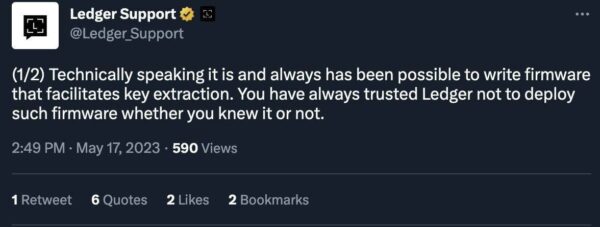
For context, Ledger stressed in a May 16 tweet that it could write firmware that could extract users’ private keys.

“Technically speaking, it is and always has been possible to write firmware that facilitates key extraction. You have always trusted Ledger not to deploy such firmware whether you knew it or not,” Ledger noted in a now-deleted tweet.

Ledger
Ledger

Following the controversy that trailed the tweet, the prominent cryptocurrency hardware wallet deleted it and issued a statement addressing the issue. According to Ledger, the deleted tweet was written by one of its customer support agents.

Ledger’s Chief Technology Officer Charles Guillemet asserted that the wallet’s operating system (OS) requires “users’ consent anytime a private key is touched.”

The statement suggests that the Ledger wallet’s OS cannot copy users’ private keys without their consent. Furthermore, Ledger noted that it cannot access users’ secret recovery phrases.

Cardano Founder Comments on the Incident

Despite Ledger’s clarification, crypto community members have been reacting to the development. Earlier today, Hoskinson highlighted six key insights regarding the controversy that trailed the prominent cryptocurrency hardware wallet.


Firstly, Hoskinson warned crypto investors to prioritize open-source software that has undergone a series of audits. It is worth noting that open-source software creates room for transparency and also makes public scrutiny easier. 

Secondly, the Cardano founder asserts that security mainly comes from simplicity rather than complex infrastructure. On this note, Hoskinson suggests that it is better to design hardware wallets with “the smallest possible footprint” as this would make it difficult for attackers to exploit vulnerabilities. 

Thirdly, Hoskinson stressed that it is essential for crypto hardware companies to adopt a non-updatable firmware model, especially when they make strong promises about their security model. 

For the fourth point, Hoskinson stated that crypto investors acquire hardware wallets in order to provide personal security for their funds. 

Additionally, the Cardano boss said the hardware wallet space is an extreme example of self-custody. 

“We could just as easily PGP encrypt some seeds and leave them in Gmail. We choose to use hardware wallets because they guarantee that the private keys stay in one place on hardware that’s hard to tamper with,” he said. 

Lastly, Hoskinson stressed the importance of not breaking social contracts. 

Ripple CEO Optimistic on Company’s Trajectory Despite Bear Market

0

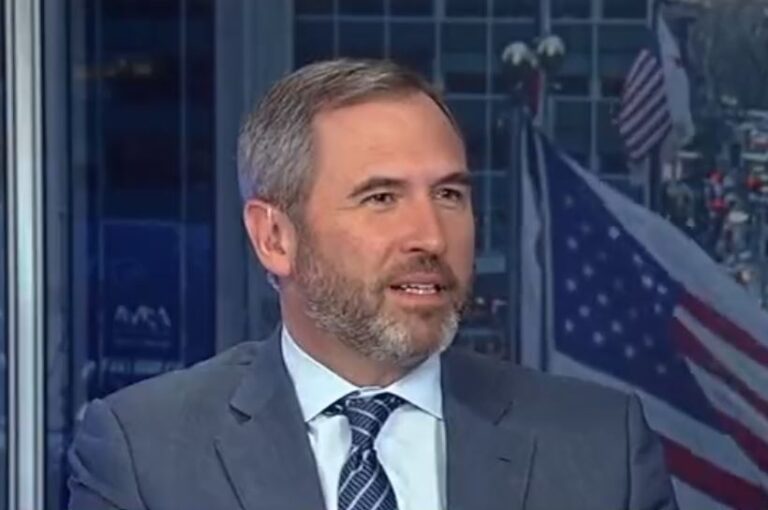
Brad Garlinghouse expresses his confidence in the direction of Ripple despite the current bear market.

Brad Garlinghouse, the CEO of Ripple, believes the company is well-positioned to weather the crypto winter and emerge as an industry leader. This is coming amid the prevalent bearish atmosphere surrounding the digital asset scene as well as the ongoing SEC lawsuit.

Garlinghouse disclosed this in a recent tweet, affirming that he is “incredibly bullish” about Ripple’s future. He highlighted the company’s commitment to long-term crypto utility and its partnerships with like-minded companies, noting that these factors will help Ripple realize its vision.

The cryptocurrency market has faced a series of setbacks in recent times, and Ripple has not been immune to the bearishness. The San Francisco-based company has been embroiled in a legal battle with the US SEC since December 2020. At the centre of the dispute is the SEC’s assertion that XRP is an unregistered security.

Despite these setbacks, Ripple and its CEO, Brad Garlinghouse, remain unfazed. As reported by The Crypto Basic, the company recently acquired Metaco, a crypto custody provider, to help institutional investors securely store, manage, and trade digital assets. 

In addition, Ripple recently launched a platform for central bank digital currencies (CBDCs), which will allow governments, central banks, and financial institutions to create their own digital currencies. Garlinghouse also revealed that Ripple has over $1 billion to facilitate its expansion.

Ripple vs. SEC: What is at Risk?

The SEC lawsuit has been one of the major hurdles for Ripple. Garlinghouse recently disclosed that Ripple will have spent over $200 million defending itself against the SEC by the time the litigation ends. Notably, the regulatory watchdog alleges that XRP is a security – a claim which Ripple has vehemently challenged.

If the court rules in favor of the SEC, Ripple may be subject to severe fines and legal consequences for selling unregistered securities. This could set a precedent for other companies in the virtual currency industry to face similar sanctions. However, Garlinghouse is confident that Ripple will win.

The result of this case could significantly influence cryptocurrency regulations globally and in the US. If Ripple wins, it could establish a model for other companies aiming to venture into the crypto scene leading to more innovation in the industry. However, if the SEC gains victory, it could discourage the emergence of other companies due to potential legal consequences.

BTC Adviser to El Salvador President Says SEC Chair Is Right to Declare XRP a Security 

0

Keiser asserts that XRP is a security. 

Max Keiser, an adviser to the government of El Salvador on Bitcoin, said SEC Chairman Gary Gensler is right to state that most crypto assets, including XRP, are securities. 

The Bitcoin proponent remarked that “everything not Bitcoin” is a security, including top crypto assets like XRP and Ether (ETH). The Senior Bitcoin Adviser to President Nayib Bukele stated that El Salvador has already established laws recognizing only Bitcoin as non-security. 

“We’re #Bitcoin Country, and we’re thriving,” said Keiser.  

Furthermore, Keiser invited the chairman of the United States Securities and Exchange Commission to visit El Salvador in order to learn how it became the leading Bitcoin country in the world. 

Gensler Slams Crypto Businesses 

Keiser made this known while reacting to Genler’s recent statement about cryptocurrency regulations. In a recent question-and-answer session, the SEC boss slammed crypto firms for not complying with existing securities rules. He also said that the crypto market is based on a “false narrative” of decentralization. 

Gensler has reiterated that most cryptos other than Bitcoin are securities. Despite claiming that most crypto assets fall under the SEC’s purview, Gensler has refused to heed the demands of crypto stakeholders, who have been calling on the commission to establish new and clear rules for the emerging market. 

Per Gensler, the crypto industry does not require new guidelines, as existing securities laws also apply to the industry. Top crypto stakeholders, including Ripple CEO Brad Garlinghouse, have slammed Gensler over his preferred regulatory approach for the industry. He has been accused of favoring regulation by enforcement over rulemaking. 

XRP Fans React as Keiser Shades Ripple 

Meanwhile, Keiser has always been vocal on crypto-related matters. Earlier this week, the controversial Bitcoin maximalist slammed Ripple following its move into the crypto custody market. 

Per Keiser, Ripple is a “cro*k” for selling unregistered securities to United States investors. The Bitcoin maximalist further noted that the SEC was right to shut down the company from operating in the U.S.  

As expected, Keiser’s comment did not sit well with XRP community members, who engaged the Bitcoin maximalist in a series of tweets. Prominent XRP enthusiast Mr. Huber (@Leerzeit) noted that Judge Analisa Torres does not look like someone who would let the SEC have its way against Ripple. 

Mr. Huber referenced Judge Torres’ recent ruling, where she ordered the sealing of documents related to Ripple’s XRP sales to On-Demand Liquidity clients due to the fact that ODL is the company’s main line of business. 

Ripple Wins Two Honors at the 2023 Digital Currency Awards

0

The awards recognized Ripple as the leading company in terms of sustainability initiatives, and acknowledged James Wallis’ leadership contributions.

Ripple has bagged two honors at the 2023 Digital Currency Awards organized by Currency Research, a notable organization that connects professionals and foster collaborations in the cash and payments industry. The awards recognized Ripple as the leading company in terms of sustainability initiatives in 2022.

Mary Hall, Ripple’s Global Marketing Lead for CBDCs, first called attention to the remarkable feat in a recent tweet. The awards were presented at the Digital Currency Conference in Mexico City.

According to Hall’s disclosure, Ripple, as a company, won the award for the Best Sustainability Initiative in 2022. In addition, James Wallis, the Vice President for Central Bank Engagements and CBDCs at RippleX, bagged the award for the Digital Currency Leader of the Year.

Information from the official Currency Research website corroborates these claims. Notably, the Best Sustainability Initiative Award recognizes companies and individuals that focus on reducing the negative effects of digital currencies on the environment and promoting sustainable practices that reduce carbon emissions. 

Ripple emerged as the winner, surpassing two other distinguished finalists, namely Andrei Lipkin, a celebrated strategic advisor to central banks and cryptocurrency enterprises, and Stellar, the company behind the open-source decentralized protocol founded by Jed McCaleb. 

As previously reported by The Crypto Basic last December, Ripple has continued to reaffirm its commitment to promoting environmentally friendly initiatives. The company joined over 300 other companies as a signatory of the Climate Pledge in September 2022, seeking to go net-zero carbon by 2040.

Ripple has also championed several initiatives aimed at reducing carbon emissions. Last May, the company made a commitment of $100 million to facilitate the development of carbon removal solutions. The month before that, Ripple became a signatory of the world’s largest purchase agreement for carbon credits.

Besides the Sustainability Initiative Award, official data from Currency Research confirms that James Wallis emerged as the winner for the Digital Currency Leader of the Year award. Wallis towered over two other finalists: Jonathan Dharmapalan of eCurrency and Shiva Bissessar of Pinaka Consulting Ltd.

The award recognizes individuals who have consistently propelled the digital currency sector forward through their innovative approaches, visionary leadership, effective advocacy, or notable contributions in various domains.

Messari Report Shows XRP Outpaced the Overall Crypto Market, Surging by 55% QoQ

0

According to a Messari report, XRP outperformed the overall crypto market in Q1, having rallied by over 55% to a high of $0.54.

Despite the recent downtrend, XRP is still registering gains this year. Most recently, a report from Messari confirmed that the asset outperformed the overall crypto market in Q1 2023, having rallied by 55% quarter-on-quarter (QoQ).

According to Messari, XRP’s market cap saw an impressive increase from $17.4 billion on Jan. 1 to $27.4 billion on March 31, marking a 59.9% surge in Q1 2023. This increase beats the 46% increase observed by the overall crypto market cap within the same time frame. Meanwhile as opposed to the 59.9% surge in market cap, XRP’s price increased by 55% in Q1.

The report stressed that XRP began the first quarter of this year with a value of $0.35, as observed on Jan. 1. Riding on the ensuing market-wide rally, the asset hit a high of $0.43 on Jan. 23 before facing resistance at the territory. XRP eventually closed January with an impressive 19.71% increase.

February was less favorable for the asset, as the bears took control of the broader market scene. XRP was battered back to $0.36 but quickly engineered a comeback that saw it close February at $0.37, with a 7.27% decline that month.

XRP Gained 43% in March

The asset’s response to this downtrend materialized in March. As previously reported by The Crypto Basic, XRP’s bullish run started gaining momentum on March 21, leading to a 24-hour increase of 11% that day. The price surge came on the back of speculations that the Ripple vs. SEC case might be coming to an end.

Building on the sustained momentum, the asset soared to a 10-month high of $0.5850 on March 29, having rallied by 56% in just two weeks. Notably, this massive rally from XRP was a solo run, with the asset posting impressive gains while other cryptocurrencies fell flat during that period. 

After fighting off a series of attacks from the bears, XRP eventually closed March at $0.54, marking a 43% increase that month. Overall, the asset’s price ended Q1 2023 with a 55% increase. March was XRP’s most favorable month since September 2022. A report from Kaiko revealed that the March rally was majorly driven by retail investors.

Meanwhile, at the time of reporting, XRP is currently looking to recover the losses of April, its worst month this year so far. Presently, the asset is trading for $0.4609, up 2.93% in the past 24 hours. XRP seeks to solidify its position above the $0.46 zone.

In addition to its price actions, Messari also called attention to XRP’s deflationary trend, which is evidenced in its burning mechanism. The Crypto Basic previously reported that over 11 million XRP has been burned to date, citing data from XRPSCAN.