Home Blog Page 21

Grayscale, 21Shares Seek Faster SEC ETF Reviews With Confidential Filings

0

Crypto firms including Grayscale, 21Shares and Andreessen Horowitz are pressing the U.S. Securities and Exchange Commission (SEC) to streamline parts of its review process for novel exchange-traded products, with proposals ranging from confidential draft registrations to shorter regulatory response times.

The push comes as the SEC considers how it should handle novel ETFs and has sought feedback on whether artificial intelligence may be contributing to multiple applications being filed in rapid succession with largely identical features. 

Grayscale proposed an optional process that would let sponsors submit draft registrations confidentially before public filing. The crypto asset manager said such an approach could reduce the incentive for rival sponsors to rush to replicate a proposed product or file similar applications. It also asked SEC staff to respond within 45 days.

21Shares backed a similar confidential approach, citing how quickly competitors can replicate information once an application becomes public.

Andreessen Horowitz, or a16z, focused on how long the review process takes. The firm argued that the process could be shortened because filings are submitted electronically, much of the disclosure follows standardized formats, and recurring questions arise across different products. It also said financial markets operate on shorter timelines than the current review period.

At the same time, a16z said accelerating the process should not reduce the depth of the SEC’s review.

Market Firms Seek Safeguards Around Faster ETF Launches

Other market participants raised concerns about some of the proposed changes.

Jane Street said pressure to bring an ETF to market quickly could lead to rushed registrations and leave sponsors with less opportunity to seek market-maker input on liquidity and fund structure. The firm also proposed requiring an ETF to have at least two authorized participants at launch. Authorized participants facilitate the creation and redemption of ETF shares.

Charles Schwab opposed making the registration process entirely confidential. Under its proposal, any filing discussed privately between a sponsor and SEC staff would have to become public at least 75 days before the fund takes effect.

NYSE, meanwhile, raised a separate timing issue involving products that have reached exchanges. The exchange said SEC staff can ask an exchange to delay a listing during its review of an issue without providing a definite timetable, even as another exchange may still be able to proceed. NYSE asked for greater predictability around those timelines.

Staking Receipt Tokens Enter Broader SEC Debate

Beyond filing procedures and review timelines, the SEC review also prompted crypto firms to seek broader changes affecting spot crypto products.

Multicoin Capital asked the regulator to permit qualifying staking receipt tokens in spot crypto ETPs, including structures in which those tokens could potentially represent all of a product’s digital asset holdings substantially. Staking receipt tokens represent crypto assets that have been staked to generate rewards.

The Jito Foundation, Jito Labs and the Solana Policy Institute joined Multicoin in calling for the SEC to establish rules allowing spot crypto products to use staking receipt tokens.

Comments on the SEC request were due Aug. 31. The regulator has nevertheless continued to post submissions dated after the deadline and has not established a timetable for further action.
XRP Next Move Could Be Huge as Analyst Targets $3–$4

0

XRP price is getting ready for another big move higher after the recent drop, according to Elliott Wave analyst XForceGlobal.

The analyst believes XRP will rise to between $3 and $4, after falling more than 20% from its recent high. XRP is currently trading near $1.44 after rebounding from lows at $1.31. It has also risen 5.27% in the past 24 hours, suggesting buyers may be returning.

XRP Price Correction is Ending

XForceGlobal believes XRP’s long decline from its all-time high may be coming to an end. The analyst says the drop looks like a complex correction rather than a normal five-wave decline.

According to XForceGlobal, the move down has likely formed a WXYXZ pattern, which is a series of smaller corrective moves. This could mean that most of the major correction is already over.

For context, XRP price dropped more than 72% from its peak of $3.66, hitting lows at $ 0.987. After reaching this under-$1 price, the price rebounded massively shortly after.

For XRP’s current pullback, the analyst sees two possible outcomes. The first is that the drop forms a simple zigzag and ends soon. The second is that XRP continues falling in a more complex pattern, reaching lower Fibonacci levels before starting its next major move higher.

Traders will watch the 38.2%, 50%, 61.8%, and 78.6% Fibonacci levels as possible support areas, with corresponding prices ranging from $1.13 to $1.39.

XRP price chart by XForceGlobal

From $0.98 to $1.70

The bullish outlook comes after XRP’s strong rally earlier in August. XForceGlobal previously said XRP’s nearly 70% rise from $0.987 to $1.70 could be the start of a new upward trend.

He noted that XRP had broken above an important resistance zone, which suggested the price may continue rising and possibly challenge its all-time high.

The recent drop has not changed that view. Instead, XForceGlobal sees the pullback as a normal part of the market before XRP starts moving higher again.

If XRP’s current correction ends, XForceGlobal expects the price to start rising again, with $3–$4 as a major target, which is a 2x to 3x upside from the current price.

Meanwhile, the analyst expects XRP to first move toward $2, with the potential to go much higher if the bullish trend continues.

Fundamental Bullish Factor

Notably, a fundamental factor that could support XRP’s uptrend is the ongoing decline in XRP reserves on the largest crypto exchange.

As The Crypto Basic reported earlier, Binance’s XRP reserves have fallen by around 500 million XRP, dropping from about 3.1 billion in November 2025 to 2.6 billion currently.

This is the lowest monthly average since February 2024. The decline happened despite XRP recently gaining nearly 30%.

One possible reason is that investors are moving XRP from exchanges into private wallets for long-term holding. The launch of spot XRP ETFs in late 2025 may have also increased demand, as ETF providers need to acquire XRP.

Overall, falling exchange reserves may suggest stronger long-term interest in XRP, potentially supporting a higher price.

Andreessen Horowitz-Backed OpenReserve Gets Preliminary OCC Approval to Form National Bank

0

OpenReserve has received preliminary conditional approval from the Office of the Comptroller of the Currency (OCC) to form a full-service national bank, moving the Andreessen Horowitz-backed company into the preopening stage of the federal charter process.

The approval requires the proposed bank to secure at least $210 million in initial paid-in capital after organizational and preopening costs, according to an OCC letter issued Wednesday. OpenReserve must also keep its Tier 1 leverage ratio at 12% or higher throughout its first three years in operation.

However, the bank cannot begin operating on the preliminary approval alone. It must complete the OCC’s preopening requirements and obtain final clearance. OpenReserve is also expected to secure Federal Deposit Insurance Corporation (FDIC) deposit insurance and apply for Federal Reserve Bank stock.

OpenReserve Plans Banking and Onchain Services Under One Institution

OpenReserve, founded in 2025 by Richard Correia and Diwakar Choubey, says its infrastructure will use a programmable core ledger with native onchain settlement.

The proposed bank plans to provide deposits and lending alongside payments, treasury services, and foreign correspondent banking. Its planned digital-asset offerings include tokenized deposit products and custody.

OpenReserve also intends to establish a wholly owned subsidiary that would issue and custody reserve-backed U.S. dollar stablecoins, facilitate their conversion, and handle related payments. OpenReserve has not filed a separate application for the subsidiary, according to the OCC letter.

OpenReserve previously raised $25 million in a seed financing round led by Andreessen Horowitz’s a16z crypto. Acrew, Jump Capital, Coinbase Ventures, Clocktower, Wintermute Ventures, Quona, Zero Knowledge Ventures, and AAF Management also backed the financing.

a16z crypto has backed OpenReserve’s approach, saying greater access to banking options and technological advances from new banks could benefit consumers and companies globally.

Crypto Firms Gain Ground in OCC Charter Process

The OpenReserve decision comes amid a broader series of conditional approvals for crypto-focused institutions under Comptroller Jonathan Gould. Gould has said companies working with novel technologies should have a path to becoming federally supervised banks.

The OCC has received 40 de novo charter applications since 2025 and approved 21. Separately, Coinbase, BitGo, Circle, Paxos, and Ripple are among the crypto companies that have obtained conditional approval for national trust bank charters.

Revolut also received preliminary conditional approval to establish a national bank on Wednesday. The decision followed the OCC’s approval of Trump-backed World Liberty Trust Company several weeks earlier.

However, the broader charter push has faced opposition from Senator Elizabeth Warren. In May, Warren accused the OCC of awarding national trust charters to crypto companies that could seek to conduct business beyond the limited activities allowed by the National Bank Act. Her criticism addressed Circle, Ripple, Fidelity, Paxos, Coinbase, and BitGo.

Cardano Founder Warns White House Crypto Summit Attendees Could Face Probes After Midterms

0

Cardano founder Charles Hoskinson has warned that several industry figures who attended the White House crypto summit could face investigations if Democrats regain control during the 2026 U.S. midterm elections.

Hoskinson made the remarks after users mocked him for not receiving an invitation to the White House Crypto Summit hosted by President Donald Trump last month.

The summit brought together prominent figures from the cryptocurrency and financial industries, including Coinbase CEO Brian Armstrong, Ripple CEO Brad Garlinghouse, Robinhood CEO Vlad Tenev, Kraken co-CEO Arjun Sethi, Gemini co-founders Tyler and Cameron Winklevoss, and Chainlink co-founder Sergey Nazarov.

Responding to a post highlighting his absence and featuring images from the event, Hoskinson said he would rather stay away and return after what he described as Republicans being “destroyed” in the midterms. He further predicted that half of the crypto executives pictured in the Oval Office could face investigations under a newly empowered Democratic Party.

Hoskinson Links Crypto Industry to Republican Political Risk

Hoskinson’s prediction reflects his broader criticism of how Republicans and Trump-aligned figures have handled the cryptocurrency industry.

In particular, he has argued that Trump’s family-linked crypto ventures and the close ties between the administration and industry participants have transformed crypto from a potentially bipartisan policy issue into a political liability.

In Hoskinson’s view, Democrats could capitalize on those connections during the 2026 midterm campaign by portraying the crypto industry as closely aligned with Trump and vulnerable to conflicts of interest or corruption allegations.

Moreover, Hoskinson has criticized the Republican approach to crypto legislation, describing it as poorly managed and arguing that the party lacks a consistent political philosophy. Alongside the historical tendency for the president’s party to lose seats during midterm elections, these factors appear to have shaped his expectation of a significant Republican setback.

Consequently, his warning about potential investigations appears tied to his belief that a Democratic takeover of Congress could bring increased scrutiny to individuals and companies closely associated with the Trump administration’s crypto agenda.

Crypto Industry Previously Faced Democratic Regulatory Pressure

Notably, several major cryptocurrency companies have faced significant regulatory scrutiny under the previous Democratic administration.

Companies and platforms such as Ripple, Coinbase, and Gemini encountered enforcement actions during the Biden administration. However, the regulatory environment has changed considerably since Trump returned to the White House. His administration has adopted a more crypto-friendly stance, emphasizing digital-asset innovation and seeking greater regulatory clarity for the industry.

The administration has also supported comprehensive cryptocurrency legislation, including the CLARITY Act, which seeks to establish a broader regulatory framework for digital assets.

Could a Democratic Victory Reverse Crypto Policy?

Against this backdrop, Hoskinson believes a Democratic return to power could potentially reverse some of the cryptocurrency industry’s recent regulatory gains.

A Democratic-controlled Congress could also increase scrutiny of crypto companies and executives that have developed close relationships with the current administration. However, Hoskinson’s prediction remains a political assessment rather than an indication that specific investigations have been announced or are currently planned.

XRP News: Ripple CEO Says Making America the World’s Crypto Capital Is Within Reach—“Let’s Finish the Job”

0

Ripple CEO Brad Garlinghouse is again calling for the United States to become the world’s leading center for cryptocurrency.

He said the goal is now closer than ever as the U.S. government moves toward new rules for crypto.

Garlinghouse made the comments on September 3, responding to CFTC Chairman Michael Selig, who discussed a recent White House meeting with crypto, tech, and financial industry leaders.

In his tweet, Garlinghouse remarked, “Making America the crypto capital of the world is within reach — let’s finish the job.”

His comments come as lawmakers prepare to vote in September on the CLARITY Act to create clearer U.S. rules for crypto assets.

Ripple CEO and Selig Back U.S. Crypto Growth

Selig’s post referred to the August 19, 2026, White House meeting, where President Donald Trump met with leaders from the crypto and financial industries.

Garlinghouse attended the meeting with Coinbase CEO Brian Armstrong and other industry leaders. SEC Chairman Paul Atkins and CFTC Chairman Michael Selig represented U.S. financial regulators.

Selig said the U.S. should lead the next wave of financial technology instead of letting other countries set the rules.

He said the “new frontier of finance” is being built in the U.S. He also highlighted steps taken by the Trump administration, including the GENIUS Act, a strategic Bitcoin reserve, and clearer rules separating crypto securities from commodities.

The CFTC later launched its Innovation Advisory Committee to advise the agency on technology, law, policy, and finance. The committee’s charter was renewed on August 19, and it held its first meeting on August 20.

CLARITY Act Faces a Key Test

The White House meeting showed that the U.S. government is paying close attention to the crypto industry. But Garlinghouse’s call to “finish the job” shows that more work is still needed.

Specifically, the CLARITY Act faces an important Senate vote on September 15. The bill has faced disagreements over stablecoin rewards, decentralized finance, consumer protection, and rules for public officials.

Meanwhile, Trump appeared confident that the bill will pass during talks with crypto and financial industry leaders. The meeting focused on solving the remaining problems and finding enough senators to support the bill.

Ripple Wants the U.S. to Lead Crypto

For Ripple and XRP, clearer crypto rules in the U.S. have been a major goal for years. Garlinghouse has said that clear regulations would encourage crypto companies to build and invest in the U.S. instead of moving their businesses overseas.

Moreover, the CLARITY Act will reduce uncertainty around assets like XRP and make it easier for U.S. businesses to use and support the token.

South Korea to Tokenize Stocks, Bonds and Funds in Three Stages From 2027

0

South Korea will begin building infrastructure in 2027 to bring a broad range of securities, including stocks, bonds and funds, into a tokenized framework under a three-stage plan announced by the country’s top financial regulator.

The Financial Services Commission outlined the roadmap on Friday following the third meeting of a consultative body on tokenized securities. Amendments giving blockchain-based securities legal recognition are due to take effect on Feb. 4, 2027.

The rollout will initially focus on instruments for institutional investors. Private money-market funds and privately placed corporate bonds will be among the first securities covered once the new law takes effect in February.

Unlisted equities will follow a different structure during the opening phase. Rather than moving the shares themselves out of the existing system, they will remain there and be placed in a trust, with investors receiving tokenized trust-beneficiary securities.

Public Securities and Onchain Settlement to Follow

A successful and stable first phase would clear the way for the FSC to broaden the infrastructure to publicly offered securities in the second stage.

The final stage is designed to add onchain settlement, allowing tokenized securities to be settled using stablecoins. In developing the three-stage framework, the FSC pointed to BlackRock’s BUIDL tokenized fund and Hong Kong’s tokenized green bonds as key references.

Existing Securities Licenses to Cover Tokenized Assets 

The regulatory approach will not require securities brokerages and trading firms to obtain an additional license before handling tokenized securities, provided they already operate under existing securities licenses. 

Separate conditions will apply to over-the-counter exchanges. Those venues must first consult the Financial Supervisory Service, while retail investors will be restricted to 100 million won ($74,000) in annual net purchases at each platform.

Non-bank issuers that plan to maintain investor accounts for their own tokenized securities will also face registration requirements. The FSC will require those institutions to hold 4 billion won ($3 million) in equity capital and maintain dedicated personnel responsible for accounts, compliance, and information technology (IT).

Shiba Inu Proponent Says SHIB Needs One Zero Gone to Return to ATH, Not 1,000 Years

0

Shiba Inu long-term proponent Mazrael has pushed back against claims that SHIB could take an extremely long time to reclaim its all-time high (ATH).

According to Mazrael, Shiba Inu only needs to eliminate one zero from its current price to return to its previous ATH. He made the argument while responding to a critic who questioned whether SHIB holders could survive long enough to wait for the token to eliminate two zeros.

The critic invoked the biblical figure Noah, who is traditionally described as having lived for nearly 1,000 years. However, Mazrael suggested that the comparison overlooks SHIB’s historical volatility and the progress its ecosystem has made since the 2021 bull market.

SHIB Needs a 16.7x Rally to Revisit Its ATH

Mazrael pointed to Shiba Inu’s previous ATH of $0.00008616. At the time of his commentary, SHIB had five leading zeros after the decimal point, compared with four at its peak.

Based on that price difference, Mazrael estimated that SHIB would need a 16.7x increase to revisit $0.00008616 from its price of $0.000005159. However, he argued that such a rally should not automatically be viewed as a multi-century proposition.

To support his argument, Mazrael highlighted SHIB’s historical price performance. According to him, SHIB has achieved a 16.7x increase within a single week on 12 separate occasions, with three of those rallies occurring within just three days.

Moreover, he noted that SHIB removed its last zero in only two days. Therefore, Mazrael believes another major rally could potentially eliminate the remaining zero much faster than critics anticipate.

Mazrael Highlights SHIB’s Growing Recognition

Meanwhile, Mazrael argued that the Shiba Inu ecosystem has changed considerably since SHIB reached its ATH in 2021. He pointed to several developments that he believes have strengthened the token’s broader recognition.

For instance, Mazrael referenced developments involving the U.S. SEC and CFTC in March 2026, emphasizing that SHIB was included among 16 digital commodities.

He also highlighted Japan, where he said the Financial Services Agency (FSA) has cleared SHIB. Additionally, he pointed to Nomura’s Laser Digital, which lists SHIB alongside assets such as Bitcoin, Ethereum, XRP, Bitcoin Cash and Litecoin.

Mazrael further emphasized that SHIB is the only meme coin included in that particular Laser Digital asset group.

Furthermore, he pointed to growing access to SHIB in Europe. Specifically, he referenced Valour’s SHIB exchange-traded product (ETP), which trades on Sweden’s Spotlight Stock Market. According to Mazrael, the product gives investors another way to gain SHIB exposure through a conventional brokerage account using Swedish krona.

SHIBArmy Remains Strong, Mazrael Says

The discussion followed a question from Chinese crypto influencer Wang Duanniao, who questioned whether the Shiba Inu community still exists.

In response, Mazrael highlighted several factors that he believes demonstrate the continued strength of the SHIBArmy. These include Shibarium, Shiba Inu’s Layer-2 network on Ethereum, SHIB’s position among major meme cryptocurrencies, its availability on leading centralized exchanges, and its growing recognition across the United States, Japan and Europe.

Ultimately, Mazrael argued that the Shiba Inu community remains active and committed despite the token’s prolonged decline from its 2021 peak. 

US Bitcoin ETFs Draw $731 Million in Biggest Inflow Day Since January

0

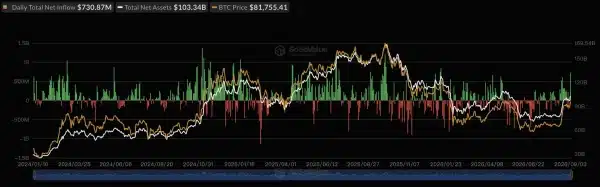
U.S. spot Bitcoin exchange-traded funds (ETFs) attracted $730.9 million in net inflows on Thursday, their biggest one-day haul since Jan. 14, as expectations for an improving macroeconomic backdrop helped lift demand for crypto assets.

The surge came as analysts pointed to Federal Reserve Governor Christopher Waller’s policy comments as a key macro catalyst. They highlighted his willingness to keep interest rates unchanged if inflation continues to cool as supportive for the market.

Crypto-linked stocks rallied alongside the move. Strategy jumped 17.6% to $144.82, Coinbase advanced 10.14% to $192.70, and Circle gained 16.46% to close Thursday at $103.23, according to Yahoo Finance data. Bitcoin also moved back above $81,000 late Thursday night before trading around $80,950 as of this writing.

The latest move added to a recovery that began in mid-August after the U.S. Treasury Department announced an expansion of its buyback program. Experts had subsequently said crypto prices would likely need another favorable macroeconomic signal to extend the rally.

BlackRock Leads Latest Bitcoin ETF Inflows

BlackRock’s IBIT captured roughly $454 million of Thursday’s ETF inflows, according to SoSoValue. Six other funds recorded positive flows, including products from Fidelity and Grayscale.

The $730.9 million daily total followed a strong month for U.S. Bitcoin ETFs. The funds attracted $3.5 billion last month, their largest monthly intake since September 2025.

Rachael Lucas, a crypto analyst at BTC Markets, said Thursday’s flows indicated that institutional investors were increasing their Bitcoin holdings. She viewed the heavy concentration in IBIT as particularly significant, saying institutions use that vehicle for larger allocations and that the pattern therefore pointed to allocation-driven demand rather than tactical positioning.

US Spot Bitcoin ETF Inflows

Inflation Data Could Test Bitcoin Rally

Whether the move can be sustained will depend in part on forthcoming macroeconomic signals, according to analysts, with Lucas identifying employment figures and the Consumer Price Index (CPI) as the principal near-term data risks.

Lucas said the supportive interpretation of Waller’s position depended on inflation continuing to cool, meaning a hotter inflation reading would directly undermine that premise. She also cited September’s weak seasonal history, noting that the two economic releases, together with the next several ETF trading sessions, would help establish whether the $81,000 level holds or the advance fades.

Beyond the immediate economic risks, Lucas also pointed to a shift in Bitcoin’s relationship with other asset classes. She said its 90-day correlation with gold had risen above 50% to a six-year high, while its correlation with the S&P 500 had declined to nearly zero. In her assessment, that pattern could suggest Bitcoin is being valued more as an inflation hedge than as a high-beta risk asset.

Lucas said that if the relationship persists, the latest ETF flows would need to be viewed differently over several months rather than days.

IMF Says El Salvador Used No Public Funds for Bitcoin Added Since June Review

0

El Salvador did not spend public money on Bitcoin added to its holdings after the International Monetary Fund (IMF) completed the first review of its financing program in June 2025. The additional Bitcoin came from private donations, the lender said Thursday.

The IMF said Salvadoran authorities provided documentation establishing how the Bitcoin was obtained. Based on those records, the lender said the additions were not purchases financed with government resources and that it does not expect further accumulation beyond the documented donations.

The finding clarifies the source of an increase in El Salvador’s reported Bitcoin holdings that had raised questions about the country’s compliance with commitments made under its $1.4 billion IMF program.

Bitcoin Accumulation Had Tested IMF Commitments

El Salvador agreed in December 2024 to reduce public-sector participation in Bitcoin as part of the IMF arrangement. The terms made Bitcoin acceptance optional for the private sector, required tax payments in U.S. dollars, and called for the government to withdraw from its involvement in the Chivo wallet.

The restrictions were further defined in March 2025, when IMF documents prohibited voluntary Bitcoin accumulation by the public sector. At the time, President Nayib Bukele responded that purchases would not end and said the country intended to continue adding at least one BTC a day.

The Bitcoin Office subsequently continued posting about additions to the country’s holdings. By July 2025, however, the IMF said that El Salvador had made no new Bitcoin purchases since the December agreement and that increases in the reported balance resulted from Bitcoin being consolidated across government wallets.

Questions about whether El Salvador was meeting its commitments resurfaced in November 2025, when the country reported acquiring 1,090 BTC worth $100 million. At the time, an IMF representative said the Fund would review the country’s adherence to the program in due course rather than comment repeatedly on individual announcements.

The IMF’s latest explanation now attributes the post-review additions covered by its assessment to private donations rather than government-funded purchases.

Chivo Control Shifts as Bitcoin Holdings Reach 7,764 BTC

El Salvador has also reduced the government’s role in Chivo as part of its commitments under the IMF program. According to the lender, a private operator now has majority ownership and operational control of the wallet, with the government holding a minority stake and remaining responsible for custody.

El Salvador currently holds about 7,764 Bitcoin, according to the National Bitcoin Office’s official reserve tracker. At CoinGecko’s current Bitcoin price of $80,900, the holdings are valued at roughly $628 million.

The reserve remains above the level recorded before the IMF agreement. However, the lender’s latest assessment distinguishes the documented post-review increase from public-sector Bitcoin purchases, saying those additions came from private donations.

Strive CEO Says $700M in Warrants Could Help Company Reach No. 2 Bitcoin Treasury

0

Strive expanded its Bitcoin treasury to 23,156 BTC after buying 3,156 BTC in August, putting the company fifth among public companies ranked by Bitcoin holdings as CEO Matt Cole outlined a potential route to second place by the end of 2026.

The August purchases marked a sharp increase from July, when Strive acquired 136 BTC while Bitcoin traded in the low $62,000 range. Its current holdings are worth nearly $1.9 billion.

Strive moved ahead of crypto exchange Bullish last week to take fifth place. Twenty One Capital currently holds the No. 2 position with 43,514 BTC, slightly less than twice Strive’s total. 

Closing that gap before year-end would require Strive to add roughly 20,400 BTC over the next 17 weeks, equivalent to about 1,200 BTC a week, assuming Twenty One does not increase its holdings. Twenty One has not added Bitcoin since July 2025.

Cole said on the One Share podcast on Wednesday that averaging 1,000 BTC in weekly purchases would itself represent a substantial accumulation pace and could allow Strive to advance quickly in the rankings. However, he cautioned that such a rate may or may not materialize.

$27 Warrant Threshold Could Unlock Additional Buying Capacity

One potential source of capital for further purchases is more than $700 million of outstanding Strive warrants scheduled to expire in mid-October.

The warrants carry a $27 exercise price. Strive shares reached a year-to-date high of $26.84 on Thursday, putting ASST less than 1% below that level.

Cole said that if the warrants are exercised, Strive could deploy about $700 million into Bitcoin while gaining another $700 million of capacity for digital credit. Together, he said, that could give the company as much as $1.4 billion in potential capacity to buy Bitcoin.

Cole said he would prefer to see the warrants exercised rather than expire unused, a scenario he said could produce a particularly strong finish to Strive’s 2026 Bitcoin accumulation.

Against that backdrop, Cole said Strive could end 2026 in the No. 2 spot among public companies ranked by their Bitcoin holdings. He stressed, however, that this was not his base case and would require several factors to move in Strive’s favor.

ASST Outperforms Major Public Bitcoin Treasury Stocks

According to Bitcoin Treasuries data, ASST has beaten the average 2026 performance of the 10 biggest listed corporate Bitcoin holders by 82%.

Cole also offered a longer-term backdrop for Strive’s Bitcoin strategy, saying he sees Bitcoin potentially surpassing $500,000 before the decade ends. At the same time, he said Strive has structured its finances so that the company does not need that price scenario to materialize.