Home Blog Page 2160

California Launches Online Platform to Tackle Crypto Scams

0

The website offers crypto educational materials and info on new scam tactics. 

The California Attorney General’s Office has launched a new website to tackle growing cryptocurrency-related scams. According to a recent report, the platform will provide the general public with relevant information about cryptocurrency-related risks and scams.

Commenting on the initiative, Rob Bonta, California Attorney General, said it became necessary to launch a website to combat cryptocurrency scams given the growing interest in digital currencies.

“From celebrities to your next-door neighbor, it seems like everyone these days is investing in cryptocurrency based on the promise of fast and easy money,” Bonta said.

He urged Californians not to fall prey to crypto “fantasy” while indicating that cryptocurrencies carry significant risks like every other investment.

“There’s no guarantee that you’ll see large – or any – returns,” he added.

Need for Due Diligence

According to Bonta, anyone willing to join the crypto bandwagon must conduct adequate research. The newly launched crypto website offers cryptocurrency educational materials, especially tips on how California residents can buy, trade, and sell cryptos and non-fungible tokens (NFTs).

Bonta warned Californians to always be on the lookout for potential scams. Furthermore, the website will be updated with the latest crypto scams to give the public an idea of the new scam tactics being used by bad actors. The California Attorney General’s office highlighted six possible crypto scams people should look out for when purchasing digital currencies. They include:

  • A promise of a high ROI in exchange for money or crypto.
  • New crypto assets share similar names to existing prominent ones.
  • Companies that mandate you to make payments in crypto.
  • Celebrity endorsements.
  • Unsolicited phone calls and emails.
  • Crypto investments that require upfront payments.

Crypto Scams Spike in California 

It is noteworthy that the move comes following a spike in cryptocurrency-related scams in the state. The California Department of Financial Protection and Innovation (DFPI) has consistently warned the public about fraudulent crypto schemes targeting California investors. In June, DFPI issued a similar warning to investors regarding crypto scam tactics on Instagram. With the spike in crypto-related scams, authorities saw the need to launch a website to tackle these illicit activities.

California Issues Crypto Executive Order

Meanwhile, California is poised to regulate the state’s crypto space to better safeguard investors. California governor Gavin Newsom issued an executive order in May for the state’s crypto space to establish a roadmap for consumer protection and regulation while creating ways for the state to benefit from the emerging industry.
US House Committee to Hold Hearing on FTX Implosion

0

The US House Committee has revealed plans to hold a hearing from the appropriate entities on the FTX implosion.

The United States House Committee on Financial Services recently disclosed that it would hold a December hearing on the recent FTX collapse to ascertain the cause as investigations ensue. The development was first reported by Reuters Wednesday.

Speaking on the matter, chairwoman of the Financial Services Committee, Maxine Waters, highlighted the financial damage the FTX debacle had on investors, as she noted that over one million users had incurred losses due to the collapse.

“The fall of FTX has posed tremendous harm to over one million users, many of whom were everyday people who invested their hard-earned savings into the FTX cryptocurrency exchange, only to watch it all disappear within a matter of seconds,” Maxine remarked.

The hearing is necessary to investigate the origin of the collapse as a way to reach an appropriate conclusion on steps to take in response. Consequently, all relevant authorities will be present, including FTX, Alameda Research, Sam Bankman-Fried, Binance, and other related entities.

Furthermore, crypto-friendly Congressman and House Committee member Patrick McHenry pointed out the significance of uncovering the actual cause of the implosion. “It’s essential that we hold bad actors accountable so responsible players can harness technology to build a more inclusive financial system,” he mentioned.

Reports of the Committee’s decision to hold a hearing come shortly after FTX filed for Chapter 11 bankruptcy. FTX filed for bankruptcy last Friday, with Sam Bankman-Fried stepping down as CEO as the saga progressed. The firm noted that it had 100,000 creditors, but recent reports suggest the number might be as much as 1 million, underlining the extent of its impact.

The FTX debacle has once again highlighted the significance of a definite regulatory framework for the cryptocurrency industry. Waters said last Wednesday that the US needs to ramp up its regulatory efforts to make sure that the appropriate authorities and the law properly oversee crypto entities.

Terra Classic In Top 10 Assets By Volume On Binance and KuCoin

0

Terra Classic (LUNC) trading volume surges amid community efforts.


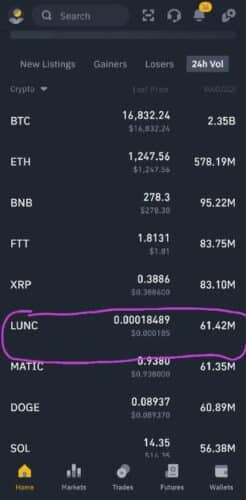
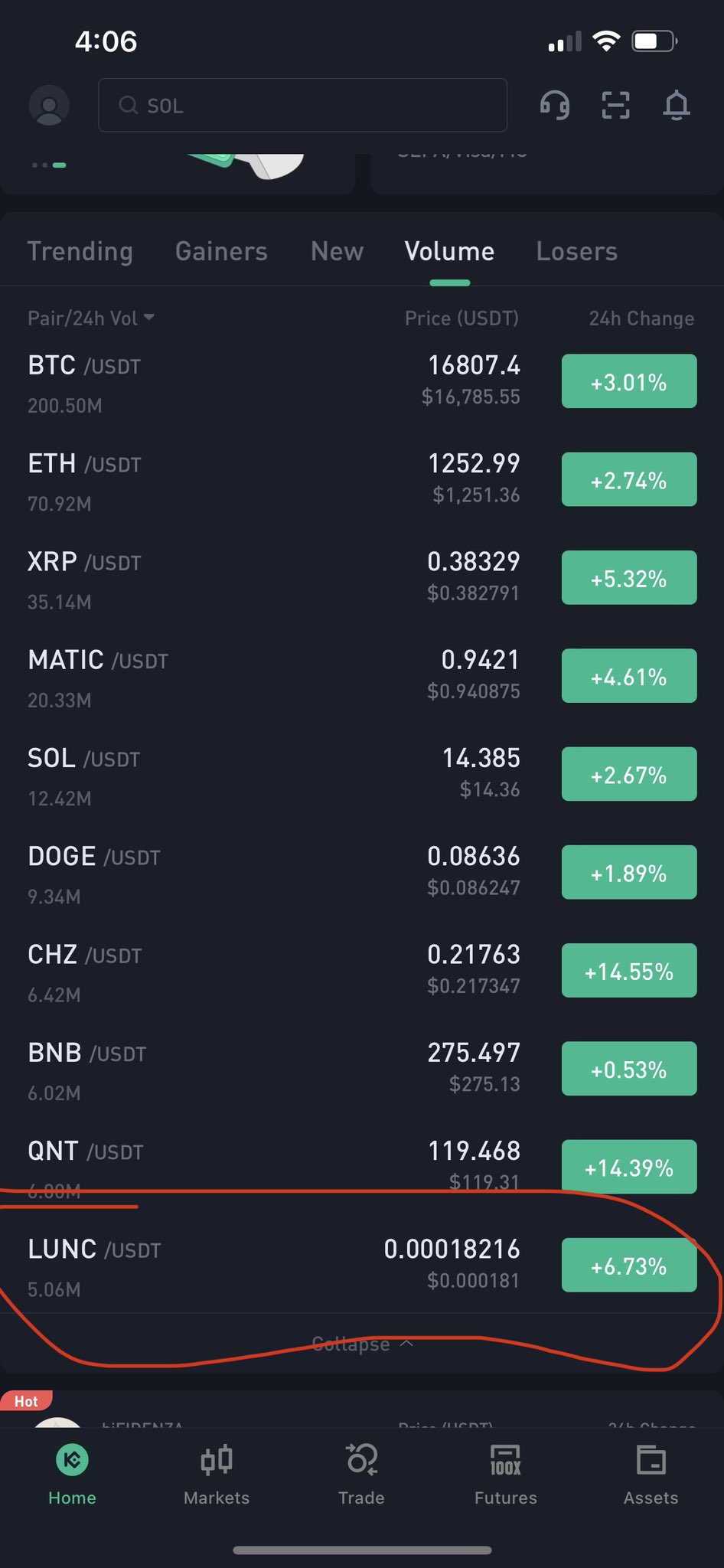
Earlier today, LUNC ranked among the top 10 crypto assets with the highest trading volumes on Binance and KuCoin.

On Binance, LUNC ranked sixth among the top 10 cryptocurrency assets with the highest 24-hour trading volume. It is noteworthy that the coin achieved the feat after Binance users traded $61.42 million worth of LUNC. According to data from Binance, LUNC ranked ahead of other top crypto assets, including Polygon (MATIC) and Dogecoin (DOGE).

photo 6028295696303634399 x 1

In a similar development, LUNC also broke into KuCoin’s top 10 crypto assets with the largest 24-hour trading volume. LUNC recorded a 24-hour trading volume of $5.06 million on KuCoin, putting it in the 10th position.

Image

According to data on CoinMarketCap, LUNC has a 24-hour trading volume of $210.9 million, up 101% in the past day.

It can be recalled that LUNC volume plummeted heavily after the community implemented a 1.2% tax burn for all LUNC on-chain transactions. The move deterred many traders from the token, as they were not interested in incurring a 1.2% deduction for their LUNC deposits and withdrawals.

LUNC’s low volume was reflected in the number of tokens burnt weekly by Binance via the exchange’s incineration of trading fees for LUNC spot and margin trading pairs. After the first two batches, the number of LUNC Binance burned in subsequent weeks reduced significantly.

In its first week, Binance sent 5.5 billion LUNC to the official Terra Classic dead wallet. 2.9B LUNC was incinerated in the exchange’s second LUNC burns. However, Binance burned 2.5B and 1.3B LUNC tokens in its third and fourth LUNC burns, respectively.

LUNC stakeholders realized the downside of the 1.2% tax burn on the asset’s volume, as they were forced to change the tax burn parameter to 0.2% to boost LUNC volume again. So far, the move is paying off as LUNC volume continues to spike.

Recall that in September, LunarCrush ranked LUNC as the asset with the highest social and market activities.

Grayscale and Binance Confirm Not Affected By Genesis Decision to Halt Withdrawals

0

Grayscale And Binance Assure Users of Funds Safety.


Grayscale has assured clients of the safety and security of their funds amid the panic triggered by the FTX implosion and redemption suspension of a subsidiary of one of its affiliate firms, Genesis Global Capital.

Grayscale Investments, a prominent digital asset investing services firm, has publicly come up to reassure its clients of the security and safety of their funds amid the commotion and panic provoked by the recent FTX collapse. Grayscale’s assurance became especially necessary following a decision from its affiliate Genesis to suspend redemptions on its lending arm temporarily.

“In the wake of recent events, our investors should know that the safety and security of the holdings underlying Grayscale digital asset products are unaffected,” Grayscale remarked in a tweet Wednesday.

Genesis Global Capital recently announced a temporary suspension of redemptions and originations of new loans amid the contagion precipitated into the space by the FTX debacle, triggering panic amongst investors. Grayscale pointed out that neither Genesis Global Capital nor Genesis Global Trading serves as a counterparty for any of Grayscale product offerings. The recent temporary suspension of redemptions does not affect clients’ funds at Grayscale.

“Grayscale products continue to operate business as usual, and recent events have had no impact on product operations,” Grayscale added in a separate tweet within the thread to assuage investor concerns and assure the public of business as usual.

The firm further noted that all the assets under management (AuM) in its Grayscale Bitcoin Trust (GBTC) and other products, including but not limited to the Grayscale Smart Contract Platform Ex-Ethereum Fund and the Grayscale Ethereum Trust, remain unaffected, as the assets under these funds are held in cold storage facilities powered by Coinbase. The GBTC, in particular, has $10.7B in AuM, making it the firm’s largest fund in mainstream crypto.

Additionally, Grayscale confirmed that it does not engage in any form of lending, borrowing, or rehypothecation of the assets within its products, and its custodian Coinbase is also prohibited from engaging in such activities. It further highlighted that all its publicly-quoted products remain operational.

These words of reassurance come amidst the developing situation surrounding Genesis Global Capital. The lending entity noted abnormal withdrawal requests after the FTX implosion. The withdrawal requests exceeded its current liquidity, and it had to suspend redemptions and originations of new loans. The development was disclosed by its CEO, Derar Islim.

The firm noted that steps were being taken to remedy the situation, including hiring appropriate advisers and raising funds to meet its obligations to the clients. Islim noted that the public would receive updates on the issue next week. The issue only affects the platform’s lending business, as other businesses remain functional.

Binance Operations Remain Normal

Binance CEO Zhao also confirmed that “Binance does not rely on Genesis or any other 3rd-party for our Earn products.”

Gemini Stopping Withdrawals

Meanwhile, being one of Genesis Global Capital’s biggest lenders, crypto exchange Gemini has to stop withdrawals and noted that it is working with Genesis to remedy the situation.

FTX Hacker Now Holds 235K ETH, 74K BNB And1.68M DAI

0


Following multiple swaps and transfers amongst several accounts, the FTX hacker now holds 74K BNB and 235K ETH, making him the 34th largest Ethereum (ETH) holder.


The hacker behind the FTX accounts with ten different accounts identified kept the stolen assets on the move, making multiple swaps across several protocols. Following the multiple swaps, the account currently has balances in several assets, including 74K BNB ($20M), 1.68M DAI, and 235K ETH ($209M). Its ETH balance makes it the 34th largest holder of Ethereum.

Blockchain security platform Peck Shield recently highlighted the hacker’s latest swaps. The wallet identified as FTX Accounts Drainer 10 bridged up to 2,697 ETH from BSC to the Ethereum network in a series of eight uneven transactions using the AnySwap protocol.

The transactions occurred 4 hours ago. Immediately after the successful bridge, FTX Accounts Drainer 10 transferred the 2,697 ETH to FTX Accounts Drainer. Following the transfer, the wallet identified as FTX Accounts Drainer – the hacker’s primary account – now holds about 235,392 ETH, making it the 34th largest ETH holder, per data from Etherscan.

Before the swap involving FTX Accounts Drainer 10, the address identified as FTX Accounts Drainer 9 had bridged 1,998 ETH from BSC to Ethereum in six transactions about 5 hours ago using AnySwap.

The address also swapped $2.7M worth of USDT for 2,173 ETH on Cow Protocol. Following the bridging and swaps, FTX Accounts Drainer 9 transferred the balance of 4,171 ETH to FTX Accounts Drainer. This contributed to the primary account’s 235.3 ETH ($286.7M). Additionally, the primary account holds 8,184 PAXG, valued at $14.5M. This brings its total holdings to $301.2M in ETH and PAXG.

Furthermore, the FTX Accounts Drainer’s wallet on the Binance Smart Chain (BSC) currently holds 74K BNB valued at $20.2M and $1.68M worth of DAI. Five hours ago, the account swapped 34,498 BNB to 4,500 ETH worth $5.5M and $3M worth of BUSD. It then bridged the assets to Ethereum.

The series of swaps and bridging has sparked reactions within the community, with some individuals asserting that the hacker is looking to engage in a sophisticated pump-and-dump scheme, dumping the ETH held for another asset. Notwithstanding, little is known of the hacker’s intentions at the time of reporting.

The Crypto Basic previously reported the movement of 21,155 ETH from three different accounts associated with the hacker to their main account on Tuesday. These transfers followed a swap that involved the selloff of 400B SHIB for 2,346 ETH on Saturday.

Recall that the FTX hacker exploited the exchange last Friday amid the company’s collapse. The exploit saw the hacker cart away with about $400M in multiple assets. Reports have surfaced that the hack was likely an insider job.

Following the exploit, blockchain company Paxos froze 11,184 PAXG worth about $19M associated with the hack. According to an official announcement, Paxos revealed that it had frozen the assets due to a directive from US authorities. Arkham Intelligence noted Monday that the hacker still holds $339M in multiple assets.

Terra Classic DEX Development Is On Track And Promises To Be A LUNC Furnace

0

TerraCVita says LUNC DEX development is on track.


The development of a decentralized exchange on the Terra Classic network is on track, according to an update from the independent development group TerraCVita in a tweet today.

“Dex is on track, along with all the other great projects,” the group tweeted as part of a meeting update. “Presale due in the next couple of weeks.”

Notably, statements from the TerraCVita indicate that the developers are confident that the DEX will massively boost the burning of excess Terra Luna Classic supply. 

“You wanted a LUNC burner, @TerraCVita built a furnace,” Rex Harrison, AKA Rexzy, of TerraCVita tweeted.

It is worth noting that following the Terra ecosystem collapse that saw the excess minting of LUNC tokens, the community has united under a shared vision to cut down the 6.9 trillion supply to 10 billion. Data from TerRarity shows that the community, through various burn initiatives and with the support of different groups and exchanges like Binance, has burned about 27.8 billion LUNC.

Harrison first hinted at the development of a Terra Classic DEX three weeks ago, as reported by The Crypto Basic. It came in response to a community poll that showed that most LUNC holders wanted to see a DEX on the network.

The development comes days after The Crypto Basic disclosed that a new NFT marketplace had launched on the network. Notably, the increased number of projects building on the chain indicates that the chain is again opening up for business.

It bears mentioning that community members may have to wait till after the re-opening of a particular Inter Blockchain Communication channel before the DEX launches. However, the IBC proposal that the TerraCVita is pushing has already reached the voting stage, as highlighted by @tiilentekija, AKA fragwuerdig, the proposer, in a tweet yesterday.

As previously reported by The Crypto Basic, the wording of the IBC proposal had raised concerns amongst some community members.

FBI Mulling SBF Extradition As Bahamas Arm Of Exchange Files For Bankruptcy

0

The FBI is in talks with Bahamian authorities to extradite the 30-year-old crypto founder.

According to a report by Daily Mail, the Federal Bureau of Investigation is planning to bring Sam Bankman-Fried to the US for questioning and is speaking with Bahamian authorities to this effect.

Notably, the Daily Mail report cites a Bloomberg story that claims three sources close to the matter verified the information.

It comes as SBF’s crypto firms collapsed spectacularly following a bank run. Notably, in the days leading up to the collapse of his empire, SBF had assured users in now-deleted tweets that the platform and user assets were fine, saying FTX remained capable of handling all client withdrawals. 

Furthermore, days after halting withdrawals, the firm appeared to be processing withdrawals again, which it claimed were to Bahamian residents under the instruction of Bahamian regulators. Bahamian regulators have since denied this claim.

However, in the aftermath of the collapse, reports of shady financial practices at the crypto exchange appear all but confirmed. For example, Reuters reports that the now-former FTX CEO covertly diverted $10 million in client funds to support his trading firm Alameda Research which had been failing. Notably, at least $1 billion of those deposits is unaccounted for.

In addition, reports have also alleged that the crypto founder had a backdoor in FTX’s accounting software so he could make these transactions without setting off any alarms. Consequently, it led employees to believe everything was fine with the books.

A new Reuters report hours ago revealed that the once-celebrated “whiz kid” during presentations fooled investors by sharing balance sheets that showed the missing assets on both FTX and Alameda Research balance sheets, hiding the hole. Furthermore, it alleges about $400 million in “software royalty” payments made from FTX to Alameda were used to inflate the price of FTT.

These findings paint the picture of a gambler who had his bluff called. Unsurprisingly, many in the crypto community are pushing for criminal prosecution and jail time for the crypto founder.

While all agree that there are bound to be colossal fallouts and contagion effects from the collapse of the once-second-largest crypto exchange in the world, it remains unclear exactly how many others will fall as a result. 

The Daily Mail, in its report, asserts that BlockFi is likely to be the first as it is already considering filing for bankruptcy. BlockFi halted withdrawals over the weekend in response to the news of FTX’s bankruptcy. BlockFi obtained a $250 million bailout from SBF in July with a buyout clause, as reports indicated it was on the brink of insolvency.

It does not appear to be getting any better, as FTX Digital, the Bahamas-based entity, has filed for chapter 15 bankruptcy protection in the US, according to a Bloomberg report today.

SBF and his various crypto startups are under investigation by the Securities and Exchange Commission, Commodities Futures Trading Commission, and Department of Justice.

Kevin O’Leary Says He Would Still Invest In SBF Again

0

Kevin O’Leary doubles down on his belief in Sam Bankman-Fried’s abilities in recent interviews, causing uproar among the crypto faithful.


Shark Tank star and serial investor Kevin O’Leary AKA Mr. Wonderful, asserted that he would be willing to invest in Sam Bankman-Fried again in a Crypto Banter interview that was aired live on YouTube yesterday.

The clip is now making the rounds on Twitter. 

“… he was one of the most brilliant traders in the crypto universe,” O’Leary said in response to whether he would invest in another SBF startup. “He also built one of the most robust platforms we used FTX actively it was a very robust platform that allowed us to get information on a compliant basis, so I really liked what he built.”

When asked the question again, the Shark Tank star said, “the answer would be yes.”

Unsurprisingly, Mr. Wonderful’s sentiments have attracted a bashing from crypto Twitter.

The Crypto Community Responds

Co-founder of Reflexivity Research Will Clemente described O’Leary’s statements as “unbelievable.” Clement citing the fraudulent actions that SBF is accused of, said the Shark Tank star “cannot be serious.”

Meanwhile, Attorney John E. Deaton asserted that SBF did not fail but defrauded customers and investors, questioning O’leary’s thought process.

@CryptoT800, AKA The CryptoInvestigator, accused the Shark Tank star of having a broken moral compass. According to the private investigator, O’Leary is scared to admit that his initial SBF assessment was wrong.

It bears mentioning that Mr. Wonderful is a paid spokesperson of FTX and an investor in the company with equity holdings in both the US arm and the global exchange. However, in an interview, O’Leary told Markets Insider that he has now written down his investments in FTX to zero following bankruptcy filings.

Meanwhile, in a separate interview with CoinDesk TV, the serial investor asserted one positive from the FTX collapse: regulations. According to Mr. Wonderful, robust rules will ensure things like this do not happen again. Ironically, SBF was one of the biggest proponents of this narrative.

Notably, the rest of the crypto community is not sure that hasty regulations will lead to positive outcomes.

Concerns Over Hasty Regulations

As O’Leary asserted, most of the crypto community believes that the fallout of the FTX collapse will lead to more stringent regulations. However, not all pundits are convinced that this is in the interest of crypto. 

DeFi proponent and ShapeShift founder Erik Voorhees clarified that the FTX collapse does not point to a problem with crypto but rather to a problem with centralized authorities. According to Voorhees, the solution to this problem is already here, and it is not regulations but rather DeFi, which allows traceable and programmable movement of funds in real time. The DeFi proponent says rules already exist for these centralized institutions but have not stopped both traditional finance and now crypto institutions from carrying out shady practices and hurting customers.

Voorhees is not alone in expressing these sentiments. The founder of W3T Inc., Alex Valatis, also expressed similar views in a tweet days ago, asserting “@FTX_Official was NOT crypto.”

Deaton, in a tweet on Monday, also called on members of Congress to consider the opinion of “ethical entrepreneurs” in formulating crypto guidelines.

These concerns come as users fear that hasty regulations could end up stifling the growth of the nascent industry in the US.

Deaton and 6 Entities Officially File Amicus Briefs Supporting Ripple

0

Seven Ripple allies officially file amicus briefs against the SEC after Judge Torres’ approval.


Shortly after U.S. District Judge Analisa Torres granted the motions of 11 entities to file amicus curiae briefs in the Ripple vs. SEC lawsuit, some companies and associations officially filed their briefs.

As of today, seven out of the 11 entities have officially filed their respective amicus briefs, according to former federal prosecutor James K. Filan.

Attorney Deaton’s Brief On Behalf of XRP Investors.

Yesterday, Attorney John Deaton, on behalf of XRP holders, officially filed an amicus curiae brief in opposition to the SEC’s motion for summary judgment that “a purchase of XRP is an investment in a common enterprise with other XRP holders and with Ripple.”

Attorney Deaton noted in the brief that if the SEC had limited its theory to specific XRP sales offered by Ripple, there would not have been a need to file an amicus brief on behalf of investors. He added that the SEC’s goal in the litigation is to expand its regulatory jurisdiction beyond Ripple’s XRP sales to regulate secondary markets.  

“More alarming, the SEC asks this Court to grant summary judgment in favor of the SEC, effectively giving the SEC jurisdiction over non-parties to this litigation, consisting of an entirely digital asset ecosystem,” attorney Deaton’s brief read. 

The brief indicated that if the SEC is successful in its quest to categorize all XRP sales as a violation of U.S. securities laws, the court would have indirectly given the SEC the authority to regulate other non-parties, including XRP users and holders, vendors, crypto exchanges, as well as developers.

Attorney Deaton added that if a ruling is granted in the SEC’s favor, the agency would “use the enforcement action as a test case for expanding its jurisdictional reach, and millions of innocent holders suffer the harm.” 

Aside from Deaton’s amicus briefs, six other entities filed their respective briefs yesterday supporting Ripple’s case against the Securities and Exchange Commission.

Coinbase Amicus Brief

As reported by TheCryptoBasic, Coinbase filed its amicus curiae brief in support of Ripple’s Fair Notice Defense. According to the San Francisco-based cryptocurrency exchange, the SEC has failed to provide clear regulations for the United States cryptocurrency industry. Coinbase asserted that without clear crypto rules, Ripple should be given the right to a fair notice defense. The exchange also noted that the securities act of 1930, which the SEC claims Ripple violated, was established without considering crypto tech. It can be recalled that Coinbase was prompted to delist XRP following the SEC’s lawsuit against Ripple, as the exchange feared the agency could sanction it for facilitating the trading of the crypto asset.

Blockchain Association Amicus Brief

The Blockchain Association has also officially filed an amicus curiae brief supporting Ripple against the SEC. According to the Blockchain Association, a court ruling in favor of the Securities and Exchange Commission could severely affect the entire blockchain industry. Notably, the SEC’s statements and claims throughout the Ripple lawsuit indicate that the agency views U.S. laws beyond the original investment contract application between investors and token issuers. It also added that the SEC’s broad interpretation of the United States securities laws “would have devastating effects on the space (and even outside the industry).” 

Paradigm Operations Amicus Brief

Yesterday, leading crypto investment firm Paradigm Operations also filed its amicus brief supporting Ripple’s case. Paradigm Operations used its amicus curiae brief to shed light on a significant area that could impact the entire cryptocurrency market. Paradigm stated that the SEC’s rhetoric in the case goes beyond whether XRP sales violated U.S. securities laws.

“The SEC’s rhetoric goes further than its claims require or the law supports. It asserts that XRPtokens, and by extension many other crypto assets, are themselves securities,” Paradigm stated.

Other companies that have officially filed amicus briefs following Judge Torres’ recent approval include Reaper Financial, Veri DAO, and Crypto Council for Innovation (CCI).

Binance Moves 350M XRP as Whales Set 528M Tokens in Motion

0

Whales have moved over 528M XRP in under 24 hours, with a Binance-affiliated address involved in the movement of 350M tokens.


XRP whales appear more active these days amidst the neverending market volatilities, as whale movements involving 528.6M XRP were recently recorded within 24 hours. These whale transactions follow a similar pattern of movements indexed recently at the start of the asset’s comeback.

The latest batch’s largest recorded transaction involved an outflow from Binance through a Binance-affiliated address to an unidentified wallet. The enormous movement saw 350M XRP valued at a $134.8M leave Binance on Wednesday, 3:48 AM (UTC), as disclosed by Whale Alert.

Following the massive movement, the wallet address that appears to be affiliated with Binance has a balance of a whopping 1.32B XRP worth over $511M at the time of writing. The address was activated as far back as 2018, a year after Binance was founded.

Meanwhile, the earliest XRP whale movement involved another exchange outflow to 33M XRP ($12.8M). The whale moved the XRP tokens from Bitstamp to an unknown wallet on November 15, 9:50 PM (UTC), Whale Alert reveals.

A minute later, another whale movement involving Bitstamp occurred which saw 60M XRP worth about $23.3M move out of the Luxembourg-based exchange on November 15, 9:51 PM (UTC). In one minute, this outflow was the second massive XRP outflow from Bitstamp.

Before outflows, an exchange inflow involving Bitstamp appears to have concurrently occurred, as 60M XRP was transferred from an unknown wallet to Bitstamp on November 15, 9:51 PM (UTC).

About 9 minutes later, an internal transfer between two Bitso addresses occurred, as 25.6M XRP (.9M) moved from one Bitso wallet to another Bitso wallet on November 15, 10:00 PM (UTC).

In total, 528M XRP moved in a few hours.

These above five transactions occurred after whales moved 259M+ XRP twenty-four hours ago when the XRP rally picked up, making XRP the highest-gaining asset amongst the top 20 cryptocurrencies by valuation, as recently reported. The recent transactions have occurred amid the resistance XRP has faced in its journey to reclaim the 40-cent price point.

Despite a loss of steam, XRP has maintained a 3% gain in the past 24 hours, trading at $0.38 as of press time. The asset attempted to reclaim the $0.40 zone on Tuesday but faced fierce resistance.

Meanwhile, sentiments surrounding Ripple and XRP remain bullish amid the panic surrounding the broader cryptocurrency space of late. On Tuesday, Ripple announced a partnership with the African mobile money interoperability hub MFS Africa. The partnership would see MFS Africa utilize Ripple’s ODL solution as Ripple seeks to penetrate the African market.

Regarding the legal tussle with the US SEC, Ripple appears to have had more amicus briefs approved than the regulatory watchdog. The Crypto Basic recently revealed that Judge Torres had approved 11 amicus briefs in favor of Ripple, with only 2 in the SEC’s favor.