Home Blog Page 2175

Ripple Vs SEC Lawsuit Is “More Complicated Than Win Or Lose”

0

Attorney Jeremy Hogan says the Ripple vs. SEC lawsuit is more complicated than what many XRP holders expect.


With recent events in the SEC vs. Ripple lawsuit going in the defendants’ favor, many XRP holders anticipate a win for the blockchain company. The positive anticipation is reflected in the price of XRP. The token has spiked by more than 9% in the past 24 hours following reports that a dozen companies and trade associations have submitted amicus briefs supporting the blockchain company. At press time, the cryptocurrency is changing hands around $0.49.

In a recent tweet, attorney Jeremy Hogan, a Partner at Hogan & Hogan law firm, burst the bubble of many XRP investors who think the lawsuit is about win or lose. Attorney Hogan said the lawsuit is more complicated than a win or lose.

He noted that every legal case is usually resolved in four ways: dismissal, settlement, summary judgment, and trial, adding that the Ripple lawsuit has already passed the “dismissal” stage.

Ripple vs. SEC Lawsuit Has At Least 4 Pieces

Attorney Hogan said the Ripple case has at least four pieces, which could lead to about 24 different outcomes. One of the pieces in the lawsuit is the fair notice defense. Ripple has requested that the fair notice defense piece be moved to trial. The company hopes to leverage the Fair Notice at the trial stage if the other pieces do not go in its favor.

Aside from the fair notice defense, attorney Hogan said any piece of the case could be resolved at any time, while the other pieces left could proceed to trial.

The case is currently in the summary judgment stage, and the parties have filed their respective motions.

“At Summary Judgment, the Judge can rule on any piece of the case and leave the remainder for trial,” he added.

Possible Rulings in Different Pieces

He cited three possible rulings that Judge Torres could give in summary judgment. Per attorney Hogan, Judge Torres may rule that all XRP sales after Ripple’s On-Demand Liquidity solution are not securities while classifying all XRP sales before the ODL launch as securities.

“… The Judge could rule that no sales of XRP after the implementation of Ripple’s ODL “use” for XRP were securities and everything prior to that will be left for trial.

Another E.g.: The Judge could decide that ALL sales were securities and leave the issue of damages and scienter of the individual Defendants for trial. Also, yes, the Judge could rule no sales were of securities and that covers ALL the pieces (thought I’d throw that out there!),” he added. 

According to attorney Hogan, Judge Torres could give a ruling requiring some time to determine whether it is a win or loss for Ripple.

Reacting to the recent analysis, the founder of Digital Perspectives asked XRP investors not to get too excited yet, as the case is far from being over.

3T Shiba Inu On Move As Shibarium Launch Comes Closer

0

The brand-new wallet received a staggering 3.36 Trillion SHIB from an anonymous wallet.


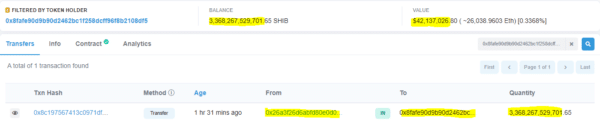
Etherscan.io recently reported a hulk transaction carrying a 3,368,267,529,701 (3.36T) SHIB, worth $42,440,170 ($42.44M) from an unknown wallet to a newly created wallet. The transaction was executed about an hour ago.

A Herculean 3.36 Trillion SHIB on the Move

The transaction comes after the lead Shiba Inu developer, Shytoshi Kusama, officially released the 1150 pages Players Guide for Shiba Inu’s Collectible Card Game dubbed Shiba Eternity in 4 separate parts with dozens of NFTs. Kusama also confirmed that he is now fully focused on Shibarium – Layer 2 solution, and the potential Beta launch is near.

Maybe for the said reason, for the past few days, Whales have constantly been shuffling trillions of Shiba Inu tokens daily. Recall that a dormant wallet suddenly woke up a day ago and transferred a mind-boggling 150,000,000,000 (150B) SHIB, worth $1,791,000 ($1.79M), to the mysterious wallet in one significant transaction.

At press time, Shiba Inu is trading at the price of $0.00001253, up 4.75% over the last day, with a 24-hour trading volume of $651,515,544 ($651.51M).

Ripple ODL Partner Novatti Gets Banking License for its Subsidiary, International Bank of Australia

0


Novatti Group, a partner of Ripple’s On-Demand Liquidity (ODL), has obtained a banking license for its subsidiary firm International Bank of Australia (IBoA).


Following years of delay, the Australian Prudential Regulation Authority (APRA) has granted a banking license to Novatti’s subsidiary firm International Bank of Australia Pty Limited, as revealed by the agency in an official press release Thursday.

According to the press release, IBoA now has full regulatory backing from APRA to function as a restricted authorized deposit-taking institution. This gives the Novatti subsidiary the liberty to operate as a recognized financial institution engaged in taking deposits, essentially operating as a bank.

Additionally, APRA approved the IBOA Group Holdings Pty Limited company as a non-operating holding company, according to provisions of the Australian Banking Act of 1959. Accordingly, IBoA has been integrated into APRA’s list of approved deposit-taking institutions.

Established as a subsidiary of Novatti, IBoA introduces a hybrid business model which incorporates cross-border settlements, borderless banking, payment services to FinTechs, SMB banking, and cross-border lending, among other offerings. IBoA’s mode of operation could utilize Ripple’s ODL solution due to the partnership between Novatti and Ripple.

Novatti Group formed a significant business partnership with Ripple in December 2020 to leverage RippleNET’s ODL solution in facilitating transnational payments. Novatti sought to target the Australian and Southeast Asian markets at the initial stage of the partnership.

Last year, Ripple highlighted the importance of its partnership with Novatti, pointing out how the firm has utilized its ODL solution and what comes next.

Community Reactions

The Ripple community admired the development.


Ripple has provided several financial institutions with an efficient and fast cross-border payment solution in ODL. Ripple’s ODL solution has not been restricted by international borders, as the firm appears to have penetrated numerous markets across different continents. The Crypto Basic recently reported Ripple’s growing impact on the crypto scene in the Middle East and North Africa (MENA).

Terra Classic Developer Suggests Community May Have To Sacrifice Burn Tax To Encourage Utility

0

Rexzy believed the burn tax parameter would have to give way for utility.


In a tweet today, a member of Terra Classic development group TerraCVita, Rex Harrison, AKA Rexzy, shared a medium blog post where he suggested that the Terra Classic chain may have to let go of the on-chain burn tax to attract lost utility.

In the article, the developer describes Terra Luna Classic (LUNC) as a “Tulip,” arguing that it has had no intrinsic value since the ecosystem collapse in May. In addition, he posits that the burn tax parameter has turned LUNC into a meme coin driven only by the desire to hold it in hopes that it would one day grow exponentially through reducing supply.

While developers proposed the burn tax parameter to spark activity on the chain again, Rexzy believes that it has achieved the opposite by discouraging the builders left on the chain and new builders interested in building.

“The ravaged ecosystem was pretty much sterilised and other than a few dApps no regrowth has occurred,” wrote Rexzy speaking on the effects of the tax. “Not only this, but exchanges have struggled with maintaining trading volume and essentially the tax has put out the fires it had hoped to create.”

However, the developer maintains that there remains a clear path to recovery, but it would require a sacrifice of the burn tax parameter. Notably, with the v23 upgrades coming in December, the network is set to achieve technological parity with LUNAv2. Consequently, decentralized apps building on the new Terra chain can easily deploy on the Classic chain.

As Rexzy explains, these DApps are incentivized to do so as the Terra Classic chain currently hosts the consumer base that the new chain lacks. However, he elaborates that for them to do so, the community has to get rid of the tax burn rate, as these projects have to make a profit from their DApps through taxes as well, and adding a tax on the burn rate could discourage users.

Meanwhile, the developer asserts that burning will continue even after the community removes the burn tax parameter. As he points out, the tax burn is not the highest contributor to the total LUNC burns. Notably, TerRarity data shows the tax burn has only contributed about 27%, with most of the burns being philanthropic to gain community support and market advantage.

Consequently, Rexzy asserts that this will remain the case. According to the developer, new DApps that can afford it will continue burning to achieve this market advantage. In addition, Rexzy also asserts that there are more effective ways to burn LUNC. Recall that Tobias Andersen, AKA Zaradar, had argued that with swaps re-enabled and chain utility with the right market environment, the network could burn LUNC at a pace comparable to the crash. 

Attracting DApps remains key to achieving this real-world utility. As reported by The Crypto Basic, the Terra Classic community reduced the tax burn parameter from 1.2% to 0.2%, as data showed that on-chain volume had significantly declined.

Investors Growing Confidence Takes XRP Above $0.50, Up 10% In An Hour

0

XRP is up 10% in an hour.


XRP has rallied close to the $0.50 zone amidst an increase in investor interest, as numerous top entities declare support for Ripple in its legal tussle with the SEC.

XRP up 9 in an hour
XRP up 9 in an hour

XRP – Ripple’s native token – continues benefiting from the positive outlook influenced by the favorable turn of events in Ripple’s battle with the U.S. Securities and Exchange Commission (SEC). Amidst an increase in amicus briefs supporting Ripple, XRP has staged a rally to eclipse the $0.50 resistance level.

Despite the prevalent bear market, XRP began November on propitious grounds since it had been consolidating below the $0.49 mark since October 19. The asset had held its own above the support at $0.45, only falling below it on rare occasions before summarily bouncing back up. Notwithstanding, since mid-October, XRP had not claimed $0.49 until recently.

As reports of numerous amicus briefs in support of Ripple against the SEC gained momentum, the asset staged a massive comeback against the bears, as it surged above $0.50 on Friday before summarily facing a sharp rejection that knocked it off the level.

Despite the intense resistance, XRP’s resilience sustained the asset’s value at the $0.49 territory, as it anticipated another leg-up to retest the resistance at $0.50. The asset has again soared above the 50-cent zone, changing hands at $0.502 as of press time.

With a sudden increase of 10.07% in an hour, XRP remains the second highest-gaining asset on the top 40 lists of cryptocurrencies within the timeframe, only behind Polygon (MATIC) with a 24-hour gain of 14%.

Due to this recently-engineered rally, XRP’s market capitalization surged from $22.5B at 6 AM to $25B at 11 AM, marking a 9% increase in 5 hours. This recent increase further solidified XRP’s position as the 6th largest mainstream asset by valuation.

XRP’s recent price movement indicates a massive rise in investor interest as demand pumps into the asset due to the favorable turn of events in the SEC litigation. The Crypto Basic recently compiled a list of up to 12 entities that have filed amicus briefs in support of Ripple.

Some of these amicus curiae include top entities such as the Chamber of Digital Commerce, Blockchain Association, I-Remit, TrapJets, and America’s largest exchange Coinbase, among others.

Speaking on the surge in amicus briefs, Ripple’s CEO, Brad Garlinghouse, highlighted the unprecedented nature of the recent pattern, noting that it underscores the potential economic damaging effects of a final resolution in favor of the SEC.

Additionally, General Counsel at Ripple, Stuart Alderoty, recently asserted that the numerous amicus briefs supporting Ripple indicate how “dangerously wrong” the SEC is in its decision to label XRP unregistered security. Alderoty also criticized the SEC for requesting a time extension to reply to the amicus briefs. 

Meanwhile, Canadian exchange Newton Crypto recently became the first exchange for relisting XRP.

Terra Classic (LUNC) Massive Developments In October: Review

0

Developments in the Terra Classic network have been coming at a rapid pace despite being community owned with no VC funding.


The Terra Classic chain has had a turbulent year and has grabbed headlines for numerous reasons, from bucking the bearish crypto market trend early in the year and creating new highs on the promise of decentralized crypto money at scale to collapsing spectacularly in May. 

Now, however, it is grabbing headlines because of its budding community that has taken over the helm, charting a path to recovery and lost glory.

Notably, since taking control of the chain, the community has wasted no time trying to tackle its major pain points. In no particular order, these include reducing the excess Terra Luna Classic (LUNC) supply, re-pegging TerraClassicUSD (USTC), fixing the chain, and creating and attracting utility.

It is worth noting from the end of August through September, the network reintroduced staking and faced the problem of significantly reducing the LUNC supply with a 1.2% on-chain tax while lobbying crypto exchanges to implement the tax on off-chain transactions. For its efforts, Binance, the world’s largest crypto exchange, kicked off a campaign to burn all trading fees obtained from LUNC trading activity.

Notably, October was rife with even more developments and heated debates, as can be expected with a community-run chain. 

The first issue members of the community sought to address in October was how it would repeg the defunct stablecoin and make holders whole. To this end, the community got to all appearances, two distinct proposals leading to heated debates on Twitter. Finally, however, developers volunteering to rebuild the chain to their credit are now working to combine these into a single proposal which would make USTC the reserve currency of the network.

As the month progressed, the community reduced its on-chain tax to 0.2%. Notably, the 1.2% tax implementation led to a significant decline in on-chain volume. To reclaim this lost volume, the community opted to reduce the tax inspired by a proposal from a community member known only as Akujiro. 

As per this new proposal, 10% of all LUNC burned goes to the community pool to fund development. Notably, some community members had believed that this seignorage would apply to only LUNC burnt by the tax and, as such, have voiced misgivings over the current application. Still, a proposal to this effect is yet to materialize.

With the new inflow to the community pool, core developer Edward Kim proposed a grant program to efficiently and transparently allocate the fund for chain development.

Furthermore, the Terra Classic community received two major positives in October. Firstly, renowned Cosmos developer Jacob Gadikian disclosed that the code to re-open Inter Blockchain Communication channels was ready. Secondly, Alex Forshaw disclosed that he had been made aware of $4 million in off-chain assets belonging to the Terra Classic chain, which promises to speed up the blockchain’s development significantly.

Notably, both disclosures have become the subject of intense debates in November. The community is yet to decide how it would manage the off-chain assets, even as the wording of a proposal to re-open IBC channels has raised concerns.

Despite all these, developers have disclosed that they are on track to roll out v23. It could see the network become Cosmos interoperable and able to run decentralized apps compatible with the new Terra blockchain in December.

SEC Requests More Time to Reply to Numerous Amicus Briefs Supporting Ripple 

0


The securities regulators want a two-week extension to reply to all amicus briefs.


With a dozen amicus briefs submitted in the ongoing Ripple vs. SEC suit, the plaintiff has requested a two-week extension to file a reply to these briefs.

The development was shared by James K. Filan, a former U.S. federal prosecutor.

The Securities and Exchange Commission wants Judge Analisa Torres to extend its reply deadline from November 15, 2022, to November 30, 2022. 

An excerpt of the SEC’s letter read: 

“The SEC respectfully requests that the date for the parties to file their sealed reply briefs be extended from November 15, 2022, to November 30, 2022.” 

SEC Makes Further Requests

The SEC also requested that the court modify the page limits for the parties’ reply briefs from 45 to 55 pages. The agency also requested other time extensions in different areas related to the order for filing reply briefs to the parties’ summary judgment motions.

The request is to enable the securities regulators to go through all amicus briefs submitted by the numerous fintech companies and trade associations.

Furthermore, the SEC also asked the court to order that no additional amicus briefs be filed after November 11, 2022. Meanwhile, Ripple consented to the Securities and Exchange Commission’s requests. 

As reported, a dozen amicus briefs have been submitted in the lawsuit. These amicus briefs explain how the SEC’s suit affects their businesses and the entire U.S. economy.

In reaction to the numerous filings, Ripple’s CEO said it has never been seen to have 12 amicus briefs submitted in a trial-level case. Although 12 amicus briefs have been submitted so far, it is expected that more companies may request to file one in the coming days.

Crypto Oasis UAE Report Highlights Ripple Growing Impact in MENA

0

Crypto Oasis has highlighted Ripple’s increasing importance in the digital asset scene in MENA, as the industry sees rapid growth.


Crypto Oasis – a leading blockchain-based ecosystem with a focus on the Middle East and North Africa (MENA) – has released its Ecosystem Report, as it highlights the growing impact of Ripple within the cryptocurrency scene in the Middle East.

The just-released Ecosystem Report from Crypto Oasis pointed out the burgeoning state of the cryptocurrency industry in MENA, as individual and institutional adoption sees a massive surge, with several crypto entities flocking to the bloc to solidify their positions in the booming sector.

Ripple, which has been on a rapid expansion of late, has made several moves to penetrate the local crypto industry in MENA, as it forms numerous partnerships with private and public entities within the bloc to foster innovation.

Due to its massive presence in the Middle East and North Africa, Ripple’s impact is largely felt in the region, especially as its RippleNET solution provides several financial entities with speed and efficiency when facilitating cross-border settlements.

As highlighted in the report, Ripple established a headquarters in Dubai as its regional growth in MENA became more apparent. The Emirate News Agency announced the move in November 2020. Per reports, the launched HQ was set up within the Dubai International Financial Centre (DIFC).

The report also highlighted the importance of Ripple’s RippleNET solution, as it is leveraged by several top entities within MENA, such as the Qatar National Bank and the Al Ansari Exchange. These entities utilize RippleNET to expedite transnational settlements.

Furthermore, Crypto Oasis’ Ecosystem Report underscored Ripple’s significant contribution to fostering the establishment of several national CBDCs. In particular, the report highlighted Ripple’s impact on the development of the CBDCs of the Republic of Palau and Bhutan.

In September of 2021, Ripple disclosed a partnership with Bhutan’s central bank, the Royal Monetary Authority, as Bhutan looked to leverage the firm’s CBDC solution in developing its digital currency. Two months later – in November – Ripple revealed another partnership with the Republic of Palau to help build its climate-friendly digital currency strategy.

Notwithstanding, Ripple’s first penetration of the digital asset scene in MENA dates back to 2017 in a trailblazing partnership with the National Bank of Abu Dhabi (NBAD). In February 2017, NBAD became the first bank in the Middle East to leverage Ripple’s solution for faster and cheaper cross-border settlements. Countless others have followed suit since then.

The equally budding crypto industry has sustained Ripple’s growing presence in MENA within the region. A recent report from Chainalysis revealed that the MENA region recorded the fastest-growing cryptocurrency market in the 12 months leading to June 2022.

The report disclosed that crypto users received a whopping $556B in crypto between July 2021 and June 2022. This figure marked a 48% increase from the previous year, indicating any region’s highest growth rate in 12 months. Additionally, MENA accounts for three nations on Chainalysis’ top 30 list of countries in terms of global crypto adoption. These are Turkey, Egypt, and Morocco.

Here’s The List Of Amicus Briefs Supporting Ripple Against SEC, Garlinghouse Says It’s Unprecedented

0

12 companies and associations are so far supporting Ripple against SEC.


Garlinghouse reacts to the increased number of amicus briefs submitted in the SEC suit.

The ongoing lawsuit between the SEC and Ripple has continued to attract much interest from XRP holders, fintech companies, and trade associations. For many people, the lawsuit is seen as the cryptocurrency trial of the century. The outcome of the case would play an integral role in determining the direction of cryptocurrency regulation. 

Some legal experts believe a win for Ripple may prompt Congress to mandate the SEC to provide clearer regulation for the emerging market. However, if the blockchain company loses, the SEC will continue its “regulation by enforcement” practice. 

Numerous Amicus Briefs Submitted

Knowing the importance of the suit, several companies, trade associations, and XRP holders represented by attorney John Deaton have filed amicus briefs in support of Ripple. As reported, attorney Jeremy Hogan, a partner at Hogan & Hogan law firm, said Judge Analisa Torres has allowed numerous briefs to be submitted at the trial level of the lawsuit because she understands the case’s complexity.

A dozen amicus briefs have been filled in the Ripple vs. SEC case. The enterprise and trade organizations that have submitted amicus briefs in the suit include: 

  1. Chamber of Digital Commerce 
  2. TapJets 
  3. I-Remit 
  4. Investor Choice Advocates Network (ICAN) 
  5. Blockchain Association 
  6. SpendTheBits 
  7. Coinbase 
  8. Cryptillian Payment Systems. 
  9. Crypto Council for Innovation (CCI)
  10. Valhil Capital LLC 
  11. Veri DAO LLC, and 
  12. Attorney Deaton, on behalf of over 75K XRP holders.

Ripple CEO React

Brad Garlinghouse, CEO at Ripple, took to Twitter to react to the increase in the number of Amicus Briefs filed in the Ripple vs. SEC suit. Garlinghouse said he was told that it’s unprecedented to see a dozen amicus briefs filed in a trial-level case like the ongoing lawsuit between Ripple and the SEC. 

He added that these amicus briefs explained how the U.S. economy would be affected if the SEC is allowed to have its way in the case. 

The SEC claims that XRP is a security, adding that Ripple violated U.S. securities laws by offering the asset class to investors. Ripple has continued to refute this claim. The blockchain company said the SEC could not establish a legal theory to back its claim that XRP is a security.

Meanwhile, Garlinghouse’s comment comes a few hours after Ripple’s General Counsel, Stuart Alderoty, slammed the SEC for requesting a time extension to file a single motion in reply to the dozen amicus briefs submitted in the suit. 

While a dozen amicus briefs have been submitted, many people expect more to be filed in support of Ripple in the coming days. However, the SEC requests that the court order that any additional amicus briefs be filed no later than November 11, 2022. 

Users Can Now Create Cardano Smart Contracts On Ledger

0

Cardano Babbage v5.0.0 App Is Now Available For Download On Ledger Live – It Will Allow Users To Create Smart Contracts.


Users can now create smart contracts using the Cardano Babbage v5.0.0 app, available for download on Ledger Live.

In a tweet yesterday, Ledger Support announced that the long-anticipated Cardano Babbage v5.0.0 app is now available for download on Ledger Live. The app will allow users to create smart contracts using the Vasil upgraded Plutus script.

Notably, before downloading the app, users must first make sure that they are running the latest version of the Ledger Live app and running the latest firmware on their Ledger wallet. 

To download the latest Cardano App, users must follow the steps below per the Ledger Support blog post.

  • Connect and unlock your Ledger device. 
  • On the Ledger Live interface, navigate to “Experimental Features” under settings.
  •  Enable “Developer Mode.” 
  • Click My Ledger and allow access to My Ledger when requested by pressing the instructed buttons.
  • Search for and install the Cardano Babbage app in the My Ledger app catalog.

As a disclaimer, Ledger Support notes that, unlike the Cardano v4 app, Ledger Live does not currently support the Babbage App. Consequently, users can only use it with third-party apps. It suggests apps like Nami, Ty.phon, and Eternl.

As reported by The Crypto Basic in October, the latest version of the Daedalus wallet rolled out with an improved Ledger JavaScript offering support for the Babbage app. As such, users of the Cardano full-node desktop-only app will also be able to access the Cardano Babbage v5.0.0 to create smart contracts using the latest Plutus scripts from the Vasil upgrade.

Unsurprisingly, the Cardano community welcomed the latest announcement with a flurry of positive responses. One user noted that he had been using the app for weeks on his Ledger Nano X asserting that it worked perfectly. Meanwhile, CTO at Input Output Global (IOG), the development company behind the Cardano network, took the opportunity to take a swipe at statements from FTX’s Sam Bankman-Fried describing Cardano as a new blockchain.

“Would the new ADA blockchain that @SBF_FTX is talking about already have Ledger support and live smart contracts?!” Romain Pellerin wrote despite SBF’s clarification.

Notably, Ledger is still working on bringing staking to Ledger Live, per a tweet yesterday. However, users can still stake their ADA on Ledger by connecting it with Adalite.