Home Blog Page 22

Strive CEO Says $700M in Warrants Could Help Company Reach No. 2 Bitcoin Treasury

0

Strive expanded its Bitcoin treasury to 23,156 BTC after buying 3,156 BTC in August, putting the company fifth among public companies ranked by Bitcoin holdings as CEO Matt Cole outlined a potential route to second place by the end of 2026.

The August purchases marked a sharp increase from July, when Strive acquired 136 BTC while Bitcoin traded in the low $62,000 range. Its current holdings are worth nearly $1.9 billion.

Strive moved ahead of crypto exchange Bullish last week to take fifth place. Twenty One Capital currently holds the No. 2 position with 43,514 BTC, slightly less than twice Strive’s total. 

Closing that gap before year-end would require Strive to add roughly 20,400 BTC over the next 17 weeks, equivalent to about 1,200 BTC a week, assuming Twenty One does not increase its holdings. Twenty One has not added Bitcoin since July 2025.

Cole said on the One Share podcast on Wednesday that averaging 1,000 BTC in weekly purchases would itself represent a substantial accumulation pace and could allow Strive to advance quickly in the rankings. However, he cautioned that such a rate may or may not materialize.

$27 Warrant Threshold Could Unlock Additional Buying Capacity

One potential source of capital for further purchases is more than $700 million of outstanding Strive warrants scheduled to expire in mid-October.

The warrants carry a $27 exercise price. Strive shares reached a year-to-date high of $26.84 on Thursday, putting ASST less than 1% below that level.

Cole said that if the warrants are exercised, Strive could deploy about $700 million into Bitcoin while gaining another $700 million of capacity for digital credit. Together, he said, that could give the company as much as $1.4 billion in potential capacity to buy Bitcoin.

Cole said he would prefer to see the warrants exercised rather than expire unused, a scenario he said could produce a particularly strong finish to Strive’s 2026 Bitcoin accumulation.

Against that backdrop, Cole said Strive could end 2026 in the No. 2 spot among public companies ranked by their Bitcoin holdings. He stressed, however, that this was not his base case and would require several factors to move in Strive’s favor.

ASST Outperforms Major Public Bitcoin Treasury Stocks

According to Bitcoin Treasuries data, ASST has beaten the average 2026 performance of the 10 biggest listed corporate Bitcoin holders by 82%.

Cole also offered a longer-term backdrop for Strive’s Bitcoin strategy, saying he sees Bitcoin potentially surpassing $500,000 before the decade ends. At the same time, he said Strive has structured its finances so that the company does not need that price scenario to materialize.

XRPL DEX Order Book Volume Spiked to 3.57M XRP in Q2 2026

0

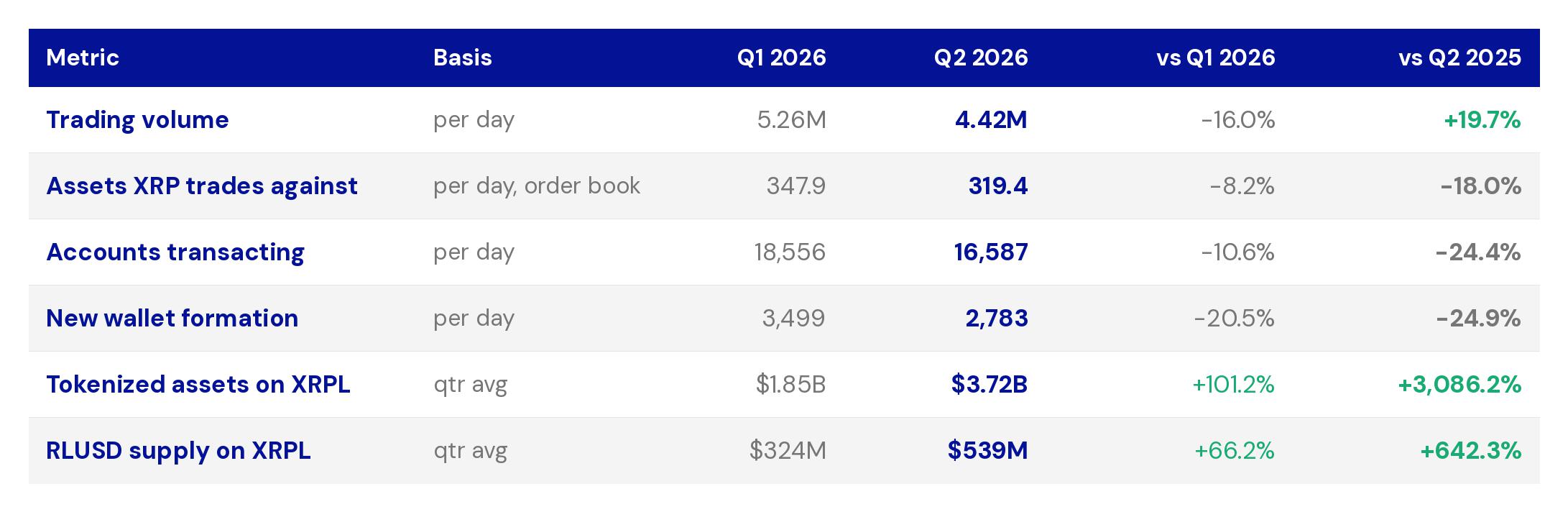
Despite the XRP price struggles, DEX order book volume on the XRP Ledger (XRPL) soared to 3.57 million XRP per day in Q2 2026.

Recent on-chain data shows that the XRP ecosystem had a mixed second quarter in 2026. This is according to a report from Evernorth, the largest XRP Treasury firm by total holdings.

Specifically, the data confirms that trading through the XRPL decentralized exchange (DEX) order book rose 79% year over year to 3.57 million XRP per day.

XRPL Quarterly Scorecard | Source: Evernorth

XRPL Order-Book Activity Points to Bigger Traders

The rise in volume came despite fewer accounts taking part in order-book trading. The number of accounts starting these trades fell from 1,864 to 1,111 per day. 

As a result, the average amount traded by each account rose to 3,217 XRP per day, compared with 1,072 XRP a year earlier. 


In addition, order-book trading also made up 81% of all DEX activity in Q2, compared with 54% a year earlier. However, total trading was 16% lower than in Q1 2026, when February recorded unusually high activity.

The rise in trading volume alongside the drop in active accounts suggests that larger and more professional traders may have taken a bigger share of XRPL DEX activity. 

This trend also came as XRPL added more infrastructure for institutional users. For instance, permissioned domains and permissioned trading venues went live in February, which gave institutions more tools to use the network.

RLUSD Grows on XRPL

Meanwhile, RLUSD also continued to grow on XRPL. Average RLUSD balances reached $539 million, compared with $73 million a year earlier. 

The balance increased in every quarter without recording a decline. This growth persisted despite stablecoin supply across the wider crypto industry falling for the first time since 2023.

On XRPL, RLUSD supply grew 642% year over year, while the value transferred through the stablecoin jumped 925%. This growth pushed XRPL’s share of total RLUSD from 20% to 34%. Higher stablecoin balances could also support larger payment and tokenized-asset transactions on the ledger.

XRPL Account Activity Falls

However, not all of the network’s numbers improved. For one, XRPL averaged 16,587 accounts transacting each day during Q2, while the number of new accounts averaged 2,783 per day. Both figures fell by about 25% from the same period a year earlier.

The broader blockchain market also saw lower activity during the period. On-chain exchange volume dropped 46% year over year, while transaction fees across the seven largest programmable networks fell 38%. 

Account numbers tend to show retail activity more clearly, and the decline suggests that retail participation weakened across the broader crypto market during the quarter.

Despite the drop in account activity, the value on XRPL continued to rise. Network value grew from $99 million to $4.26 billion across six quarters. Each quarter recorded a higher figure than the previous one, with Q2 reaching the series high. The increase has continued for a year and a half.

XRP Volume Per Account Remains Strong

Trading volume per account moved in the opposite direction from overall account growth. Across the entire exchange, XRP traded per account rose 81% to 1,149 in Q4 2025. It then climbed another 85% to 2,125 in Q1 2026.

Q2 gave back 15% of that increase, taking the figure to 1,815 XRP per account. Despite this decline, the resulting level remained 2.7 times higher than the series starting point of 636 XRP.

Overall trading volume also recovered after reaching its lowest point in 2025. Daily volume fell to a Q3 2025 low of 2.63 million XRP before recovering to 3.15 million XRP per day in Q4 2025 and 5.26 million XRP per day in Q1 2026. Volume then declined in Q2 to 4.42 million XRP per day.

However, Q2 volume remained 68% above the 2.63 million XRP low. It also remained higher than every quarter of 2025 except Q1 2025, which still holds the series high.

Several XRPL Metrics Hit New Lows

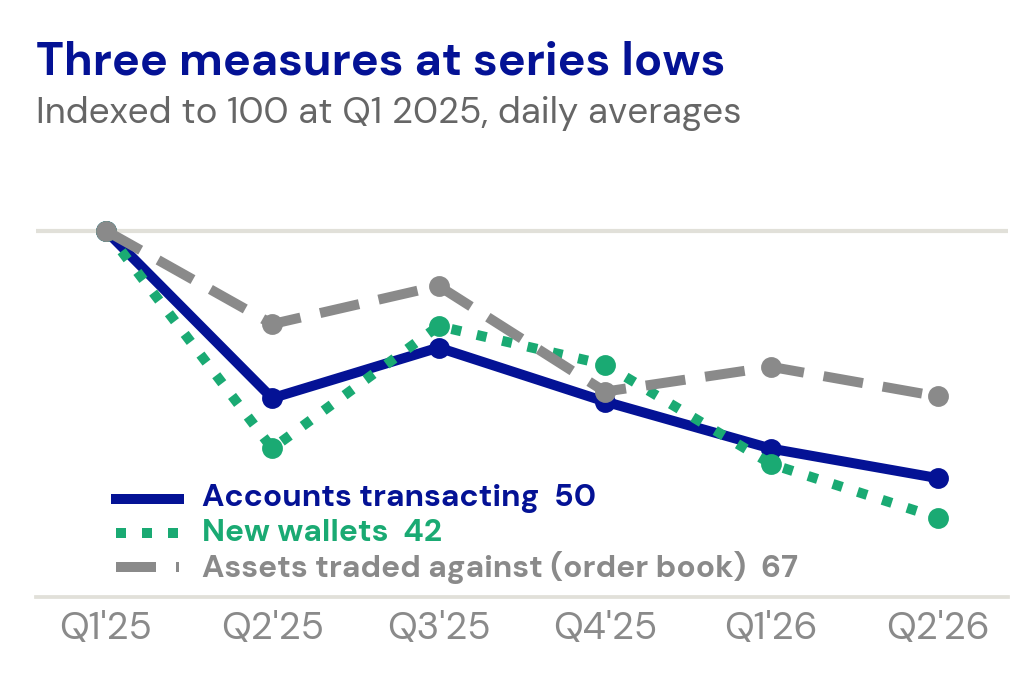
Three metrics ended Q2 at their lowest levels in the six-quarter period. Specifically, daily transacting accounts fell from 33,145 to 16,587, while daily new wallets declined from 6,617 to 2,783. The number of assets traded against XRP on the order book also dropped from 479.9 to 319.4.

Three XRPL Metrics Hit Series Lows | Source: Evernorth

At the same time, XRP-paired pools grew 26% across the same six-quarter period, while trading through those pools fell 74%. This suggests that the growing number of pools reflects available capacity rather than stronger trading activity.

XRP CVD Confirmation Score on Binance Hits Positive

0

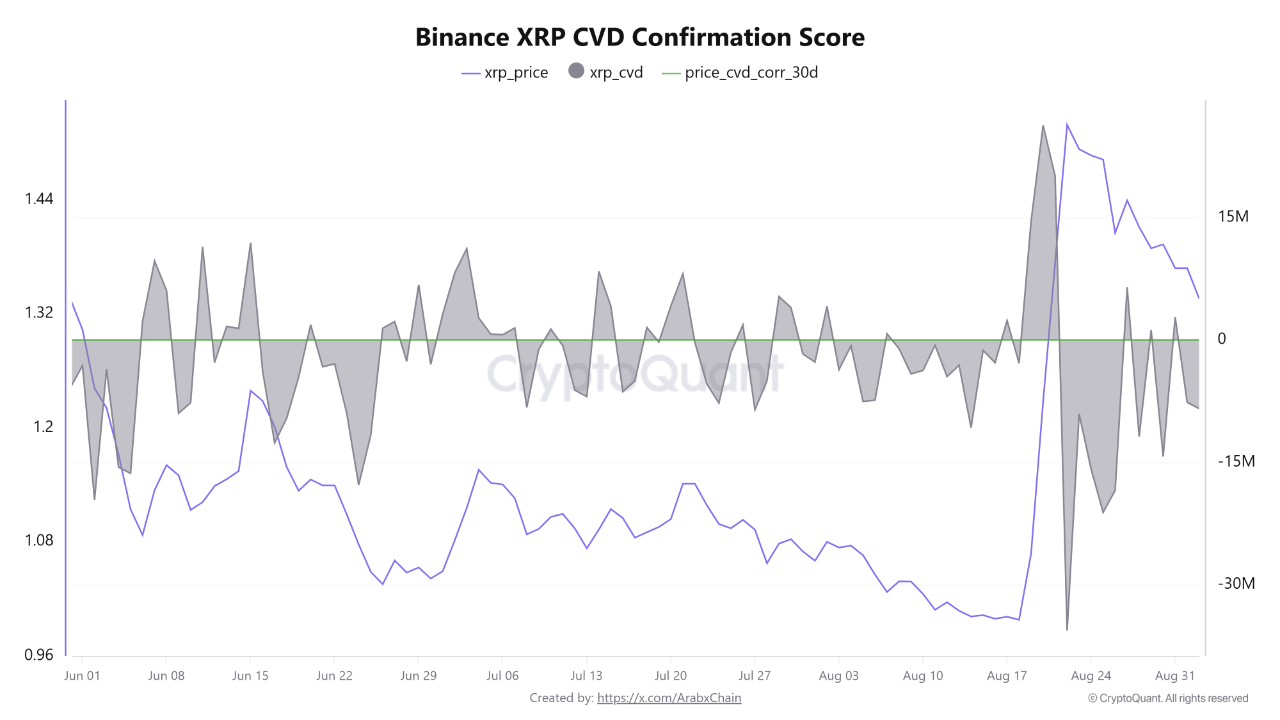
The XRP CVD Confirmation Score on Binance indicates that the spot market remains healthy despite the recent pullback from XRP’s August rally. 

Specifically, the CVD Confirmation Score has moved into positive territory, suggesting that XRP’s price movement still has a reasonable link with activity in the spot market.

The reading comes as XRP enters a period of consolidation after rising 28.5% in August, its best August performance since 2021. 

However, selling pressure remains visible across both the spot and derivatives markets. As a result, XRP’s next move now depends largely on whether buyers can regain control of the market.

XRP CVD Shows Signs of Improvement

The 30-day correlation coefficient between XRP’s price and its Cumulative Volume Delta (CVD) currently sits at about 0.43.

XRP CVD Confirmation Score on Binance | Source: CryptoQuant


This shows a moderate positive relationship between price and spot order flow. In simple terms, XRP’s recent price gains have had some support from actual buying activity instead of coming entirely from speculative trading or low liquidity.

For the uninitiated, the CVD Confirmation Score uses price data and CVD to determine whether actual buying and selling activity supports a price move. As a result, a positive reading gives the market a reason for some optimism amid the pullback.

However, the XRP spot CVD remains negative at around -8 million. This means sell orders continue to exceed buy orders when measured across the period. While the positive confirmation score indicates improving price-flow alignment, the negative CVD shows that buyers have not yet taken full control of spot trading.

XRP at Key Support After August Rally

Notably, XRP gained 28.5% in August, with most of the increase coming during the final two weeks of the month. The token climbed from around $1.00 to a local high above $1.69 before the rally began to lose momentum.

XRP has since formed a descending triangle following the August surge and now trades around $1.36. The decline so far shows XRP is now in a period of consolidation after a sharp rally, although the continued weakness in CVD shows that sellers remain active.

U.S. spot XRP ETFs also recorded strong inflows during August. These products attracted $153.55 million during the month, with $150.28 million coming in during the final two weeks. That was about 46 times the pace recorded during the first half of August. 

Binance Data Shows Selling Pressure

Meanwhile, the derivatives market currently looks weaker than the positive CVD Confirmation Score suggests. Binance Perpetual CVD dropped from about -$480 million on Aug. 22 to -$882.1 million on Aug. 31. 

This represents a roughly 84% increase in the negative imbalance and marks the most negative reading since July 2026.

Spot trading on Binance also weakened during the same period. Binance Spot CVD fell from approximately +$39 million to -$167.5 million, marking a negative swing of about $206.5 million.

This reduction in leverage has both positive and negative effects. It lowers the amount of leverage that could trigger further liquidations if XRP falls. However, it also leaves the market with less leveraged positioning that could support a strong short squeeze.

Analyst Ali Martinez has identified the $1.35-$1.38 region as an important demand area. Around 3.2 billion XRP previously traded within this range, which makes it a key level for the current market structure.

XRP Ledger Liquidity Soars as RLUSD Supply Jumps 642%

0

The XRP Ledger (XRPL) saw a major change in trading activity in the second quarter of 2026 alongside RLUSD.

Trading became more concentrated among fewer accounts, while RLUSD balances on the network increased sharply, according to a report from Evernorth, the largest public XRP treasury company.

Evernorth’s Q2 2026 XRP Liquidity Report found that order-book trading averaged 3.57 million XRP per day, up 79% from the same period last year. However, the number of accounts making these trades fell from 1,864 to 1,111 per day.

As a result, the average daily trading volume per account nearly tripled, increasing from 1,072 XRP to 3,217 XRP. Order-book trading also made up 81% of all decentralized exchange (DEX) trading on XRPL, compared with 54% in Q2 2025.

Image

XRP Trading Becomes More Concentrated

XRP trading on the XRPL became more concentrated in Q2 2026, with fewer accounts handling more XRP.

Fewer accounts traded on the order book, but those that remained traded much larger amounts. Evernorth said this could mean that professional and institutional traders are becoming a bigger part of the market.

Overall DEX trading averaged 4.42 million XRP per day in Q2, up about 20% from the same period last year. However, trading was 16% lower than in Q1, when activity was unusually high because of strong trading in February.

This change comes as the XRPL adds more tools for institutional and advanced traders. Permissioned domains and trading venues launched in February, along with other network upgrades.

RLUSD Supply on XRPL Surges

Meanwhile, RLUSD liquidity on the XRP Ledger grew sharply in Q2 2026. RLUSD balances averaged $539 million during the quarter, up from just $73 million a year earlier. That’s a 642% increase. Evernorth also said the figure has increased every quarter since it began tracking it.

The amount of RLUSD transferred also jumped, rising 925% year over year. This growth happened even as the overall stablecoin market shrank for the first time since 2023.

As a result, the XRP Ledger’s share of total RLUSD supply grew from 20% to 34%.

Evernorth said that having more stablecoins on the network could help support larger payments and more tokenized-asset transactions.

RLUSD also expanded to more networks during the quarter. On June 4, Ripple’s stablecoin became available across several additional blockchains, including Base, Optimism, Ink, Unichain and the XRPL EVM sidechain, as well as XRPL and Ethereum.

RLUSD supply metric by Evernorth

Retail Activity Falls Across Crypto

Retail activity on the XRP Ledger (XRPL) weakened in Q2 2026, even as liquidity grew in other areas. The XRPL averaged 16,587 active accounts per day, while new accounts averaged 2,783 per day. Both numbers were about 25% lower than a year earlier.

This decline was part of a wider trend. Across the crypto market, on-chain exchange trading fell 46% year over year, while transaction fees on seven major blockchains dropped 38%.

Evernorth said account numbers are a good measure of retail activity, suggesting that fewer retail users were active across the market—not just on XRPL.

However, the total value held on the XRP Ledger continued to grow. It averaged $4.26 billion in Q2, the highest level in the six-quarter period studied. Network value increased every quarter, rising from $99 million at the start of the period.

XRPL Infrastructure Continues to Improve

Several technical upgrades also took place during Q2. In May, the XRPL EVM sidechain released version 9.0.0, moving to newer and better-supported software and adding updated Ethereum standards.

Another upgrade, called fixCleanup3_1_3, also went live in May. It improved multi-purpose tokens and permissioned domains. Validators were also reviewing new vault and lending features.

Meanwhile, U.S. spot XRP ETFs brought in $273 million during Q2, with investors adding money in every month.

Overall, the data shows an interesting shift in the XRP ecosystem: fewer retail users were active, but the users who remained traded more and more money flowed through the network.

In simple terms, XRPL activity became smaller in participation but deeper in capital and trading volume.

History Hints at How XRP Could Perform Against Bitcoin for the Rest of 2026

0

Historical data suggests that while XRP could build on the August rally against Bitcoin in September, the asset may face a drawdown in October.

XRP has continued to lag behind Bitcoin, despite briefly gaining the upper hand during the market’s rebound two weeks ago. 

The recent outperformance did not last, as XRP has spent the past two weeks falling behind Bitcoin again. The XRP/BTC pair currently trades at 0.00001754, which puts it 48% below its January 2025 high of 0.00003415.

However, market commentator EGRAG Crypto believes XRP’s weakness against Bitcoin could continue into October 2026. At the same time, he expects XRP to build on its 4% gain in August 2026 and potentially make another move higher against Bitcoin in September 2026.

XRP Could See a September Rally Against Bitcoin

EGRAG recently called attention to a strong seasonal pattern for XRP/BTC during the final months of the year. 

Notably, based on historical monthly averages, XRP has gained 17.0% in September, while October has recorded an average decline of 19.6%. The trend then turns positive again, with November averaging a 30.5% gain and December averaging a 44.1% gain.

XRP Monthly Performance Against Bitcoin

However, EGRAG believes the sequence is more important than the averages themselves. Historically, September has marked a rotation, October has brought a shakeout, November has seen expansion, and December has produced further acceleration. 

If the pattern plays out again, XRP could begin gaining ground against Bitcoin in September before facing another decline in October.

October Has Been a Difficult Month for XRP Against Bitcoin

October has historically been one of the weaker months for XRP against Bitcoin. The XRP/BTC pair finished lower in 11 of the last 13 Octobers, making it a period that investors may need to watch.

However, an October decline does not necessarily mean that XRP would enter a longer bearish phase. Previous years show that sharp losses in October have sometimes been followed by much stronger moves in November.

For example, XRP/BTC fell 22.4% in October 2020, only to jump 93.8% in November. A similar pattern appeared in 2024, when the pair dropped 24.9% in October before rising an impressive 179.2% in November.

These past moves suggest that another October correction would not automatically weaken the broader case for XRP. However, it could become part of a larger rotation that eventually favors XRP against Bitcoin.

XRP Has Lagged Bitcoin for Most of 2026

XRP’s performance against Bitcoin this year also shows how much the pair has struggled. XRP/BTC fell 0.5% in January 2026 and another 1.8% in February. The decline hit 4.4% in March and then reached 8.8% in April.

XRP managed to post a 1.0% gain in May, but the recovery did not last. The pair fell another 2.0% in June and 4.8% in July. August finally brought some relief, as XRP/BTC gained nearly 4.0%.

This leaves XRP with a long record of underperformance against Bitcoin during 2026, despite the improvement seen in August.

August Breakout Could Set the Tone

The next major question is whether the 4% gain in August 2026 marks the start of a broader XRP/BTC rotation. EGRAG believes a break above the pair’s August high could provide an important signal.

If this happens, XRP could continue its recovery against Bitcoin in September 2026. The move could then face resistance in October, in line with the historical shakeout pattern, before XRP potentially sees stronger performance in November and December.

History does not guarantee that XRP/BTC will follow the same pattern in 2026. However, XRP’s prolonged weakness against Bitcoin and the recent August rebound may be setting the stage.

Australia Warns Crypto Firms Needing Licences to Act by Sept. 30 or Risk 10% Turnover Fines

0

Australia’s temporary enforcement relief for certain digital asset businesses is set to expire after Sept. 30, leaving firms that require regulatory authorization at risk of civil and criminal penalties, including fines of up to 10% of annual turnover, if they fail to meet the conditions for continued protection.

Businesses that need an Australian Financial Services licence must apply for authorization or request changes to an existing licence by Sept. 30 to satisfy the relevant requirements of the Australian Securities and Investments Commission’s no-action position.

Companies requiring market or clearing and settlement licences face a different process. They must notify ASIC and hold a pre-application meeting before the deadline.

From Oct. 1, businesses that require authorization but have not fulfilled the applicable conditions could be operating in breach of Australian financial services law.

ASIC Records More Than 45 Digital Asset Licence Applications

ASIC said Wednesday that more than 45 digital asset-related licence applications have been recorded since the regulator revised its guidance in October 2025.

That figure has increased from about 30 applications reported when ASIC extended the transition period on June 25. The regulator moved the previous June 30 cutoff to Sept. 30 and widened the relief to include crypto businesses working as authorized representatives of licensed firms or under certain intermediary arrangements.

ASIC’s current transitional enforcement relief is distinct from the broader Australia’s Digital Asset Framework, scheduled to begin on April 9, 2027.

Standard Chartered Opens Spot Bitcoin, Ethereum Trading to UAE Institutions

0

Standard Chartered has expanded its regulated digital asset business in the United Arab Emirates (UAE) with spot Bitcoin and Ethereum trading for institutional clients, adding the service to a regional crypto offering that already includes custody.

The London-headquartered bank introduced digital asset custody in the UAE in September 2024. In June 2026, it followed with a banking agreement allowing CoinMENA to use Standard Chartered for fiat on- and off-ramps, client money accounts and transaction management through virtual accounts.

The bank is providing the new service through Standard Chartered DIFC, an entity regulated by the Dubai Financial Services Authority (DFSA).

Institutional Clients Gain Spot Crypto Access

Eligible institutions can access spot Bitcoin (BTC) and Ethereum (ETH) trading through electronic trading channels integrated into Standard Chartered’s existing platforms.

Standard Chartered said Thursday that it is the first Global Systemically Important Bank (G-SIB) to offer the capability in the UAE and the only global bank currently providing institutional digital asset spot trading in the region.

Other Platforms Seek UAE Crypto Approvals

The launch comes amid broader efforts by cryptocurrency and trading businesses to secure regulatory authorization for digital asset products in the UAE.

Capital.com disclosed plans in August to provide spot crypto services to UAE clients after its affiliate, Capital Vault UAE, obtained a virtual-asset licence from the country’s Capital Market Authority (CMA).

Revolut also moved to expand its crypto services in July, when the neobank received in-principle approval from Dubai’s Virtual Assets Regulatory Authority to provide crypto-related services in the UAE.

Uphold President Says XRP and XRPL Have a “Leg Up” in the New Financial System

0

Uphold’s U.S. president, Nancy Beaton, says XRP and the XRP Ledger (XRPL) are in a position to benefit as traditional finance moves onto blockchain technology.

In a video on Ripple’s official YouTube channel, Beaton said the shift from traditional banking to blockchain finance is already underway. She believes companies like Ripple, Uphold, and other fintech firms will need to work together to make this transition happen.

Beaton also explained that Uphold is more than a platform for buying and trading digital assets. Its API-based technology lets other businesses use its infrastructure to build and offer financial services.

This infrastructure is useful for banks and financial institutions that want to offer digital assets to customers without building their own blockchain systems.

Uphold and Ripple Work More Closely on XRPL

Beaton said Uphold is “constantly working together” with Ripple and the XRP Ledger (XRPL), while also pointing to opportunities to work with other companies in the XRPL ecosystem.

She said Uphold, Ripple, and XRPL can work together to give banks and other financial institutions a complete solution for offering digital assets to their customers.

This positions XRPL as more than just a cryptocurrency network. The blockchain is also becoming part of the infrastructure supporting financial services moving onto the blockchain.

Meanwhile, Ripple increasingly focuses on using XRP and XRPL in regulated financial markets. Its 2026 plans include regulated finance, tokenization, cross-chain liquidity, and other financial infrastructure use cases.

XRP Has an Advantage

Beaton believes XRP and the XRP Ledger have an important role to play as the financial system moves to blockchain. Specifically, she said XRPL and XRP could lead this transition, giving them a “leg up” in the market.

One major advantage of blockchain is the ability to make financial transactions faster and cheaper. Blockchain networks operate 24/7 and offer lower-cost transactions compared with many traditional payment systems.

Blockchain also makes international money transfers faster. Instead of waiting days and paying high fees to move money across borders, transactions can take place continuously and at much lower costs.

These benefits give banks and other financial institutions a strong reason to adopt blockchain technology.

From Payments to a Blockchain-Based Economy

Beaton sees blockchain as a way to give people greater control over their money and assets. It allows people to move assets across borders, earn returns, and use digital assets in different financial services.

She said sending money will eventually become as easy as sending an email. Digital assets will also allow people to earn returns on their holdings and use crypto as collateral for loans.

This goes beyond simply making payments faster. Blockchain is building a financial system where asset ownership, payments, lending, and transaction settlement operate on shared infrastructure.

As more banks and financial institutions use blockchain for payments and settlement, demand for the XRP Ledger and XRP will increase.

Shiba Inu Whale Who Turned $13K Into $9B Moves 600B SHIB to BitGo 

0

An early Shiba Inu whale has resumed large-scale selling after a month of inactivity, moving nearly 600 billion SHIB worth $3.09 million. 

According to Arkham data, the whale moved the tokens in two transactions. The whale first transferred 280 billion Shiba Inu tokens before sending another 320 billion SHIB in a separate transaction. 

Notably, the whale sent both transfers to a Forwarder address associated with distribution activity, which subsequently moved the tokens to an address affiliated with BitGo. This transfer pattern suggests that the whale could be preparing the tokens for sale or exchange, potentially adding further selling pressure to SHIB. 

Shiba Inu Whale Moves 600B SHIB

Whale Bought 103 Trillion SHIB for $13,700

The whale’s history makes the latest transaction particularly significant. The address acquired 103 trillion SHIB in August 2020, around the time Shiba Inu launched. At the time, the whale spent just $13,700 to build the massive position, which represented 17.4% of SHIB’s total supply. 

The investment later generated extraordinary gains. During SHIB’s all-time-high period in October 2021, the whale’s holdings reached a value of $9.1 billion.

Despite the enormous appreciation, the whale did not immediately liquidate its position. Instead, it sold only a portion of its holdings before becoming largely inactive for several years.

Dormant Whale Resumes SHIB Sales

The whale has now returned to the market in 2026 and has gradually transferred portions of its enormous SHIB holdings.

Notably, the latest 600 billion SHIB movement follows a similar transfer previously linked to the same wallet. Before the latest transaction, the whale’s most recent SHIB sale occurred a month ago.

With these transactions included, the whale has sold approximately 10.06 trillion SHIB so far. Nevertheless, the whale still controls a substantial position. The address currently holds 93.27 trillion SHIB, worth around $485.94 million at a SHIB price of $0.0000052.

This means the whale could still exert significant influence on SHIB’s market dynamics if it continues moving large portions of its remaining holdings. 

Whale SHIB Holding
Whale SHIB Holding

SHIB Exchange Inflows Signal Rising Distribution

Meanwhile, the whale’s activity coincides with broader signs of increased SHIB distribution across exchanges.

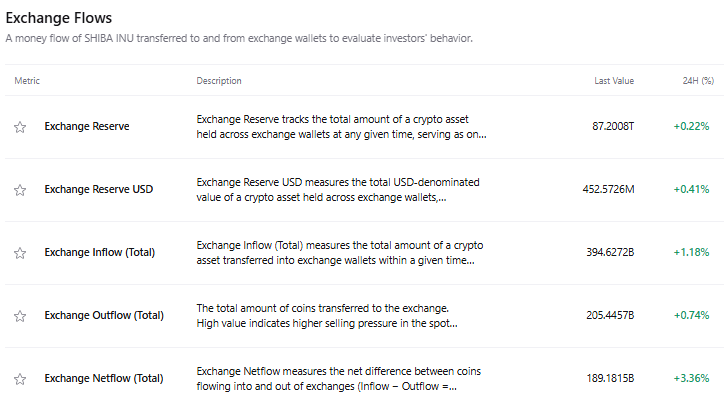
According to CryptoQuant data, exchanges recorded a net inflow of 189.18 billion SHIB over the past 24 hours. In other words, wallets deposited more SHIB into trading platforms than they withdrew during the period. 

Shiba Inu Exchage Flow

Generally, investors transfer tokens to exchanges when they intend to sell, trade, or otherwise deploy their holdings. Therefore, sustained positive exchange netflows can indicate rising potential selling pressure.

Coldcard Theft Funds Begin Moving as Hacker Routes Bitcoin Through THORChain

0

Stolen Bitcoin from the third wave of the Coldcard wallet attacks has begun leaving the hacker’s original addresses, with part of the holdings being swapped into Ethereum through THORChain.

The movement is the first recorded departure of funds from the original attacker addresses across any of the three waves, according to Alex Thorn, Galaxy’s head of research. Thorn said Wednesday that the third-wave attacker had moved about 10% of the stolen holdings, leaving roughly 90% untouched.

Several attempts to convert the assets have not gone through as intended. Thorn said the attacker’s swap attempts through THORChain had repeatedly resulted in refunds, prompting further attempts.

Researchers following the activity on-chain were able to trace the transfers beyond THORChain to a fresh Ethereum address. Thorn said the address had been passed to relevant authorities and crypto companies. He also said the attacker’s next step remained uncertain, including whether the assets would be moved again to make them harder to follow or transferred to an exchange.

Coldcard Attackers Remain Active

The latest transfers follow a broader Coldcard exploit that Galaxy Research has linked to the loss of at least 1,789 Bitcoin across 8,865 addresses. Those assets were valued at approximately $114.7 million when they were stolen.

Blockchain security company CertiK had also reported activity involving funds associated with the exploit in August, when 64 Bitcoin and 200 Ether were sent to cryptocurrency mixers, including Tornado Cash.

The latest movement comes days after Thorn reported further evidence that the Coldcard attackers remained active. A deliberately weakened wallet set up by a researcher was swept on Aug. 28. The wallet was designed to determine whether the attackers could locate vulnerable keys.