Home Blog Page 2205

TapJets and I-Remit Can Now Officially File Amicus Briefs In Lawsuit Supporting Ripple Against SEC

0

Judge Torres finally granted the firms’ requests to file amicus briefs in the lawsuit.


Judge Analisa Torres has approved I-Remit and TapJets’ requests for leave to file amicus curiae briefs in the Ripple vs. SEC lawsuit. The development comes after the Judge thoroughly reviewed the third parties’ requests to file amicus briefs alongside the parties’ reply.

“The Court has reviewed the requests by I-Remit Inc. and TapJets Inc. for leave to file amicus curiae briefs dated September 30, 2022, and the parties’ letters dated October 4, 2022, and October 5, 2022. Accordingly, the requests are granted,” an excerpt of the ruling read.

Following the approval, both TapJets and I-Remit must officially file their amicus briefs by October 14, 2022. In addition, the third parties are mandated to ensure that their briefs comply with the requirements outlined in Section III.D of the court’s practices in civil cases.

The development was shared by James K. Filan, a former federal prosecutor. 

Individual Third Parties’ Interest in the Suit

Recall that both TapJets, a private jet charter company, and I-Remit, a Philippine-based settlement company, requested to file amicus briefs supporting Ripple. 

The companies noted that their interest in the case stems from their use of Ripple solutions, which could see the lawsuit’s outcome impacting their business operations.

I-Remit uses Ripple’s On-Demand Liquidity (ODL) solution for cross-border settlements. On the other hand, TapJets accepts XRP as a payment method for its services, which it uses to solve the “Friday Night Problem.” 

SEC and Ripple’s Replies 

While the companies declared interest in the lawsuit due to their adoption of Ripple’s solution, the SEC kicked against their involvement in the case.

The Securities and Exchange Commission said it would be prejudiced by its inability to verify the claims of the third parties. As a result, the SEC asked the court not to grant their requests to file amicus briefs.

Responding to the SEC’s objection, Ripple said the agency should not have started the lawsuit if it could not evaluate independent third-party claims.

“Nothing could be more to the point than these two amicus briefs refuting (or at least disputing) both [claims that the SEC made about XRP purchase],” Ripple added.

Following Ripple’s backing, Judge Torres granted TapJets and I-Remit’s requests to file amicus briefs in support of the blockchain company.
Users Can Now Make Payments Using LUNC In 180 Countries With Apple Pay, Samsung Pay, and Google Pay

0

The Terra Classic Community Can Now Make Payments Using LUNC In 180 Countries.


LUNC can now be used for payments using Apple Pay, Samsung Pay, and Google Pay.

In a tweet today, popular crypto influencer Travis Dickenson also known as Travaladd Crypto, disclosed that Terra Luna Classic has now been integrated with Okse. This non-custodial crypto wallet offers users access to a Visa card that enables them to use crypto for payments.

Consequently, users can now use their LUNC to make payments in 180 countries via Apple Pay, Samsung Pay, and Google Pay.

Moreover, Eljaboom claims that all of this is happening on-chain, which means it is subject to the 1.2% burn tax.

Notably, several community members have celebrated the development lauding Travaladd Crypto and Eljaboom for their efforts in making it happen.


Both influencers direct users to get some OKSE which is currently only available on Bybit and Pancake Swap. To use LUNC for payments, users must complete a KYC, deposit BEP20 LUNC to the wallet, then deposit the same to the card. See the video below:

All the tweets were retweeted by the official OKSE Twitter account, confirming the development.

It bears mentioning that it is a big win for the community as it offers on-chain utility, which has been a cause for concern since the community started rebuilding efforts. Additionally, it could greatly speed up the rate of burns as it will be subject to the 1.2% tax burn. Notably, the community is voting on a proposal to reduce the tax parameter to 0.2% to incentivize on-chain transactions, as volumes have largely dropped since the tax implementation.

It is worth noting that since gaining control of the chain in August, the LUNC community has kicked off efforts to rebuild the chain in earnest. The efforts so far have revolved around 3 main goals; reducing LUNC supply, chain development to attract projects, and reclaiming the TerraClassicUSD (USTC) dollar peg.

LUNC is trading at the $0.0002964 price point, up 4.12% in the last hour.

Ripple CEO Confirms No “Answers” in Ongoing Lawsuit Against the SEC This Year

0

Garlinghouse is expecting an answer to Ripple’s summary judgment motion by the first half of next year.


Brad Garlinghouse, CEO of Ripple Labs, said he is not expecting the court to give an “answer” to the company’s summary judgment motion against the SEC this year.

According to Ripple’s CEO, sued by the Securities and Exchange Commission, the court would likely rule on the case by the first half of next year, Garlinghouse tells Bloomberg.

He stated that it is difficult to predict court proceedings, which is why he cannot predict the exact period the court would likely give its ruling on its summary judgment motion. 

“I think we’ll have an answer in the first half of next year. We shall see whether that’s the first or second quarter,” the Ripple exec said.

Ripple Open to Settle With SEC

It can be recalled that the Silicon Valley tech company filed its summary judgment motion last month, asking the court to dismiss the lawsuit. Ripple claimed that XRP is not a security, as alleged by the SEC.

Per Garlinghouse, should the court rule that XRP is not a security, Ripple would consider settling with the Securities and Exchange Commission.

XRPL Labs Finally Launch On/Off-Ramp Service For XRP In The Netherlands

0

XRPL Labs Finally Launch On/Off-Ramp Service For XRP In The Netherlands With Germany, Belgium, And The UK Possibly Next.


XUMM Pro wallet users in the Netherlands can easily swap their Euro for XRP and vice versa without any third party.

XRPL Labs, in a tweet today, has announced that the long-anticipated on/off-ramp service is now finally live in the Netherlands, with plans to expand to other parts of Europe and the UK.

“We launched our own on-ramp/off-ramp service,” tweeted the firm. “Starting with a pilot in The Netherlands, we’re aiming for EU+UK coverage in due time.”

Notably, only the on-ramp is available now. The off-ramp is scheduled to go live later this week.

Service Requirements

It bears mentioning that the new service is available only to XUMM Pro wallet users, as explained by XRPL Labs developer Wietse Wind in a long thread. Notably, there are Know-Your-Customer (KYC) requirements to use the service. Interested customers will be required to have at least 2 of the following:

  • Dutch Bank account
  • Proof of address in the Netherlands 
  • Dutch Passport

Wietse Wind assures users that they do not have to worry about their data being shared with a third party as it is a fully XRPL Labs-operated service fully approved by the Dutch central bank.

Notably, the service is not available for businesses.

How It Works And Costs

According to Wietse Wind, to purchase XRP, users will be given a description with which they can send their Euro from their international bank account number (IBAN) to XRPL labs’ to receive their XRP in minutes. Notably, the developer assures users of the best possible rates. It bears mentioning that the service has a yearly fee of about $5 in addition to the XUMM Pro wallet yearly subscription of about $60. Despite these costs, Wietse Wind assures users that it is more convenient than using other third parties.

Notably, XRPL Labs has set its sights on launching in Belgium, Germany, or the UK next. Wietse Wind disclosed the development of the service in July while clarifying that the development team had no plans to launch a XUMM wallet native token.

While there are plans to launch outside the Eurozone, the developer believes that the rates may not be as favorable as they are likely to launch the service with the help of a third party.

Shiba Inu Completely Takes Over SHIB Burn Portal, Ends Relationship With Ryoshi Vision 

0

Shiba Inu ends its relationship with Ryoshi Vision and takes over Burn Portal operations.


Leading canine-themed cryptocurrency project, Shiba Inu (SHIB), has announced that it has completely taken over the official burn portal and has ended its relationship with the Ryoshi Vision (RYOSHI) team.

According to a blog post today, the team behind the development of Shiba Inu will host the official burn portal as part of the project’s decentralized exchange (DEX), ShibaSwap.

Furthermore, Shiba Inu said it is working on additional burn utility mechanics that will be introduced alongside the upcoming Layer-2 network Shibarium.

“During the upcoming weeks, and as the portal transitions to being a fully run ShibaSwap platform, our team will focus on communication efforts for the platform with the community,” the blog post read.

Shiba Inu disclosed that it is also working on a suitable way to effectively reward users of the burn portal, adding that it welcomes feedback from the community on how best to implement the solution.

Following the announcement, the Shiba Inu team will continue to host the Burn Portal as a part of ShibaSwap. It will no longer require the “reliance or collaboration of Ryoshi Vision” to “deploy a reward system.” Shiba Inu team further confirms that the official SHIB Burn Portal, from now onwards, will be powered by Shiba Inu’s internal development team, who’s already working on additional burn utility mechanics with solutions such as the upcoming Shibarium protocol. The decision comes after Ryoshis Vision failed to deliver workflows precisely based on the platform’s promise.

Why Shiba Inu Cuts Ties With Ryoshi Vision 

There have been several complaints by both Ryoshi and SHIB communities over the inefficiencies of the burn portal to distribute rewards. Shiba Inu noted that all efforts to get in touch with the Ryoshi Vision team to solve the issue did not yield positive results.

Per the announcement, Shiba Inu decided to part ways with Ryoshi Vision after the project formed a new team to replace the previous ones.

Ryoshi Vision was originally tasked with managing the SHIB burn portal and distributing rewards to users who participated in the exercise.

Elon Musk’s “Boring Company” Launches Fragrance Accepting Dogecoin Payments

0

Musk promotes a new fragrance with Dogecoin among accepted payment options.


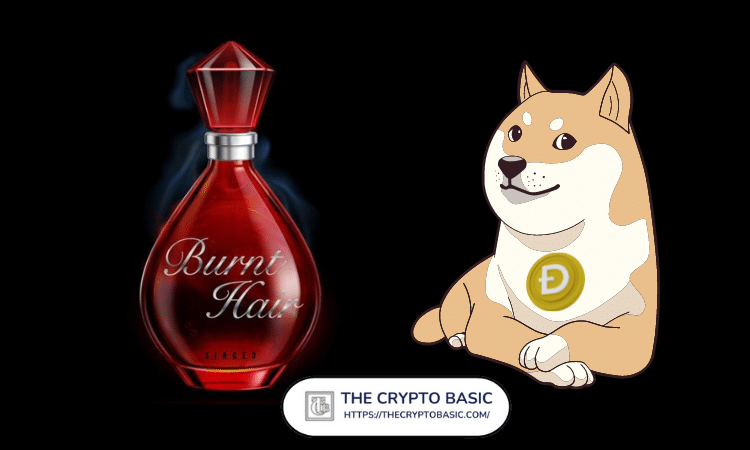
In a tweet today, Elon Musk promoted a perfume called “Burnt Hair” from The Boring Company, noting that people can make payments in Dogecoin.

“The finest fragrance on Earth!” as Musk describes it costs $100, including tax and shipping, for those within the US, according to the shopping page. Notably, this is a little above 1650 DOGE at current exchange rates. The product will ship in Q1 2023 for interested buyers.

Per the product description, it will make you smell like you leaned over the candle at dinner. While the context has many people confused, some see it as the perfect follow-up to the “Not-A-Flamethrower” launched by the company in 2018, which sold out over 20,000 units.

The Burnt Hair perfume sale comes a little less than a month after the Tesla Cyberwhistle, for which the company only accepted DOGE payments.

Notably, Elon’s long-running romance with Dogecoin as a means of payment continues. Elon especially confirmed by a tweet that the perfumes could be bought with dogecoin.

So far, according to ELON, 10K bottles of Burn Hair are already sold.


It bears mentioning that after the billionaire put the Twitter deal back on the table, DOGE spiked by over 8%. Today the beloved doggy meme token is up about 2.81%, trading at the $0.6062 price point.

SEC Reportedly Probing Bored Ape Yacht Club (BAYC) Creators Over Securities Laws Violation 

0

A source said the SEC is investigating whether Yuga Labs violated U.S securities rules via BAYC offerings. 

The United States Securities and Exchange Commission (SEC) is reportedly investigating Yuga Labs, the company behind the development of the famous non-fungible token (NFT) Bored Ape Yacht Club (BAYC). 

Sources familiar with the matter told Bloomberg that the U.S SEC is scrutinizing the project to determine whether it violated the country’s securities laws during the offering of BAYC. According to the source, the financial regulator is examining whether the Yuga Labs’ NFTs are akin to traditional financial instruments – stock – which would require the company to follow the same disclosure rules. 

The source requested that his identity should not be revealed because the ongoing investigation is still private. It is noteworthy that since the creation of Yuga Labs, the company has not been indicted of any wrongdoings. 

The recent development does not automatically imply that the Securities and Exchange Commission will slam a lawsuit against Yuga in the coming weeks. 

However, if the SEC is convinced that Yuga Labs breached its rules, the agency may gather as much evidence as possible before officially charging the company. 

Commenting on the development, Yuga Labs said in a statement published by Bloomberg: 

“It’s well-known that policymakers and regulators have sought to learn more about the novel world of web3. We hope to partner with the rest of the industry and regulators to define and shape the burgeoning ecosystem,” adding that “As a leader in the space, Yuga is committed to fully cooperating with any inquiries along the way.”

At press time, a spokesperson for the U.S. SEC declined to comment on the development. Per the source, the SEC is also investigating whether ApeCoin (APE), a cryptocurrency distributed to BAYC holders, is a security. 


Top Whale Sells 1.64B Shiba Inu, 623B in 21 Days But Still Holds 23 Trillion Shib

0

Shiba Inu (SHIB) plunges 5.7% as Top ETH Whale sold $1,646,400 ($1.64M) worth of SHIB in the past 24 hours and a total of $6.79 Million in the past 21 days.


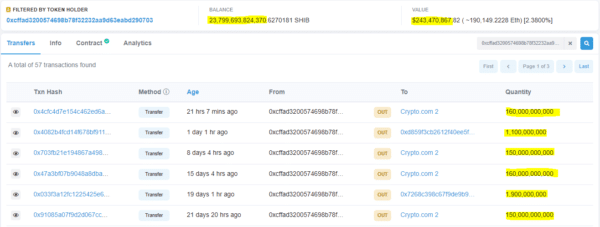
Etherscan.io, a blockchain explorer platform for the Ethereum blockchain, recently reported that the key ETH investor had reduced her SHIB holdings by 160,000,000,000 (160B) tokens, worth $1,646,400 ($1.64M) in one significant transaction in the past 24 hours.

According to the reports, the major ETH Whale has continued to shrink her Shiba Inu holdings since September 19th, 2022. The Whale offloaded 623,000,000,000 (623B) SHIB, worth $6,790,790 ($6.79M) through 6 separate transactions in the past 21 days.

The interesting thing is Whale still holds 23,799,693,824,370 (23.79T) canine-themed tokens, worth $243,470,867 ($243.47M).

Top ETH Whale Sold 6.79 Million Worth of SHIB in the Past 21 Days

Following the major selloff from deep-pocketed ETH investors, the CoinGecko data reports that the value of Shiba Inu depreciated -22.6% over the last 30 days, -7.7% over the last seven days, and -5.7% over the last 24 hours.

Whilst the blockchain data tracking website, WhaleStats reports that Shiba Inu still appears as the top favorite token of the top 100 ETH Whales. The top 100 ETH Whales currently hold $133,970,949 ($133.97M) worth of SHIB in their wallets.

At the time of writing, Shiba Inu is trading at the price of $0.00001032, down -5.7% over the last day, with a 24-hour trading volume of $278,464,852 ($278.46M).

Binance CEO Says Lesser Fees Would Lead To Greater Terra Classic (LUNC) Burns

0


CZ believes the lower the fees, the greater the burn, and he has the numbers to back it up.


In a recap of an AMA held three days ago shared by the Terra Rebels, Binance chief Changpeng Zhao, fondly called CZ, asserted that lower fees would produce greater burns.

“…to burn more and more LUNC, we need to have a minimal fee so that our LUNC fee revenue becomes the highest, and then we burn all of all revenue,” said CZ explaining that higher fees discourage trading activity. “Just charging more fees does not mean we have more income. Very often, charging more means you have less income. I think most of LUNC members think that if we charge 1.2%,  Binance will burn more LUNC, but it is a mistake.”

He also said:

“… we burn all of our revenue. We do not make any money from LUNC trading fees. We burn it all.”

He also encouragesd other exchanges to burn LUNC but said he do no control them.

“I also encourage other exchanges to do it… But I and LUNC community do not control other exchanges. So it’s up to every body else; we have done our part.”

It bears mentioning that despite earlier pressure from the Terra Luna Classic (LUNC) community to apply a 1.2% tax to off-chain activity, Binance opted to burn the 0.1% fees it obtains from trading instead. While this is a considerably lower fee, it has managed to burn almost twice as much as the 1.2% tax within the same period, with about 8.5 billion LUNC burned so far. 

Notably, despite the hype surrounding the 1.2% burn tax on on-chain activities, the tax has failed to meet expectations. For example, Terra developer Alex Forshaw highlighted in a recent blog post that the on-chain volume has declined by as much as 90% since its implementation.

Consequently, a new proposal has been launched to reduce the tax to 0.2% while reserving 10% of the tax obtained for the development of the chain. The proposer, known as Akujiro, hopes that the proposal can attract people who moved to central exchanges to avoid the tax back to on-chain activities.

Notably, Vegas, one of the most popular rebels, has said he thinks it is too early to change the tax parameter. However, the Terra Rebel has launched a poll opting to vote in favor of the community.

On the other hand, Alex Forshaw, who has always been opposed to the tax, hopes that the lower tax rate combined with the CosWasm update will attract a flurry of decentralized applications (DApps).

Cardano Staking Yields Almost A Third of Staked Funds in 5 Years, Data Suggests

0


Recent reports suggest investors could get a third of staked ADA in half a decade.


Assets running on Proof-of-Stake (PoS) blockchains allow their communities to earn passive income by staking their tokens. Validators utilize these staked assets for block validation to ensure a more secure blockchain.

Several PoS chains, such as Ethereum, BNB, and Solana, promise mouthwatering yields to stakers. Notwithstanding, an in-depth look at Cardano’s staking service indicates that the network might provide one of the best yield generations for stakers.

An unofficial community-based Cardano Twitter handle recently revealed the yield generation analysis.

“If you stake 100,000 ADA on Cardano for 5 years you will earn 30,000 ADA. It is almost 1/3 of the coins with which you started,” the handle highlighted in a tweet Tuesday.


The community-based account further challenged investors to compare the yields to what they would accrue from storing their assets in a savings bank account. The cryptocurrency community has often highlighted the benefits of storing one’s funds in digital assets rather than leaving them in a bank account.

Data from a spreadsheet shared indicates an approximate value of  0.435% in monthly yield on the amount of ADA staked by investors. This translates to a 435 ADA yield for every 100,000 ADA staked in a month.

Furthermore, there is a 5.43% promised annual yield for ADA staked by investors, per information. Investors expect 5,433 ADA for every 100,000 ADA staked in a year. Additionally, there appears to be a potential 30% yield in five years, as indicated on the spreadsheet.

This data puts Cardano’s staking yields up with top competitors like Ethereum and Solana. Notwithstanding, several proponents have come up to dispel claims made on the spreadsheet, noting that staking rewards have somewhat lowered below expectations over time.

Cardano staking yields have decreased by nearly 50% from the initial 7% two years ago to between 3.5% and 4% in annual percentage yield (APY). Nevertheless, this rate still appears decent to some investors compared to traditional finance.

ADA’s TVL has also seen a decline. According to data from DeFi TVL aggregator DeFiLlama, Cardano’s TVL has decreased by over 76% since the peak of over $320M witnessed in March. Cardano’s current TVL sits at $70.6M as of press time.