Home Blog Page 2231

Dogechain Launches Dogegress, a Governance Platform For Projects on Dogechain

0


Dogechain developers have launched a governance platform for Dogechain projects dubbed Dogegress.


The concept of community governance is one of the major highlights of decentralization. Community voting brings democracy to decentralized finance (DeFi) as it allows holders of an asset to have a say on projects built on the blockchain. Noting this, Dogechain seeks to give its community this privilege.

The launch was announced Wednesday by the Twitter handle for Dogechain – DogechainFamily. “Shibes, we have the pleasure to announce the launch of Dogegress, the dedicated decentralized governance platform for Dogechain projects. dogegress.dog,” the handle noted in a tweet.


As is traditional with governance tokens, at its initial stage of launch, the Dogechain team will present various development phases and projects of the network to the community for voting through the Dogegress platform.

“At launch, this platform will enable the Dogechain core team to propose governance votes on various development phases. This includes the upcoming Early Shibe vesting extension, using DC tokens.”

One such project is the Early Shibes Vesting Extension, whose voting process will mark the pilot of the governance platform. The community will have the opportunity to decide on whether the Early Shibes airdrop’s vesting period be increased from one year to four years or not.

Announcement of the Early Shibes Vesting Extension proposal is scheduled to come in on September 22 at 3 AM (UST). The Dogechain team has promised guidance on how to vote and provision of information regarding the conditions in due time.

As seen on the official Dogegress site, the option for making new proposals is currently greyed out as of press time. “Further down the road, the platform will also enable all project builders to create their own proposals,” the DogechainFamily handle mentioned.

Furthermore, all the tokens on the Dogechain network will be supported by the Dogegress platform. To this effect, the teams of other projects running on Dogechain will be able to make proposals for voting on their development phases as well.

Following its controversial launch, Dogechain appears to have taken a path of exponential growth. The Crypto Basic previously noted that the layer-2 network launched its unique naming service called “DogeNameService” on Monday.

Before the DNS announcement, the Dogechain team highlighted an outstanding feat that underscored the network’s surging adoption rate. According to the official Dogechain handle, as of September 5, transactions on the network had surpassed 15M. The achievement came three days after they announced a 10M milestone. These recent projects are likely to boost the network’s adoption rate further.

Bitcoin Short-Term Accumulation Loses Steam, A Perfect Time For Whales To Lift Market And Create FOMO?

0


Short-Term Bitcoin Accumulation Loses Steam as the Bear Market Persists.


CryptoQuant analysis reveals a slowdown of Bitcoin (BTC) accumulation by short-term investors, but the markets could be seeing a reversal soon.

The buy-the-dip sentiment is largely propagated by the majority of the crypto community, but only a handful actually see it through. When the markets are down, most investors are more focused on their underwater positions than seeing an opportunity to increase their holdings.

A recent CryptoQuant analysis indicates that this practice has persisted in this cycle, as the Bear Market becomes more intense. CryptoQuant analyst, Dan Lim uncovered this metric in his recent report on the general outlook of bear and bull markets.

Lim cited the Bitcoin UTXO Age Bands chart in the range of 1 week to 1 month – the territory of short-term investors. “As with all investment products, this indicator shows people always buy the most near the highs. And the longer the market falls, the less short-term buying,” he said.


As observed on the chart, short-term accumulation appears to have slowed down at the beginning of the year when the effects of the bear market kicked in. Despite a few cases of mild accumulation surges, purchases have seen a stunted growth till now. These mild accumulation surges can be attributed to the occasional relief rallies BTC staged along the way.

Taking this into consideration, Lim highlighted the fact that most investors who talk about buying the dip when the market is booming do not in fact carry out their initial plan when the market sees a prolonged downturn.

“And people who said they would buy when the BTC price falls, there are not many people who actually buy when the price falls for a long time,” he said. Situations like this are usually influenced by the dread of further dips, as most investors oftentimes do not believe the bottom is priced in yet.

Notwithstanding, Lim noted that it is only a matter of time before the markets set off on a path to recovery. The accomplished analyst mapped out two possible scenarios. 

The first scenario which he dubbed Case 1 involves a period of consolidation at this price range before a takeoff. The second scenario, Case 2, sees a slight dip from this price before a reversal. And when either of these scenarios kicks in, Lim mentioned that investors, like always, will express regrets about not buying the dip.

Whichever becomes the reality, Lim has noted that whale accumulation is likely to help with Bitcoin’s recovery campaign despite the selloffs from short-term investors. 

“However, like most things, the market moves against people’s psychology, and I am not sure if it will be Case 1 or Case 2, but if no one is buying as it is now, the whale will be ready at some point to lift the market,” he concluded.

Furthermore, both the BTC Exchange Reserve and Exchange Netflow metrics show some disturbing realities. BTC reserve on exchanges has recently seen a spike, indicating a higher selling pressure on investors. Additionally, net deposits of BTC on exchanges have risen of late.

Market watcher and CryptoQuant author JA Maartun pondered if this sudden rise in exchange reserve is influenced by preparation to hedge against further price declines as the community awaits the upcoming FOMC meeting.


Despite the recent trend of distribution from short-term investors, long-term holders appear to be accumulating more BTC with each price dip. The UTXO Age Bands in the range of 12 months up to 5 years see a significant boost in accumulation of late. The 12M ~ 18M category in particular has seen a surge since the start of the year.

Michael Saylor’s MicroStrategy revealed that they purchased additional 301 BTC between August 2 and September 19 in a recent SEC filing. This brings the company’s total BTC holding to 130k BTC, sealing its position as the largest institutional holder of the asset. The firm purchased the coins at an average price of $19,851.

MicroStrategy’s recent disclosure highlights the inverse reality of things with long-term whale investors. Despite the selloffs from short-term investors, whales remain largely unfazed and this attitude is just what the market needs. BTC trades at $19,135 as of press time, down 5.7% in the past week.

Over 9M Terra Classic Burnt By Tax Burn In Few Hours, Here’s How Much LUNC Would Be Burnt Weekly, Monthly & Annually

0


Terra LUNA Classic (LUNC) supply has been reduced by over 9 million in just two hours.


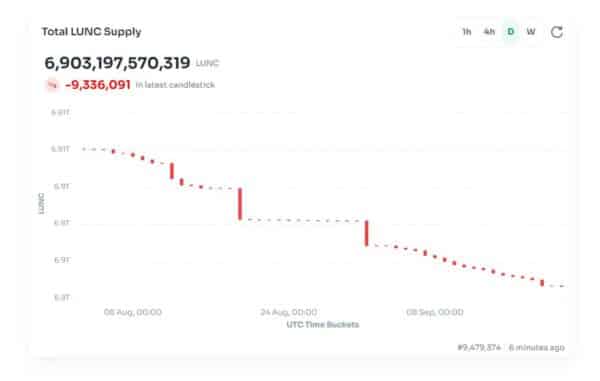
In just a few hours since the LUNC 1.2% tax proposal went live, over 9 million LUNC tokens have been burned already, according to data from LUNC validator StakeBin.

9.3M LUNC Burnt since 1.2% tax burn went live

It bears mentioning that the LUNC tax parameter change went live today at about 6:18 UTC after weeks of anticipation by the community. The tax parameter is programmed to run till the LUNC supply falls to 10 billion tokens. Notably, the current supply sits at about 6.9 trillion.

The Terra Classic network will need to maintain high volumes with a low LUNC price to get the most out of the tax burn. Moreover, even with these conditions in place, it could still take up to a decade for the network to achieve its goal with a burn rate of 1.2%.

In a Twitter thread on Tuesday, using only on-chain volume for the last two weeks, LUNC Burn, an unofficial account tracking LUNC burn activity, tried to give the community a sense of what can be expected following the parameter change should volumes remain high.

Going by last week’s volume of 1.17 trillion and applying the 1.2% burn tax, 14 billion LUNC can be burnt every week, 60 billion every month, and 720 billion yearly.

On the other hand, using the volume of 8.33 trillion LUNC from the week before, 99.96 billion will be burnt every two weeks, 199.92 every month, and over 2.3 trillion every year.

Approximately at these rates, it will take at least five years to take Terra classic total supply to billions.

Again the analysis emphasizes that the higher the volume, the greater the burn.

It bears mentioning that the 1.2% tax burn is not the only plan the community has in mind to bring down the supply of LUNC tokens. In a post released earlier this month co-authored by Terra Classic Core developer Edward Kim, the authors reveal a bold idea to help recover the dollar peg of TerraUSD (UST), now TerraClasicUSD (USTC), through a form of debt restructuring funded by the community. Notably, the original algorithmic controls that helped USTC could burn excess LUNC tokens at a faster rate.

Aside from on-chain transactions, the community has also received support from some trading platforms and exchanges to collect and burn the 1.2% tax from off-chain transactions like spot trading activity. Notably, MEXC Global was the first, running a 2-week burn event before the proposal went live, burning over 466 million LUNC in the process.

While the event is over, several community members hope the exchange will resume burning LUNC tokens as it said it could extend the initiative depending on community feedback. Meanwhile, yesterday, trading platform eToro revealed its plan to implement the proposal on trading activity along with Kucoin, and MEXC Global.

Several other exchanges like Binance, kraken have also pledged support but only for on-chain activity (deposits and withdrawals).

Ripple General Counsel Says SEC Chair Cannot “Appoint Himself As Cop On the Beat for Crypto” 

0

Alderoty takes yet another swipe at SEC’s boss.


The Securities and Exchange Commission (SEC) has been heavily criticized for its regulatory approach in the cryptocurrency industry, which many believe has continued to impede the emerging market growth.  

One of the cryptocurrency players who have constantly kicked against the SEC’s crypto regulatory approach is Stuart Alderoty, Ripple’s General Counsel. In a recent POLITICO Live interview, Alderoty spoke about the regulatory uncertainty of the U.S. cryptocurrency industry, especially SEC Chair Gary Gensler’s overreach in the sector. 


Alderoty Slams Gensler

Gensler had claimed that Bitcoin is the only cryptocurrency he believes to be out of the SEC’s jurisdiction. Thus, suggesting that all crypto assets aside from Bitcoin are security and should be regulated by the agency.

Responding to these claims, Alderoty said he is unaware of any election in the crypto space that resulted in the appointment of the SEC as the cop on the beat for crypto.

“Well, I don’t remember anyone holding an election for the cop on the beat for crypto. I don’t remember Congress appointing Gary Gensler as the cop on the beat for crypto.” Alderoty said, “You [Gensler] cannot self-appoint yourself as the cop on the beat for crypto.” 

Unclear Crypto Regulations in the U.S.

Alderoty said the United States crypto space had faced regulatory uncertainty for years compared to other sophisticated economic centers like Singapore, the United Kingdom, and Dubai.

The Ripple General Counsel added that the United States has been promoting politics and power over sound policies via the SEC, which has continued to hurt innovators, entrepreneurs, and retail investors.

“What we’re doing here in the U.S., I think principally through the SEC as an institution, is that we’re elevating politics and power over sound policy. Doing this, you’re not only hurting innovation, innovators, and entrepreneurs like Ripple, you’re also hurting the retail holders of these assets because one in five Americans own or have interacted with cryptos,” Alderoty said.

Alderoty had previously slammed the SEC for the massive loss the agency brought upon investors following its lawsuit against Ripple. He described the legal battle as a rug pull against XRP investors.

Bitcoin-Only Gaming Company Launches New Card Game To Earn Free BTC

0


THNDR: Earn Bitcoin While Playing Solitaire.


THNDR Games, a Bitcoin-only gaming company, has launched Club Bitcoin: Solitaire. The new game allows players to earn free BTC while playing one of the most popular card games.

“This release aims to bring free bitcoin to wider audiences: specifically female audiences and emerging markets.”

The stated mission of THNDR is to bring Bitcoin to the world through mobile gaming. This new game will specifically target female audiences and emerging markets, two demographics that are particularly underserved by the current cryptocurrency landscape.

According to stats, 2.6 Billion people around the world play mobile games. The interesting fact is that 63% of them are women. THRIVE’s mission to provide free Bitcoin to the world through play is progressing. Over 80% of its users are new to Bitcoin and earn their first free BTC in THNDR’s play-to-earn games.

Club Bitcoin Solitaire is a reimagining of the classic Microsoft game, which is installed on over 1 billion computers and still has 35 million monthly users and 100 million daily plays (as of 2020).

Bringing Bitcoin to the World

In 2019, the Microsoft Solitaire was inducted into the World Video Game Hall of Fame. TNDR plans to take advantage of this popularity by releasing a better game that pays players in Bitcoin.

“Solitaire and classic card games, in general, have mass appeal… Games like Solitaire offer a safe, familiar and fun environment for users to learn about bitcoin and earn their first sats. Club Bitcoin: Solitaire is THNDR’s next step in bringing bitcoin to the world,” THNDR stated in its press release.

The THNDR games are free for download on both the Google Play Store and the Apple App Store.

In-app purchases and ads will generate revenue for the company, which will be distributed to users through a daily prize draw in Bitcoin. Users can cash out their earnings at any time.

THNDR plans to release more games in the future that will pay players in cryptocurrency. The company hopes that doing so will help bring Bitcoin to the mainstream.

Ripple Says SEC Wants to Use New Tactics to Further Delay the Resolution of the Lawsuit 

0

The blockchain company has slammed the SEC’s recent suggestion.


Ripple has objected to the Securities and Exchange Commission’s plan to seek extra pages and time to respond to additional amici curiae briefs in the ongoing lawsuit.

As reported by TheCryptoBasic, the SEC noted that it does not take a position over the Chamber of Digital Commerce’s request to file an amicus curiae brief in the lawsuit. However, if attorney John Deaton submits his own amici curiae briefs, the SEC said it would require more time and pages to respond to amicus briefs.

Ripple’s Response to SEC’s Suggestion

While Ripple does not object to the Chamber of Digital Commerce’s request to file an Amicus brief, the blockchain company is strongly against the SEC’s suggestion that it would need more time and pages to oppose additional briefs.

According to Ripple, the comment is a deliberate attempt by the SEC to further cause unnecessary delays in the lawsuit.

“This is another attempt by the SEC to further delay resolution of this case, and the court should reject it,” Ripple said in its letter.

Ripple noted that it is not surprising to see multiple amici curiae seek to file briefs in the lawsuit because the SEC’s “overboard theory” of what should be security threatens an unwarranted expansion of its authority beyond what Congress permits.

The blockchain company added that the court has already set page limits for Amici briefs and opposition and cannot just grant additional pages to respond to arguments.

“The SEC is free to use the already allocated space in its opposition and reply briefs to address arguments raised by amici, and do so on the already-established briefing schedule, just as Defendants are. The court should not countenance the SEC’s request,” Ripple added.

However, should the court assent to the SEC’s request, Ripple said the changes should also apply equally to both sides.

Meanwhile, attorney Deaton, the lawyer representing over 72,000 XRP holders in a lawsuit against the SEC, took a swipe at the commission in a recent tweet, saying: “The claim that SEC lawyers, with all their Ivy League Law Degrees and wealth of experience in securities laws, need more time to respond to the “Twitter Lawyer”, (as they called me) is both pathetic and embarrassing.”

Web3 Won’t Go Mainstream Until There Is Seamless Blockchain Integration: With More and More Bridge Attacks, What Does This Mean?

0

Back in March 2022, the cryptocurrency network Ronin revealed it had fallen victim to one of the biggest hacks of all time, suffering a breach that allowed attackers to steal more than $540 million worth of Ethereum and USD coins. The incident saw hackers exploit a vulnerability in a service known as the Ronin Bridge. It’s one of a number of successful attacks on “blockchain bridges” recently that have drawn attention to their inherent security inefficiencies.

Blockchain bridges, sometimes called network bridges, are services that make it possible for crypto holders to move their digital assets from one blockchain to another. They provide an important role, because cryptocurrencies are often siloed and lack interoperability, meaning you can send Bitcoin to an Ethereum wallet address, for example. Because of this siloed nature, bridges have emerged as a key mechanism within the crypto economy.

Bridge services don’t actually transfer one kind of digital asset to another chain. Rather, what they do is “wrap” cryptocurrency tokens in order to convert them into a new asset on the other chain. So if a user wants to bridge Bitcoin to Solana, the bridge will essentially freeze the original BTC by locking it in a wallet address, before spitting out what’s known as wrapped BTC (WBTC) that can be used on the second chain. It can be thought of as a kind of gift card that provides the exact same monetary value, which can only be used in a specific store.

Due to the way they work, bridges therefore hold significant reserves of cryptocurrency tokens that are locked in smart contracts, and those reserves make them especially attractive to hackers.

As crypto stalwarts know only too well, any value that’s held on-chain is subject to attack at any time of the day. The internet never goes offline, meaning the tokens held by any bridge can always be accessed.

Ronin Hack Shows The Danger Of Centralization

 The attack on the Ronin Network was one of the biggest-ever DeFi heists in terms of dollar value. Ronin is an Ethereum sidechain that enables cheaper transactions at much faster speeds than the main network. It was the bridge of choice for the popular “play-to-earn” cryptocurrency game Axie Infinity, meaning it constantly processed millions of dollars in crypto and stablecoins.

Sidechains are a blockchain scaling solution that require a bridge to connect to other chains. With Ronin, users are able to lock up their ETH and mint wrapped ETH on alternative networks. Transactions are processed and approved via a Proof of Authority consensus algorithm. With this model, 5 out of 9 validators must agree on a transaction for consensus to be achieved. However, four of Ronin’s validators were operated by one company – Sky Mavis, the developer of Ronin.

It was a heavily centralized setup that resulted from the Axie Dao’s decision to set up a gas-free RPC node in November 2021 to try and fix network congestion. The DAO allowlisted Sky Mavis keys to sign transactions on its behalf. It was only supposed to be a temporary arrangement, but the allow list was never revoked. This created an opening for the attackers – said to be the North Korea-sponsored Lazarus Group – which used social engineering techniques to compromise Sky Mavis’s four keys. The hackers then discovered a vulnerability in the RPC’s code, giving it control of a fifth validator and allowing it to make an illicit withdrawal.

The main issue was that Ronin’s multi-signature system for signing off on transactions was compromised due to a lack of decentralization. It illustrates the weakness of security mechanisms where the majority of governance is concentrated in the hands of a single entity.

Smart Contract Vulnerabilities Persist

 The Ronin hack was not a one-off, but rather just the latest in a string of high-profile attacks on blockchain bridges that have resulted in millions of dollars worth of value being lost. One month earlier, attackers successfully made off with around $80 million worth of Ethereum following an attack on the Qubit Bridge.

It’s a service operated by the Qubit Finance platform, which enables users to lend and borrow digital assets across the Ethereum and Binance Smart Chain networks. For instance, it makes it possible to deposit an ERC-20 token and receive a BEP-20 coin in exchange, which can then be used on the Binance chain.

Qubit Bridge was hacked due to what was said to be a “logical error” within its smart contract’s code. The vulnerability enabled the hacker to manipulate the bridge using malicious data, so he or she could withdraw BSC tokens without making any deposit on Ethereum. An autopsy of the attack found that the QBridge smart contract did not properly verify that the required amount of ETH was locked. Instead, the hacker was able to show fake proof of a non-existent deposit.

The incident served to highlight how smart contract vulnerabilities remain a persistent problem in DeFi, and especially for blockchain bridges. The vast majority of bridge attacks target bugs in smart contracts, which are automated contracts that self-execute when certain conditions are met.

Bridges Are Key To Expanding Crypto’s Reach

 Crypto platforms have been subject to an endless stream of attacks ever since the nascent industry started becoming popular. Adherents of DeFi say it can provide a more accessible and equitable alternative to traditional financial services, but as the space has evolved it has been subjected to what is essentially a trial by fire. Attacks on bridges have become as commonplace as cryptocurrency exchange and DeFi protocol heists. The issue is that bridges, like exchanges and protocols, are high-stakes platforms that hold enormous amounts of value and any one of them could be vulnerable to bugs in their underlying code.

There’s a widespread belief that crypto and DeFi will never achieve widespread adoption without a proper solution to the risk of attacks. The vast majority of the world’s value is held by institutional investors, such as investment banks and big hedge funds. Such organizations prioritize compliance and the safety of their funds above whatever potential profits could be had. So DeFi and crypto is unlikely to become much more than a niche investment industry until its security problems can be resolved.

Bridge security is of special importance. The siloed nature of blockchains is a severe handicap that limits the potential reach of any decentralized application. A dApp built on Ethereum cannot talk to others based on different blockchains. It cannot transact with Bitcoin, the world’s most valuable and widely used cryptocurrency, meaning BTC holders have no way to interact with the DeFi ecosystem. If crypto is ever going to become ubiquitous, users must have a safe way to communicate with different chains.

Building Better Bridges

 The good news is that there are those in the industry who recognize the importance of secure blockchain connectivity. One exciting prospect is AllianceBlock’s highly promising AllianceBridge, which supports major networks including Ethereum, Binance Smart Chain, Avalanche, Polygon, Arbirtrum, Optimism and Energy Web with a unique infrastructure that’s more decentralized and delivers faster and safer performance.

Unlike centralized bridges, which rely on a single or just a few entities to verify that transactions are legitimate, decentralized bridges are based on the same principles as blockchain itself. There are multiple operators that utilize well structured consensus mechanisms to establish the validity of transactions. AllianceBridge is a decentralized bridge that has developed a unique method to ensure consensus is reached.

As with others, AllianceBridge locks the tokens it receives into a smart contract and then issues wrapped tokens on the target blockchain. Those wrapped tokens will exist on the second chain until such time as the user decides to redeem them on the original network. At that point, the wrapped tokens are burned, meaning they cease to exist, while the original tokens on the native chain are unlocked.

Where AllianceBridge differs is that it employs an EVM-compatible network of bridge operators. In addition, it leverages the robust, third-party Hedera Hashgraph Consensus Service that’s powered by an innovative “gossip-about-gossip” consensus algorithm.

Using the HCS service, blockchain applications and networks can submit messages to the Hedera public ledger, where they are time-stamped and ordered with full transparency. This makes it possible for AllianceBridge to reach consensus without maintaining synchronization between its bridge operators. This means faster performance with a high degree of decentralization, while HCS provides an extra layer of trust that makes the bridge more secure.

AllianceBridge’s smart contracts, which are used to lock the original assets and mint and burn wrapped tokens, provide even more reassurance. The entire smart contract codebase was written to resonate with the EIP-2535 standard and has been fully audited by Omniscia. During the audit, Omniscia pointed out a number of potential problems that were promptly fixed by AllianceBlock before the code went live.

The security and reliability of AllianceBridge has played a key role in expanding the utility of AllianceBlock’s suite of DeFi offerings, including DeFi Terminal, which provides an easy way for projects to launch liquidity mining and staking campaigns across multiple supported networks and dApps. With its secure blockchain interoperability protocol, AllianceBlock is building the robust foundation that a rich, interconnected Web3 ecosystem needs in order to grow and evolve.


126 Million Shiba Inu Burnt in One Transaction, 132M in 24 Hours As Burn Rate Soars 1502%

0

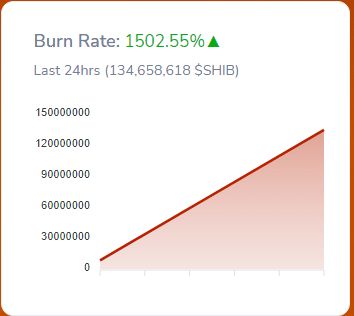
Shiba Inu’s Burn Rate is up 1502% as 132.77 Million SHIB Burned in the Past 24 Hours, 126.73 Million in One Transaction.


Shiba Inu’s Burn Rate Skyrockets 1502% as 132.77 Million SHIB Burned in the Past 24 Hours, 126.73 Million in One Transaction.

Shiba Inu’s Burn rate soars 1502.55% as the most powerful Community in the crypto space set fire to 132.77 Million SHIB in the past 24 hours. One of the Community-led Burn projects destroyed 126.73 Million SHIB in one significant transaction.

One of the Community-led Burn initiatives dubbed “1Cent” added fuel to the fire and caused Shiba Inu’s burn rate to skyrocket 1502.55% over the last day when only 8,402,785 (8.40M) SHIB had been burned.

Shiba Inus Burn Rate Skyrockets

1Cent, a SHIB Burn Project created by Shiba Inu holders, cremated a big chunk equal to 126,735,223 (126.73M) SHIB tokens in one worth mentioning transaction carried about 12 hours ago. The project also has destroyed 70 Bone ShibaSwap (BONE), in a separate transaction.

Why DeFi Could be a Disruptive Force in Finance Once the Interoperability Challenge is Solved

0

Financial markets have taken a great hit this year, with inflation and debt levels on the rise. But as the famous saying goes ‘in the midst of chaos, there is also opportunity’, the launch of Bitcoin in 2009 paved the way for an entirely new era of finance; decentralized markets. While it has taken over a decade for DeFi innovations to become a reality, this nascent crypto niche now enjoys over $52 billion in total value locked (TVL). 

Could DeFi be the way out of the current financial mess across the globe? Most crypto natives would argue that it is indeed the future; similarly, a fair share of traditional diehards believe DeFi is another passing fad. That said, recent trends indicate that DeFi is slowly becoming a darling in the retail and institutional market, with traditional banks such as JP Morgan softening their stance on digital assets. 

“Decentralized finance and blockchain are real, new technologies that can be deployed in both public and private fashion, permissioned or not.” – JP Morgan CEO, Jamie Dimon. 

DeFi’s Interoperability Dilemma 

As much as DeFi is a likely game-changer, there is much to be done before it can compete for the capital in legacy markets. Most notably, the existing innovations in this space are often limited to a single ecosystem, Ethereum currently leads the pack with a 55% market share of the TVL.  In other words, DeFi protocols are operating in siloed environments, which beats the logic of permissionless access to financial services under a unified market. 

Assuming an investor has their money on an Ethereum-based DeFi application, the process of transferring the funds to another ecosystem like Avalanche or Solana is not as straightforward. This is a big hurdle especially for newbies who are joining the Web 3.0 bandwagon. In fact, a good number of prospective DeFi stakeholders lose interest as soon as they realize how cumbersome it is to leverage opportunities across the board. 

On the brighter side, crypto innovators are always quick to adopt; the interoperability challenge is being addressed by several innovators in the industry. Some of the prominent solutions that have been launched in this line include Polkadot’s parachain, Cosmos Inter-Blockchain Communication Protocol (IBC) and the t3rn smart contract hosting platform. While the latter is the latest kid on the block, t3rn’s multi-chain infrastructure stands out from the rest. 

t3rn; The Open-Source Smart Contract Registry 

Before diving into the specifics, it is worth noting smart contracts are the pre-coded programs which are designed to operate as the middleman. Instead of relying on a broker or banker, DeFi protocols depend on smart contracts to automatically execute processes once the pre-coded conditions are met. However, until the launch of t3rn, most smart contracts were built specifically for one blockchain network. 

This smart contract hosting platform introduces a fundamental building block, one that unifies DeFi innovations under a single umbrella. Ideally, t3rn features a smart contract registry that can host diverse types of codes. Developers in the crypto ecosystem looking to create multi-chain products are flexible to contribute to the t3rn open-source repository, alongside additional perks such as remuneration anytime their code is executed by someone else. 

Should the world move to embrace decentralized markets, interoperability solutions such as the one offered by t3rn will be an integral part of the infrastructure. DeFi markets ought to offer the same utility to traditional finance, with an added advantage when it comes to self-governance and community incentives for contributing to the on-chain networks. 

Summary 

Financial market participants are currently in search of new solutions to disentangle themselves from the toxic nature of corporations and governments. With crypto assets having survived the uncertain times, it is time stakeholders put more consideration into their potential. Why suffer under the chokehold of third-party intermediaries when DeFi offers a peer-to-peer market environment? 

With decentralized ecosystems emerging as alternatives, the main focus should be fixing the underlying issues to attract more human capital and resources. At the core, innovators should make DeFi more interoperable and easily accessible to all. Solving this challenge will be big step into the future of finance. 

New Development Announced for First Ripple’s XRPL-Based Game

0

OnXRP Partners Styngr to Integrate Music Into Its Ripple’s XRPL-Based Game.


The partnership will curate the in-game radio station with a series of electronic dance music.

Leading music integration platform for metaverse and gaming, Styngr has announced a partnership with Ripple’s XRPL-based decentralized exchange onXRP. Under the partnership, Styngr will add music to onXRP’s upcoming blockchain-based battle royale game, Maladroids.

Notably, the partnership will see an in-game radio station alongside an electronic dance music playlist (EDM). Styngr also partnered with Dutch independent music label Armada music to feature some of the songs from the label’s artist. Additionally, new tracks from two major artists of EDM, Tom Starr and Kryder, will also be released in the game, Styngr added.

The artists will release two new tracks monthly from their collaboration with the game. 

Kaj Leory, CEO of onXRP, said it had been a fantastic journey working with Styngr and Ripple to launch music in the Meladroid’s in-game radio, adding:  

“It’s not every day that independent games studios can launch new music from well-known artists and to do so from the release of level one is an accomplishment for our brand. We’re excited for players to get into Maladroids and compete against friends and strangers as they discover great new music from Tom Staar and Kryder.” 

Also commenting on the development, Alexx Tarrand, the co-founder of Styngr noted that launching an entire album into a game is groundbreaking. 

“We are thrilled to be collaborating with record labels like Armada Music to bring brand new tracks from some of EDM’s top artists to blockchain gaming that leverage the best-in-class capabilities of the XRP Ledger,” Tarrand said.

Details

Meladroids is a game being developed by onXRP on Ripple’s XRP Ledger. In the game’s initial release launch this month, players will compete as droids in groups of 10 through an obstacle run, requiring speed and agility to push opponents to finish the race. OnXRP will launch new game modes and maps in subsequent releases. 

The game features Play-to-Win capabilities that leverage onXRP’s staking system. Through this, players can commit their OXP and XRP in a cumulative pool, whereby the first to finish the race takes all the tokens in the pool. Meladroids is the first game to be launched on Ripple’s XRPL.

OnXRP Facilitating XRP Purchase in the U.S.

Meanwhile, onXRP is one of the top U.S.-based decentralized exchanges that have continued to allow residents in the United States to purchase XRP despite the ongoing legal battle between Ripple and SEC.

In a report published this month, onXRP said 1,329 U.S. residents had purchased over 2 million units of XRP via its platform.