Home Blog Page 2238

Ripple General Counsel Slams SEC Chairman’s Recent Testimony Says “Does He Really Know The Law”

0

Ripple General Counsel Question SEC Chairman’s Interpretation of Supreme Court’s Security Test.


Ripple General Counsel Slams SEC Chairman’s Interpretation of Supreme Court’s Security Test.

Stuart Alderoty, the General Counsel at Ripple, has banged SEC Chairman Gary Gensler for misinterpreting the U.S. Supreme Court test to determine what should be a security. 

The general counsel of the leading blockchain company made this known in a tweet today, saying that he could not ascertain why Gensler misstated the Supreme Court’s test. 

He wondered whether Gensler misstated the test intentionally or if the misinterpretation was because the SEC chair did not understand the law. Alderoty posed a question to his followers to determine which of the scenarios could be worse. 

“In today’s Senate Banking Committee hearings, Chair Gensler misstated the Supreme Court test to determine what is and isn’t a security,” Alderoty said. 


Reactions to the Question

The question raised by Alderoty has prompted many responses from cryptocurrency enthusiasts, with many people stating their views on the issue. 

Attorney James K Filan said: “There are no accidents.”


LBRY, a crypto-related company currently in a legal battle with the Securities and Exchange Commission, also replied: “Your tact is admirable, but we all know which one it was.”

Gensler Defends SEC’s Regulatory Stance on Crypto

Alderoty’s view on Gensler’s comment comes a few hours after the SEC boss defended the agency in front of the U.S. Senate Banking Committee. 

Gensler noted at the hearing that aside from Bitcoin, all cryptocurrencies fit the definition of security and should be registered accordingly. 

He commented after skeptical senators noted that there is a possibility that some cryptocurrencies could be classed as conventional stocks. 

Pat Toomey (Penn.), the top Republican on the panel, said: 

“Crypto tokens have varying degrees of decentralization, they usually do not have a financial claim on the issuer […] These are very major and important differences from traditional securities, and they merit a clearly stated and tailored regulatory framework.” 

Responding to the Senators’ concerns, Gensler said the Supreme Court had already put to rest the argument on what assets should be classed as a security. 

The SEC chair said many factors can be used to ascertain security, adding: “It’s not one spectrum of decentralization versus decentralization.” 
Polygon (Matic) Now Available on Binance Card In Argentina

0

Binance Card Argentina Adds Polygon (Matic).


Polygon’s MATIC is now available on Binance Card in Argentina, as announced by a recent tweet. This is great news for those who want to use their crypto to make purchases, as it opens up a whole new world of opportunities. 

The Binance Card is a prepaid card that can be used at 90 million merchants worldwide, offering up to 8% cash back on purchases. There are also no fees for ATM withdrawals.

This huge development for MATIC will undoubtedly increase its adoption. This is also positive news for Binance, which is looking to expand its reach in the Argentinian market. With the Binance Card, users can spend their crypto easily, making it a more attractive proposition.

The Binance Argentina Card is a great way to use your crypto in the real world. It allows you to convert and spend USDT, USDC, BTC, BNB, ETH, ADA, SOL, MATIC, and other cryptocurrencies. With this card, you can purchase and pay bills directly with crypto, which reduces your exposure to the crashing peso.

When a payment is made using the Binance Card, the digital currency is immediately converted into other fiat currencies, and all fees and commissions are automatically deducted.

According to Maximiliano Hinz, general director of Binance Latin America, payments is one of the first and most visible applications for cryptocurrency, yet uptake has a long way to go. Merchants continue to receive fiat currency, and users pay in the cryptocurrency they choose using the Binance Card. We think that the Binance Card is a significant step toward wider crypto usage and global adoption.

XRP Ledger (XRPL) Back On Track To Launch NFTs As XLS-20 Proposal Fixed And Opened For Community Review

0


XRP developers respond swiftly to a bug in the XLS-20 proposal with a simple fix.


In a tweet on Thursday, the director of engineering at Ripple and author of the XLS-20 amendment proposal, Nik Bougalis, revealed that a new version of the proposal incorporating a fix to the bug identified on Monday is currently open for community review.

“And today, the proposed 1.9.4 release, which incorporates the fix described below, is up for review,” Bougalis wrote.

As previously highlighted by Combat Kanga, the fix to the bug was pretty simple, requiring a correction to a single line of code, and was coded up by developers the following day. Notably, the new fix limits NFT holders from selling NFTs for assets that the issuer does not have a trustline, allowing for seamless royalty payments. However, Bougalis says in the future, royalties paid in assets the issuer does not have trustlines for could be converted to XRP using a DEX.

When asked about a timeline for implementation, Bougalis noted that it depends on how quickly operators update. While admitting that there is some “upgrade fatigue,” the developer expressed hope for quick adoption of the new release.

It bears mentioning that The Crypto Basic reported on Monday that the launch of native NFTs on the XRPL had faced a setback following the discovery of a bug by xTokenize, hours to the implementation. Notably, the bug could max out a minters XRP reserve by creating an infinite number of trust lines at little cost to the attacker.

It is worth noting that Combat Kanga expects the full implementation to proceed in a month in the best case and two and a half months in the worst, as it takes time for operators to test and update their servers before voting can once again commence. However, the XRP community has been working towards native NFT functionality since last year, with developers expressing readiness in July.

XRP faithful will hope for a swift implementation as the introduction of NFTs promise to usher in a new wave of adoption.

OKLink Launches New EthereumPoW (ETHW) Explorer After Merge Upgrade Goes Live 

0

EthereumPoW is already making significant progress since launching on mainnet. 

With Ethereum Merge finally live, OKLink, a leading cryptocurrency data analytics platform, has launched a new EthereumPoW (ETHW) explorer. The solution will provide multi-dimensional on-chain data for the forked Ethereum network, which includes address overview, transaction information, block information, etc. 

“New ETHW Explorer Launched!! https://oklink.com/en/ethw. OKLink has launched the ETHW explorer, providing multi-dimensional on-chain data including transaction information, address overview, gas fee, block information, large transactions, and so on,” the official Twitter account of EthereumPoW tweeted. 

ETHW Launches Following ETH 2.0 Development

Following Ethereum’s plan to transition from a Proof-of-Work algorithm to a Proof-of-Stake consensus, miners slammed the idea, saying they would not move to the PoS network. 

Based on this, a fork of the Ethereum network was conducted to enable miners to continue with the existing PoW algorithm. EthereumPoW was launched by prominent miner Chandler Guo. After the launch of Ethereum Merge, EthereumPoW shared important details about the forked network, including the official RPC that users can add to their wallets and block explorer. 

Less than an hour after the link to EthereumPoW’s OKLink block explorer was shared, the ETHW website server crashed as a result of heightened user activities. 

ETHW Support Grows Despite Controversies

Since the launch of ETHW, there has been a lot of Fear, Uncertainty, and Doubt (FUD) around the project. People have warned about the likelihood of replay attacks, which could stem from interaction in the chain IDs between the forked Ethereum and the Proof-of-Stake ETH. Thus, allowing malefactors to submit transactions on both chains, and putting investors who interact with the forked Ethereum at risk of losing their ETH PoS coins. 

Despite these fears, EthereumPoW has continued to receive numerous support from cryptocurrency exchanges such as FTX, Bybit, and Bitmart. 

ETH PoS Successes

Meanwhile, Ethereum Merge has had a smooth launch, with significant successes recorded so far. According to famous cryptocurrency investor, Lark Davis, Ethereum has become more deflationary following the launch of Merge. 

He added that over 185 Ethereum coins have been burnt since the merge upgrade went live. 

New Solution Launched to Burn Three Times More Terra Luna Classic (LUNC) Tokens  

0

A new solution has been deployed to accelerate the burn rate of Terra Luna Classic (LUNC) tokens. 


Eris Protocol, a liquid staking and auto-compounding protocol for LUNC, was recently launched to burn three times more Luna Classic tokens at the same cost. 

Through Eris Protocol, users can stake their LUNC and still be able to move the tokens without having to wait for the 21-day un bounding period. These liquid Luna Classic tokens are called Amplified Luna (ampLUNC). The auto-compounding feature of the Eris Protocol allows for an increase in investors’ yearly yield. 

LUNC DAO, a Terra Community validator that uses its commission to burn the Luna Classic tokens, write details: 

“We found a way to burn WAY more for the same cost by working with erisprotocol.com, who just launched on LUNC You can also use this to multiply your LUNC.

eris_protocol is liquid staking, and auto-compounding protocol for LUNC Liquid staked LUNC on Eris is called $ampLUNC and lets you move around LUNC without having to wait for a 21-day un bonding period Auto-compounding of ampLUNC increases the yield you receive every year.

Therefore, if we send LUNC to the burn wallet, it simply stays the same amount of LUNC forever, But if we send ampLUNC to the burn wallet, it continues to receive staking rewards and burn the yield APY too. At current rates, approximately doubling the burn.

But wait, there’s more…Not only can we do this, but we can provide liquidity to the LUNC / ampLUNC pool on Astroport, then burn the entire LPNow we not only burn the auto compounded increasing value of ampLUNC, but also the APY from pool volume. This likely means burning >3X LUNC this year than the original 14.2M LUNC cost.”


Moves to Compensate Victims of Terra Collapse

The Eris Protocol solution joins the list of initiatives launched to compensate victims of the Terra ecosystem collapse. Burning part of LUNC supply is considered the best step to making Terra investors whole again. 

Investors recently passed a proposal to implement a 1.2% tax burn on all on-chain LUNC transactions. The proposal is scheduled to be implemented on September 20, 2022, and several exchanges have declared they would support the move. 

Some of the exchanges that have pledged support for the 1.2% tax burn include Binance, KuCoin, Gate.io, MEXC Global, Bitrue, etc. 

Terra investors are confident that they can revive the ecosystem’s classic tokens – USTC and LUNC – via consistent community efforts. 


Nassim Taleb, Author of “The Black Swan,” Says Economy Is Hurt By Creating Tumors Like Bitcoin

0

“The Black Swan” author Nassim Taleb, recently likened Bitcoin to a tumor, as he blamed the Fed for hurting the economy.


From environmental concerns to backlash for allegedly having the features of a Pyramid Scheme, Bitcoin has had its fair share of criticism. As the global financial scene faces unique troubles due to new realities, it appears these criticisms have not seen a stop, especially with Bitcoin’s recent correlation with traditional finance.

A Lebanese-American risk analyst and author of “The Black Swan,” Nassim Nicholas Taleb is the latest in line to slander the firstborn crypto. Taleb appeared on Thursday on CNBC’s Squawk Box show to discuss markets, risk, and uncertainty.

Squawk Box host Andrew Ross Sorkin sought Taleb’s opinion on the state of the American economy and if the Federal Reserve is making the right choices in combating the economic concerns. In response, Taleb noted that the growing issues with the economy are due partly to the inexperience of the younger generation due to living in a predominantly bubbling economy in the past.

“I think we’ve had 15 years of Disneyland that basically destroyed the economic structure… You are hurting the economy… creating tumors like bitcoin. There was at some point such a thing as a discount rate. All these notions escape the new generation.”

Furthermore, according to Taleb, the Federal Reserve’s lowering rates helped create “tumors like Bitcoin.” Taleb’s opinion stems from the fact that Bitcoin has mostly bloomed due largely to economic concerns.

The cryptocurrency adoption rate surged much higher in 2020 during the COVID-19 pandemic, as traditional finance hit a messy stop. Investors turned to Bitcoin and other digital assets as a hedge against the growing inflation and economic issues. Taleb thinks Bitcoin’s growth can be likened to a tumor. 

“The Fed overshot by lowering interest rates too much. The first 100 basis points worked; the second, much less. Zero interest rate, of course, for a long period of time; you’re hurting the economy, you’re creating bubbles, you’re creating tumors like Bitcoin,” Taleb said.

This would not be the first time Nassim Taleb has been swiping at Bitcoin. As previously reported by TheCryptoBasic in February, Taleb took to Twitter to criticize Bitcoin, calling the asset “a perfect sucker game” that only thrives when interest rates are down. Taleb’s comments followed Bitcoin’s crash below $40k at the onset of the bear market.

Furthermore, Taleb is also known for dubbing Bitcoin a “Ponzi Scheme,” noting that it is worth zero and cannot hedge against inflation. Taleb’s criticism of the asset came after he previously lauded it as a way for investors to protect themselves from the government’s control over money.

NASDAQ-listed BigCommerce Now Allows Merchants Across The Globe To Accept Shiba Inu As Payment

0

U.S.-based eCommerce Platform, BigCommerce Added Support for Shiba Inu (SHIB) via BitPay.


Now, tens of thousands of merchants from over 150 countries would be able to accept Shiba Inu (SHIB) along with 14 other major cryptocurrencies as payment since U.S.-based eCommerce platform, BigCommerce partners with the leading blockchain payment firm, BitPay.

BigCommerce, a NASDAQ-listed eCommerce platform, recently announced its partnership with the world’s leading crypto payment gateway Bitpay to allow BigCommerce merchants all across the globe to accept cryptocurrencies easily and in the most secure way. BigCommerce’s merchants and other payment methods can now offer crypto payments with with single-click integration.

The partnership will allow BigCommerce merchants to accept a total of 15 cryptocurrencies. The list of supported cryptocurrencies includes Shiba Inu (SHIB), Dogecoin (DOGE), Bitcoin (BTC), Ethereum (ETH), and others.

According to the Press release, Bigcommerence merchants can accept the following crypto as payment:

“With BitPay, merchants can accept a variety of cryptocurrencies, including Bitcoin (BTC), Ethereum (ETH), Dogecoin (DOGE), Bitcoin Cash (BCH), Shiba Inu (SHIB), Wrapped Bitcoin (WBTC), Litecoin (LTC), XRP (XRP) and 5 USD-pegged stablecoins (BUSD, DAI, GUSD, USDC, and USDP). Having pioneered blockchain payment technology, BitPay has processed more than $5 billion in payments volumes since 2011 and supports over 100 crypto wallets.”

Founded in 2009, BigCommerce is a NASDAQ-listed eCommerce platform based in Austin, Texas, United States of America (USA). The company is launched to support merchants all across the globe while building, innovating, and growing their businesses online. BigCommerce is currently operational in over 150 countries and has hired over 1000 employees to serve its client merchants to reach their fullest potential. As of 2022, over 60,000 merchants use BigCommerce from all across the globe, with the United States, Australia, United Kingdom, Canada, and India in the top five.

Cardano Number Of Total Transactions Surpasses 50 Million

0

The leading Proof-of-Stake (PoS) network Cardano transactions has hit a new milestone.


The total number of transactions processed on the Cardano network has surpassed 50 million.

According to data from the blockchain explorer of Cardano, Cardanoscan.io, the Charles Hoskinson-led blockchain has now processed a total of 50,014,931. Cardano achieved the milestone after completing 51,686 transactions yesterday. 

Data from cryptocurrency on-chain analytics firm Messari shows that Cardano currently has a transaction count of 51,7033 daily, with the volume expected to soar tremendously once Vasil hard fork goes live. 

It is noteworthy that the current transaction volume of Cardano represents regular transactions between users and various trading operations across various Cardano-based protocols.  

Aside from Vasil’s hard fork, several solutions, like decentralized borrowing and lending, synthetic tokens, and Djed stablecoin, are expected to bolster Cardano’s total transaction volume in earnest.

The spike in Cardano transactions is a positive development for the entire ecosystem. Growth in transactions will positively impact Cardano’s evolution as the fees received from these transactions will be used to encourage developers to continue building on the network. This, in turn, would lead to the launch of significant decentralized applications (dApps), thus boosting the mainstream adoption of Cardano and its native cryptocurrency ADA. 

Cardano Prepared for Widespread Adoption

Cardano is currently up to the task of receiving as many users as possible, as the team behind the blockchain’s development, Input Output Global (IOG), is known for always building the project. Earlier this week, Cardano led other crypto projects regarding developers’ activities. 

“Our team analyzed the development activity of 7,400 crypto projects in August and improved our algorithms. Cardano is a new leader!” Centora, a platform tracking social and technology-related data on cryptocurrencies, said in a tweet. 

Cardano has not experienced any downtime since it went live in 2017, and the development team is releasing more upgrades for the network to strengthen it.

45% of Ethereum Nodes Post-Merge Run by Only Two Addresses, Posing Centralization Risks

0

Is Ethereum Decentralized After Merge?


Data from Santiment indicates that over 45% of the Ethereum nodes run so far following The Merge are attributed to only two addresses which arouse new centralization concerns.

The Ethereum and broader crypto community have been anticipating The Merge since its announcement. Several proponents within the space have dubbed it the most revolutionary event in the crypto space for a while due to the immense transformation it brings to the Ethereum blockchain.

Notwithstanding, Ethereum’s transition to Proof-of-Stake might not be without fundamental issues, as Santiment data arouses some fresh centralization worries.

Crypto data feed and analytics platform Santiment took to Twitter to share a shot of its “Ethereum Post Merge Inflation” dashboard on Thursday, a few hours after The Merge happened. Interestingly enough, according to information from the shot, over 45% of all nodes run on the Ethereum PoS chain so far are attributed to just two addresses.

“This heavy dominance by these addresses is something to watch.”


The first address has a share of 28.97%, contributing to the validation of up to 188 blocks alone. Additionally, the second address has validated 105 blocks, taking a large chunk of 16.18% contribution. Both these addresses have cumulatively validated 293 blocks, representing a share of up to 45.15% of all validated blocks.

“This heavy dominance by these addresses is something to watch,” the Santiment handle added, as the hegemony of the two addresses appears to confirm previous allegations of a prospective centralized state for Ethereum in the event of a switch to PoS.

As a response to the tweet from Santiment, a proponent who goes “Soroush” alleged that both addresses could belong to the Ethereum Foundation and American multinational investment bank JPMorgan Chase & Co. She noted that her assertions have been proven right after six years. “Ethereum is the biggest lie and fraud in the history of blockchain and investment,” she added.

According to Martin, the top seven entities controlling over 2/3 of the stake is disappointing.


Pre-Merge, there had been several concerns of a centralization issue arising from Ethereum’s switch to PoS. Several Bitcoin maximalists and other crypto proponents have brought up claims about this centralization issue from different directions. Notwithstanding, the Ethereum team has debunked these claims each time.

Co-founder of Web3 storage infrastructure, Maggie Love, shared a disturbing discovery about Ethereum nodes last month. Taking to Twitter, Love shared a shot indicating that most Ethereum nodes are run on centralized providers. Additionally, it appears Amazon Web Services (AWS) dominates in this sphere, contributing a 52.1% share, with 1,442 nodes then.

Speaking on this, Love noted, “Ethereum cannot be decentralized if the stack is not decentralized… ” Besides AWS, Hetzner Online GmbH has 467 nodes, with a contribution of 16.9%. 


Furthermore, there have also been concerns about Ethereum being centralized due to the fact that liquid staking service, Lido accounts for over 31% share of all staked ETH. This has further raised concerns about the Ethereum blockchain being more vulnerable to censorship as a PoS chain.


Dogecoin Becomes Second Largest Proof Of Work (PoW) Crypto

0

Dogecoin Becomes Second Largest PoW Crypto Following Ethereum’s Shift to Proof of Stake (PoS).


Dogecoin is now the second largest crypto-asset powered by mining, as The Merge successfully transitions Ethereum to PoS.

dogecoin is now 2nd largest PoW crypto


The much-anticipated Ethereum Merge is finally here, bringing with it certain changes the crypto space has been expecting. One of these changes directly affects the canine-themed meme coin Dogecoin. 

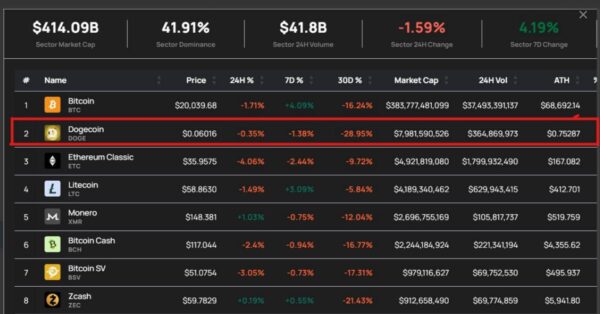
DOGE, which had remained the third largest PoW cryptocurrency before The Merge, has now moved to second place, bestriding notable assets such as Ethereum Classic (ETC) and Litecoin (LTC). Dogecoin is only below the firstborn crypto Bitcoin (BTC), on the list.

With a market capitalization of $8.04B at the time of reporting – per data from CoinMarketCap – Dogecoin still comfortably places itself in the 10th position of largest cryptocurrencies, considering all assets, including PoS tokens. 

The shift to the second position of the largest PoW assets is an outstanding achievement for the meme coin, considering its initial frivolous outlook and the sentiments surrounding it. A Dogecoin proponent who highlighted the feat on Twitter acknowledged the surreal nature of the accomplishment. “Who would have thought that this would happen? Congrats, Dogefam,” he remarked.

As noticed on the screenshot shared, amongst the top PoW cryptocurrencies, Ethereum Classic (LTC), Litecoin (LTC), Monero (XMR), and Bitcoin Cash (BCH) respectively secure third, fourth, fifth, and sixth positions.

The fact that Dogecoin sits above Litecoin on the list despite being launched two years after it underscores the increasing interest in the asset. Launched in 2013, Dogecoin has crept into the hearts of several proponents, including billionaire and Tesla CEO Elon Musk. They had in the past repeatedly given the asset-free PR on Twitter.

As previously reported, by TheCryptoBasic, Elon Musk’s Tesla recently put up its premium collectible Cyberwhistle for sale, with Dogecoin being the only currency accepted for its purchase. Priced at 1000 DOGE – an approximate value of $60 against prevailing rates – the collectible sold out hours after Musk promoted it on Twitter.

Dogecoin, in part, has Ethereum to thank for this recent unconscious leg up. The Ethereum Merge, which occurred on September 15 at a Total Terminal Difficulty (TTD) of 58,750,000,000,000,000,000,000, remains the talk of the town. The entire crypto space is currently abuzz, as proponents acknowledge the event’s significance.

By transitioning Ethereum to PoS, The Merge successfully reduced Ethereum’s energy usage by over 99% – this translates to a reduction of global energy usage by 0.2%. Notwithstanding, the ETHPoW – the Ethereum hard fork chain which would continue utilizing mining – is likely to go live soon as well. The official Twitter account of the ETHPoW mentioned that the 1-hour countdown to the mainnet release would go live in under 23 hours.