Home Blog Page 2250

What Determines the Price of a Cryptocurrency?

0

Introduction

It is a fairly known fact that cryptocurrencies are one of the most volatile asset classes in history. It is not uncommon for cryptocurrency assets to record triple-digit gains or losses in a single day as they grapple with the forces of supply and demand.

This feature of cryptocurrencies has attracted daring traders to the markets looking to strike a fortune, while still keeping risk-averse investors away from the space. While it may seem like crypto prices have a mind of their own, there is a science behind these price fluctuations.

As traders walk the tightrope of wild price swings, the use of a coin price tracker like CoinStats is a sure-fire way to always stay one step ahead of the volatility. The crypto portfolio tracker has features like auto alerts, a stellar news aggregator, and access to enterprise-grade research tools to take trading to the next level.

Several factors play a role in the wild price swings including the utility, cost of creating new tokens, and government regulations amongst others. This piece will delve into details on what determines the price of a cryptocurrency and without further ado, let’s dive right in.

1.   Factors of Supply and Demand

Although cryptocurrencies stand apart from other types of assets, they are still governed by the forces of supply and demand. The general rule of thumb is that cryptocurrency prices increase when there is a spike in demand amongst traders, and an oversupply of a crypto asset will lead to a fall in prices.

To balance the forces of supply and demand, cryptocurrency projects have employed elaborate processes to control the circulation of tokens. Some of the processes are implemented in the token minting stage to regulate the creation of new tokens. For example, with each mined Bitcoin block, only a fixed amount of BTC enters into circulation. The use of a fixed maximum supply for cryptocurrencies is another method of maintaining equilibrium, with Bitcoin going the extra mile to introduce a halving feature to create scarcity.

Cryptocurrencies without a fixed maximum supply have adopted the strategy of burning existing tokens to put a lid on circulation. The common means of burning is to send the tokens to an unrecoverable address, and this strategy has been employed by projects like Shiba Inu and Ethereum to relative success.

2.   Minting New Tokens

The creation of new tokens plays an integral role in crypto prices. Cryptocurrencies, especially those with a Proof-of-Work consensus mechanism, generate new tokens through mining, i.e. solving complex mathematical problems through computing power.

This method of crypto mining often requires the use of expensive mining equipment and large amounts of electricity supplies to function. Given the high costs of mining processes, miners will only be incentivized to secure the blockchain network when they will be sufficiently rewarded for their efforts.

The complexity of the mining process of a particular cryptocurrency contributes to an increase in its price. This is particularly evident in Bitcoin and Ethereum, the two largest crypto networks that have reached highs of $64,789 and $4,891 respectively, and consume the most electricity in their mining processes.

3.   Fundamentals

Cryptocurrency traders often approach the markets by focusing on technicals by peering at the charts for hours. However, reports and activities around a particular cryptocurrency project are often decisive in determining prices.

For instance, reports of technological advancement or a groundbreaking partnership will precede a bullish run. Ethereum’s London hard fork and Cardano’s Alonzo hard fork were the precursors for the bullish runs that led to the all-time highs of their native tokens.

Negative reports around a cryptocurrency project will send prices crashing to rock bottom as it triggers waves of bearish sentiments. Reports of a security breach or a botched upgrade have historically led to falling prices, with the DAO hack of 2016 leading to Ethereum’s decline.

4.   Listing on Exchanges

Cryptocurrency exchanges play important roles in determining the prices of crypto assets. Projects listed on the popular exchanges increase the options of investors, leading to increased demand. This spike in demand correlates to an increase in asset prices.

For crypto projects listed on smaller exchanges, retail and institutional investors will not have diverse options to invest capital in those projects. A study from Messari noted the phenomenon of the “Coinbase Effect” in which crypto tokens recorded a marked spike in their valuations after being listed on leading exchanges.

Crypto exchanges play the role of providing liquidity to cryptocurrency traders. Low levels of liquidity are often behind high market volatility, while the presence of high liquidity ensures that the price swings are not chaotic. Bitcoin and other large-cap cryptocurrencies do not experience triple-digit swings in a day, but cryptocurrencies with small caps are susceptible to increased levels of volatility.

5.   Government Regulations

The rise and fall of cryptocurrency prices can be linked to the actions of government agencies and legislative houses. One positive law giving cryptocurrencies legal status in a jurisdiction can send prices to new highs, and a crackdown on cryptocurrency activities can spell bearishness for prices.

China’s infamous crackdown on cryptocurrency activities in 2021 nearly sent the ecosystem to a crypto winter, and the SEC’s prolonged court case with Ripple Labs has had an adverse effect on XRP’s price.

On a positive note, the approval of Bitcoin ETFs in the U.S. and the European Union’s decision to not ban Proof-of-Work cryptocurrencies within its borders was a bullish moment for the crypto prices globally.

Conclusion

Cryptocurrency prices are determined by the interplay of several factors like government regulations, exchanges, media reports, and the duo of supply and demand. An understanding of these factors would be an added advantage for traders, helping them to make the right trading decisions.

Investors that are risk-averse may decide to stick with large-cap cryptocurrencies that do not have the downsides of erratic price changes, while those with a large risk appetite may wade to crypto assets with smaller market capitalization. Regardless of the side of the divide you stand on, a knowledge of the factors that determines cryptocurrency prices will be useful in navigating the markets.

Dogechain (DC) Transactions Soars 50% to Over 15 Million in 3 Days

0

Dogechain Adoption is growing.


The Dogecoin ecosystem has continued to record tremendous growth despite the controversies that marred the project at its inception.

In a recent development, the official Twitter account of Dogechain said a total of 15 million transactions had been recorded on its network. The feat comes a few days after Dogechain announced that it had surpassed 10 million transactions. 

In just three days, Dogechain transaction volume spiked 50%, thus bringing the total number of transactions carried out on the network to more than 15 million. 

“Just 3 Days ago on 09/02, we announced we crossed 10 Million transactions on Dogechain. We just crossed 15 Million. +50% In 3 Days… Global adoption is increasing,” Dogechain tweeted. 

Widespread Adoption of Dogechain Amid Controversies

The development suggests a widespread adoption of the meme-based cryptocurrency chain despite its controversial launch.

Recall that the Dogechain project was marred with major controversies when it officially made its debut. First, ZachXBT, a famous crypto investigator, disclosed that 20 million Dogechain tokens (DC) were sent to a developer linked to the project. Shortly after the transfer was made, the address started dumping the tokens on unsuspecting investors, which harmed the cryptocurrency’s price. 

While the project was still trying to address the negative news, it was reported that the team behind Dogechain offered Dogecoin (DOGE) founder a $14 million bribe to promote DC to the Dogecoin community. Which the doge founder rejected.

Ordinarily, these allegations could have been the end of most crypto projects. However, Dogechain turned these controversies into strength and continued to grow.  

DC Down 20% in 24 Hours Despite Massive Adoption

Since it went live, DC’s adoption has skyrocketed. The token has also been listed on top cryptocurrency exchanges, including KuCoin, Gate.io, and Huobi. 

Dogechain is currently among the top 10 trending coins on Coingecko, suggesting a growing interest in cryptocurrency. DC is currently changing hands at around $0.0022, down 20.8% in the last 24 hours.

Kucoin Ran Out Of LUNC, Binance LUNC Trading Volume Crosses $1B As Terra Luna Classic Up 70% In 24 Hours

0


Terra LUNA Classic (LUNC) Price Rallies By 70% As Trading Volumes On Exchanges Spike.


According to Coimarketcap data, Terra Luna Classic (LUNC) is up as much as 70% this morning. The trading volume on Binance is around $1.2 billion as the project continues to attract increased attention in recent weeks.

Terra LUNA Classic Up 70%
Terra Classic Up 70%
Terra Luna Classic volume

Notably, a user on Twitter with the handle LUNC DAO noted that the demand has been so high that KuCoin ran out of tokens.


The renewed interest in the Terra Classic project comes as the community has taken it upon itself to revive the project with burn initiatives to bring down the supply of the excess LUNC tokens.

The most recent initiative by the community is a tax policy proposal to take a 1.2% tax on all on-chain transactions. Notably, the collected tax in LUNC tokens will be sent to the burn address provided by Terra.

It bears mentioning that the proposal has received support from Uk based crypto exchange Y5 Crypto and MEXC Global. The proposal appears to have been approved as MEXC has already started burning LUNC tokens. According to updated information on MEXC’s blog, nearly 48 million LUNC have been burnt in fees in the last three days, with over 22 million LUNC burnt today, the highest so far. 

Notably, the support from MEXC is billed to last for two weeks but could be extended if the exchange sees a positive response from MEXC users. 

It bears mentioning that following the Terra ecosystem collapse in May that saw investors’ LUNA and UST holdings dive to zero, Terraform Labs opted to create a new chain, effectively abandoning the now Terra Classic project despite pleas from the community to burn the tokens. However, LUNAtics is yet to give up on the project. 

LUNC is trading at the $0.0004391 price point.

Bitcoin Dominance Slumps Under 39% For First Time in 4 Years; As Cardano & Ethereum Takes Center Stage

0

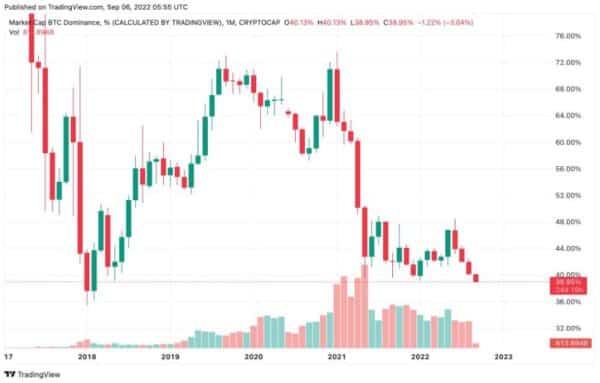
Bitcoin Dominance Slumps Under 39% For First Time in 4 Years.


Bitcoin price today slipped marginally, trading below the $20,000 level at press time. For the past few days, the coin has been trading sideways between $19,500 and $20,500. It is currently trading at $19,815.80.

The world’s largest cryptocurrency by market capitalization dominance fell below 39% for the first time in four years.

Famous analyst Ali writes: “Bitcoin dominance fell below 39% for the first time in four years. It appears that Ethereum has taken the spotlight with its upcoming Merge upgrade, and Cardano is also gaining some traction with its Vasil hard fork.”


BTC dominance falling below 39
Image source: https://twitter.com/ali_charts/status/1567029215672913921?


Ethereum’s upcoming “Merge” upgrade appears to have taken the spotlight away from Bitcoin, and Cardano is also gaining some traction with its Vasil hard fork. Ethereum is preparing for its highly anticipated Merge upgrade, which is less than two weeks away. The price of the coin continues to hold at $1,600 levels.  Ethereum is transitioning to proof-of-stake for its consensus protocol. The Merge is a system-wide upgrade that will bring multiple improvements to the network, including enhanced security and energy efficiency. 

Messari data confirms that ETH dominance has increased by 3.21% in seven days, with current dominance sitting at 19.187%.

Cardano’s ADA token price has risen by over 2% in the past 24 hours and 15.30% in the last seven days. The price of ADA is now $0.51, and the market capitalization is $17.44 billion. Cardano’s upcoming hard fork will reportedly introduce several improvements to the network. These include increased security, improved governance, and new features for smart contracts. The hard fork is scheduled to occur on September 22.

Messari data shows that Cardano dominance has increased by 13% in seven days, with current Cardano dominance sitting at 1.17%.

Meanwhile, dogecoin’s value was flat at $0.06, while Shiba Inu dropped by around a percent to $0.000013. Today’s performance of other cryptocurrencies was varied, with Chainlink, Apecoin, XRP, Uniswap, Binance USD, Polkadot, Tether, Litecoin, Avalance, and Solana prices making moderate gains over the last 24 hours.

Top U.S. Attorney Says Ripple and SEC Could Settle Before December 2022

0

Attorney Hogan still thinks a settlement is possible in the Ripple vs. SEC lawsuit.


Attorney Jeremy Hogan, a Partner at Hogan & Hogan law firm, is not ruling out the possibility that a settlement could happen soon in the ongoing lawsuit between Ripple and the Securities and Exchange Commission (SEC). 

According to attorney Hogan, a settlement between the parties could occur from now until November ends. 

Hogan made the assertion in response to a tweet made by an XRP holder. In a tweet, the user sought to see if the parties could settle this month, as speculated by attorney Hogan a year ago. 

“Hi Jeremy! About a year ago you stated that around Sept 13th would be the most likely settlement date… Do you still believe it could happen?” the Twitter user quizzed. 

Responding to the question, attorney Hogan said: “Most likely. [The] settlement timeframe is from now until the end of November because the cards will be on the table.” 

Lingering Crisis Between Ripple and SEC

The ongoing lawsuit between Ripple and the SEC has lingered for over a year, which has badly affected the price of XRP. 

XRP holders are left to endure the havoc caused by the lawsuit as they hope that the parties will reach an agreement on or before March 31, 2022.  

Both parties do not look like a settlement could be reached anytime soon. While the SEC wants to make a scapegoat out of Ripple, the blockchain company wants to end the SEC’s stringent regulatory practices in the crypto sector. 

Attorney Deaton: A Settlement Could Happen Only If…

However, some experts believe a settlement is imminent based on certain developments in the lawsuit. Recall that the court has insisted that the SEC produce the internal documents that led to the formulation of the controversial William Hinman’s speech. 

Despite all efforts to keep the documents away from Ripple, Judge Sarah Netburn refused to agree with the SEC’s motions. With the SEC still committed to keeping Hinman’s documents, John Deaton, an attorney representing over 72,000 XRP holders in a class action against the SEC, believes the agency would likely settle with Ripple rather than produce the documents in court. 

Global Crypto Exchange Bitmart Adds Support For Bone ShibaSwap (BONE)

0

Cayman Islands-based global crypto exchange, Bitmart adds support for Shiba Inu Ecosystem Token, BoneShibaSwap (BONE).


Bitmart, a global digital asset trading platform, recently announced the schedule to list Bone ShibaSwap (BONE), the governance token of the Shiba Inu ecosystem.  As per the announcement, the listing will take place on September 6th, 2022, with the BONE/USDT spot trading pair.

Bitmart will enable the deposit feature for BONE at 1:00 PM (UTC), whereas trading will go live on the platform at 3:00 PM (UTC) on the same day. However, the withdrawal feature for BONE is scheduled to open at 3:00 PM (UTC) on September 7th, 2022.

Founded in 2017, Bitmart is a globally integrated digital asset trading platform based in the Cayman Islands. The exchange’s official website claims to serve more than 9 million users with its fast, secure, and professional crypto trading services while allowing its users to trade over 750 high-quality currencies and more than 800 trading pairs.

Recall that on August 31st, the leading cryptocurrency exchange with over 7 million users, LBANK added support for Bone ShibaSwap on its platform.

BONE is gaining much traction from centralized cryptocurrency exchanges these days as the cryptocurrency has posted incredible gains in the past two weeks. BONE is now trading up 156.2% over the past 14 days. At press time, BONE is trading at the price of $1.92, down -1.77% over the last day, with a 24-hour trading volume of $14,602,882 ($14.60M).

Cardano Founder Blasts Ethereum Classic, Says ETC “Is A Dead Project With No Clear Purpose”

0

Hoskinson once again blasted another top crypto project.


Shortly after being accused of trying to exploit Ethereum Classic (ETC) miners, Charles Hoskinson, the founder of Cardano, hit out at the project. 

In a recent tweet, a prominent Ethereum Classic supporter with the username @Sethccormack9 alleged that Hoskinson wanted to impose a 20% miner tax in a bid to “milk” the network. 

“Charles Hoskinson wanted to implement a 20% miner tax to milk ETC,” @Sethccormack9 said. 

Hoskinson Responds Harshly

The comment did not sit well with Hoskinson, prompting him to publicly comment on the development. Hoskinson noted that the so-called tax was a sustainable development fund, not a miners’ tax, as the Ethereum Classic proponent claimed. 

“I love how a sustainable development fund turns into a miner tax,” Hoskinson said. 

He added that the Ethereum Classic network still makes him sad for not reaching its full potential. Furthermore, Hoskinson said ETC is a dead project with no clear purpose of existence outside of spite. 

Hoskinson is known to always respond to issues capable of denting his reputation or the Cardano project. On several occasions, he has taken swipes at top blockchain projects that previously criticized Cardano. 

As reported by TheCryptoBasic, Hoskinson compared Solana to an old Nintendo console while recommending a YouTube video that could fix the constant network congestion experienced on the network. 

Cardano Enthusiasts React

Aside from Hoskinson, other core Cardano supporters also slammed the user for “wrongfully” accusing the founder of Cardano. @MarcoMeerman says:

“You lack love and positive attention because you get attention with being negative. I am not jealous of you, you must be going through a hard time in your life. Here is a hug.”

Meanwhile, Hoskinson is not the only top crypto enthusiast who has slammed Ethereum Classic in recent times. The project has continued to be slammed for not reaching its full potential after its hard fork from the Ethereum network. 

Ethereum’s Vitalik Buterin Thinks Otherwise

However, not all crypto stakeholders believe Ethereum Classic is dead. 

With the Ethereum Merge upgrade around the corner, many people expect another network hard fork to occur once ETH Merge is live. The belief is that miners will want to continue the mining activity even after Ethereum transitions to a Proof-of-Stake algorithm consensus. 

In July, Vitalik Buterin, the co-founder of Ethereum, urged ETH miners to migrate to ETC after the Merge upgrade finally ships. He described Ethereum Classic as: 

“a very welcoming community, and I think they’ll welcome Proof-of-Work fans […] It’s not even a joke. If you like Proof-of-Work, you should go use Ethereum Classic. It’s a totally fine chain.”

BTC Dormant Supply Reaches New All-Time High As 12.5 Million Bitcoin Remain Stagnant For More Than A Year

0

Bitcoin Dormant Supply Over The Last Year Reaches New All-Time High.


Glassnode asserts that we are still in a bear market. In a tweet on Monday, on-chain metrics and insight firm Glassnode highlighted that Bitcoin’s unspent supply over the last year had tapped a new all-time high of 12.589 million BTC representing nearly 66% of the supply, noting that the increased holding was typical of bear markets.

“The volume of Bitcoin supply that has remained unspent for at least 1yr has reached a new ATH of 12.589M BTC.

This is equivalent to 65.77% of the circulating supply.

Increasing dormant supply is a characteristic of Bitcoin bear markets,” the firm noted.


It is worth noting that investors who are inherently bullish on an asset during long periods of market correction will prefer to hold on to the asset than sell at a loss. While this statistic reveals that we are in a bear market, it may also indicate that more investors are bullish on Bitcoin than ever before.

Notably, some users were confused as the insight by Glassnode appeared contradictory. For example, a user opined that reduced supply should indicate a bull market.


It bears mentioning that despite this insight by Glassnode, Bitcoin remains under significant selling pressure. As reported by The Crypto Basic yesterday, a whale sent over 200k BTC to exchanges, with CryptoVinco, formerly CryptoWhale, asserting that the whale is Michael Saylor’s MicroStrategy, despite a lack of conclusive evidence. Also, 5000 BTC, which has been dormant since 2013, was moved to Kraken on the same day. Additionally, on Saturday, it was revealed that miners sold over 4k BTC in 72 hours as mining profitability continued to plummet with an increase in Bitcoin difficulty.

Notably, should Bitcoin buckle under the selling pressure, it has a lot of room to fall. For example, Seasoned analysts like Peter Brandt, Justin Bennett, and Mac have all given room for the possibility of the asset finding a price base within the $10 to $12k price range. Meanwhile, CryptoQuant analysis last Friday indicated that the asset might need to drop by another 28% to the $14k price point to find a bottom around the Delta price.

Bitcoin is currently trading at the $19,827.72 price point, up 0.48% in the last 24 hours. 

Major Ethereum Whale Sells 183 Billion Shiba Inu (SHIB), Worth $2.26 Million

0

This time a whale sells instead of buying.


Major Ethereum (ETH) Whale sold $2.26 Million worth of the most popular canine-themed cryptocurrency.

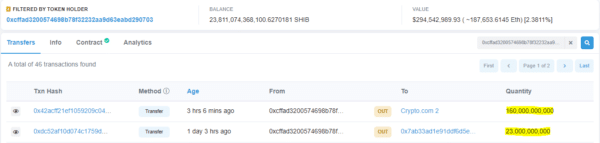
Etherscan.io data reports that major ETH Whale sold out a whopping total of 183,000,000,000 (183B) SHIB, worth $2,265,540 ($2.26M) in two separate transactions in the past 24 hours.

ETH Whale Selling SHIB

As per data provided by Etherscan.io, the mysterious deep-pocketed ETH investor first sold 23,000,000,000 (23B) SHIB, worth $284,740 in one significant transaction. Few hours later, the Whale carried one gigantic transaction and cut her holding further by 160,000,000,000 (160B) SHIB, worth $1,980,800 ($1.98M). Despite such massive selling, Shiba Inu is still the second biggest holding for the 6th biggest SHIB Whale. She is still holding a hulk total of 23,811,074,368,100 (23.81T) SHIB, worth $294,542,989 ($294.54M) in her wallet.

Vitalik Confirms Ethereum Beacon Chain Bellatrix Upgrade Set To Kick Off Today, Merge On September 13 to 15

0


Merge expected around September 13 to 15.


In a tweet today, Ethereum founder Vitalik Buterin while highlighting that the Bellatrix upgrade kicks off today, let slip that the Merge is expected to happen from around September 13 to 15, urging node operators to upgrade their clients.

“The merge is still expected to happen around Sep 13-15. What’s happening today is the Bellatrix hard fork, which *prepares* the chain for the merge. Still important, though – make sure to update your clients!” Buterin wrote in the tweet.


It is worth mentioning that the Bellatrix upgrade represents the first phase of the Ethereum Merge. The Bellatrix upgrade prepares the Ethereum proof-of-stake (PoS) Beacon chain for The Merge with the Ethereum execution layer. 

The next phase, as previously reported by The Crypto Basic, is the Paris Upgrade which will trigger the Ethereum Merge once a Terminal Total Difficulty (TTD) of 58750000000000000000000 has been reached. As per Buterin’s comments today, we expect this to happen sometime between September 13 and 15.

The Merge is an Ethereum upgrade years in the making that will see the programmable blockchain move from the energy-intensive proof-of-work (PoW) consensus model for transaction validation to PoS. Notably, the move will reduce Ethereum’s carbon footprint by 99.95%.

However, it bears mentioning that, as clarified by Ethereum developers, the upgrade will not lead to reduced gas fees or faster transactions as things like sharding that will help with these are expected in future upgrades. In the meantime, Ethereum urges users with the desire for better scalability and cheaper fees to use the Layer 2 solutions built on it, which include Polygon, Arbitrum, and Optimism.

As The Merge approaches, Ethereum price speculation has spiked, with the crypto community divided on which direction the asset price will take post-Merge. The Crypto Basic recently reported that over 94k ETH was added to the ETH 2.0 staking contract on September 1 alone.

Ethereum is currently trading at the $1,643.22 price point, up 4.25% today and 4.08% in the last seven days. It is leading the gains among the top 10 crypto assets by market cap.