Home Blog Page 2283

Ripple Says SEC Is Wrong to Object Court Rulings Regarding William Hinman’s Documents 

0

The blockchain company has urged the court to deny the SEC’s objection to Judge Netburn’s ruling over Hinman’s documents. 


Ripple and Individual Defendants Brad Garlinghouse and Chris Larsen have filed their responses to the US Securities and Exchange Commission’s (SEC) objection to Judge Sarah Netburn’s ruling on the William Hinman documents. 

SEC’s Quest to Protect Hinman’s Documents

Recall that the SEC had asserted that it could not surrender the drafts to Hinman’s speech because the documents were protected by deliberative process privilege (DPP). 

Judge Netburn denied the decision. Following the court’s decision, the SEC also filed another motion, claiming Hinman’s documents are protected by the attorney-client privilege. The SEC contended that Hinman received legal advice from lawyers at the commission before drafting the speech. 

Interestingly, the motion was also denied by Magistrate Netburn, who later slammed the SEC for its hypocritical tactics. Again, the court ordered the commission to produce the document to aid Ripple and Individual Defendants in their Fair Notice Defense. 

Despite these rulings, the SEC still objected to the order. According to the commission, the court erred in its ruling. 

Ripple’s Response to SEC’s Objections

According to Ripple, the SEC is wrong to object to the ruling because it cannot show clear errors in any of the rulings. 

“The SEC effectively concedes that Judge Netburn got the law right on these issues, setting out the legal tests in nearly identical terms and citing the same authority. It disagrees only with the Court’s factual findings and the natural conclusions therefrom,” an excerpt of Ripple’s response reads. 

As regards Judge Netburn’s ruling on SEC’s DPP claims over Hinman’s documents, Ripple stated that the verdict “follows well-established Second Circuit law as applied to the record the SEC built.”  

The blockchain company and its executives also noted that Magistrate Netburn’s ruling on SEC’s claims over Hinman’s documents is in line with the straightforward application of undisputed law to factual records and sworn evidence submitted by both Hinman and the agency. 

Additionally, Ripple slammed the SEC for changing its story as it deemed fit to keep the drafts from being surrendered to the company. 

Notably, the SEC had asserted that the 2018 Hinman speech was his personal opinion and did not represent any of its policies. 

However, after a year, the SEC made a u-turn, claiming the speech was guidance to market participants. 

“[The SEC] sought to put the toothpaste back in the tube and rely on self-contradictory lawyer arguments to avoid the consequences of its litigation strategy. But that was not an error; it was the faithful application of law to facts. The SEC’s objection must be denied,” Ripple said.

Parties File Motion to Exclude Expert Testimonies

Meanwhile, attorney James K. Filan noted that Ripple and the Securities and Exchange Commission have started filing motions to exclude expert testimonies. 

However, the motions are being filed under seal until Judge Analisa Torres decides what should be publicized in the filing. 

Baby Dogecoin Swap Ready To Launch, TestNet Date Revealed

0


Doggy meme coin rising star ready to launch its decentralized exchange (DEX).


In a tweet on Wednesday, Baby Dogecoin announced its long-anticipated swap is ready to launch, adding that its TestNet would go live less than a week from now, offering lucky users the chance to be beta testers.

“BabyDoge is honored to announce our swap is complete! We invite the entire community to join us when TestNet goes live,” Baby Dogecoin tweeted.

Additionally, the doggy meme token reveals that its DEX would offer users more than just the chance to swap one Binance Smart Chain (BSC) token for another. According to BabyDoge, users would also be able to farm and stake their tokens using the swap. Furthermore, users would be able to hold BabyDoge at lower fees and receive a free token locker.

It is worth noting that BabyDoge first disclosed its plans to launch a swap in April, stating that it would have burn features. Then, in June, a tweet revealed that its DEX would charge fees as low as 0%.

Notably, the doggy meme coin is growing in popularity and, in just over a year, is looking to become the third man in the doggy meme coin race. In April, the meme coin became the third most followed doggy meme coin after the likes of leaders Dogecoin and Shiba Inu. Additionally, BabyDoge, according to BscScan, has the largest number of holders among the 3, with nearly 1.6 million holders, more than twice the number of Dogecoin holders.

Aside from the increasing utility, users continue to be attracted by the deflationary nature of the meme coin through regular token burning. Notably, BabyDoge burned 50 quadrillion coins worth over $88 million in a single transaction in July, the largest burn event ever in the crypto space.

On Tuesday, BabyDoge reveals that it is now ranked 139 on CoinGecko. At the time of writing, BabyDoge is trading at the $0.000000001563 price point, up 1.58% in the last 24 hours.

How Decentralized Finance (DeFi) Can Bank The Unbanked

0

In the world of blockchain, the vast majority of decentralized finance news focuses on how this industry can further innovate financial technology, improving existing features and increasing the efficiency of the field as a whole. Yet, a function of DeFi that is commonly overlooked is its accessibility, and what that access could mean to the 1.7 billion unbanked adults around the world.

The vast majority of unbanked individuals across the globe simply do not have access to the correct documentation to start a bank account. This is especially the case in developed countries, where financial institutions often require a fixed home address to apply for a bank account, something that many people do not have.

In this article, we’ll be delving into the concept of banking the unbanked, revealing exactly how DeFi could be a powerful solution for financial onboarding, and a whole host of other financial functions.

How Does DeFi Provide Accessibility?

In a decentralized financial system, users access any financial services through the blockchain. This is the critical difference, as blockchain technology provides a decentralized network, the opposite of what current banking institutions use. Within DeFi, users are able to open financial wallets, which act as bank account equivalents.

The core difference between the process of opening a DeFi wallet and the practice of opening a bank account is documentation. Absolutely anyone that has access to the internet can instantly open a DeFi wallet in their name, making the process of getting a bank equivalent quick and easy. While the vast majority of the unbanked population don’t have the right documents to submit for a bank account, they can make a DeFi wallet and start depositing money right away.

From these digital wallets, DeFi users are able to execute a range of smart contracts to make payments or transfer money, granting them a range of similar financial functions. One difference is that in the world of decentralized finance, cryptocurrency is the active money medium, with leading cryptos like Blockchain or Ethereum being the main financial coins.

Considering how easy it can be to create a bank account within the DeFi network, this new system could empower millions of unbanked individuals around the globe, helping them to find a more stable form of financial management.

DeFi Offers An Onward Progression

Alongside simply storing capital within digital wallets, the world of DeFi is rapidly growing and increasing the number of functions that it could offer any user. There are now over 4,000 decentralized applications, each of which offers further services to users. Some of these apps might be for investing money; some might be for security, some might be for gaming, and so onward.

With the ever-expanding number of dApps that users can connect their digital wallet to, the extent to which the DeFi environment becomes a useful tool grows further. With this current projection of upward growth, we’re likely going to see even more dApps in the coming years, bringing more financial functions to those that are banking with DeFi.

The vast majority of dApps are run on the Ethereum network, with this platform seeing nearly 70,000 active users. With this in mind, it’s likely that ETH will be the chosen cryptocurrency of note, with the ease of scalability and fast transaction speed of this network being the most effective for blockchain payments.

Beyond Just Banking with DeFi

Alongside just holding money and participating with dApplications, a range of companies have started to turn their sights on DeFi and what could be possible with these decentralized services. Everything from healthcare companies and gaming companies to insurance businesses and more are starting to spring up in the world of DeFi. With each arrival, the range of opportunities and the actions that users banking with DeFi can execute further increase, making this accessible system even more valuable.

One of these said companies, known as SOMA.finance, aims to allow anyone using DeFi to trade and list a range of digital assets. Going beyond just crypto assets, they also allow users to trade and list tokenized equities, NFTs, STOs, and even ETFs through their platform. As a globally compliant multi-asset decentralized exchange, they provide a central marketplace where anyone using DeFi can go to trade their assets.

Without users having to go through centralized systems in order to trade their digital assets, they will be able to save a great deal of capital, boost their investments, and ensure that they are accessing a financial trading system with no room for market manipulation. As a multi-asset platform, they effectively open up the world of DeFi trading, going far beyond the initial cryptocurrency that DeFi wallets entail and allowing anyone using these services to actively trade whatever digital currency they want.

SOMA.finance is a fantastic example of how individual projects within the world of DeFi are actively fighting to make this system even more lucrative than what it already is. With companies like this in a range of different industries, the offer pool of what users can achieve with DeFi is continually expanding, further bringing utility to those looking for an accessible and high-impact financial system.

Final Thoughts

With millions of people left around the globe without a feasible method of accessing centralized finance, DeFi poses as the perfect solution. As an accessible financial system that allows absolutely anyone to start a DeFi wallet, this would provide a platform that unbanked individuals could turn to.

Instead of facing layers of documentation that prevent unbanked individuals from getting an account, the world of DeFi is significantly more accessible, helping them to get started with their own financial journey. Alongside just securing an account, the ongoing developments within the world of DeFi have made this financial system even more full of advantages and potential.

Over the next few years, we’re likely to see the true capabilities of DeFi further flourish, bringing utility to the unbanked, and absolutely anyone that’s looking for a decentralized, applicable, and feature-rich financial system.

Why Are Most P2Es So Boring?

0

P2E (play-to-earn) games have been around for quite a while now. Numerous platforms have entered the market, each trying something different and at least somewhat unique to differentiate itself from the pack.

It’s only natural, as you want your platform to succeed and offer something novel and exciting to vast audiences. However, many of them still boil down to the same thing — they urge you to buy generic things in the game, often in the form of NFTs and novel cryptocurrencies. When you put it like that, they bring nothing new to the table — they are just using newer technologies to offer the same things as free-to-play games.

This makes them, well, a bit boring. After all, is it really as simple as this? Could it be that the entire gaming industry is effectively the same? In a nutshell, yes, if you explain it in such a simplistic way.

That’s why we wanted to truly examine P2E platforms, as they are still incredibly important for the market and have the potential to revolutionize it. Let’s see what makes so many of them boring and what they need to do to become exciting once again and potentially lead us into the new future of gaming.

The Boring Part

This opinion might be controversial: in fact, some might even say we want to end P2E as a model. However, that’s not the case. We are well aware of how important it has become for the whole gaming industry.

A typical gamer spends more than eight hours per week on their favorite games, and we are sure that P2E platforms take up a big portion of that time. Plus, this model doesn’t just let players buy things in games — it also allows them to create something unique and even build a whole world.

As you can see, each player gets the chance to change the game with their creations entirely. Therefore, the developers no longer have to design captivating games that will occupy every player in the same way — now, the players themselves get to let their imaginations run wild and create something entirely new.

Simply put — it’s incredible. However, the model has not lived up to its potential. So many developers are sacrificing the fun-first element and focusing on creating a highly-functional P2E element.

Several have tried to come up with something new here, but they primarily focus on tokenomics and forget that a game has to be entertaining above all. On the other hand, there are those who don’t forget about this aspect — they simply choose to create a platform that will yield them a fortune. Finally, some are just in it because it’s a popular type of platform. They hardly think things through and end up creating a boring product.

So many of these platforms are bleeding players dry without offering enough bang for the buck. In fact, it’s one of the main reasons why some of the bigger names in the industry are losing players. For instance, Axie Infinity saw its player count fall below the one million mark early in May.

The P2E model is flawed, and things need to change.

What P2E Platforms Need to Do to Improve

The simple solution to the problem is to create fun platforms. However, many developers are actually trying to do that: the issue is that they often sacrifice the entertaining part in order to make their game work the way they want it to.

They forget that many of their adjustments are not necessary. You don’t have to sacrifice the fun-first view when creating a Web3 platform. If you focus on the fun part, the P2E elements will automatically follow and fit in organically. Even less fleshed-out P2E elements will become near-perfect if the platform itself is enjoyable.

A great example of this is Fashion League. This new Web3 platform is being built with compelling P2E elements, but it is first developed to be entertaining. The game focuses on fashion, and players get absolute freedom to create their own clothes and clothing stores, become virtual designers, and sell, rent, or trade their creations. The NFT and crypto element is still there, but it rewards players for their imagination — it doesn’t exist solely to make money for the developers.

It’s just one of the many ways P2E platforms can avoid becoming boring by creating a compelling experience that will be rewarding for both the developers and the gamers.

The Future of P2Es

Despite what we’ve said so far, we believe P2E has a bright future. Even though there are some developers who create boring games, others work hard to develop something fun and exciting. We expect the latter to be the leaders of the industry and the ones who will push it forward.

The technology behind P2E platforms will only continue to evolve and surpass everything else. It’s up to P2E platform creators to use it in the right way and truly earn the time and effort players are prepared to put into these games. As long as they don’t sacrifice the fun-first approach, they are bound to succeed.

Mike Novogratz Says Ethereum Could Reach $2,200 Before The Merge

0


Mike Novogratz predicts Ethereum might hit $2,200 or more before its Merge release.


As the date of the Merge upgrade draws closer, Ethereum has emerged as the front-runner in the cryptocurrency sector.

In an interview with Bloomberg TV, Galaxy Digital founder and crypto billionaire Mike Novogratz said that the world’s second-largest cryptocurrency might reach $2,200 or more at its peak in the run-up to its much-awaited upgrade, also known as The Merge. At the time of this writing, the price of Ethereum is $1692.


Novogratz is well-known for his price predictions of cryptocurrencies, especially Ethereum (ETH) and Bitcoin (BTC). However, in contrast to his prognosis about ETH, the investor thinks that the price of BTC will not exceed $30,000 any time in the near future.

Novogratz isn’t the only one bullish on ETH right now. According to the statistics recently published by CoinShares, Ethereum received $16.3 million from various institutional investors throughout the past week. Over the course of the last seven weeks, Ethereum has received more than $159 million in net inflows.

Furthermore, the derivatives market for Ethereum (ETH) has increased dramatically; As reported by The Crypto Basic, according to the most recent report by the blockchain analytics company Glassnode ETH has now exceeded BTC for the first time in the options market. According to Glassnode, the $6 billion worth of open market interest in ETH options has surpassed the $4.8 billion of BTC.

“Ethereum options open interest at $6.6B is now higher than for Bitcoin at $4.8B. Whilst, not an all-time-high yet, ETH options OI is close to setting a new one.”

FTX Partners Reddit to Enable Redditors to Utilize Their Community Points for On-Chain Transactions 


Redditors can use community points for on-chain transactions via FTX Pay. 


Leading cryptocurrency exchange FTX said in a press release today that it has partnered with Reddit to enable users to perform on-chain transactions with the points earned on the social media platform. 

Under the partnership, the popular cryptocurrency exchange said FTX Pay would be used as an exchange and payment solution to support the integration of Reddit community points. 

Notably, the Reddit points initiative was launched in 2021, following a partnership with the social media platform and Arbitrum. The initiative is used as a tool to measure users’ contributions and reputation in different communities on Reddit. 

Notably, Community Points are used to measure reputation on the platform. Now users can take the reputation earned via Community Points can be taken anywhere on the internet. Redditors can use the Community Points to purchase special membership perks, supported community tokens, and other incentives. Additionally, Communities can gift their points to members for publishing interesting content or good behavior.

Following Reddit’s community points integration with FTX Pay, Redditors can purchase Ethereum (ETH) from supported Reddit applications, which can be used to pay fees for all on-chain community points transactions. 

“We’re excited to partner with Reddit to continue their work to empower online communities to harness the power of blockchain. FTX Pay’s payment and exchange infrastructure integrate with Reddit Community Points, making the customer experience a more seamless process,” Sam Bankman-Fried (SBF), FTX’s CEO, said. 

SBF also noted that the initiative would contribute to bringing web3.0 utilities. 

Commenting on the development, Niraj Sheth, Staff Software Engineer at Reddit, said: 

“We’re always working to empower communities and introduce new ways to use Reddit, and decentralized, self-sustaining blockchain technology allows us to do that. By working with FTX, we’re able to do this at scale.”


Iran Makes First Crypto-Based Import Order Worth $10 Million

0


The Iranian government makes its first payment in cryptocurrency for imports totaling $10 million.


The Iranian government is said to have recently completed its first crypto-funded import order, for the amount of $10 million, according to reports from the local media. However, the reports did not include any information on the particular cryptocurrency that would be used for the transaction.

This is another step the country is taking to trade using virtual currencies instead of the dollar-dominated global financial system, as it allows them to trade freely with other countries. This move will help the Islamic Republic to avert the crippling effects of U.S. sanctions on its economy.

Alireza Peymanpak, an official from Iran’s Ministry of Industry, Mine and Trade, stated:

“By the end of September, the use of cryptocurrencies and smart contracts will be widely used in foreign trade with target countries.”


In 2019, the government of Iran passed a law that made it legal to mine Bitcoin and other cryptocurrencies. Despite this, the country continued to exercise a high degree of scrutiny over the industry. The Islamic Republic was known for its stringent crypto regulation, and one example of this is how it dealt with local Bitcoin miners early last year over their energy use.

However, Iran has been gradually easing its attitude towards the crypto sector over the past year. For example, the Iranian Presidential Center for Strategic Studies advocated cryptocurrency mining in March 2021 to help the country avoid the effects of international sanctions. Crypto mining could bring in $700 million annually for the nation, while transaction fees might bring in an additional $22 million in yearly revenue.

WingRiders Loses 59% Of Its Total Value Locked, Plunges Cardano TVL Below $100M

0


Popular Cardano-based decentralized exchange WingRiders has lost its position as the most valuable DEX on Cardano. 


WingRiders slumped from the first position to third after losing more than 59% of the total value locked (TVL) on the platform in the past 30 days. 

At the time of writing this line, WingRiders is now the third-largest DEX by total value locked, with a TVL of $19.66 million. It is noteworthy that WingRiders maintained the top spot for more than two months, claiming  42% of TVL On Cardano. However, the DEX has fallen from glory ever since. 

Minswap Is Now Cardano’s Most Valuable DEX

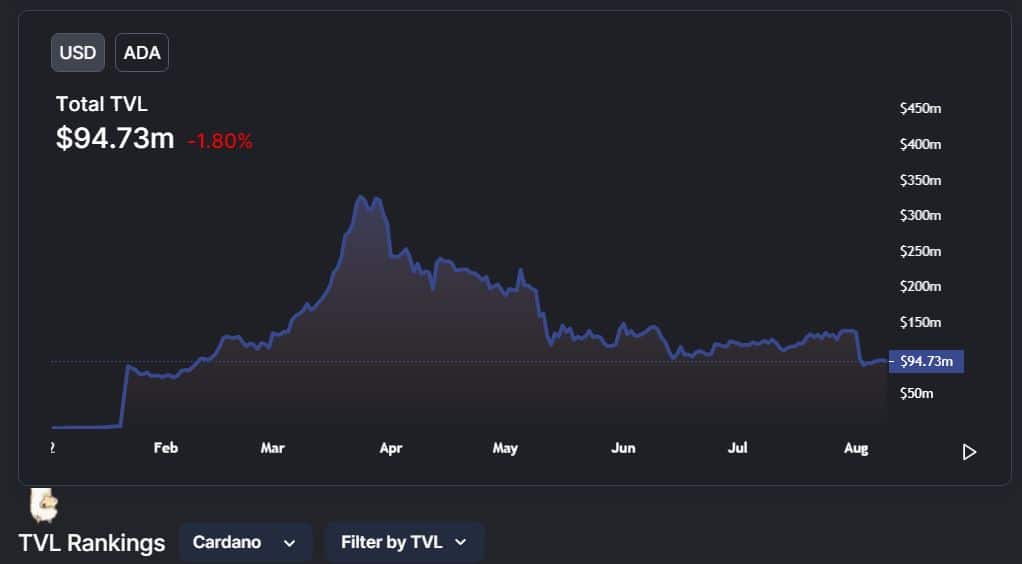
The development also affected the total value locked on Cardano. The total value locked on Cardano has fallen below $100 million in the last 30 days after the WingRiders TVL slumped. 

cardano total value locked
Cardano total value locked

Interestingly, Minswap has taken the lead to become the most valuable decentralized exchange on Cardano after the massive decline of WingRiders’ TVL. 

At press time, Minswap is leading, with a $49.09 million total value locked on the platform. The DEX hit the milestone after recording a massive growth of 30.9% in its TVL in the past 30 days. Minswap accounts for 51.82% of the total value locked on Cardano. 

SundaeSwap, the first decentralized exchange on Cardano, is now the second most valuable DEX in the ecosystem. SundaeSwap is second in the ranking, with $19.72 million in TVL. 

Like WingRiders, SundaeSwap has also lost a significant amount of its TVL over the past 30 days. In the past month, SundaeSwap has lost nearly 10% of the funds locked on the platform.

Commenting on the development, Cardano Daily, a platform that shares new developments about Cardano, said: 

“After the major decline of @wingriderscom, the TVL scenario of the Cardano ecosystem has stabilized back to normal as we have seen in the past few weeks. @MinswapDEX still led the ecosystem with $51M TVL, contributing 50% of the ecosystem.” 

Top Exchange Employee Gregory Dwyer Plead Guilty to AML Violations

0


BitMEX Former top Employee Gregory Dwyer Plead Guilty to AML Violations.


Australian cryptocurrency mogul and former top executive at BitMEX Gregory Dwyer on August 8th pleaded guilty to violating American banking laws. The U.S Attorney for the Southern District of New York made this disclosure in a press release. 

Specifically, Gregory Dwyer admitted that BitMEX, one of the world’s largest cryptocurrency exchanges, failed to implement nor abide by Anti-Money Laundering (AML) standards, thereby violating the Bank Secrecy Act (BSA). 

Establishing, implementing, and maintaining an active AML program is a mandatory requirement for companies wishing to operate in the U.S. This also includes implementing Know Your Customer (KYC) policies to identify transacting customers. However, the embattled mogul admitted that he and the three founders of BitMEX willfully neglected to comply with these requirements. 

Rather than comply, he admitted that the company operated in the US under the impression that it had implemented these AML and KYC requirements. This violation, the prosecutors alleged, carried on between 2015 to 2020, and the exchange operated as a money laundering platform.  

Per the plea agreement, the Aussie is facing five years imprisonment and a $150,000 fine. 

In a statement, U.S Attorney Damian Williams said: “With this plea, this office has now obtained criminal convictions against all three founders, as well as a high-ranking employee at BitMEX, for willful violations of anti-money laundering laws. Today’s plea reflects that employees with management authority at cryptocurrency exchanges, no less than the founders of such exchanges, cannot willfully disregard their obligations under the Bank Secrecy Act.”  

The 39-year-old Dwyer, who was one of the first employees at BitMEX, previously served as its Head of Business Development. The company’s regulatory woes started in August last year after it paid $100 million to settle civil allegations that it allowed illegal trades for years and violated AML standards. 

Benjamin Delo, Samuel Reed, and Arthur Hayes, the trio who found BitMEX earlier in February, pleaded to similar charges of failing to establish, implement and maintain an AML program. 

This was followed by probation and a $10 million fine issued against each of them in May by the U.S Commodity Futures Trading Commission for breaching these AML requirements.   

U.S regulators have, since the Terra-Implosion, which caused billions to be wiped off the market, increased their regulatory watch on cryptocurrency institutions in the U.S. As part of its regulatory clampdown, the US Department of the Treasury’s Office of Foreign Assets Control (OFAC), earlier on August 9, banned virtual currency mixer Tornado Cash.

As per recent developments, broader crypto regulations are expected to be introduced in the coming months.

Polygon To Launch Blockchain Gaming Platform Intella X

0


Polygon and Neowiz team up to launch Blockchain gaming platform Intella X.


South Korean online game publisher Neowizz becomes the latest gaming company to test Web3 waters as Polygon announces an upcoming collaboration between the two companies. Polygon made the revelation today in a tweet stating that the two companies have teamed up to launch Intella, a blockchain gaming platform. 


Intella: The Gaming Platform

According to a post on Polygon’s website, games covered under Neowizz Intellectual Property (IP) will transition to Web3 games on Intella. Popular Neowizz games such as “Cats & Soup” and “Brave Nine” and social casino games such as House of Slots and House of Poker are expected to go live on the platform in 2023.  This also includes a new PFP NFT project titled “Early Retired Cats Club.” 

The post also stated that the platform would stay true to the Web3 principle of revenue redistribution based on a develop and earn model. This means developers who contribute to the platform’s growth will be rewarded in the platform’s native token “IX.” 

Likewise, projects built on the platform will be compensated in IX and have a cut of the revenue generated. As seen in most other Web3 games, players will also have an opportunity to earn IX and other tokens on the game, which they could later swap for IX. 

In addition, an IX wallet will be created on the platform where players and developers can store the IX and tokens earned on Intella.  

Polygon Web3 game partnership drive

This latest collaboration adds to a growing list of Web3 gaming projects between Polygon and prominent gaming developers and publishers. This includes existing partnerships with Atari, Ubisoft, Animoca, Wildcard, and Tilting point.

The Ethereum-hosted network, earlier on August 4, partnered with web3 games development studio Epic League, following the studio’s $100 million valuation. The partnership is expected to introduce some of the studio’s iconic games, such as Dark Throne, an action roleplaying game. 

Also, Polygon recently partnered with Game Space in a move that Game Space hoped to use to bring more gamers to Web3 games.

However, Polygon web3 gaming history hasn’t been all rosy. As per a recent TheCryptoBasic post, the newly launched Polygon-based web3 game Dragoma project suffered a rug pull worth an estimated $3.5 million.