Home Blog Page 2302

Two US Senators Have Tabled A Bill To Let Users Buy Items With Bitcoin To Boost Crypto Adoption

0


Two US Senators Have Introduced A Bill To Buy Products With Bitcoin And Exempt BTC Transactions Under $50 From Capital Gains Tax.


Two pro-crypto US senators want the taxman to stay away from small BTC transactions.

Cryptocurrencies have gained a significant following and courted serious attention over the last few years. Today, even some financial institutions and governments are pro-crypto – especially Bitcoin. However, there have been a few hurdles introduced by the authorities in terms of taxation, especially in the US. People who conduct crypto transactions are required to pay capital gains tax.

However, two US senators are now tabling a bill “that would allow consumers to buy items with Bitcoin” and could see those who conduct Bitcoin transactions of under $50 relieved from the tax burden. The two senators are Pat Toomey of Pennsylvania and Krysten Sinema of Arizona. News of the bill was reported by CNBC’s Squawk Box.

“Senator Toomey and Senator Sinema are introducing a bill that would allow consumers to buy items with Bitcoin without having to pay a capital gains tax to encourage more public adoption of crypto.”


According to the two bill backers, the tax exemption is meant to boost Bitcoin adoption among Americans and enable the use of BTC payments for micro-transactions, digital payments, and even service subscriptions.

Senator Toomey said,

“While digital currencies have the potential to become an ordinary part of Americans’ everyday lives, our current tax code stands in the way.”

The bill has the backing of major entities in the crypto industry, including the Bitcoin Association, Coin Center, and the Association for Digital Asset Markets.

Impactful Idea

Granted, a tax exemption for small Bitcoin transactions would encourage adopting and using crypto payment provisions in various economic sectors. This would be a huge plus for the top coin as more Americans would learn about it and adopt it in their day-to-day financial transactions.

This bill comes even as the US SEC waddles the stormy waters of the crypto industry in search of the best means to regulate it. The authorities and the SEC have long been pressured to formulate proper policies to govern cryptos. The taxation angle introduced by the two senators could be a great starting point.

Ukraine’s Digital Transformation Minister Says Crypto Remains Essential To Country’s Defense Despite Crypto Winter

0


Alex Bornyakov reaffirms Ukraine’s belief in crypto.


In a tweet on Tuesday, Ukraine’s Deputy Minister of Digital Transformation, Alex Bornyakov, maintains that crypto remains a key part of Ukraine’s defense strategy despite the extended market downturn, adding that he believes crypto is here to stay.

“Despite the ‘bear market’ crypto has become an essential tool of Ukraine’s defence, providing flexibility and speed that literally saved our soldiers’ lives. Every ‘crypto winter’ leads to a ‘crypto spring’, but the industry is here to stay,” Bornyakov wrote in the tweet today.


It is worth noting that since Putin’s Russia came bearing down on Ukraine’s borders, the East European nation has leaned to crypto as a means of raising funds due to its unique advantages over other forms of cross-border payments. Michael Chobanian, the founder of Ukraine’s largest exchange, KUNA, highlighted this while speaking with Bloomberg, noting that while a transaction on the blockchain took minutes, it took about three days for international payments to be processed through the traditional banking system.

While it is difficult to estimate how much Ukraine has raised through crypto, several sources put the figure above $100 million. Notably, the country raised about $10 million in just four days after the war started. In addition, Bornyakov had earlier revealed that funds raised from crypto had provided key emergency equipment needed for the early days of the war, and food, fuel, and bulletproof vests for soldiers.

However, Ukraine’s crypto stash has not been unaffected by the extended crypto market downturn. As The Kyiv Independent reported on Monday, charities receiving crypto donations have also seen a decline in the frequency of donations.

Despite these hurdles in the wake of the crypto winter, Ukraine remains undeterred. The Ukraine government continues to pursue crypto fundraising initiatives as it has now called on artists to create NFTs to raise funds for the country’s defense and rebuilding process.

“We’re using the latest technologies to bring Ukraine closer to victory,” the Ukrainian Minister of Digital Transformation Mykhailo Fedorov reportedly said.

The United Kingdom Treasury’s New Crypto Proposal

0

The United Kingdom Treasury has revealed a new proposed legislation with regards to digital assets and cryptocurrencies. This came just before the members of Parliament were set to debate the measures on how cryptocurrencies will be regulated.

A copy of the proposed legislation has been published, with the Treasury’s proposed modifications to the current regulation and rules for banking and payment systems. The 335-page bill outlines the United Kingdom’s plans to build the financial systems and markets. Any changes proposed will be aimed at strengthening the market after the country’s exit from the European Union – with plans in place to deal with any financial implications that might still come from Brexit.

The United Kingdom’s approach to digital currencies

In the financial bill, cryptocurrencies and blockchain-based assets, referred to as “digital settlement assets”, include assets that are both under technology that makes an asset cryptographically secure as well as other digital assets that are not. 

The rules laid out by the Treasury speak largely to stablecoins and assets that are used for payments and settlements. Stablecoins, which are cryptocurrencies with a value that is pegged to an underlying asset such a fiat currency, are seen as assets that have the benefits of cryptocurrencies without the industry’s volatility. 

It’s worth noting that other utility-focused cryptocurrencies (such as Ethereum, Cardano, and Solana) are not designed only for settlements and offer the industry and the development of Web3 more functional use than transactional payments. 

Historically, the cryptocurrency market has had a turbulent time with regards to how the United Kingdom authorities regulate it. In June 2022, the country’s leading financial regulator issued a nation-wide warning for investors to take caution before investing in cryptocurrency. Not even one month later, however, the country’s chief financial minister commented that the United Kingdom intends to build itself to become a cryptocurrency powerhouse. The economic secretary to the Treasury echoed the financial minister’s sentiments, saying that the United Kingdom is “the very best place in the world to start and scale crypto-companies”.

The Treasury’s plans to make the United Kingdom a crypto hub includes establishing a sandbox in the financial market infrastructure. This will be designed to give crypto companies, like Bitcoin Prime , a space to experiment and innovate within the economy with the aim to explore how the digital asset industry can be actively integrated into the traditional systems. The Treasury hopes that this will encourage the development of cryptocurrency as a major player in growing the financial sector.

Meanwhile, the country’s Financial Conduct Authority (FCA) has ordered companies that offer cryptocurrency services and products to register with the regulator. Despite the apparent conflict with the financial regulators, Treasury has stated that it is aware of how cryptocurrency might offer a way for criminals and hostile states to take advantage of the anonymous space. To contend this and still make way for innovative exploration, Glen stated that the country will not compromise on anything that might risk national tension or investor’s security, noting that all anti-money laundering (AML) regulation and know-your-customer (KYC) protocols are paramount to the industry.

Cryptocurrency is still a nascent space and countries across the globe are still working on how to regulate the industry without crippling innovation. Finding the line between companies having freedom to experiment in the emerging industry and protecting investors from scams and hacks requires strategic regulation. 

As more countries adopt cryptocurrency into their legislation, with rules and protocols in place, we’ll likely see how the industry overall will offer users and investors a way to use the assets; both in payments and financial fields as well as other functional uses with smart contract technology.

Ripple Opposes SEC’s Request to Seal Witnesses’ Identifying Information Regarding Motion to Exclude Experts’ Testimony

0

The blockchain company has asked the court to deny the SEC’s request because it is not narrowly tailored.


Ripple and Individual Defendants Brad Garlinghouse and Chris Larsen have objected to the SEC’s request to seal identifying information of five of its experts in the upcoming Daubert challenge. The SEC’s request should be denied because it is the opposite of narrowly tailored, Ripple noted. 

According to the blockchain company, the “identifying information” the agency plans to seal is imperative to the resolution of the Parties’ Daubert motions. 

Recall that the SEC requested that in addition to sealing the names of all experts, the court should seal their identifying information, including educational background, employment history, publication, and professional affiliations. 

The federal agency noted that it wants all identifying information sealed because the public can still use the information to carry out an online search that will display the experts’ names.

Ripple’s Objects SEC’s Request

Responding to this, Ripple noted that no court has ever approved such a request “to seal the qualifications and publication of witnesses in the context of deciding a Daubert motion.” 

Additionally, the blockchain company asserted that the SEC’s latest request to seal the identities of all five experts in connection with the Daubert motion is quite different from other sealing rulings. 

The SEC has not justified why its request should be granted but solely relies on the court’s previous rulings. In the ruling, certain information about the agency’s experts is sealed in connection to Amici’s motion to access the SEC’s expert report. 

Aside from sealing sensitive information, Ripple requested that the court not allow any other redaction from the SEC. 

“The parties will very shortly be briefing summary judgment and will surely discuss potential expert testimony, at which time the presumption of public access will be of the highest,” Ripple concluded. 

SEC Objects to Ripple’s Request to Seal Financial Information

In the meantime, the Securities and Exchange Commission has also filed an objection to Ripple’s motion to seal certain information regarding the expert challenge. 

It can be recalled that in Ripple’s requested to seal information of non-parties, certain personally identifying information, and financial information. 

While the SEC noted that it does not object to the sealing of information that may result in the identification of non-parties and Ripple’s employees, it is strongly against the company’s request to seal certain financial statements. 

“Defendants cannot overcome the substantial presumption of public access. The court should therefore deny Defendants’ request to file this information under seal,” the SEC said in a letter filed yesterday. 

Businesses Can Now Pay Employees’ Salaries in Shiba Inu (SHIB) 

0

NOWPayments Launches Solution to Enable Businesses to Pay Employees’ Salaries in Shiba Inu (SHIB).


The solution will further expand Shiba Inu’s utility and prove that the asset is no longer a memecoin.

NOWPayments, a non-custodial cryptocurrency gateway, has launched a new solution that will enable businesses to pay employees salaries in Shiba Inu (SHIB).  

Per a recent blog post, NOWPayments noted that businesses with SHIB enthusiasts among their employees could offer them the opportunity to receive their salaries in Shiba Inu tokens. 

Notably, the crypto gateway platform now features a Mass Payments tool that can be adopted by businesses looking to pay interested employees salaries’ in the meme-based cryptocurrency. 

Benefits of Using the Solution

NOWPayments noted that businesses adopting the solution would enjoy key benefits such as a simple payment process, quick transactions, privacy, transparency, accountability, and security. 

Businesses using the solution will not have to endure the stress of adhering to the strict know-your-customer (KYC) rules. This method is mainly associated with traditional payment methods, which usually cause delays in payment processing. 

“SHIB solves this issue by offering a fast payment method. Essentially, to send SHIB salaries, you will only need a SHIB crypto address. These addresses can be generated in a matter of seconds. Once you have your address and the required sum of SHIB in your wallet, you can pay the salary to your employee,” NOWPayments said in a statement. 

Steps to Paying Employees in SHIB

The service has been simplified by NOWPayments, making it easier for any business to adopt. 

Any business considering paying employees in Shiba Inu must first create a NOWPayments account. The business owner will be required to generate an API key and fill out the NOWPayments form for mass payout requests. 

The admin of the account will need to activate the Mass Payment service by sending a request to the NOWPayments’ official email address partners@nowpayments.io. 

Once the service is active, the Business owner then has to deposit SHIB in the account and click “Create Mass Payout” from the balance section. 

Additionally, the business will be required to upload the .csv file with the amount owner want every employee to receive, with the worker’s wallet address. 

Once you click to proceed, the payment will be instantly sent to the employee. 

The initiative expands the utility of Shiba Inu and would further support the narrative that the cryptocurrency is not a memecoin.

New Record: Shiba Inu Ecosystem Token ‘BONE’ Surpasses 50,000 Holders

0

The Governance Token of ShibaSwap Ecosystem Bone ShibaSwap (BONE) Surpasses 50,000+ Holders.


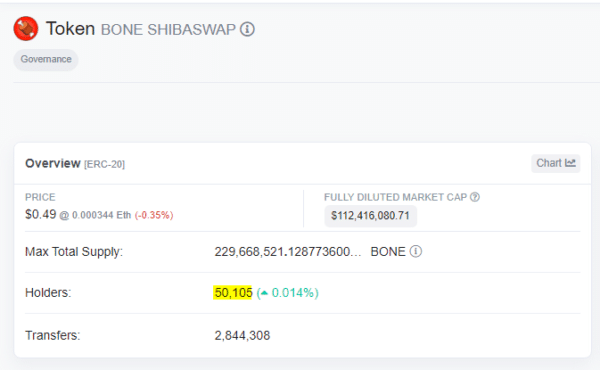
Bone ShibaSwap, the governance token of the ShibaSwap Ecosystem, now has more than 50,000 holders.

The long-term interest of investors in the Shiba Inu Ecosystem is growing daily. Shiba Inu supporters are celebrating a major milestone as the number of BONE holders reached a new all-time high, approaching the 50K round mark.

Etherscan.io data reports that holders of the BONE token have surpassed 50,000 unique addresses. The current holders’ count stands at 50,105.

BONE Holders
BONE Holders

The demand for the governance token of ShibaSwap Ecosystem, BONE, increases as Unification XFUND, the developer of Shibarium – Layer 2 Solution, brings the potential launch of Shibarium near. The blockchain solution provider company confirmed via an official blog post that the Shibarium Public Beta TestNet is planned for deployment in Q3.

BONE would be used as a native “GAS Token” on Shibarium, meaning every SHIB holder would need BONE to perform a transaction on Shibarium. The token currently serves as the governance token of the ShibaSwap Ecosystem, allowing the Shiba Inu Community to vote on upcoming proposals.

On the other hand, the Shiba Inu Community voted in favor of halting the minting process for BONE at 230 million coins to save the remaining 20 million for validators in the crypto market. However, the team decided not to halt BONE minting but instead adjusted the current minting rate to just 1 BPB (BONE Per Block) to avoid potential over-minting of the token.

As reported by The Crypto Basic, the Shiba Inu team also intends to venture a brand-new reward token, “TREAT,” which will replace BONE as ShibaSwap Rewards.

Besides all this, most of the Centralized Exchanges (CEXs) and leading payment gateways are adding BONE support.  In July, Singapore-based exchange CoinTiger, Canada-based exchange Biconomy Global, Top Estonian Exchange Switchere, and Canada-based leading Payment Gateway FCF Pay listed BONE on their platforms.

Coinbase Faces SEC Investigation As Federal Agency Accuses Exchange Of Trading Tokens Deemed As Securities


SEC Accuses Coinbase Allowing People To Trade Tokens Deemed As Securities – Will There Be A Lawsuit?


Bloomberg reports that the popular crypto exchange, Coinbase, is facing an Investigation from US SEC for listing tokens considered as securities which can turn into a lawsuit.

The US SEC (Securities and Exchange Commission) seems to be overdoing itself when it comes to targeting the crypto market for any incidents of misdeeds. For years, the institution has been called upon to keep a keener eye on the budding market. Now, crypto entities, including exchanges and developer companies, are catching its attention in more ways than one.

The latest company to attract the attention of the SEC is Coinbase, which happens to be the largest crypto exchange in the US. The SEC accuses Coinbase of listing tokens that could be classified as securities and allowing people to trade with them on the platform. For this reason, it’s possible that SEC could file a case against Coinbase.

As reported by TheCryptoBasic, “The nine crypto assets fingered by the SEC as securities include; Power Ledger’s POWR token, Flexa’s AMP token, Rally’s RLY token, DerivaDEX’s DDX token, XY Labs’ XYO token, Rari Capital’s RGT token, Liechtenstein Cryptoassets Exchange’s LCX token, DFX Finance’s DFX token, and Kromatika Finance’s KROM token.”

“Coinbase Does Not List Securities”

On its part, Coinbase maintains that it doesn’t list securities. This was conveyed in a recent blog entry crafted by the exchange’s Chief Legal Officer, Paul Grewal. This came after SEC charged a former executive of the exchange with insider trading where he tipped off his brother, a friend, to buy some cryptos right before they were listed on exchanges. Out of the nine tokens involved, seven are listed on Coinbase. Coinbase says none of these is security. SEC claims otherwise.

A part of the blog entry by Coinbase’s legal officer reads,

“Coinbase has a rigorous process to analyze and review each digital asset before making it available on our exchange — a process that the SEC itself has reviewed. This process includes an analysis of whether the asset could be considered to be a security and also considers regulatory compliance and information security aspects of the asset. To be explicit, the majority of assets that we review are not ultimately listed on Coinbase.”

Trading Platforms Should Protect Investors

While various entities in the crypto industry have called on SEC to formulate appropriate regulatory policies for the space, the regulator has often called upon trading platforms like exchanges to develop frameworks to protect retail investors. This is incredibly profound in the wake of the recent crypto crash that saw some crypto investment firms go bankrupt, leading to investors losing billions.

How SEC Determines Securities

For some time now, there have been complaints about how the SEC determines which tokens are securities and which are not – especially within the expanding digital world with thousands of digital assets or cryptos in the market. The regulator relies on a historical US supreme court verdict made way back in 1946 that spells out a framework for a legal test to be used by SEC to determine securities. If an asset falls under this scale, it’s considered security and under SEC’s jurisdiction.

However, the SEC has been reluctant to provide a list of crypto tokens it deems as securities. Also, the anticipated case against Coinbase isn’t the first that SEC has filed against a big crypto entity. SEC is already embroiled in a fierce court battle with Ripple, the creator of XRP. The regulator claims XRP is a security. Ripple disagrees with that. 

Ripple vs. SEC: Attorney John Deaton Blasts SEC To Revoke His Amici Status And To Bar Him From Participating in Lawsuit

0

Ripple vs. SEC: Attorney John Deaton Blasts SEC in His Quest to Participate in Upcoming Daubert Challenge.


Amici Curiae has filed a response to the Securities and Exchange Commission’s opposition to its motion to participate in the upcoming Daubert challenge.

The letter comes a week after the SEC requested that the court deny Amici’s motion to participate in the lawsuit and to bar Amici’s lawyer, attorney John Deaton, for gross misconduct. 

Recall that the SEC had previously requested the court revoke attorney Deaton’s Amici status in the lawsuit for publicizing the name of one of its experts. 

The SEC noted that Deaton’s action resulted in a series of threats and embarrassment to the expert. Thus prompting the SEC to request the sealing of identifying information of its other experts to prevent a recurrence. 

Attorney Deaton’s Response

In Amici’s response to the SEC’s objection to its motion to participate in the upcoming Daubert challenge, attorney Deaton defended his actions by discussing key issues related to the case. 

According to attorney Deaton, before he disclosed the SEC’s expert’s name, the parties in the lawsuit – Ripple and SEC – had previously identified another SEC witness before it filed its motion. 

“I never anticipated the issues with the second SEC expert, nor should I have been expected to, particularly given the release of the other expert’s identity by the parties,” attorney Deaton said. 

The attorney representing Amici Curiae also added that he publicly denounced himself from all threats and harassment targeting the SEC expert. 

Deaton: SEC’s Continuous Double Standard

Attorney Deaton blasted the SEC for taking a hypocritical stance regarding the Expert’s reports. Per Deaton, the SEC had previously given the same expert report to some XRP holders, who sued Ripple, alleging XRP sales violated U.S. securities law. 

The SEC willingly gave the expert report to the XRP holders because its position is aligned with theirs, Deaton added. 

“The SEC’s diametrically opposed legal positions are consistent with Judge Netburn’s harsh but accurate observation that the SEC is adopting its litigation positions to further its desired goal, and not out of a faithful allegiance to the law,” attorney Deaton said. 

SEC Using Unconventional Methods to Dismiss Amici, Deaton Says

Attorney Deaton further accused the SEC of engaging in character assassination to achieve its aim of revoking Amici’s status and barring him from participating in the lawsuit.

He noted that the SEC is bent on revoking Amici’s rights in the lawsuit because summary judgment filing is around the corner. 

In its quest to revoke Amici’s right, the SEC had been recycling materials previously known to the court before Amici’s status was granted, attorney Deaton added. 

Attorney Deaton Adds Hinman’s Conflict of Interest in His Response

Meanwhile, attorney Deaton took a shot at William Hinman, the former director of SEC’s Corporate Finance. The Amici Curiae attorney discussed Hinman’s conflict of interest during his time at the SEC. 

Recall that Empower Oversight shared information about how Hinman blatantly ignored a direct command from the Ethics office not to have a meeting with his Ethereum-related Simpson Thatcher. 

As expected, attorney Deaton’s response to the SEC has attracted a lot of reactions from the Ripple community. 

Attorney Jeremy Hogan, a partner at Hogan & Hogan law firm, praising Deaton, said: “Att’y Deaton’s response might be my FAVORITE brief in the Ripple case so far. It defends his position in the case, defends his own actions, attacks the SEC, and attacks the SEC expert, all in four pages. AND also happens to spill on Hinman and his “relation” to Ethereum. BRAVO!”

Titanium Blockchain Chief Pleads Guilty In $21 Million Crypto Fraud Scheme: US Department of Justice

0


CEO of fraudulent crypto firm pleads guilty to securities fraud.


A press release by the US Department of Justice (DoJ) on Monday reveals that the CEO of Titanium Blockchain Infrastructure Services, Michael Alan Stollery, has pleaded guilty to security fraud after he and his firm, in a fraudulent scheme, raised $21 million from investors in an initial coin offering in 2018.

According to the release, the court documents show that Stollery, aged 54, lured investors to buy “BARs,” the company’s blockchain token, through a series of false claims. Additionally, Stollery failed to register TBIS’s ICO with the SEC despite being required to do so under US securities law.

The press release further reveals that Stollery admits to falsifying details in the project’s white paper to attract investors. Notably, Stollery claimed to be in business with several known businesses and agencies, including the Federal Reserve, to inspire confidence, going as far as falsifying testimonials on the company’s website.

The TBIS’s chief further admits that the firm failed to execute the promises made to investors after raising over $21 million from investors in the United States and overseas. Instead, Stollery admits to using part of the funds raised to settle personal bills and maintain a condominium in Hawaii.

It is worth noting that Stollery and his firm were first charged with securities fraud in May 2018. By pleading guilty to one count of securities fraud, Stollery faces up to 20 years in jail. Stollery is scheduled to be sentenced on November 18.

It is worth noting that the US DoJ continues to show increased efficiency in prosecuting technology and crypto-related fraud cases. For example, at the beginning of this month, the US Doj revealed that a former Apple Lawyer pleaded guilty to insider trading just weeks after it had indicted a former OpenSea executive for similar crimes.

Ripple Partners Singapore Payment Giant “FOMO Pay” To Enable Cross-Border Treasury Payments

0


Ripple continues to see global adoption.


In a press release today, Ripple reveals that it has formed a partnership with Singapore payment giant FOMO pay to enable instant cross-border treasury payments leveraging on Ripples On-Demand Liquidity (ODL).

“As one of the leading payment institutions in Singapore, FOMO Pay aims to provide clients with more efficient and cost-effective payment modes in different currencies. We are excited to partner with Ripple to leverage On-Demand Liquidity for treasury management, which allows us to achieve affordable and instant settlement in EUR and USD globally,” Louis Liu, Founder, and CEO of FOMO Pay, said, speaking on the partnership.

Notably, the latest partnership would allow FOMO pay to make instant cross-border treasury settlements at a significantly lower cost improving the company’s liquidity. According to the press release, “By leveraging ODL for treasury payments, FOMO Pay is able to get 24/7, all-year-round access to liquidity for EUR and USD, thereby enabling same-day settlement globally.

FOMO joins the likes of Azimo, Novatti, FlashFX, iRemit, Tranglo, SBI Remit, and Pyypl that have adopted ODL using XRP as a bridge for instant settlements.

It is worth noting that Ripple continues to make big strides globally despite legal woes in the US. As Ripple chief Brad Garlinghouse noted recently, Ripple is still growing rapidly as the world continues to adopt it despite the verdict of the US SEC, whose authority is limited to the US.

As previously reported by The Crypto Basic, Ripple’s XRP has recently been adopted as a payment method on CryptoBar, a Tokyo-based cryptocurrency social media platform. Additionally, minting and listing NFTs on the XRP Ledger have grown significantly recently.

Consequently, the XRP network has boasted impressive metrics in recent weeks. As reported on Saturday by The Crypto Basic, the XRP network shows a high level of activity that has not been seen since the SEC filed a lawsuit against Ripple alleging that XRP is unregistered security.

At the time of writing, XRP is trading at the $0.3359 price point. It is down 2.61% in the last 24 hours and 5.51% in the last seven days.