Home Blog Page 2330

Former Director For Corporate Law At Apple Pleads Guilty To Insider Trading


Former Director For Corporate Law At Apple Pleads Guilty To Insider Trading.


A statement by the District of New Jersey’s US Attorney’s Office on Thursday reveals that the former corporate secretary and director of corporate law at Apple has pleaded guilty to six counts of securities fraud.

California native Gene Levoff before Judge William Martini in Newark, New Jersey, with his plea, admits to taking advantage of his position at the leading tech company to commit acts of insider trading for five years between 2011 and 2016.

During this period, Levoff served as corporate secretary, director of corporate law, and co-chairman of the company’s disclosure committee. As a result, Levoff had significant access to the company’s quarterly reports and revenue data long before they made their way to the public.

However, Levoff broke Apple’s trust and the company’s insider trading rules he was supposed to enforce. “Gene Levoff betrayed the trust of one of the world’s largest tech companies for his own financial gain,” surmised Attorney for the United States, Khanna.

Executing trades off of confidential information, the lawyer made up to $227,000 in profits and avoided losses of about $377,000. 

“The average American, whose retirement savings is invested in these companies, has every right to expect that rules are being followed, the game is being played fairly, and their nest egg is safe from profiteers who willingly sidestep the rules to improve their own financial future at the expense of others. The FBI is here to make sure the playing field is level,” noted Terence Reilly, FBI Acting Special Agent in Charge in Newark, speaking on the severity of the crime.

It is worth noting that for each charge, Levoff faces the possibility of a 20-year jail term and $5 million in fines. A sentence for the case is expected on November 10.

The US DOJ, in recent times, has committed to fighting the scourge of insider trading, as highlighted by US Attorney Khanna as he says, “This Office will continue to prioritize securities fraud prosecutions.”

Earlier this month, the DOJ had revealed that it was indicting former OpenSea executive Nathaniel Chastain for similar charges. Chastain allegedly broke the trust of the leading NFT marketplace by using confidential company information to purchase NFTs scheduled to be featured on its homepage ahead of time to profit from the consequent surge in price afterward. 

 

Ripple Team Launches Clio 1.0 to Enhance XRP Ledger Data Scalability Along With Automated Market Maker Proposal 

The new updates will further bolster Ripple’s scalability and efficiency.  


Ripple’s development team from the RippleX and XRP Ledger Foundation has announced the launch of Clio 1.0, an upgrade designed for the XRPL API server that will improve websocket and HTTP API calls.

According to an announcement, the Clio 1.0 update is designed for lower memory usage, higher throughput for API requests, simple horizontal scaling, as well as storage overhead.

The development was also shared by David Schwartz, the CTO at Ripple, who recently shared details of his cryptocurrency portfolio.

“Excited to announce the release of Clio 1.0 which significantly improves the scalability of access to XRPL data. It doesn’t matter how quickly and cheaply the ledger can reach finality if you can’t support massive numbers of queries from wallets, exchanges, and explorers,” Schwartz said.

Features of Clio 1.0

An important feature of the upgrade is that multiple Clio servers can access the same dataset, thus enabling the development of a cluster of Clio servers without any form of reduction of computation or data storage.

The Clio update uses a space-efficient format to store validated historical ledgers and transactions, thus using up to 4 times less storage space than what is achievable on the Ripple network.

Clio uses ScyllaDB or Cassandra, which fosters a more scalable throughput. Unlike most API servers, Clio does not connect to a peer-to-peer (P2P) network to obtain data. Clio server gets its data from a specified Ripple server that has a connection to the P2P network, as this helps to reduce the load on servers in P2P mode.

Per the announcement, the Clio upgrade was built and tested on Ubuntu 20.04 Focal Fossa.

“Clio offers the complete HTTP / WebSocket APIs. By default, it uses the latest validated ledger to serve requests. For any requests that require access to the P2P network, Clio automatically forwards the request to a P2P server and passes the response back,” excerpt of the announcement reads.

Ripple Introduces an Automated Market Maker Proposal

Meanwhile, the Ripple development team has shared details of an automated market maker (AMM) proposal on the XRPL.

The proposal, described as a “secret sauce” by Schwartz, will introduce “a continuous auction mechanism that incentivizes arbitrageurs to burn liquidity tokens and arbitrageurs sooner, more accurately, and more frequently to increase the benefits to liquidity providers.”

4.55 Billion Shiba Inu (SHIB) Burned in June, 219 Million in 24 Hours

0

Over 4.55 billion Shiba Inu (SHIB) tokens have been sent to inferno addresses in June 2022.


Shiba Inu Community has incinerated a whopping total of 4.55B SHIB, worth $46,446 in the month of July, using the SHIB Burn Portal. Whereas, 219.66 million SHIB tokens have been destroyed in the last 24 hours.

Shibburn.com recently released a monthly burn figure and reported that 4,553,606,683 (4.55B) SHIB tokens had been sent to dead wallets by the community in June 2022 of 400 separate burn transactions.

1Cent token, ETH SHIBA, and Travis Johnsons are among the prominent SHIB burners project of the month.

Among all these prominent SHIB Burners, 1Cent token burnt 385.55 million SHIB and becomes the biggest SHIB burner of the month. ETH SHIBA secures the second spot with 290 million burnt SHIB tokens. Whereas, Travis Johnson SHIB Super Store manage to take the third spot with 234 million burnt SHIB.

Travis Johnson’s SHIB Super Store came up with a new idea to burn SHIB via Amazon Audible Bounty Program this June. SHIB Super Store earns $5 per signup as a bounty/reward from Amazon and uses the revenues earned from these signups to burn Shiba Inu.

Past 24-Hour Burn:

Besides monthly burns, a total number of 219,660,376 (219.66M) SHIB have been burned by Shiba Inu Community through 16 separate transactions in the last 24 hours, with the help of the SHIB Burn Portal, Shibburn.com reports

Bitcoin (BTC) Records Its Worst Quarterly Close in 11 Years, Loosing Nearly 60% In Three Months

0

The world’s largest cryptocurrency has set another disappointing record amid an ongoing bear market.


Bitcoin (BTC) has been having a tough year since January after recording a massive decline in its value due to several unfortunate incidents, with the bear market at the top of the list.

The popular cryptocurrency asset keeps recording low stats amid the ongoing bear market and it does not seem like it will be ending anytime soon.

For many people, the ongoing bear market is regarded as the toughest since the inception of the nascent asset class, as investors have seen the value of their investments shrink massively.

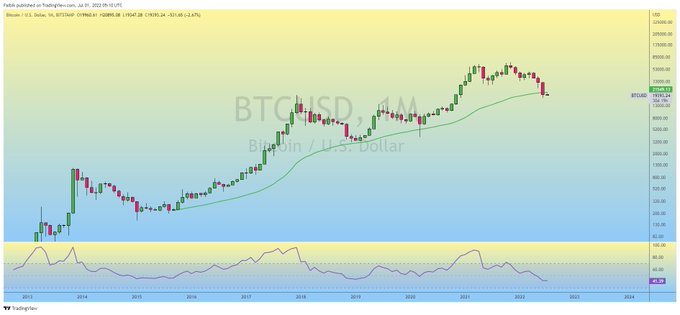
Bitcoin further echoed these investors’ sentiments recently, as the asset class recorded its worst quarterly loss in 11 years. In the last three months, the price of BTC has fallen 58%, data from crypto tracking service platform Coinmarketcap suggests. Bitcoin was trading at around $46,735 on Ist April beginning the 2nd quarter of 2022 and closed June at $19,918.

Aside from the devastating quarterly record BTC had, the cryptocurrency also recorded another disappointing monthly close. For the first time ever, Bitcoin monthly candles closed below MA50 (21.5k) and a low monthly RSI (41).

Image

Image Source: Twitter

Investors’ Expectations Cut Short

Many Bitcoin investors had high expectations this year, as they expected the price of the world’s largest cryptocurrency by market capitalization to hit $100,000 by year-end.

Cryptocurrency experts have made favorable price predictions for the top asset class, reaffirming investors’ hopes in cryptocurrency.

Unfortunately, things did not go as expected, as the world’s largest cryptocurrency continues to shred a huge chunk of its value since the beginning of the year.

BTC Underperformance Since ATH

It is worth noting that Bitcoin started the year around $47,000 after rallying to an all-time high (ATH) of $69,044 on November 8, 2021.

However, BTC fell below $20,000 for the third time in one month. In the last 30 days alone, BTC is down 38%, with the value of Bitcoin not looking like it would be stable anytime soon.

Bitcoin is trading at $19,426, down approximately 72% from its all-time high record of $69,044.

Experts See Bitcoin Bottom Around $10K and $14K

Following the massive plunge of Bitcoin’s value, many investors are left with no choice but to ponder when BTC will finally hit its bottom.

According to a poll by veteran futures trader Peter Brandt, the vast majority of respondents believe BTC is yet to find a bottom. Some analysts, including Brandt, had predicted that BTC’s bottom is around $10,000 to $14,000.

The good news is that some financial experts from investment banking company JPMorgan predict that the ongoing cryptocurrency winter will soon be coming to an end as the market has gone beyond a good portion of the bear market troubles.

FBI Places $100K Bounty On ‘Cryptoqueen’, Places Her In FBI Top 10 Most Wanted List As She Scams Investors For $4B


OneCoin Creator, ‘Cryptoqueen’ Joins FBI Top 10 Most Wanted List.


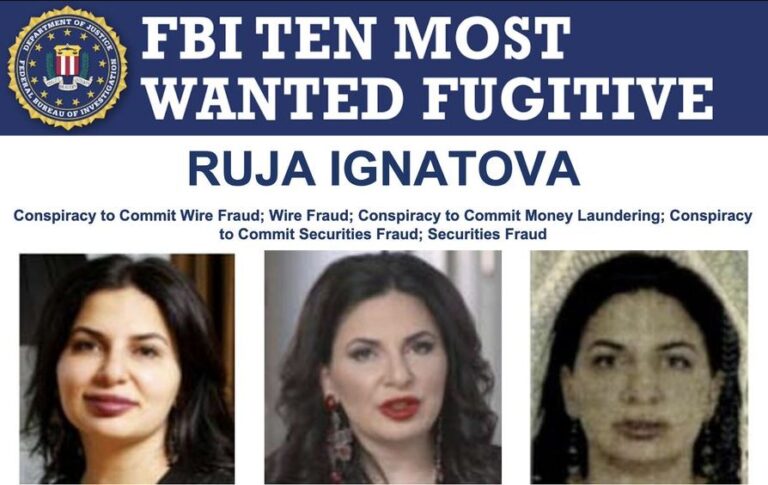
The FBI, in a statement on Thursday, revealed that Ruja Ignatova, co-creator of OneCoin, a fake cryptocurrency project, has been added to its most-wanted list.


Ruja Ignatova created OneCoin in 2014 with her partner, touting the project as a Bitcoin competitor. However, the FBI alleges that from 2014 to 2017, Ignatova had scammed investors of about $4 billion.

Despite claiming to be a cryptocurrency, it is worth noting that the OneCoin project failed to exhibit some of the key characteristics of crypto. After taking advantage of the hype and almost cult following surrounding the crypto market, Ignatova was able to sell the idea of a private blockchain with multi-level marketing promotional tactics. Additionally, the creators set the OneCoin price instead of supply and demand market forces.

“OneCoin claimed to have a private blockchain,” explained Special Agent Ronald Shimko, an investigator on the case at the FBI’s New York Field Office. “This is in contrast to other virtual currencies, which have a decentralized and public blockchain. In this case, investors were just asked to trust OneCoin.”

Ignatova was last seen fleeing from Bulgaria to Greece in October 2017. The FBI suspects someone tipped off the wanted fugitive that law enforcement was on to her as she has not been seen since. Ignatova is facing charges of conspiracy to commit wire fraud, wire fraud, conspiracy to commit money laundering, conspiracy to commit securities fraud, and securities fraud. 

In addition, the FBI has offered the public a $100,000 reward for information leading to her arrest.

“There are so many victims all over the world who were financially devastated by this. We want to bring her to justice,” surmised Special Agent Shimko.

Unsurprisingly, scammers have become increasingly interested in the crypto space with the increased fanfare and market value. A report by the Federal Trade Commission in June shows that losses to crypto scams have surpassed $1 billion since 2021. In addition, the number of reported losses to fraud has grown 60 times since 2018.

However, it is worth noting that law enforcement and the US DOJ also appear to have become more adept at tackling these crimes. Two headline-grabbing cases this year include the arrest of the Frosties NFT creators and the seizure of 700 BTC from an individual suspected of selling people’s private online data.

Ripple Unlocks One Billion XRP From Escrow, Will It Affect Price?

One Billion Ripple (XRP) Unlocked.


In line with its monthly token unlock initiative, Ripple’s popular blockchain network has unlocked yet another one billion units of XRP from escrow.

Whale Alert, the famous cryptocurrency tracking service, shared data of the transaction, which was split into two lumps of 500 million XRPs each.

The two transactions were completed at exactly the same time and it is not surprising to see that the dollar value of the two 500 million XRP lumps correspond in dollar value, with both worth approximately $329 million at the time the tokens were unlocked.

Ripple’s Token Unlock Program

It is noteworthy that the XRP unlock initiative has been consistent since 2017 and it is programmed to be made at the beginning of a new month.

The Ripple team is holding a large percentage of the XRP total supply, as part of efforts to keep the price afloat. Unlike most cryptocurrency projects, the team chose to gradually release the tokens under its custody in bits (usually 1 billion lump sum on a monthly basis) to the community.

However, due to the ongoing lawsuit between Ripple and the Securities and Exchange Commission that has continued to wreak havoc on the price of the crypto asset, the Ripple team chose to always lock back about 800-900 million units of the newly released tokens, and it usually takes place a few hours after the exercise has been completed.

The tokens are usually sent back to escrow to keep the value of XRP from diminishing further while the other 200 million tokens are usually left in circulation to cater to the company’s operational expenses.

Although Whale Alert did not share the transaction details of the newly unlocked XRP tokens sent back to Escrow, the movie is expected to be carried out later today.

Large XRP Transactions Recorded

Meanwhile, moments before Whale Alert shared details of unlocked XRP tokens, the cryptocurrency tracking service reported a large volume of XRP transactions made between several crypto exchanges and unknown wallets.

At first, a sum of 100 million XRP tokens were moved from the Ripple wallet to an unknown wallet.

The unknown wallet later transferred the tokens to two cryptocurrency exchanges, with Bitstamp and Bitso receiving 40 million and 60 million XRPs, respectively.

After a while, the XRPs were sent back to the unknown wallets but this time with some gains, as Bitso and Bitstamp transferred 60.5 million and 44.9 million tokens, respectively, back to the unknown wallets.

XRP Not Largely Affected By Token Unlock

The tokens unlocked from escrow did not have much effect on the price of XRP, as the asset class is trading around the value it has been changing hands for most of the week.

At press time, XRP is trading at $0.31, representing a decline of 3.6%. The price decline of XRP stems from the cryptocurrency market’s bearish state and not from the token unlock.

Data Shows Ripple Facing Bears Better Than Others As XRP Unique Wallets Exceed 200k Since Feb 2020

XRP Bucks The Downtrend As Unique Wallet Activity Spikes.


Santiment Data Shows Ripple Holding Up Better Than Other Altcoins As XRP unique addresses are growing.

In a tweet on Thursday, Santiment revealed that the activities of unique wallets on the XRP network had received a significant boost to record highs even as it pointed out that the token was holding its own despite the general market slide.

According to Santiment data, active unique addresses on the network had exceeded 200,000 for the first time since early 2020.

“XRP is holding up better than most altcoins on a Thursday crypto slide day. A couple of days ago, the XRPNetwork exploded with unique addresses interacting on the network, exceeding 200k for the first time since February 2020. This is worth watching,” said the analytics firm in the tweet.


It is worth noting that on Thursday, Bitcoin, the leading digital asset by market cap, again plunged below the closely watched $20k price support. Consequently, the slide, which pushed the price as low as $18,729, led to a major price drop in major altcoins. 

However, XRP appeared to uncharacteristically buck the trend. The digital asset remained largely unaffected, opening the day at the $0.329 price point and closing at the $0.3314 price point, a 0.7% rise which is quite impressive considering the overall crypto market performance on the day.

Notably, the XRP price and growth performance have been hard hit since Ripple Labs became embroiled in a court case with the US SEC in 2020. As a result, the cryptocurrency, once the 3rd largest by market cap, is now ranked 8th by CoinMarketCap.

However, the fundamentals surrounding the asset have become increasingly positive. For one, as the nearly 2-year-long legal battle drags on, speculators are becoming increasingly convinced that the XRP creators will land a huge victory over the US SEC.

Additionally, Ripple has hinted at expanding soon with several mergers and acquisitions (M&A) lined up despite the crypto winter as it boasts a strong balance sheet. Furthermore, the firm has consistently built products geared towards utility within this period to ensure its long-staying power in the turbulent crypto world.

In May, Santiment data had shown that whales were accumulating the token at a record pace holding over 6% of its total supply. CoinShares data 2 weeks ago also showed that institutions were increasingly allocating capital to the token. With such strong fundamentals, a win for Ripple over the SEC could see it launch a meteoric rise.

Cardano (ADA) Founder Confirms Vasil Testnet Will Launch on July 3, 2022 

0

Hoskinson embarked on yet another live session to update the Cardano community on what to expect in the coming months.  

Charles Hoskinson, the CEO of Input Output Global (IOG), which oversees the Cardano blockchain project, has not failed to provide the necessary updates to ADA investors, as part of efforts to keep community members informed.

In a Twitter live session, the founder of Cardano said he is aware that crypto investors are still trying to cope with the ongoing bear market, which has continued to wreak havoc on people’s investment.

Hoskinson Says Bear Markets Are for Building

Despite the negative effects of bear markets on crypto prices, Hoskinson said the period presents the perfect opportunity to build.

“Bear market is a period when everybody gets more collaborative. It is when more people are willing to join and work with you,” Hoskinson was quoted as saying in a Twitter live video.

The Cardano exec stated that the IOG team will take advantage of the ongoing bear market to carry out important upgrades that will make the popular blockchain project stronger.

IOG’s Major Focus

Hoskinson shared some details of some of the things the IOG team is focused on at the moment and at the top of the list is its flagship upgrade, Vasil Hard Fork Combinator (HFC).

According to Hoskinson, the Vasil tesnet will be launched on July 3, 2022, and it will be followed by a mainnet launch by the end of July.

He noted that Vasil has been the most complicated Hard Fork Cardano has built since its inception. Hoskinson added that the team initially postponed Vasil’s mainnet launch earlier this month because it could not afford to make any mistakes like other crypto projects, especially Terra.

After the Vasil mainnet launch, the Cardano team will concentrate more on four development tracks, such as Shirley, Goguen, Basho, as well as Volataire.

The four development tracks run concurrently and will further introduce better features and improvements to the Cardano network in the near future.

Hoskinson noted that many of the features that will be introduced by these four development tracks will go live when the Vasil upgrade is finally launched by the end of next month.

Cardano Founder Hails Community Members 

Hoskinson did not fail to acknowledge the resilience and support from the Cardano community as he remained optimistic about their support for the project, saying:

“One thing that remains constant is that bulls or bear, the Cardano community is here to stay.”

FCFPay To Add Support For Shiba Inu Ecosystem Coin “BONE” As Payment Method

0

Top Canada-based Payment Gateway, FCFPay Might Add Support For Bone ShibaSwap (BONE) as Payment Method Soon.


Merchants from across the world will be able to accept Bone ShibaSwap as payment soon via FCFPay as BONE has won the recently launched FCFPay Twitter Poll with over 70% votes.

Following the listing of Shiba Inu (SHIB) as a payment method on April 13th as reported by TheCryptoBasic,  FCFPay now plans to add support for more cryptocurrencies including the two other tokens of the Shiba Inu ecosystem, Bone ShibaSwap (BONE), and The Dogecoin Killer (LEASH).

FCFPay, the Canada-based crypto payment gateway, is looking to add other cryptocurrencies for payments in their ever-growing network. FCFPay initiated a Twitter Poll asking followers to vote for the coin/token which they want to use next as a payment method on their platform.

FCFPay has provided the Community with four options: BONE, LEASH, TRX, and MATIC.

A total of 3,158 votes were cast. Out of which Bone got over 70% votes in its favor. LEASH managed to take the second spot with 10.7% votes, whereas, MATIC secures the third position with 10.1% votes. Tron earns only 4.2% of the votes.

The poll results suggest that FCFPay will soon enable merchants across the globe to accept Bone ShibaSwap in exchange for their services.

The Twitter Poll from FCFPay comes in after Switchere which becomes the first exchange in the world to list the “Trifecta” of the Shiba Inu ecosystem i.e., SHIB, BONE, and LEASH at once.

BONE is Gathering Attention from the Community. Here’s Why?

Bone ShibaSwap is gathering a lot of attention from the community these days as Unification brings the potential launch of Shibarium Layer-2 solution near. According to the Unification XFUND, a blockchain service provider company has officially announced that the Shibarium beta testing will commence by the third quarter of 2022.

Bone will reportedly play an important role in the Shibarium Layer-2 solution. It will act as the native “Gas Token” of Shibarium. This means each and every holder of Shiba Inu will need a BONE to make transactions on the Shibarium blockchain. At present, Bone ShibaSwap is acting as the governance token of the ShibaSwap ecosystem that empowers the Shiba Inu Community to vote on upcoming proposals.

Grayscale CEO Says “SEC Is Acting Arbitrary And Capricious”

0

Grayscale CEO Says SEC Is Not Applying Uniform Treatment to Identical Bitcoin ETFs. Sonnenshein throws more light on why Grayscale chose to sue the SEC. 


In light of the lawsuit filed against the Securities and Exchange Commission by Grayscale, Michael Sonnenshein, CEO of Grayscale, has accused the SEC of exhibiting an “arbitrary and capricious behavior” via its method of regulation.

Sonnenshein said in a CNBC Squawk Box interview today that the Securities and Exchange Commission has continuously denied spot-based Bitcoin exchange-traded funds (ETFs) while approving futures Bitcoin ETFs.

“When you look at the Administrative Procedure Act and the Securities Exchange Act of 1934, which governs the way regulators have to govern, [spots and futures ETFs] have to be treated alike, but in this case they are not,” Sonnenshein was quoted as saying.

The company’s exec noted that the SEC is discriminating against issuers, including Grayscale, which has done everything to introduce new financial instruments “into the United States regulatory perimeter.”

Grayscale CEO’s comments echo those made earlier today by the company’s senior strategist lawyers and former U.S. solicitor general Donald B. Verrilli Jr., who said the SEC is violating the 1934 Administrative Procedure Act.

Grayscale Sues SEC Amit Bitcoin ETF Rejection

The development comes less than 24 hours after Sonnenshein announced that Grayscale had filed a lawsuit against the SEC in the U.S. Court of Appeals for the District of Columbia, challenging the agency’s decision to deny its spot-based Bitcoin ETF application.

Grayscale is poised to convert its flagship Bitcoin Fund (GBTC) to a spot BTC ETF following increased client demand.

However, all efforts to convert GBTC, which traded at a negative premium of 29% earlier today, have been pushed back by the SEC on numerous occasions.

This time, Grayscale took a more stringent approach by filing a lawsuit against the SEC with the hope that the agency would reconsider its ETF application.

A team of legal practitioners, including Verrilli Jr., and other attorneys at the law firm Davis Polk & Wardwell are heading the Grayscale legal team in the lawsuit.

SEC Continually Denies Grayscale’s Bitcoin ETF Application

It is noteworthy that since 2013 when Grayscale launched, the company has filed a series of Bitcoin ETF applications, but the SEC has continued to deny the requests.

The SEC has asserted that it is bent on protecting U.S. investors from the risks associated with cryptocurrencies.

However, the agency did not seem to consider investors’ protection when it approved futures-based Bitcoin ETFs, including the Bitcoin ETF offered by Valkyrie Investments.

The agency’s regulatory approach prompted Grayscale to accuse the SEC of not applying uniform treatment to identical investment vehicles.