
Home Blog Page 2467

Number of Addresses Holding At Least One Ethereum Reaches New High, ETH 2.0 Deposit Hits $30 Billion

0

The widespread adoption of Ethereum (ETH) has continued to grow, as the price of the second-largest cryptocurrency by market capitalization recovers from the January market crash.


It is no longer news that whale investors have used the recent market dip to increase their Ethereum holdings, as thousands of ETHs have been purchased and transferred from exchanges to unknown wallet addresses. 

While whale traders have been on an ETH accumulation spree, small traders do not want to be left out of the Ethereum adoption trend. 

Fresh data suggests that the number of small-time investors holding at least one ETH has set a new all-time record, a move that bodes well for the second-largest cryptocurrency by market capitalization. 

Glassnode data suggests that the number of addresses holding at least one ETH has reached a new all-time high (ATH). 


At press time, the total number of such addresses now stands at 1,423,856, surpassing the previous ATH of 1,421,792 recorded on February 5, 2022. 

Ethereum is becoming more popular by the day following the massive interest in several niches of the network, including decentralized finance (DeFi) and non-fungible tokens (NFTs). 

Both sectors have continued to lure retail and institutional investors as billions of dollars flow in and out of related platforms. 

Interestingly, investors are either holding on to their ETH or looking for opportunities to increase their holdings in the cryptocurrency as analysts have predicted that the price will soar tremendously in the near future. 

Last month, Cathie Wood’s Ark Invest predicted that the price of a unit of ETH will hit $160,000 by 2030. 

Such predictions are among the reasons the number of investors holding at least one unit of ETH has been steadily increasing.

ETH 2.0 Beacon Chain Deposit Hits $30 Billion

Despite the massive interest in Ethereum, developers are still seeking ways to make the network more efficient in order to onboard more users in the coming years. 

One of the ways developers are planning to achieve this feat is to fully launch Ethereum 2.0, an initiative that will scale the network’s performance by adopting a proof-of-stake (PoS) algorithm. 

In order to achieve this feat, validators are required to stake 32 ETH into a deposit contract for the Ethereum 2.0 Beacon Chain. 

Ether Scan data shows that the deposit contract now holds 9,371,474 ETH, worth nearly $30 billion, at the time of writing, 

Last year, we reported that a total of 7.7 million ETHs were deposited in the Ethereum 2.0 smart contract. 

Ethereum Whales Accumulates Over 6 Million MATIC, Worth $13.73M Within 24 Hours

0

Polygon (MATIC), the first well-structured, easy-to-use platform for Ethereum scaling and infrastructure development, has recently raised $450 million in an investment round led by venture capital firm Sequoia Capital India to support its Web 3 plans.


Following the news, Ethereum whales became active and started to fill up their bags with MATIC before the next Bull Run for the coin starts.

Looking into the data provided by WhaleStats, we found that in the last 24 hours, two Ethereum Whales have accumulated a total of 6,805,973 (6.8M) MATIC, worth $13,730,006 ($13M) in 4 transactions.

The 655th biggest whale of Ethereum has bought 4 million MATIC, worth $8,080,000 in just a single transaction.

As per data provided by WhaleStats, MATIC is now the second biggest holding for the whale and currently has a total of 2,112,543 (2.1M) MATIC tokens, worth ,174,132 (4.1M).

Shortly after this transaction, another whale which is currently ranked as the 290th biggest whale, carried three transactions, i.e., 902,990 MATIC in his first transaction, and bought 2,805,973 (2.8M) MATIC, worth $5,650,006 ($5.6M) in total. Digging deep into the data of the second whale, MATIC also seems to be her second-biggest holding, following Ethereum (ETH). This whale holds a total of 21,628,466 MATIC coins, which she purchased at an average price of $2. The worth of MATIC coins in his wallet equals $42,731,376 ($4.2M).

Bitcoin Enters Top 10 Global Assets by Market Cap Beating Nvidia, Ethereum Takes 27th Spot Surpassing Mastercard

0

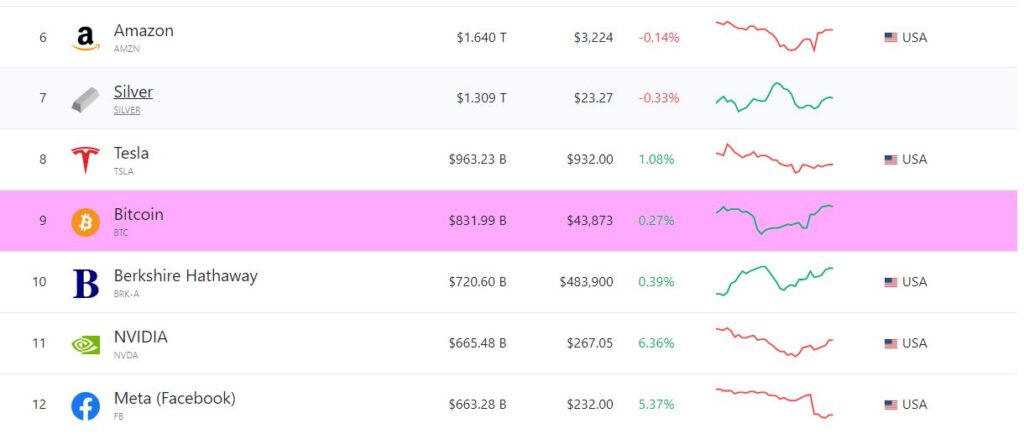
Bitcoin surpasses Berkshire Hathaway, Nvidia, and Facebook to enter the top 10 list of world assets by market cap while Ethereum Overtakes Mastercard, Nestle, and Alibaba to Become 27th Largest Global Asset.


Interestingly, the world’s largest cryptocurrency Bitcoin has moved ahead of popular companies like Facebook, now renamed Meta, Visa, JPMorgan Chase, and Samsung. 

Bitcoin, which had a market capitalization of $200 billion less than two years ago, was initially ranked in the top 30 spots in the ranking.  

However, following the widespread adoption of Bitcoin by both retail and institutional investors, its market cap has soared to $832.13 billion, which puts it as the 9th largest asset in the world. 

It is worth noting that Bitcoin also had its fair share of price crashes in January, as its price dipped below $33,000. 

bitcoin enters top 10 assets by market cap
image source: https://companiesmarketcap.com/assets-by-market-cap/

Ethereum:

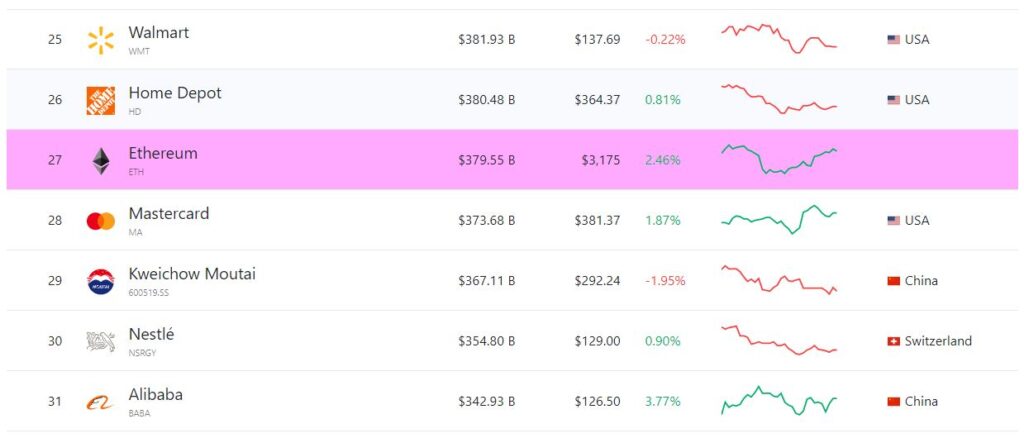
The second-largest cryptocurrency by market capitalization, Ethereum (ETH), is currently ranked the 27th largest asset in the world, surpassing major brands like Nestle, Exxon Mobil, Mastercard, and Alibaba. 

According to data on Companies Market Cap, Ethereum became the 27th largest global asset after hitting a market cap of $379.55 billion. 

The remarkable achievement for the second-largest cryptocurrency puts the digital assets ahead of popular firms like Mastercard, Nestle, and Alibaba, which currently have a market cap of $373.68 billion, $354.80 billion, $342.93 billion, respectively. 


image source: https://companiesmarketcap.com/assets-by-market-cap/

Ethereum achieved the feat after the crypto market recovered from a massive price crash in January that wreaked havoc on all cryptocurrencies, including Bitcoin (BTC). 

Recall that after Ethereum peaked at $4,878 in November 2021, ETH price has suffered a major correction, falling below $2,300 in January 2022. 

However, a number of developments have prompted the crypto market to recover from bearish price movements, with ETH not left out. 

ETH is changing hands around $3,184 across major cryptocurrency exchanges at press time.

Baby Doge Aiming For Metaverse Following Its Rival Shiba Inu

0

Following its rival Shiba Inu (SHIB) token, Baby DogeCoin (BabyDoge) also seems to prepare itself to enter the Metaverse.


On Wednesday, Baby DogeCoin asked its 957K followers whether they wanted to see the BabyDoge in the metaverse?

The tweet also comprises 19 seconds video, which seems like a trailer. The video appears to be animated, and BabyDoge is shown moving here and there, somewhere in the metaverse.

The tweet comes on the same day when the meme coin’s rival SHIB declared that they are launching the purchase of their first-ever Virtual Real Estate (Shiba Lands).

This shows that Baby DogeCoin doesn’t want to miss the train, and they’re thinking about entering into the Metaverse.

BabyDoge’s price is trading at $0.000000004017 per coin, up more than 1% for the day. However, the 24-hours trading volume for the coin tanked 46.68% to $12,238,356.57 compared to the previous trading day.

BabyDoge has recently registered its all-time high price of $0.000000006345 on January 16, 2022, i.e., 24 days ago. BabyDoge is undoubtedly getting more popular day after day and has continuously seen trending on Twitter since the start of the New Year 2022.

BabyDoge’s official Twitter handle is now close to hitting a record 1 million followers following the Twitter trend.

The popularity of BabyDoge increased so much that it has even surpassed the SHIB token in terms of holders’ count. Looking into the BscScan data, we found that BabyDoge’s current holder count stands at 1,392,797 (1.3M) compared to its rival Shiba Inu holders’ count of 1,166,064.

Moreover, Baby DogeCoin was recently listed on the Canadian biggest crypto exchange, Biconomy Global.

Apple To Launch Tap To Pay Feature On iPhone That Will Empower Businesses To Accept Crypto Payments

0

Apple will add a new Tap to Pay feature on iPhone devices to make cryptocurrency payments.


Apple announced plans to launch Tap to Pay for its iPhone, a new feature that effectively turns the smartphone into a point-of-sale device for businesses and merchants. The announcement explains that with Tap to Pay, iPhone-owning merchants receive contactless payments by using their mobile devices as a point-of-sale machine thanks to the near-field communication technology, or NFC.

The new capability will empower millions of merchants across the US, from small businesses to large retailers, to use their iPhone to seamlessly and securely accept Apple Pay, contactless credit and debit cards, and other digital wallets through a simple tap to their iPhone — no additional hardware or payment terminal needed.

“As more and more consumers are tapping to pay with digital wallets and credit cards, Tap to Pay on iPhone will provide businesses with a secure, private, and easy way to accept contactless payments and unlock new checkout experiences using the power, security, and convenience of iPhone,”

Apple Pay is already accepted by more than 90 percent of US retailers, and with this new capability, virtually every business, big or small, will be able to allow their customers to Tap to Pay on iPhone at checkout. Tap to Pay on iPhone will also roll out to Apple Store locations in the US later this year.

With Tap to Pay on iPhone, customers’ payment data is protected by the same technology that makes Apple Pay private and secure. All transactions made using Tap to Pay on iPhone are encrypted and processed using the Secure Element, and as with Apple Pay, Apple doesn’t know what is being purchased or who is buying it.

Tap to Pay on iPhone will be available to participating payment platforms and their app developer partners to leverage in their software developer kits (SDKs) in an upcoming iOS software beta.

While Apple Pay will most likely not allow direct purchase of goods and services via Bitcoin, it will convert the user’s crypto holdings to match the dollar amount requested by the merchant’s point-of-sale machine to make the purchase.

Court May Allow Ripple’s Fair Notice Defense While Maintaining Charges Against Firm’s Execs

0

As the cryptocurrency community anticipates the outcome of the Securities and Exchange Commission (SEC) v. Ripple lawsuit, attorney Jeremy Hogan has forecast that Judge Analisa Torres may likely dismiss the case against the blockchain company. 


However, the SEC may not drop the charges against Ripple’s founders Brad Garlinghouse and Chris Larsen, who are alleged to have profited from the sale of unregistered securities in the U.S. 

Hogan stated this in response to a Twitter user, @XRPMule comment, who noted that fair notice will be allowed, adding that the SEC will not drop charges against Garlinghouse and Larsen. 

“That’s what I’m thinking as well,” attorney Hogan said in response to @xrpmule. 

SEC Evidence Against Ripple Founders Weak

Attorney Hogan noted that the evidence, especially the ones against Larsen, is weak because it revealed that Hogan sold 30,000 EUR of XRP to a Portuguese buyer in 2012.

This revelation alone implies that the case is outside of SEC jurisdiction. 

“The argument is that the email is not relevant because it was not sent to a U.S. national and the SEC only has jurisdiction over U.S. Nationals,” attorney Hogan commented. 

At the time of writing, it is not clear whether the SEC has evidence that both Garlinghouse and Larsen conducted unregistered token sales with U.S. nationals, but further details are expected to emerge in the coming weeks. 

Yesterday, XRP price rose as high as $0.91 after Judge Torres ruled that all sealed documents should be opened. 

The outcome of the lawsuit is expected to be a standard and a major determinant of how cryptocurrencies will be classified in the near future. 


Five Play To Earn (P2E) And Metaverse Projects Built on Cardano

0

Here are Five P2E and Metaverse Projects Built on Cardano.


Play-to-Earn (P2E) games are becoming increasingly popular in recent times as the cryptocurrency niche presents gamers with the opportunity to generate revenue. 

The vast majority of these games have launched on Ethereum, with others being deployed on Solana and Polygon. 

However, specific technical issues like network congestion across these networks have seen P2E gaming projects switch their interest to Cardano, as the project’s team continues to upgrade the blockchain to onboard more users. 

Cardano is gradually becoming a home for decentralized exchanges (DEXs) following the deployment of smart contracts, and the network is well on track to become the favorite choice for a series of metaverse projects. 

Several P2E games and metaverse projects are launching on Cardano following the network’s upgrade. 

Five Cardano-based Projects

That said, let’s examine some of the metaverse projects on Cardano: 

MetaShooter 

Earlier this month, MetaShooter became the first blockchain-based decentralized hunting metaverse in Cardano. The project combines blockchain technology and hunting to give users an exciting experience. 

The game, set on an open world island, enables interested players to earn rewards when they win different tournaments and competitions. In addition, players can use the MetaShooter marketplace to build personalized weapons to enhance their accuracy.

Other features of the game include real-life graphics, NFT marketplace, etc.  

Pavia (PAVIA) 

Pavia is a non-fungible token (NFT) platform built on Cardano that enables users to create, trade, and explore in a virtual world. 

The team announced its first-ever blockchain-based land sale that was allocated randomly to crypto enthusiasts. There are currently more than 10,000 virtual landowners in Pavia following the event. According to the team, each parcel of land represents a uniquely numbered Cardano NFT (CNFT). Users can begin deploying content on their piece of land once the project development is complete. 

Users who missed out on the virtual land sale can own a piece by acquiring the project’s native cryptocurrency, $PAVIA. Pavia is planning on launching a P2E game soon.

Cornucopias 

Cornucopias is another Cardano-based P2E game that rewards players with landed properties and other NFT assets, exchanging for real money. 

The game is set on an island segmented into three zones, namely Wild West, Wild Life, and Age of the Samurai. Players are given other means to earn value in the game by designing items like coffee tables and beds and selling them to other users in the Cornucopias’ NFT marketplace. Aside from gaming, traditional eCommerce companies can also promote their brands on the market. 

Cardania 

Cardania is currently being built on the Cardano network, utilizing blockchain tech, P2E, and NFT. The project is being developed by a team of artists and developers building on things they believe will be fun and unique for users. 

The team’s mission is to build a gaming ecosystem centered on money, relevant resources, and culture. Cardania has completed the sale of its virtual plot of land. Users who miss out on the opportunity to own a piece can purchase the project’s native cryptocurrency, the RAD token. So far, Cardania has minted 90 billion units of RAD on the Cardano blockchain. Cardania has a marketplace where different digital collectibles can be bought. 

Cardano City 

Cardano City is another evolving metaverse project built on the Cardano blockchain. Cardano City users will be allowed to collect, create, customize, trade, and conduct various virtual activities in the city. The platform has 50,000 unique NFTs with corresponding data of rarity. 

Here is a list of 12 decentralized exchanges set to launch on Cardano.

Even Seven Months After Death, Tech Tycoon And Crypto Enthusiastic McAfee’s Body Remains Trapped in Spain 

0

With the death of John McAfee, founder of the McAfee antivirus, many believed the saga surrounding his 75 years of existence on earth would finally be over.


However, in contrast to their opinion, the McAfee story and saga have continued to linger even after his death. 

Market Watch noted that the body of McAfee, who died in a Spanish prison in June 2021 is still in a Spanish-based morgue freezer more than seven months after he was confirmed dead. 

Reason for the Delay

Part of the delay in extraditing the antivirus proponent’s remains was due to the legal battle between his daughter Jen and ex-wife Janice McAfee, over who will get custody of the body. 

While Jen wants her late father’s body to be cremated and sent back to the United States, it is unclear at the time of writing what McAfee’s ex-wife wanted for the antivirus software developer. Two family factions had separately petitioned a Spanish court for possession of the body.

Despite Jen recently giving up legal claims over the remains of her late father’s body to stop any additional delay of McAfee’s burial, the body is yet to be released.

Other sources say the reason for the delay of McAfee’s burial is because Spanish authorities are yet to issue a report stating the cause of his death.

In Spain, death reports are issued by a court system led by a judge, which is in contrast to what is being practiced in the United States where coroners are assigned to issue such reports in months. 

According to Jen’s lawyer, Joy Athanasiou investigations into the cause of McAfee’s death are being stalled as a result of the increased number of coronavirus-related deaths in Spain. 

“To my knowledge, they have done nothing to the body. It has been sitting there [in a freezer] all these months,” Athanasiou said. 

Recall that the cybersecurity expert was charged for promoting an Initial Coin Offering (ICO) in exchange for $23.1 million. 

The development led to his arrest in Spain and he subsequently committed suicide in prison despite pleading not guilty. 

Moments after McAfee committed suicide in a Spanish prison, there have been numerous twists surrounding his death from his ex-wife and daughter. 

Despite sources stating that McAfee committed suicide in a Spanish prison, Janice said she blamed the United States government for his death. 

Janice further noted that she does not believe the suicide story, adding that the note found in the deceased’s pocket sounded like it was written by someone who wanted to imitate the deceased. 

Russia To Publish Bill That Will Legalize And Regulate Cryptocurrencies on February 18, 2022

0

Russia joining India in regulating crypto rather than banning them.


The Russian government supported the cryptocurrency industry regulation concept proposed by the Ministry of Finance.

“The implementation of the regulations will ensure the creation of the necessary regulatory framework for crypto, it will bring the digital currency industry out of the shadows, and create the possibility of legal business activities,” the Russian government said in a statement.

Less than a month after Russia’s President Vladimir Putin called for unity over the cryptocurrency regulation dispute between the Bank of Russia and its Finance Ministry; the country is ready to recognize the nascent asset class as an alternative currency. 

Local news outlet Kommersant reported today that both the Bank of Russia and the government had reached an agreement to see the country publish a draft bill on how cryptocurrencies will be regulated. 

Per the report, the draft regulation, expected to be presented to the National Assembly by February 18, will see cryptocurrencies, including bitcoin and Ethereum, classed as an “analogue of currencies” rather than digital financial assets. 

However, the report added that the distribution and circulation of cryptocurrencies would only occur through licensed intermediaries like banks. 

Further details of the report reveal that cryptocurrency transactions of 6,000 rubles (appr. $8,000) and above within the legal sector must be declared to relevant authorities. In contrast, related transactions outside the jurisdiction will constitute a criminal offense. 

Furthermore, fines will be introduced for the illegal acceptance of cryptocurrencies as a means of payment when the draft bill eventually becomes law. 

“The purpose of the regulation is to integrate the mechanism for the circulation of digital currencies into the financial system and ensure control over cash flows in the circuit of credit institutions,” the Russian government said in a statement. 

Previous Russian Crypto Regulation Efforts 

Since last year, cryptocurrency regulation has been a significant topic of discussion in Russia. 

The issue became more severe after the Bank of Russia called for a blanket ban on cryptocurrencies, stating that the asset class posed a major threat to its existing financial system. The Bank of Russia added that cryptos are primarily used to finance illicit activities, including money laundering and terrorist financing. 

In contrast to the country’s apex bank motion, Ivan Chebeskov, a representative of Russia’s Ministry of Finance, called for regulation instead of a ban. 

The argument prompted president Putin to weigh in on the matter, urging both parties to reach a consensus on crypto regulation for the country to benefit from the opportunities inherent in digital currencies, especially in mining.

Recently crypto became legal in India; India introduced a 30% tax on digital assets income and launched a digital Rupee.

U.S Seizes $3.6B In Stolen Bitcoin Linked To 2016 Bitfinex Hack Arresting A Couple For Alleged Conspiracy

0

Representatives of the US authorities announced the detention of two persons involved in the hacking of the Bitfinex exchange in 2016 and the confiscation of bitcoins worth $3.6 billion.


According to a press release from the US Department of Justice, the defendants are the spouses – 34-year-old Ilya Lichtenstein and 31-year-old Heather Morgan.

“According to court documents, Lichtenstein and Morgan allegedly conspired to launder the proceeds of 119,754 bitcoin that were stolen from Bitfinex’s platform after a hacker breached Bitfinex’s systems and initiated more than 2,000 unauthorized transactions.”

According to officials, the stolen cryptocurrency ended up in a Liechtenstein-controlled wallet.

“Over the last five years, approximately 25,000 of that stolen bitcoin were transferred out of Lichtenstein’s wallet via a complicated money laundering process that ended with some of the stolen funds being deposited into financial accounts controlled by Lichtenstein and Morgan.”

The remainder of the stolen coins – more than 94,000 BTC  were kept in a separate wallet.

“The remainder of the stolen funds, comprising more than 94,000 bitcoin, remained in the wallet used to receive and store the illegal proceeds from the hack. After the execution of court-authorized search warrants of online accounts controlled by Lichtenstein and Morgan, special agents obtained access to files within an online account held by Lichtenstein.

Those files contained the private keys required to access the digital wallet that directly received the funds stolen from Bitfinex and allowed special agents to lawfully seize and recover more than 94,000 bitcoin that had been stolen from Bitfinex. The recovered bitcoin was valued at over $3.6 billion at the time of seizure.”

Representatives of the Ministry of Justice stressed that this is the largest case of confiscation of cryptocurrency in the department’s history.

“Today’s arrests, and the department’s largest financial seizure ever, show that cryptocurrency is not a safe haven for criminals,” said Deputy Attorney General Lisa O. Monaco.

“Today, federal law enforcement demonstrates once again that we can follow the money through the blockchain and that we will not allow cryptocurrency to be a safe haven for money laundering or a zone of lawlessness within our financial system,” said Assistant Attorney General Kenneth A. Polite Jr. of the Justice Department’s Criminal Divisio

“Criminals always leave tracks, and today’s case is a reminder that the FBI has the tools to follow the digital trail, wherever it may lead,” said FBI Deputy Director Paul M. Abbate.

If Lichtenstein and Morgan are found guilty, they face up to 25 years in prison. both, New Yorkers, are scheduled to make their initial appearances in federal court today at 3:00 p.m. in Manhattan.

Bitfinex representatives said they would continue to work with the US Department of Justice to try to receive seized bitcoins. If this succeeds, the company will use 80% of the amount received within 18 months to buy back and burn UNUS SED LEO tokens, as provided in the white paper.

As a result of a hack in early August 2016, Bitfinex lost almost 120,000 BTC, $71.8 million at the exchange rate at that time, more than $5 billion at the current exchange rate.

In May 2020, unknown persons sent 30.667192 BTC from stolen funds to anonymous addresses. In August, 4571 BTC and 473.3183 BTC moved.

Recently TheCryptoBasic reported on Feb 1st, that 20,000 Bitcoin Worth $767M were moved from Bitfinex 2016 Hack.