
Home Blog Page 42

Meta Stock Sheds $54 Billion as 29-State Trial Puts Instagram’s Engagement Model at Risk

Meta Platforms shares dropped sharply Tuesday as investors weighed a landmark child-safety trial that could produce substantial financial penalties and force changes to Facebook and Instagram.

META fell approximately 3.7% to $547.80 during early trading. Using the same share-count basis across both prices, the decline reduced Meta’s estimated market capitalization from approximately $1.449 trillion at Monday’s close to $1.395 trillion, erasing about $54 billion in market value.

That figure was an intraday estimate and will change with Meta’s share price. The decline also occurred during a broader technology selloff, meaning the lawsuit cannot be identified as the sole cause of Tuesday’s weakness.

The longer-term damage is more substantial. Meta stock was approximately 31% below its 52-week high of $790.80. Applying Meta’s current effective share count across both share classes suggests that approximately $619 billion in market value has disappeared from the peak.

Meta Faces Its Largest Youth-Safety Trial

Opening arguments began Tuesday in an Oakland, California, federal trial involving a bipartisan coalition of 29 states.

California, Colorado, Kentucky and New Jersey are presenting claims that Meta deliberately designed Facebook and Instagram features to encourage compulsive use among children and teenagers while misleading consumers about platform safety.

The trial will also address allegations from all 29 states that Meta improperly collected and used children’s personal information in violation of federal law. The claims include accusations that Meta gathered data from users younger than 13 without verifiable parental consent.

Meta denies the allegations. The company maintains that the states have not demonstrated actual harm or consumer deception and says it has invested extensively in protections for younger users.

CEO Mark Zuckerberg and Instagram head Adam Mosseri are expected to testify during the multiweek trial.

An eight-person advisory jury will evaluate the evidence, but its verdict will not be binding. U.S. District Judge Yvonne Gonzalez Rogers will ultimately decide the case.

Penalty Estimates Stretch From $200 Billion to $1.4 Trillion

The potential penalty remains heavily disputed.

Meta calculated that the states’ statutory theory could produce penalties as high as $1.4 trillion approximately equal to the company’s current market value. Attorneys representing the states have not formally specified an amount but recently told the court that the figure could be closer to $200 billion.

The two numbers should therefore be treated as competing litigation estimates rather than a confirmed penalty range. Neither represents an expected final judgment.

Even $200 billion would equal approximately 14% of Meta’s current valuation. However, the possible operational remedies may present a more important long-term risk than the financial penalty.

The states are seeking nationwide changes that could include age restrictions, removal of infinite scrolling, deletion of algorithms trained on children’s data and changes to how content is recommended, according to Reuters.

Those remedies could reduce the amount of time younger users spend on Facebook and Instagram. Lower engagement could produce fewer advertising impressions and reduce the value of Meta’s recommendation technology.

The trial therefore challenges elements of Meta’s engagement-driven business model rather than presenting only the possibility of a one-time legal expense.

Previous Meta Rulings Increase the Stakes

The federal trial follows several legal setbacks for Meta.

A New Mexico judge recently ordered the company to provide $567 million for remedies addressing youth-related harms. That decision followed a $375 million civil penalty imposed by a jury in March, bringing the state’s potential recovery from the same litigation to more than $942 million.

Meta has said it will appeal. Reuters reported that the final recovery remains dependent on the appeals process.

Separately, a Los Angeles jury found Meta and Alphabet-owned YouTube liable in a social-media addiction lawsuit involving a young user.

The jury awarded $3 million in compensatory damages and another $3 million in punitive damages. Meta was assigned 70% of the responsibility, leaving it responsible for approximately $4.2 million of the combined award. Both companies have challenged the outcome or indicated that they intend to pursue legal options.

The monetary award was immaterial to Meta’s finances. Its greater significance was the jury’s acceptance of claims targeting product design and failure to warn not merely harmful content posted by users.

That distinction could influence thousands of existing lawsuits brought by individuals, states, school districts and municipalities.

Legal Threat Arrives as AI Spending Accelerates

Meta remains highly profitable and retains substantial liquidity, but its AI infrastructure spending has sharply reduced reported free cash flow.

Second-quarter operating cash flow increased 25% year over year to $31.86 billion. Capital expenditures, including principal payments on finance leases, reached $31.08 billion.

That left Meta with $784 million in free cash flow under the company’s non-GAAP calculation, down from $8.55 billion one year earlier.

Meta cautions that this measure should not be interpreted as the amount of residual cash available for discretionary spending. The company still held $90.26 billion in cash, equivalents and marketable securities at the end of June.

Its official second-quarter results also showed:

  • Revenue increased 28% to $60.80 billion.
  • Operating income declined 8% to $18.78 billion.
  • Net income fell 14% to $15.85 billion.
  • Legal proceedings generated $2.4 billion in charges.
  • Meta raised its expected 2026 expense range to between $165 billion and $169 billion.
  • Full-year capital spending is expected to reach $130 billion to $145 billion.

These figures show that Meta has the resources to absorb a manageable penalty. A judgment approaching $200 billion—or operational restrictions affecting advertising engagement—would be considerably more difficult to dismiss.

METAB Tokenized Stock Follows META Lower

Meta’s tokenized bStock also followed the Nasdaq-listed shares lower.

METAB traded near $549 at the time of reporting and was down approximately 5.4% over the previous 24 hours. The Binance METAB/USDT pair was also quoted close to $549.

Total trading volume across tracked markets reached approximately $2 million, according to CoinGecko.

METAB’s 24-hour percentage change should not be compared directly with META’s regular-session decline. The token trades outside Nasdaq hours and through separate cryptocurrency order books, creating differences in measurement periods, liquidity and price discovery.

Verdict for META and METAB

The $1.4 trillion headline substantially overstates the most likely financial outcome, but the underlying case presents a meaningful risk.

A manageable fine would not fundamentally threaten Meta’s business. A nationwide order requiring the company to remove or redesign engagement features could be more consequential because it may affect user activity and advertising revenue for years.

The near-term outlook for META and METAB remains cautious while the trial proceeds. A favorable ruling could remove part of the legal discount already reflected in Meta’s valuation.

An adverse ruling targeting addictive platform design, however, could strengthen thousands of existing claims and establish a framework for courts to regulate the engagement systems powering Facebook and Instagram.


Micron Stock’s Road to $1,625 Hinges on AI Rewriting the Memory Cycle

UBS’s $1,625 price target for Micron Technology is back in focus as investors debate whether artificial intelligence has permanently changed the economics of the memory-chip industry.

The target represents approximately 67% upside from Micron’s early Tuesday price of $970.67.

UBS first introduced the forecast on May 26, when analyst Timothy Arcuri raised his previous target from $535 and maintained a Buy rating. Current analyst data lists the call as reiterated on August 18, meaning the recommendation may have received a fresh endorsement—but the $1,625 target itself is not new.

The more important part of the UBS thesis is not the headline price. The investment bank is betting that AI demand and long-term supply agreements will make Micron’s earnings considerably more durable than they were during previous memory cycles.

Why UBS Believes Micron Deserves a Higher Valuation

Memory manufacturers have historically moved through repeated periods of shortages, aggressive capacity expansion and eventual oversupply. Those swings produced unpredictable earnings and kept valuation multiples below those assigned to less cyclical semiconductor companies.

UBS believes AI could weaken that pattern.

As AI models grow, system performance increasingly depends on the speed at which data can move between processors and memory. Additional computing power provides diminishing benefits when memory bandwidth becomes the primary bottleneck.

Long-term supply agreements could also reduce volatility. UBS estimates that as much as 30% of industrywide DDR volumes could become covered by agreements that lock in customer commitments and establish partially fixed pricing.

Hyperscale customers have reportedly secured approximately 60% to 70% of server DDR5 supply through enhanced agreements. These contracts provide manufacturers with greater demand visibility while giving customers more certainty that they will receive scarce memory products.

However, the contracts may reduce cyclicality rather than eliminate it. Pricing could still weaken if manufacturers add too much capacity or AI infrastructure spending slows.

What UBS’s $1,625 Forecast Assumes

UBS forecasts Micron earnings of approximately:

  • $155 per share in calendar 2027
  • $167 per share in calendar 2028
  • $117 per share in calendar 2029

The bank expects Micron to generate more than $400 billion in cumulative free cash flow across those three years. Its 2029 estimate assumes a moderate memory downturn while keeping annual earnings above $100 per share.

The $1,625 target is based on approximately 15 times forward earnings, using UBS’s longer-term profit expectations and discounting the valuation back by one year.

When the target was introduced, it was the highest among the 46 brokerages covering Micron, according to Reuters. Other analysts have since published targets exceeding $1,625, so it is no longer the undisputed highest forecast.

Micron’s Results Support the AI Memory Thesis

Micron’s latest financial results provide evidence that memory is capturing an expanding share of AI infrastructure spending.

Fiscal third-quarter revenue reached a record $41.46 billion, compared with $23.86 billion in the previous quarter and $9.30 billion one year earlier.

GAAP net income reached $28.24 billion, while operating cash flow climbed to $25.39 billion. Micron earned $24.67 per share on a GAAP basis and $25.11 per share after adjustments.

The company also projected fiscal fourth-quarter revenue of approximately $50 billion, plus or minus $1 billion. Gross margin is expected to reach about 86%, while adjusted earnings are forecast at approximately $31 per share.

Micron said HBM4 was already shipping in high volume for its lead customer, with qualification samples delivered to additional customers. Its 2026 high-bandwidth-memory supply was also fully allocated, according to the company.

These figures support UBS’s argument that memory has become a critical AI resource. They do not prove, however, that today’s extraordinary margins can survive the next major increase in industry supply.

Why Micron Stock and MUB Are Falling Today

Despite the long-term bullish outlook, Micron stock fell 4.06% to approximately $970.67 shortly after Tuesday’s opening bell, according to Google Finance.

The decline was part of a broader semiconductor selloff as rising Treasury yields pressured technology and AI-related stocks. SanDisk, Nvidia, Marvell and several other chip companies also traded lower.

Higher bond yields can reduce the present value investors assign to future corporate earnings, placing particular pressure on stocks that have already recorded substantial gains.

Micron’s tokenized bStock followed the underlying shares lower. MUB declined approximately 3.6% over 24 hours to a multi-exchange average of $965.64, according to CoinGecko.

The Binance MUB/USDT order book traded closer to $958, while total reported 24-hour volume across tracked markets reached approximately $18.6 million.

The difference reflects CoinGecko’s aggregated price calculation and Binance’s separate order book. Extended trading hours, liquidity and spreads can also create temporary divergences between MUB and Nasdaq-listed Micron shares.

Verdict for Micron Stock and MUB

UBS’s $1,625 forecast presents a credible long-term bull case, but it depends on assumptions that have not yet been tested through a complete memory cycle.

Micron must sustain unusually high earnings after current shortages ease. Long-term customer contracts must also prevent—or at least soften the pricing collapse that traditionally follows major expansions in memory-production capacity.

The outlook for Micron stock and MUB remains supported by AI memory demand, HBM4 shipments and strong pricing. Nevertheless, Tuesday’s decline demonstrates that both assets remain sensitive to rising interest rates, profit-taking and any evidence that new supply could restore the industry’s traditional boom-and-bust cycle.

Nebius Clears Vineland Hurdle, but Its $17.4 Billion Microsoft Test Is Already Underway

Nebius Group has cleared a major local planning hurdle for the second phase of its Vineland, New Jersey, data-center development, reducing uncertainty around one of the company’s most important US projects.

The decision is operationally positive, but it does not start the delivery schedule attached to Nebius’s multibillion-dollar Microsoft agreement. That work is already underway, with the first two service tranches delivered before the latest planning-board meeting.

The approval instead shifts attention toward the remaining construction, power deployment and GPU commissioning required to fulfill the rest of the contract.

Vineland Approval Removes a Planning Obstacle

The Vineland Planning Board considered an amended preliminary and final major site plan for the project during an August 17 special meeting.

The official agenda describes a 129,622-square-foot first phase and a 587,980-square-foot, two-story second-phase expansion. It also lists extensive supporting infrastructure, including power-generation areas, a chiller building, liquefied-natural-gas equipment, a water-treatment plant and modular data-center structures.

Significantly, the planning-board agenda describes both phases as already under construction. The approval therefore did not launch the project from scratch; it cleared an amended development plan for work already progressing.

Nebius has said the broader Vineland campus could eventually provide approximately 300 megawatts of capacity. However, planning approval does not eliminate every remaining construction, environmental, power-supply or commissioning risk.

Microsoft Deliveries Have Already Begun

The commercial importance of Vineland comes primarily from Nebius’s agreement to provide Microsoft with dedicated GPU infrastructure at the campus.

Under the agreement disclosed in September 2025, Microsoft committed to payments of as much as $17.4 billion through 2031. Optional capacity and additional services could increase the contract’s total value to approximately $19.4 billion.

The infrastructure is being deployed in multiple tranches. According to Nebius’s latest annual filing, the company delivered the first tranche in November 2025 and the second in February 2026.

The contract includes delivery and service-level commitments. Microsoft may receive service credits or terminate individual services under specified circumstances, including certain delivery delays and repeated failures to meet availability requirements.

Consequently, the latest approval does not begin the Microsoft delivery clock. It reduces one obstacle affecting Nebius’s ability to complete the remaining tranches on time.

An approved data-center expansion does not produce revenue until power is available, GPU systems are installed and customers can use the capacity reliably.

The $250 Target Is Not a Fresh Approval Reaction

Claims that D.A. Davidson raised its Nebius target from $175 to $250 in response to the Vineland decision appear inaccurate.

The firm’s $250 target was published in May, months before the latest planning-board meeting. Separate reports indicate that D.A. Davidson subsequently assigned Nebius a Neutral rating with the same target.

Against Nebius’s Monday closing price of $268.85, a $250 target implies approximately 7% downside. Published Wall Street targets remain unusually dispersed, reflecting substantial disagreement over the value of Nebius’s future AI capacity.

Consensus averages also differ between market-data providers and should not be attributed to Google Finance without a clearly displayed source and calculation methodology.

Nebius’s Valuation Raises the Stakes

Nebius recently reported second-quarter revenue of $582.3 million, an increase of 454% from the previous year. The company also generated $236.2 million in adjusted EBITDA as demand for AI computing capacity accelerated.

However, Nebius spent approximately $5.7 billion on capital expenditures during the quarter. Its market value of more than $65 billion therefore incorporates substantial expectations for campuses under construction and power capacity that has not yet been fully converted into revenue.

The central risk is no longer simply whether Nebius can attract customers. It is whether the company can build, energize and operate enough infrastructure to satisfy those commitments without significant delays or cost overruns.

What the Approval Means for NBIS and NBISB

Investors following Nebius shares and the company’s tokenized stock should now watch operational milestones rather than planning headlines alone.

The most important developments will include completed data halls, energized capacity, installed GPU clusters and confirmation that the remaining Microsoft tranches have entered service on schedule.

The Vineland approval removes a meaningful obstacle, but it is not the beginning or the end of Nebius’s Microsoft delivery test. The decisive question is whether the company can turn its approved construction plans into reliable, revenue-producing AI infrastructure.

XRP Now Undergoing the Painful Phase of a Wyckoff Accumulation: What Happens Next?

0

XRP may currently be undergoing the painful phase of a Wyckoff Accumulation structure, but data suggests a recovery would follow.

XRP remains just below the $1 mark as sellers continue to keep pressure on the asset. Since the broader market selloff began in October 2025, XRP has given back most of its gains from the previous bull run, and market sentiment has weakened. 

However, the weekly chart shows that the current market structure looks similar to a Wyckoff accumulation phase, which can involve a long period of weakness before a major move higher.

A Long-Term Trendline Supports XRP

The current XRP market structure goes back to the 2020 low of $0.17, where its long-term rising trendline began. The asset tested this trendline again in June 2022, falling to $0.2910. This 2022 low remains an important anchor for this trendline.

The next bull cycle brought several major liquidity sweeps. XRP first dropped to $0.52 in July 2024 before recovering. 

The major breakout came in November 2024, after Donald Trump’s U.S. election victory, sending XRP to $3.40 by January 2025. 

XRP then faced another sharp decline to $1.61 in April 2025 before eventually reaching a new all-time high of $3.66 in July 2025, all resulting in three liquidity sweeps. This final move pushed above previous resistance before selling pressure took over.

XRP Remains Within Wyckoff Accumulation Structure

The Oct. 10, 2025, market-wide crash created the fourth major liquidity sweep, pushing XRP down to $1.58 and starting the current downtrend. XRP then continued to form lower highs while going through several more liquidity sweeps.

XRP Wyckoff Accumulation

In January 2026, XRP recovered to $2.41, marking the fifth sweep, but the rebound failed to last. The next major decline came in early February 2026, when XRP fell to $1.11 in the sixth and latest sweep. This move increased selling pressure.

The analysis notes that XRP’s spring sits at $0.75. In Wyckoff analysis, a spring can mark the point where heavy selling finally loses strength, and larger buyers begin taking in the available supply. This makes $0.75 an important level for the current accumulation phase.

XRP Enters the Test Phase Near $1

XRP now trades around $0.99 and remains within the $1.00-$1.10 range. This area fits the possible Wyckoff test phase, where the market returns to test the earlier low after a spring. During this stage, uncertainty can remain high as sellers and buyers compete for control.

The $1.00 area is important for several reasons. Essentially, it acts as psychological support, provides a test of the $0.75 spring low, and could allow longer-term buyers to absorb more supply.

On-chain data also supports the accumulation bias. Whale wallets are accumulating XRP between $1.00 and $1.20, while cumulative volume delta remains neutral. This suggests that buyers are absorbing supply without showing aggressive buying activity.

XRP’s realized price is currently $0.75, which represents the average cost basis of XRP held on-chain. With the asset trading near $1.00, the average holder remains in unrealized profit. This position could reduce the need for holders to sell and may help XRP build a stronger base.

What Happens Next?

The most important level to watch is $1.20. A move above this level with strong trading volume could provide the Sign of Strength (SOS) needed to confirm that the test phase has ended and a new markup phase may be starting.

If XRP breaks through $1.20, the first target area sits between $1.21 and $1.30. A sustained move above that range could then expose XRP to the $1.50-$2.00 region. The larger target from the current setup sits much higher, between $3.00 and $5.00.

Still, the bullish case has a clear line that XRP cannot afford to lose. A weekly close below $0.75 would break the current accumulation structure and invalidate the setup.

XRP Measured Move Remains at $15+ with 1,350% Gains: Details

0

XRP is setting up for a major price breakout, according to analyst Javon Marks, who cited a long-term technical structure.

While the coin trades below $1, Marks maintains that XRP’s measured-move target remains above $15, with a more precise projection of around $17.

The forecast comes as XRP trades near the lower end of its recent range, with the cryptocurrency facing renewed bearish sentiment after a prolonged decline from its 2025 peak.

XRP Targeting Approximately $17

In his post, Marks said XRP’s long-term technical target is above $15, with $17 being a more specific projection. He says XRP is approaching another important point following its strong breakout in late 2024.

XRP chart by Javon Marks

Notably, before the 2024 breakout, XRP had remained stuck around the $0.50 range before things changed for good in November. During that month, XRP broke above $1 for the first time since 2021 and continued to $2 by December 2024, marking its first time reaching that level since 2018. The momentum then pushed XRP to $3 by January 2025.

The momentum culminated in XRP reaching $3.66 in mid-2025, after which its price continued to decline. Now, it is trading below $1 again. Meanwhile, Marks sees an opportunity for another massive price explosion.

He said that if XRP breaks upward again, it could potentially gain more than 1,350% from the levels he highlighted. However, XRP would first need to break through several resistance levels and maintain a strong upward trend.

These include the $2 and $3 psychological price levels. Therefore, the $17 target is only a technical prediction and is not a guaranteed price.

73% Below Its 2025 Peak

XRP’s current market performance remains far removed from the bullish scenario outlined by Marks.

According to CoinMarketCap data, XRP was trading at approximately $0.9945 at press time, down 1.10% over the past week and 9.13% over the past month. The token is also down roughly 46% year-to-date.

More significantly, the coin remains about 73% below its July 2025 all-time high of $3.66. The contrast highlights the scale of the recovery XRP would need to reach the projected $15-$17 region.

ChartNerd Says XRP’s Falling-Wedge Pattern Is Working Out

Another XRP analyst, ChartNerd, is also bullish on XRP’s long-term outlook. He says XRP is following a falling-wedge pattern, which suggests that a major price reversal could occur.

ChartNerd believes XRP’s ongoing decline is a temporary reset. He believes the coin is moving back into its previous “triangle” pattern, which could set the stage for another major rally.

Image

ChartNerd also pointed out how quickly investor sentiment has changed. When XRP was around $3.60, many people wished they had bought it below $1. Now that XRP is back near $1, investors have become much more negative and skeptical.

In sum, both analysts believe XRP’s current weakness will eventually lead to another major rally. Marks sees a long-term target of around $17, while ChartNerd believes XRP could dip to $0.70 but expects a double-digit price target in the next bull cycle.

Can 110 Billion Shiba Inu in Net Exchange Outflows Save SHIB From Further Decline?

0

Could rising Shiba Inu exchange outflows, including a 110B SHIB withdrawal, ease selling pressure and help the token recover from its ongoing downturn? 

Shiba Inu continues to struggle as broader weakness across the crypto market keeps the token under pressure. Notably, SHIB fell to around $0.000004360, extending its decline to 2.3% over the past 24 hours and 3.4% over the past week.

The latest weakness has also put SHIB’s position among the largest cryptos at risk. With a market cap of $2.57 billion, Shiba Inu currently ranks as the 30th-largest crypto asset. Meanwhile, Cronos, which ranks 31st, has a market value of about $2.25 billion.

As a result, another sustained decline in SHIB’s market capitalization could increase the risk of the token losing its place among the top 30 cryptocurrencies.

Exchange Outflows Offer a Glimmer of Hope

Despite SHIB’s bearish price action, recent exchange data offers a potentially encouraging signal for holders.

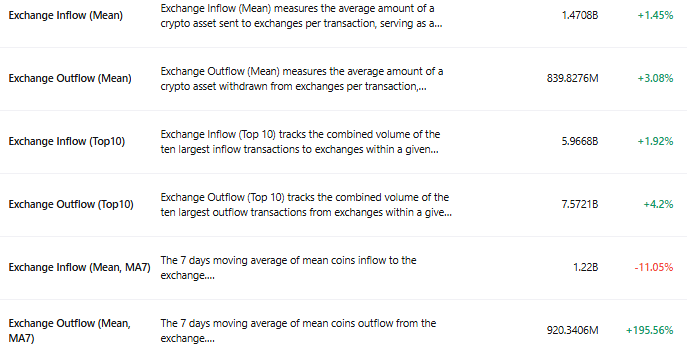
According to CryptoQuant data, the seven-day moving average of mean SHIB exchange inflows has declined 11.05% to 1.22 billion tokens. At the same time, the seven-day moving average of mean exchange outflows has surged 195.56% to 920.34 million SHIB.

This shift suggests that exchange activity is increasingly favoring withdrawals. However, the data does not yet indicate a complete reversal in exchange flows because average inflows remain higher than average outflows. Nevertheless, the sharp increase in withdrawals could gradually reduce the amount of SHIB readily available on trading platforms.

Large Holders Move SHIB Away From Exchanges

Activity involving larger transactions makes the latest trend even more notable.

CryptoQuant data shows that the top 10 exchange outflows reached 7.57 billion SHIB, compared with about 5.97 billion SHIB in inflows. Therefore, large transactions are currently favoring withdrawals over deposits.

Recent data has also pointed to 87 billion SHIB leaving exchanges on a net basis. If this trend persists, declining exchange-held supply could eventually help ease short-term selling pressure. 

Seven-Day MA of Shiba Inu Exchange Flow

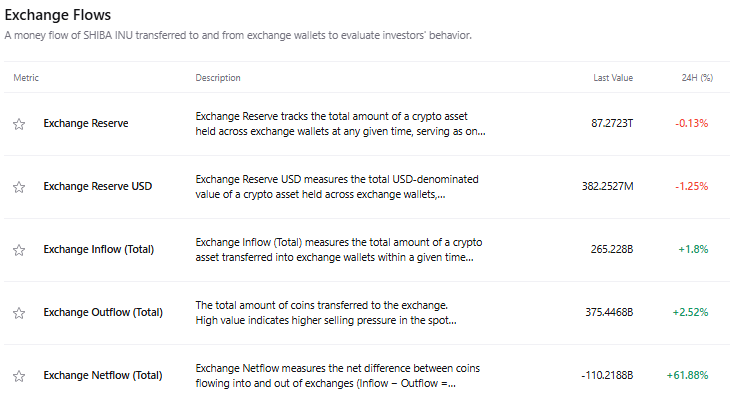
The latest 24-hour figures further reinforce the outflow narrative. SHIB withdrawals from exchanges climbed 2.52% to approximately 375 billion tokens. Meanwhile, withdrawals exceeded inflows by roughly 265 billion SHIB, resulting in net outflows of about 110 billion tokens. 

Over 110B Shiba Inu Tokens Withdrawn From Exchanges

Can Outflows Stop SHIB’s Decline?

The latest exchange data gives Shiba Inu investors a reason for cautious optimism. However, it does not guarantee an immediate price recovery.

SHIB remains vulnerable to broader cryptocurrency market conditions and continues to trade near its recent lows around $0.0000042. Moreover, exchange outflows become significantly more bullish when they persist alongside stronger demand and improving market sentiment.

Meanwhile, other potential catalysts have weakened. SHIB burns, for instance, have declined 18.95% over the past day to just 2.21 million tokens.

For now, however, the growing withdrawal trend provides an important counterpoint to SHIB’s recent weakness. If billions of tokens continue leaving exchanges while selling pressure diminishes, Shiba Inu could gradually establish the conditions needed for stabilization.

Therefore, the latest outflows may not immediately stop SHIB’s bleeding, but they could represent one of the first signs that selling pressure is beginning to weaken. 

XRP Whales Are Back: $1M Transactions Surge 280% as Price Trades at 73% Discount

0

Whale activity on the XRP Ledger has surged as XRP price continues to trade at a $1 discount, with large transactions hitting their highest levels in recent weeks.

On X, market watcher Ali Martinez highlighted that XRP whale activity has exploded over the past 24 hours. Citing data from Santiment, he noted the number of XRP transactions worth more than $1 million surged 280%, climbing from 9.90 to more than 38 large transactions.

When a user asked why whales were returning, Martinez pointed to XRP’s steep decline from its previous all-time high.

“XRP is trading at a discount,” Martinez said, adding that the coin is currently about 73% below its all-time high.

Price Remains Deeply Below Its Peak

XRP is trading at around $0.9998 at press time. The token has declined 3.29% over the past week, 8.22% over the past month, and roughly 47% year to date.

The decline is even more pronounced against XRP’s July 2025 peak of about $3.66. At current prices, XRP remains about 73% below that high.

The sharp discount may be attracting larger investors even as overall market sentiment surrounding XRP remains weak.

XRP Ledger Activity Sends a Different Signal

The surge in whale transactions comes as Santiment has highlighted rising activity on the XRP Ledger despite the price weakness.

On August 14, Santiment reported that XRP-related negativity had reached a three-month bearish extreme across X, Reddit, Telegram, and other crypto communities.

However, the on-chain picture was considerably stronger. The analytics platform recorded 49,929 active addresses in a single 24-hour period, marking XRP Ledger’s highest activity level in more than two months. 

Santiment described the divergence between negative sentiment and rising network participation as a potential bullish counter-signal.

With XRP’s market value falling back below $1, retail sentiment remains weak. Yet increased on-chain participation suggests that existing users and investors are becoming more active at lower prices.

XRP chart by Sanitment

Existing XRP Holders Are Driving Activity

Santiment previously noted on August 13 that XRP’s on-chain activity had increased even as the token closed at its lowest level since November 2024.

Average daily active addresses reached approximately 35,700 in August, compared with about 26,400 in July, representing an increase of roughly one-third.

However, the data does not indicate a major influx of new users. New addresses averaged around 2,260 per day in August, almost unchanged from approximately 2,270 in July.

Key Signal

In sum, the latest 280% increase in $1 million-plus transactions adds to the divergent XRP market picture. While price performance and retail sentiment remain weak, network activity and large-value transactions are moving higher.

The current situation suggests whales are capitalizing on low prices before the next bullish phase.

Hoskinson Reacts as Buterin Credits Bitcoin, Not Cardano, for Ethereum’s UTXO Push

0

Cardano founder Charles Hoskinson has reacted with apparent amusement to recent comments from Ethereum co-founder Vitalik Buterin about incorporating UTXO-style concepts into Ethereum’s future scaling architecture.

The reaction followed Buterin’s acknowledgment that Bitcoin developers pioneered several ideas that are now influencing Ethereum’s proposed approach. 

Buterin credited Bitcoin developers for concepts such as Utreexo while explaining that Ethereum is exploring a model that could combine UTXO-style state with dynamic state and its existing account-based architecture.

Hoskinson Responds With a Laughing Reaction

Hoskinson responded to the report with a facepalm-to-laugh GIF. Although he did not directly mention Cardano or Ethereum, his reaction appeared to question the way the development was being presented.

The response also carries added significance because Cardano has long used an Extended UTXO (EUTXO) architecture. Consequently, some members of the Cardano community viewed Ethereum’s growing interest in UTXO-style concepts as closely related to design principles that Cardano has already implemented.

In July, Hoskinson criticized Ethereum developers after the Ethereum Foundation published a research proposal exploring native UTXO-style payment designs. At the time, he argued that Ethereum was moving toward concepts resembling Cardano’s EUTXO model without adequately recognizing Cardano’s years of work in the area.

Cardano Community Sees Indirect Validation

Meanwhile, some Cardano users interpreted Buterin’s latest comments as indirect validation of the principles behind Cardano’s architecture.

They argue that Ethereum’s interest in combining UTXO-style state with its existing account model highlights the potential benefits of UTXO-based designs. In particular, proponents believe such an approach could improve scalability while maintaining decentralization and keeping node operation accessible.

Lily Brodi, an Algorand Foundation ambassador, also joined the discussion, describing Ethereum’s initiative emphatically as “literally Cardano.” Her comment further underscored the similarities observers see between Ethereum’s proposed direction and Cardano’s existing architecture.

A Renewed Debate Over Blockchain Architecture

The latest exchange has revived a broader debate about the origins, evolution, and recognition of blockchain design concepts.

Notably, Bitcoin pioneered the UTXO transaction model, while Cardano later developed its EUTXO architecture to support smart contracts and more deterministic transaction execution. 

Meanwhile, Ethereum built its network around an account-based model that provides flexibility for smart contracts and decentralized applications. Currently, Ethereum is exploring ways to incorporate some UTXO-style characteristics into its future architecture while retaining elements of its account-based system. 

For Hoskinson and some members of the Cardano community, the development reinforces their argument that EUTXO represents an important architectural innovation that deserves greater recognition. 

Jeonbuk Bank Makes Landmark Move as First Regional Korean Bank to Adopt Ripple Payments

0

Jeonbuk Bank, a major regional bank in South Korea, has adopted Ripple Payments for cross-border remittances, becoming the first regional bank in Korea to use the payment solution.

Ripple announced the partnership in a recent press release, confirming that Jeonbuk Bank will use Ripple Payments to help businesses send money across borders more quickly.

Jeonbuk Bank to Leverage Ripple Payments for Faster Settlements

The development will allow the bank to provide near-real-time settlement to customers who have traditionally depended on international transfers that can take several days.

Notably, traditional bank transfers often pass through several intermediary banks through the SWIFT network before reaching their destination. 

This process can take days to complete. Interestingly, Ripple Payments can settle transactions in seconds to minutes and runs 24/7. This gives Jeonbuk Bank a faster option for its business customers.

The bank plans to use the service for customers such as import-export companies, IT startups, and online content creators. Faster settlement could also help these businesses manage international payments with less delay and potentially lower costs.

Ripple Deepens Its Presence in Korea

Fiona Murray, Managing Director, Asia Pacific at Ripple, said the partnership shows the growing interest in digital asset infrastructure among Korean financial institutions. 

She also highlighted Ripple’s approach to working with financial institutions. Specifically, the company provides services across payments, custody, treasury, and wallet infrastructure, which allow institutions to choose solutions based on their individual needs and their progress in adopting digital assets.

Park Choon-won, President of JB Jeonbuk Bank, said the partnership will help the bank move beyond its traditional role as a regional lender.

According to him, the bank wants to build a stronger position in digital finance and use the partnership as a new source of growth while continuing to introduce new technology.

The latest deal also adds to Ripple’s growing list of partnerships in Korea. In 2026, Ripple partnered with Kyobo Life Insurance, Korea’s largest life insurer, to explore on-chain government bond settlement. 

Ripple also formed a partnership with Kbank, Korea’s first internet-only bank, to provide institutional wallet-as-a-service infrastructure through Ripple Custody.

Ripple Payments Continues to Grow

The Jeonbuk Bank partnership comes as Ripple continues to expand its international payment network. As of 2026, more than 300 financial institutions across 55+ countries connect to RippleNet, while the network supports more than 70 active corridors.

The service operates in markets including Australia, Brazil, Dubai, Mexico, Singapore, Switzerland, and the United States.

Several banks and financial institutions have also adopted Ripple’s payment infrastructure. For instance, AMINA Bank in Switzerland became the first European bank to adopt Ripple Payments in December 2025, using it to support near-real-time cross-border transfers for crypto-focused clients.

In Japan, SBI Remit and SBI Holdings have used Ripple’s ODL infrastructure since around 2017. Their use expanded through the Japan–Philippines corridor in 2021, followed by expansion into Vietnam and Indonesia in 2023. Meanwhile, Travelex Bank became the first Latin American bank to use ODL in August 2022.

Ripple’s broader network also includes institutions such as Santander, MUFG, Axis Bank, YES Bank, SEB, Akbank, UnionBank, BMO, U.S. Bank, Cross River Bank, and CBW Bank. Payment companies including Tranglo and LianLian have also worked with Ripple’s infrastructure.

However, these institutions do not all use Ripple in the same way. Some rely on RippleNet mainly for payment messaging, while a smaller group uses ODL, which can leverage XRP liquidity, or the newer Ripple Payments solution.

“We Survived Biden”: Cardano Founder Says Crypto Will Also Survive Trump

0

Cardano founder Charles Hoskinson highlighted the resilience of the crypto industry, arguing that digital assets can continue to thrive regardless of which political administration controls Washington.

Responding to a question from Anthony Scaramucci about whether Washington, D.C., matters for Bitcoin, Hoskinson said the crypto industry had “survived the Biden administration” and would also survive the Trump administration. 

The statement reflects Hoskinson’s longstanding view that the crypto market should not depend entirely on political leadership. Although governments can influence regulation, market conditions, and institutional adoption, he believes they cannot easily eliminate an industry built on decentralized technology.

Hoskinson Separates Crypto’s Future From Politics

Hoskinson’s position is notable because he has criticized both Democratic and Republican approaches to cryptocurrency policy.

During the Biden administration, the crypto industry faced substantial regulatory pressure, particularly from the SEC under former Chairman Gary Gensler. Nonetheless, Bitcoin, Cardano, and other blockchain networks continued to develop, while many major crypto assets reached record highs during the broader 2021 market rally.

Against that backdrop, Hoskinson argues that the industry can similarly withstand the Trump administration. However, his assessment does not mean he supports every aspect of Trump’s cryptocurrency policies.

Hoskinson Has Criticized Trump’s Crypto Strategy

Despite acknowledging that crypto can thrive under Trump, Hoskinson has criticized several aspects of the administration’s approach to digital assets.

One of his major concerns has been Trump’s personal involvement in cryptocurrency. Following the launch of the Trump memecoin, Hoskinson argued that the move risked turning crypto from a broadly bipartisan issue into a partisan political weapon. In his view, this could undermine opportunities to build bipartisan support for comprehensive cryptocurrency legislation.

Hoskinson has also questioned Trump’s proposal to expand the U.S. government’s cryptocurrency reserves beyond Bitcoin. The 2025 proposal identified Bitcoin alongside Ethereum, XRP, Solana, and Cardano’s ADA as potential reserve assets.

However, Hoskinson argued that the government should not actively select cryptocurrency winners and losers. Instead, he has favored a Bitcoin-focused reserve based primarily on digital assets already seized by the government, rather than having Washington deliberately choose specific altcoins.

Political Changes Cannot Stop Decentralized Networks

Hoskinson has further argued that Trump’s involvement in cryptocurrency could make it easier for opponents to associate the industry with one political party. In his view, that dynamic could weaken the bipartisan momentum surrounding the CLARITY Act.

Notably, the CLARITY Act stalled in the Senate before the August 2026 recess, with most Democrats opposing its advancement. Nevertheless, Hoskinson’s broader position revolves around the idea that crypto’s future should not depend on any single president or political party.

Governments can shape the regulatory environment and influence how quickly the industry develops. However, Hoskinson believes decentralized networks can withstand political transitions and continue evolving over the long term.