
Home Blog Page 423

OCC Clarifies US Banks Can Hold Crypto to Cover Gas Fees

0

The U.S. Office of the Comptroller of the Currency has clarified that national banks may hold certain cryptocurrencies to cover network fees tied to approved digital asset operations.

The update adds regulatory certainty at a time when the US is still shaping its broader crypto rulebook.

OCC Confirms Banks’ Ability to Hold Crypto for Operational Use

In its Tuesday guidance, the OCC confirmed that banks can keep specific crypto-assets on their balance sheets to pay network, or gas, fees. However, this permission applies only when the fees support activities already allowed under banking rules.

Additionally, the agency stated that banks may hold crypto as principal when testing platforms linked to legitimate crypto services.

Importantly, the OCC reiterated that all crypto-related activities must remain safe and sound and fully comply with applicable laws.

Guidance Builds on Earlier Direction for Digital Asset Services

Notably, the new notice does not stand alone. Instead, it builds on a May letter that opened the door for banks to handle customer-facing digital asset services and outsource certain crypto functions to third parties.

Together, these updates demonstrate the OCC’s ongoing efforts to provide clarity for banks exploring digital assets. They also reflect a shift from the more restrictive posture seen during the Biden administration, offering institutions a clearer path forward.

GENIUS Act Shapes Regulatory Expectations

The latest guidance also aligns with the GENIUS stablecoin legislation signed in July. This law establishes a federal framework for payment stablecoins, which will subsequently fall under the oversight of banking regulators.

Specifically, the OCC noted that stablecoin transactions often incur network fees, which may require banks to utilize cryptocurrency already in custody. Otherwise, they might rely on agents to process those fees.

Consequently, this link between operational needs and regulatory clarity helps explain why the OCC addressed gas-fee handling at this time.

Implementation of the Stablecoin Law Still Months Away

Although the GENIUS Act is now law, its provisions are not yet in effect. The U.S. Treasury and the Federal Reserve must still develop implementing rules, delaying full execution for several months.

In the meantime, the OCC’s interim guidance provides banks with essential direction, enabling them to navigate the transition and prepare for the forthcoming regulatory framework.

Meanwhile, as regulators finalize rules for stablecoins, lawmakers are moving forward with legislation on the structure of digital-asset markets.

Overall, these parallel efforts—regulatory updates from the OCC and legislative action in the Senate—signal that the U.S. is moving toward a more defined and coordinated approach to crypto oversight.

Michael Saylor Says Wall Street Is Making Bitcoin More Stable, Not Riskier

0

The recent Bitcoin pullback has not shaken Michael Saylor’s confidence in the asset.

The Strategy executive chairman said Bitcoin is becoming more stable over time, even as major financial players increase their exposure.

Speaking with Fox Business, Saylor addressed concerns that Wall Street might be amplifying Bitcoin’s volatility. He argued the opposite, noting that Bitcoin’s behavior has become more predictable over time.

Bitcoin is More Stable, Not Riskier

Saylor pointed to Strategy’s first purchases in 2020, when Bitcoin showed about 80% annualized volatility. Since then, he said current levels sit near 50%, which he views as evidence of a maturing asset.

Building on that view, he expects volatility to fall by “about five points every few years” as liquidity grows and market depth improves. 

Ultimately, according to him, Bitcoin could eventually stabilize at 1.5 times the volatility of the S&P 500, while still outperforming the index.

His comments follow a week of sharp price movement that unsettled some investors. For instance, Bitcoin has slipped nearly 12% over the past week, according to CoinMarketCap. The decline pushed the price to around $91,616, erasing almost all of its gains this year.

Meanwhile, Saylor stressed that “Bitcoin is stronger than ever,” even after the recent slump. Notably, Strategy continues to hold 649,870 BTC worth roughly $59.59 billion, according to SaylorTracker.

However, the firm’s mNAV multiple has moved lower. It is now at 1.11x, down from 1.52x when Bitcoin reached its record $126,080 on October 6.

MSTR Shares Mirror Bitcoin Weakness

Strategy’s stock has also responded to the broader market slide. Shares closed Tuesday at $206.80, marking an 11.50% drop over the past five days, according to Google Finance. 

Because MSTR often trades at a premium or discount relative to Bitcoin, its price typically shifts in tandem with major Bitcoin moves. This close correlation highlights the company’s exposure to digital-asset sentiment.

Company Built to Withstand Deep Market Stress

Even with that exposure, Saylor said he remains unfazed by the possibility of a deeper downturn. He emphasized that the Strategy can handle an 80–90% decline in Bitcoin without disrupting operations.

Interestingly, calling the firm “indestructible,” he said its current leverage position is exceptionally robust, allowing it to navigate extreme market cycles with confidence.

Dogecoin Bounces Off Key Fib Support: Is the Bottom In?

Dogecoin bounces off key Fibonacci support, suggesting a potential bottom, but resistance still remains.

As of today, Dogecoin changes hands at $0.1571, reflecting a 2.4% increase in the last 24 hours, with a market cap of $23.84 billion. The top meme coin has demonstrated a degree of resilience, bouncing between $0.1533 and $0.1625 in the past 24 hours.

In the longer timeframes, Dogecoin has experienced a period of notable volatility, with the price showing a decline of approximately 8.9% in the last seven days. This downward movement has led to a 14-day price drop of around 4.8%, indicating sustained pressure. As DOGE recovers in the short-term, traders are looking for signs that the meme coin has already hit its bottom.

Dogecoin Price Analysis

Looking at daily price action, technical indicators show that DOGE is preparing to test the 0.236 Fibonacci retracement level (around $0.1654), after bouncing off its main support at 0 Fibonacci level at 0.15178. This level has held relatively well so far, suggesting that the price might have hit its bottom there. 

Screenshot 2025 11 19T102437443
Dogecoin

However, there remain additional Fibonacci zones to watch, including the 0.382 and 0.5 retracement levels at $0.1738 and $0.1807, respectively, which could act as resistance if the price starts to recover.

The Relative Strength Index stands at 39.35, which is in a neutral to slightly oversold zone. While this indicates that Dogecoin is not yet in extreme oversold territory (below 30), it suggests that the asset still has room for price movement in either direction.

The current RSI value indicates that Dogecoin may not have reached its bottom yet, as the market sentiment still leans toward further downside.

Analyst Highlights Most Significant Support

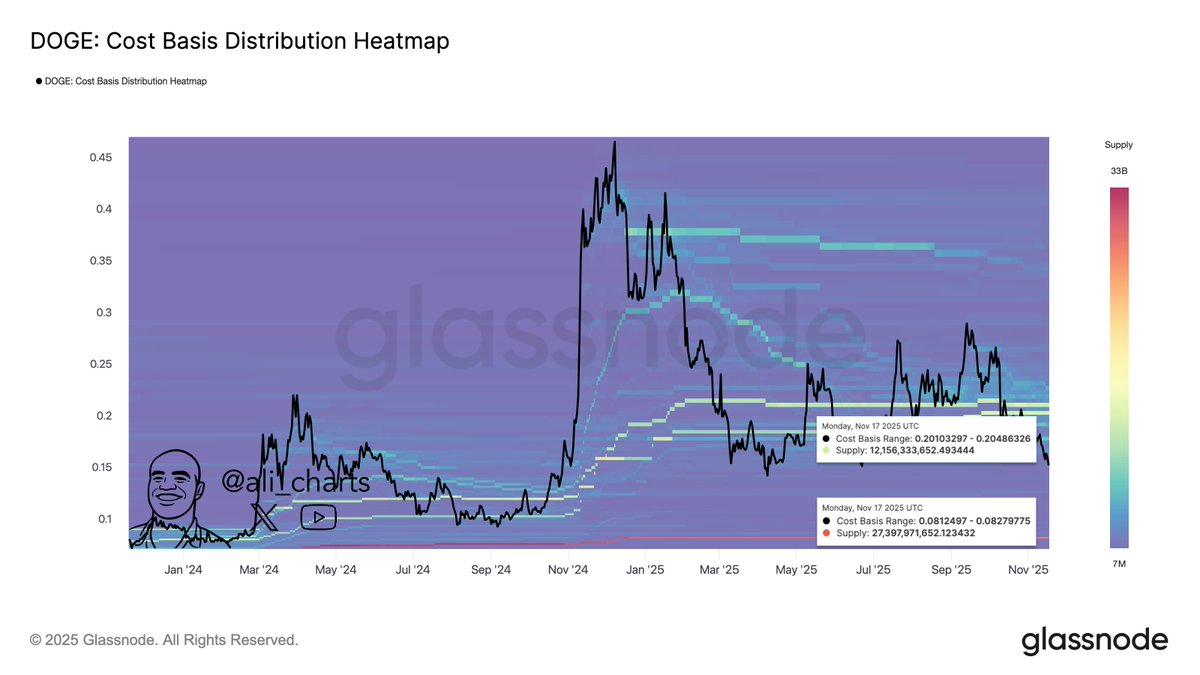
Meanwhile, Analyst Ali Martinez’s post highlights a cost basis range for 27.4 billion Dogecoin, which investors accumulated at $0.08.

Image

This means that investors purchased the DOGE at this price level, making it the most important support zone. Given that $0.08 marks the price at which a whales purchased a significant volume of Dogecoin, it establishes this level as the most significant support range for DOGE. 

Additionally, the upper cost basis range rests between $0.201 and $0.205, with 12.16 billion DOGE accumulated in this range. This region likely serves as a resistance zone. If Dogecoin experiences a rally, these holders might begin to sell and lock in profits, potentially capping upward price movements.

MoonPay Addresses Incessant Mockery of XRP

0

Popular crypto trading platform MoonPay has addressed the recurring negativity it encounters whenever it posts about XRP on X. 

Over the years, XRP has amassed significant support from retail investors, institutional clients, and major crypto platforms. Meanwhile, MoonPay has emerged as one of the few trading services that have consistently been bullish on the asset. 

The company has repeatedly shared bullish posts about XRP, celebrating its price rallies, hosting token giveaways, and even declaring in August that XRP holders deserved a follow from its X account. 

MoonPay Calls Out Negative Sentiment Toward XRP 

While maintaining its bullish stance on XRP, MoonPay took to X to address the hostility that often breaks out whenever it posts about the token. The company noted that some users often ridicule XRP, largely due to personal bias or loyalty to other assets.

MoonPay stressed that such reactions are unwarranted. It pointed out that the success of one cryptocurrency does not depend on the failure of another. In other words, Bitcoin, Solana, Cardano, or any other token can all thrive in the same market alongside XRP. 

The firm further acknowledged that XRP may not align with everyone’s crypto philosophy, but this does not mean others are wrong for supporting or believing in it.

Ultimately, MoonPay’s message calls for more respect and less tribalism in the crypto space. It suggests that diverse projects and perspectives are part of what makes the crypto industry dynamic and innovative.  

MoonPay Launches New XRP Campaign 

MoonPay’s commentary comes just hours after it launched a new XRP campaign. In an announcement on X, the company revealed that it will reward one follower with $2,025 worth of XRP, provided the token reaches a new all-time high by December 31, 2025.

The campaign highlights MoonPay’s continued support for XRP. For the reward to be issued, XRP would need to climb roughly 80% from its current price of $2.14. Such an increase would push the token to about $3.85, surpassing its previous all-time high of $3.84 set in January 2018. 

XRP Price Glitch Takes XRP to $91.6 on Kraken

0

A wild XRP price glitch occurred on the prominent cryptocurrency exchange Kraken, sending the coin to an unprecedented high of $91.6 per coin.

XRP trades at $2.16 at the time of writing, down over 2.2% since the start of today. Yet for a moment, the coin rallied to $91.6, leaving enthusiasts drooling over the potential impact of this price shift on their portfolios.

XRP Briefly Pumps to $91.6 on Kraken

Crypto millionaire Kevin Cage highlighted this glitch on the XRP/USD chart on Kraken early Wednesday. He shared that this “super weird flashwick” came to his knowledge as the spike triggered his price alert.

Meanwhile, data from TradingView confirms this glitch. On the 5-minute timeframe, XRP crashed to a low of $0.00272 at 04:05 (UTC) on November 19 but recovered to close at $2.18.

About 10 minutes later, XRP spiked to $91.62 but quickly retreated, closing at $2.18. Notably, research shows that this anomaly was peculiar to the Kraken exchange, as the price of XRP across other exchanges stood at around $2.18 at the time.

XRP Price Glitch on Kraken

Interestingly, this glitch marked a staggering 4,102% surge from the market price at the time. This would have represented a remarkable portfolio growth for holders if it were a reality.

XRP Enthusiasts Dreamed, but for a Moment

Meanwhile, reactions expressed optimism about this price action, with some suggesting it was a sign of things to come. A user explained that the flicker on Kraken is beyond a random noise but a real signal of where the “vacuum pockets are.” He added that the vacuum on Kraken is higher, not lower, suggesting that XRP is programmed for a substantial rally.

Other reactions also confirmed being notified of this spike. However, there has been no report of filled orders at the time of writing, indicating there may have been no impact on the platform’s order book.

Notably, such a spike occurs on exchanges when there is a thin order book. A large order during this time of low liquidity tends to move prices to match it with the best available counterorder in the record book.

One of Many Price Glitches

Meanwhile, this is not the first time an XRP price glitch has happened. One recent example of this is a flashwick to $5.59 on the crypto exchange GateHub in July.

Another event of this spike occurred on Gemini in August 2023. Following XRP’s listing on Gemini after Ripple’s notable victory in its now-concluded legal battle against the US SEC, the token spiked to $50 per coin.

BitMine Buys Ethereum Dip with Fresh $66M Cash

0

BitMine Immersion Technologies increased its Ethereum reserves again this week, taking advantage of a fresh market dip as ETH dropped below $3,000 for the first time since July.

According to blockchain analytics platform Lookonchain, a new wallet associated with BitMine received 21,054 ETH from Kraken. The transfer, worth $66.57 million, was recorded on November 18 at 19:22:59 UTC.

Although the timing aligns with BitMine’s ongoing buying trend, the company has not confirmed the transaction.

Ethereum Drops to a Four-Month Low

Meanwhile, this wallet activity coincided with the ongoing downturn in Ethereum’s price. ETH traded near $2,997 this week, marking a four-month low amid intensified selling pressure.

CoinGecko data shows ETH has dropped 26% over the past month, highlighting the sharp decline that may open up new buying opportunities for large holders like BitMine.

Earlier ETH Purchases by BitMine

Notably, the new acquisition comes just days after BitMine disclosed a separate major purchase. On Monday, the company said it added more than 54,000 ETH the previous week, valued at approximately $173 million.

With this addition, BitMine now holds 3.6 million ETH, pushing the firm close to controlling 3% of Ethereum’s circulating supply. The company also maintains smaller positions in Bitcoin and holds equity in Eightco (ORBS).

Additionally, its cash reserves have risen from $398 million the previous week to $607 million. This growth underscores the company’s stronger liquidity, despite tightening market conditions.

Tom Lee Links Market Weakness to Liquidity Stress

BitMine Chairman Thomas Lee (a.k.a. Tom Lee) attributed the current crypto weakness to a sudden drop in liquidity.

He suggested that a major market maker may have pulled back after the October 10 crash, thus creating short-term strain. Lee likened the situation to a form of crypto quantitative tightening (QT), noting a similar phase in 2022 lasted six to eight weeks.

Although the market remains volatile, Lee expressed that he does not see crypto reaching its cycle peak yet. In his November note to investors, he indicated that key structural trends might delay the peak until 2026 or later.

He also highlighted asset tokenization, including bonds, stocks, and real estate on Ethereum, as a trend that could reshape financial markets and strengthen long-term demand for blockchain infrastructure.

Eric Trump Says Smart Trade as Dave Portnoy Buys $1,000,000 in XRP

0

Barstool Sports founder Dave Portnoy, a trader with 3.7 million followers on X, has revealed a major XRP acquisition.

This came in a tweet today in which he announced that he had purchased more than $2 million in crypto assets during Monday night’s market downturn.

The move included a massive $1 million position in XRP and has caught the attention of Eric Trump, who called it a “smart trade.”

Portnoy Buys $1M in XRP Amid “Blood in the Streets”

Portnoy described the moment as classic “blood in the streets” trading, saying he acted like a “Great White Shark” during the market dip.

In the video posted on X, he detailed his rapid-fire buys on November 17. At 6:38 PM, he purchased $500,000 worth of XRP, followed by $400,000 worth of Ethereum and $750,000 worth of Bitcoin at 6:37 PM.

One minute earlier, at 6:36 PM, he added another $500,000 of XRP, bringing his total XRP purchase to $1 million.

According to Portnoy, the opportunity was too compelling to ignore:

“I bought over $2,000,000 in crypto. There’s blood in the streets, and I’m like a Great White Shark.”

Eric Trump Calls It a “Smart Trade”

The announcement drew notable reactions, including one from Eric Trump. He publicly praised the move, saying, “Smart trade, Dave Portnoy.”

Eric has been increasingly active in crypto conversations throughout the year. He previously predicted that Bitcoin could end the year at $170K and reach $1 million in the years to come. He often calls for buying the dip during market downturns, hence his praise for Portnoy’s $2 million investment.

Screenshot 2025 11 19 at 84647 am
Eric Trump Comment

For context, Portnoy’s buys came amid significant weekly and monthly declines across major cryptocurrencies.

XRP is trading at $2.14 after dropping 10.3% in the past week. Bitcoin sits at $90,919, down 12% over the same period, while Ethereum has slid to $3,038, falling 11.77%.

On the monthly chart, the losses are even deeper, with Bitcoin down 18.5%, Ethereum down 25.5%, and XRP down 13.14%.

The steep declines have created the kind of environment traders like Portnoy see as a buying opportunity.

Portnoy’s Previous XRP Exposure

In an interview in May, Portnoy explained why he invests in XRP, saying his interest is mainly due to “good FOMO.”

He likened XRP’s upside potential to Bitcoin’s early days. Portnoy said he enjoys the thrill of making money effortlessly, comparing crypto gains to placing successful bets. He admitted he doesn’t rely on XRP’s fundamentals but sees it as one of the few tokens that still carries underdog appeal.

Meanwhile, in July, The Crypto Basic reported that Portnoy regretted panic-selling roughly $3 million in XRP after misinterpreting a friend’s warning text.

He had planned to hold through volatility but sold at $2.40 when he feared bad news, only for XRP to surge to $3.65 shortly after. Portnoy said missing the rally made him “sick,” despite gains in BTC and ETH.

RippleX Explores to Include Native XRP Staking on XRPL

0

RippleX has opened an important conversation in the XRP community, as its engineering team considers how native staking could eventually work on the XRP Ledger. 

Notably, the XRPL has operated for more than a decade, yet it still trails other networks in DeFi because of its underlying technology. For instance, the ledger uses a Proof-of-Authority model instead of the Proof-of-Stake approach that powers most modern DeFi platforms. 

RippleX Exploring Native XRP Staking on XRPL

As a result, the XRPL does not support staking, and the system burns transaction fees rather than distributing them to validators. Now, RippleX engineers want to examine if staking can fit within the XRPL’s design.

Ayo Akinyele, Head of Engineering at RippleX, opened the discussion through a thread on X. He explained that the launch of the first XRP spot ETF, along with expectations of more products, shows that the ecosystem has entered a new phase as institutions adopt tokenized treasury products and money-market funds. 

According to Akinyele, this change triggered conversations between him and Ripple CTO David Schwartz about whether the XRPL could one day support native staking and what the system would require to achieve this.

On the approach to take, Akinyele noted that the XRPL cannot copy the staking model used by Proof-of-Stake networks. He pointed out that XRP burns fees, settles payments quickly at low cost, and gives every validator an equal vote regardless of token holdings. 

Because the XRPL does not link validator power to economic incentives, staking would need to serve an entirely different purpose. 

He pointed out that staking would also require a clear reward source and a fair distribution method, and both elements would decide how value flows across the network. The engineering head stressed that the conversation remains exploratory and aims to show what might change and what must remain the same.

Ripple Executives Respond

Adding to the discussion, Ripple CEO Brad Garlinghouse commended Akinyele’s effort and encouraged the community to think about what the XRPL could support as new XRP-based DeFi projects continue to appear.

In response, David Schwartz noted how much the blockchain industry has changed since the XRPL launched in 2012. 

Ripple CTO tweet shsshshsh

He said that his views on consensus and governance have also changed over time and that he has recently revisited how XRP works in DeFi, both through off-chain ecosystems such as Flare, MoreMarkets, Axelar, and Doppler, and through native on-chain activity. 

With programmability efforts and smart contract discussions underway, Schwartz believes this moment presents an opportunity to consider what additional native DeFi features might look like. 

Two Technical Possibilities

However, an XRPL dUNL validator known as Vet shared his own concerns. He questioned how staking fits into a network that does not use Proof-of-Stake and asked what practical problem it would solve. 

Responding, Schwartz presented two technical possibilities. The first idea would add a second, incentivized inner layer: an inner set of validators, roughly 16, chosen by the outer layer according to stake, with staking and slashing used only to advance the ledger.

The second idea would keep the existing consensus intact but use transaction fees to fund zero-knowledge proofs that vouch for correct smart-contract execution, so nodes would not have to run contracts themselves. 

The Ripple CTO called both concepts clever on a technical level but warned they probably would not make for practical or healthy changes in the near term.

Emerging Concerns Around Introducing Native XRP Staking

Meanwhile, in a separate commentary, Vet warned that adding staking rewards could create misalignment between users and validators, which might push fees higher. 

He also raised questions about who would receive the rewards and warned that redistributing fees could introduce governance issues, Sybil risks, and validator clustering as operators search for lower operating costs.

Akinyele then addressed each of these concerns. Specifically, he reiterated that the XRPL does not rely on stake-based influence and that validators do not compete for block production, so staking cannot play any role in consensus. 

He noted that the ledger avoids tension between users and validators by treating fees purely as anti-spam charges. The RippleX engineer warned that introducing incentives would push the XRP Ledger toward behaviors it originally avoided. 

He also explained that only UNL validators participate in consensus and that paying either everyone or only the UNL could create new risks or encourage operators to game the system. 

Akinyele added that incentives might even push validators to cluster in cheaper data centers, which would work against XRPL’s goals of resilience and decentralization. 

Meanwhile, community contributor WrathofKahneman argued that staking would carry a major structural impact because Ripple holds the largest amount of XRP. He suggested that such a setup could increase Ripple’s influence over governance and make amendment approvals easier if staking became tied to voting power.

Data Reveals Why XRP Is Showing Good Signs of a Potential Rebound

0

Despite the rising crypto market uncertainties, XRP could be on the cusp of a recovery to higher prices spurred by retail sentiment.

The excitement around an XRP rebound on Tuesday has quickly turned sour. After an over 2.4% increase to an intraday high of $2.23, the cryptocurrency relinquished all of its gains early Wednesday, retracing to $2.14 at the time of writing.

Rebound Signs Stands Strong

Yet, there remains widespread sentiment that XRP could see higher prices from current levels. One such assertion comes from Santiment, a prominent market intelligence platform, which shared in a recent analysis that XRP is showing promising signs of a rebound.

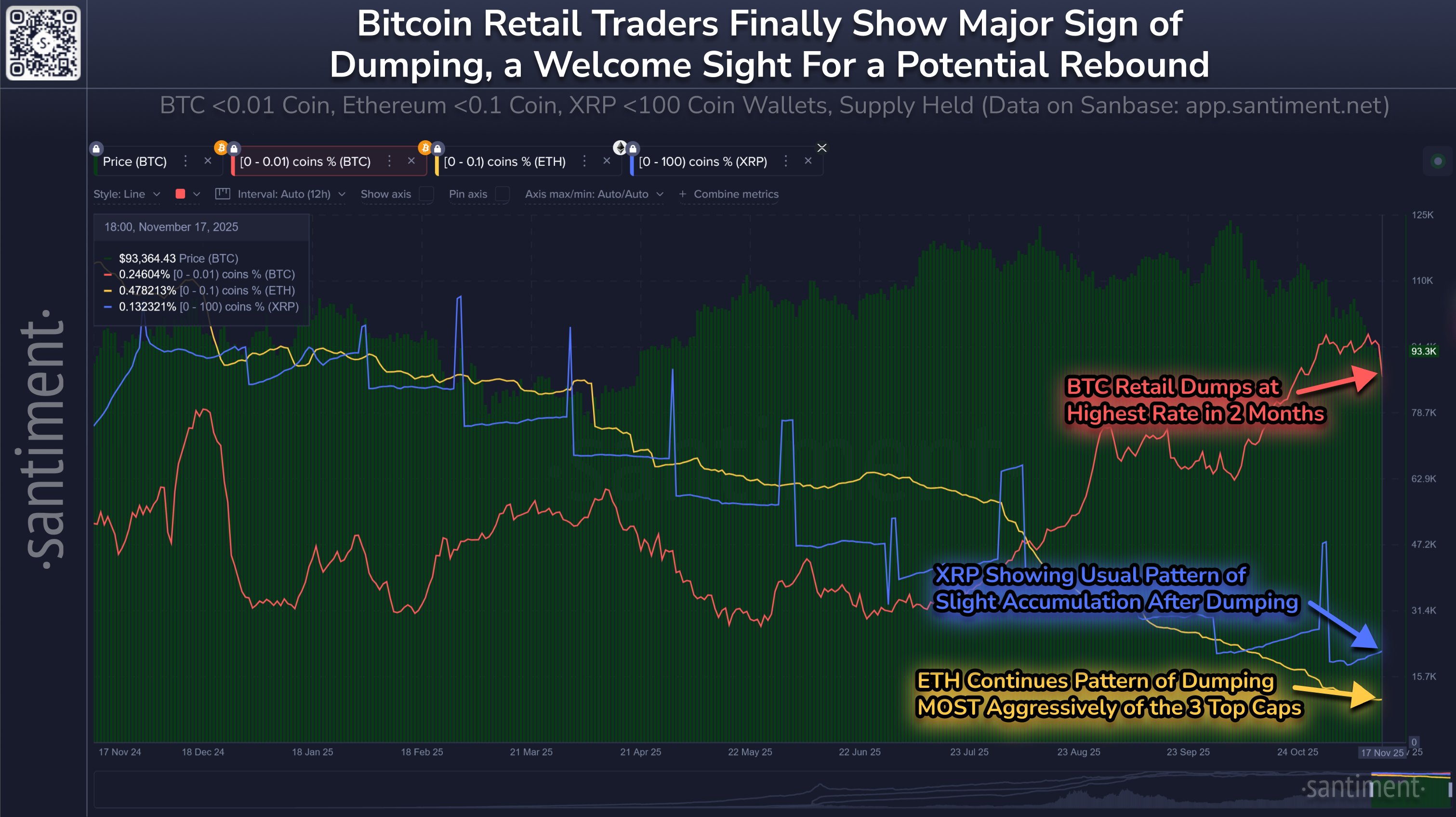
The firm’s belief in this trajectory stems from retail market sentiment and how prices have historically reacted to it. Santiment highlighted that retail wallets are selling off their XRP holdings, a move that typically sparks a price recovery.

For context, the analysis classified retail wallets in this context as addresses with less than 100 XRP, worth $214 at the current market price.

Specifically, holders in this category have sold 1.38% of their holdings since the start of November in response to adverse market conditions. Recall that a recent report from The Crypto Basic shows that XRP supply in profit has dropped to 58.54%, a low last seen when the token changed hands at $0.53. The ensuing panic appears to be influencing the latest selloffs.

Yet, Santiment believes this is a good sign for XRP. It stressed that prices tend to move in the opposite direction to retail trader behavior. When small wallets panic and sell their holdings, it is a positive sign for market recovery.

XRP Shows Signs of Accumulation

An accompanying chart shows that XRP is exhibiting a usual sign of slight accumulation after severe retail sales, highlighting a brief pause in retail dumps. This pattern is normal in the small wallet behavior observed since December 2024, where they halted briefly before continuing their liquidation.

Retail Traders Dump XRP, Bitcoin, and Ethereum

However, the other coins in the top three cryptocurrencies by market cap (excluding stablecoins) have seen more aggressive sales. Bitcoin retail traders dumped at the highest rate in two months, with holders of less than 0.01 BTC selling 0.36% of their stash in the past five days.

Ethereum retail traders are selling at the most aggressive rate among the top three. Specifically, addresses with less than 0.1 ETH have sold 0.90% of their holdings in the past month, coinciding with the asset’s dip.

Santiment noted that all three leading crypto assets are showing promising signs of a rebound, spurred by these retail dumps. This also suggests a possible recovery from Bitcoin’s current trend at $90,410 and Ethereum’s price of $3,011 to greater heights.

XRP Price Prediction for 2026: Here Are 4 Reasons Why XRP Could Hit $5

0

Amid the ongoing bearish trend impacting XRP, experts believe the token could reach a new all-time high of $5 by next year. 

The asset currently trades at $2.17, down 10.97% over the past month and 9.21% over the past week. Major cryptocurrencies like Bitcoin, Ethereum, and Cardano have also recorded significant losses in the same period.

Despite the broader downturn, XRP remains one of only three top-10 cryptocurrencies still in positive territory year-to-date. Although its YTD growth is now modest at 4.6%, the token maintains a substantial yearly upside of 92%.

XRP to Hit $5 in 2026?

Meanwhile, last year, optimism was high, with many projections calling for XRP to reach ambitious targets, such as $5 by the end of 2025. However, with just six weeks left in the year and the market under sustained pressure, XRP remains trapped in the $2 range.

Now, commentators have shifted the timeline to next year. For instance, an X user predicted that XRP would hit $5 by 2026, assuming “everything goes well.”

From its current price, XRP would need to rally 131.41% to reach the $5 target. This surge would lift its market cap to over $300 billion.

4 Factors That Could Push XRP to $5

Multiple factors support the price outlook. For context, XRP’s November 2024 breakout was triggered by the resolution of the SEC v. Ripple lawsuit.

For five years, that case cast a shadow over XRP’s prospects, discouraging institutional interest and limiting broader adoption. As the lawsuit ended, XRP jumped to $3.65 before sliding back to $2.17 amid the market-wide downturn.

With the legal uncertainty finally behind it, several other catalysts could help pave the way for the next wave of XRP’s rally, potentially pushing it toward the $5 milestone in the coming year.

ETF Inflows

The broader crypto market has already witnessed how Bitcoin reacted to strong inflows into its spot ETFs. A similar scenario could unfold for XRP.

Earlier this month, the first U.S. spot XRP ETF officially launched on Nasdaq, led by Canary Capital. According to SoSoValue data, the fund has already recorded net inflows of $276 million.

More spot XRP ETFs from issuers such as Franklin Templeton and 21Shares will debut later this month, potentially boosting cumulative inflows. Given how ETF demand helped fuel Bitcoin’s rally earlier this year, XRP could experience a comparable trajectory if inflows accelerate.

XRP Treasury Efforts

Corporate adoption is also emerging as a potential catalyst for XRP. Several publicly traded companies, including VivoPower, Webus, Wellgistics Health, and Worksport, have announced plans to establish or expand their XRP treasury holdings.

In addition, Ripple recently joined a joint venture with SBI, Kraken, and other firms to create a $1 billion XRP treasury, the largest corporate XRP treasury to date.

As more companies accumulate XRP for their reserves, the circulating supply on the open market could decline significantly. This reduction in available tokens may ease selling pressure and help drive the asset’s price higher over time.

Institutional Adoption of Ripple’s Payment Solution

Ripple remains a leading provider of cross-border payment infrastructure, with XRP serving as one of its core bridge assets. Financial institutions such as Tranglo and SBI have already integrated Ripple’s technology for cross-border settlements, and further adoption is expected.

As Ripple’s payment solutions gain traction, institutional interest in XRP could strengthen accordingly.

Favorable Crypto Market Outlook

Although the crypto market has struggled in recent weeks, many analysts anticipate a shift in momentum. JPMorgan recently forecast that Bitcoin could reach $170,000 next year—a move that could ignite a broader market-wide bull run.

Historically, assets like XRP have followed Bitcoin’s trajectory during such rallies, suggesting the token may benefit from any renewed bullish sentiment.

While these catalysts could help propel XRP toward $5 next year, it is important to note that external macroeconomic pressures could still undermine upward momentum, as seen earlier this year.