
Home Blog Page 453

Expert Says XRP Will Become the Place People Store Most of Their Wealth

0

A growing number of voices in the XRP community now believe the coin will also become a primary means of storing wealth.

The latest commentary comes from software engineer Vincent Van Code, who suggested that “a time will come when XRP and the XRP Ledger are just where you keep most of your wealth.”

His remark comes at a moment when conversations around XRP’s long-term relevance, utility, and role in global finance are intensifying.

XRP as a Treasury Asset

Van Code’s comment reflects a broader view emerging among XRP builders and analysts. They believe the asset is shifting from a simple payment bridge to a core store of value within the XRPL ecosystem.

This view aligns with Ripple CTO David Schwartz, who argues that XRP’s real strength is in letting users act as their own banks.

He describes XRP as a neutral, borderless asset with no counterparty risk, no chance of being frozen, and no need for intermediaries. These qualities make it well-suited for long-term wealth storage, according to proponents.

Schwartz’s Defense of XRP’s Unique Position

The debate grew after Western Union chose Solana instead of the XRP Ledger to launch its stablecoin. Critics argued this showed XRP was losing relevance. Meanwhile, Ripple CTO David Schwartz disagreed, saying XRP’s true strength lies in its neutrality and independence.

He explained that the XRPL supports a financial system where users fully control their money, without middlemen, fees, or restrictions.

Schwartz contrasted this with stablecoins, which depend on central issuers and can be frozen or reversed. He also noted that while speculation currently drives most crypto value, he believes XRP’s long-term worth will come from its real-world utility.

XRP in Long-Term Wealth Protection

Furthermore, the idea of XRP as a “treasury asset” also mirrors views from other prominent community commentators.

Crypto educator Coach JV recently said he stores his family’s wealth in Bitcoin and XRP because both have fixed supplies and resist inflation.

With inflation eroding the dollar’s value by as much as 96% since 1913, he argues that deflationary assets like XRP will naturally attract long-term savers. Support for this thesis is growing:

  • XRP has appreciated by over 65,000% in the past decade.
  • Analysts like Zach Rector forecast XRP reaching $100, driven by economic instability and flight into alternative assets.
  • Broader pressures, including inflation, job losses, and shifting Fed policies, are already driving more people toward borderless, fixed-supply assets.

Essentially, Van Code’s “treasury” comment reflects this belief that XRP could evolve into a trusted store of value as confidence in traditional systems declines.

Meanwhile, critics still question XRP’s future demand. Yet many now see it evolving from a bridge asset into a financial base layer where people and institutions could ultimately store their wealth.

Here’s XRP New Price If Escrow Reduces XRP Supply by 20%

0

How could the XRP price react if burns from the Ripple escrow reduce the token’s total supply by 20%?

Right now, XRP boasts a massive total supply of 99.9 billion tokens. Notably, about 60 billion of those tokens already circulate in the market, while 35 billion remain locked in escrow under Ripple’s control. 

However, this supply situation has long triggered discussions within the XRP community. Specifically, some believe Ripple should burn the escrowed tokens, arguing that doing so could drive the price higher and ease concerns about supply centralization. Still, no one knows for sure how such a move would affect XRP’s value.

The Potential Impact of a 20% Supply Burn

As a result, we asked Google Gemini what might happen if Ripple burned 20% of XRP’s total supply. In response, Gemini presented a hypothetical model but clarified that the prediction was entirely theoretical. It explained that the outcome would depend on real-world factors like investor demand, token utility, and regulation, not just on a reduction in supply.

In the hypothetical scenario, Gemini assumed there was a 20% burn of the total supply, roughly 19.98 billion tokens. This would drop the total supply from 99.9 billion to about 79.92 billion. 

XRP Supply Reduction Scenario Google Gemini
XRP Supply Reduction Scenario | Google Gemini

Notably, if all the burned tokens came from escrow, the pool would drop from 35 billion to roughly 15.02 billion XRP. However, the number of tokens in circulation would stay the same at 60 billion since the burn would only affect tokens locked in escrow.

Gemini noted that this wouldn’t immediately change the number of tokens being traded, but it would massively reduce future supply. According to the chatbot, this kind of reduction could create long-term bullish pressure because a smaller available supply tends to boost value when demand holds steady or grows.

Bullish XRP Price if Escrow Burns Reduce Supply by 20%

From here, Gemini presented what it called an “ultra-bullish” scenario. In this scenario, the burn leads to strong market excitement, regulators offer clear support, and the XRP Ledger sees higher adoption. 

Under these perfect conditions, Gemini suggested that XRP’s market cap could surge to around $4 trillion. This figure would represent almost a 28x jump from XRP’s current $144 billion market cap. For context, the broader crypto market cap today hovers around $4 trillion.

XRP Ultra Bullish Price Google Gemini
XRP Ultra Bullish Price | Google Gemini

Using this assumption, Gemini calculated a potential new price for XRP by dividing the projected $4 trillion market cap by the circulating supply of 60 billion tokens. The result came to about $66.67 per XRP. This represents a dramatic increase from today’s $2.40 level, representing a 27.8× rise.

Gemini noted that this isn’t a forecast, but a theoretical assessment to show how massive a major supply cut could be if the market reacted positively. However, Ripple CTO David Schwartz had in the past suggested that a burn might not impact XRP price at all, citing a similar effect from Stellar’s supply burn in 2019.

Long-Term Holders Now Offloading $260,000,000 in XRP Per Day: Details

0

A recent Glassnode report has identified one factor contributing to pressure on the XRP price, as long-term holders ramp up profit-taking trades.

The latest disclosure comes on the back of the ongoing struggles the market has faced over the past few days, despite clear macro tailwinds such as the recent Federal Reserve 25-bps rate cut, confirmation of an end to quantitative tightening in December, and easing trade tensions between China and the U.S.

Even with these favorable conditions, the total crypto market has lost $170 billion over the last four days, relinquishing the $4 trillion valuation mark. While XRP has been a victim of the market-wide collapse, it appears to be showing greater resilience than most, up more than 1% over the past 24 hours.

With XRP struggling at current prices, Glassnode recently confirmed that profit-taking trades from long-term holders have been contributing to the pressure. According to the market analytics platform, long-term holders who bought XRP before its November 2024 breakout have ramped up profit-taking since August 2025.

XRP’s Struggles Before the November 2024 Breakout

For context, before November 2024, XRP traded below $1 following the collapse of the Terra ecosystem in May 2022. The altcoin spent over two years changing hands between $0.4 and $0.6 most of the time, with occasional swings to $0.8 and periodic dips to $0.3. 

Interestingly, during this time, while others wrote XRP off, some investors leveraged the price dip to accumulate more tokens at lower prices. Following the impressive 281% surge in November 2024, which pushed prices toward $2, these long-term holders who bought before the breakout are now sitting on massive gains.

Long-Term XRP Holders Ramp up Profit-Taking

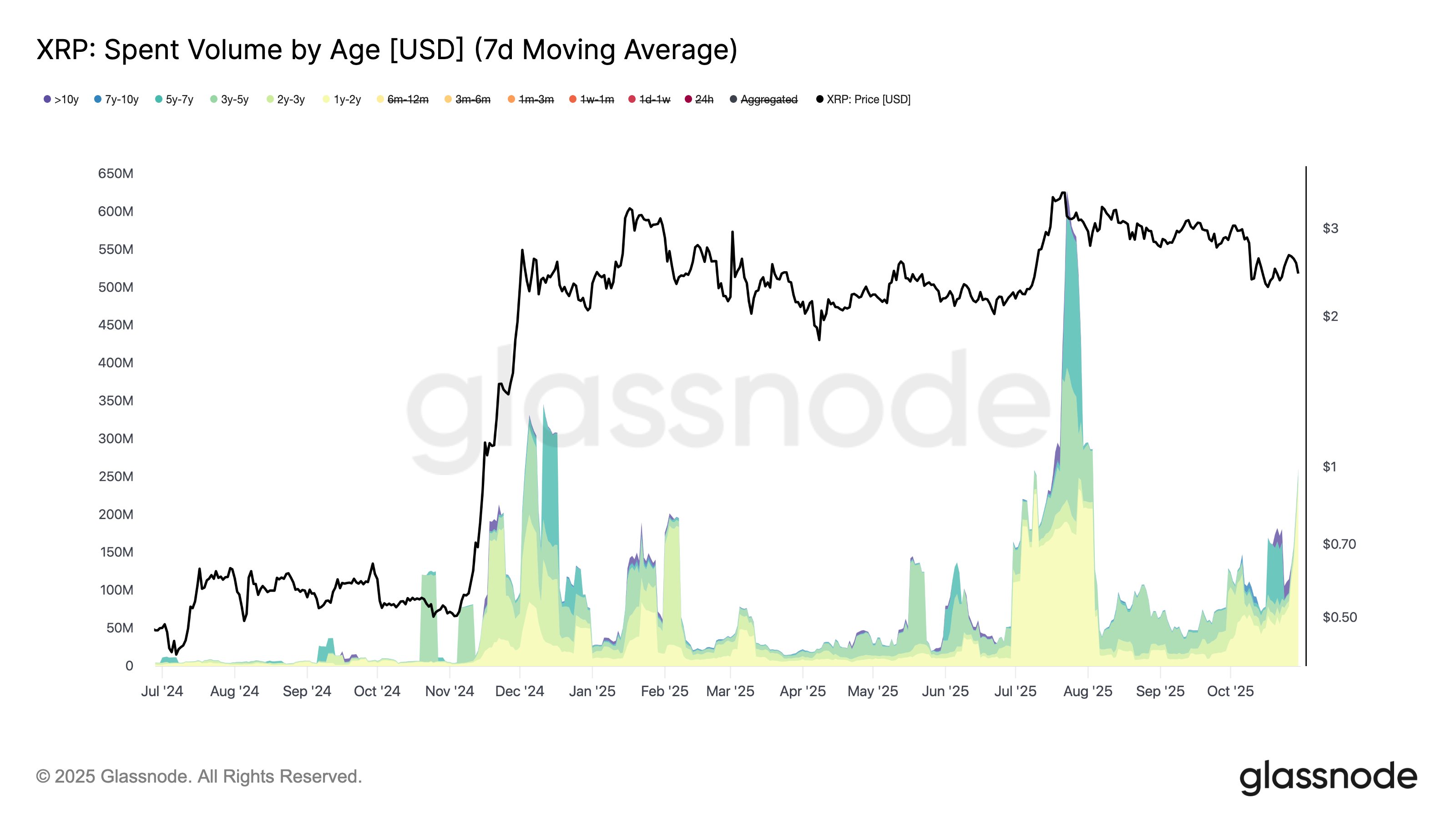
Now, some of them have begun engaging in profit-taking trades, especially as the XRP price faces a prolonged period of stagnation around $2. According to Glassnode, these investors had been offloading an average of $36 million worth of XRP every day. 

However, after XRP collapsed from the $3.66 peak in mid-July and a recovery attempt in early August failed to gain momentum, long-term holders ramped up their profit-taking trades by about 580%, increasing from an average of $36 million sold per day to around $260 million. 

Data from the accompanying chart confirms this disclosure. Notably, after a sudden spike in profit-taking trades during the rally in November 2024 to January 2025, the selloffs toned down from February to July. However, after the rally and correction in July, profit taking spiked above $500 million per day in early August before settling at the current $260 million figure.

XRP Spent Volume by Age Glassnode
XRP Spent Volume by Age | Glassnode

XRP Seeing Lower Highs and Lower Lows

The impact on XRP price has been obvious. Specifically, since the fallout in July, XRP has been witnessing lower highs and lower lows. This has led to the formation of a descending channel on the daily chart. 

XRP 1D Chart
XRP 1D Chart

Notably, if this profit-taking volume reduces and whales ramp up buying, XRP could observe the much-needed recovery above this channel, especially on the back of a broader market rebound. Most analysts already believe Bitcoin (BTC) and the crypto market could stage a recovery campaign in November.

Here’s the Most Important Date for XRP Holders in Recent Years

0

The long-awaited historic moment that XRP holders have been anticipating may finally be on the horizon.

The XRP community has witnessed several milestone events over the years that have fueled optimism and driven price surges for its favored token. 

One notable example came earlier this year, when Ripple announced that the SEC had agreed to settle its long-running lawsuit—a turning point that reignited investor confidence. Now, several months later, the community appears to be approaching yet another potentially pivotal date in XRP’s journey. 

Next Important Date for XRP Holders 

According to Paul Barron, the host of crypto-focused podcast ‘The Paul Barron Network (PBN), November 13 could go down as the most crucial day for XRP in recent years. This date is when leading asset manager Canary Capital intends to launch its highly anticipated spot-based XRP exchange-traded fund (ETF). 

Canary, which recently launched two separate ETFs focused on Litecoin and Hedera, is attempting to follow the same route to bring its XRP ETF to market. As previously reported, Canary amended its S-1 registration statement, removing the “delaying amendment,” which initially gave the SEC the exclusive right to determine when the fund could debut. 

With the recent amendment, Canary aims to make its XRP ETF auto-effective, meaning the fund would launch automatically 20 days after the filing. Since the amendment was submitted on October 24, pro-crypto journalist Eleanor Terrett suggests that Canary’s XRP ETF could go live as early as November 13, 2025. 

Importance of November 13 

Now, Paul Barron believes November 13 could be the most important date for XRP holders in recent years. In his view, the economic importance of Canary’s upcoming ETF cannot be overstated. This is because the product is designed to provide institutional clients with regulated exposure to XRP. 

Notably, he highlighted comments from Bitwise CIO Matt Hougan, who predicted that these funds could quickly attract billions of dollars in assets within the first few months of going live. This is already evident in the REX-Osprey XRP ETF (XRPR), which Paul argues has a different structure. 

Since the REX-Osprey XRP ETF debuted in September, the fund has already surpassed $100 million in assets under management, with its total AUM now standing at $114 million. Besides Canary, six other major firms, such as WisdomTree, Bitwise, 21Shares, CoinShares, Grayscale, and Franklin Templeton, have pending XRP ETF applications.  

With Canary Capital leveraging the auto-effective mechanism to fast-track its XRP ETF launch, Paul noted that the landscape has evolved into a competitive race to market. 

Next Catalyst for a Rally? 

Meanwhile, Paul highlighted the potential impact that these XRP ETFs could have on the token’s price action. He recounted how the price of XRP spiked by over 10% immediately after the SEC dropped its case against Ripple. Hence, he suggested that the upcoming ETFs could be the next major catalyst for a potential price surge. 

As anticipation mounts ahead of November 13, it’s important to note that the launch of Canary’s XRP ETF ultimately hinges on Nasdaq’s approval of the accompanying Form 8-A application.

Additionally, the potential reopening of the U.S. government could play a role. If the U.S. government reopens and the SEC resumes full operations, the agency may issue further comments or feedback on the filing, which could impact whether the fund goes live on November 13. 

Pundit Says XRP Is Becoming Ripple’s Strategic War Chest

0

A notable community commentator asserts that XRP is evolving into Ripple’s “strategic war chest” as nonprofits adopt RLUSD for tangible impact.

In an announcement today, Ripple highlighted its expanding role in global payments amid a new wave of nonprofit adoption for its RLUSD stablecoin. 

At the same time, prominent community voice Crypto Eri says the company is now carving a long-term path that could turn XRP into a “strategic war chest.”

Ripple Showcases Real-World Impact Ahead of Swell

With Ripple Swell approaching, the company highlighted how leading global nonprofits like World Central Kitchen, GiveDirectly, Water.org, and Mercy Corps are now utilizing Ripple Payments and RLUSD to expedite aid delivery.

These organizations are moving funds across borders in seconds, even into regions with weak financial infrastructure. Ripple says this shift is already reshaping how firms execute emergency support, development funds, and local disbursements.

Water.org recently began routing all of its Latin American transactions through Ripple Payments after successful pilots in Mexico, Brazil, and Peru.

Meanwhile, Mercy Corps Ventures has begun testing RLUSD for parametric insurance and anticipatory cash transfers in Kenya, with GiveDirectly preparing similar pilots.

With RLUSD surpassing $900 million in market cap less than a year after launch, Ripple is positioning its stablecoin as a core part of a modern humanitarian and financial infrastructure.

Ripple Executives Highlight Momentum

Notably, Ripple’s leadership highlighted the rapid expansion of the model. Jack McDonald, former Standard Custody CEO and now SVP of Stablecoins at Ripple, noted that more than $50 million worth of RLUSD has already been deployed for social impact projects across both XRP Ledger and Ethereum. 

He added that more partnerships are coming as stablecoin use cases continue to emerge.

Meanwhile, Ripple President Monica Long pointed to the shift as “real adoption and real impact,” noting that next week’s Swell event will detail how blockchain-based payments are becoming the infrastructure behind global aid.

XRP Is Becoming Ripple’s Strategic Engine

Now, Crypto Eri has reacted to the latest developments, arguing that Ripple’s long-term strategy is now becoming clear. 

The firm is laying deep foundations across global finance via acquisitions, partnerships, and stablecoin expansion. To her, Ripple is preparing to leverage XRP in increasingly strategic ways.

Essentially, her view is that XRP’s escrow may eventually evolve into the “ultimate strategic war chest,” enabling Ripple to deploy capital, liquidity, and settlement power across a unified ecosystem.

Notably, Ripple holds 35 billion XRP in escrow and 5 billion in available, which collectively are worth over $100 billion.

The comments follow Ripple’s accelerating acquisitions, including Hidden Road (Ripple Prime), Standard Custody, Metaco, and GTreasury, which signal a transition into an institutional-grade financial platform.

Ultimately, the combination of nonprofit adoption, expanding stablecoin use cases, and institutional alignment is fueling a new narrative within the XRP community.

Ripple is building a multi-layered financial infrastructure where RLUSD provides stable liquidity, and XRP acts as a fast, neutral bridge for moving value worldwide.

With Swell coming up, conversations are heating up about how these elements work together and what it could mean for XRP’s future.

Analyst Identifies the Area XRP Must Pull Back to Before Full Recovery Above $3

0

A well-known analyst has identified the crucial area XRP would have to pull back to before it can stage a full recovery to previous highs.

For context, XRP has been trying to regain its footing after the sharp drop on Oct. 10, but the recent weakness across the broader crypto market has slowed its recovery. Despite supportive macro factors, such as the latest interest rate cuts from the U.S. Federal Reserve, XRP’s price is seeing another pullback after briefly rebounding. 

Still, it continues to hold above $2.5, and several analysts believe this shows XRP is setting up for one last correction before it begins another strong move toward $3 and beyond.

XRP Trading Within Large Descending Channel

Market analyst DustyBC remains one of the few championing this narrative. In a recent analysis, he noted that XRP continues to follow its expected path and highlighted a key price range that could mark the end of the current correction. 

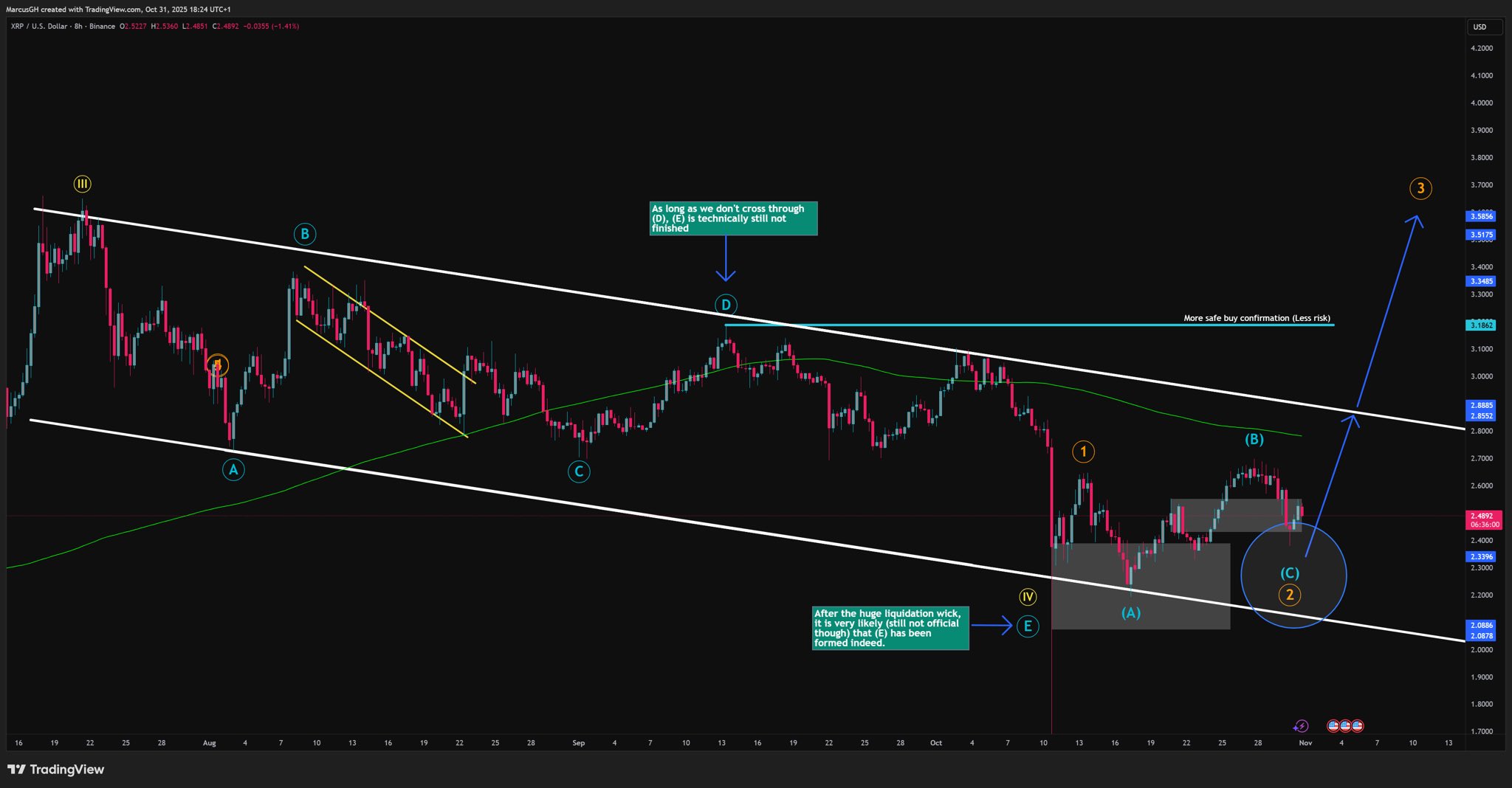
Data from his 8-hour XRP/USD chart shows that XRP has been trading inside a descending channel since it fell from $3.66 on July 18. Within this larger setup, XRP also formed smaller patterns, including a secondary descending channel and an ABCDE correction, which ended when the price dropped to $2.3 on Oct. 10.

XRP 8h Chart DustyBC
XRP 8h Chart | DustyBC

The chart indicates that the drop completed the ABCDE correction and started a new Elliott Wave structure, which now overlaps with another ABC correction. 

Notably, the recovery to $2.64 on Oct. 13 marked the end of Wave 1, while the decline to $2.29 on Oct. 17 formed wave A of the ABC correction. From there, XRP bounced back to $2.69 on Oct. 27, completing wave B. Since then, XRP has started to retreat again, in line with DustyBC’s expectation of one final dip.

Level XRP Must Drop to Before Full Recovery

The chart further shows that this current pullback could complete both the C wave of the ABC correction and Wave 2 of the ongoing Elliott Wave structure. Specifically, he circled a price zone between $2.08 and $2.33 and described it as the level XRP needs to revisit before it can build strength for the next rally. 

Once XRP reaches this area, he expects the correction to end and Wave 3 to begin, a move he believes will push XRP above the descending channel and drive it past $3, possibly retesting the $3.5 region.

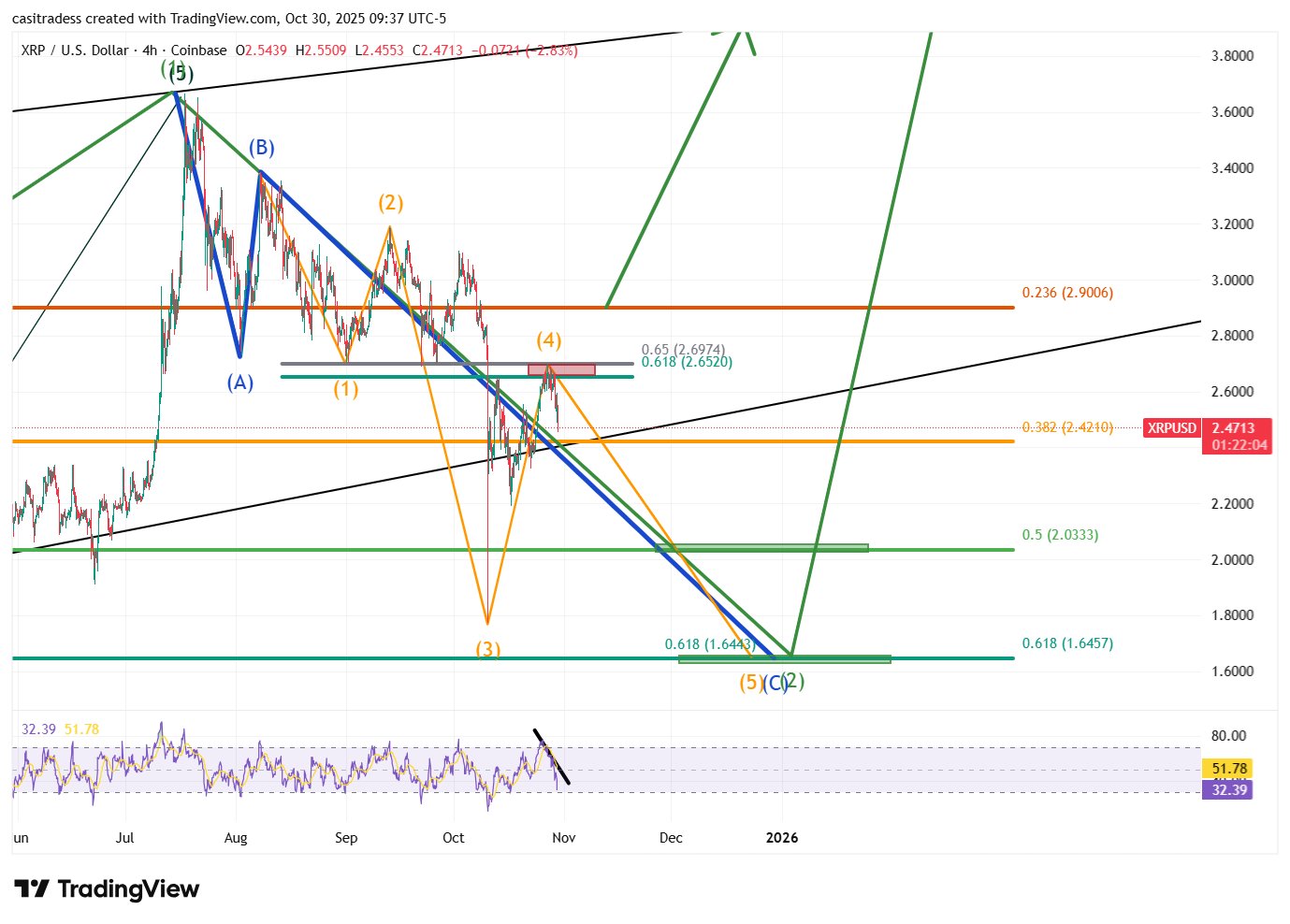
Interestingly, another analyst, Casi Trades, shares a similar outlook. She said XRP looks ready for its final drop before a major rebound. According to her, XRP turned bearish after rejecting Wave 4 resistance near $2.68, while the RSI formed a new low, confirming that Wave 5 of the correction has started.

XRP 4h Chart Casi Trades
XRP 4h Chart | Casi Trades

Casi pointed out three main support levels on Coinbase at $2.42, $2.03, and $1.65. She explained that a break below $2.42 would likely confirm more downside toward $2.03 and $1.65, with the last level aligning with the macro 0.618 Fibonacci retracement. 

She expects the price to bottom out around this zone before a strong Wave 3 impulse begins, which could send XRP quickly through resistance levels and toward new highs.

A Familiar Response to Fed Rate Cut

Meanwhile, as XRP and the broader market continue to correct despite the Federal Reserve’s latest rate cut, Dark Defender pointed out that XRP showed similar behavior before its last major rally. 

He noted that when the Fed cut interest rates by 50 basis points on Sept. 18, 2024, XRP traded near $0.50, and the market’s lack of excitement came just weeks before its surge to $3.66. With the Fed’s recent 25-basis-point cut, he suggested that another rally could form before the next Fed meeting.

Conexus to Integrate Bitcoin and Stablecoins Into Venezuelan Banking Network

0

Venezuelan payment giant Conexus is developing a blockchain-based interbank system that will allow local banks to process Bitcoin and stablecoin transactions directly.

The initiative represents one of the most ambitious efforts yet to merge traditional finance with digital assets in Latin America.

Bringing Bitcoin and Crypto Services to Everyday Banking

Notably, the upcoming platform will enable banks to offer crypto custody and exchange services alongside existing financial products.

Once operational, Venezuelans would be able to manage Bitcoin and stablecoin balances directly from their local bank accounts. This, in turn, would eliminate the need for external digital asset platforms.

The company has not yet confirmed an official release date. However, industry observers expect the system to launch by December 2025.

Conexus: Key Player in Venezuela’s Payment System

Conexus currently processes around 40% of all electronic transfers in Venezuela. Its role as a central payment intermediary provides a strong foundation on which to integrate blockchain into the national banking infrastructure.

Company president Rodolfo Gasparri said the move reflects a growing need among Venezuelans for stable alternatives to the rapidly devaluing bolívar. In fact, many citizens are turning to stablecoins like USDT to protect their savings from inflation.

Blockchain for Security and Transparency

Furthermore, Gasparri emphasized that blockchain technology will bring greater transparency and security to financial transactions. He explained that the system would operate under clear regulations to safeguard users’ digital assets.

“This approach strengthens trust in Bitcoin and USDT circulation,” Gasparri said, adding that blockchain ensures that all transactions are traceable and verifiable.

Model for Other Developing Nations

Venezuela’s project could become a pioneer example of integrating cryptocurrencies into mainstream banking under regulatory oversight. While many nations are still debating crypto regulation, Venezuela’s plan places it among the first to merge digital assets with traditional finance.

If the initiative is successful, it could inspire other developing countries facing inflation, currency instability, or high remittance costs to explore similar blockchain solutions.

For ordinary Venezuelans, the shift toward digital currencies is less about innovation and more about survival. Indeed, with hyperinflation eroding the bolívar’s value, stablecoins have become a practical refuge for everyday transactions and savings.

By integrating blockchain technology with the formal banking system, Conexus aims to provide citizens with a more stable financial framework. At the same time, it upholds government oversight and compliance.

BlackRock Dumps $384M Bitcoin on Coinbase as Prices Dip

0

The world’s largest Bitcoin ETF manager, BlackRock, has continued to offload more BTC as prices remain depressed.

Over the past day, Bitcoin’s price dipped to $106,376, after trading much higher at $116,400 earlier this week. The falling price now coincides with BlackRock’s continued sale of Bitcoin.

Market watchers highlighted in posts on X today that BlackRock moved 3,496 BTC to Coinbase Prime, the exchange’s institutional arm.

BlackRock’s Bitcoin and Ethereum Dump

Data from Arkham confirms that the latest transfer came in a series of mostly 300 BTC transactions sent to Coinbase hours ago. Collectively, the offloaded BTC tokens are worth $383 million.

These figures align closely with the two consecutive days of outflows BlackRock’s ETF has recorded. ETF data shows that BlackRock’s funds liquidated $88.1 million worth of Bitcoin on Wednesday and another $290.9 million on Thursday. The combined total of $379 million closely matches the observed transfer to Coinbase today.

Meanwhile, BlackRock is not only selling Bitcoin. It is also heavily offloading its Ethereum ETF holdings. Market data shows that BlackRock’s Ethereum ETF moved 31,754 ETH, worth $122 million, to Coinbase today. This figure also aligns with the $118 million in Ethereum ETF outflows recorded on Thursday.

Notably, this marks BlackRock’s first ETH sale this week. It previously sold $101 million worth of ETH on October 24.

Like Bitcoin, these Ethereum sales come as the price of ETH continues to decline. Ethereum is trading at $3,850 at press time, representing an 11.28% drop over the past 30 days.

Other ETFs Also Selling: Nearly $1 Billion in Two Days

This trend of selling is also visible across ETF products from other issuers. Asset managers, including Fidelity, Bitwise, Grayscale, and Ark Invest, posted negative flows at the end of trading yesterday.

In particular, seven Bitcoin ETFs, including BlackRock, sold BTC on Thursday, with no new inflows. This resulted in a total net outflow of $488 million. On Wednesday, the total net outflow was $470 million.

In other words, over the past two days, Bitcoin ETFs have collectively dumped nearly $1 billion worth of BTC. 

Bitcoin ETF records for Thursday

However, the week began on a positive note, with inflows of $149.3 million on Monday and $202.4 million on Tuesday. Similarly, Ethereum ETFs recorded $380 million in purchases during those two days.

As the spot market turns bearish, ETFs are scaling back their investments. Still, these asset managers maintain significant holdings of BTC and ETH. For instance, BlackRock currently holds approximately $85 billion in Bitcoin and $14.87 billion in Ethereum.

Market Outlook

Despite the ongoing bearish trend, analysts believe the final two months of the year could hold promise for BTC and other assets. Among the most anticipated targets this year is for Bitcoin to break $150,000 or even $200,000. 

Historically, BTC has reached new peaks in the final months of the year, and this time may be no different.

BitMine Says Coinbase’s Ethereum Acquisition Proves ETH Is a Store of Value

0

BitMine Immersion Technologies has highlighted Coinbase’s acquisition of Ethereum in Q3 2025 as proof that ETH is a store of value. 

Yesterday, Coinbase released its Q3 2025 earnings report, highlighting both strong financial performance and a notable expansion of its crypto holdings.  

Coinbase Grows Its ETH Holdings 

One detail that drew significant investor attention was the substantial increase in Coinbase’s Ethereum reserves. Notably, Coinbase amassed about 12,000 ETH in the third quarter, growing its total Ethereum holdings to 148,715 ETH as of September 30, 2025. 

This represents a 9% increase from the previous quarter and a 28.5% rise compared to Q4 2024, when the exchange held about 115,700 ETH.

Meanwhile, Coinbase also increased its Bitcoin holdings to 14,548 as of September 30, 2025, up 111% from the 6,885 BTC reported in Q4 2024. 

BitMine Makes Case for Ethereum’s Store of Value Narrative 

Following the acquisition, BitMine, through its official X account, pointed out that Ethereum serves as a treasury asset for Coinbase. In BitMine’s view, Coinbase is holding Ethereum as part of its corporate treasury, rather than a speculative token. 

BitMine further suggested that Coinbase’s consistent quarterly accumulation of ETH strengthens the view that Ethereum functions as a store-of-value asset.

While this designation has traditionally been reserved for Bitcoin, BitMine, and other industry observers have long argued that Ethereum also fits this category, given its growing institutional adoption and long-term holding patterns. 

BitMine’s ETH Acquisition

Interestingly, BitMine is also acquiring Ethereum. The company has been purchasing substantial amounts of ETH on a near-weekly basis using proceeds from its equity offerings. It aims to acquire around 5% of Ethereum’s supply. 

Data from Arkham Intelligence indicates that BitMine currently holds approximately 3.16 million ETH (worth $12.13 billion) in one of its wallets. This accounts for 2.61% of Ethereum’s total supply.

Bitmine Ethereum holding

Meanwhile, Lookonchain reports that the firm recently purchased an additional 44,036 ETH during the latest market downturn. The acquisition, sourced from BitGo and Kraken, was transferred to two newly created wallets earlier today. 

Bitcoin Retests Historical Make-Or-Break Level: Here Are Possible Scenarios

0

Recent consolidatory price trends have pushed Bitcoin to a critical price level, and its reaction from here will determine its short-term direction.

If things close as they currently stand, Bitcoin would record its first red October in seven years. The premier asset is down 3.7% this October, and yesterday’s price fluctuation reflects the predominant uncertainty around Bitcoin’s price recently.

For perspective, Bitcoin started on a positive note, rallying to $111,620 amid a positive outcome from the US-China trade talks. However, the apex cryptocurrency quickly turned bearish as the day progressed, dropping to a low of $106,323 before closing at $108,350.

Bitcoin Touches Key Cost Basis Quantiles

On-chain insight provider Glassnode highlighted that yesterday’s dump took the price of Bitcoin to the 85th quantile in the cost basis distribution model.

For those who are unfamiliar, this metric divides the total supply of BTC into 100 equal quantiles based on their acquisition price. This helps identify areas of major purchases or mining activity, thereby highlighting major support areas.

Notably, the 85th quantile, or the 0.85 cost-basis band, currently stands at around $109,000, and Glassnode has emphasized the importance of this area. The platform described the band as a “make or break” level, which has historically determined the near-term price action of Bitcoin.

Bitcoin Cost Basis Quantile Model | Glassnode

Possible Scenarios for Bitcoin

Glassnode highlighted that Bitcoin needs to hold this percentile to have a chance at rebounding. The band has historically sparked major rallies when BTC holds above it.

Hence, continuing above it is bullish for the largest cryptocurrency by market cap. At the time of writing, BTC changes hands at $110,120.

However, Bitcoin would see far lower prices if it lost the area. Glassnode predicts a possible slide towards the 75th quantile, which currently stands at $98,000. The move would see BTC drop below the psychological $100,000, marking an 11% correction from the current price.

Meanwhile, Ali Martinez has highlighted the “most important” supply zone for Bitcoin in case it rebounds to higher prices. He identified it at $112,340, using data from the UTXO realized price distribution (URPD): ATH-partitioned indicator.

The metric highlights major resistance and support areas for Bitcoin using areas where large amounts of the token changed hands. At $112,340, approximately 654,535.556 (654K) BTC (3.28% of the circulating supply) moved between addresses, potentially serving as a point of selling pressure.

Breaking above the level, which is just 2% away, would set Bitcoin up for higher prices. Notably, November is the month when Bitcoin has had its best average performance, and analysts are optimistic that BTC will perform better if it holds major support areas and breaks through this resistance.