Home Blog Page 50

Grayscale Withdraws Filing for Planned Spot Cardano ETF

0

Grayscale has withdrawn its registration statement for a planned spot Cardano ETF, ending its immediate push to launch a dedicated ADA investment product in the United States.

In a filing with the U.S. SEC on August 7, Grayscale Investments Sponsors, LLC requested permission to withdraw the Form S-1 registration statement for the proposed Grayscale Cardano Trust ETF.

The asset manager explained that it no longer intends to proceed with the planned distribution of shares registered under the filing. Notably, Grayscale confirmed that the SEC had not declared the registration statement effective. Furthermore, the company said it had neither issued nor sold securities under the registration statement or the accompanying prospectus.

Withdrawal Comes Just Before ADA’s ETF Eligibility Date

The timing of Grayscale’s decision stands out because it came just two days before Cardano reached a key milestone in the SEC’s streamlined spot ETF review framework.

Cardano was expected to reach its six-month ETF eligibility milestone on August 9, 2026. For context, CME Group launched regulated ADA futures on February 9, 2026, giving Cardano a regulated futures market in the U.S.

The availability of regulated futures helped satisfy an important condition for the streamlined review of a potential spot ADA ETF. Consequently, August 9 marked an important date in Cardano’s race for a U.S. spot ETF.

However, Grayscale withdrew its S-1 registration on August 7, just two days before ADA reached that milestone.

SEC Review Ends as Grayscale Withdraws Application

Grayscale originally filed its Cardano ETF proposal in February 2025. A few weeks later, the SEC acknowledged the related NYSE 19b-4 filing, formally advancing the proposed listing through the regulatory process.

However, the application will no longer proceed under Grayscale’s current filing because the asset manager has withdrawn its registration statement. 

Grayscale Withdraws Cardano ETF Application

Grayscale Also Withdraws Hedera and Polkadot ETF Filings

The Cardano withdrawal is not an isolated decision. Grayscale also submitted withdrawal filings for its proposed Hedera and Polkadot ETF products. As a result, the simultaneous withdrawals suggest that the asset manager may be reassessing several of its planned single-asset crypto ETF offerings.

Nonetheless, the Cardano decision carries particular significance because Grayscale had been the only asset manager seeking to launch a dedicated spot ADA ETF in the United States.

The withdrawal temporarily removes the most prominent standalone Cardano ETF proposal from the U.S. regulatory pipeline.

ADA Still Has Exposure Through Crypto Basket ETFs

Despite the withdrawal, investors can still gain indirect exposure to ADA through several diversified crypto investment products.

For instance, Cardano is included in the Grayscale Smart Contract ETF, the Bitwise 10 Crypto Index ETF, and the Hashdex Nasdaq Crypto Index ETF. These products give investors exposure to ADA alongside other digital assets.

However, a dedicated spot ADA ETF would have provided a more direct investment vehicle for Cardano exposure without requiring investors to purchase and hold ADA themselves.

XRP Whales Holding 10M to 100M Tokens Add 1.23B XRP in 2026 Despite 43% Price Crash

0

XRP has had a difficult 2026, with its price falling 43%. However, whales holding between 10 million and 100 million XRP have continued to build their holdings. 

Santiment data shows that this group has added 1.23 billion XRP to its combined balance since the start of the year.

For context, these whales held 10.97 billion XRP at the beginning of 2026. Their combined balance now stands at 12.2 billion XRP, giving them an exact increase of 1.23 billion tokens. 

At XRP’s current price of $1.04, the newly added tokens have a value of about $1.2792 billion. At XRP’s all-time high of $3.66, attained in July 2025, these 1.23 billion tokens would be worth $4.5 billion.

XRP Whales on an Accumulation Spree Santiment
XRP Whales on an Accumulation Spree | Santiment

XRP Whales Show Erratic Accumulation Trend

The group’s accumulation has followed an uneven pattern since the start of the year. The buying began well before 2026, as these XRP whales added more than 2.4 billion tokens in November 2025 alone despite the price struggles. Their combined balance rose from 8.4 billion XRP to more than 10.8 billion during that month.

The pace then slowed as XRP remained under pressure. Notably, their holdings moved above 11 billion XRP in December 2025 but later slipped slightly to 10.97 billion XRP by the start of 2026. The group stayed mostly quiet until March 2026, when it began a mild but steady accumulation campaign.

This buying continued through the following months. By July 8, 2026, the whales had pushed their combined holdings to a new all-time high of 12.27 billion XRP. 

Notably, they have distributed some tokens since then, bringing the balance down gradually to 12.2 billion XRP. Despite the recent decline, their current holdings remain far above the 10.97 billion XRP they held at the start of the year.

More Large Holders Enter the Group

The increase in holdings has not come only from existing whales buying more XRP. On-chain data also shows that more addresses have entered the 10 million-to-100 million XRP range.

Specifically, the group had 301 addresses at the start of 2026. Today, it has 313. The number initially fell to 285 in mid-February before recovering. It then climbed steadily to 322 addresses in early July and later dropped to the current 313.

Despite this year’s increase, the number of addresses remains below the group’s all-time high of 351, which it reached in October 2025. Still, the rise from 301 to 313 addresses shows that the group has expanded since the beginning of the year.

Other XRP Whales Show Different Behavior

Other major XRP holders have behaved differently during the same period. Whales holding between 100 million and 1 billion XRP have cut their combined balance from 8.43 billion XRP at the start of the year to 8.13 billion XRP today. This amounts to a distribution of 300 million XRP in 2026.

Other Major XRP Holders

Meanwhile, whales holding between 1 million and 10 million XRP have moved in the other direction, but their increase has been much smaller. This group has added 260 million XRP to its holdings, taking its combined balance to 3.83 billion XRP today.

The 100,000-to-1-million XRP shark group has also reduced its holdings. Specifically, its combined balance has fallen from 6.43 billion XRP at the beginning of 2026 to 6.37 billion XRP today.

Franklin, Bitwise Inject $3.45M Into XRP ETFs, Reversing First Outflow in a Month

U.S. spot XRP exchange-traded funds (ETFs) returned to positive territory, attracting $3.45 million in net inflows just one day after recording their first outflow in nearly a month.

The rebound erased much of the previous session’s weakness, when XRP ETFs lost $3.58 million, their first day of net outflows since July 8.

Bitwise and Franklin Lead XRP ETF Recovery

The recovery was driven by two issuers. Yesterday, Bitwise’s XRP ETF attracted $2.89 million in fresh capital, while Franklin Templeton’s XRPZ added another $561,560. No other XRP ETF recorded net flows during the session.

The inflows came just a day after Bitwise accounted for the entire $3.58 million withdrawal on Aug. 5. This suggests investors quickly returned to the fund after the brief pause in buying.

Despite the temporary outflow, U.S. spot XRP ETFs continue to hold $1.51 billion in cumulative net inflows. Bitwise remains the largest XRP ETF by cumulative inflows at $510.21 million, followed by Canary with $468.12 million and Franklin Templeton with $426.53 million.

XRP ETF | SoSoValue
XRP ETF | SoSoValue

Bitcoin and Ethereum ETFs Also Extend Winning Streak

The broader U.S. crypto ETF market also remained positive on Aug. 6. Spot Bitcoin ETFs recorded $128.69 million in net inflows, marking another day of institutional buying.

BlackRock once again led the sector with $128.33 million in inflows. Other positive contributors included:

  • Fidelity: $11.20 million
  • Grayscale Bitcoin Mini Trust: $7.48 million
  • Grayscale Bitcoin Trust: $6.83 million
  • Bitwise BITB: $1.70 million
  • Morgan Stanley ETF: $14.94 million

The gains were partially offset by VanEck, which recorded $32.77 million in outflows, and Valkyrie, which saw $9.07 million leave its fund.

Meanwhile, spot Ethereum ETFs attracted $92.15 million in net inflows, extending their recent streak of positive flows as institutional investors continued buying ETH.

Among the four major spot crypto ETF categories, Solana ETFs were the only segment to finish in negative territory, posting $859,450 in net outflows.

XRP Lags Bitcoin and Ethereum Price Performance

Meanwhile, the ETF inflows came even as XRP continued to underperform the broader crypto market. At the time of writing, XRP traded at $1.03, down 1.01% over the past 24 hours and 3.43% over the previous seven days.

By comparison, Bitcoin traded at $64,822, gaining 0.35% on the day and 1.60% over the past week. Ethereum changed hands near $1,912, rising 0.5% in the last 24 hours and 1.4% over the previous seven days.

The divergence between ETF demand and XRP’s price suggests that institutional investors continued to accumulate exposure despite the token’s recent short-term weakness.

Cardano Explodes 12% to Break Above $0.20 After Two Months

0

Cardano has reclaimed the psychologically important $0.20 level after spending more than two months trading below that mark.

Notably, Cardano last traded above $0.20 on June 4, 2026. After that, ADA entered a prolonged downtrend that eventually pushed it to a multi-year low of $0.1387. However, buying pressure gradually returned over the past few weeks, setting the stage for a strong breakout. 

After weeks of gradual recovery, the token broke through the key level with a 12.13% intraday surge, climbing from $0.1879 to $0.2107. Although it later gave back part of its gains, it has continued to hold above the $0.20 threshold. At press time, ADA was trading around $0.2032, signaling renewed bullish momentum.

Cardano Tops Weekly Performance 

The latest rally has pushed Cardano to the top of the weekly performance rankings among the 100 largest cryptocurrencies by market cap.

Over the past seven days, ADA has spiked 20.63%, outperforming several leading altcoins and emerging projects. MemeCore ranked second with a 17.44% increase, while Ethena, Pump.fun, Algorand, and LayerZero followed with gains of 14.38%, 13.81%, and 12.91%, respectively.

Cardano has also maintained strong momentum on the daily timeframe. The token has risen 8.42% over the past 24 hours, making it the second-best-performing cryptocurrency among the top 100 assets during that period. 

Cardano Emerges as Top Gainer

Ecosystem Developments Fuel Investor Confidence

It is noteworthy that several developments in the ecosystem have reinforced Cardano’s bullish outlook.

Cardano has officially entered its Dijkstra development era, a new governance phase that allows core development to be funded directly through the community treasury following the successful implementation of the van Rossem hard fork.

Meanwhile, on-chain activity has continued to strengthen. Whale wallets accumulated 240 million ADA in recent days, highlighting growing confidence among large investors. At the same time, Cardano expanded its interoperability by launching a new IBC testnet bridge with Cosmos through Injective, further boosting optimism around the ecosystem’s long-term growth.

In the meantime, investor sentiment has also remained firmly positive despite ADA’s recent volatility. According to CoinMarketCap, Cardano currently ranks as the fifth most bullish cryptocurrency by community sentiment, with a bullish score of 79.4%. Combined with rising whale accumulation, expanding network capabilities, and renewed buying momentum, the positive sentiment has helped support ADA’s return above the critical $0.20 price level.

XRP Just Officially Printed Its Lowest Daily Close of the Year: What Comes Next?

XRP price has posted its lowest daily close of 2026 amid ongoing selling pressure as the coin lags behind Bitcoin.

While a short-term bounce remains possible, technical analysts say the overall downtrend is still intact.

According to TradingView data, XRP closed at $1.027 on Aug. 6, its weakest daily close of the year. Notably, the token briefly dipped to $1.009 on June 26 but recovered before the daily candle closed.

At press time, XRP was trading around $1.02, putting a breach below the psychological $1 level back in focus. For context, a break below it would mark XRP’s first move under $1 since November 2024.

Expects a Relief Bounce

Technical analyst ChartNerd highlighted the milestone on X. The analyst noted that XRP has returned to the June low region after repeated rejections at key moving averages.

According to ChartNerd, XRP has been rejected at the 50-day exponential moving average (EMA) in eight of the past 10 weeks. More recently, the token also failed to reclaim the 20-day EMA, helping drive the latest drop toward $1.01.

The daily chart also shows XRP breaking below an ascending support trendline before revisiting a gray demand zone near the June lows. Even so, ChartNerd believes the current support area could trigger a short-term rebound.

“Highly likely we witness a decent bounce here,” the analyst wrote. However, he expects any recovery to be a relief rally, not the start of a lasting trend reversal.

Image

XRP Still Losing Ground to Bitcoin

In a separate post, ChartNerd argued that XRP looks even weaker against Bitcoin. The analyst said XRP has fallen nearly 17% against BTC since mid-June. In ChartNerd’s view, that underperformance is likely to continue through the rest of the year.

The analyst also urged traders to respect the ongoing pattern of lower highs until the market confirms a structural breakout.

ChartNerd made the comments while responding to market commentator Jake Claver, who suggested XRP could briefly break below support before staging a rally, similar to previous market cycles.

ChartNerd disagreed. He argued that XRP is more likely to continue lagging behind Bitcoin following a recent breakdown in market structure. 

Stronger demand, the analyst added, appears to be waiting at lower price levels. Historically, those areas have preceded periods of XRP/BTC outperformance and stronger XRP/USD rallies.

For now, XRP remains at a key technical level. Traders are watching whether support around $1.01 can hold. If it fails, the token could fall below $1 for the first time in nearly two years.

XRP/BTC Price Action

XRP’s price dipped by 0.81% over the past day, worsening its monthly performance to a 4% decline and its year-to-date performance to 45.42%. Meanwhile, Bitcoin gained 0.33% over the past day, with positive monthly gains of 4.64%.

Shiba Inu Burn Rate Reverses Sharply as Daily Burns Fall to Just $33 Worth of SHIB

0

Shiba Inu’s burn activity has reversed sharply this week after recording one of its strongest performances in months.

Over the past 24 hours, Shiba Inu witnessed the incineration of just 7.10 million SHIB worth approximately $33 at current prices. This dramatic slowdown follows a period of intense burn activity that fueled optimism across the Shiba Inu community.

The latest figures represent a steep decline from the elevated burn levels recorded at the end of July, indicating that the recent momentum has cooled, at least for now.

Burn Volume Drops From Billions to Millions

The latest burn figures stand in sharp contrast to the final week of July.

As previously reported, Shiba Inu burn activity accelerated significantly on July 26 and July 27, with more than 1 billion SHIB destroyed on each day. The surge pushed Shiba Inu’s monthly burn total above 3.2 billion SHIB in July, marking its highest monthly burn in several months.

Following that milestone, many community members expected the trend to continue into August. However, burn activity has slowed considerably. For instance, only 1.38 million SHIB, worth roughly $7, were burned on August 5, reflecting an 87.63% decline in the daily burn rate. 

Although the latest 24-hour burn increased to 7.10 million SHIB, it still represents only a fraction of the billion-token burns recorded less than two weeks ago. Despite the sharp decline in daily burns, longer-term burn statistics continue to paint a stronger picture.

According to data from the Shibburn tracking portal, the community has permanently removed 283.98 million SHIB over the past seven days. Meanwhile, the 30-day burn total has climbed to 3.47 billion SHIB, largely driven by the massive burn activity recorded in late July. 

Shiba Inu Burn
Shiba Inu Burn

Community Debates the Impact on SHIB Price

The latest slowdown has sparked mixed reactions across the Shiba Inu community.

Some investors argue that the reduced burn rate could weaken SHIB’s deflationary mechanism and limit its price recovery if burn activity fails to rebound. Others, however, believe traders should focus on broader on-chain indicators instead of daily burn statistics.

One metric attracting attention is exchange activity. According to CryptoQuant, investors withdrew 127.9 billion SHIB from exchanges over the past 24 hours. Such large exchange outflows are often viewed as a sign that holders are moving tokens into private wallets for long-term storage rather than preparing to sell.

Other Shiba Inu Metrics Continue to Weaken

Although exchange outflows provide a positive signal, several other ecosystem indicators remain under pressure.

Notably, Shibarium’s decentralized exchange (DEX) volume has remained at zero for days, underscoring subdued activity across the Layer-2 network. Moreover, Shibarium’s daily transaction count has declined to a multi-month low of just 636.

Meanwhile, SHIB continues to struggle in the market. The token remains below the key psychological level of $0.000005 and currently trades at approximately $0.000004661.

XRP Ledger Rolls Out Major 3.3.0 Upgrade: Details

The XRP Ledger (XRPL) has introduced version 3.3.0, adding support for five proposed protocol amendments. 

Notably, the amendments will expand the blockchain’s capabilities for privacy, institutional finance, tokenized assets, and network efficiency.

The update was announced by the official XRP Ledger Operations account. However, the new features are not yet live. Each proposed amendment must first receive validator approval through the XRPL amendment voting process.

Five Proposed Amendments Expand XRP Ledger

XRPL version 3.3.0 adds support for five proposed amendments, along with a bundled fix amendment. Specifically, the new features include Confidential Transfer, which keeps Multi-Purpose Token (MPT) balances and transfers private by encrypting them on the XRP Ledger.

Meanwhile, Batch lets users combine up to eight transactions into a single operation, making complex payments, trustless swaps, and OTC trades easier. The Sponsor amendment allows a third party to pay transaction fees and reserve costs for another user.

Permission Delegation lets wallet owners give limited permissions for specific transactions without sharing full control of their accounts. Dynamic MPT allows token issuers to update certain properties of Multi-Purpose Tokens after they have been created.

The update also reduces memory usage by 10%–15%, improves node synchronization, and includes several stability improvements.

Ripple Engineers Highlight Privacy and Institutional Benefits

Ripple Head of Engineering Ayo Akinyele said the update improves the XRP Ledger’s privacy, payments, account management, and token features as more financial assets move on-chain. Meanwhile, he stressed that the five amendments are still proposals and must be approved by validators before they become active.

XRPL validator Vet (Hussein Zangan) called the release a major upgrade. He said Confidential Transfer is XRPL’s first native privacy feature, while Batch transactions make trustless swaps, OTC trading, and new app business models possible.

Vet also said Permission Delegation helps organizations manage funds more securely by letting them keep large wallets offline while giving limited permissions for everyday transactions.

Asked whether the features were built for institutions or retail users, Vet said both groups requested them, adding that some features such as Dynamic MPT and Confidential Transfer are designed to work together.

Performance Improvements

RippleX Staff Software Engineer Mayukha Vadari said many of the biggest improvements in xrpld 3.3.0 go beyond the new amendments.

The update cuts memory usage by more than 15%, improves online_delete performance, fixes about 60 bugs found during AI-powered testing, upgrades the code from C++20 to C++23, and expands test coverage.

It also removes several older amendments that have been active for more than two years, making the codebase simpler and easier to maintain.

If validators approve the proposed amendments, they will add new privacy, token, treasury management, and settlement features while making the XRP Ledger faster and more efficient.

XRP Short Positioning Accelerates as OI Hits $195M and CVD Sinks to -$363M

0

Amid the latest XRP price pullback, on-chain and derivatives data show that market positioning has moved increasingly toward the short side.

Notably, investors appear to be preparing for further downside as XRP loses ground and selling pressure strengthens across both the spot and derivatives markets.

XRP Short Positioning Spikes

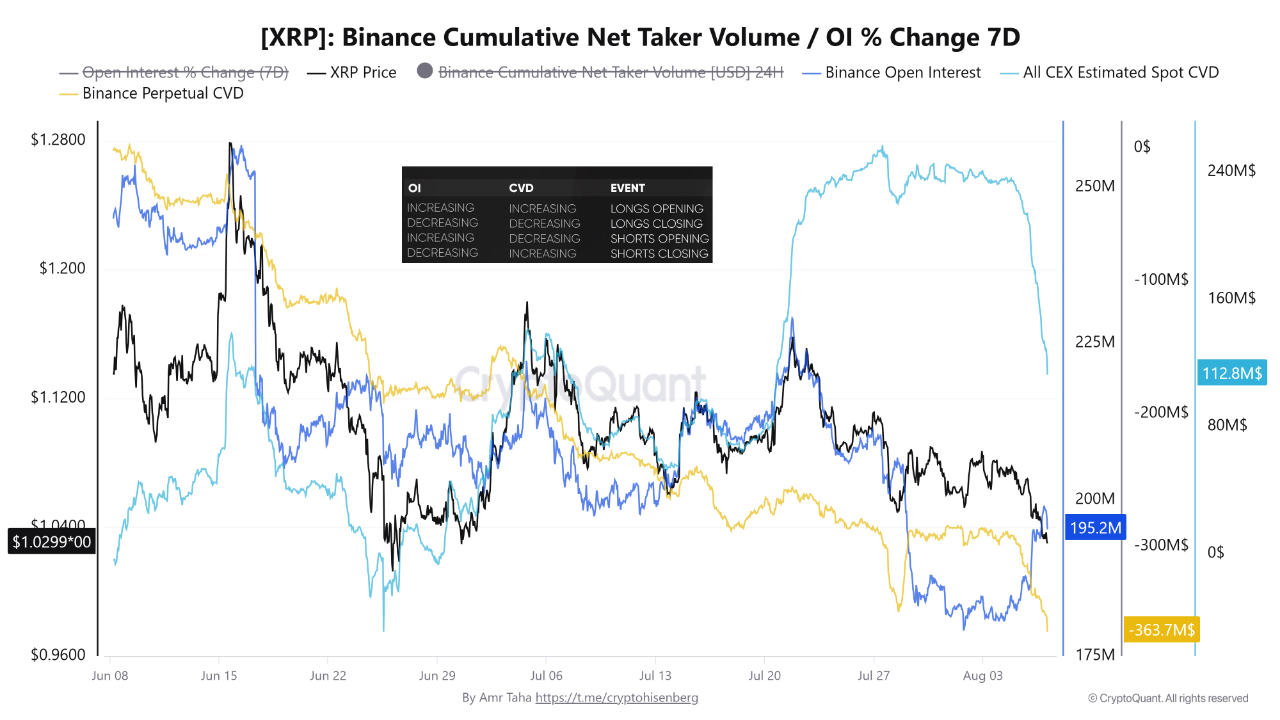
XRP derivatives positioning has changed over the past 72 hours. Between Aug. 4 and 7, Binance XRP open interest rose from about $180 million to $195 million, an increase of roughly 8%. 

Meanwhile, during the same period, Binance perpetual CVD fell from around -$292 million to -$363 million, representing a decline of about $71 million.

The rise in open interest alongside the drop in perpetual CVD indicates that there are new short positions entering the market. Specifically, traders are adding leverage while selling pressure increases, as more derivatives traders are positioning for another move lower.

XRP Short Positioning Builds CryptoQuant
XRP Short Positioning Builds | CryptoQuant

Spot Buying Pressure Fades

Further, the spot market has also lost strength. Estimated XRP spot CVD across centralized exchanges dropped from about $235 million to $112 million between Aug. 4 and 7. This represents a decline of more than 52%.

Meanwhile, spot CVD remains positive at $112 million, but the sharp fall from $235 million shows that buying activity has weakened massively. Buyers are still present, but they are no longer providing the same level of support from earlier in the period.

All this data confirms a change in XRP’s short-term market structure. Spot demand has weakened, while derivatives positioning has moved further toward the sell side. The next major signal will be whether Binance open interest continues to rise as perpetual CVD falls further into negative territory.

Long Liquidations Trigger Increased XRP Short Positioning

Coinglass liquidation data shows why most investors have resorted to short positioning. Notably, long liquidations have dominated across several timeframes, indicating that traders who expected XRP to rise have taken most of the losses during the recent decline.

XRP Liquidation Data Coinglass
XRP Liquidation Data | Coinglass

On the 4-hour timeframe, XRP recorded $6.30 million in total liquidations, including $6.27 million from long positions. Longs therefore accounted for 99% of all liquidations during that period. 

Over 12 hours, total liquidations reached $7.51 million, while long liquidations stood at $7.46 million, giving them a 99.3% share.

The trend is also present over 24 hours, when XRP recorded $9.60 million in total liquidations. Long positions accounted for $9.48 million, or 98% of the total. These figures show that bullish traders have borne most of the pressure as XRP moved lower.

XRP Drops Toward $1 as Shorts Increase

The wave of long liquidations has come as XRP fell from the $1.05 to $1.08 range to a current price of about $1.0296. The decline has put more pressure on traders who positioned for a recovery and has strengthened the bearish mood across the market.

As XRP continues to correct and long liquidations rise, more investors have turned bearish, leading to the increased XRP short positioning. However, the growing short bias could eventually work against them if XRP stages a strong recovery.

A sharp rebound could force heavily positioned short traders to close their positions, potentially triggering a short squeeze.

Cardano Founder Says Elizabeth Warren Wants to Ban All Cryptocurrencies

0

Cardano founder Charles Hoskinson has criticized U.S. Senator Elizabeth Warren following her latest comments opposing the current version of the CLARITY Act.

Hoskinson’s remarks come as the debate over the CLARITY Act continues to intensify, with lawmakers remaining divided over the best framework for overseeing digital assets.

Warren Backs Crypto Regulation but Rejects the CLARITY Act

During a recent interview, Warren reiterated that she supports regulating the cryptocurrency industry but argued that the CLARITY Act, in its current form, falls short.

According to her, the legislation was designed to benefit the crypto industry rather than protect consumers. She contended that the bill fails to adequately address corruption, consumer protection, national security risks, and broader economic concerns. Warren also accused the cryptocurrency industry of attempting to influence lawmakers and criticized the insufficient safeguards in the legislation.

Furthermore, she advocated for crypto regulations that prioritize retail investors, retirement savers, and national security rather than advancing what she believes are industry-friendly policies.

Hoskinson Accuses Warren of Opposing Crypto Innovation

Reacting, Hoskinson dismissed Warren’s criticism, arguing that her opposition extends well beyond the CLARITY Act itself. He contended that her regulatory approach would damage the crypto industry rather than strengthen it.

According to Hoskinson, Warren’s stance reflects a broader effort to ban cryptocurrencies and blockchain technology, leaving little room for compromise between industry advocates and proponents of stricter regulation.

“She wants to ban all Cryptocurrencies and Blockchain technology,” Hoskinson remarked.

In a follow-up comment, Hoskinson suggested that the divide over cryptocurrency policy is increasingly becoming a generational issue. He argued that younger policymakers may be more receptive to blockchain innovation than some long-serving lawmakers.

Senate Delays Vote on the CLARITY Act

Meanwhile, the U.S. Senate has postponed consideration of the legislation until after the summer recess. Senate Majority Leader John Thune confirmed that lawmakers will not vote on the bill until September, delaying one of the cryptocurrency industry’s most closely watched regulatory proposals.

The delay has also dampened market expectations. Prediction platform Polymarket now assigns only a 15% probability that the CLARITY Act will be signed into law before the end of 2026. 

CLARITY Act Odd
CLARITY Act Odd 

Hoskinson Remains Bullish on Crypto’s Future

Despite the legislative uncertainty, Hoskinson remains optimistic about the long-term outlook for digital assets.

Speaking during a Midnight Discord AMA, the Cardano founder argued that as much as $10 trillion could eventually flow into the cryptocurrency market regardless of whether the CLARITY Act becomes law.

However, he emphasized that passing the legislation would significantly strengthen the United States’ position as a global leader in the digital asset industry, potentially accelerating institutional adoption and broader blockchain innovation. 

XRP NUPL Hits Deep Capitulation Levels That Marked Past Market Bottoms

0

The XRP Net Unrealized Profit/Loss (NUPL) metric has collapsed to -0.3391, representing one of its weakest readings in recent years.

This places XRP deep in the capitulation zone, a level that has appeared near major XRP market bottoms in previous cycles. 

For context, the NUPL measures whether XRP holders, as a whole, are sitting on unrealized profits or losses. At -0.3391, unrealized losses now outweigh unrealized gains across the market.

XRP NUPL
XRP NUPL

This is one of XRP’s lowest NUPL readings since the devastating 2022 bear market. In the past, deeply negative NUPL levels have shown that many investors who bought at higher prices were beginning to lose confidence. 

As fear grows, weaker holders often sell, while long-term investors continue to hold. Previous XRP cycles show that this sort of market condition has appeared near the end of bear markets.

MVRV Shows XRP Trading Below Holders’ Average Cost

Elsewhere, XRP’s Market Value to Realized Value (MVRV) ratio currently stands at 0.7468, meaning the market values XRP about 25.3% below the average price that on-chain holders paid for their coins. 

Whenever the MVRV falls below 1.0, XRP trades below its aggregate cost basis. In previous cycles, this has often encouraged long-term investors to accumulate even when prices continued moving lower in the short term.

XRP showed similar MVRV readings during the 2018-2019 bear market bottom and again throughout the extended 2022 capitulation period before both recoveries began. The current 0.7468 reading puts XRP back in that historical undervaluation range. 

However, today’s conditions have not matched the extreme levels seen in 2022, when NUPL dropped to around -0.75 to -0.80. Essentially, the current structure shares several similarities with earlier market bottoms but has not yet reached the same level of stress.

Historical XRP NUPL Trends

Notably, the NUPL chart covering 2021 through 2026 provides perspective on where XRP stands today. In early 2021, NUPL climbed above 0.50 into the Euphoria-Greed zone, showing that most holders were sitting on healthy unrealized gains. 

As market conditions weakened, the indicator moved through the Belief-Denial and Optimism-Anxiety stages before entering deep Capitulation during 2022, where it eventually bottomed around -0.75 before the next recovery started.

The 2024-2025 bull market briefly changed the trend. Specifically, XRP climbed above $3.00 in early 2025, pushing NUPL back into positive territory and close to euphoric levels. 

However, since then, the asset has remained under heavy selling pressure. XRP has dropped nearly 70% to around $1.06, while NUPL has fallen back to -0.3391. The current path matches the early and middle stages of the 2022 capitulation that eventually led to a market bottom.

XRP Still Trades Below Key EMAs

Currently, XRP trades at around $1.04, below its 20-day EMA at $1.08, 50-day EMA at $1.1134, 100-day EMA at $1.1940, and 200-day moving average at $1.3872. Meanwhile, the Relative Strength Index (RSI) sits around 39.27, still above the classic oversold region.

XRP Below Key EMAs
XRP Below Key EMAs

XRP also recently broke below a symmetrical triangle on the daily chart, confirming that the broader downtrend remains in place. 

The area between $1.00 and $1.03 now acts as the main support zone. If XRP closes a week below $1.00, selling pressure could increase and send the price toward $0.90 to $0.95. 

On the upside, buyers first need to push XRP back above the $1.10 to $1.14 resistance range before any recovery can gain strength. Beyond that, the 200-day moving average near $1.38 represents the next major target.