Home Blog Page 55

South Korean Authorities Arrest Three Suspects in $8.6 Million XRP Investment Scam

0

South Korean police have arrested three individuals and secured an Interpol Red Notice for a fourth suspect over an alleged XRP investment scam.

According to a report by Yonhap News Agency, the Seoul Metropolitan Police Agency (SMPA) accused the group of operating a fake cryptocurrency investment platform that lured investors with promises of guaranteed returns before disappearing with their digital assets.

Investigators said the suspects launched the fraudulent website Fxrpntwork.com in October 2025 and persuaded 71 investors to transfer 3.4 million XRP, worth 12.3 billion won ($8.6 million) at the time.

To attract victims, the platform promoted itself through blog posts, online news articles, and YouTube videos. It claimed to offer full principal protection and fixed monthly returns of 1.5% to 1.8%, promises that authorities say were entirely false.

Fraudsters Exploited Interest in Flare’s FXRP Launch

Police said the operators boosted the scheme’s credibility by impersonating legitimate projects within the XRP ecosystem, particularly Flare Network, capitalizing on heightened interest surrounding its FXRP launch in September 2025.

For context, Flare enables users to lock native XRP while receiving an equivalent amount of FXRP on the Flare network. This mechanism allows XRP holders to participate in decentralized finance (DeFi) applications and earn yields without selling their original assets.

Authorities said the suspects instructed victims to transfer their XRP from South Korean cryptocurrency exchanges to designated wallets through an overseas exchange. Once the transfers were complete, the operators shut down the website and disappeared with the funds.

Investigation and Subsequent Arrests 

The Seoul Metropolitan Police Agency launched its investigation in October 2025 after receiving intelligence about a rise in cryptocurrency-related fraud.

Investigators quickly traced the movement of the stolen digital assets and froze the suspects’ cryptocurrency wallet within three days of receiving the initial report, preventing additional investor losses.

Authorities later arrested the alleged ringleader after he returned to South Korea from overseas. They also apprehended two other suspects while they attempted to evade arrest in different parts of the country, with one already referred to prosecutors.

Meanwhile, police secured an Interpol Red Notice for a fourth suspect to locate and provisionally arrest the individual pending extradition proceedings.

XRPL Validator Warns Community About Emerging DeFi Scams

Following the arrests, prominent XRP Ledger dUNL validator Vet urged the XRP community to remain vigilant as decentralized finance activity expands on the XRPL.

While commending the South Korean authorities for their swift action, Vet cautioned that the growth of new financial applications on the XRP Ledger could also create opportunities for fraudsters. According to him, upcoming XRPL lending protocols may deliver legitimate innovation but could also inspire fake staking, lending, and yield-generation schemes designed to exploit unsuspecting investors.

Vet encouraged XRP holders to verify the authenticity of investment platforms before transferring funds, emphasizing that scammers often exploit excitement surrounding new ecosystem developments. 

XRPL dUNL validator warning

Ethereum Miners Are Selling Less Than Ever — Could Institutional Demand Trigger the Next Major Rally?

Ethereum (ETH) selling pressure from miners has dropped to near historic lows, and two CryptoQuant analysts say this could create a favorable setup for a strong price recovery.

The on-chain data comes as Ethereum trades at $1,912, down 0.65% over the past week but up 21% over the last month, according to CoinMarketCap data. Despite the recent rebound, ETH remains 49.8% below its price from a year ago.

Ethereum Miner Selling Pressure Hits Near-Record Lows

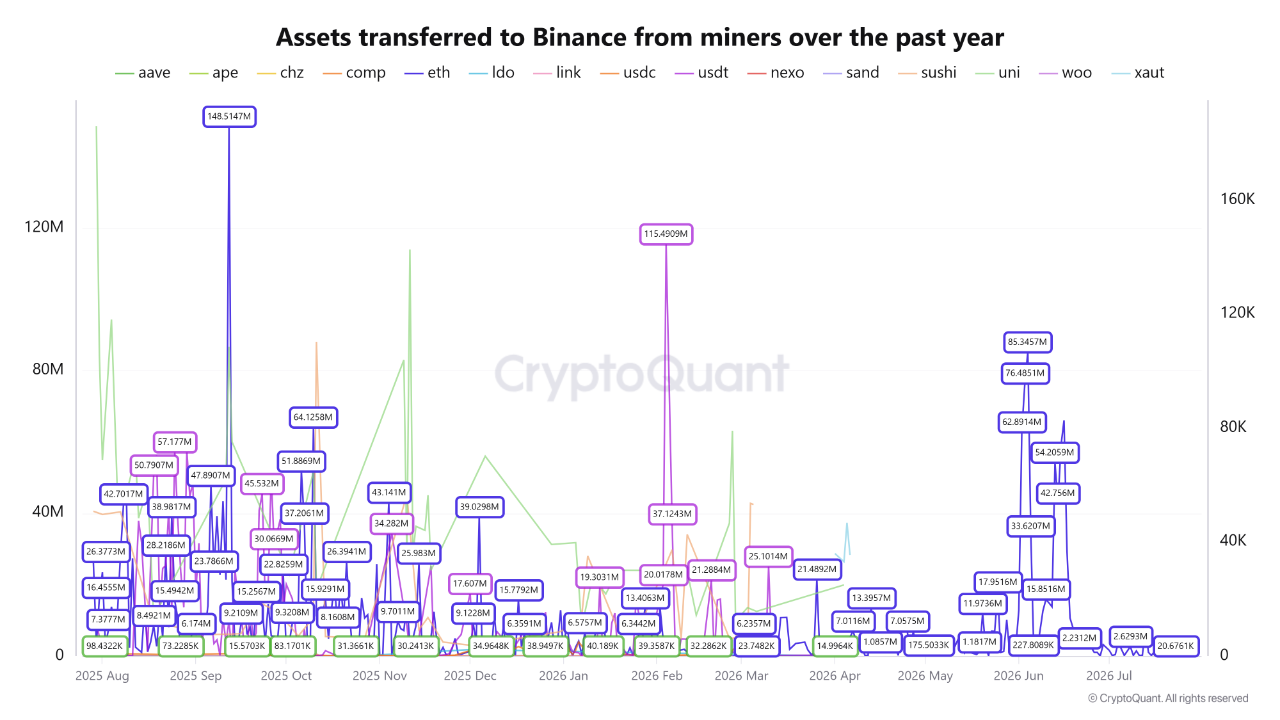
CryptoQuant analyst PelinayPA said Ethereum miner transfers to Binance have fallen close to their lowest levels in the past year. The decline points to a sharp drop in miner-driven selling pressure.

The large ETH transfer spikes seen in previous months have mostly disappeared. Transfers briefly increased in June but fell sharply afterward, returning to near-baseline levels by the end of July.

Binance remains the world’s largest venue for spot and futures Ethereum trading. Because of this, miner deposits to the exchange are a key signal of potential selling activity.

The current decline suggests miners are adding little immediate selling pressure to the market.

quicktake-image

PelinayPA noted that miners are a natural source of ETH supply. When fewer coins move to exchanges, there is less ETH immediately available for sale. This can make it easier for buyers to absorb available liquidity.

However, the analyst warned that lower supply alone is not enough to push prices higher. Reduced miner selling may limit downside risks, but Ethereum remains range-bound because demand has not accelerated.

According to PelinayPA, a new wave of institutional buying could provide the catalyst for Ethereum’s next major upside move. 

Over the past day, the Ethereum ETF sold $18.65 million worth of ETH but had accumulated $23.76 million two days earlier.

Ethereum Regains Strength Against Bitcoin

Meanwhile, CryptoQuant analyst CryptoZeno said Ethereum is beginning to recover relative strength against Bitcoin after months of underperformance. However, a sustained recovery will depend on whether capital begins rotating back into ETH.

The analyst pointed to Ethereum’s ETH/BTC Market Value to Realized Value (MVRV) ratio. The metric has recovered from historically discounted levels and moved above its long-term average.

Similar recoveries in previous market cycles have signaled a shift from capitulation toward improving Ethereum performance relative to Bitcoin.

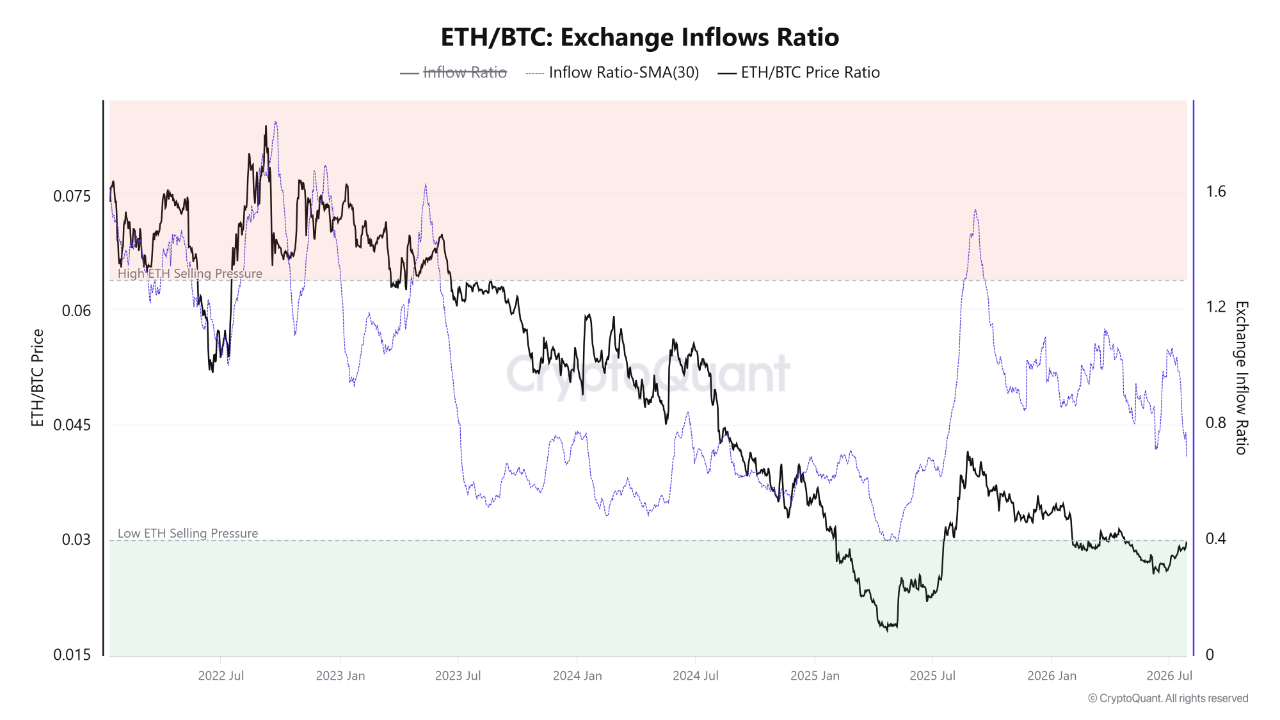
CryptoZeno also highlighted better exchange flow trends. The ETH/BTC Exchange Inflows Ratio has fallen significantly from levels seen during earlier distribution phases.

This suggests Ethereum holders are moving fewer coins onto exchanges, reducing potential near-term selling pressure.

Capital Rotation Could Drive the Next Move

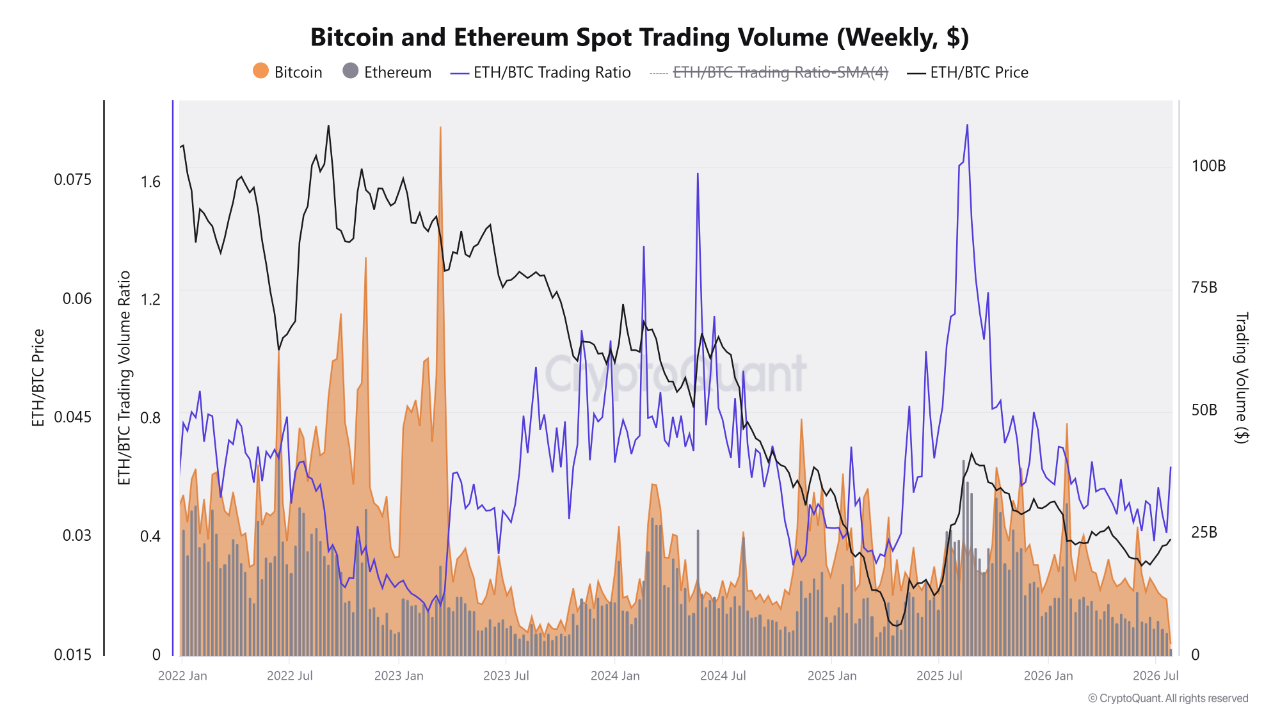
The analyst added that weekly spot trading data shows Bitcoin still dominates overall activity. However, the ETH/BTC trading volume ratio has stopped falling and is beginning to stabilize.

Historically, improvements in this ratio have often come before stronger Ethereum performance. This typically happens as institutional and retail investors expand their focus beyond Bitcoin.

Despite these positive signals, CryptoZeno said the market has not yet entered a full altcoin leadership phase.

Instead, Ethereum is rebuilding on a stronger on-chain foundation. A sustained rally will require continued capital inflows, limited exchange selling, and stronger spot market participation.

Essentially, both analysts highlighted the same key factor: Ethereum’s supply-side conditions have improved significantly, but stronger institutional demand may be needed to trigger the cryptocurrency’s next sustained upward move. In this scenario, ETH holders could look at prices beyond $2,000.

XRP Biggest Players Are Missing From the Market, CryptoQuant Finds

XRP whale activity on Binance has fallen sharply, with both inflows and outflows declining, according to CryptoQuant analyst PelinayPA.

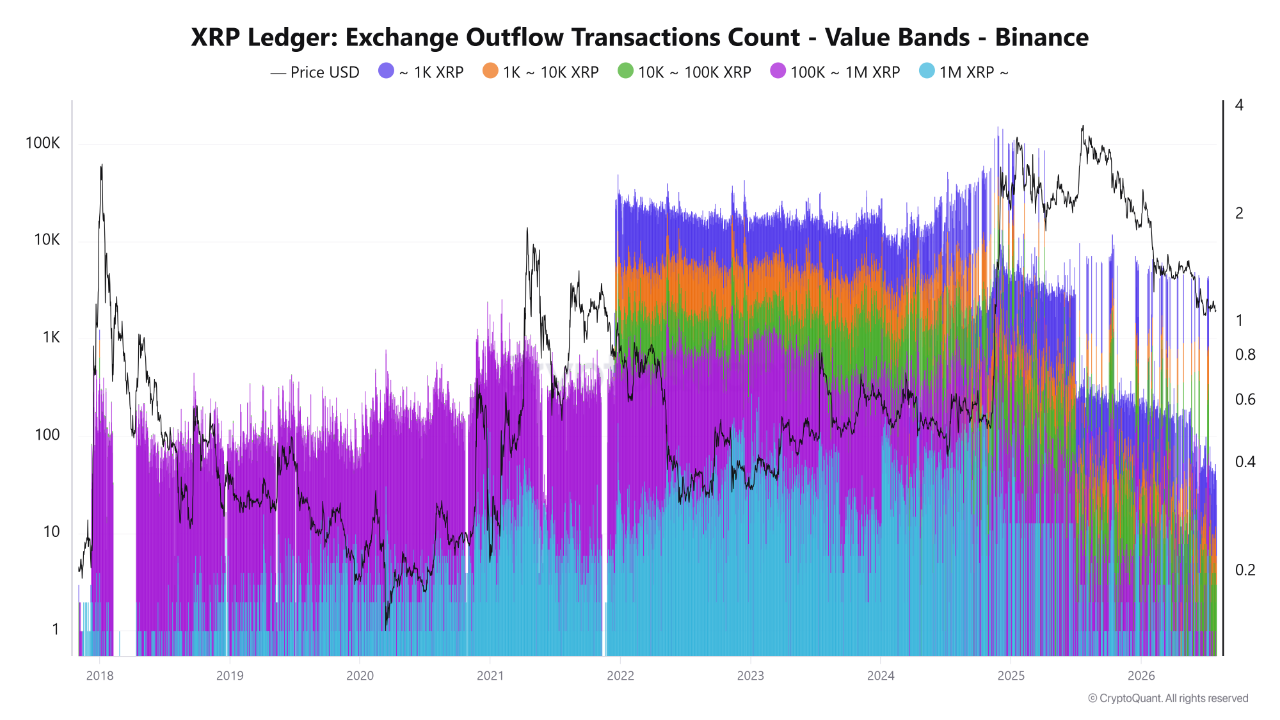
The trend suggests large investors are staying on the sidelines instead of actively accumulating or selling the token. The analyst said transaction counts across major value bands have dropped significantly, pointing to weaker buying interest amid lower selling pressure.

XRP Whale Activity Drops Across the Board

According to the analysis, large XRP withdrawals from Binance have declined considerably from 2024 and 2025 levels. The slowdown is most noticeable in transfers between 100,000 and 1 million XRP, as well as transactions above 1 million XRP.

Large exchange outflows are often seen as a sign that investors are moving assets into private wallets for long-term holding. However, PelinayPA said the current decline is not a bullish accumulation signal. That’s because whale outflows themselves have become unusually rare.

The same pattern is visible on the inflow side. Large XRP deposits to Binance have also dropped sharply, suggesting whales are not moving tokens to exchanges to sell. As a result, near-term selling pressure appears much lower than in previous market cycles.

Market Stuck in a Waiting Phase

With both exchange inflows and outflows declining, PelinayPA said there is little evidence of either aggressive accumulation or large-scale distribution.

Instead, the analyst described the market as being in a “waiting phase”. Lower liquidity and weaker trading activity are making it harder for XRP to establish a clear trend in either direction.

One of the clearest signs is the sharp decline in transactions exceeding 1 million XRP. Both inflows and outflows in this category have fallen, suggesting major holders are largely inactive.

Retail Traders Drive Most Activity

Despite weaker whale participation, transactions between 1,000 and 10,000 XRP still account for most network activity. This suggests retail traders remain the market’s main participants.

However, PelinayPA noted that previous XRP bull markets were driven largely by high-volume whale activity rather than retail flows. Until institutions or large holders return with fresh capital, the analyst expects XRP to remain in a relatively quiet, range-bound market.

XRP Open Interest on Binance Falls to Lowest Since 2024.

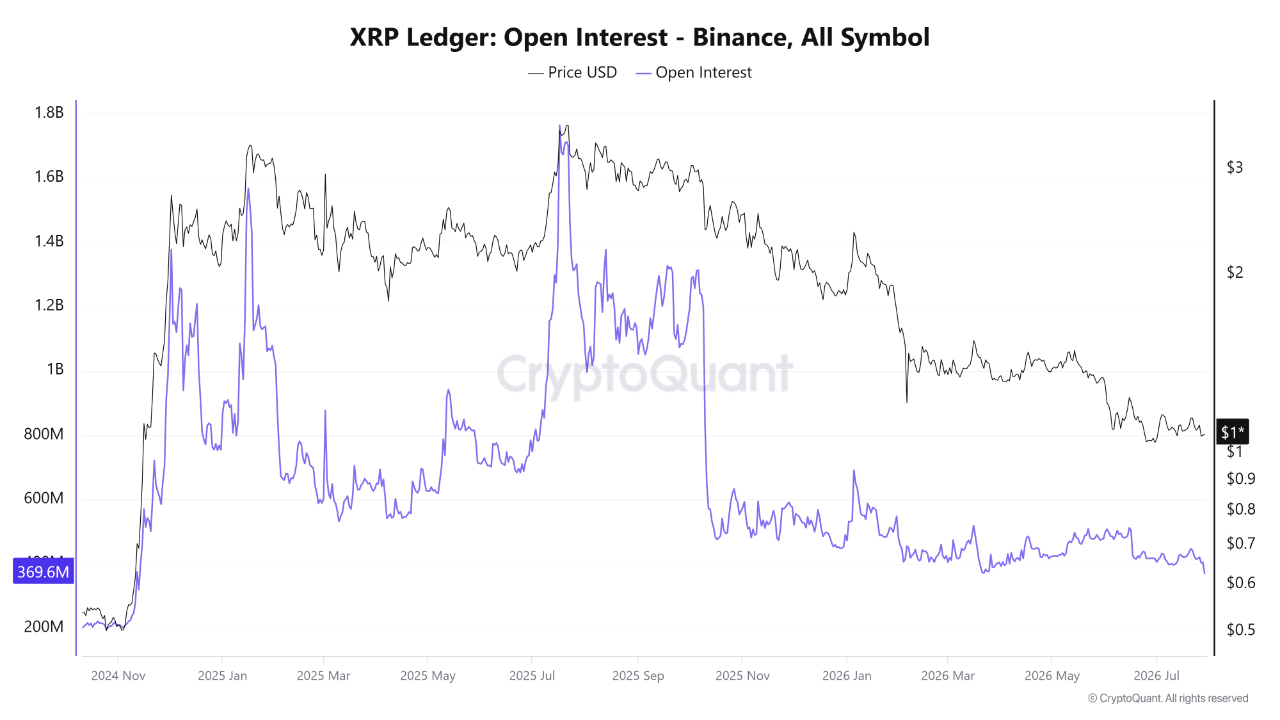
Meanwhile, XRP futures open interest on Binance has dropped to its lowest level since 2024, falling to about $370 million, according to CryptoQuant analyst Arab Chain. The decline appears specific to XRP, as Binance’s broader derivatives market remains active.

The drop suggests traders are closing leveraged XRP positions amid uncertainty following the U.S. Federal Reserve’s latest policy decision. While lower open interest doesn’t signal a bullish or bearish trend, it reflects a more cautious market, reducing liquidation risk but also indicating weaker confidence.

Arab Chain noted that a rebound in both XRP’s price and open interest would suggest fresh capital is returning, while continued declines would signal ongoing trader caution.

XRP Ledger Processes $4.28B in Stablecoin Transfers as RLUSD Dominance Grows

0

The XRP Ledger (XRPL) has experienced a noticeable increase in stablecoin activity as Ripple’s RLUSD, the largest stablecoin on the network, expands its dominance.

According to RWA.xyz, a leading provider of real-world asset (RWA) data, stablecoin transfer volume on the XRP Ledger has risen 10.8% over the past 30 days to $4.28 billion.

The increase suggests that more people and businesses have begun actively using the network to move funds. Notably, rising transfer volume usually points to stronger network activity, as it shows that stablecoins are changing hands more often instead of sitting idle in wallets. 

Such activity can improve liquidity across the ecosystem, support decentralized finance applications, and encourage developers and institutions to build on the XRP Ledger. 

It also confirms the network’s role as a blockchain designed for payments and tokenized assets, as higher transaction activity shows growing real-world use.

RLUSD Continues to Drive Stablecoin Growth

The rise in transfer volume comes as the XRP Ledger’s stablecoin market continues to grow. Over the same 30-day period, the total stablecoin market capitalization on the network grew 12.27% to $926.11 million.

Stablecoin Market on XRP Ledger

Expectedly, RLUSD remains the market leader. Ripple’s stablecoin now has a market capitalization of $872 million on the XRPL, which gives it a 94% share of the network’s entire stablecoin market.

The stablecoin has made impressive progress since Ripple launched it in December 2024. While the company initially focused on Ethereum, it has gradually shifted its attention to the XRP Ledger by reducing RLUSD supply on Ethereum and increasing it on XRPL. 

Ripple has achieved this through large token burns on Ethereum alongside substantial minting activity on the XRP Ledger.

XRPL Overtakes Ethereum in RLUSD Supply

Ripple’s strategy has changed the balance of RLUSD across the two networks. The continued burns on Ethereum and increased minting on XRPL allowed the XRP Ledger to overtake Ethereum in RLUSD supply last month, in June.

Over the past three months, Ripple burned $1.15 billion worth of RLUSD and minted about $668 million on Ethereum. During the same period, it burned $577 million worth of RLUSD on the XRP Ledger while minting $1.2 billion on the network.

As a result, the XRP Ledger now holds 55% of RLUSD’s total supply, which currently stands at around $1.58 billion.

XRPL Stablecoin Holder Count Also Moves Higher

The XRP Ledger has also continued to attract more stablecoin users, although growth has been more modest than the increase in transfer volume and market capitalization. Over the past 30 days, the number of stablecoin holders on the network rose 1.03% to 60,200.

Besides RLUSD, several other stablecoins contribute to the ecosystem. These include BBRL, Braza’s Brazilian Real-backed stablecoin with a market capitalization of $15.1 million, and USDB, another Braza-issued stablecoin valued at $12 million. 

The network also supports EUR CoinVertible (EURCV) from Societe Generale-FORGE, which has a market capitalization of $11.3 million, and USDC from Circle, which currently has a market capitalization of $5.6 million on the XRP Ledger.

Notably, Circle improved the network’s stablecoin ecosystem when it launched native USDC on the XRP Ledger in June 2025.

XRP ETFs Defy Market Weakness, Reach Record $1.5B in Cumulative Inflows

0

XRP ETFs have reached a new milestone, setting a record for cumulative net inflows despite XRP’s price struggles extending into the 12th month. 

Specifically, on July 27, the ETF products pushed their cumulative net inflows to $1.50 billion, marking a new all-time high. The increase came after the funds recorded $592,470 in net inflows that day. 

Before this, cumulative inflows had remained unchanged at $1.49 billion for three consecutive trading days, with the ETFs posting no net flows from July 22 through July 24 at the close of the previous week.

Early Momentum Gave Way to Slower but Steady Growth

The latest milestone represents the first time XRP ETFs have accumulated $1.50 billion in net inflows since they began trading in November 2025.

XRP ETFs Cumulative Inflows Sosovalue
XRP ETFs Cumulative Inflows | Sosovalue

Notably, the products attracted capital quickly after launch, reaching $1 billion in cumulative inflows by mid-December 2025, less than a month after the first spot XRP ETF entered the market.

This early period saw strong investor demand. Daily inflows regularly exceeded $20 million, with the ETFs attracting $164 million on Nov. 24, 2025, and an even larger $243 million on Nov. 14, 2025.

The pace changed after cumulative inflows climbed above $1.2 billion in early January 2026. On Jan. 7, 2026, the ETFs recorded their first daily net outflow, with $40.8 million leaving the funds. 

Although inflows picked up again afterward, they slowed enough for cumulative inflows to fall to $1.17 billion by the end of January 2026.

Investor Interest Remained Strong as XRP Lost Value

The ETFs recovered after January and continued to attract fresh capital. While a few trading sessions ended with net outflows, inflows outweighed outflows on most days. 

This consistent demand helped cumulative inflows climb to $1.30 billion in late April 2026, before rising again to $1.40 billion in May 2026. The funds then spent the next two months working toward another milestone before finally reaching $1.50 billion. 

This progress came even as XRP remained under heavy selling pressure. During the same period, the token lost 70% of its value from its all-time high of $3.6.

Monthly XRP ETF Flows Remain Mostly Positive in 2026

The trend has remained largely positive throughout this year despite XRP’s weak price performance. While the cryptocurrency has fallen 41% since the beginning of the year, XRP ETFs have continued to record positive monthly inflows almost every month.

XRP ETF Monthly Flows Sosovalue
XRP ETF Monthly Flows | Sosovalue

The funds brought in $15.59 million in January 2026, followed by $58.09 million in February 2026. They then recorded their first monthly net outflow in March 2026, when investors pulled $31.16 million from the products. So far, March remains the only month to finish with negative net flows.

Since then, the ETFs have returned to positive territory every month. They recorded their strongest monthly performance of the year in May 2026, attracting $131.94 million in net inflows. 

Overall, the funds have added $329 million in cumulative net inflows during 2026, helping lift their overall cumulative inflows to the new record of $1.50 billion.

Bitwise Leads ETF Rankings

Among all XRP ETF issuers, the Bitwise XRP ETF now holds the largest share of cumulative inflows. The fund has attracted $500 million, giving it 33% of the total $1.50 billion accumulated since launch. It recently moved ahead of the Canary Capital XRP ETF, despite entering the market after Canary.

Bitwise Leads XRP ETF Race

The Canary Capital XRP ETF now ranks second with $466.97 million in cumulative net inflows, accounting for 31% of the overall total. Franklin Templeton’s XRPZ ETF follows in third place with $422.45 million in cumulative inflows, while Grayscale’s XRP ETF (GXRP) ranks fourth after bringing in $131.46 million.

The 21Shares XRP ETF (TOXR) remains the only product still in negative territory. Since its launch, it has recorded -$20.06 million in cumulative net flows.

Shiba Inu Scores Major Adoption Win Ahead of Sixth Anniversary: Details

0

Shiba Inu has achieved another major real-world adoption milestone after Emirates Airlines officially integrated cryptocurrency payments into its flight booking platform.

According to an official announcement, eligible customers can now pay for flight bookings through Crypto.com Pay on both the Emirates website and mobile application. The newly launched payment option supports 30 cryptocurrencies, including Shiba Inu, allowing users to purchase flights with the meme-inspired digital asset.

In addition to SHIB, the supported cryptocurrencies include Bitcoin (BTC), Ethereum (ETH), XRP, Cardano (ADA), Dogecoin (DOGE), USDT, USDC, Litecoin (LTC), Chainlink (LINK), and several other leading digital assets.

How Customers Can Pay With SHIB

The crypto payment feature is currently available to eligible UAE residents with a Crypto.com account.

During checkout, customers booking flights priced and settled in Emirati Dirham (AED) can select Crypto.com Pay as their preferred payment method. Crypto.com then processes the transaction, enabling users to complete their purchases with any of the supported cryptocurrencies, including Shiba Inu.

Notably, this launch marks the commercial rollout of the strategic partnership that Emirates and Crypto.com announced in July 2025. With the integration now live, the collaboration has moved beyond plans into practical use.

Move Supports Dubai’s Digital Finance Vision

Beyond offering travelers another payment option, the rollout advances Dubai’s ambition to become a global hub for digital finance.

Specifically, the initiative aligns with Dubai’s Cashless Strategy under the emirate’s D33 Economic Agenda. The strategy promotes the widespread adoption of digital payment technologies while reinforcing Dubai’s position as a leading center for financial innovation, blockchain development, and cryptocurrency adoption.

Shiba Inu Adoption Grows Ahead of Sixth Anniversary

The Emirates integration arrives just as the Shiba Inu community prepares to mark the project’s sixth anniversary, giving supporters another reason to celebrate.

Launched on August 1, 2020, by the anonymous developer or developer group known as Ryoshi, Shiba Inu began as a single-token project. However, it has since evolved into a broader ecosystem featuring multiple tokens, the ShibaSwap decentralized exchange, NFTs, and the Shibarium Layer-2 blockchain.

Since its launch in August 2023, Shibarium has processed more than 1.56 billion transactions across 18.31 million blocks, with over 269.92 million wallet addresses interacting with the network. 

Meanwhile, SHIB now boasts approximately 1.67 million on-chain holders, highlighting the ecosystem’s continued growth despite challenging market conditions.

SHIB Remains Well Below Its All-Time High

Despite expanding real-world utility and ecosystem development, SHIB’s market performance has remained under pressure.

After delivering an extraordinary rally following its launch, the token has experienced a prolonged decline. At press time, SHIB trades at $0.000004600, representing a decline of about 94.8% from its all-time high of $0.00008845.

Nonetheless, the Emirates integration adds another tangible use case for SHIB, demonstrating that the token continues to gain commercial utility even as its market price remains significantly below its peak. 

Bitcoin Preparing for a Major Move as On-Chain Signals Turn Positive

Bitcoin is showing early signs of undervaluation as traders weigh improving on-chain metrics against mixed exchange flows and weak short-term demand.

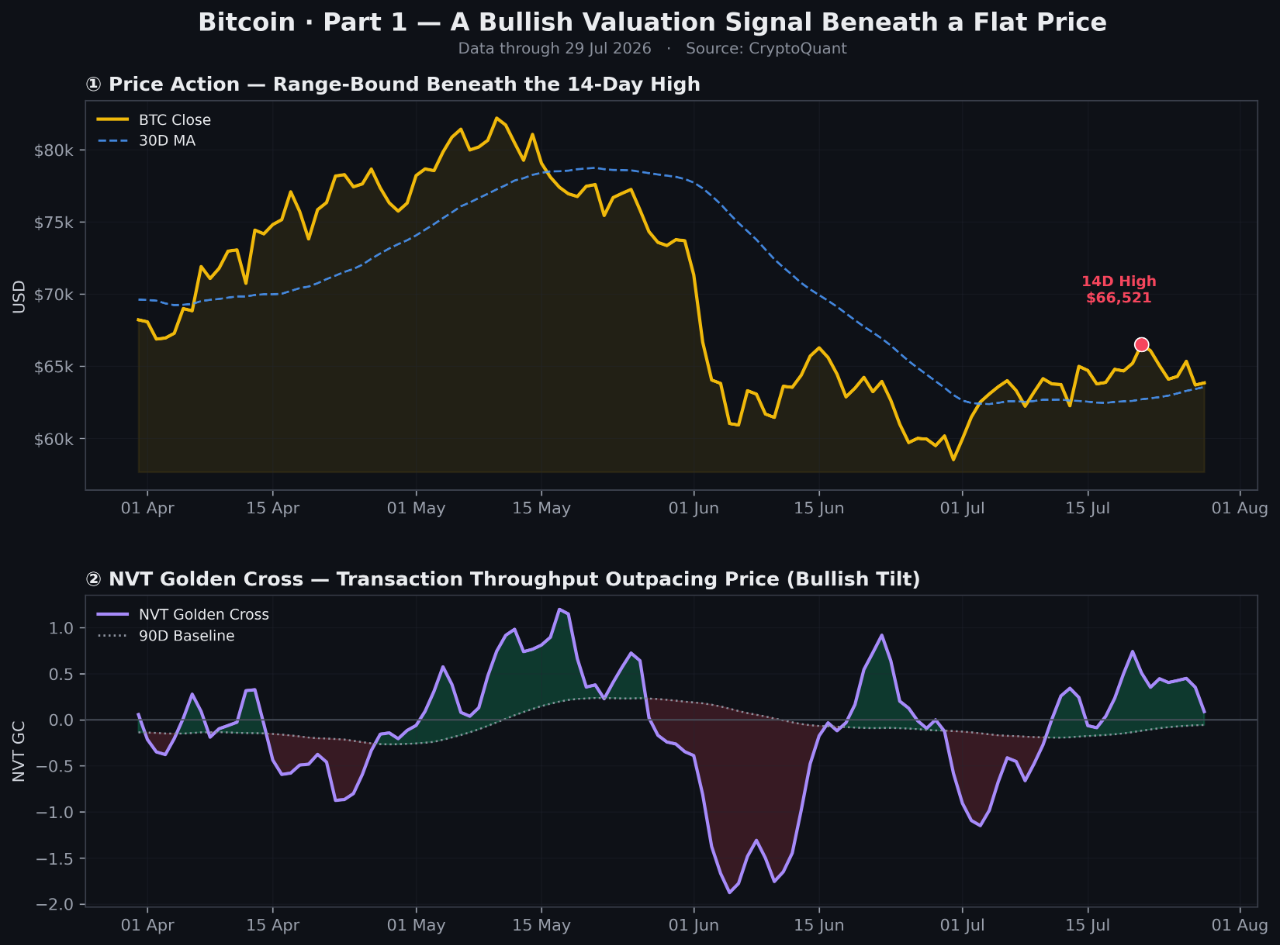
CryptoQuant author CryptoOnchain noted Bitcoin closed at $63,850.66 on July 28, down from its recent high of $66,520 on July 21. However, blockchain data suggests that the market could be preparing for a larger move.

NVT Golden Cross

CryptoOnchain pointed to the NVT Golden Cross as a key bullish trend. This metric compares Bitcoin’s market value with its transaction activity and helps identify when the price may be lower than the network’s actual usage suggests.

The indicator jumped 429% above its 90-day average and increased 34.7% over the past week to reach 0.36.

Historically, a rising NVT Golden Cross indicates that network activity is growing faster than Bitcoin’s price, which can suggest that the asset is undervalued. While the indicator has been associated with recoveries in previous market cycles, the analyst said it should not be used alone to predict future price movements.

quicktake-image

Binance BTC Flows Change Quickly

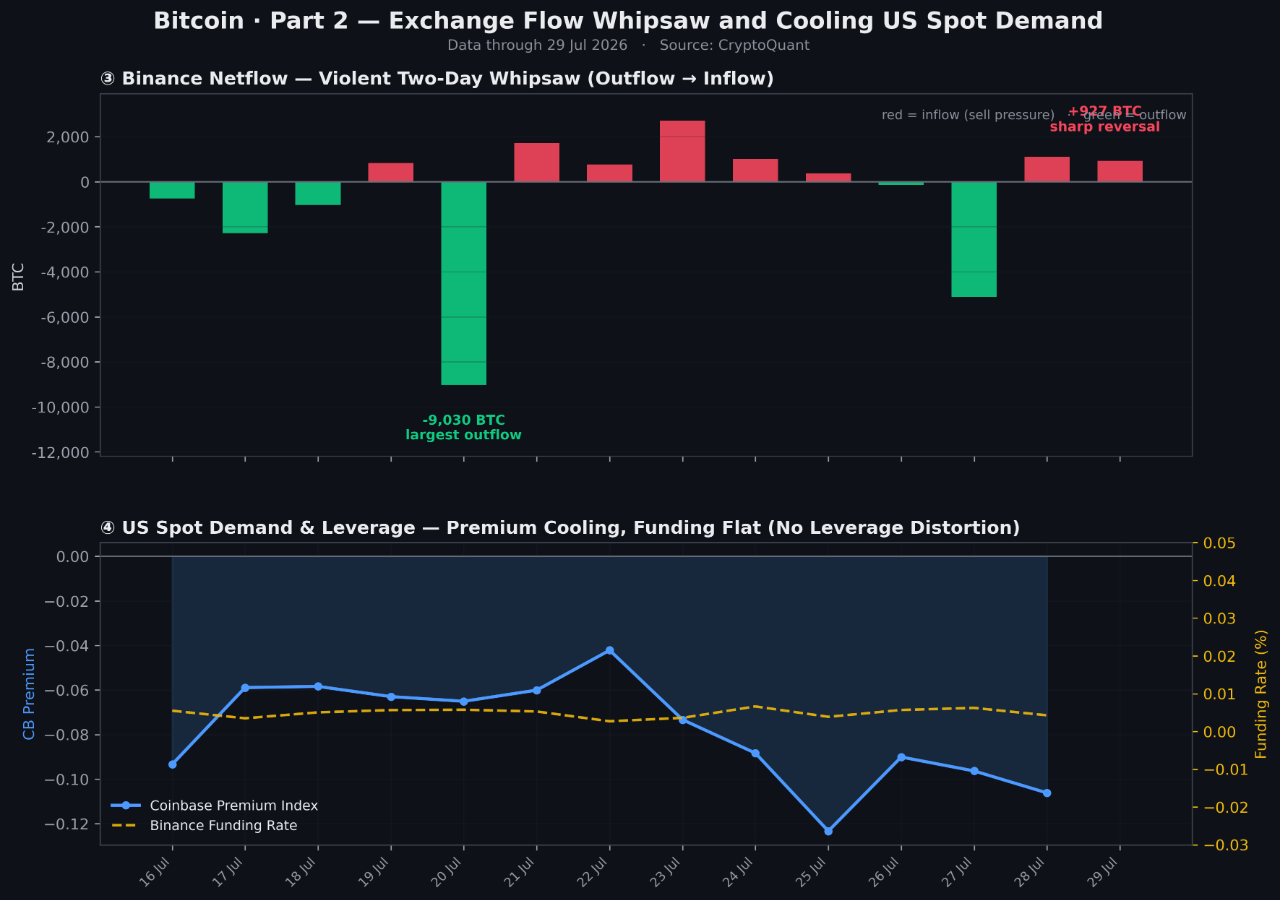
While the valuation signal is positive, exchange data shows mixed signs. Binance saw 5,124 BTC leave the platform on July 27, but the trend quickly reversed, with 1,109 BTC flowing back in on July 28.

The sudden shift suggests that traders are adjusting their positions rather than following a clear buying or selling trend. CryptoOnchain noted that these rapid changes can create short-term market uncertainty and make Bitcoin’s next move more difficult to predict.

quicktake-image 

At the time of writing, Bitcoin is trading at $63,980, down 0.51% over the past day and down 2.4% over the past week.

Bitcoin Funding Rates and Coinbase Premium Remain Weak

Other market indicators also point to cautious sentiment. Binance funding rates remained close to 0%, indicating that traders were not using excessive leverage in the futures market.

The Coinbase Premium also fell to -0.11, its lowest level in two weeks. A negative premium suggests weaker buying demand from U.S. investors compared with other markets.

Volatility Compression Signals Bigger Move Ahead

Supporting the constructive on-chain outlook, another CryptoQuant author, RugaResearch, said Bitcoin’s current low volatility could signal that a major price move is approaching.

The analyst noted that Bitcoin’s realized volatility has fallen to cycle lows, meaning the price has remained unusually stable for an extended period. At the same time, the ADX indicator, which measures trend strength, has been gradually increasing even as Bitcoin trades within a narrow range.

RugaResearch explained that low volatility often indicates that the market is building momentum ahead of a larger move. However, these indicators do not reveal whether the next move will be upward or downward.

The analyst added that similar periods of low volatility have previously been followed by major Bitcoin price movements, suggesting that traders should prepare for a potential breakout.

Crypto Founder Reveals Two Key Moves That Could Push ADA Beyond $5

0

SongMarketCap founder Jure Karamarko has proposed two major changes that he believes could ultimately help ADA climb above $5.

In a recent commentary, Karamarko urged Cardano founder Charles Hoskinson to immediately register as a Delegate Representative (DRep) under Cardano’s decentralized governance framework. In addition, he called on a major company, a venture capital firm, or an influential investor to purchase 1 billion ADA at current market prices and to register as a DRep.

Experienced Business Leaders Could Drive Growth

Karamarko argued that Cardano would benefit from greater participation by experienced business leaders in its governance process. According to him, executives with proven records of building companies, managing teams, and scaling businesses would provide stronger leadership while attracting fresh capital to the ecosystem.

At the same time, he criticized some existing DReps, suggesting that individuals without practical experience in growing successful businesses should not wield significant influence over the future of a multi-billion-dollar blockchain network.

“The moment experienced business leaders begin shaping Cardano’s future will be the moment we start moving beyond $5,” Karamarko stated.

Proposal Aligns With Cardano’s Governance Evolution

Karamarko’s comments come as Cardano continues to expand its governance model through the Voltaire era, which allows ADA holders to influence ecosystem decisions by delegating their voting power to DReps.

Meanwhile, Hoskinson has already expressed his intention to become a DRep through the creation of a political party within the Cardano ecosystem. More recently, he urged the community to support the initiative, promising to eliminate growing cynicism and pessimism surrounding the network if he receives sufficient backing.

Community Divided Over Institutional Participation

Karamarko’s proposal has generated mixed reactions across the Cardano community.

Supporters believe that increased participation from established companies, institutional investors, and venture capital firms could strengthen governance while attracting more institutional funding. They also note that Cardano has historically secured less venture capital investment than competing blockchain networks such as Ethereum and Solana.

However, critics argue that greater VC involvement could introduce conflicts of interest, as large investors might prioritize decisions that maximize their financial returns rather than benefit the broader Cardano ecosystem. Others have also questioned whether existing ecosystem organizations have demonstrated sufficient leadership during recent governance disputes.

How Far Is ADA From the $5 Target?

Despite the ambitious proposal, ADA remains well below the suggested price target. The cryptocurrency currently trades around $0.1626, far below the $5 milestone.

Notably, ADA has never reached $5 since its launch. Achieving that level would establish a new all-time high and require a gain of approximately 2,975% from its current price. 

While Karamarko believes stronger governance and institutional participation could improve Cardano’s long-term prospects, reaching that milestone would likely depend on broader market conditions, sustained network adoption, and continued ecosystem growth. 

XRP OI Crashes to $369M on Binance, Marking Lowest Levels Since 2024

0

The XRP Open Interest (OI) on Binance has recently crashed to its lowest levels since 2024, indicating a decline in derivatives activity.

XRP remains under selling pressure as its ongoing downtrend stretches into the twelfth month. Meanwhile, alongside the weak price performance, new derivatives data points to another sign of fading market activity. 

According to a recent report from CryptoQuant analyst Arab Chain, Binance has recorded the lowest XRP Open Interest since 2024.

Arab Chain revealed that Open Interest for XRP contracts on Binance has dropped to about $369.6 million, the lowest level seen since 2024. 

XRP Open Interest on Binance CryptoQuant
XRP Open Interest on Binance | CryptoQuant

This decline comes even though Binance continues to post high trading volumes across its overall derivatives market. The trend suggests that the slowdown is limited to XRP contracts.

Traders Cut Back on Leveraged XRP Positions

According to Arab Chain, the drop in XRP Open Interest shows that traders are closing positions and using less leverage. 

Most market participants have reduced their exposure as uncertainty continues to affect market sentiment instead of opening new leveraged trades or keeping existing ones.

He also called attention to the uncertainty that followed the Federal Reserve’s latest monetary policy decision. He believes the decision encouraged traders to become more cautious, leading many to reduce their leveraged exposure to XRP.

Arab Chain stressed that the decline only affects XRP contracts and does not reflect the overall performance of Binance’s derivatives market. While trading activity remains high across the exchange, interest in leveraged XRP positions has dropped.

Why the Decline in Open Interest Matters

Arab Chain pointed out that falling Open Interest does not automatically indicate either a bullish or bearish outlook. However, it simply shows changes in market participation and the amount of leverage traders are willing to use.

Notably, lower leverage can reduce the risk of liquidations and limit sharp price swings caused by heavily leveraged positions. Meanwhile, it can also show that fewer traders are interested in keeping existing XRP positions or opening new ones under current market conditions.

Arab Chain noted that a rise in Open Interest alongside a recovery in XRP’s price could indicate that speculative trading is returning and fresh capital is flowing back into XRP derivatives. 

However, if Open Interest continues to fall, it could suggest that traders remain cautious despite the strong trading volumes across Binance’s broader derivatives market.

XRP Technical Indicators Still Favor the Bears

Meanwhile, XRP’s short-term outlook remains weak. The cryptocurrency is currently trading at around $1.0755, posting a modest 0.3% gain over the past 24 hours. Even with this slight increase, the overall market structure continues to favor the bears.

XRP remains below the 20-day Exponential Moving Average (EMA20) at $1.0947, the 50-day Exponential Moving Average (EMA50) at $1.1287, and the 200-day Exponential Moving Average (EMA200) at $1.4104. This shows that bearish momentum still controls the daily chart.

For now, the first support area sits between $1.07 and $1.08. This zone lines up with both the daily S1 pivot and the lower Bollinger Band, which makes it an important level for buyers to defend.

XRP Short Term Price Action

Below that, $1.00 remains the key psychological support level. If XRP drops below it, the price could fall toward $0.93, with $0.80 becoming the next downside target if selling pressure continues to build.

On the upside, buyers first need to push XRP back above the $1.10 to $1.11 range, where the daily pivot meets the EMA20. After that, the next major hurdle is the EMA50 at $1.1287, which sits close to the upper Bollinger Band at $1.1388. XRP will need stronger buying momentum to break above those levels and improve its short-term outlook.

Hoskinson Seeks Support for Cardano Political Party to Unite Ecosystem and Challenge Internal Pessimism

0

Cardano founder Charles Hoskinson has urged the community to rally behind a new governance structure that he believes can help the blockchain regain momentum.

Reflecting on Cardano’s journey, Hoskinson said the network represents the majority of his meaningful adult life. Due to that deep personal commitment, he stressed that he has no intention of stepping away from the project despite its recent governance challenges.

Instead, Hoskinson pledged to continue working through the ecosystem’s difficulties and help position Cardano for its next phase of development.

Hoskinson Pushes for a New Political Structure

A central focus of his remarks was the need to reform Cardano’s decentralized governance model through the creation of a political party within the ecosystem.

According to him, growing cynicism and persistent pessimism have made it increasingly difficult for Cardano to execute long-term strategies. To reverse that trend, he urged community members to support the formation of a coordinated political organization that could provide stronger leadership, clearer direction, and more effective decision-making.

Hoskinson said that, if the community grants him sufficient support and authority, he will work to eliminate the negativity that has slowed the ecosystem’s progress. He also vowed to challenge individuals and groups that he believes continue to create unnecessary division within Cardano.

Ending Internal Conflicts to Drive Adoption

Beyond governance reform, Hoskinson emphasized that Cardano must shift its attention back to ecosystem growth and real-world adoption.

He argued that stronger leadership would enable the network to improve its marketing efforts, accelerate user adoption, and establish a clearer growth strategy. In his view, resolving internal governance disputes would allow the community to focus on attracting developers, businesses, and new users instead of remaining distracted by political disagreements.

Hoskinson believes that a more organized governance structure would ultimately strengthen Cardano’s competitive position within the broader blockchain industry.

Hoskinson Remains Fully Committed to Cardano

Despite acknowledging the frustrations shared by many community members, Hoskinson reaffirmed his confidence in Cardano’s future.

He said he has no desire to abandon the project and believes the broader community shares that commitment. Instead, he expressed confidence that he still has the energy and determination to make another concerted effort to address the ecosystem’s challenges and continue advancing Cardano’s long-term mission.

For Hoskinson, the current governance difficulties represent another challenge to overcome rather than a reason to walk away.

ADA Holders Will Have the Final Decision

Meanwhile, he recognized that Cardano’s decentralized governance model ultimately places decision-making authority in the hands of ADA holders and other stakeholders.

While he said he is prepared to exercise stronger executive leadership if the community chooses to entrust him with that responsibility, he also acknowledged that stakeholders are free to support another leader instead. Regardless of who leads, he stressed that Cardano must unite behind a coherent long-term strategy to succeed. 

Hoskinson’s latest comments come as he moves closer to launching the proposed political party within the Cardano ecosystem. Earlier this month, he revealed that the initiative is nearing completion, although he did not announce a specific launch date.

The proposal follows several months of governance disputes, including the rejection of multiple treasury proposals associated with Hoskinson. Those disagreements also contributed to the cancellation of Cardano Summit 2026, leading him to initially consider serving as a Delegate Representative (DRep) before expanding the concept into a broader political organization.

If established, the proposed party would operate as a major DRep within Cardano’s on-chain governance system. It would help coordinate ecosystem development, treasury allocation, and long-term strategic decisions while giving ADA holders a structured platform to participate in governance through membership and voting.