Home Blog Page 564

China Renaissance to Allocate $100M in BNB, Signs Deal with YZi Labs

0

China Renaissance Holdings Limited has partnered with YZi Labs to deepen its footprint in the crypto asset space, particularly within the BNB Chain ecosystem. 

In a voluntary disclosure today, the company revealed the signing of a non-binding Strategic Cooperation Memorandum.

$100 Million in BNB Allocation

As part of the agreement, China Renaissance will allocate approximately $100 million to BNB. This makes it the first Hong Kong-listed company to include BNB in its crypto asset portfolio. 

The move seeks to generate competitive yields from the BNB ecosystem while also securing long-term involvement in high-quality projects within the BNB Chain.

The partnership will also focus on promoting Web3 initiatives and the compliant listing of BNB on licensed Hong Kong crypto asset exchanges.

In collaboration with China Asset Management (Hong Kong) and other ecosystem players, China Renaissance plans to develop fund-based investment products and further the adoption of BNB through compliant financial channels.

RWA Fund to Integrate BNB in Real-World Use Cases

Under the guidance and cooperation of YZi Labs, China Renaissance intends to launch a multi-hundred-million-dollar Real-World Asset (RWA) fund. The fund aims to accelerate the integration of BNB public chain technology in stablecoin and RWA applications, particularly among Hong Kong-listed companies.

YZi Labs will serve as a strategic advisor in the cooperation, supporting China Renaissance with:

  • Ecosystem project referrals and third-party connections (custodians, validators, infrastructure providers)
  • Branding and promotional support via official channels
  • Collaborative Web3 and capital markets initiatives

Together, the parties plan to identify and execute new growth opportunities that benefit China Renaissance’s financial services capabilities and the BNB Chain ecosystem.

BNB Breaks New ATH Amid Institutional Frenzy

Notably, BNB is the native token of BNB Chain, one of the most actively used blockchains globally. It helps in powering transactions, securing the network through governance, and supporting applications in DeFi and beyond.

Market-wise, BNB surged to an all-time high of $881 on Thursday, continuing a strong uptrend with a 35% gain over the past 60 days. A wave of institutional interest has fueled the rally. In July, companies like Windtree Therapeutics and Nano Labs collectively invested $610 million into BNB.

However, not all corporate crypto bets have fared well. Windtree’s stock, which initially soared on the announcement, has since plunged nearly 90%, putting it at risk of delisting from the Nasdaq.

While the memorandum between China Renaissance and YZi Labs is non-binding and subject to final agreements, the collaboration further confirms institutional confidence in BNB and its ecosystem.

Ethereum Treasury Firm SharpLink Launches $1.5B Stock Buyback

0

SharpLink Gaming, one of the largest corporate holders of Ethereum (ETH), has announced a $1.5 billion stock buyback program. 

In a press release today, the Minneapolis-based company said its board gave the green light to the plan as part of a strategy to manage capital more effectively and strengthen long-term shareholder value.

SharpLink Launches Stock Buyback Program

The company explained that the program gives it room to repurchase shares whenever market conditions make sense. 

SharpLink pointed out that if its stock trades at or below the net asset value of its Ethereum holdings, issuing new equity could reduce the ETH value attached to each share. In that case, buying back stock would present a smarter and more rewarding approach for shareholders.

Notably, Co-Chief Executive Officer Joseph Chalom said the program ensures the company can move quickly when opportunities arise. He added that SharpLink views the plan as a way to provide stability in the market, use capital more efficiently, and show its commitment to sustainable growth.

Per the press release, SharpLink also clarified that it has several options for carrying out the buyback. Specifically, the company may buy shares directly from the open market, negotiate private transactions, or use other legal methods. 

It did not set a fixed number of shares to repurchase. Instead, it said the scale of the program will depend on market trends, stock price, and trading activity. The company also reserved the right to pause or end the program at any time.

SharpLink Continues to Expand Its Ethereum Treasury 

Meanwhile, market data shows that SharpLink boasts a strong financial standing. Its stock (SBET) currently trades at $18.4, with a net asset value ratio of 1.03 tied to its Ethereum reserves. According to data provider SER, the company has already made a profit of $742.7 million from its ETH holdings.

Interestingly, the stock buyback plan comes just days after SharpLink made a massive ETH purchase. On Aug. 19, the company purchased 143,593 ETH for $667 million, lifting its total Ethereum holdings above the $3 billion mark. 

SharpLink now holds around 740,800 ETH worth about $3.11 billion, securing its spot as the second-largest Ethereum treasury company in the world. Only BitMine holds more, with 1.5 million ETH valued at $6.76 billion.

Speaking on the company’s position, Ethereum co-founder Joseph Lubin said SharpLink could grow faster than many of its peers in the Ethereum treasury race. Lubin, who also serves as SharpLink’s chairman, has supported the company’s decision to align its treasury reserves with Ethereum.

Remarkably, data from SER shows that SharpLink is part of a wider trend of corporations building ETH reserves. At the moment, 69 companies hold a combined 4.102 million ETH, which equals about 3.4% of Ethereum’s total circulating supply of 120.7 million tokens.

SharpLink Ethereum Holdings and NAV SER
SharpLink Ethereum Holdings and NAV | SER

BNB Trading Goes Live on Top UAE Bank RAKBANK

0

BNB, the fifth biggest crypto closely associated with Binance, is now officially live for trading on RAKBANK’s mobile banking app.

Binance founder Changpeng Zhao (CZ) confirmed today that BNB trading is now live on RAKBANK’s crypto platform. The update surfaced when Arabian Web3 YouTuber Ghazi posted the news on X, which CZ later retweeted to his millions of followers.

This makes RAKBANK the first traditional bank in the UAE where retail customers can trade BNB directly from their local bank accounts.

First UAE Bank to Offer Crypto Trading

RAKBANK, officially known as the National Bank of Ras Al Khaimah, became the UAE’s first conventional bank to launch crypto trading in late July. At launch, the bank revealed support for eight cryptocurrencies, including BNB. However, trading for certain assets, such as BNB, was not immediately enabled.

The service is integrated into the RAKBANK mobile app, allowing users to buy, sell, and swap digital assets directly from their UAE dirham accounts. Customers can avoid transferring funds to external exchanges and sidestep foreign exchange conversion fees.

Partnership With Bitpanda

The new trading function is powered by Austrian fintech Bitpanda. Transactions are executed through Bitpanda Broker MENA DMCC, a Dubai-based entity licensed by the Virtual Assets Regulatory Authority (VARA).

Bitpanda also offers custody for customer assets, ensuring secure and regulated management of digital holdings.

At launch, RAKBANK CEO Raheel Ahmed stated that the service reflects the bank’s commitment to secure, simple, and regulated access to the cryptocurrency market.

Bitpanda deputy CEO Lukas Enzersdorfer-Konrad described the partnership as a milestone for the Middle East. He noted that Bitpanda already works with several European banks, including Deutsche Bank and N26. This, he added, makes RAKBANK’s move a clear sign of growing global momentum in regulated crypto services.

Limited Rollout Phase

Currently, RAKBANK’s crypto service remains available on an invitation-only basis. A full rollout to all retail clients is in the coming months as the bank monitors demand and customer feedback.

BNB Price Action

The activation of BNB trading comes shortly after the token reached a new all-time high of $882.59 earlier this week. As of the latest update, BNB trades at around $875, giving it a market capitalization of $122 billion. This cements its position as the fifth-largest cryptocurrency globally.

Philippines Proposes Strategic Bitcoin Reserve Bill to Accumulate 10,000 BTC

0

A lawmaker in the Philippines has submitted a bill seeking to establish a strategic Bitcoin Reserve (SBR) in the country. 

In June, Rep. Miguel Luis R. Villafuerte introduced House Bill 421, known as the Strategic Bitcoin Reserve Act, which proposes the establishment of a national BTC stockpile. Although the bill was introduced in June, the public only recently learned about it. 

Philippines Strategic Bitcoin Reserve proposal

Philippines’ Bitcoin Reserve Proposal 

Notably, the bill proposed that the Philippine government should direct the country’s central bank, Bangko Sentral ng Pilipinas (BSP), to establish an SBR. Under the program, the BSP governor is mandated to acquire up to 2,000 BTC per year over five years, building a total reserve of 10,000 BTC. 

The bill proposes that the acquisition must be transparent and strategic to minimize any potential market disruption. According to the bill, the entire 10,000 BTC will be held in a strategic reserve for a minimum of 20 years. 

If the legislation is enacted, the central bank governor shall publish an annual report highlighting the progress of the SBR program throughout the 20-year holding period. 

A year before the minimum holding period ends, the BSP governor shall inform Congress on whether the country should continue with the SBR program. Upon expiration of the 20-year holding period, the governor can recommend selling the Bitcoin in the reserve. However, only 10% of the total holdings can be sold over two years to prevent large sell-offs. 

Rationale Behind Establishing an SBR in the Philippines 

While the Philippines currently holds gold and U.S. dollar reserves, Miguel argued that establishing an SBR is crucial to safeguard the country’s financial standing and tackle its rising debt. 

In the explanatory note, Rep. Miguel presented key arguments why the Philippine government should consider creating an SBR. It mentioned Bitcoin’s remarkable growth over the years, with Jerome Powell, the U.S. Federal Reserve Chair, characterizing it as digital gold. 

The explanatory note pointed out that Bitcoin has outperformed other financial instruments, boasting a 40% CAGR over the past five years. According to Miguel, Bitcoin’s remarkable performance coincides with President Trump’s endorsement of establishing a national Bitcoin stockpile in the United States. 

He also pointed out that other countries, including El Salvador and Brazil, have established their Bitcoin Reserve initiatives. With the U.S. and other countries showing interest in Bitcoin, Miguel emphasized that the trend could trigger a wave of BTC acquisition globally. Hence, he suggests that the Philippines should also get involved in the strategic Bitcoin reserve initiative. 

XRP to $1,000 is Impossible, Pundit Says Don’t Be Fooled by Unrealistic Fantasies

0

A top XRP community voice has debunked the idea that XRP could realistically reach a target of $1,000 per token. 

Rosa, a member of the XRP community, recently took to X to argue that the $1,000 price prediction for the token is unrealistic. According to Rosa, it is mathematically impossible for XRP to rally to that ambitious target. 

Why is $1,000 Prediction Unrealistic? 

Given XRP’s supply of 100 billion tokens, Rosa emphasized that its market cap would explode to $100 trillion if the $1,000 price materializes. She noted that the projected $100 trillion market cap would be ten times larger than the current global GDP. 

As of 2024, the World Bank estimates the global GDP at $111.33 trillion. This implies that XRP’s estimated valuation at $1,000 (equivalent to $100 trillion) would nearly equal the value of the entire world economy. 

Meanwhile, Rosa stressed that the market demand for XRP is not sufficient to push the token’s price to $1,000. She argued that it could take several years for XRP to even reach $10, a far more modest target compared to the ambitious $1,000 projection.

At $10, XRP will have a market cap of $1 trillion, which is less than Bitcoin’s valuation. As a result, she warned other XRP investors to be cautious of overly ambitious predictions.

Community Pushes Back

As expected, some community members pushed back on Rosa’s claim, arguing that market cap is not a strict barrier limiting how high an asset can rally. One community member, “FutureXRP,” said XRP does not require $100 trillion in new money to reach the $100 trillion valuation. 

The user also argued that while the market cap of oil is up to $300 trillion, that information is not documented because it is irrelevant since oil is treated as a commodity. Therefore, they urged Rosa and other community members to adopt a similar approach for crypto assets like XRP. 

Responding, Rosa said that while market cap may not be a direct indicator for price, it does reflect an asset’s size and demand. She emphasized that XRP would require substantial demand to reach the $1,000 target. 

XRP to $1,000 Prediction 

The discussions surrounding the XRP $1,000 price projection have become a recurring theme in the XRP community, thanks to speculation that XRP would play a significant role in the global financial system. 

Earlier this month, Black Swan Capitalist co-founder Versan Aljarrah set $1,000 as XRP’s bear target if the token is leveraged as a bridge asset for global financial infrastructure. 

Popular community member Armando Pantoja believes there would be a full-blown FOMO should XRP reach the $1,000 price. In his view, several investors would be struggling to own as little as 1 XRP in their portfolios. 

Meanwhile, some commentators have offered a ten-year timeline for XRP to reach $1,000. As of today, XRP trades at $2.85 with a seven-day decline of 8.31%. From the current price, it must rise 34,987% to reach $1,000. 

CFTC Launches Next Phase of ‘Crypto Sprint,’ Opens Public Comment Period

0

The U.S. Commodity Futures Trading Commission has launched the next stage of its “Crypto Sprint” initiative, opening public consultation on federal digital asset regulation and signaling deeper coordination with the SEC.

The U.S. CFTC confirmed Thursday that it is moving forward with the next phase of its “Crypto Sprint”. This initiative, first announced earlier this month, aims to accelerate regulatory action in the crypto sector.

According to the agency, the new phase will focus on implementing additional recommendations from the President’s Working Group on Digital Asset Markets.

Public Engagement Now Open

Acting Chair Caroline Pham emphasized that stakeholder participation will be central to the next stage of the program. 

The CFTC has invited comments from the public, industry leaders, and financial institutions on how best to apply the report’s proposals. Feedback will be accepted until October 20, 2025, giving market participants just under two months to contribute their views.

Pham noted that responses will help the commission address complex issues. Among these are challenges related to leveraged or margined retail trading on regulated exchanges.

This announcement follows the rollout of the program’s first phase on August 4, 2025. That stage focused narrowly on allowing the trading of spot crypto asset contracts on exchanges registered with the CFTC.

The expansion now signals that the regulator is preparing to look beyond spot markets and into broader aspects of digital asset regulation.

Federal Priority on Digital Assets

Pham highlighted that the Trump Administration views federal oversight of digital assets as an urgent priority. She explained that the goal is to strike a balance between innovation and safeguards. By doing so, crypto markets can grow responsibly under U.S. law.

“The Administration has made it clear that enabling immediate trading of digital assets at the federal level is a top priority,” Pham stated.

Areas of Focus in Next Stage

While the CFTC did not release full details of the next stage, the working group’s report suggests possible directions. Topics under review may include registration of exchanges, custody of digital assets, standardized trading practices, and record-keeping obligations.

Industry experts anticipate that inter-agency coordination will be a key feature, with joint efforts aimed at reducing regulatory gaps and conflicts.

Collaboration With SEC

A key element of the recommendations is closer coordination between the CFTC and the Securities and Exchange Commission (SEC).

The SEC, under Chair Paul Atkins, recently launched “Project Crypto”, an initiative to modernize securities regulations for blockchain-based markets. Atkins has described the project as a step toward future-proofing American markets and ensuring global competitiveness in digital financial systems.

SEC’s Position on Crypto Tokens

Earlier this week, Atkins argued that only a small fraction of crypto tokens fall under securities law. He stressed that regulators should encourage innovation while preventing harmful practices in digital markets.

According to Atkins, the SEC aims to design a framework that reduces uncertainty and avoids unnecessary restrictions on the industry.

Together, the CFTC’s “Crypto Sprint” and the SEC’s “Project Crypto” highlight Washington’s growing urgency to regulate digital assets. The combined efforts suggest a future where crypto markets may finally receive clearer federal rules on trading, custody, and investor protection.

Here’s How SWIFT Taps XRP Without a Direct SWIFT-Ripple Link

0

XRP community researcher SMQKE recently shared an analysis outlining how Ripple Payments and XRP can interact with SWIFT without any formal partnership.

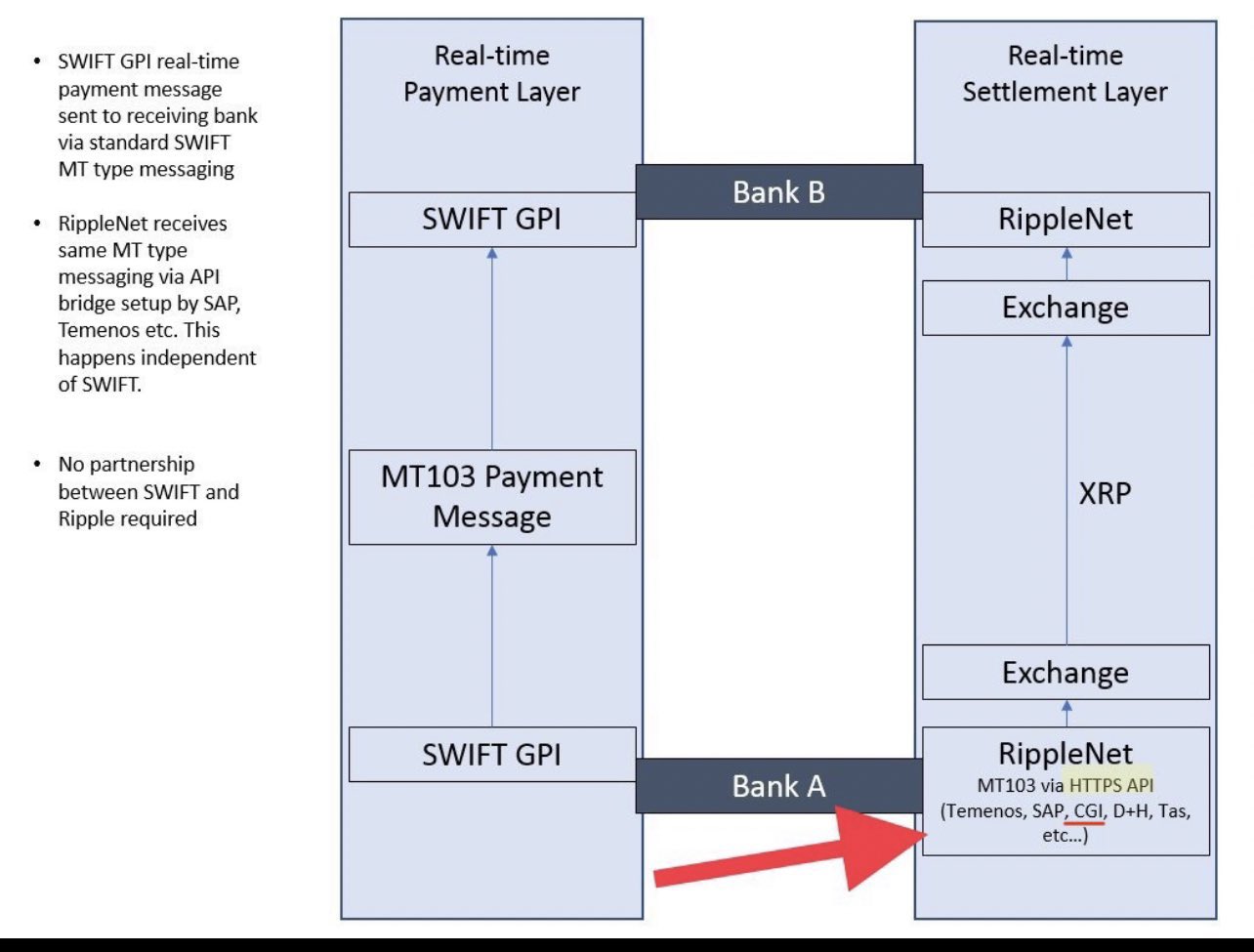
According to him, instead of direct integration, the connection is possible through third-party vendors and API bridges developed by firms such as SAP, Temenos, and CGI. These intermediaries enable RippleNet to receive SWIFT’s MT103 payment messages via HTTPS APIs, creating an indirect but functional pathway between the two networks.

How the Flow Works

When a payment is initiated on SWIFT GPI, the message is transmitted through the traditional banking system. RippleNet receives the same MT103 message through vendor-managed APIs.

From there, RippleNet can route the transaction through exchanges and leverage XRP as a liquidity tool within its settlement layer. This setup allows banks connected to RippleNet to settle transactions that originated on the SWIFT network, without SWIFT and Ripple working together directly.

Image

Does This Actually Work? Ripple Dev Responds

SMQKE’s recent revelation about how Ripple, XRP, and the SWIFT system could work together raised eyebrows across the crypto community, including among influential voices in the XRP space. Many have questioned the legitimacy of the document he presented.

One of the most vocal critics was XRP-focused YouTuber Crypto Eri. She publicly called on Neil Hartner, a software engineer at Ripple specializing in Ripple Payments, to weigh in on the document and clarify whether the proposed workflow is technically viable, especially since SMQKE did not cite a source.

In response, Hartner described the scenario as “plausible”. He added that, from a technical view, the flow could indeed be implemented. He noted that, theoretically, a bank could send the MT103 message to the Ripple Payments (formerly RippleNet) API using the additional_info field.

However, Hartner also stated that he could not comment on specific vendor names, cautioning: “Don’t read too much into my answer.”

ISO 20022 at Work

A crucial factor behind this interoperability is ISO 20022, the global standard for financial messaging. Ripple is one of the foremost payment institutions to adopt this standard.

By aligning with ISO 20022, RippleNet ensures compatibility with traditional networks like SWIFT and newer blockchain-based systems. This reduces fragmentation and paves the way for APIs and distributed ledger technology to support real-time settlement and improved cross-border efficiency.

XRP Ledger to Capture Part of SWIFT Volume

While Ripple and SWIFT have no formal partnership, members of the XRP community continue to hold out hope for either a future partnership or for a scenario in which Ripple ultimately replaces SWIFT.

At the 2025 XRPL Apex event, Ripple CEO Brad Garlinghouse stated that the XRP Ledger (XRPL) could manage up to 14% of SWIFT’s transaction volume by 2030.

According to Forbes, SWIFT processes approximately $150 trillion in annual transaction volume. If XRPL were to capture 14% of that, it would amount to roughly $21 trillion flowing through XRPL each year.

Based on this projection, an analysis estimated that if XRP were to turn over 30 times per year, a liquidity pool of around $700 billion would be required. With XRP’s circulating supply, this would imply a token price in the range of approximately $11 to $24.

However, it’s important to note that these projections are purely speculative.

Kanye West’s YZY Coin Crashes 75% After Launch—Insiders Take Millions

0

Kanye West’s newly launched meme token lost three-quarters of its value as questions over insider activity have shaken investor confidence.

The American rapper and fashion mogul, now legally known as Ye, launched his meme-inspired coin, YZY Money. The token, deployed on the Solana blockchain, was unveiled on Thursday when West shared the contract address and official website on his X account.

In his post, West described the project as “a new economy, built on-chain”. He framed YZY as a digital asset and cornerstone of a broader financial ecosystem.

Only 40 minutes after going live, YZY saw its market capitalization climb to nearly $3 billion. The rapid surge captured attention from traders across the globe, especially given West’s celebrity status.

Ecosystem Vision: YZY Pay and YZY Card

According to the official website, YZY Money will serve as the currency of a new digital financial system. The roadmap highlights two upcoming products.

The first is YZY Pay, a blockchain-powered payment processor that aims to allow seamless crypto transactions. The second is the YZY Card, a debit card connected to YZY balances. It is designed to bring token utility directly into everyday spending.

The website promotes YZY as a project that merges culture, finance, and technology. However, buried in the fine print are cautionary notes, warning users about the “potential for complete loss” when investing in digital assets. It also states that the token is unavailable to users in certain restricted regions.

The Crash: From $3 Billion to $773 Million

Despite its dramatic entry, YZY couldn’t sustain momentum. Within hours of the launch, the coin’s value began to drop sharply. By the following day, its market capitalization had fallen to $773 million, a loss of more than 75%.

Such volatility is not unusual in the world of meme coins. However, the scale and speed of the decline raised eyebrows, especially given West’s direct involvement and the promotional campaign that surrounded the launch.

Insider Trading Allegations

The rapid decline coincided with allegations of insider activity. Conor Grogan, a director at Coinbase, highlighted that at the time of its launch, insiders possessed over 94% of the YZY tokens. Alarmingly, one multisig wallet alone held 87% of the total supply before the tokens were spread across several other wallets.

This raised suspicions that insiders or developers could manipulate liquidity and potentially offload large amounts of YZY onto unsuspecting retail buyers. On-chain observers noted that the liquidity pool contained only YZY tokens without balancing assets. This setup allowed developers to adjust or withdraw liquidity at any time.

Such practices have become a recurring concern in celebrity crypto projects, where token supply concentration often creates opportunities for early insiders at the expense of latecomers.

Big Winners and Painful Losses

Despite the risks, the coin’s launch created huge opportunities for speculative traders. One investor mistakenly bought the wrong token and lost $710,000. However, he later recovered his losses after switching to the correct YZY contract.

Another user reportedly made $3.4 million in profit. To secure their early buy, they paid $24,000 in Solana priority fees, ensuring the transaction was confirmed ahead of others.

According to Onchain Lens, one early buyer was sitting on nearly $6 million in profits at the token’s peak.

These stories of substantial gains and losses highlight the lottery-like nature of memecoin trading. In such a market, timing often plays a bigger role in determining outcomes than the underlying fundamentals.

Celebrity Traders and Whales Show Interest

While some retail investors expressed frustration over the price drop, several high-profile traders showed confidence in the token.

Leverage trader James Wynn revealed that he invested after a 60% pullback, arguing that YZY’s liquidity and volume would attract whales. He compared the situation to U.S. President Donald Trump’s TRUMP token, which saw its value quadruple within just over a day of its launch. Wynn suggested YZY could follow a similar trajectory, at least in the short term.

Meanwhile, a tweet from Arthur Hayes, co-founder of crypto exchange BitMEX, signaled that he had bought YZY. This move further fueled speculation and attention around the project.

Pattern of Volatility in Celebrity Memecoins

YZY’s rocky debut follows a pattern seen in other celebrity-backed cryptocurrencies. Earlier this year, Argentina’s President Javier Milei briefly mentioned the LIBRA token on X, temporarily boosting its market value to $4 billion. He later removed the post following public criticism, and the token’s price quickly plummeted.

Similarly, Donald Trump introduced the TRUMP token just before his presidential inauguration, and its value fluctuated wildly as traders quickly bought and sold it.

These cases highlight the unpredictable nature of celebrity-driven crypto projects, where star power drives hype. At the same time, insider control and lack of regulation create serious risks for ordinary investors.

What’s Next for YZY?

West, whose current net worth is estimated at $400 million by Forbes, has positioned YZY Money as a bold experiment in financial innovation. Yet, the token’s collapse and allegations of insider dominance may tarnish its credibility.

For now, YZY remains active on Solana, and trading continues with significant volume. Whales and short-term traders still see opportunities. However, analysts caution that without greater transparency, the token may struggle to build long-term trust.


Expert Forecasts Shiba Inu Price Path for 2025 — How High Can SHIB Go?

0

Renowned community commentator LuckSide Crypto outlines a conditional bullish case for Shiba Inu to rise to a lofty target this year. 

As observed in previous cycles, the prices of altcoins usually skyrocket several months after a Bitcoin halving. Since the last Bitcoin halving occurred in 2024, many believe that 2025 could be the year when altcoins, like Shiba Inu, would rally to new all-time highs (ATHs). 

However, the expectation has largely been unmet as Shiba Inu continues to underperform since the beginning of 2025. Shiba Inu has lost 41.5% of its value since January 2025, with the asset currently trading at $0.00001240. 

Shiba Inu Resilience 

Despite this, popular analyst LuckSide believes the token has been resilient so far. He noted that while the market has been challenging, Shiba Inu has still not added a zero to its price like many anticipated. 

He highlighted strong fundamentals that have supported Shiba Inu’s price, such as significant whale accumulation and the transfer of SHIB tokens from exchanges to blockchain wallets. The analyst argued that everything looks set for a big Shiba Inu boom. 

Important Catalyst for Shiba Inu Boom in 2025 

For LuckSide, the only thing preventing this big boom from coming to fruition is the lack of retail adoption. This involves retail traders flooding the market, downloading exchange apps, and pushing capital into the crypto market. 

He contended that retail investors love meme coins like Shiba Inu and that inflows from them could spark sharp rallies. According to him, without retail inflow, Shiba Inu might surge to a modest target of $0.00003 by September. 

However, if retail investors re-enter the market and purchase meme coins, LuckSide expects Shiba Inu to drop a zero off its price and spike to $0.0001 and above. He emphasized that the $0.0001 target will mark a new all-time high for Shiba Inu. 

Interestingly, LuckSide remains confident that Shiba Inu could hit $0.0001 this year, provided retail adoption gains momentum. He believes that factors such as supply shock and FOMO could trigger a massive price spike for Shiba Inu. 

Notably, he warned that the window of opportunity is narrowing, emphasizing that the market will take off later this year or early 2026. 

Shiba Inu to $0.0001 Forecast 

Meanwhile, several crypto analysts believe that Shiba Inu would set a new all-time high of at least $0.0001 this year. In an analysis on TradingView, crypto expert Bunchhieng speculated that SHIB could reach the $0.0001 price milestone before the end of 2025. 

Renowned community expert Oscar Ramos sees Shiba Inu reaching the target in the 2024/2025 market cycle, which is expected to end by December 2025. A Forbes publication also teased that the $0.0001 forecast will materialize for SHIB by the end of 2025. 

Reaching the target demands a surge of 706.45% from the current price of $0.00001240. If SHIB clinches the target, its market cap will skyrocket to $58.92 billion. 

Expert Says XRP Rally to $3,000 Would Only Make a Few People Rich: Here’s Why

0

The pundit behind the 24hrsCrypto account has argued that an XRP rally to lofty price targets would only make a few people rich.

Notably, many XRP proponents have repeatedly suggested that XRP is undervalued and could eventually climb to $100 or even $1,000. However, these predictions often trigger criticism. 

Particularly, these skeptics usually point to two reasons. First, they argue that XRP’s market cap would become unreasonably large at those prices. Second, they claim such a rally would turn millions of people into billionaires, with XRP currently boasting 6.88 million wallets. They believe this is unrealistic.

Nonetheless, market commentator 24hrsCrypto recently tackled this issue in a YouTube session, focusing on the second claim. He said the idea that millions would suddenly become rich misunderstands how XRP holdings are actually distributed.

XRP Rich List Shows Only A Few Could Become Wealthy

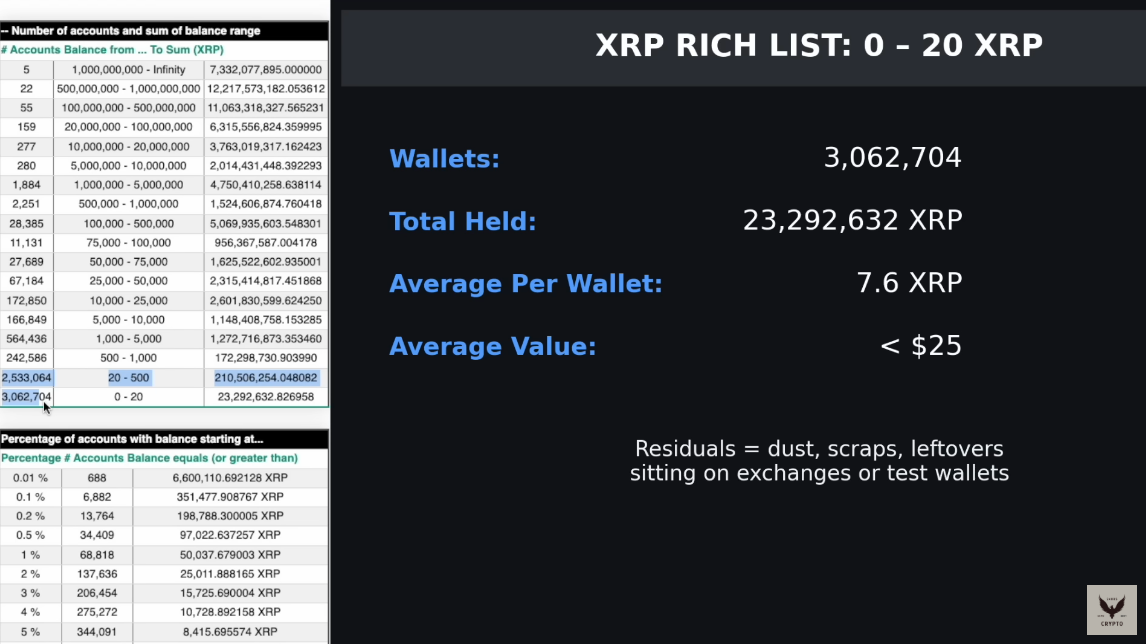
To explain, 24hrsCrypto discussed the XRP rich list. He started with the lowest tier, where just over 3 million wallets hold between 0 and 20 XRP each. He described these as scraps left over in exchanges or test wallets. 

XRP Rich List for 0 to 20 XRP Wallets

On average, these wallets contain about 7 XRP, which he rounded to 8. At today’s prices, that works out to less than $25 per wallet.

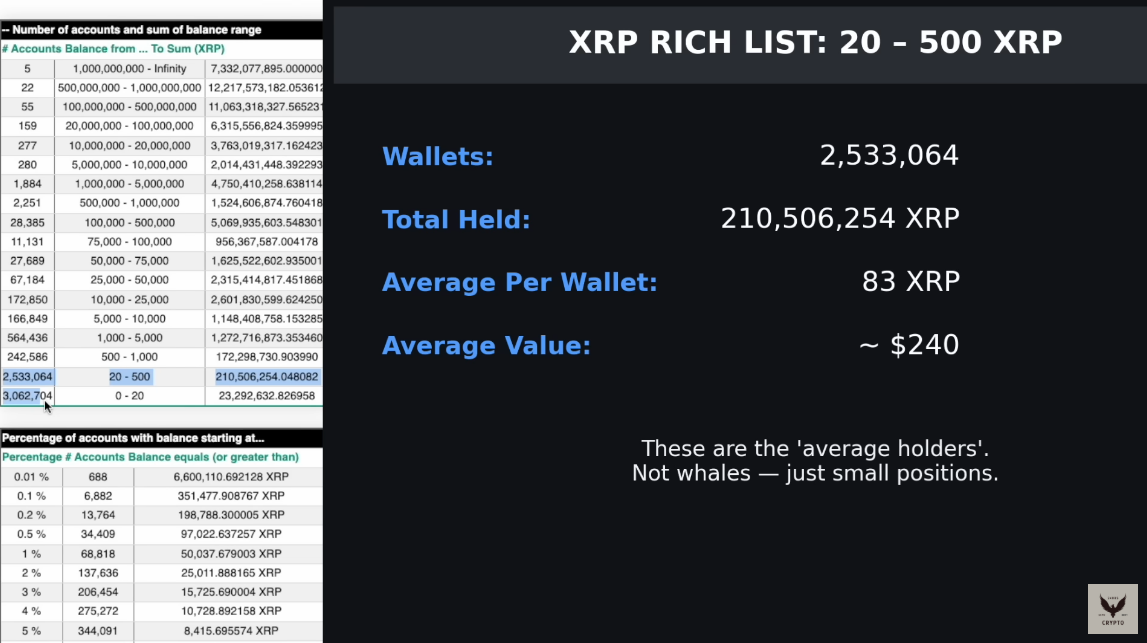
The next tier includes 2.5 million wallets with balances between 20 and 500 XRP. Together, these wallets hold about 210.5 million XRP. On average, each wallet in this group has roughly 83 XRP, worth around $240.

XRP Rich List for 20 to 500 XRP Wallets

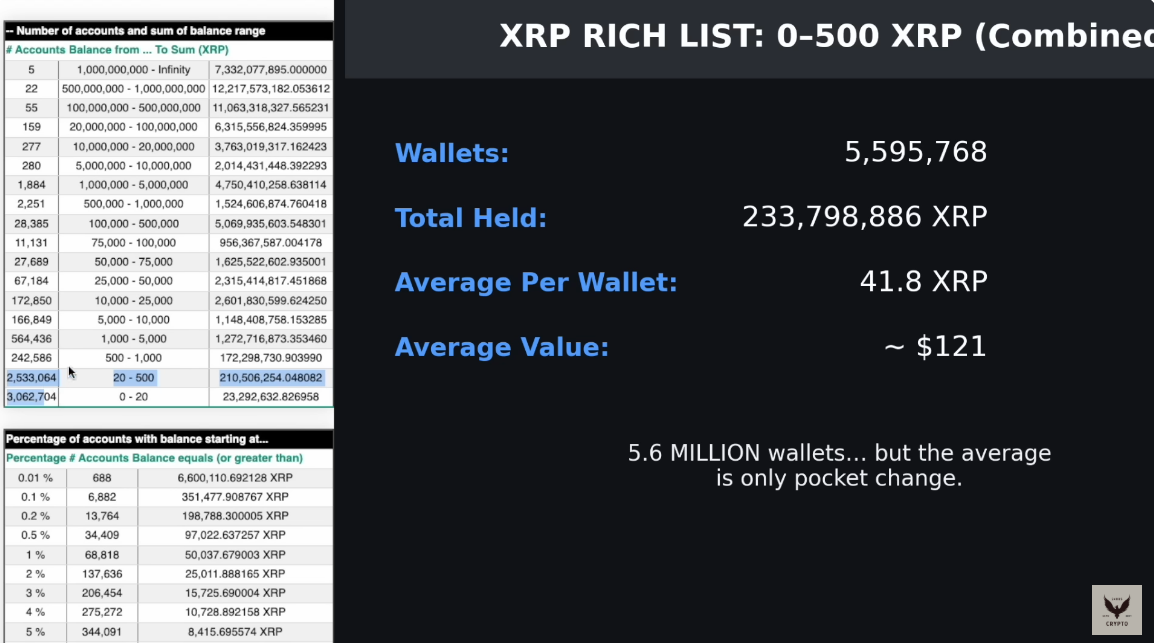
Adding both categories together, there are about 5.6 million wallets, already 81% of total XRP wallets, with a combined balance close to 233.8 million XRP. However, 24hrsCrypto stressed that the average person in these groups holds only pocket change, not life-changing wealth. As a result, even if XRP hits lofty targets like $1,000, their balances would not reach millions or billions.

XRP Rich List for 0 to 500 XRP Wallets

Most XRP Whale Investors Own Multiple Wallets

He then moved to the upper brackets, where wallets carry anywhere from 1,000 XRP up to 5 million. While the numbers look big, he pointed out that wallet counts do not equal individual people. Specifically, many investors spread their holdings across several wallets. 

One person might keep 10,000 XRP in one wallet, 25,000 tokens in another, and 50,000 XRP in yet another. This means the actual number of people in these larger brackets is far smaller than the charts suggest.

To him, this makes the argument that “millions” will become wealthy completely flawed. Out of billions of people worldwide, only a tiny fraction owns enough XRP to see life-changing gains. Most holders only control between $25 and $240 worth of tokens. 

Notably, to own 500 XRP today, someone would need to spend about $1,400. He argued that this alone shows how few people could truly benefit on a massive scale.

XRP’s Long-Term Price Prospect

24hrsCrypto then discussed XRP’s long-term price outlook. He believes XRP will eventually reach $100 and could climb as high as $2,000 or even $3,000. He insisted that critics may doubt this, but the math and time will prove them wrong. 

Essentially, the market pundit believes the structure of XRP ownership guarantees that only a small group of holders would see extraordinary gains, while the majority would not.