Home Blog Page 601

Bolivia Signs Crypto Cooperation Deal with El Salvador Amid Economic Crisis

0

Bolivia has signed a landmark agreement with El Salvador to advance crypto adoption.

According to a recent press statement, Bolivia’s Central Bank signed a memorandum of understanding (MoU) with El Salvador to deepen cooperation on crypto policy. The deal marks a turning point in Bolivia’s approach to digital assets.

Under the MoU, the two countries agreed to coordinate on crypto regulation and share technology tools. They also pledged to enhance financial access for underserved populations.

Bolivia’s Central Bank chief Edwin Rojas Ulo and El Salvador’s Digital Assets Commission president Juan Carlos Reyes García signed the agreement, which took effect immediately and will remain in force indefinitely. The move formalizes their partnership and reflects both governments’ commitment to integrating crypto into their financial systems.

Learning from El Salvador’s Bitcoin Playbook

El Salvador, renowned for becoming the first country to adopt Bitcoin as legal tender, offers Bolivia a practical case study in navigating both the opportunities and hurdles of crypto regulation.

Through this collaboration, Bolivia aims to modernize its financial infrastructure. It also seeks to expand access to financial services for families and small businesses that have long been underserved.

From Ban to Boom

Bolivia’s crypto landscape has undergone a remarkable transformation. In June 2024, the government lifted a long-standing ban on crypto. Following this decision, cryptocurrency trading volume surged to $46.8 million within just three months, averaging $15.6 million per month. This marked a twofold increase over the monthly average of the previous 18 months.

The momentum has only accelerated in 2025. By June 30, total trading volume had reached $294 million, according to the Central Bank. This highlights the growing enthusiasm for digital assets among Bolivians.

This rising interest is evident not only in trading activity but also in everyday use. A growing number of Bolivians are now turning to cryptocurrencies, such as Bitcoin and stablecoins, for routine purchases.

Economic Crisis Fuels Digital Currency Pivot

The crypto push comes at a time of acute economic pressure. Bolivia’s foreign currency reserves have collapsed from $12.7 billion in 2014 to just $165 million as of April 2025, according to Trading Economics. 

Amid severe U.S. dollar shortages, the government has even authorized state-owned oil and gas company Yacimientos Petrolíferos Fiscales Bolivianos (YPFB) to accept cryptocurrency payments for fuel imports.

In response, many local merchants have begun pricing goods in Tether (USDT). This reflects a growing reliance on stablecoins as a hedge against currency volatility.

Elections Could Define Crypto Future

This ambitious pivot toward digital finance is unfolding just weeks before Bolivia’s general elections on August 17. Many citizens see the vote as a referendum on the country’s long-standing socialist leadership. 

According to Bolivia’s electoral rules, a candidate must win over 50% of the vote, or at least 40% with a 10-point lead over the nearest rival, to avoid a second round. If these conditions aren’t met, a runoff will take place on October 19.

Forecasts from crypto prediction platform Polymarket suggest an outright win is unlikely, placing the odds of a first-round victory at just 5%.

Political analysts and crypto market observers alike are watching closely, as the next government will likely determine whether Bolivia continues to embrace cryptocurrency or recalibrates its approach.

Public Companies Invest $47 Billion in Bitcoin in 2025, Outpacing ETF Inflows

Corporate Bitcoin adoption is entering a new era of acceleration, despite the firstborn crypto asset trading near its all-time high.

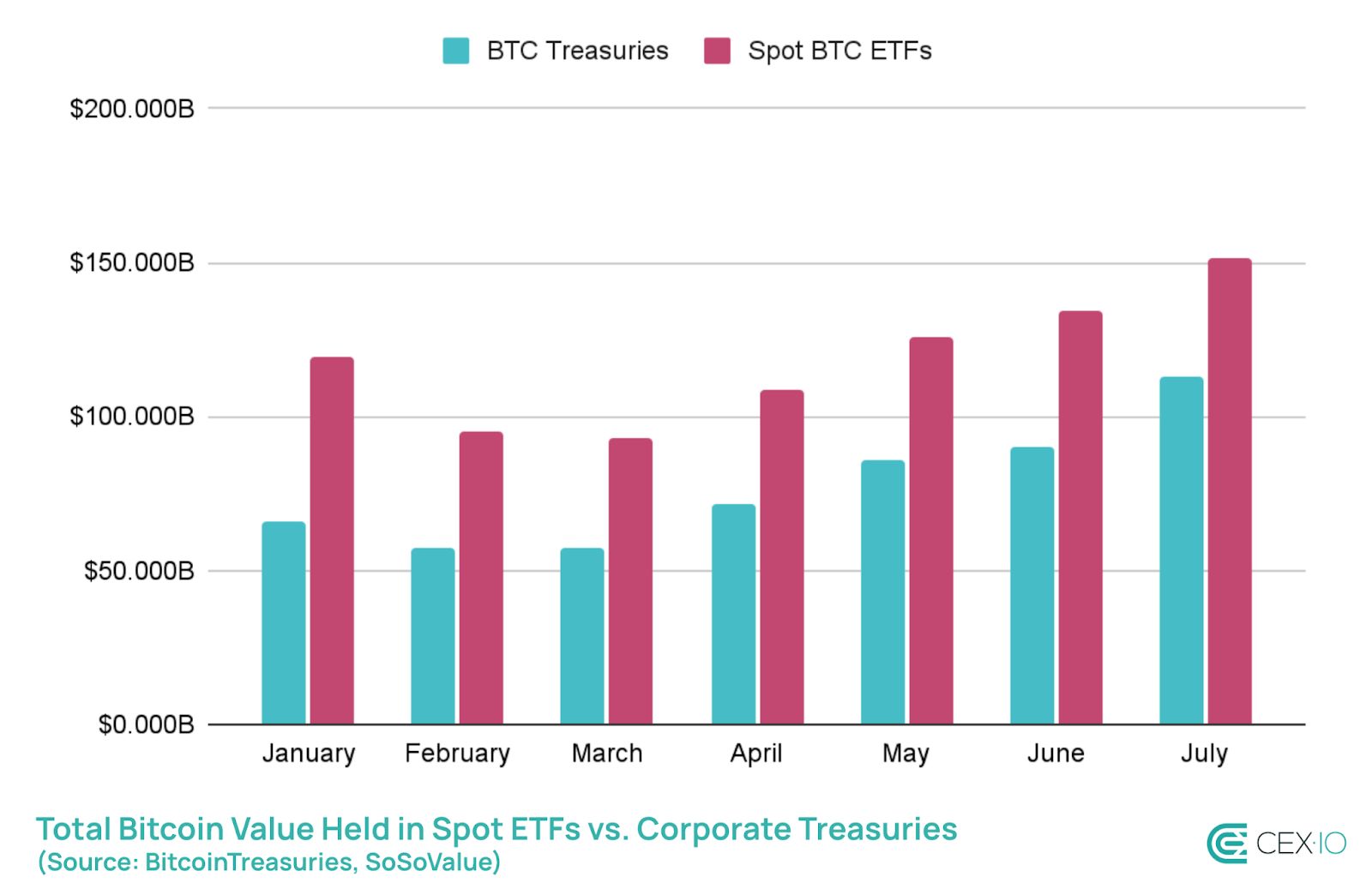
According to a new report by crypto exchange CEX.IO, public companies have collectively added $47.3 billion worth of Bitcoin to their treasuries in 2025. This figure significantly outpaces the $31.7 billion in inflows into U.S. spot Bitcoin ETFs during the same period.

Leading the charge is Strategy (formerly MicroStrategy), which has acquired $17 billion in BTC this year alone. The company now holds 628,791 BTC, worth over $74.23 billion. Meanwhile, Twenty One Capital has crossed the $5 billion mark, while Japan’s Metaplanet now holds over 17,132 BTC on its books.

Bitcoin Treasuries Closing the Gap on ETFs

At the beginning of 2025, spot Bitcoin ETFs held nearly $120 billion, almost double the $65.8 billion held by public companies. But that gap has been shrinking rapidly. 

By the end of July, corporate holdings had surged to over $113 billion at its peak, reflecting a 96% year-to-date increase, compared to a 44% rise in ETF holdings.

Specifically, these firms collectively hold 925,389 BTC worth over $109 billion today, representing 4.4% of Bitcoin’s maximum supply. Meanwhile, ETFs hold even more—1,496,556 BTC worth over $176 billion—representing 7.12% of Bitcoin’s supply.

A chart of Bitcoin accumulation by public firms and ETFs

The pace at which public companies are closing the gap highlights their growing presence at the core of the crypto infrastructure, favoring direct Bitcoin custody over ETF exposure.

Strategic Commitment

Moreover, treasury-held Bitcoin typically stays off-exchange and on-chain, signaling a more permanent allocation with less concern about massive sell-offs. It is unlike ETFs, which are liquid and investor-facing.

Notably, 161 public firms now hold Bitcoin on their balance sheets. Meanwhile, 53 private firms hold 426,190 BTC worth over $50 billion. Among the big names in this group are Block and Tether, the issuer of USDT.

Overall, the growth in holdings across various firms confirms institutional FOMO in Bitcoin, as the premier asset trades in the six-figure range with widespread long-term conviction to crack the seven-figure mark.

As of press time, Bitcoin is trading at $118,500, slightly below its peak of $123,200. Bitcoin bulls like Michael Saylor, Robert Kiyosaki, and Jack Dorsey have predicted that the price could exceed $1 million in the next decade.

Bitcoin Eyes $150K as Inverse Head and Shoulders Breakout Aligns with Fibonacci Target

0

A prominent crypto analyst believes Bitcoin could be on a path to $150,000 following a confirmed breakout on the weekly chart. 

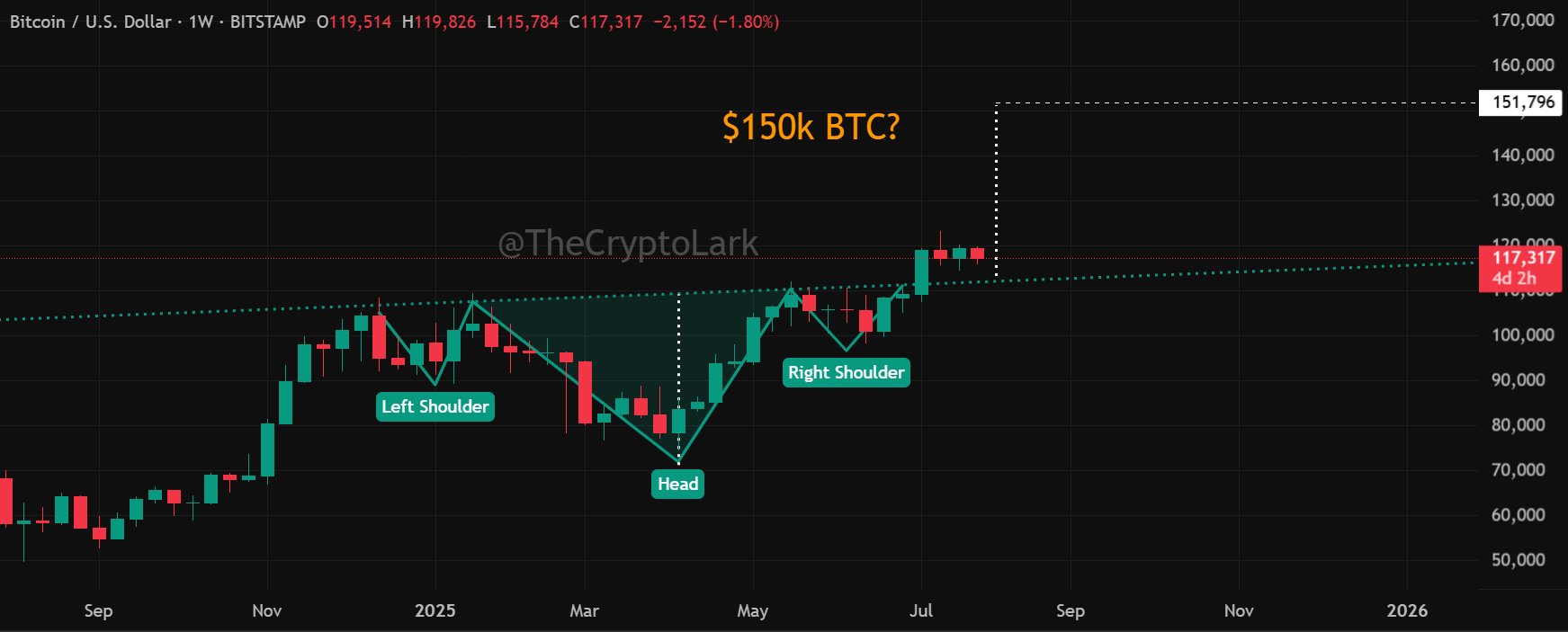
In a post on X, analyst Lark Davis pointed to an inverse head and shoulders pattern, a technical structure often associated with bullish trend reversals.

The breakout occurred just above the pattern’s neckline, around $117,000, with Bitcoin now trading slightly above that level. Davis emphasized that the pattern’s projected target exceeds $150,000 and aligns with the 2.618 Fibonacci extension level.

Pattern Suggests Bullish Continuation

For context, the chart’s inverse head and shoulders pattern includes a left shoulder formed near $94,000, a head dipping to around $72,000 in April 2025, and a right shoulder near $90,000 in June. The neckline, now flipped into potential support, was broken in early July after weeks of sideways movement.

Bitcoin Inverse head and Shoulders
Bitcoin Inverse Head and Shoulders

Bitcoin’s current price is $118,024, a 0.4% rise in the past day, increasing its monthly gain to 10% amidst recent volatility. Bitcoin reached a weekly high of $119,826 on July 27 after retracing from the all-time high above $123,000 recorded on July 14. 

Notably, the current pattern suggests a measured move upward that supports a long-term price objective of over $150,000, assuming momentum continues, and price holds above the neckline.

Fibonacci Levels Add Weight to the Target

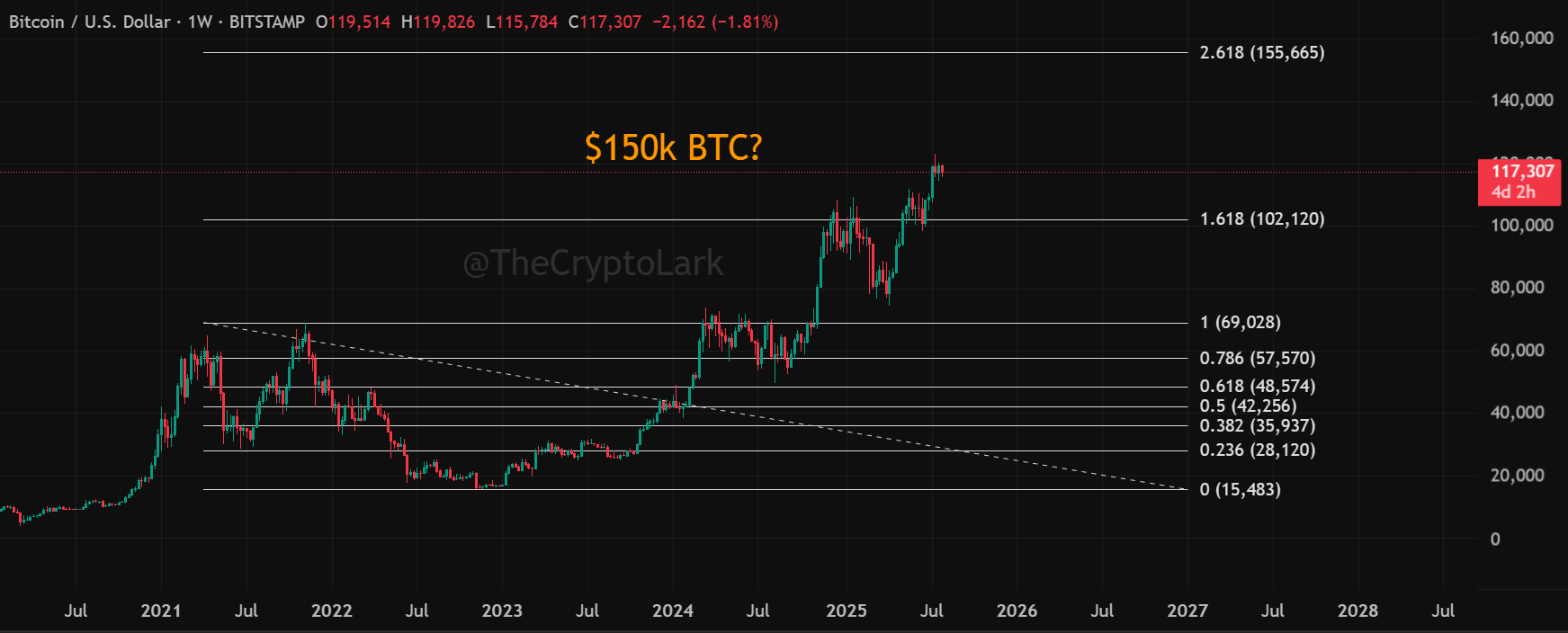
The Fibonacci extension level further supports the bullish target. Davis drew the extension from Bitcoin’s all-time high of $69,028 in November 2021 to its bear market bottom at $15,483. The resulting 2.618 extension level is $155,665, which nearly matches the projected breakout target from the pattern.

Bitcoin Fibonnaci sequence

Bitcoin has already crossed the 1.618 Fibonacci extension at $102,120, signaling that a new price discovery phase may be underway. 

Momentum Holds, but Support Is Crucial

Despite a weekly dip of paltry 0.6%, Bitcoin remains above the key $117,000 neckline. This level remains a point of note for analysts to see whether the level continues to hold as support. A sustained move above this zone could open the door for further upside.

However, a breakdown below $117,000 could pause the current trend or trigger a short-term correction. Lark Davis suggested that the breakout has defined the next major target for Bitcoin and that reaching it may now depend only on timing.

How High Can Bitcoin Go in 2025?

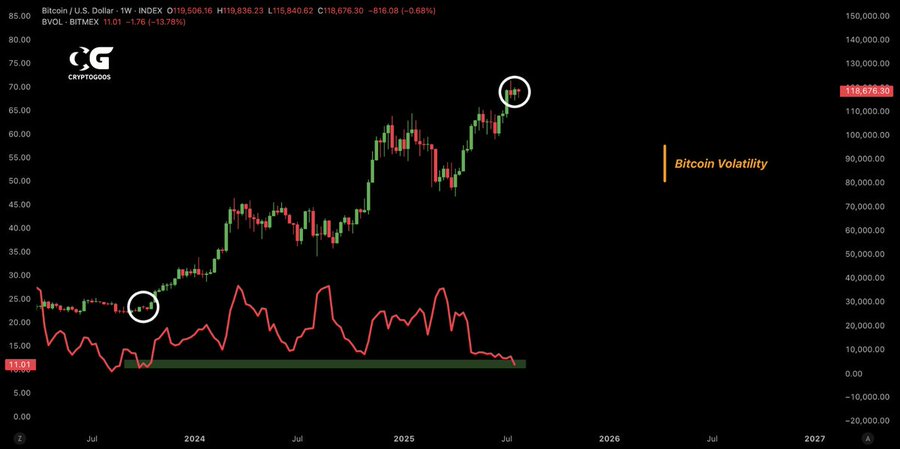
Similarly, crypto analyst CryptoGoos pointed out that Bitcoin’s volatility dropped to around 11.1%, returning to levels last seen in late 2023 when BTC was priced near $20,000. That previous volatility low preceded a major rally. 

Bitcoin volatility chart shows comparison with 2023 level
Bitcoin volatility compares with the 2023 level.

With Bitcoin trading within 116,000 to $120,000, CryptoGoos’ chart highlights a similar setup, volatility pressing against historical lows while price consolidates tightly. This coiling behavior suggests the market may be preparing for a significant breakout, as periods of extreme volatility compression often lead to explosive moves.

Adding to the bullish sentiment, veteran trader Peter Brandt recently predicted a cycle top between $125,000 and $150,000 by Q3 2025, contingent on Bitcoin reclaiming its parabolic trendline, an outlook supported by his long-term weekly chart analysis. 

Meanwhile, analyst apsk32 believes Bitcoin still has significant upside, forecasting a surge past $200,000 before the end of 2025. His view aligns with projections from Bernstein, Bitwise, and Robert Kiyosaki. 

Fold Partners Blackhawk to Make Bitcoin Gift Cards Available to Major US Digital Retailers

0

Nasdaq-listed Bitcoin financial service firm Fold has announced a collaboration with Blackhawk to expand its Bitcoin Gift Cards to major US digital retailers.

A July 31 press release confirmed the partnership, aimed at broadening the reach of Fold’s Bitcoin gift card innovation. Blackhawk will champion the distribution of the Fold Bitcoin Gift Card across major US online retailers, increasing its mainstream reach.

Fold Aims to Leverage Bitcoin Embrace in the US

For context, the United States is slowly becoming the friendliest country towards Bitcoin globally amid Donald Trump’s favorable stance. Interestingly, Nasdaq-listed Fold Holdings looks to leverage this momentum and growing demand for Bitcoin to expand its reach in the country.

Its collaboration with Blackhawk, a leading branded payment solution, aims to reach major US digital retailers. Fold will leverage the Blackhawks’ extensive network to distribute the Fold Bitcoin Gift Card, potentially reaching over 400,000 customer touchpoints globally.

Notably, the US gift card market is worth over $300 billion, and Fold has set its sights on establishing itself as a go-to for crypto gift cards in the market. Furthermore, with increasing interest in digital assets, Fold aims to spearhead the growth of the crypto gift card category in America.

Moreover, the Incentive Gift Card Coalition shares this sentiment. 47% of the company’s executives believe that crypto gift cards will grow as a sector in 2025.

Collaboration to Bring BTC to More Retailers Through Bitcoin Gift Cards

The Fold Bitcoin Gift Card launched in May 2025, revolutionizing how users interact with the asset. Notably, the appeal of this bitcoin gift product is its simplicity. The Fold Bitcoin Gift Card makes it easier for both crypto novices and experienced users to send, receive, and use Bitcoin, as more outlets accept the cryptocurrency.

Currently, customers can either buy or redeem the gift cards on the Fold App. Nonetheless, Fold disclosed that it plans to launch an in-store retail point later in the year as part of its expansion strategy.

Meanwhile, Will Reeves, the CEO of Fold, noted that the Bitcoin gift cards break the divide, ensuring that an average person can access and share Bitcoin. He stated that the innovation paves the way for millions of users who already own or use BTC.

Notably, Blackhawk made a similar partnership in 2021 with BitCard. The branded payment technology leader collaborated with BitCard to offer Bitcoin gift cards to select US retailers.

Microsoft Becomes Third Asset to Cross $4 Trillion: Here’s How High Bitcoin Must Climb to Surpass It

0

Microsoft has officially crossed the $4 trillion valuation mark, becoming the third asset in history to do so, but can Bitcoin still surpass the tech giant?

Notably, Reuters reported that Microsoft’s surge past the $4 trillion milestone followed a strong earnings report, which pushed the company’s stock up by 6.6% to $546.33 during morning trading. 

Speaking on the feat, Gerrit Smit, portfolio manager at Stonehage Fleming Global Best Ideas Equity Fund, explained that Microsoft continues to shift toward cloud infrastructure and enterprise AI while keeping strong profits and cash flow despite rising AI-related costs.

How High Must Bitcoin Climb to Overtake Microsoft?

For context, the company first reached the $1 trillion mark back in April 2019. Unlike Nvidia and Apple, Microsoft’s climb to $3 trillion happened more gradually. In contrast, Nvidia tripled its value in a year, becoming the first company and second asset to break the $4 trillion barrier on July 9.

Meanwhile, as Microsoft celebrates this achievement, Bitcoin stays far below the $4 trillion mark. This fact remains despite it holding the sixth spot among the world’s most valuable assets. 

Currently, the Bitcoin price trades at $118,396, with a market cap of $2.356 trillion and 19,899,847.97 BTC in circulation. This market value puts Bitcoin just ahead of Alphabet (GOOGL), which has a $2.355 trillion market cap. However, to move past Microsoft, Bitcoin would need to jump to $201,056 per coin.

Notably, Bitcoin first reached the $1 trillion milestone in February 2021 when it hit a then-record price of $58,354. That same year, it fluctuated around the $1 trillion level several times, and eventually lost it completely in 2022. In November 2022, its market cap dropped to $297 billion during the FTX collapse. 

Bitcoin later recovered the $1 trillion level in February 2024 and has held above it ever since. It first reached the $2 trillion milestone in December 2024 but briefly dipped below it earlier this year before reclaiming it in June. So far, it has stayed above the $2 trillion mark throughout July.

Prices at Which Bitcoin Could Surpass the Other Assets Above It

For Bitcoin to climb higher in the global rankings, it must claim new highs. Specifically, to overtake Amazon, which ranks fifth with a $2.484 trillion value, Bitcoin must rise to $124,825. To pass Apple, now in fourth place with a $3.118 trillion market cap, Bitcoin needs to reach $156,684. 

Passing Microsoft, ranked third at $4.001 trillion, requires a price of $201,056. Meanwhile, to beat Nvidia’s $4.439 trillion valuation, Bitcoin must reach $223,067. Interestingly, to overtake gold, the top-ranked asset with a $22.519 trillion market cap, Bitcoin would need to trade at $1,131,616.

Despite these ambitious targets, several analysts believe Bitcoin could eventually hit these levels. In December, VanEck CEO Jan Van Eck predicted that Bitcoin could reach $160,000 in 2025. At that price, Bitcoin’s market cap would rise to $3.184 trillion, allowing it to leap past both Amazon and Apple to claim the fourth spot. 

Meanwhile, in June, Fundstrat’s Tom Lee raised his 2025 target to $250,000, a 111% increase from the current price. Notably, this would push Bitcoin’s market value to $4.975 trillion, enough to surpass both Microsoft and Nvidia, making it the second-most valuable asset in the world.

Further, Ark Invest predicted in May that Bitcoin could hit $1.5 million by 2030, which would boost its market cap to $29.894 trillion. If that happens, Bitcoin will dethrone gold and take the top spot among global assets.

Visa Adds PYUSD, USDG, and EURC Stablecoins; Expands Blockchain Support to Stellar and Avalanche

0

Global payments network Visa has enabled support for three additional stablecoins and two blockchains, enhancing settlement flexibility for issuers and acquirers.  

The company announced the development today in a press release following a partnership with popular blockchain infrastructure and tokenization platform Paxos. 

Thanks to the partnership, Visa will now support two additional USD-backed stablecoins, PayPal USD (PYUSD) and Global USD (USDG), within its settlement platform. In addition to PYUSD and GUSD, Visa also added support for Circle’s euro-backed stablecoin EURC. 

Notably, this is not the first time that Visa will be incorporating fiat-backed stablecoins into its network. In 2021, the payment giant added Circle’s USDC to its settlement platform, allowing users to settle transactions in fiat currencies alongside the dollar-pegged stablecoin. 

Amid the expansion of the stablecoin ecosystem, Visa has now added support for three additional stablecoins. With the latest additions, Visa partners can now settle transactions in over 25 fiat currencies. 

Visa Supports Avalanche and Stellar 

Meanwhile, Visa also announced support for two additional blockchains, Avalanche and Stellar. The newly added blockchains will join Solana and Ethereum, which already exist on Visa’s settlement platform. With the latest additions, Visa currently supports four blockchains and four stablecoins. 

Rubail Birwadker, Visa’s Global Head of Growth Products and Partnerships, stated that the company focuses on establishing a multi-coin and multi-network foundation to cater to its partners’ payment needs. 

“When stablecoins are scalable, interoperable, and trusted, they can fundamentally transform how money moves globally,” Birwadker remarked. 

Growing Interest in Stablecoins 

The development comes weeks after the United States signed the GENIUS stablecoin regulation into law. Since then, major traditional banks, including Citibank and Bank of America, have signaled interest in stablecoins and are exploring plans to launch their own.

Amid this, Visa has grown its list of supported stablecoins, adding two USD-backed stablecoins and a Euro-backed stablecoin. Notably, the stablecoin market currently stands at $275 billion, with projections suggesting $2 trillion by the end of this decade.

Here’s XRP Price If It Maintains 4% Dominance in a $50 Trillion Crypto Market

In a future where the global crypto market reaches $50 trillion, XRP could be well-positioned to benefit, given its current market share.

Today, the global crypto market is at $3.31 trillion. Of this, Bitcoin controls $2.14 trillion, amounting to over 65% dominance. Meanwhile, XRP has a market cap of $129 billion, giving it a 3.93% share.

While conservative compared to Bitcoin, this approximate 4% dominance could translate into a dramatic outcome for XRP if the global crypto market grows to $50 trillion and XRP maintains its share.

XRP Price in a $50 Trillion Crypto Market

As of today, XRP is trading at $3.14, with a circulating supply of 59 billion tokens, resulting in a market cap of approximately $130 billion. Notably, if the global crypto market valuation were to hit $50 trillion, and XRP maintained its 4% share, its market cap would rise to approximately $2 trillion.

Relative to its circulating supply, this would imply a token price of $33.27. Essentially, if the global crypto market reaches $50 trillion and XRP holds its current market share, each XRP token could be worth around $33.

Given XRP’s current price of $3.14, reaching the $33 mark would represent a surge of 1,412% for holders, a 15x increase. In perspective, someone holding over 30,000 XRP tokens, worth about $66,000 today, would see their holdings grow to over $1 million.

A $50 trillion crypto market would, in essence, significantly benefit prominent altcoins like XRP.

When Can the Crypto Market Reach $50 Trillion?

However, the big question is whether the global crypto market can reach a $50 trillion valuation and how long that might take.

For context, if the total crypto market reaches $50 trillion, Bitcoin would likely account for over $32 trillion of that, based on its traditional 60%+ dominance. Given its supply, this would mean a Bitcoin price of over $1.6 million per BTC.

Several forecasts have predicted that Bitcoin will surpass $1 million, including those from industry leaders such as Cardano founder Charles Hoskinson, Eric Trump, and Michael Saylor.

Hoskinson believes Bitcoin could pass $1 million by the end of this decade. Meanwhile, former Twitter CEO Jack Dorsey has argued that BTC could be worth at least $1 million by 2030. Telgaon analysts have projected that Bitcoin could exceed $1.5 million by 2035.

Essentially, industry experts foresee Bitcoin crossing the $1 million mark within the next decade. This helps put the possibility of a $50 trillion crypto market into perspective.

In other words, XRP may be looking at a $2 trillion market cap and a $33 price beyond this decade, assuming it maintains its current market position without a significant increase in dominance.

Could XRP Surpass $2 Trillion Before the 2030s?

However, this projected timeline doesn’t align with the expectations of many XRP holders. Interestingly, some analysts are calling for XRP to reach prices between $30 and $100 as early as this year. Prominent voices pushing this narrative include Dustin Layton, XForceGlobal, and Javon Marks.

This suggests they expect XRP to be worth even more by the 2030s, when the global crypto market could realistically reach the $50 trillion mark.

Can XRP Overtake Ethereum: Here’s What Needs to Happen for XRP to Surpass Ethereum

As XRP holds the third spot among the most valuable crypto assets for most of July, discussions about further progress from this level are emerging again.

Notably, XRP climbed one step up the ranks by overtaking Tether’s USDT in the second week of July when its market cap surpassed $160 billion. It then rose to reach $216 billion, its highest valuation ever, shortly after. This further cemented its position as the third biggest crypto.

Despite occasional fluctuations, XRP has consistently maintained a market cap above that of USDT as it trades above $3. Now, anticipation is growing for further progress from XRP to again surpass Ethereum, as it did in the first week of 2018.

Meanwhile, during XRP’s price and market value expansion, Ethereum did not sit idle. With ETH trading at $3,870, it boasts a 30-day gain of 57%, which notably outpaces XRP’s 43% gain during the same period.

Overall, Ethereum’s market cap has expanded more significantly than XRP’s this month, further widening the gap between XRP and ETH. Specifically, at press time, Ethereum’s valuation stands at $467 billion, while XRP’s is $187 billion.

What Does It Take for XRP to Overtake Ethereum?

Despite the widening gap, optimism remains high in the crypto community about the rise of a new altcoin king, and the XRP Army believes their beloved coin will wear the crown.

At the moment, XRP’s price needs to more than double from its current position to match Ethereum’s market cap. With XRP trading at $3.16 at press time, its price must expand approximately 2.5 times to slightly surpass Ethereum. This would mean an approximate price of $8 for XRP.

However, any further price increase from Ethereum would widen the gap, reducing the odds of XRP overtaking it.

Notably, analysts are already predicting a major breakout for XRP beyond $3 soon. For instance, market watcher Zach Rector forecasts XRP breaking into the $4–$5 range “any day now,” with potential upside to $15 by early September.

If Ethereum fails to make any notable price leaps, this 380% increase could send XRP’s market cap near $900 billion, almost twice ETH’s current valuation.

Calls for XRP Flippening

Previously, calls for XRP to flip Ethereum were at a fever pitch, particularly as the second biggest crypto massively underperformed while Bitcoin was breaking new price territory. Many wrote off ETH as dead, favoring rivals in the smart contract ecosystems like Solana and SUI.

Commentators like John Deaton cited silent Wall Street interest in XRP, particularly via ETFs, as a factor for why he believes XRP will overtake ETH this year. Meanwhile, Harvard engineer Austin King highlighted inflationary risks and rising competition among his supporting factors for the flippening.

Ethereum’s Surprising Comeback

However, these skeptical voices have quietened recently amid Ethereum’s surprising comeback. The coin has soared by over 112% in the last 12 weeks, the best performance among the most prominent cryptos.

In fact, some prominent industry voices are now forecasting a future where ETH trades at $60,000 per coin.

FG Nexus Debuts with $200M Ethereum Treasury Plan

0

Fundamental Global rebrands as FG Nexus and raises $200 million to build an Ethereum-based treasury.

Fundamental Global, a publicly traded investment firm on Nasdaq, is charting a new course in the digital asset sector with a rebrand to FG Nexus and a fresh $200 million in funding to drive its crypto-focused initiatives.

The capital was secured through a private placement. This involved 40 million prefunded warrants, each valued at $5.

Notably, this financing round drew participation from some of the most reputable firms and investors in the crypto space. Among the prominent names were Galaxy Digital, Kraken, and four other participating firms.

These backers bring deep expertise in blockchain technology and strategic insight. Their support will play a key role in advancing FG Nexus’s growth and expansion plans.

FG Nexus intends to use the offering proceeds to acquire Ethereum tokens, establishing it as the company’s primary reserve asset. Interestingly, this move comes amid Ethereum’s 10th anniversary. The firm aims to earn staking rewards through its ETH holdings while also exploring opportunities in tokenized real-world assets.

As part of the strategy rollout, Galaxy Digital will provide strategic advisory services and oversee treasury and staking infrastructure. Meanwhile, Kraken will help drive the company’s staking operations.

FG Nexus Taps Veteran Finance and Crypto Leaders

The newly rebranded organization will be led by experienced leadership. Joe Moglia, ex CEO of TD Ameritrade and co-founder of Fundamental Global, will take on the role of Executive Advisor. Additionally, Maja Vujinovic, a recognized expert in the blockchain space, will spearhead the company’s digital asset strategy.

The new ticker symbols, FGNX and FGNXP, are scheduled to begin trading shortly after the offering closes around August 1.

Institutional Interest in Ethereum Heats Up

FG Nexus is the latest in a wave of publicly listed companies adopting Ethereum-centric treasury strategies. It joins the ranks of firms like BitMine Immersion, SharpLink Gaming, and Bit Digital.

Earlier today, SharpLink Gaming acquired 11,259 ETH at $3,828 per token, totaling $43 million. This latest purchase makes it the second-largest publicly listed ETH holder, behind BitMine, which currently holds 625,000 ETH valued at around $2.41 billion.

As previously reported by The Crypto Basic, The Ether Machine purchased around 15,000 ETH at an average cost of $3,810, worth $57 million. This latest investment increases its overall ETH holdings to 334,757, ranking it as the third-largest holder among publicly traded entities.

Overall, the moves highlight the growing institutional belief in Ethereum’s role as a foundational layer for future financial systems, particularly in decentralized finance.

Expert Predicts Timeline for XRP to Reach $7–$15, Says $4–$5 Could Happen Any Day Now

A new phase of the bull run is unfolding in the altcoin space, and hopes are high for XRP to do wonders.

XRP is currently trading above the $3.15 mark, and multiple analysts now believe a major breakout beyond this $3 range is imminent.

Notably, the ongoing altcoin rally is being led by Ethereum. Earlier today, Ethereum approached a $500 billion market cap, with its price reaching $3,940, one of its highest levels this year. BNB, on the other hand, set a new all-time high above $850.

Meanwhile, XRP has yet to set a new price milestone. However, all eyes are now on XRP for a surprise move, as seen with other leading altcoins.

XRP $4–$5 Range “Any Day Now”

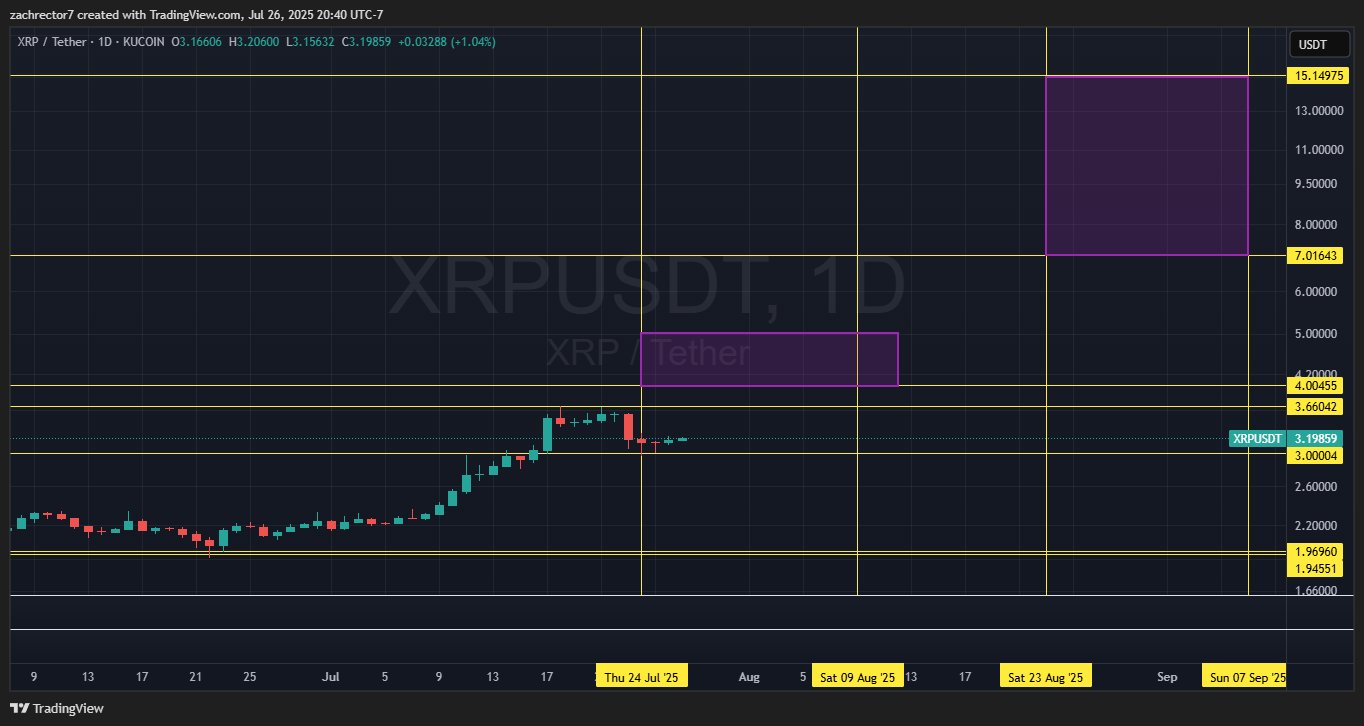
According to analyst Zach Rector, XRP is primed to break into the $4 to $5 range “any day now.” He expects the momentum to persist, forecasting further upside potential that could reach as high as $15 by early September. 

Notably, Rector shared a daily chart showing XRP in a tight consolidation just above $3.00 to $3.25 range. The chart highlights a breakout structure, with short-term price targets set between $4.00 and $5.00, up to a 56% increase from today’s price. Notably, this range would mark a new all-time high for XRP.

XRP daily chart by Zach Rector

Timeline for XRP to Reach $7–$15

Meanwhile, Rector’s mid-to-long-term projection places XRP in the $7.01 to $15.14 range. The lower end implies a 119% gain, while the upper bound suggests a massive 373% upside for holders. Rector pointed to a window between August 23 and September 7, during which he expects XRP to break into the upper price bands. 

This analysis comes as XRP forms a bullish base above key support zones, indicating momentum is building for a vertical move.

Fibonacci Targets Add Fuel to the Rally

Supporting the bullish outlook, Tony Edward, host of the Thinking Crypto Podcast, shared Fibonacci-based projections suggesting XRP’s potential path beyond $9. 

According to his weekly chart, XRP could reach $4.5, $6.3, $8.0, and $9.1—all aligned with Fibonacci extension levels. These targets align with Rector’s $4–$15 projection, confirming the growing consensus among analysts that XRP is entering a strong breakout phase.

Measured Move at $20+

In a separate analysis, market watcher EGRAG projected an average price of $20 for XRP this cycle, based on historical patterns.

According to this analysis, XRP surged 2,600% in 2017, implying a potential $33 target in the most optimistic scenario this season. It also surged 500% in 2021, suggesting a target of $7.70. 

Averaging these, EGRAG arrives at a $20 price target, which he deemed realistic. Meanwhile, he notes that the full “measured move” could push prices even higher.