Home Blog Page 639

GameSquare Launches $100M Ethereum Treasury Strategy

0

GameSquare Holdings is pivoting its financial strategy toward crypto with a $100 million Ethereum-based treasury plan.

The technology company announced this significant strategic shift in treasury management via a post on X on Tuesday. This change involves the launch of an Ethereum-based financial strategy. Notably, the board has approved up to $100 million for this initiative, to be deployed in phases.

In the first phase, GameSquare is conducting an underwritten public offering of 8,421,054 shares at $0.95 per share to raise $8 million in gross proceeds. The offering will close on July 9, 2025.

Lucid Capital Markets is acting as the sole book-runner. It also has the option to purchase up to 1,263,157 additional shares within 45 days.

Dialectic Partnership for On-Chain Yield

As part of this new strategy, GameSquare is collaborating with Dialectic, a leading crypto investment firm. The company will leverage Dialectic’s Medici platform, which utilizes machine learning, automated optimization, and multi-layered risk controls.

This platform generates targeted yields between 8 and 14%, unlike the typical 3–4% returns from standard Ethereum staking.

The strategy may also include diversification into stablecoins and non-fungible tokens (NFTs), enhancing both yield potential and risk management. This move signals GameSquare’s intention to become more active in decentralized finance (DeFi) while maintaining a secure and flexible treasury structure.

GameSquare CEO Justin Kenna stated that the company’s goal is to create “real, on-chain yield generation” while broadening its footprint across DeFi ecosystems.

The updated treasury model is designed to support additional ETH purchases and fund potential share buybacks. It also enables reinvestment in growth-focused initiatives across its business verticals.

Stock Market Reaction

Meanwhile, the market responded swiftly to GameSquare’s crypto-focused treasury announcement. Shares of the company soared 58.76% on Tuesday, closing at $1.54 on the Nasdaq—marking one of its strongest single-day gains to date.

Momentum carried into after-hours trading, where the stock added another 6.49%. With this rally, GameSquare’s market capitalization rose to approximately $60.25 million, reflecting renewed investor confidence in the company’s strategic pivot toward blockchain-based finance.

Cardano Records First-Ever Golden Cross on The Weekly Chart

0

Cardano could be up for a massive price outbreak as an analyst highlights its first-ever bullish cross on the weekly timeframe.

Cardano may be down 2% in the past 24 hours, but momentum around its price is building up nicely. This comes as an analyst has identified a bullish catalyst, as technical indicators interact perfectly to set up the possibility of a northward trend in the coming days.

First-Ever Golden Cross for Cardano

Specifically, analyst Mr. Brownstone shared in a recent X commentary that Cardano has just seen its first-ever golden cross in the weekly time frame, precisely on the ADA/USD chart. For the uninitiated, this bullish signal flashes when a short-term moving average moves above a long-term moving average (typically between the 50-day MA and 200-day MA).

Golden Cross On Cardano’s Weekly Chart

Interestingly, this suggests that Cardano’s momentum is turning positive in the short term, which usually precedes a significant rally. Many analysts also view the indicator as a buy signal in preparation for a bullish price action.

Meanwhile, the analyst agrees that Cardano’s price is better set up for an uptick above the moving averages. For perspective, ADA trades at $0.597, below both the 50-day and 200-day MA, currently at $0.663 and $0.643, respectively.

This aligns with a previous suggestion from analyst MasterAnanda. Specifically, in an earlier post, he shared that Cardano needs to reclaim the 34-period exponential moving average (EMA34) and MA200 to turn bullish.

Although Mr. Brownstone did not mention any price target for the impending rally, earlier analyses have identified possible targets for Cardano. A recent TradingView commentary from Arman Shaban suggests that ADA is poised for price growth to $1.33, while Dan Gambardello believes $10 is a realistic target for this cycle.

Whale Traction Fuels Positive Momentum

Moreover, whales are back to buying Cardano, another sentiment booster for enthusiasts. After a period of less traction, large holders have acquired 120 million ADA in the past two weeks, Ali Martinez shared in a recent post.

ADA Whale Accumulation

These acquisitions came from the largest ADA whales, specifically from wallet addresses holding between 1 million and 10 million ADA. With the purchases, they now hold 5.5 billion ADA, worth approximately $3.3 billion at the current market price.

It is worth noting that such whale activity typically indicates that market movers remain keen on higher prices for Cardano. It also precedes a price uptrend, with the latest golden cross further fueling the optimism of an ADA bounce soon.

Ripple CEO to Officially Introduce XRP to US Senate

0

Ripple CEO Brad Garlinghouse is set to introduce XRP to the U.S. Senate later today, highlighting the token’s technical strength and utility. 

Garlinghouse took to X yesterday to share a PDF link to his prepared remarks for the upcoming Senate hearing on the crypto market structure. The Ripple CEO’s testimony revolves around the topic of “Building Tomorrow’s Digital Asset Markets.” 

His remarks began with greetings to members of the Senate Committee on Banking, Housing, and Urban Affairs. He highlighted the company’s global footprint, as well as its role in facilitating cross-border payments on behalf of financial institutions, including banks. 

Garlinghouse Formally Introduces XRP to Senate 

Interestingly, Garlinghouse highlights how Ripple utilizes the XRP Ledger (XRPL) and its native token, XRP, to facilitate cross-border payments. This statement aims to enlighten the U.S. Senate that XRP has real-world utility, particularly in the global payments sector. 

Moreover, the Ripple CEO highlighted XRP’s core attributes, emphasizing that the coin is designed to enable highly scalable, low-cost, and fast transactions. This description positions XRP as a relevant asset in cross-border payments. 

Ripple CEO introduces XRP to US Senate

Notably, Garlinghouse cleverly framed XRP and its underlying technology as the engine behind the software products that Ripple builds to power not only cross-border payments but digital custody and stablecoins. 

Furthermore, he stated that Ripple deliberately works with regulators and policymakers, adding that the company operates with over 60 payments, money transmitters, and crypto licenses globally, including within the U.S. 

Ripple’s compliance-first approach serves as a reassurance to Congress that the company is focused on complying with the law.

XRP Regulatory Clarity

Furthermore, Garlinghouse recounted how the SEC initiated an enforcement action against Ripple in 2020. According to him, Ripple was the first leading crypto company that the SEC sued in the United States. Meanwhile, he noted that Ripple had successfully fought the SEC in court and ultimately prevailed. 

Garlinghouse noted that the court ruled in Ripple’s favor on everything that mattered, including finding that XRP is not a security in itself. He stated that the legal victory cleared the pathway for other crypto-related companies to fight back, with some leveraging the XRP ruling as a defense in their cases. 

Notably, Garlinghouse’s testimony is part of an upcoming hearing on market structure legislation for digital assets. The proposed bill aims to provide clarity for digital assets by specifying when a token will be regulated as a security or commodity. 

“I urge you to prioritize the passage of market structure legislation for digital assets through this Committee and the full Senate to provide the rules and regulations needed to ensure that the U.S. becomes the crypto capital of the world,” Garlinghouse stated in his prepared remarks. 

Here Is How Much You’d Make By 2050 If You Buy 1 Billion SHIB Tokens and Never Sell

0

Based on bullish forecasts from multiple entities, investors could see substantial gains of up to $1 billion if they buy and hold 1 billion Shiba Inu tokens until 2050. 

Top Shiba Inu community figures have been emphasizing the importance of holding SHIB for the long term, advising against focusing on short-term price fluctuations. This view hinges on the belief that losses occur when investors sell their tokens early during temporary dips. 

Interestingly, most Shiba Inu investors have continued to hold SHIB despite short-term price swings. IntoTheBlock data suggests that over 1.1 million addresses of the 1.53 million SHIB on-chain holders have been holding the token for more than a year. 

Current Worth of 1 Billion SHIB Tokens 

With several investors focusing on the long term, we estimated what 1 billion SHIB tokens could be worth by 2050, using predictions from multiple entities. 

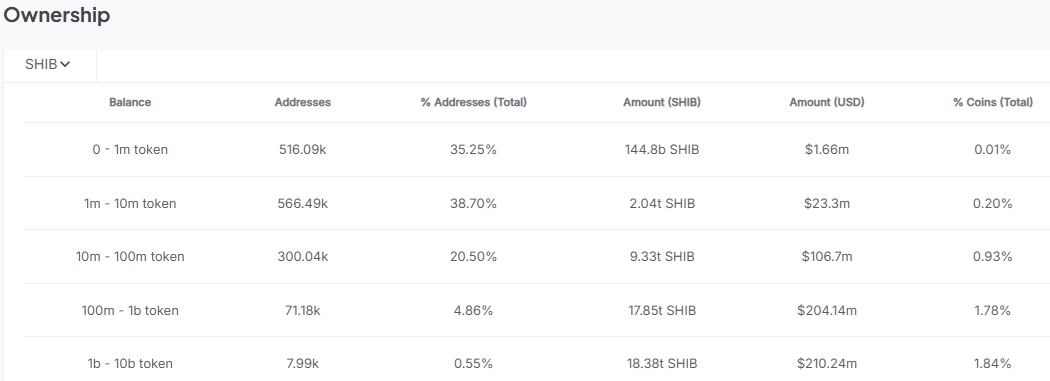
For context, it costs around $11,540 to purchase 1 billion Shiba Inu tokens at the current price of $0.00001154. Currently, only 7,990 addresses hold a minimum of 1 billion Shiba Inu tokens. 

Shiba Inu ownership metric

The value of these 1 billion Shiba Inu could spike tremendously by 2050 if SHIB reaches any of the ambitious price targets set by top experts. 

Why Shiba Inu Could Soar By 2050 

In anticipation of this year’s bull run, several market commentators believe Shiba Inu will exceed the $0.0001 price target by the year’s end. While some investors are excited about this projection, others have remained focused on Shiba Inu’s upside potential in the next few years, specifically by 2050. 

It is expected that Shiba Inu could outpace its 2025 peak target and aim for higher levels by 2050, potentially driven by widespread adoption and clearer regulations. 

Additionally, the market is expected to witness six more Bitcoin halvings between now and 2050. The Bitcoin halving event usually sets the stage for a broader crypto market rally. Recall that several months after Bitcoin’s 2020 halving, Shiba Inu witnessed a significant surge in value, driving its price to an all-time high of $0.00008845.

The upcoming Bitcoin halvings – 2028, 2032, 2036, 2040, 2044, and 2048 – are not expected to differ significantly from previous cycles. Therefore, some market analysts envisage a massive rally for Shiba Inu by 2050. 

Potential Value of 1B Shiba Inu By 2050

According to Changelly, the highly anticipated one-cent dream could become a reality by 2050. By this time, experts affiliated with the exchange believe Shiba Inu could trade at a conservative target of $0.0123 and a maximum price of $0.0148. 

Based on Changelly’s predictions, 1 billion SHIB tokens could be worth $12.3 million if SHIB’s price reaches Changelly’s 2050 conservative target of $0.0123. Notably, the value of this 1 billion SHIB portfolio will skyrocket to $14.8 million at Changelly’s maximum target of $0.0148. 

Flitpay 

India-based crypto exchange aggregator Flitpay also set ambitious 2050 price targets for Shiba Inu. According to Flitpay, Shiba Inu could hit a peak price of $0.089 by 2050, with its minimum target set at $0.0085. 

If you don’t sell your 1 billion Shiba Inu tokens, they could be worth $8.5 million at Flitpay’s conservative target of $0.0085 and $89 million at the peak price of $0.089. 

Telegaon 

Notably, the prediction platform Telegaon believes Shiba Inu’s price could be worth more than one cent by 2050, predicting a price range of between $0.62 and $1.06. This suggests that these 1 billion Shiba Inu could be valued at around $620 million to $1.06 billion if Telegaon’s prediction comes true. 

AI Forecasts 

Meanwhile, popular AI models ChatGPT and Google Gemini also set different 2050 price targets for Shiba Inu. While ChatGPT predicts Shiba Inu’s climb to $0.0031 by 2050, Google Gemini expects the token to trade around $0.047 by then. 

At ChatGPT’s forecast of $0.0031, 1 billion SHIB tokens would be valued at $3.1 million. Notably, the value of this 1 billion SHIB portfolio will spike to $47 million if Google Gemini’s $0.047 price forecast materializes. 

Here’s When Ripple Escrow Will Run Out of XRP if Current Release Patterns Continue

The Ripple escrow system might run out of XRP over the next ten years if the current trend persists. However, there are changes that could hasten the process.

Ripple’s escrow system has always been important in determining how XRP enters the market. For context, the system releases 1 billion XRP tokens every month, but Ripple re-locks most of them. Amid this trend, the XRP community often wonders how long the escrow will last. 

Ripple Escrow Release Patterns

A well-known analyst who runs the “XRP Liquidity” community-driven account on X recently discussed the current trend and presented projections on when Ripple might exhaust its escrow supply if the trend continues or if Ripple makes some minor changes.

Recall that Ripple locked away 55 billion XRP back in December 2017 to help manage supply and avoid flooding the market. Now, each month, the escrow system unlocks 1 billion XRP. 

However, Ripple doesn’t always use the entire amount. Instead, it often puts a large portion back into escrow. According to XRPScan, as of July 2025, the Ripple escrow still holds 35.908 billion XRP, spread across 14 wallets.

How Long Will the Escrow Last If This Pattern Continues 

The “XRP Liquidity” analyst recently highlighted this release pattern. Specifically, for the first seven months of this year, 2025, Ripple re-locked 700 million XRP in January, February, March, April, May, and July, while June saw a slightly lower re-lock of 670 million. 

Meanwhile, back in 2024, Ripple consistently returned 800 million XRP each month from April to October, with one exception in November when it only re-locked 530 million. This pattern shows that the firm increased the amount of tokens it retains by 100 million XRP. 

Based on this trend, the analyst outlined a few possible scenarios going forward, depending on the approach Ripple takes. For instance, if Ripple continues to use just 300 million XRP per month, the escrow could last another 10 years. 

However, if the company increases the amount it retains again next year and starts using 400 million XRP a month beginning in January 2026, the escrow would run out in about 7.5 years. 

Meanwhile, in an approach where Ripple increases its monthly usage by 100 million XRP every year from 2026, the timeline would shorten to six years. The analyst also suggested that if Ripple stops locking any tokens back in, the entire supply could drain even faster.

Recent Anomalies in the Ripple Escrow Schedule 

Notably, Ripple’s recent activity suggests it is already changing its approach. In July 2025, the company split its usual 1 billion XRP release into two parts: 500 million on July 1 and another 500 million on July 4. 

Ripple returned 700 million XRP to escrow and allocated the remaining 300 million to support various parts of its business. These include On-Demand Liquidity (now Ripple Payments), exchange-traded products, and other partnerships.

Interestingly, this two-stage release isn’t a one-off change. Since March 2025, Ripple has started staggering its releases and moving away from its usual first-of-the-month schedule. For instance, in June 2025, the company unlocked the 1 billion XRP on June 4 and later returned 670 million XRP to escrow.

Harnessing The Power of Meta Aggregators For Multi-Chain Trading

0

Anyone who’s tried to move crypto between different blockchains knows the pain. You’re constantly switching between different bridge websites, comparing fees that change by the minute, and praying your transaction doesn’t get stuck somewhere in the void. It’s like trying to navigate a city where every street requires a different GPS app.

This mess is exactly why meta aggregators like Jumper Exchange have become such a big deal. They’re basically the universal remote for crypto trading across chains.

Why cross-chain trading used to be bad

Before meta aggregators, moving crypto between chains was like planning a multi-city flight with different airlines. You’d spend hours researching which bridge to use, then discover halfway through that there’s a cheaper option you missed. Each platform had its own quirks, fee structures, and ways of doing things.

Want to move some tokens from Ethereum to another chain? Better hope you picked the right bridge and that it’s actually working today. Plus, you’d need to keep track of gas fees on multiple networks, which changes faster than weather forecasts.

How meta aggregators fix the mess

Meta aggregators solve this by doing all the heavy lifting behind the scenes. Need to bridge FTM from Fantom to BNB on BSC? Just tell the platform what you want, and it handles the rest. The system automatically finds the best route, considering things like fees, speed, and reliability.

The really clever part is how these platforms adapt in real-time. If one bridge is having issues or becomes expensive, the system automatically switches to a better option. It’s like having a traffic app that actually works for crypto.

Beyond basic transfers

Modern meta aggregators can handle some pretty complex stuff. You can move MATIC from Polygon to SOL on Solana while the platform automatically swaps tokens as part of the same transaction. No need to do separate bridge and swap operations.

Some platforms even support newer chains and unusual routes, like bridging LINK from Solana to Arbitrum or moving SOL from Ethereum to Base. This flexibility means you’re not locked into just the popular chains.

The security question

Cross-chain bridges have a reputation for getting hacked, which makes people nervous about using them. Meta aggregators actually help with this problem by spreading risk across multiple services. If one bridge goes down or gets compromised, your transaction can automatically route through a different path.

Most reputable meta aggregators also monitor bridge health constantly and will blacklist services that look sketchy. It’s not perfect, but it’s better than blindly trusting whatever bridge you found on Google.

Saving money (Finally)

One of the best things about meta aggregators is how they optimize costs. Gas prices change constantly, and what’s cheap on Ethereum might be expensive on Polygon at any given moment. These platforms track all of this in real-time and find the most cost-effective route.

During busy periods, this can save significant money. Instead of paying peak fees on a congested network, the system might route your transaction through a quieter chain that gets you to the same destination for less.

Making multi-chain actually work

Meta aggregators aren’t just a nice-to-have anymore – they’re becoming necessary infrastructure. The crypto space has gotten too complex for manual chain-hopping to be practical. 

These platforms turn what used to be a multi-hour research project into a simple transaction. Whether you’re an experienced trader or just trying to move some tokens around, meta aggregators make the whole multi-chain experience actually usable instead of frustrating.

Disclaimer: This Press release article is provided by the Client. The Client is solely responsible for this page’s content, quality, accuracy, products, advertising, or other materials. Readers should conduct their own research before taking any actions related to the material available on this page. The Crypto Basic is not responsible for the accuracy of info and any damage or loss caused or alleged to be caused by the use of or reliance on any content, goods, or services mentioned in this press release article.

Please note that The Crypto Basic does not endorse or support any content or product on this page. We strongly advise readers to conduct their own research before acting on any information presented here and assume full responsibility for their decisions. This article should not be considered investment advice.

Here’s XRP Price if It Is Adopted by SWIFT as a Liquidity Layer

Expert projections suggest XRP price could potentially reach three-digit levels if SWIFT adopts XRP as a liquidity layer.

Many analysts still believe XRP trades far below its real value despite its current price of $2.22 representing an over 300% increase from November 2024. They argue that XRP’s utility in payments, especially in the cross-border scene, hasn’t been fully recognized by the market. 

XRP Currently Undervalued?

According to these commentaries, if more institutions begin to adopt XRP and its full potential is priced in, they expect the value to climb significantly. However, there is widespread uncertainty around how high this utility could push XRP price.

To explore this idea further, we asked ChatGPT, OpenAI’s AI chatbot, to assess what XRP price might look like if it powered SWIFT’s global payment system as a liquidity layer.

In response, ChatGPT presented a multi-model analysis. For context, SWIFT currently moves about $150 trillion in transactions each year. If XRP steps in as the main bridge currency for these transactions, its price could rise sharply depending on the model it follows.

XRP Price if SWIFT Adopts It as a Liquidity Layer

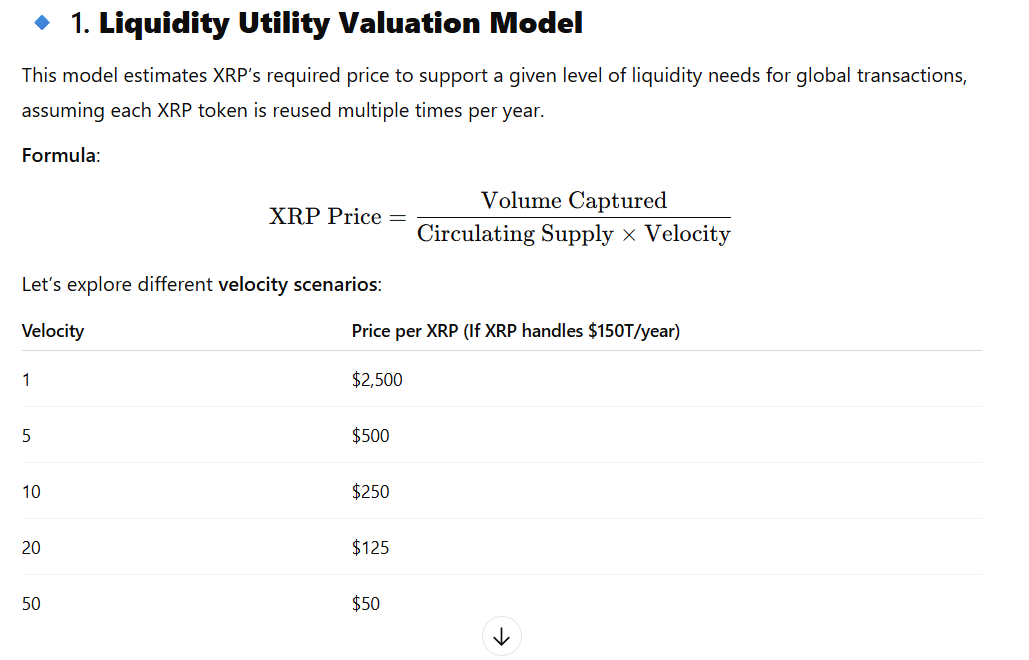
The first model focuses on how much liquidity XRP needs to support SWIFT’s volume. The major factor here is velocity, which represents how many times each XRP token is used in transactions each year. 

With 60 billion XRP in circulation, the model shows that if each token moves through ten transactions annually, the price will need to rise to around $250 to support $150 trillion in volume. If velocity increases to 20 or 50, the required price per token would drop, but $250 is the middle-ground estimate based on reasonable reuse rates.

XRP Price Liquidity Valuation Model ChatGPT
XRP Price Liquidity Valuation Model | ChatGPT

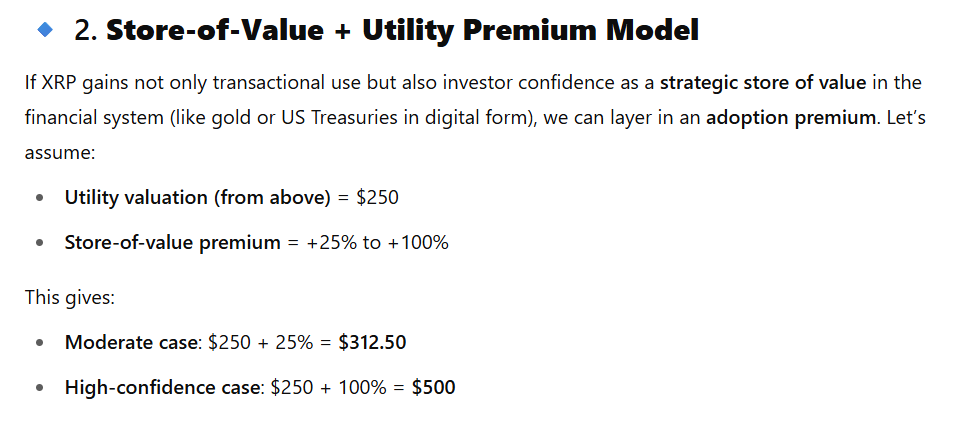
Next, ChatGPT highlighted that XRP might also gain value as a store of wealth. Notably, this means investors would not only use it for transactions but also hold it long-term, like gold or U.S. Treasuries. 

If that happens, XRP could attract a premium over its utility value. For instance, a 25% premium on the $250 base value would push the price up to about $312.50. If investor confidence grows stronger and the premium hits 100%, the XRP price could rise as high as $500.

Utility Premium Model ChatGPT
Utility Premium Model | ChatGPT

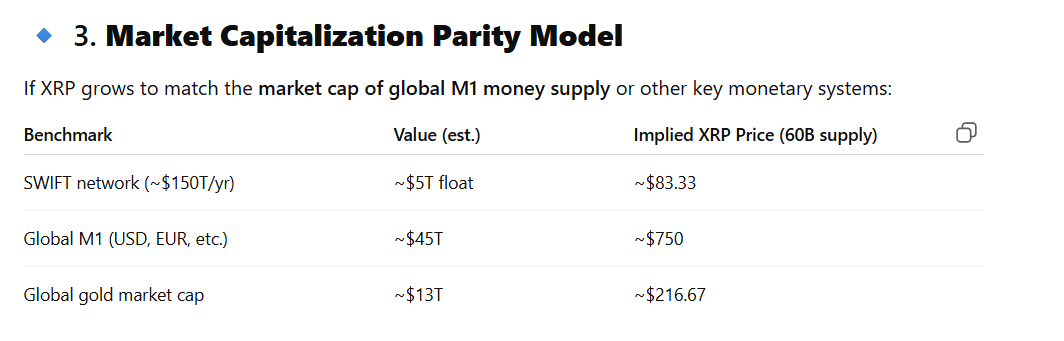
Meanwhile, the third model looks at XRP’s price if it reaches the market cap of major monetary systems. Should XRP match the estimated $5 trillion float of the SWIFT network, the price could land around $83 per token. 

Market Cap Parity Model ChatGPT
Market Cap Parity Model | ChatGPT

After putting all these models together, ChatGPT presented a price range. Specifically, if XRP plays a central role in SWIFT’s operations and gains widespread trust, the price could climb to somewhere between $250 and $500. 

Robinhood CEO Calls Tokenization the Biggest Innovation in Finance

Robinhood CEO Vladimir Tenev recently joined The Pulse on Bloomberg, where he shared why he believes tokenization could improve financial markets. 

In a conversation with host Francine Lacqua, Tenev explained how Robinhood is using blockchain technology to give everyday investors access to assets once limited to institutions and wealthy individuals.

How Tokenization Works with Robinhood 

Tenev discussed how Robinhood’s tokenization system works. Specifically, when a customer buys a tokenized asset, Robinhood either holds the real asset or works with a licensed U.S. broker that does. Their system then creates blockchain-based tokens that represent the asset. However, when customers sell, Robinhood burns those tokens. 

According to him, the process is slightly different depending on whether the asset is a public stock or shares in a private company, but the goal stays the same, which is to offer real exposure to the underlying asset through a digital format.

Meanwhile, Lacqua asked how Robinhood values shares in private companies. In response, Tenev explained that institutional and high-net-worth investors usually buy and sell these shares on secondary markets through negotiated deals. 

Speaking further, the Robinhood CEO said that under European rules, these tokens count as derivatives. He noted the EU’s clear crypto regulations, especially MiCA and MiFID, as the reason Robinhood could roll out these products. 

On the area of customer rights and possible disputes, especially regarding dividends, Tenev said many early efforts in this space failed to give users full benefits like dividend payouts. Nonetheless, he confirmed that Robinhood found a way to offer those rights within its system. 

Tenev Talks Tokenization in the US

Lacqua then asked whether Robinhood plans to launch tokenized products in the U.S. Tenev said the SEC already has the power to approve tokenization without needing new laws. 

He mentioned that SEC Chair Paul Atkins recently called tokenization a great innovation. Tenev agreed with this. “We think tokenization is perhaps the biggest innovation to come into capital markets in the past decade,” he said.

According to him, the U.S. shouldn’t fall behind. “The opportunity is too large to ignore,” he added. Tenev added that Robinhood has joined tokenization roundtables at the SEC and that momentum is growing across the industry.

Still, he admitted that change might take time. He pointed out that while the current U.S. financial system works, it still doesn’t offer 24/7 access like tokenized platforms can. 

He also noted that many institutions still rely on outdated systems. Despite this, he still expressed confidence that the growing demand for useful blockchain-based products will encourage faster adoption.

Robinhood’s Push into Tokenization 

Notably, Robinhood officially entered the tokenization space on June 30, 2025, by launching tokenized trading for more than 200 U.S. ETFs and stocks in the EU. 

On that same day, the company also introduced promotional tokens for shares in private companies like OpenAI and SpaceX. Interestingly, crypto exchange Kraken also introduced tokenized trading for different U.S. stocks on Solana.

However, to support its own project, Robinhood has revealed plans to build its own blockchain, an Ethereum-compatible layer-2 network called “Robinhood Chain,” based on the Arbitrum Orbit framework.

While this marked a big step forward, it also drew regulatory attention. This month, EU regulators, including the Bank of Lithuania, have started reviewing Robinhood’s offerings after OpenAI raised concerns that the tokens did not represent actual equity. 

Despite this, Robinhood has continued to advocate for tokenization. Back in May, the company submitted a proposal to the SEC outlining a federal framework for real-world asset tokenization in the U.S.

CME Overtakes Binance in Bitcoin Futures as Institutions Flood Crypto Derivatives Market

The first half of 2025 marked a pivotal transition in the crypto derivatives landscape, with institutional capital driving significant changes in market structure.

According to CoinGlass’s H1 2025 report, the surge in demand for regulated products and robust inflows into spot ETFs have redefined the Bitcoin and Ethereum markets.

CME Leads Bitcoin Futures 

In particular, CME has become the top exchange by Bitcoin futures open interest (OI), surpassing crypto-native giant Binance. As of June 1, CME’s BTC futures OI stood at 158,300 BTC, worth $16.5 billion. This eclipsed Binance’s 118,700 BTC, worth $12.3 billion.

These figures highlight a growing preference for regulated derivatives platforms, with institutions increasingly gaining exposure through CME and spot ETFs. 

While Binance still holds the largest share among crypto-native exchanges, its market dominance has notably eroded. This comes as rivals like OKX and Bybit also gain ground.

BTC and ETH Futures Reach Record Highs

Meanwhile, total open interest across BTC derivatives soared past $70 billion in May amid rising institutional flows and futures demand. On the Ethereum front, ETH futures OI crossed $30 billion. Binance led the ETH exposure with 2.354 million ETH worth $6 billion.

Despite the increase in aggregate open interest, user leverage remained disciplined. Episodes of heightened volatility in February and April flushed out over-leveraged positions, helping to keep market-wide leverage ratios in check.

Bitcoin Recovers, Strengthens Market Dominance

Notably, Bitcoin experienced considerable volatility in the first half of 2025. After hitting $109K in January, BTC plunged to $74K in April, only to stage a strong recovery and reach a new high of $112K in May. It stabilized at around $107K in June.

Amid this recovery, Bitcoin’s market dominance surged past 65% by Q2, the highest level since 2021. Analysts attribute this to BTC’s growing status as a macro hedge bolstered by ETF inflows and global macroeconomic factors.

Ethereum Underperforms, ETH/BTC Ratio Plunges

Meanwhile, Ethereum’s performance was markedly weaker. After briefly touching $3,700 in January, ETH slumped below $1,400 in April, a drawdown of over 60%. It recovered to $2,500 by June and has continued to hold that level.

The ETH/BTC ratio plummeted by over 50%, falling from 0.036 to 0.017. This highlights diminishing investor confidence in ETH relative to BTC despite the rollout of the Pectra upgrade.

coinglass_wiki_img
ETH/BTC chart by Coinglass

Looking ahead, CoinGlass noted that the crypto market’s trajectory will likely hinge on macroeconomic developments and regulatory progress. Specifically, potential Fed rate cuts and the approval of staking features in ETH spot ETFs could reignite risk appetite.

For now, BTC’s role as a macro hedge continues to solidify while institutionalization in the derivatives market accelerates.

Trump’s Truth Social Files for “Blue Chip” Crypto ETF Including XRP

0

Donald Trump’s Truth Social has filed for a new basket of crypto ETFs, including major cryptocurrencies like Bitcoin, Ethereum, and XRP.

Truth Social, a subsidiary of Donald Trump’s Trump Media & Technology Group, has submitted yet another crypto exchange-traded fund (ETF), further dipping its toes into the digital asset sector. An update from the US Securities and Exchange Commission’s (SEC) website today shows that Trump Media has filed for a blue-chip cryptocurrency ETF.

Truth Social Submits S-1 Form

The media firm submitted an S-1 registration form with the US SEC seeking to list and trade the “Crypto Blue Chip” ETF. For context, the fund will provide investors with indirect exposure to cryptocurrencies like Bitcoin, Ethereum, XRP, Solana, and Cronos.

Specifically, the investment vehicle will comprise approximately 70% BTC, 15% ETH, 8% SOL, 5% CRO, and 2% XRP. If approved, it would be one of the first funds with such weight distribution, offering a new dynamic for potential investors.

As seen in previous filings, Yorkville America Digital is the ETF sponsor, while Forix DAX Trust will act as the fund’s custodian. Furthermore, it would trade on the New York Stock Exchange, subject to regulatory approval from the US SEC.

A Step Deeper Into the Digital Asset Industry

Interestingly, this is not the first crypto ETF application from Truth Social. The firm applied for a Bitcoin spot ETF and a Bitcoin and Ethereum spot ETF last month. These multiple filings come on the heels of a partnership between its parent firm, Trump Media, and Singapore-based crypto exchange Crypto.com to debut a basket of “Made in America” investment products.

It is based on this partnership that Truth Social has included its native token Cronos in its Tuesday multi-asset crypto ETP application. Meanwhile, the CRO token has surged over 11% following the announcement.

Notably, Truth Social will hope that its multi-asset ETFs follow in the footsteps of Grayscale’s Digital Large Cap Funds, which include Bitcoin, Ethereum, XRP, and Cardano. The US SEC approved the funds last week but halted their conversion a few days later.

Notably, several other assets individually track these assets are waiting for approval from the US SEC. For instance, Bitwise and Franklin Templeton have applied for XRP and Solana spot ETFs with Wall Street’s top regulatory body.