Home Blog Page 746

Here’s What XRP Could Be Worth If Bitcoin Marketcap Hits $200 Trillion, According to Blockstream CEO

XRP price could reach a three-digit figure if the crypto market maintains its current dynamics when Bitcoin hits a $200 trillion market cap as projected by the Blockstream CEO.

Despite the ongoing market-wide uncertainty, crypto investors have maintained optimism in their respective assets, including XRP, as confidence builds. One of the primary reasons behind this confidence is the slew of bullish predictions surrounding the global crypto market.

Blockstream CEO Sees Bitcoin Hitting $200T Market Cap

For instance, Adam Back, co-founder and CEO of Bitcoin-focused technology firm Blockstream, recently suggested that Bitcoin could claim a massive $200 trillion market cap. According to him, this growth could be triggered by the activities of Michael Saylor’s Strategy and other firms focused on accumulating Bitcoin.

Notably, public and private companies have procured 1.119 million Bitcoin, representing 5.33% of Bitcoin’s total supply, over the past years. These tokens are currently worth $105 billion at press time, with Strategy holding the biggest share, as its balance amounts to 553,555 BTC worth $52.26 billion.

Back believes this growing accumulation trend could lead to what he calls hyperbitcoinization, contributing to a massive spike in its price and market cap. However, if Bitcoin ever claims the projected $200 trillion market cap, representing a 10,595% increase from the current figure of $1.87 trillion, altcoins such as XRP would benefit.

This is due to the extreme price correlation between Bitcoin and altcoins like XRP. Particularly, data from CoinMarketCap confirms that XRP and Bitcoin have traded in the same direction over the past month despite a slight deviation in their price actions earlier on. 

Bitcoin and XRP Price Correlation
Bitcoin and XRP Price Correlation | CoinMarketCap

XRP Price if Bitcoin Claims the $200T Valuation

If this pattern persists, and the overall crypto market maintains its current dynamics, XRP price could skyrocket as well, should Bitcoin claim the $200 trillion market cap. Specifically, if Bitcoin sustains its current market dominance of 64.73% when it hits a $200 trillion market, the broader crypto market cap would amount to $309.02 trillion.

At this rate, other assets such as XRP would also need to maintain their respective dominance positions or witness an increase to see corresponding gains. Currently, XRP has a market dominance of 4.35%. If it sustains this position when the broader market hits $309.02 trillion, its market cap will skyrocket to $13.44 trillion. 

Now, considering the current circulating supply of 58.5 billion XRP, a $13.44 trillion market cap would translate to an XRP price of $229 per token. This would mark an increase of 10,534% from the current XRP price of $2.45, aligning with the rise in Bitcoin’s market valuation. 

While this price appears rather too ambitious for XRP, some market resources believe the asset is capable of claiming it. However, they predict it could happen in the years to come. For instance, Telegaon analysts expect XRP price to cross the $200 mark by 2050, predicting a maximum price of $285.5 for the altcoin.

XRP Price Prediction Telegaon
XRP Price Prediction | Telegaon

Changelly believes XRP will hit $229.65 to $272.51 in January 2040.

XRP Price prediction 2040
XRP Price Prediction 2040

On the other hand, with XRP’s current supply of 57.3 billion in circulation and a total supply of 100 billion tokens, XRP would need a $5.73T market cap to hit $100, far above today’s total crypto market. Hitting $300 or $500 would rival gold’s value, making such prices highly unrealistic in the near future.

Here’s When $1K, $5K, and $10K in Shiba Inu Could Turn Into $115K, $580K, and $1M

Shiba Inu investors with $1K to $10K could grow into six figures if the token cancels more zeros and reaches a trillion-dollar market cap. 

Shiba Inu previously made holders millionaires during its historic price run in the 2020/2021 cycle. Now, expectations are high for a repeat of history, where the coin could once again deliver significant financial gains to investors.

Amid these expectations, this article analyzes how Shiba Inu holdings of $1,000, $5,000, and $10,000 could potentially grow to $115K, $580K, and $1 million, respectively.

Turning $1K, $5K, and $10K in Shiba Inu Into $115K, $580K, and $1M

At press time, Shiba Inu is trading at $0.00001466, up 3% over the past day. At this price, $1,000 could buy approximately 68.21 million SHIB tokens. This portfolio would rise to a value of $115K if the price of SHIB reaches $0.0017.

This would represent a 115-fold return on investment, requiring an extraordinary price increase of 11,496%. According to analysts at Telegaon, Shiba Inu could reach the $0.0017 level within ten years.

Meanwhile, crypto enthusiasts investing $5,000 in Shiba Inu today could see even greater upside at this same price. Notably, $5,000 could buy around 341 million SHIB tokens. This portfolio could be worth $579,126 if the token’s price hits $0.0017.

Likewise, investors allocating $10,000 to Shiba Inu today could potentially achieve millionaire status if the token reaches $0.0017. For context, $10,000 at the current price of $0.00001466 could purchase 682.12 million SHIB tokens. At $0.0017, this portfolio would be worth approximately $1.158 million.

Prospects for Shiba Inu investments at $0.0017

With this enticing prospect of Shiba Inu reaching $0.0017, questions arise about whether this price level is realistically attainable. For context, with a circulating supply of 589 trillion tokens, SHIB’s market cap would be approximately $1 trillion at that price.

Can SHIB Reach a $1 Trillion Market Cap?

Currently, Bitcoin is the only cryptocurrency with a trillion-dollar market cap. Its closest rival, Ethereum, trails far behind with a market cap of just $220 billion. Meanwhile, Shiba Inu is even further behind with a market cap of only $8.5 billion. Essentially, reaching the $1 trillion threshold would be a monumental challenge.

While skepticism surrounds SHIB’s potential to reach this level, optimism remains strong within the community. Earlier this year, Shiba Inu lead developer Shytoshi Kusama backed a bold prediction suggesting SHIB could achieve a $1 trillion market cap.

Responding to a tweet by enthusiast “Shib Research,” who envisions SHIB playing a key role in a future Shibarium-based financial ecosystem, Kusama expressed excitement and agreement. He even hinted that skeptics might be surprised by the project’s long-term potential.

Meanwhile, crypto prediction platforms like Changelly suggest it could take Shiba Inu up to 15 years or until 2040 to reach the $0.0017 price point needed for a $1 trillion market cap, assuming the supply remains unchanged.

10x Research Updates Its Bitcoin Target, Predicts Further Upside as BTC Hits $106K

0

Bitcoin has moved closer to the $106,000 mark, prompting fresh attention from analysts at institutional research firm 10x Research, who predict further upside.

According to market data, Bitcoin is trading at $104,272, showing a marginal 1.29% decline in the past 24 hours. This drop comes after Bitcoin soared to $105,706, closing in on the $106,000 milestone.

Despite the drop, it remains up 10.47% over the last seven days. While price fluctuations remain steady, research platform 10x Research reports that the recent rally may only be the beginning of a broader trend.

Breakout Above $84,500 Marked the Turn in Sentiment

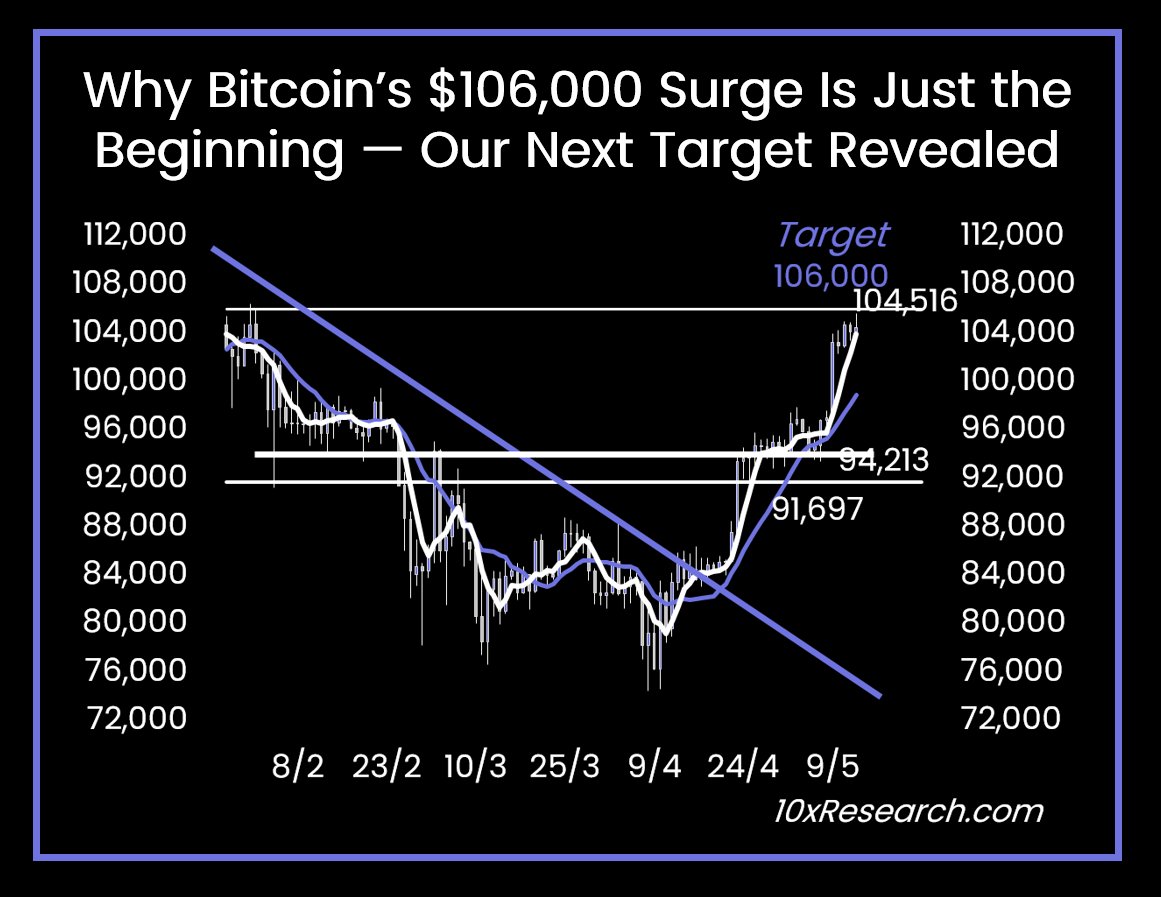
10x Research stated that it shifted bullish on April 12–13 after Bitcoin broke above the critical $84,500 trendline. At that time, the asset had been trading under a descending resistance level, failing to surpass key price points near $92,000 and $94,213.

Image

However, Bitcoin eventually formed a series of higher lows throughout April despite a broader consolidation trend. It secured a breakout above the trendline in late April, and this was followed by continued upward movement, confirming a reversal pattern.

At the point of breakout, several technical signals turned favorable. The Relative Strength Index (RSI) crossed the 50% threshold, suggesting strengthening momentum. Notably, analysts also observed a bullish divergence between price action and RSI readings, as Bitcoin printed a lower low that was not matched by the RSI.

This divergence aligned with the firm’s long-term strategy on call spreads, which has performed successfully as Bitcoin approached $106,000. Notably, 10x Research has now pushed its Bitcoin target upward, suggesting that the $106,000 is only Bitcoin’s steppingstone. However, the firm has hidden this new target behind a paywall.

Macro Conditions Support the Upside

Meanwhile, recent observations by 10x Research point to a changing market structure. The firm attributes the potential move to a combination of macroeconomic developments and increased demand through spot markets.

Easing inflation concerns and strategic buying have contributed to the rally. Additionally, growth in options trading has introduced new dynamics to Bitcoin’s price action. Platforms like Bybit now offer options, creating avenues for traders to leverage volatility and hedge positions.

Also note that in a May 9 update, 10x Research advised traders to retain existing $100K call spreads while rolling into June expiry spreads at $110K–$120K. The recommendation also includes hedging through short positions in the S&P 500. This trade setup reflects expectations of continued upside in the near term.

Technical Patterns Suggest Further Upside Toward $112K

Meanwhile, according to The Crypto Basic, the current price setup on the 4-hour chart indicates a breakout from an expanding wedge pattern. The recent upward surge has formed a 24-hour high of $105,706 while carving out a parallel channel.

Notably, a morning star pattern has emerged, often associated with breakout rallies. However, despite the price gain, the RSI has not shown a corresponding increase in this timeframe, suggesting a potential bearish divergence.

This lack of momentum may prompt a short-term retest of the previously broken trendline. For further gains, Bitcoin must close above the channel’s upper boundary. If achieved, the price could target the R1 pivot resistance near $108,284, with potential to extend toward R2 at $112,439.

Bitcoin Leads as Crypto Inflows Hit $882M in Fourth Straight Week of Growth

0

Digital asset investment products continued their positive momentum, recording a fourth straight week of capital inflows. 

According to data from CoinShares, these products brought in $882 million last week, raising total year-to-date (YTD) inflows to $6.7 billion. This marks a sustained investor interest in the digital asset space, coinciding with the recent uptick in crypto prices. 

For context, Bitcoin surged to touch $105,000, while Ethereum led the alternative coins with a surge to trade over $2,600.

Bitcoin Maintains Dominance 

Bitcoin continued to dominate digital asset inflows, drawing $867 million last week. This performance pushed U.S.-listed Bitcoin ETFs to a new milestone. Since launching in January 2024, these ETFs have accumulated $62.9 billion in net inflows, surpassing the previous all-time high of $61.6 billion set in February. 

In contrast, Ethereum saw limited activity with just $1.5 million in inflows last week. However, another notable development came from Sui, which posted $11.7 million in weekly inflows. This figure exceeded inflows for both Solana and Ethereum. As of now, Sui’s YTD inflows stand at $84 million, placing it ahead of Solana’s $76 million. 

While Bitcoin and Sui captured the largest inflows, several other altcoins posted modest movements, highlighting a more selective investor appetite.

XRP registered $1.4 million in weekly inflows, bringing its year-to-date (YTD) total to $258 million, placing it among the more favored alternatives this year. XRP has maintained steady interest with its assets under management (AUM) of $1.35 billion.

Inflows Driven Largely by Blackrock

According to CoinShares, last week’s inflows were largely driven by BlackRock’s iShares ETF, which attracted $1.02 billion. However, this gain was partly offset by outflows from several other major providers, including Grayscale and Bitwise. These outflows amounted to a combined $257 million.

Meanwhile, regional breakdowns show the United States retained its dominant position, contributing $840 million of the global total. Germany followed this with $44.5 million and Australia with $10.2 million in inflows. 

In contrast, Sweden saw the highest regional outflows, losing $12 million. Hong Kong and Canada also experienced negative flows of $8 million and $4.3 million, respectively.

Macroeconomic Trends Reinforcing Demand

According to CoinShares, the recent surge in digital asset prices and capital inflows appears linked to several overlapping market developments. Among the primary drivers is the global expansion of M2 money supply, which has increased liquidity across major economies. 

Simultaneously, persistent concerns over stagflation in the United States—where inflation remains elevated even as growth slows—are prompting investors to explore alternative stores of value. In addition, a number of U.S. states, such as Arizona, have started to pass legislation that recognizes Bitcoin as part of their strategic reserve holdings.

MicroStrategy Goes All-In Again on Bitcoin, Adds 13,390 BTC to Its Massive Reserve

Renowned Bitcoin firm Strategy is maintaining its weekly BTC acquisition strategy, announcing a fresh billion-dollar purchase today.

Specifically, Strategy has added 13,390 BTC tokens worth $1.34 billion to its expansive Bitcoin portfolio. The acquisition came at an average cost of $99,856 per coin. Following this latest addition, Strategy now holds a massive Bitcoin war chest totaling 568,840 BTC tokens.

Notably, the firm’s Bitcoin portfolio accounts for 2.864% of BTC’s circulating supply. This sizable holding further strengthens its position as the largest corporation with Bitcoin on its balance sheet.

While Bitcoin is trading above $103,300, Strategy’s average purchase price of $99,856 suggests the acquisition occurred several days ago, prior to today’s public disclosure by Michael Saylor, the company’s chairman.

Continued Bitcoin Acquisition

Strategy, formerly known as MicroStrategy, has been accumulating BTC since September 2020. During this period, the firm mostly followed a monthly purchasing schedule until the last quarter of 2024, when it transitioned to primarily weekly acquisitions.

Last week, it announced the purchase of 1,895 BTC worth $180.3 million at an average cost of $95,167. This week, the company disclosed an acquisition over seven times larger, committing more than $1 billion.

Strategy’s largest single Bitcoin purchase was announced on November 25, 2024, when it took custody of 55,500 BTC tokens worth $5.4 billion at the time.

To date, Strategy has invested $39.41 billion in Bitcoin over the past four years. With the overall portfolio now valued at $58.82 billion, based on BTC’s current price above $103,000, the company is sitting on an unrealized profit of $19.39 billion.

Notably, the company funded the latest purchase of 13,390 BTC using proceeds from its ongoing $42 billion at-the-market (ATM) equity offerings, which include both common stock (MSTR) and preferred stock (STRK).

Critics Warn of Market Risk

While the company’s bold strategy of raising capital through ATM offerings to purchase Bitcoin has earned praise, critics are also expressing concern. In response to the latest move, long-time Bitcoin skeptic Peter Schiff remarked that Strategy’s next buy could push its average cost above $70,000 per coin.

Schiff warned that a significant downturn in Bitcoin could send its market price below Strategy’s average cost basis. He argued this could be problematic, given how much the company has borrowed to accumulate Bitcoin. “When Saylor sells,” Schiff cautioned, “small paper losses will become huge real losses.”

However, Strategy founder Michael Saylor has made it clear he has no plans to sell. He previously stated that he would continue buying Bitcoin, even if the price climbs to $1 million per coin.

BlackRock Files with SEC for In-Kind Redemptions on Its Ethereum ETF: Here’s What It Means for ETH

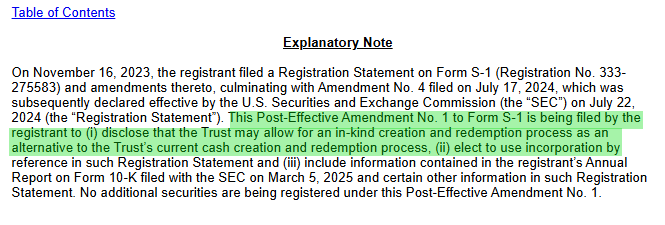
BlackRock has submitted an amended S-1 form to the U.S. SEC, proposing the inclusion of in-kind creation and redemption for its iShares Ethereum Trust ETF, ETHA. 

James Seyffart, a senior ETF analyst at Bloomberg, was the first to share details of this filing on X, confirming that the asset manager made the move on May 9. He revealed that the amended form now includes language that would allow in-kind redemptions once the SEC approves. 

BlackRock Pushing for In-Kind Redemption: What Does It Mean?

Seyffart, alongside fellow Bloomberg analyst Eric Balchunas, expects that the agency will approve in-kind processes at some point within 2025. Notably, the final deadline for the SEC to deliver a verdict on this application is November 10, 2025.

BlackRock Amendment James Seyffart
BlackRock S1 Amendment | James Seyffart

For the uninitiated, in-kind redemptions represent a crucial feature for many institutions. Instead of redeeming ETF shares for cash, authorized participants would be able to directly exchange shares for the underlying asset, in this case, Ethereum (ETH). 

This model could reduce transaction costs, minimize taxable events, and may even lead to greater operational flexibility, all of which are especially beneficial in the crypto markets.

BlackRock Also Wants to Include Staking in Its Ethereum ETF

While this recent filing centers on redemption processes, BlackRock is also actively engaging the SEC on another pivotal issue: staking. According to internal discussions with the SEC’s Crypto Task Force, BlackRock is pushing for ETHA to include staking features. 

Robert Mitchnick, the firm’s head of digital assets, has noted that staking is an important part of Ethereum’s investment appeal. Mitchnick argues that excluding staking from Ethereum ETFs overlooks a major portion of potential yield, and this limits the attractiveness of such products to investors.

Although the SEC has not yet approved staking, the conversations are ongoing. Seyffart previously suggested in April 2025 that while early approval for staking is possible, the final decision is expected by late October, with interim milestones likely in May and August.

BlackRock Ethereum ETF Performing Well

Meanwhile, amid these regulatory developments, ETHA’s market performance continues to show momentum. According to Sosovalue, on May 9, 2025, the fund recorded $17.61 million in net inflows, making it the only Ethereum ETF among nine trading in the U.S. to post positive flows that day. 

This followed a $21.77 million outflow on May 7 and zero flow on May 8. The two active trading days, May 7 and 9, marked the only sessions with movement last week, while the remaining days saw no net activity. Essentially, the ETF has amassed $15.94 million in net inflows for May so far.

As of May 9, cumulative net inflows since the fund’s inception in July 2024 stood at $4.2 billion, with total net assets valued at $2.93 billion. Despite volatility in weekly flows, ETHA closed April with $108.19 million in net inflows. 

Remarkably, since launch, the ETF has experienced only one month of net outflows, which occurred in March 2025 when it saw $200.81 million withdrawn.

Amber Unveils $100M Crypto Reserve Plan, Seeks to Invest in XRP, Bitcoin, and Fuel Institutional Crypto Adoption

0

Leading crypto finance company Amber International has announced plans to launch a $100 million crypto ecosystem reserve for XRP, Bitcoin, and other blockchain projects. 

The company unveiled its crypto reserve initiative in a press release today. According to the announcement, this reserve differs from other companies’ existing crypto treasury holdings. 

Reason for the Reserve 

It emphasized that the reserve would be deployed to solidify its leadership at the crossroads of decentralized (DeFi) and traditional finance (TradFi). 

In addition, Amber will use part of the $100 million fund to support high-impact blockchain projects boasting enormous potential. The company will use its AI-powered decision tool to determine which blockchain projects to support. 

So far, it has already made a strategic investment in Solana-based DeFi Development Corp (DFDV) and partnered with Web3 VC Hash Global on BNB Fund. 

Amber to Acquire High-Conviction Cryptos  

Further, it will use part of the $100 million fund to acquire high-conviction crypto assets. According to the announcement, Amber will initially focus on Bitcoin, XRP, Solana, Sui, Ethereum, and BNB. 

Amber disclosed plans to add other ecosystem tokens, including stablecoins like World Liberty Financial USD (USD1). For context, most of the cryptos on Amber’s watchlist–SOL, BTC, XRP, and ETH–are expected to feature in the United States crypto reserve. 

To meet institutional standards, Amber International said its crypto ecosystem reserve will operate within a comprehensive risk-management framework. This framework includes technical audits, legal and compliance reviews, constant monitoring, and economic considerations.  

Amber Contrasts Its Reserve with Existing Treasury Holdings 

Commenting on the development, Amber’s CEO Wayne Huo noted that the company’s crypto reserve initiative is unique, indicating that it is different from existing crypto treasury holdings. 

According to him, the reserve is not just about holding cryptos and anticipating potential price gains in the future. Instead, the funds will be deployed to foster institutional adoption of cryptocurrencies. 

He added that the company is currently aligning deeply with institutional clients while also enhancing its impact in the crypto ecosystem. According to Huo, the goal is to create a secure and scalable path for institutional investors to channel funds into the crypto market. 

The crypto reserve initiative has remained a major topic of discussion in the crypto community. Strategy pioneered the adoption of cryptos as reserve assets, and other companies like Metaplanet have also embraced the initiative. Interestingly, nation-states, particularly the United States, are also exploring ways to establish their own strategic crypto reserves. 

However, unlike existing treasury holdings, Amber aims to leverage its crypto reserve to support blockchain projects, invest in high-conviction assets, and enhance institutional crypto adoption. 

Former Ripple Head of XRP Markets: Why Ripple Holding a Large Volume of XRP Is Beneficial to XRP Adoption

A fresh perspective on Ripple’s massive XRP holdings has brought back discussions within the crypto community.

XRP community researcher Anderson argues that Ripple’s large stash of XRP is a strategic advantage, not a flaw. He states that Ripple’s holdings align its financial interests with XRP’s long-term adoption and value growth.

Ripple’s Incentives Tied to XRP’s Success

According to Anderson, Ripple holding a significant volume of XRP gives the company a strong incentive to prioritize building out the XRP Ledger (XRPL) ecosystem. If Ripple held little to no XRP, it would lack the financial motivation to prioritize XRP over competing blockchains.

Anderson noted that those with significant holdings of a particular coin are often the most likely to advocate for its adoption. He pointed to examples such as Michael Saylor’s support for Bitcoin. He also cited the early proponents of Ethereum, who invested during its initial coin offering and contributed their vision to shape the project’s future.

Former Ripple Executive Supports the Case

To bolster his point, Anderson referenced a video featuring Miguel Vias, Ripple’s former Head of XRP Markets. Vias was responsible for building XRP’s market infrastructure and liquidity during his tenure. His comments discussed how Ripple’s XRP reserves strengthen the market and support adoption.

Key points from Vias include the fact that Ripple can lend XRP to professional market makers at attractive rates, enhancing liquidity. Vias stressed that this is a difficult feat to achieve with Bitcoin.

Additionally, in less-liquid cross-border payment corridors using Ripple Payments, the company can temporarily cover cost gaps, encouraging usage until those corridors become self-sustaining.

Vias also noted that liquidity drives both utility and price. He explained that the more liquidity there is, the more utility XRP has — and, in theory, the more valuable it becomes over time.

Ripple’s Strategy

This approach positions Ripple as a long-term ecosystem builder. Rather than offloading XRP for short-term gains, Ripple is leveraging its balance sheet to set the foundation for adoption in the global payments infrastructure.

While skeptics often cite centralization risks with Ripple’s holdings, proponents like Anderson believe those holdings may be important for accelerating XRP’s utility and eventual valuation.

As of the end of 2024, Ripple held 42.51 billion XRP, with 4.48 billion tokens in spendable balances and 38 billion in escrow. However, the most recent data from Ripple’s API shows the company now holds 36.53 billion tokens in escrow and 4.906 billion in spendable wallets. This brings its total XRP war chest to 41.43 billion, worth $104.83 billion today.

With this massive financial position, Ripple CEO Brad Garlinghouse recently disclosed that the company’s strategy includes pursuing acquisitions of financial institutions that could further enhance its crypto-based payment solutions. The most recent — and most expensive — was its April acquisition of prime broker Hidden Road.

Pundits believe Hidden Road’s integration into the XRP ecosystem could lead to trillions of dollars in inflows.

Here’s Where XRP Really Fits Into ISO 20022

A prominent voice in the XRP community has reignited the conversation around XRP’s role in the future of global payments, particularly with ISO 20022.

Initial reports suggest that this standard will dominate financial messaging by 2025. While XRP’s role in ISO 20022 has been a topic of debate, the analyst behind “All Things XRP” believes that many discussions often overlook key points.

“XRP Is Not ISO 20022 Compliant,” But That’s Not the Point

The XRP community figure acknowledged that XRP is not ISO 20022 compliant. However, this claim has led to a misconception that continues to circulate within the community. In his view, the reality is more nuanced.

He explained that ISO 20022 is a messaging format for payment instructions and data. As such, XRP, being a digital asset, cannot be ISO 20022 compliant in itself.

However, Ripple’s enterprise blockchain solution, which facilitates cross-border payments, is ISO 20022 compliant. It integrates seamlessly with the new messaging standard. XRP serves as a settlement asset within this framework.

XRP’s Strengths Align with ISO 20022 Goals

The push toward ISO 20022 centers on enabling faster, richer, and smarter payments. XRP’s key strengths—settlement in 3–5 seconds, near-zero fees, and high throughput—mirror these objectives.

As a carbon-neutral, non-mined token capable of theoretically handling 1,500 transactions per second, XRP is in a good position to serve as a bridge asset in a system powered by ISO 20022, the community commentator explained.

Ripple’s Strategic Positioning

In 2020, Ripple decided to join the ISO 20022 Standards Body, becoming the first blockchain firm to do so. Its payment system already supports ISO 20022 messaging, allowing financial institutions to integrate without overhauling their legacy systems.

“All Things XRP” explained that through a unified API, these institutions can access Ripple Payments and choose to settle transactions with XRP.

This model doesn’t aim to replace ISO 20022 but rather complements it by offering liquidity and settlement capabilities, whereas the standard itself focuses on communication.

XRP vs. the Field

Several other blockchain projects, such as Stellar (XLM), XDC, Algorand, and Quant, also claim alignment with ISO 20022. However, few have cultivated the institutional partnerships that Ripple has.

With over 300 financial entities reportedly engaged with Ripple Payments, the company appears to be further along in real-world implementation than many of its peers.

Despite technical readiness and strategic integration, regulatory uncertainty had been a barrier to full-scale adoption. Ripple’s partial legal victory against the U.S. SEC was a milestone, but the recent final regulatory clarity could open the road even further.

Meanwhile, the commentator also addressed the rise of central bank digital currencies (CBDCs), noting that they introduce both a threat and an opportunity. According to him, while CBDCs could reduce reliance on bridge assets like XRP, there’s also potential for XRP to serve as an inter-CBDC settlement layer.

XRP Isn’t at the Core, But Around It

The pundit concluded that while XRP isn’t at the core of ISO 20022, it plays a crucial supporting role. It’s a fast, liquid settlement layer designed to ride alongside the new global messaging standard, not replace it.

In his view, its ultimate success will depend on adoption, regulation, and how central banks implement digital currency infrastructure.

Analysts See XRP Reaching $7 to $15, Citing Cycle Blow-off Top and Symmetrical Triangle Breakout

Several analysts expect XRP to claim new price peaks in the foreseeable future, citing a blow-off top in the current cycle and a symmetrical triangle breakout.

These analyses come on the back of the renewed momentum in the crypto market, buoyed by the recent Bitcoin (BTC) recovery above the $100,000 mark. XRP has also jumped on the uptrend, looking to break into the upper end of the $2 price region and leverage this as a launchpad for higher price gains.

XRP in Parabolic Phase

Amid this current push, market analyst Mags, who calls himself “the scalping pro,” believes XRP is on the verge of an impressive run. In his latest commentary, Mags first confirmed that he predicted an XRP rally when the asset was stuck below $0.5. This rally materialized when XRP soared nearly 600% from November 2024 to January 2025.

Now, the analyst says a subsequent upsurge could occur, potentially leading to a $7 price target. Notably, after the November 2024 to January 2025 run, XRP faced a pullback from the $3.3 peak and slipped into a consolidation phase at the $2 mark. This consolidation has persisted since February 2025.

Mags suggests the range-bound movements resemble what XRP faced back in 2017/2018. During this period, the asset rallied from $0.0055 in March 2017 to $0.3988 in what the analyst called a parabolic phase. After this phase, XRP consolidated for six months before soaring further to $3.4, which he referred to as the blow-off top pattern. 

XRP Cycle Phases Mags
XRP Cycle Phases | Mags

In his chart, Mags indicated that XRP typically follows four different phases in each cycle: the first bounce, the accumulation phase, and then the parabolic phase and blow-off top.

XRP Eyes $7 as Blow-off Top Target

During this ongoing cycle, the accumulation stage occurred during the bear market from June 2022 to October 2024, as XRP hovered around $0.50. After this, the parabolic phase emerged in November 2024, with XRP soaring to the $3.4 peak by January 2025.

Now, Mags suggests the current consolidation is similar to what the market observed during its six-month consolidation in 2017. Just like in 2017, he expects a breakout that would lead to the blow-off top, targeting an ultimate price of $7.3. This represents an increase of 202% from the current price of $2.41.

A Possible Push to $15

However, while analyst Ali Martinez believes XRP has another leg up, he expects the asset to see a more substantial gain. Martinez cited a breakout from a multi-year symmetrical triangle pattern that formed from January 2018 to November 2024. XRP broke above this pattern when it rallied toward $2 after the U.S. elections in November 2024.

Currently, the asset is witnessing a consolidation after the breakout. According to Martinez, if the symmetrical triangle dynamics are still governing XRP’s current price action, the asset still has room for more growth. He expects a rally to $15, marking a 522% upsurge.

Meanwhile, the analyst behind the Crypto Crew University trading platform is also bullish on XRP. In a recent analysis, he confirmed that XRP might be repeating an RSI explosion it observed in 2017 and 2021. This involves a surge in the monthly RSI above 65.

XRP 1M RSI Crypto Crew University
XRP 1M RSI | Crypto Crew University

According to the analyst, during the previous two instances of this explosion, XRP price saw a substantial upsurge. He believes this bullish push could repeat this time. He stressed that the Stock RSI cross-up could be the early signal that this bullish RSI explosion is about to occur.