Home Blog Page 750

Here is How High Shiba Inu Can Go by 2050

Despite its meme-inspired origins, industry experts have identified Shiba Inu as one of the crypto projects with the potential to endure and remain relevant for decades.

Shiba Inu entered the crypto scene in August 2020 and has since climbed the ranks, becoming one of the top ten cryptocurrencies at various points. With a market cap of $7.8 billion, Shiba Inu is the 17th largest cryptocurrency by market capitalization and the second most prominent meme after Dogecoin.

Today, Shiba Inu trades at $0.000015. Many believe the coin could cancel more zeros in the future with ongoing development and expansion in the SHIB ecosystem. 

In light of this, The Crypto Basic considers how high Shiba Inu’s price could go by 2050, or 25 years from now. This article relies on price predictions by AI chatbots and suggestions from renowned industry commentators.

Token Burns and Supply Dynamics

One of the most critical factors influencing SHIB’s future price is its massive circulating supply of approximately 589 trillion tokens. For context, reaching a price of $0.01 would require a market cap of $5.89 trillion.

However, token burns are intended to address this issue. Projections suggest that reducing the supply by 50% to 90% could create the deflationary pressure necessary for meaningful price growth without requiring an astronomical market cap.

Ecosystem Expansion and Real Utility

Although Shiba Inu began as a meme coin, its ecosystem has expanded significantly. Key components now include:

  • Shibarium, a Layer-2 network for faster, cheaper transactions
  • ShibaSwap, a decentralized exchange
  • NFT projects and a planned presence in the metaverse
  • Partnerships with major institutional and government entities, such as the UAE

These developments are gradually transforming SHIB from a meme coin into a utility-driven asset. Analysts suggest that continued innovation and ecosystem adoption will be crucial for Shiba Inu to stay relevant and attract long-term investors.

Shiba Inu Price Predictions for 2050

Various sources, including AI-powered platforms like ChatGPT and Grok AI, have shared a broad range of price forecasts for Shiba Inu by 2050.

ChatGPT cited conservative estimates suggesting that SHIB could be worth between $0.0005 and $0.005. This projection assumes moderate token burns, limited but focused utility, and steady market growth.

Given SHIB’s current price of $0.000015, reaching $0.0005 would require a growth of approximately 3,746%. Hitting $0.005 would demand a more substantial increase of around 38,362%.

In contrast, Grok AI offered more optimistic projections, with potential highs ranging from $0.008 to $0.089 by 2050. These estimates are based on broader adoption and robust ecosystem development. Notably, reaching $0.089 would require a staggering growth of 684,515% over the next 25 years.

Even more ambitious predictions have come from Telegaon, which projected that SHIB could reach $1.06 by 2050. This would represent an astronomical growth of 8,153,746%.

However, it’s important to note that reaching $1 would require a market cap nearing $589 trillion. Experts agree that this is highly unrealistic without a supply reduction of more than 99%.

Analyst Explains Why $10, $100, and $1,000 XRP Targets Are “Realistic” with 5 Scenarios

Crypto analyst “Stellar Rippler” has reignited discussions around the long-term valuation of XRP.

He argued that the often-mocked price targets of $10, $100, and even $1,000 are not only feasible but rooted in real-world utility and global financial infrastructure transitions.

In an X thread, the commentator broke down how XRP could tap into global liquidity. The analysis touched on avenues like SWIFT and derivatives, presenting XRP as the backbone of a new monetary system.

Scenario 1: Replacing a Fraction of SWIFT Could Drive $27–$50 XRP

The first scenario relies on SWIFT, which processes around $5 trillion daily transactions. According to the thread, if XRP captures even 10% of this flow as a settlement layer, given its design for fast cross-border transactions, it would handle $500 billion daily.

Assuming conservative liquidity multipliers, the price range of XRP in this model lands between $27 and $50.

Scenario 2: Unlocking Trapped Capital in Nostro/Vostro Accounts

Notably, banks collectively hold around $27 trillion in pre-funded Nostro/Vostro accounts. The analyst suggests XRP could be the bridge asset to free up that capital.

If XRP handles just 5% of that value, the price projection jumps to $80–$100. Notably, this is based on the assumption that XRP would need to be held in sufficient quantity to support such liquidity.

Scenarios 3–5: From Banking Licenses to Derivatives and Global Integration

Meanwhile, the thread outlines even more ambitious scenarios. One involves the potential role of XRP if Ripple secures a banking license that enables direct access to central bank systems and global lending. It argued that XRP could power a new on-chain financial architecture, placing its price “easily above $100.”

Another scenario involves adoption by the IMF and World Bank. With Ripple already in correction to over 40 central banks and referenced in tokenization reports by the IMF and BIS, the analyst sees a $250–$500 price tag if XRP is standardized as a global liquidity rail.

Regarding derivatives settlement, the analyst suggested that tapping just 0.1% of the $1 quadrillion derivatives market via the XRP Ledger could catapult the token to over $1,000.

So Why Isn’t XRP at These Levels Now?

According to Stellar Rippler, these projections remain far-fetched due to lawsuits, suppression, and “confusion.” The argument is that XRP’s full potential is being intentionally delayed until the legacy financial system is ready to integrate such a transition.

This perspective suggests XRP will become significantly more expensive than its current price of around $2.

While many have laughed off four-digit XRP forecasts, this thesis attempts to flip the narrative. It positions XRP not as a speculative altcoin but as core infrastructure for global liquidity movement.

The analyst compared XRP’s utility-driven future to Bitcoin’s belief-driven past. Specifically, it claimed that if BTC rose to over $100K based on belief, XRP may rise based on function.

Stellar Rippler also acknowledged that if, for the sake of argument, $1,000 per XRP is unrealistic due to the required $55 trillion market cap, then a $10 target is “ridiculously achievable.”

Notably, this target would require only a $582 billion market cap, though XRP’s current market cap is far below that, at approximately $130 billion.

The World’s First International Crypto Trading Cup Goes Live

0

The International Crypto Trading Cup (ICTC-2025) has officially kicked off — marking the debut of the world’s very first global crypto trading competition conducted live, right on stage.

For the next two days, from May 9 to May 10, audiences across the globe will experience an unprecedented spectacle: two intense 6-hour crypto futures trading sessions, broadcast live with complete transparency. Expect expert analysis, real-time strategy discussions, market commentary, and professional insights, bringing crypto trading closer to viewers than ever before.

Why you shouldn’t miss ICTC-2025

A worldwide milestone: Watch top traders from different corners of the world battle it out live on a single stage.

Shaping the industry’s future: More than just a competition, this event sets a new benchmark for combining crypto trading with education and entertainment.

An engaging experience: Part competition, part interactive workshop — viewers can learn trading tactics, explore new strategies, and compare approaches alongside seasoned professionals.

Interactive by design: Watch every move live, vote for your favorite traders, and even join the competition yourself.

How to get involved?

Besides tuning in to the live event, there are multiple ways to participate in the action.

Thinking of competing?

You can join the tournament either solo or as part of a team. Simply visit the official competition page and choose “Compete Solo” or “Choose Squad.” If you’re already a registered user on the exchange, all you need to do is confirm your subaccount creation and connect it to your TradingView account.

Competitors will trade from 13:00 to 19:00 UTC on May 9 and May 10, utilizing WhiteBIT futures pairs directly through the TradingView platform.

Prefer watching with a chance to win?

Not trading? You can still participate by voting in several exciting award categories. If your picks closely match the actual outcomes, you’ll earn a share of the 6,500 USDT prize pool spread across five categories.

To unlock voting access, just complete a few simple steps like signing up on the exchange or passing KYC to start collecting points.

Whether you’re a crypto veteran, a trading beginner, or simply curious about digital finance, this is an event you won’t want to miss.

Powered by Industry Giants

ICTC-2025 is backed by a powerhouse lineup of industry leaders driving innovation. TradingView takes the role of official technology partner, while Tether steps in as title sponsor and prize pool contributor.

Adding more firepower to the championship, XTraveler, Anda Seat, and Renty.ae join as official partners and prize sponsors. XTraveler serves as the official travel partner. Anda Seat ensures traders compete in comfort with their top-tier gaming chairs on stage. Meanwhile, Renty.ae elevates the prize offerings with an exclusive 52-foot yacht experience.

About WhiteBIT

WhiteBIT stands as Europe’s largest cryptocurrency exchange by trading volume, featuring over 780 trading pairs, 330+ digital assets, and supporting 9 fiat currencies. Established in 2018, it operates under WhiteBIT Group, catering to more than 35 million users worldwide. The platform collaborates with major brands including Visa, FACEIT, FC Barcelona, Trabzonspor, and the Ukrainian national football team, all while advancing global blockchain adoption.

This announcement reflects the operations of all WhiteBIT Group entities globally, not limited to its activities in Europe.

Brazil’s B3 to Launch Ethereum and Solana Futures, Cuts Bitcoin Contract Size

The Brazilian Securities and Exchange Commission (CVM) has approved the launch of Ethereum and Solana futures contracts by B3, the country’s main stock exchange. 

The products will launch on June 16, marking a significant step forward in Brazil’s embrace of crypto asset derivatives.

This expansion follows B3’s earlier introduction of Bitcoin futures in 2023. Now, investors will have access to a broader range of regulated crypto derivatives through the traditional financial system.

Contracts Priced in USD, Tied to Nasdaq Indices

Unlike Bitcoin futures traded in Brazilian reais, the new Ethereum and Solana contracts will be denominated in U.S. dollars. The pricing will be linked to the Nasdaq Ether Reference Price and Nasdaq Solana Reference Price, providing globally recognized benchmarks.

Each Ethereum futures contract will represent 0.25 ETH, while Solana contracts will be sized at 5 SOL. These instruments will settle financially based on price movement, with monthly expirations on the last Friday of each month.

Bitcoin Futures Contract Size Reduced by 90%

Meanwhile, to broaden retail access, the CVM also approved a tenfold reduction in the Bitcoin futures contract size. Starting June 16, each contract will represent 0.01 BTC instead of 0.1 BTC. This brings the notional value down to roughly R$5,300, from the previous R$53,000, a 90% reduction.

The goal is to increase market participation and liquidity while reducing the costs of trading large contracts. Regarding accessibility, the change aligns the Bitcoin product more closely with the newly launched Ethereum and Solana futures.

Beyond futures contracts for Bitcoin and Ethereum, B3 is also offering exchange-traded products related to crypto assets. Among the most recent introductions is the Hashdex spot XRP ETF.

B3 Positions Itself as a Crypto Derivatives Hub

According to B3’s Director of Products, Marcos Skistymas, the move reflects a growing demand from investors for secure, regulated exposure to crypto assets.

He noted that the company is introducing more advanced financial instruments and broadening the choices available for those who want to follow digital asset price movements.

Bitcoin and Ethereum Hunt Bears as Crypto Short Liquidation Hits 4-Year High of $871M

0

Meteoric price rallies from Bitcoin and Ethereum dealt severe blows to bears, with liquidation figures reaching multi-year highs.

The cryptocurrency market added over $235 billion in the past day as the sector continues its recovery process. The rally pushed the industry’s valuation to $3.25 trillion, with bears in shambles.

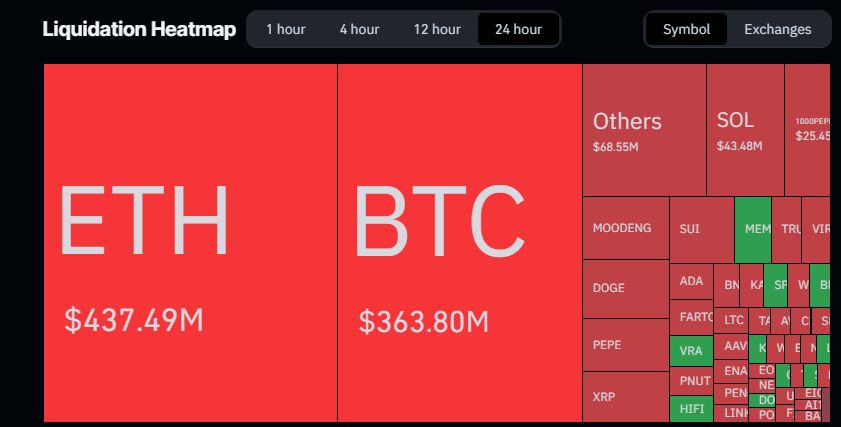
Data from Coinglass highlighted a bear battering in the past 24 hours, with short liquidation reaching insane levels. Specifically, traders betting on lower Bitcoin and altcoin prices suffered losses reaching $871 million, the largest since July 2021.

Liquidation Frenzy

While bulls suffered considerable losses, bears predominated the liquidation frenzy. For perspective, about $1.17 billion worth of leveraged positions were chalked off the crypto market in the past 24 hours, with 74% worth $871 million in shorts and 26% ($300 million) in longs.

Meanwhile, Ethereum bears suffered the most losses following the asset’s over 20% rally in the past day. The altcoin king surged from sub-$2,000 to a three-month high of $2,490, liquidating $300 million in leveraged short bets. Notably, $136.74 million worth of long positions also left the market, totaling $437.49 million.

Bitcoin bears also felt the heat, accounting for 91% of all BTC liquidated positions. Today’s 5% rally to above $104,000 ensured that $330 million of the $363.80 million worth of positions affected were bearish bets.

Other notable assets with massive liquidation figures include Solana, Pepe, and, surprisingly, MOODENG. An 11%, 35%, and a staggering 152% uptick ensured that $34.7 million, $17.56 million, and $14.85 million worth of bear positions were liquidated, respectively.

Crypto Liquidation Heatmap

Remarkably, Coinglass noted that Binance did not fully disclose its data, suggesting there might be higher statistics than displayed. Meanwhile, the largest singular liquidation in the past 24 hours came from a whale, who lost $11.97 million on the BTC/USDT pair on Binance.

Easing Selling Pressure Suggests More Upsides

For context, CryptoQuant’s CEO, Ki Young Ju, highlighted easing Bitcoin’s selling pressure as a catalyst for this price acceleration. He noted in a tweet that whales did not just stop selling; massive inflows from institutions and US exchange-traded funds (ETFs) have accelerated.

While admitting to his earlier wrong disposition, he stressed that the crypto market dynamics have evolved from old whales and retail passing around Bitcoin to a more diverse setting with growing capital influx from institutions and even governments.

Meanwhile, with market indicators slowly turning bullish, analysis suggests Bitcoin may see further upside. Moreover, prominent market participants have predicted prices like $120,000 before the end of Q2 and $200,000 by the end of the year.

Top Researcher Says Bitcoin Going Higher Amid Global M2 Expansion Trends

0

Crypto researcher Julien Bittel links the ongoing Bitcoin surge to global M2, suggesting that the largest cryptocurrency may climb further in the coming weeks.

Bitcoin briefly surged past the $100,000 mark this week, climbing as high as $104,000 before settling near $103,000. This movement followed reports suggesting U.S. and Chinese officials would meet in Switzerland over the weekend to discuss a possible trade agreement. 

The news injected optimism into markets, pushing Bitcoin higher. Yet, beyond this headline-driven jump, ongoing analysis of liquidity trends and their relationship to Bitcoin is taking center stage, with contrasting views from key market observers.

Global M2 as a Leading Indicator for Bitcoin

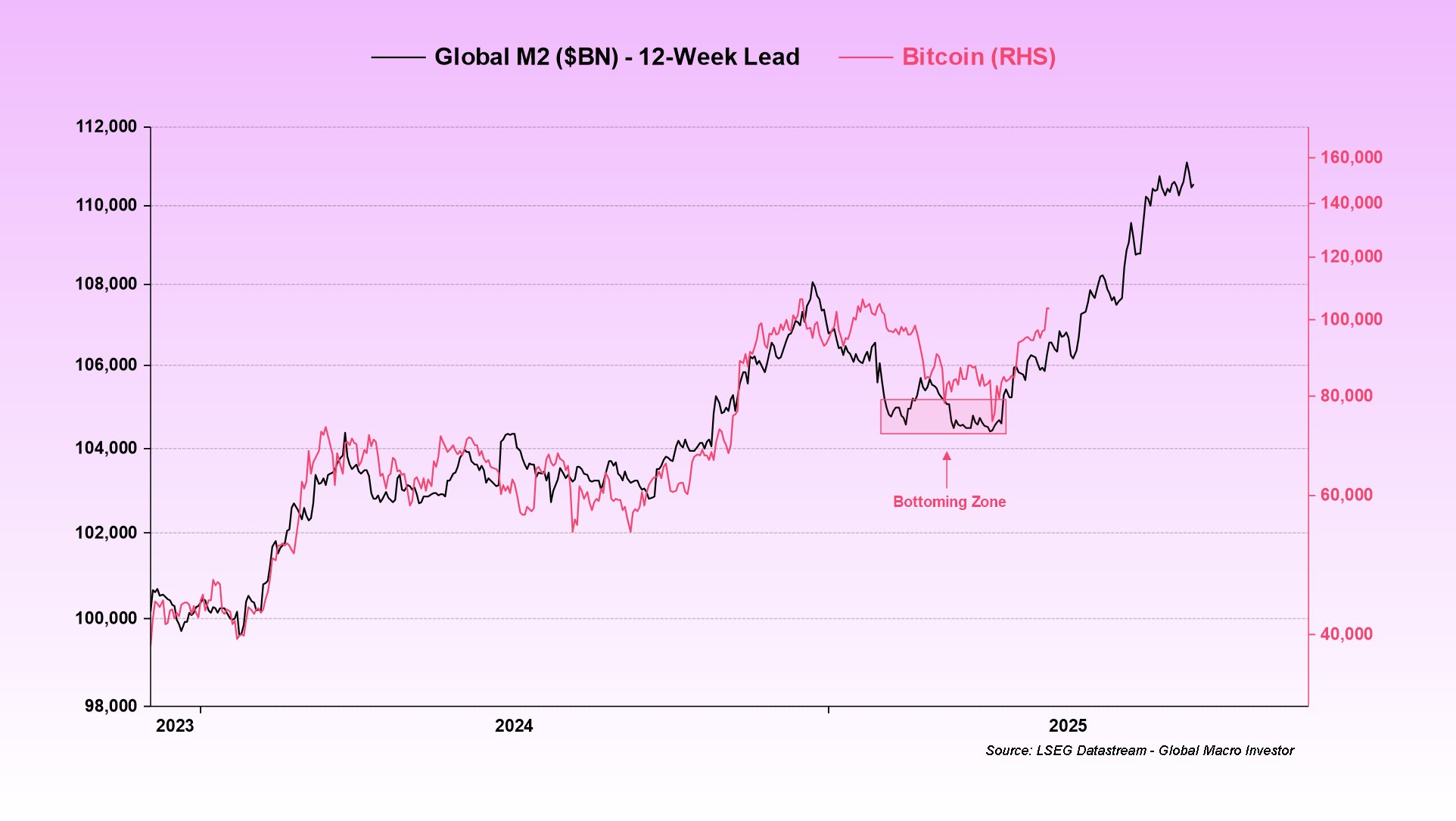
For instance, Julien Bittel, Head of Macro Research at Global Macro Investor (GMI), has pointed to a chart linking global M2 money supply to Bitcoin’s price action.

According to Bittel, the chart shows M2 acting as a 12-week leading indicator, where increases in global liquidity often precede Bitcoin rallies by about three months. Over the past two years, this pattern has remained consistent.

Image

From early 2023 to early 2024, global M2 steadily climbed from around $98 trillion to just above $108 trillion. Bitcoin’s price action mirrored this rise, with a notable rally over $100,000 by late 2024.

However, mid-2024 saw a temporary pause in M2 growth, which coincided with Bitcoin entering a range-bound phase, dipping below $80,000. This phase, described as a “bottoming zone,” marked a consolidation period that aligned closely with the M2 stagnation.

Since late 2024, global M2 has resumed a sharp upward trajectory, now exceeding $111 trillion. Based on the existing 12-week lead relationship, this recent rise may signal continued Bitcoin strength into mid-2025. 

Bittel stated that the recent surge in global M2 indicates further upside for Bitcoin in the weeks ahead, noting, “We’re going higher.”

Alternative View: Bitcoin as a Leading Signal

Meanwhile, Benjamin Cohen has questioned the narrative that Bitcoin lags liquidity. On X, he challenged the offset-based approach often used in liquidity charts. He noted that applying a three- to four-month M2 lead fails to align with Bitcoin’s 2021 and 2017 tops, both of which occurred before M2 peaked.

Instead, Cohen proposed that Bitcoin could lead liquidity trends. Under this framework, the 2021 Bitcoin peak aligns directly with M2’s later rise, while Bitcoin’s summer 2022 lows correspond with a delayed M2 bottom. He noted the FTX collapse extended Bitcoin’s decline beyond the liquidity signal’s timing.

This perspective implies Bitcoin’s current surge could suggest an upcoming contraction in global M2, rather than continued expansion. This interpretation challenges the prevailing assumption and raises new questions about Bitcoin’s role in macroeconomic forecasting.

Impact of DXY and Market Implications

As Cohen expands his analysis, he suggests that movements in the U.S. Dollar Index (DXY) could explain changes in global M2. Because global M2 largely reflects dollar strength, a rising DXY could reduce global liquidity. He traced DXY’s trajectory from late 2024 and anticipates a rally back to its 20-week simple moving average before further declines in 2026.

According to Cohen, if Bitcoin is indeed leading liquidity, a DXY rebound may push global M2 lower into the summer. This development could impact crypto markets more broadly, especially altcoin-to-Bitcoin pairs. Historically, these pairs tend to weaken when the dollar strengthens, suggesting a potential downtrend in alternative assets relative to Bitcoin.

CryptoQuant CEO Admits He Was Wrong in Saying Bitcoin Bull Run is Over Amid Push Above $100K

0

CryptoQuant CEO Ki Young Ju has publicly retracted his previous bearish forecast, citing sustained institutional inflows through Bitcoin ETFs as a major factor redefining the market landscape.

This changing view by the leading analyst comes at a time when Bitcoin has surpassed the $100,000 psychological resistance, now trading at $103,608.

While Ki had earlier concluded that the bull market had ended, he now attributes his misjudgment to structural changes brought on by large-scale capital movements, particularly from institutional investors.

Capital Inflows Alter Traditional Market Structure

Institutional engagement through ETFs has introduced a new liquidity mechanism in the Bitcoin market, according to Ju. Historically, the Bitcoin cycle revolved around miners, whales, and retail traders. 

Once individual capital ran dry, whales typically triggered coordinated sell-offs, leading to rapid market reversals. That cycle often resembled a musical chairs scenario, where late exits resulted in losses for retail participants. However, the current environment, characterized by consistent ETF participation, has disrupted this previous pattern.

Now, ETF issuers, institutional buyers, and entities such as MicroStrategy are active market participants. Ki emphasized that these actors continue to absorb sell-side pressure from whales, resulting in a more stable capital base. 

Importantly, Ki noted that market indicators are still at neutral levels, with no definitive signals pointing to a sustained bull or bear phase. Despite this ambiguity, he stressed that the profit-taking cycle has shifted, prompting a need to revisit traditional models of analysis.

On-Chain Models Face Recalibration

Even long-standing on-chain metrics have begun showing signs of reduced predictive power. Ki referenced the Signal 365 MA model, which tracks Bitcoin’s deviation from its 365-day moving average. 

Although this model has reliably marked market extremes in the past, it now struggles to align with current price behaviors. Ki acknowledged this limitation and committed to improving the sophistication of CryptoQuant’s analytical tools in response to the changing conditions.

Despite recent misjudgments, Ki reinforced that on-chain data remains valuable when paired with updated interpretations. He also referenced analysts like Minolet, who presented alternative insights during the same period. 

ETF Flows And Bullish Prediction

Notably, Ki’s disclosure remains plausible, as Bitcoin ETFs continue to observe massive inflows. The products recorded another day of positive inflows on Thursday. According to data, they added $117 million, slightly down from the $142 million reported the previous day. 

Screenshot 2025 05 09T173405935
Bitcoin Flows

However, none of the major ETFs experienced outflows, supporting the view that institutional sentiment remains optimistic. 

This continued interest aligns with recent long-term forecasts by Muneeb Ali, founder of Bitcoin Layer 2 platform Starks.

Ali has projected another potential 10x surge in Bitcoin’s value to $1 million, based on prior historical movements. He outlined previous exponential climbs—first from $100 to $1,000 in 2013, then to $10,000 by 2017, and finally to $100,000 by late 2024. These sequential phases, he noted, form a pattern that may extend further if current conditions persist.

Market Expert Predicts Timeline for Bitcoin to Reach $200K

A market analyst has predicted when Bitcoin could reach the $200,000 price milestone, updating his earlier target upward due to current market realities.

Bitcoin (BTC) is currently outperforming market expectations amid the ongoing recovery effort. The firstborn crypto has ripped above the $100,000 resistance milestone, currently holding the $102,000 mark following an impressive 6.4% intraday gain on May 8.

Data from pseudonymous market expert, Intuit Trading, the founder of media platform Blockchaindaily, shows that Bitcoin has exceeded his expectations during this uptrend. 

Bitcoin Exceeds Earlier Target, Eyes $200K by July 2025

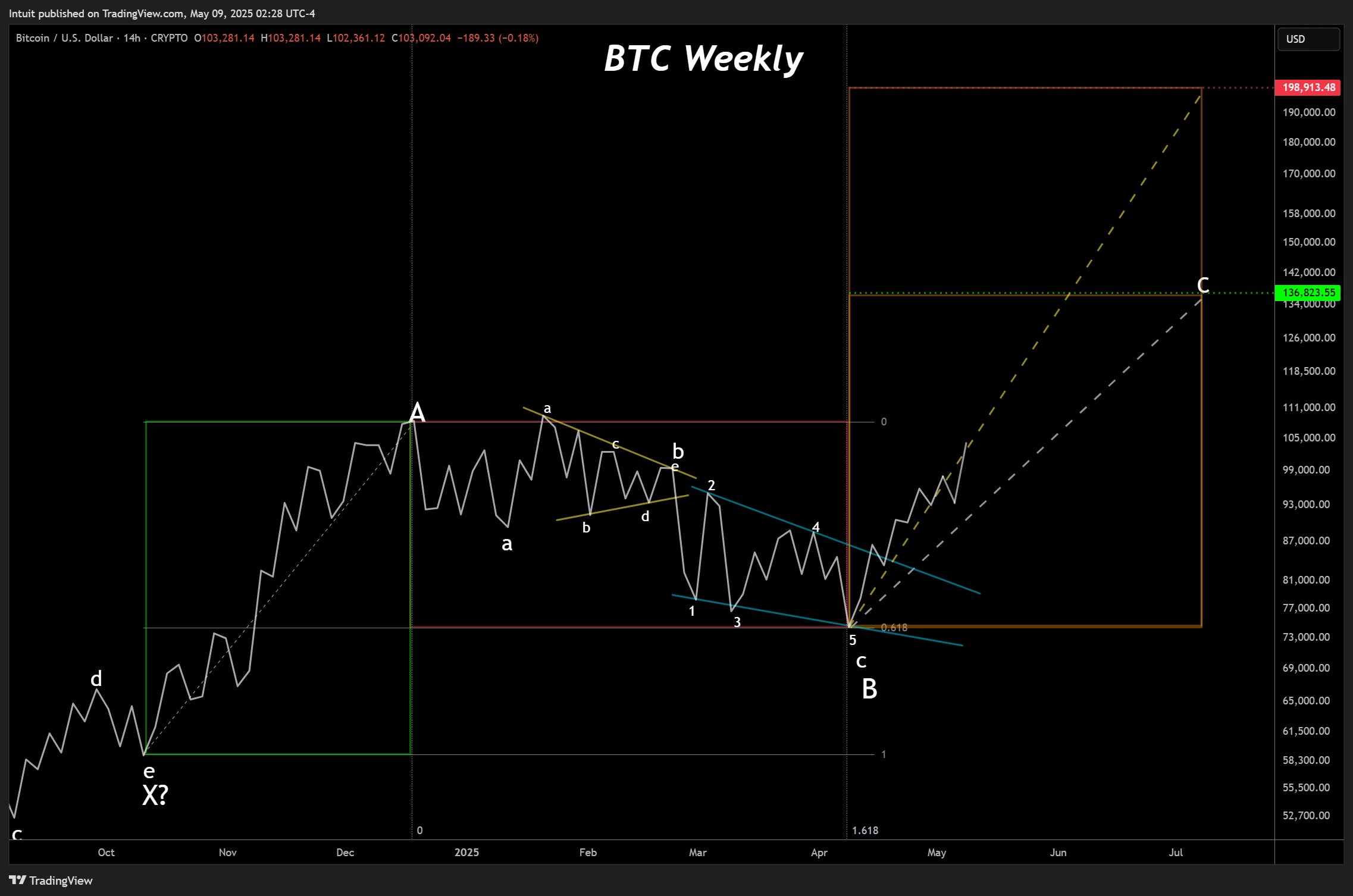
Earlier last month, the analyst suggested that the crash to $74,000 on April 7 represented Bitcoin’s bottom, and the asset could only soar from here. This report came up three days after the crash, on April 10, affirming confidence in the crypto firstborn’s potential. 

Twenty days later, on May 1, Intuit Trading confirmed that Bitcoin had gained 25% since his earlier analysis. Building on the bullishness, he predicted that the asset would continue its bullish run, eventually claiming a new ATH of $136,000 by July 2025. He traced a gray pattern that Bitcoin could follow on this path to $136,000.

However, Bitcoin’s recent price action has deviated from this path, but on a positive note. Intuit Trading’s latest report indicated that the premier crypto asset has moved much faster than he anticipated, suggesting that it would have remained on the gray path if $136,000 was the target by July.

Instead, the analyst suggested that Bitcoin is following another path, a yellow trendline, which points to a much higher target by July. According to him, BTC has remained on this yellow line since the bottom on April 7, persistently above the gray one. Interestingly, the yellow line leads to a $200,000 price target by July 2025.

Bitcoin Following Yellow Trendline Intuit Trading
Bitcoin Following Yellow Trendline | Intuit Trading

Notably, several analysts have also projected a Bitcoin run to $200K. For instance, Dan Gambardello also argued last month that the bottom is in, predicting a rally to $200K. Further, leading asset manager Bitwise also predicted a BTC upsurge to $200K by year-end. Bernstein analysts also expect Bitcoin to reach $200K by the end of this year.

Analysts Growing Increasingly Bullish

Meanwhile, amid the recent recovery, analysts are now growing increasingly bullish. For one, Ki Young Ju, founder of CryptoQuant, admitted he was wrong when he suggested the Bitcoin bull run was over back in March. 

According to him, the market is currently absorbing new liquidity, and the 4-year cycle theory might be useless now as the Bitcoin market grows incredibly diverse. Still, he insisted that most indicators are not showing clear bullish or bearish signals but lying around the borderlines.

Also, Julien Bittel, a Chartered Financial Analyst and Head of Macro Research at GMI, provided an update to the Bitcoin chart against the Global M2 supply chart. Interestingly, the comparison shows that Bitcoin has continued to follow the trajectory of the M2 money supply since 2023.

Bitcoin Follows the Global M2 Lead

Currently, the global M2 money supply has risen to surpass the $110 trillion mark, with Bitcoin looking to maintain the correlation. If the correlation persists, then Bitcoin still has some upside potential, with a possible rally to the $160,000 mark. At press time, Bitcoin changes hands at $102,991, up 3.8% over the past 24 hours.

Taiwan Lawmaker Proposes Integrating Bitcoin Into National Diversified Reserve

0

Ko Ju-Chun, a Taiwanese lawmaker, urges the government to consider integrating Bitcoin into its diversified reserve to hedge against economic uncertainties. 

Ju-Chun made the recommendation at today’s National Conference. The Taiwanese lawmaker also took to X to call crypto enthusiasts’ attention to his speech, in which he advocated for Bitcoin investment at the federal level. 

Need to Recognize Bitcoin Alongside Gold and Foreign Exchange Reserves 

During his speech, Ju-Chun argued that Bitcoin can hedge against global economic uncertainties. Therefore, he advised the Taiwanese government and NGOs to recognize Bitcoin alongside gold and foreign exchange reserves. 

In his view, this effort could strengthen the Taiwanese financial system’s resilience and adaptability. The development comes after Ju-Chun met with popular Bitcoin proponent Samson Mow to explore the potential adoption of a BTC reserve strategy in Taiwan.

Mow’s hyperbitcoinization-focused company, Jan3, announced the development yesterday, suggesting that adoption is crucial due to the increased volatility of fiat currencies. 

Why Taiwan Should Adopt Bitcoin as a Reserve Asset 

Hours after the announcement, Ju-Chun spoke at the National Conference to further advocate for the Taiwanese government’s investment in Bitcoin. According to him, Taiwan, which is an export-driven economy, has experienced significant fluctuations in the value of its fiat currency, the New Taiwan Dollar (NTD). 

He attributed this volatility to global inflation and other geopolitical risks. Previously, countries have leveraged gold and other foreign exchange reserve assets to hedge against these economic uncertainties. 

Notably, Ju-Chun also disclosed that Taiwan has 423 metric tons of gold in its reserves and an additional $577 billion worth of foreign exchange assets. However, following recent economic uncertainties, government officials like Ju-Chun think these traditional assets are insufficient to protect against major currency volatility and potential regional conflicts. 

He emphasized that the Taiwanese government may not be able to guarantee NTD’s security and liquidity during intense economic uncertainties. Therefore, he suggested integrating Bitcoin into the national reserve. 

The lawmaker highlighted several reasons why he believes Bitcoin is a suitable addition, including its decentralized nature, fixed supply, resistance to censorship, and resilience for over 15 years. 

He disclosed that several countries are already exploring Bitcoin’s hedging properties and urged Taiwan to do the same. 

Ju-Chun Wants 5% of Taiwan Reserve Allocated to Bitcoin 

Meanwhile, the legislator stressed that while Bitcoin is not the only solution to growing economic challenges, the Taiwanese government needs to hold a small fraction of the cryptocurrency in reserve. 

Earlier this month, Ju-Chun revealed that Taiwan could allocate up to 5% of its $50 billion reserve to Bitcoin, representing $2.5 billion. 

He made this suggestion following reports that New Hampshire has become the first U.S. State to authorize allocating 5% of its treasury to Bitcoin. 

Since Donald Trump ordered the creation of a strategic Bitcoin reserve in the U.S., several nations and states have been deliberating on whether to follow suit. While the U.S. strongly advocates for this initiative, countries like the U.K. and Japan have kicked against adopting BTC as a reserve asset. 

XRP Above $2.41 Is Bullish, Below $2.15 Is Bearish — Anything In Between Is Just “Micro Noise”: Analyst

Renowned chartist EGRAG has issued an updated analysis of XRP price behavior based on the Bull Market Support Band (BMSB).

In the recent disclosure, he emphasized the importance of the current range between $2.15 and $2.41. According to the analyst, the market is in a crucial consolidation phase, where decisive moves above or below these levels could determine XRP’s next trajectory.

XRP Stuck in “Micro Noise” Zone

The latest commentary updates his analysis from May 5, when EGRAG noted that XRP was trading around $2.14, right at the edge of what he calls the Bull Market Support Band.

The analyst closely monitors this zone, ranging from $2.15 to $2.41, for a breakout or breakdown. He categorizes any price action within this range as “just micro noise,” suggesting it lacks a meaningful directional signal.

Notably, XRP is up over 6% today, trading at $2.30. EGRAG now suggests that a bullish breakout would be confirmed if XRP closes above $2.41 for three consecutive days.

Meanwhile, he noted that a close below $2.15 could invalidate short-term bullish sentiment and indicate a deeper correction. According to him, XRP remains in limbo until either level is breached with conviction.

Furthermore, EGRAG stated that if XRP fails to hold the $2.15 level, the $1.90 zone could become the next key support. This level may serve as a retest point where buyers could step in to drive a recovery attempt.

Image
XRP chart by Egrag

Macro Outlook Still Intact

Despite short-term uncertainty, the analyst maintains that macro targets for XRP remain unchanged. This reflects continued optimism for long-term price growth, provided the market maintains key structural levels.

In a previous commentary, EGRAG argued that XRP has the potential to surge 15x, reaching a new all-time high of $27 amid a BMSB retest. In another analysis, he projected even greater upside potential, with targets as high as $31.

Beyond his BMSB analysis, EGRAG has also relied on other technical indicators to support these bold projections.

Earlier this month, he forecasted that XRP could surge to $17 this year, citing a six-month candle pattern similar to one seen in 2017 that preceded a major rally.

After observing five similar monthly candles since November 2024, he believes a “mega candle” is imminent. If XRP hits $17 and breaks its macro channel, EGRAG projects a further rally to $55, aligning with other bullish predictions.

Other market commentators, such as Javon Marks, share a similar bullish outlook for XRP in this cycle. However, some, like Crashius Clay, argue that now is an ideal time to short XRP massively. In his view, XRP is overvalued.