Home Blog Page 822

Store of Value? Recent Price Action Shows Bitcoin Decoupling from Risk Assets

0

Bitcoin has shown resilience in the face of a broader market capitulation, with prominent analysts suggesting a decoupling from risk assets.

The US stock sell-off reached insane levels yesterday as Donald Trump’s tariff hike continued to push the broader market sideways. After investors pulled out $2.85 trillion from the US stock market on April 3, they resumed with another $1.5 trillion at market open on Friday.

At the end of Friday’s trading session, the US stock market’s value shed $3.25 trillion, the worst two-day risk asset dump in five years. While this fracas continued, the crypto market took a contrarian stand, surprising prominent market watchers.

Bitcoin Adds Billions of Dollars While Risk Assets Dumped

Interestingly, Bitcoin and the broader crypto market saw massive inflows despite risk asset sell-offs in the US market. Data showed that $5.4 billion flowed into the sector on Friday, marking a sentiment shift among global investors.

Crypto Market Adds $54 billion

What was more fascinating about Friday’s Bitcoin contrarian play was that the dumps affected gold, which has been in fine form since the market depression. The precious metal hit a new all-time high of $3,167 on April 3 but dropped sharply yesterday to near $3,000, spurred by adverse market conditions.

Bloomberg’s ETF analyst James Seyffart highlighted this morale-boosting event for the crypto market in an April 4 tweet. The prominent market watcher noted he was aghast at Bitcoin’s resilience in the face of the sell-offs, a feat the pioneering crypto has recently failed to pull off.

He noted that Bitcoin’s trend above $80,000 despite yesterday’s risk asset sell-offs and gold’s failure to keep its cool left him “genuinely shocked.” This again reinstates Bitcoin’s emerging maturity and store of value characteristics.

Bitcoin Decoupling from Risk Assets?

In response to Seyffart, Adam Back, the co-founder of Blockstream, alleged that Bitcoin is finally decoupling from risk assets. For context, the crypto firstborn has mirrored the trend of the US stock market since the tariff development, raising skepticism among crypto market enthusiasts.

However, yesterday’s event suggested a change of course. Back noted that the resilience might have come from market makers leveraging the lack of fiat liquidity to autocorrect Bitcoin’s correlation.

For perspective, the recent global market downturn saw investors take a cautious stand, limiting liquidity supply to the assets like Bitcoin. In these market conditions, market makers can supply liquidity and influence the price action of cryptocurrencies, as trading volumes are low to counter such manipulation.

Meanwhile, Seyffart suggested that this resilience might come from incessant Bitcoin demand from companies like MicroStrategy, Marathon Digital, and, most recently, GameStop. Notably, MicroStrategy has resumed its weekly Bitcoin acquisition after a brief stop, buying the asset for the third week running.

Meme stock firm GameStop recently adopted Bitcoin as its primary treasury asset, announcing afterward that it would raise $1.3 billion to stack more of the asset. The Bloomberg analyst noted that this demand might have kept Bitcoin up in the face of the current adverse market condition.

At the time of writing, Bitcoin trades at $83,338, up 1.2% in the past week.

Is $2 the New $0.50 for XRP? Here’s How Often XRP Tested $2 Since November 2024

0

The $2 mark appears to have served as a technical anchor for XRP since November 2024, similar to how $0.50 played the same role in early 2024. 

Recall that $0.50 served as a strong support level for XRP during the peak of the SEC v. Ripple lawsuit. During that period, the price of XRP often tested the $0.50 price mark and later rebounded without closing below it. 

Following the consistency of this movement, the $0.50 mark became an important floor price for XRP in early 2024 and the months leading up to the U.S. election. However, XRP got a major break in November 2024 following President Donald Trump’s reelection. Shortly after the election, XRP embarked on a rally that led to a massive price spike. 

Number of Times XRP Tested $2 Price Mark Since November 2024 

Abdullah “Abs” Nassif, the host of the Good Morning Crypto show, called attention to this development, highlighting the number of times XRP tested the $2 mark since November 2024. 

According to the expert, XRP has tested the $2 price mark eight times since November 2024. Since XRP reached the $2 threshold, Nassif emphasized that the coin has never had a daily close below the mark. 

This indicates that even though XRP sometimes plunges below $2 due to massive sell-offs, bullish activity usually pushes the price above that level at close, preventing it from ending the day below this support. 

It bears mentioning that data from CoinMarketCap shows XRP hit the $2 price mark on December 1, 2024. Ever since, it has never traded below the $2 price mark. 

Factors Keeping XRP Above $2 

Some factors have been instrumental in helping XRP stay above the $2 support. They include speculation about the resolution of the Ripple lawsuit, XRP ETF approval, and XRP inclusion in the U.S. digital asset stockpile initiative. 

As previously reported, Ripple disclosed that the SEC had dropped its appeal, adding that it returned the gesture by dropping its cross-appeal. While the settlement terms have not been documented in court, XRP community members believe the lawsuit has ended. 

Last month, Donald Trump mentioned XRP among the five digital assets to be included in the U.S. digital asset reserve. Although the official executive order did not include XRP, enthusiasts have remained confident that the coin will be featured in the stockpile, which is expected to hold only altcoins. 

Lastly, speculation suggests that the U.S. SEC will approve at least one XRP ETF this year from the list of over 11 filings. This confidence stems from the resolution of the Ripple case–which ended the regulatory uncertainty surrounding XRP. 

Here’s What Dogecoin Price Could be if Shiba Inu Hit $0.001

0

Dogecoin price could surge to unprecedented highs if it maintains its correlation with Shiba Inu as SHIB hits the $0.001 target.

Dogecoin, the original meme coin, has continued to face bearish pressure amid the market-wide turbulence. In the same vein, Shiba Inu, the second-largest meme coin by market cap, is also observing similar bearishness, as the broader market trends downward.

Amid the downtrend, Dogecoin has dropped by a massive 46.64% year-to-date, currently changing hands at the $0.16 mark. Meanwhile, SHIB has dropped by a less substantial 40.08% within the same timeframe.

Despite the bearish pressure plaguing both assets, most investors remain optimistic, evidenced in recent accumulation patterns. For one, The Crypto Basic recently confirmed that large Shiba Inu holders had resumed inflows in what appeared to be a buy-the-dip trend.

Dogecoin and Shiba Inu Price Correlation

In addition, analysts have also presented several ambitious targets for when a recovery ensues, with the Shiba Inu to $0.001 goal maintaining prominence. Last September, analyst Krao suggested SHIB could reach $0.001. However, some commentators believe the $0.001 target might not materialize soon.

Regardless of how long it takes, the consensus is that Shiba Inu has the potential to clinch it. Interestingly, should this occur, Dogecoin might be a beneficiary of the broader trend due to the price correlation it boasts with Shiba Inu.

Data from IntoTheBlock indicates that Shiba Inu maintains the largest price correlation with Dogecoin, which has steadied at a 95% rate over the past 60 days. If this pattern persists and SHIB soars to the $0.001 mark, Dogecoin could also see a comparative increase.

Shiba Inu and Dogecoin Price Correlation ITB
Shiba Inu and Dogecoin Price Correlation | ITB

Dogecoin Price if Shiba Inu Hits $0.001

To put things into perspective, Shiba Inu must rally by 7,798% from its current price of $0.00001266 to the $0.001 target. With the 95% price correlation, Dogecoin could observe a similar price appreciation. Notably, a similar 7,798% increase would push Dogecoin price from $0.1682 to $13.2.

While analysts have not repeatedly championed the $13 target for Dogecoin, most have predicted equally lofty targets like $10. For instance, Ali Martinez projected in February that Dogecoin could soar to $10 as long as a particular support holds. Also, last December, Dima Potts suggested Dogecoin could hit $10 between February and May 2025. 

‘I’ll Be Laughing at Everyone Who Said XRP Can’t Hit $10–$20,’ Says Korean Certified Elliott Wave Analyst

XForceGlobal, a self-acclaimed first-of-its-kind Korean Certified Elliott Wave Analyst, expressed confidence in the future price of XRP.

With the crypto asset currently trading at $2.08, XForceGlobal teased that he would “be laughing at everyone” who currently doubt XRP’s potential to hit a price range between $10 and $20 in the near future.

The broader crypto market has been in an unyielding downtrend, and XRP has not escaped this momentum. Its price has dipped by over 15% in the past few weeks. At its current value, XRP has lost all gains accrued since the start of 2025, with a year-to-date gain of 0.82%.

Is XRP in a League of Its Own?

Despite this, XRP is holding up much better than its rivals. Ethereum, for instance, has tanked by over 50% in the last 90 days. A similar trend is observable with top coins like Solana and Dogecoin.

Analyst XForceGlobal emphasized the significance of this in a separate analysis. He pointed out that XRP has stayed above its regional and immediate lows while most altcoins have dropped by 50–70%.

The analyst also mentioned that, from an objective perspective, the market might be forming a potential triangle for a breakout. He stressed that XRP’s resilience suggests it is in a league of its own and not entirely dependent on the broader market’s actions.

XRP’s Path to $20

In numerous episodes of his Elliott Wave analysis, XForceGlobal has made bold predictions about XRP’s prospects for this cycle. In one of the most recent cases, he predicted XRP could reach $20 to $40 this year or next, based on a 5-wave pattern.

He also noted a 5% -10 % premium in South Korea, indicating strong demand for XRP in the region, which supports the bullish outlook.

However, given the market’s overall conditions, critics continue to dismiss such lofty heights as far-fetched for XRP’s near-term potential. For context, XRP would need to soar by 381% to break into the $10 range and an even stronger 861.5% surge to enter the $20 level.

Notably, these two price levels would mean a $1 trillion and $2 trillion market cap for XRP. The magnitude of the valuation also counts among the reasons critics dismiss the possibility of it reaching those levels in the near term.

How Long Until $10 to $20 for XRP?

However, XForceGlobal, confident in his technical analysis, asserted that he would make fun of critics who argue that XRP would never reach the $10 to $20 level.

In response to this bold outlook, a community member noted that the main question is how long it will take to see $10 to $20 XRP, to which XForceGlobal subtly suggested it could take a while. Meanwhile, in previous commentary, he had suggested a 2026 timeline for this to happen.

Expert Questions Why Bitcoin Trades Like Wall Street Stocks Nowadays

0

Dave Portnoy, the inventor of Barstool Sports, has gone to the X platform, asking whether Bitcoin is truly independent from the U.S. stock market. 

Portnoy pointed out a recurring pattern: Bitcoin’s price movements often mirror those of the stock market. He noted that when equities rise, Bitcoin rises, and when stocks fall, Bitcoin follows suit. 

This has led him to question whether Bitcoin can still be considered an asset that operates outside traditional financial systems, as its price seems to behave just like other risk assets.

Bitcoin’s Behavior Amid Market Turmoil

For context, the week leading to the announcement of Trump’s “liberation day” tariffs provides a notable example of Bitcoin’s correlation with the broader market. As equities tumbled across Asia, Europe, and the U.S., Bitcoin also experienced a significant drop. 

The largest digital asset fell by as much as 4.5%, reaching approximately $81,770. Other cryptocurrencies, including Ethereum and XRP, saw similar declines. 

Industry Leaders Response

In response to these observations, Michael Saylor, Executive Chairman of Strategy, presented his perspective. Saylor explained that Bitcoin’s short-term price movements are largely due to its liquidity. 

He emphasized that, during times of panic, traders often sell assets that are the most liquid and easily accessible. This explains why Bitcoin, as the most liquid digital asset available 24/7, may experience price movements akin to stocks during market stress. However, Saylor clarified that this doesn’t imply a long-term correlation with the stock market.

Notably, the volatility of Bitcoin has also been a key reason for its price fluctuations. Sven Henrich, a financial strategist, pointed out that Bitcoin’s correlation with equities is largely due to liquidity flows. 

Currently, the monthly correlation between the two markets is above 90%, with Bitcoin typically showing greater volatility. Henrich noted that while Bitcoin’s price can be affected by market conditions, its role as a highly liquid asset contributes to these price swings.

However, Henrich also acknowledged that Bitcoin’s volatility is not solely driven by market speculation. Its status as the most liquid digital asset means that it is more susceptible to market changes, particularly during periods of heightened uncertainty.

A Slow Path Toward Independence

While Bitcoin’s price movements have closely followed those of traditional financial markets, another market watcher agrees it may still be too early to conclude that Bitcoin will always behave this way. 

Barstool Sports’ Jack Mac suggested that Bitcoin’s true independence will take time to materialize, especially given the involvement of large institutional investors. These institutions may continue to sell Bitcoin during times of economic uncertainty, further aligning its behavior with the broader market.

At the same time, expert analyst Brett believes that Bitcoin’s value lies not only in its potential as a “store of value” but also in its technological innovation. For countries facing economic instability, Bitcoin has proven to be a hedge against collapsing national currencies. 

Nevertheless, as long as institutional players remain integral to the market, Bitcoin’s price may continue to reflect the ups and downs of the stock market.

OKX Faces €1 Million Fine Over AML Breaches in Malta

0

Crypto exchange OKX faces a €1.1 million ($1.2 million) fine from Maltese authorities for breaching the country’s anti-money laundering (AML) rules. 

The fine, issued by Malta’s Financial Intelligence Analysis Unit (FIAU), follows an on-site compliance examination in April 2023. It uncovered a series of serious and systematic failures within the exchange’s operations. 

The FIAU’s findings suggest that OKX failed to adequately assess the risks associated with its products and services. Accordingly, it raised concerns about potential money laundering activities.

Compliance Shortcomings Identified

Notably, the FIAU’s report highlighted that OKX’s internal business risk assessment was insufficient in identifying potential money laundering risks. Furthermore, the examination revealed that OKX did not conduct risk assessments for about half of the client files reviewed during the compliance check. 

This lack of proper onboarding procedures raised alarms about the exchange’s ability to detect illicit activities. In addition to these failures, the FIAU pointed out issues related to transaction monitoring and external reporting.

Meanwhile, OKX has responded to the fine by emphasizing its improvements to its compliance efforts. The exchange stated that it has implemented a comprehensive compliance program over the past two years, including technology upgrades and enhanced monitoring systems.

Notably, the FIAU acknowledged these efforts, noting that OKX had voluntarily taken remedial action to address the identified deficiencies.

Regulatory Setbacks in Other Jurisdictions

This latest penalty from Malta adds to a series of regulatory challenges OKX faces in various regions. In late February, the Seychelles-based parent company of OKX agreed to pay over $500 million to settle allegations with U.S. authorities for failing to register as a money transmitting business. 

In addition, Thailand’s securities regulator filed a criminal complaint against OKX for operating without a license in the country. 

Notably, OKX’s compliance struggles have not gone unnoticed by other industry players. Bybit CEO Ben Zhou recently accused OKX of enabling hackers to launder $100 million from a February 2025 hack involving a $1.5 billion breach.

However, OKX has firmly denied the allegations. The exchange has also criticized Bybit’s statements as misinformation.

Bitcoin Outlook as JPMorgan Warns of 60% Recession Risk Amid $3T Market Crash

Bitcoin could emerge as a potential haven as JPMorgan raises the probability of a global recession to 60%.

The bank’s bleak forecast follows the impact of the latest tariff announcement under President Donald Trump. The announcement on Wednesday wiped out $3 trillion from U.S. equities in a single day, with investors bracing for heightened economic uncertainty. This has sparked discussions about Bitcoin’s role in a shifting financial landscape.

Tariff Shock Sparks Economic Concerns

JPMorgan’s latest forecast warns that the U.S. economy, burdened by Trump’s aggressive tariff policies, could drag the world into recession. The investment bank estimates that the tariffs will impose a $700 billion burden on U.S. consumers, effectively acting as a major tax hike.

In particular, JPMorgan points out that this year’s tariff increase of about 22 percentage points would mark the largest U.S. tax hike since 1968.

Notably, historical parallels are concerning. The Smoot-Hawley Tariff Act of 1930, which raised duties on over 20,000 imports, is widely believed to have exacerbated the Great Depression. JPMorgan argues that today’s tariffs could have an even greater impact, given the modern interconnected nature of global supply chains.

The stock market’s reaction has been severe. As fear grips investors, equities suffered their worst single-day loss since the COVID-19 crash, with $3 trillion in value erased. The crash continued on Friday, with another $1.5 trillion lost at the market’s open.

While traditional assets face volatility, Bitcoin has also exhibited notable price fluctuations.

Bitcoin Role in Uncertain Times

During Wednesday’s stock market crash, Bitcoin’s price dropped to $81K but has since recovered to above $83K. The opening hours of the stock market briefly impacted Bitcoin’s recovery, with a retest of the $81K level, but it has since rebounded.

Interestingly, while the stock market crashed, gold hit an all-time high. Investors are now weighing whether Bitcoin, often called “digital gold,” could also benefit from capital flight away from traditional markets.

Previous economic crises have driven Bitcoin adoption. During the 2020 market crash, Bitcoin initially dipped alongside stocks but later surged as inflation concerns grew.

Now, with the risk of a recession rising and economic policies becoming more protectionist, crypto markets may receive increased attention.

But BTC Dips Alongside the Stock Market

Meanwhile, some investors have questioned Bitcoin’s role if it also experiences volatility alongside the stock market. Dave Portnoy, owner of DDTG Global, raised this concern in a tweet.

The tweet went viral, racking up 5 million views. Industry leaders like Michael Saylor responded, explaining that Bitcoin only behaves like a risk asset in the short term because it is the most liquid, tradable, 24/7 asset on Earth.

In moments of panic, traders sell what they can, not necessarily what they want. This doesn’t imply long-term correlation but means Bitcoin is always accessible.

Bitcoin and Crypto Hold Strong as US Stock Market Loses $1.5T at Open Amid Renewed Crash

0

Bitcoin and the broader crypto market have surprisingly held strong despite a massive crash in the U.S. stock market amid another round of declines.

The U.S. stock market plunged again on Friday, April 4, 2025, erasing $1.5 trillion in market cap within the day’s opening hours. This sharp selloff comes from growing global trade tensions, particularly following new tariffs announced by President Donald Trump. 

As investors grow increasingly uneasy over the possibility of a prolonged trade war between the U.S. and China, equities suffered deep losses across major indices and sectors. 

However, in sharp contrast, Bitcoin and the broader cryptocurrency market demonstrated resilience, presenting investors with a surprising safe haven in a turbulent financial atmosphere.

US Stock Market Crashes

Particularly, the S&P 500 collapsed 4.8% at press time, marking its steepest one-day drop in over four years. The downturn prompted several leading investment banks to slash their year-end forecasts. 

UBS revised its projection from 6,400 down to 5,800, while RBC reduced its outlook to 5,550. JPMorgan Chase suggested that if tariffs remain in place, there is now a 60% likelihood of a global recession. 

Tech stocks were among those that suffered the biggest impact. The Roundhill Magnificent Seven ETF, heavily weighted with top tech performers, fell by nearly 7% and is now down 20% for the year. Apple’s shares tumbled 8%, while Amazon dropped 7%. Tesla also faced a significant hit, shedding 5.4% of its value. 

Notably, Dan Ives of Wedbush warned that the escalating tariffs could halt the growth trajectory of AI and push the tech industry back a full decade. Meanwhile, financial institutions did not escape the carnage either, with shares of JPMorgan and Citigroup both sliding around 5%.

Bitcoin and Crypto Surprisingly Unmoved

However, amid the chaos in traditional markets, the crypto sector demonstrated remarkable steadiness. After suffering a steep 3.13% correction on Wednesday, April 2, falling to the lower end of the $82,000 range, Bitcoin regained traction the following day, posting a 0.76% rebound even as Wall Street extended its losses. 

On Friday, April 4, Bitcoin has only dipped slightly, trimming just 0.42% off its value. Interestingly though, over the past 24 hours, the asset has gained 1.07%, now trading at $82,809 and sitting near the upper end of its recent range.

The global crypto market cap showed similar resilience. Although it briefly dipped to $2.58 trillion earlier today, it recovered to $2.61 trillion, representing a modest 0.54% increase from its opening figure. 

Further, among the top 10 cryptocurrencies, all have posted gains over the past 24 hours. Dogecoin led the rally with a 5.4% gain, while XRP closely followed, climbing 5.22%. Ethereum improved by 1.5%, Cardano added 3.29%, and Solana rose by 2.02%.

This divergence has drawn the attention of analysts. Joe Burnett, head of research at Unchained, noted that Bitcoin is approaching a new all-time high against the NASDAQ, indicating growing confidence in the asset’s role as a hedge during equity market turmoil.

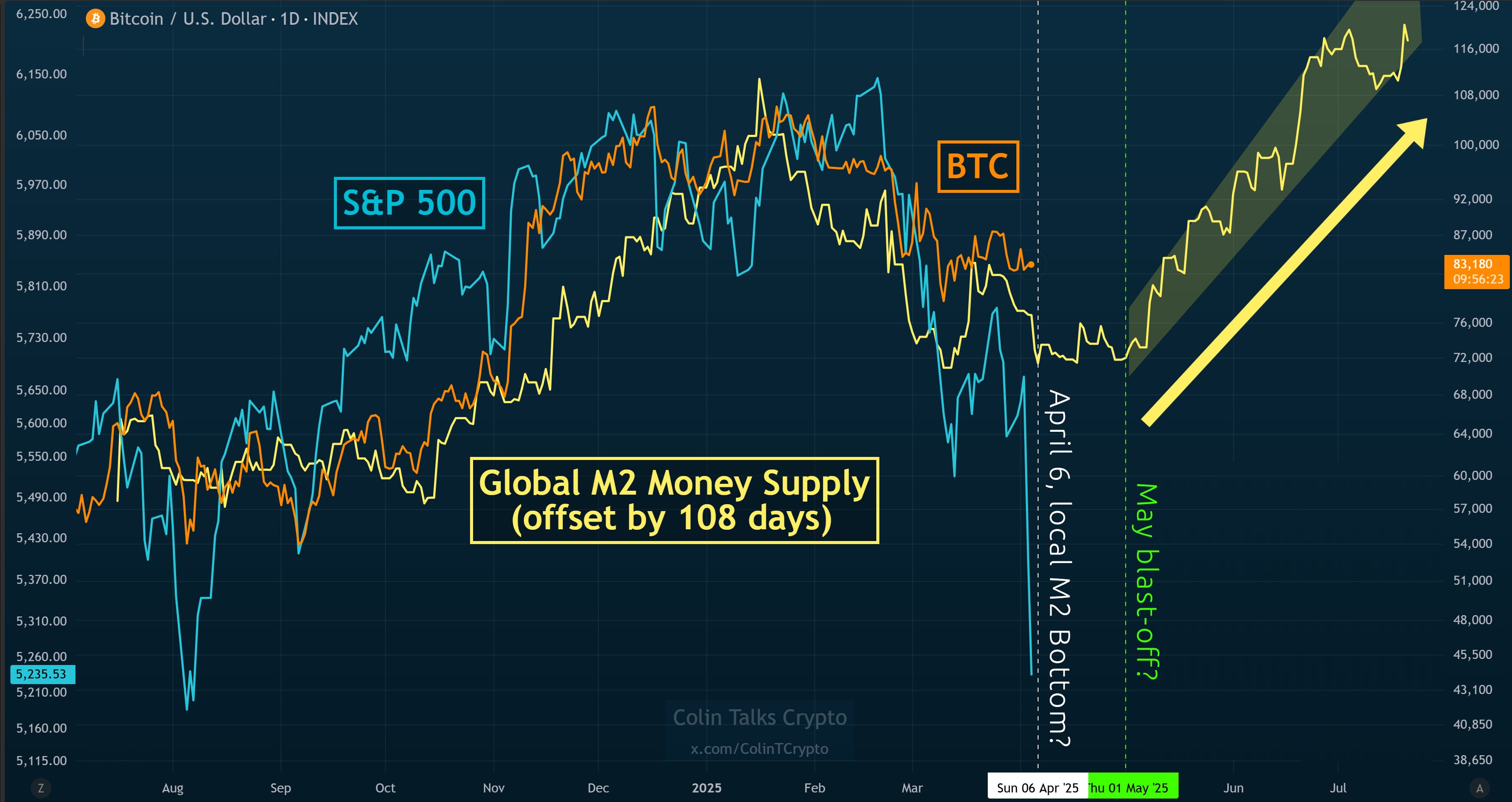
Meanwhile, analyst Colin observed that the global M2 money supply is aligning in a way that could suggest a near-term bottom around April 6, with a potential expansion phase beginning in May. 

Bitcoin 1D Chart Colin
Bitcoin 1D Chart | Colin

While he noted that this is merely an observation and not a forecast, he highlighted how Bitcoin has outperformed stocks during this downturn, maintaining a notable level of resilience.

Crypto Users Can Now Buy and Sell Solana and Chainlink on PayPal and Venmo

0

PayPal Holdings has expanded its digital asset offering, integrating two new cryptocurrencies for trading among US PayPal and Venmo users.

According to an April 4 announcement, users of the most prominent financial technology platforms in the United States and associated territories have two new cryptocurrencies at their disposal. PayPal and Venmo users can now buy, sell, and hold Solana and Chainlink directly on their mobile applications.

PayPal Expands Crypto Offering

Before now, PayPal users could only acquire Solana and Chainlink through a third-party integration. Specifically, MoonPay allowed US users to buy SOL, LINK, and other assets like XRP, DOT, DOGE, and USDC, which were unavailable directly on the platform.

However, PayPal has added support for the two prominent cryptocurrencies, currently standing at 7th and 13th in the rankings by market cap. They also join assets like Bitcoin, Ethereum, Litecoin, and Bitcoin Cash as the cryptocurrencies that customers can trade directly on PayPal and Venmo.

Meanwhile, the addition follows customers’ clamor for an extended list of cryptocurrencies available for transacting. May Zabaneh, PayPal’s vice president of product, blockchain, crypto, and digital currencies, noted that the payment giant has heeded their feedback and has started the expansion with Solana and Chainlink.

He noted that the addition also aligns with their ambitions to revolutionize payments by adopting broader and easier means of processing clients’ transactions. Furthermore, more digital assets on PayPal and Venmo meant enhanced flexibility and access.

Notably, Solana and Chainlink remained unmoved by the announcement, posting meager gains in the past 24 hours. Particularly, SOL trades at $115.20 and LINK at $12.52.

Expansion Amid Milder Regulation

PayPal started dabbling in cryptocurrency years ago and has dipped its toes deeper over time. The prominent payment firm began offering cryptocurrency services in 2020 and launched its dollar-pegged stablecoin, PayPal USD, on the Ethereum network in August 2023. Today, the stablecoin has expanded to Solana and platforms like Crypto.com, ByBit, and Zero Hash.

In September, PayPal allowed direct purchases of cryptocurrencies on its platform but was very conservative in its pick. It integrated Bitcoin, Ethereum, and two other digital assets without securities tags.

This was at the peak of the US Securities and Exchange Commission’s regulatory clampdown on cryptocurrency. Under former chair Gary Gensler, the Wall Street regulator branded several digital assets as securities and sued multiple firms for offering these alleged unregistered securities.

However, the tides are easing under pro-Bitcoin President Donald Trump, who promised to end the former administration’s war against cryptocurrency. Under acting chair Mark T. Uyeda, the SEC has dropped lawsuits against digital asset firms and formed a task force to create a clear crypto framework, encouraging firms like PayPal to expand their offerings to US users.

Grayscale Files New S-1 Document for Solana ETF, Seeks to Rename Its Solana Trust Product

0

Grayscale Investments has submitted a Solana ETF S-1 document to the SEC seeking to rename its investment product, Grayscale Solana Trust (GSOL). 

The top crypto asset manager submitted an S-1 filing today, indicating plans to change the name of its Solana Trust product to ‘Grayscale Solana Trust ETF.’ 

This development first appeared on our X channel, confirming that Grayscale has submitted a Solana ETF S-1 document. 

This comes four months after NYSE Arca filed a 19b-4 application with the SEC to list GSOL shares. Although the SEC has acknowledged the application, it has not approved NYSE’s request to list shares of Grayscale Solana Trust. 

Grayscale Solana ETF S-1 Filing 

Meanwhile, Grayscale has filed an S-1 document to rename its Solana Trust to Grayscale Solana Trust ETF. Grayscale’s name change application is part of an effort to align the trust’s identity with its planned ETF status. 

If approved, Grayscale’s Solana Trust ETF shares will trade on NYSE Arca under the ticker symbol GSOL. Notably, the trust’s shares are currently quoted on the OTCQX market under the same GSOL ticker. 

The proposed Solana ETF aims to expose investors to the performance of the SOL cryptocurrency. The shares only track the underlying asset’s price. Hence, owning the shares does not give investors direct ownership of Solana. 

Shares of Grayscale Solana Trust ETF will be created and redeemed in one or more blocks of 10,000 shares, with the shares issued to authorized participants. This issuance will leverage cash for settlements instead of actual SOL tokens. 

No Staking Support 

Meanwhile, Grayscale clarified that the ETF will not support staking functions. This indicates that investors will not receive additional returns from staking. 

For context, the Grayscale Solana Trust is one of the largest investment products tied to SOL, the seventh-biggest cryptocurrency by market cap. GSOL is currently trading at $9.75 per share. The fund boasts total assets of $61.23 million, with an outstanding share of about 7.22 million. 

Grayscale’s latest Solana ETF update comes as SOL attempts to recover from the recent market downturn. The token’s price has spiked 2.85% over the past 24 hours to $115.91. Despite this recovery, SOL is still down 10.91% over the past seven days.