Home Blog Page 829

Here’s How Many Wallets Holding 10 Billion XRP

Prominent XRP community figure Chad Steingraber recently drew public attention to the holdings of the largest XRP wallets.

Notably, the data shared by Steingraber suggests that the top ten XRP addresses with the largest balances hold about 10.6 billion XRP tokens. Additionally, when considering the top 50 XRP wallets, this group controls 30.3 billion XRP tokens. Notably, this is about half of XRP’s circulating supply.

Largest XRP Holders with 10B Tokens

Citing data from XRP explorer XRPScan, the report disclosed that the wallets holding 10 billion XRP include Ripple, exchanges Uphold, Bithumb, UPbit, Binance, Bitbank, and Coincheck, and an unidentified owner.

The Uphold exchange holds the largest XRP in a single wallet, with over 1.8 billion XRP in one address. The Bithumb exchange owns the second-largest address, followed by Ripple’s address in third place.

However, Ripple is the largest overall holder of XRP when combining the holdings from all of its addresses. Specifically, Ripple controls about four escrow wallets, each holding 5 billion XRP, while four other escrow wallets contain between 4 billion and 4.6 billion XRP each.

XRP Supply “Running Low” on Exchanges

Meanwhile, Steingraber’s disclosure focused on the amount of XRP available on exchanges, as these tokens are often easily accessible for trades on the open market.

He argued that the circulating supply of XRP on exchanges is much smaller than many people realize. According to him, a significant amount of XRP has been lost forever. He also estimated that around 20 billion XRP is currently on exchanges, which he categorized as “Low Supply.”

In response, community member Rookery Heart emphasized that the exchange XRP supply is “extremely tiny.” Heart suggested that it would only take one major player purchasing XRP off exchanges to send the price soaring.

Hypothetical Suggestions

Notably, this discussion ties back to Steingraber’s earlier argument that XRP could skyrocket to $20,000 per token. He proposed speculative scenarios in which banks and large financial institutions hoard XRP to strengthen their balance sheets, triggering a digital arms race.

Furthermore, Steingraber argued that most of XRP Ripple’s escrow will never be released. He referred to this as the “Lender of Last Resort” scenario, where, once over-the-counter (OTC) options run dry, the public supply of XRP, particularly on exchanges, would become the next available resource—and, according to him, this supply is limited.

Essentially, he argues that financial institutions could create a buying “tsunami” unlike anything seen before.

According to Steingraber, once these institutions enter the market, they wouldn’t sell XRP for profits, as the money from selling would be trivial compared to the scale of the global money transfer business, which involves trillions of dollars.

These speculative scenarios have fueled Steingraber’s predictions about XRP’s potential value. However, his arguments remain speculative, and as of now, XRP continues to trade just above $2.

SEC Seeks Court Permission to Delay Gemini Suit by 60 Days

0

The U.S. SEC has announced its interest in exploring a “potential resolution” of its enforcement lawsuit against Gemini, the crypto exchange founded by the Winklevoss twins. 

Gemini Trust and the SEC jointly filed a motion in a New York court, requesting a 60-day delay in the ongoing civil case. They cite the potential for a resolution that could conserve judicial resources. However, the motion did not specify whether the resolution would lead to a settlement, dismissal, or another form of agreement. 

Both parties have proposed submitting a joint status report within the 60-day period if the motion is granted. This delay would provide additional time to explore potential resolutions before any further legal proceedings.

Notably, the SEC sued Gemini in 2023, accusing the crypto exchange of illegally raising billions of dollars in crypto assets through the Gemini Earn program. Meanwhile, Gemini previously settled a separate case with New York regulators, agreeing to return at least $1.1 billion to customers involved in the program.

Softening Approach Toward Crypto Industry

In recent months, the SEC has shown signs of softening its stance on crypto regulation. In February, the agency cleared Gemini from a previous probe. Additionally, the SEC recently dropped several other high-profile cases involving crypto firms. This shift in approach includes the conclusion of the SEC’s lawsuit against Ripple. 

The SEC officially dropped its appeal in the long-running case, signaling the end of a four-year legal battle. This case’s end marks a significant moment for the crypto industry, as it clears some regulatory uncertainty surrounding digital assets.

Meanwhile, the SEC also ended its investigation into OpenSea, an NFT platform. The agency decided to drop its probe, marking another positive development for the crypto sector.

In a related move, the SEC filed a stipulation to dismiss its civil enforcement action against Coinbase, another major player in the digital asset space.

VanEck Eyes First US Binance Coin (BNB) ETF Following Registration with Delaware

0

VanEck, a prominent asset manager headquartered in New York, has made a first-ever attempt to launch a Binance Coin (BNB) ETF in the US following a major step.

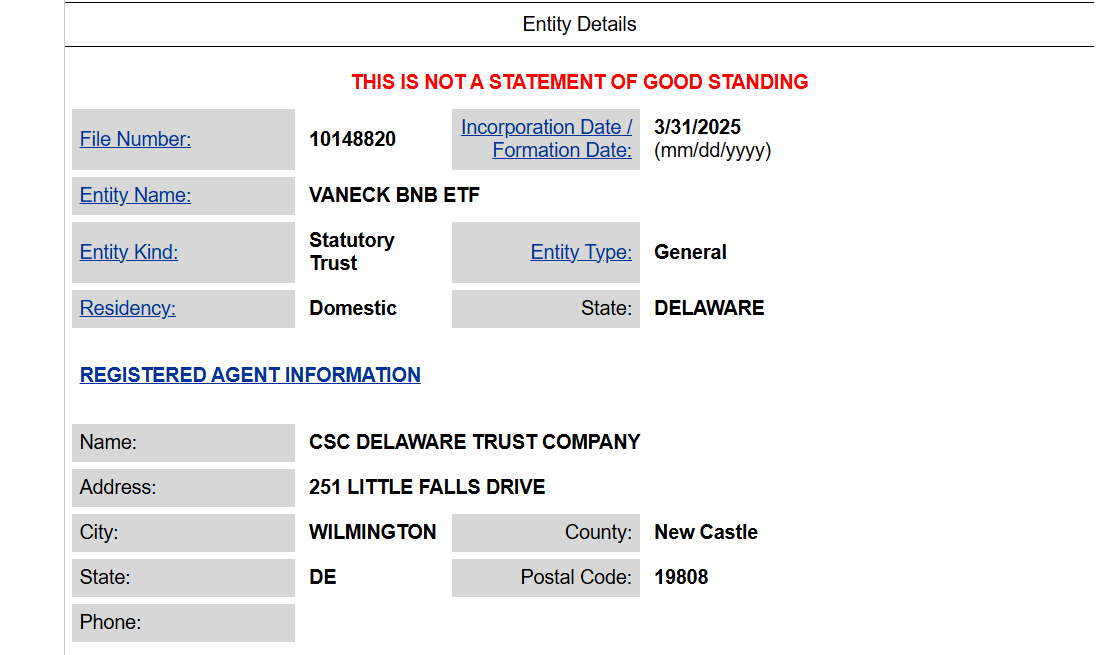
The $115 billion asset manager registered a spot Binance Coin (BNB) with the CSC Delaware Trust Company on March 31, the agency’s official website discloses. With file number 10148820, VanEck registered the VanEck BNB ETF as a corporate trust fund.

Significantly, the registration marks the first attempt to list and trade a BNB spot exchange-traded fund (ETF) in the United States. Although there are investment funds offering corporate exposure to the fifth-largest cryptocurrency by market—like the 21Shares BNB ETP—these are not ETF products.

VanEck BNB ETF
VanEck BNB ETF

First Of Many Steps

It bears mentioning that registering with Delaware does not officially mean filing for a BNB spot ETF, and not all funds registered with the agency end up being filed with the US Securities and Exchange Commission. However, the enrollment marks interest in debuting an ETF and is the first of many steps in the process.

If launched, the investment product will track the performance of the Binance and BNB Chain’s utility token. Surprisingly, asset managers have shown little interest in launching a US BNB-focused ETF despite its fair share of the crypto market capitalization.

Notably, this may be due to the regulatory impediments Binance has faced in America, specifically with its brawls with the US SEC and Department of Justice (DoJ). However, with a clearer regulatory environment, VanEck has taken the initiative and made the first step in the filing process.

Meanwhile, the next step would an S-1 registration by VanEck and then a 19b-4 filing by an exchange on VanEck’s behalf. The former properly kicks off the approval process.

VanEck Registers Fifth ETF With Delaware

The Monday filing marks VanEck’s fifth standalone ETF registration with Delaware. For context, the prominent asset manager has notarized Bitcoin, Ethereum, Solana, and most recently, an Avalanche ETF with the prominent corporate and tax services provider.

Notably, the asset manager has filed all four earlier ETFs with the US SEC, and two have already gained regulatory approval. VanEck filed for the Solana ETF in June 2024 and the Avalanche ETF last month.

Hype Will Not Move XRP, Pundit Explains What Could Trigger Long-Term XRP Price Growth

0

A well-known XRP community-driven account has suggested that hype is not enough to push XRP price amid the current bearishness.

Notably, currently trading for $2.10, XRP has remained under bearish pressure despite several promising developments, including reports of its inclusion in a U.S. strategic reserve, the resolution of Ripple’s lawsuit, and multiple ETF filings. 

However, according to the community-driven analyst behind the “XRP Investing” account, speculative hype alone will not be enough to drive a sustainable price surge for XRP. Instead, utility and real-world adoption are the major catalysts for long-term price appreciation.

XRPL Utility Could Drive XRP Price Growth

In the commentary, the analyst stressed that XRP’s role in financial infrastructure is important for its future price movement. They argued that if the XRP Ledger (XRPL) begins processing transactions worth $1 trillion daily and fully supports tokenization of real-world assets, XRP could see massive value appreciation. 

The analyst compared this to SWIFT, which moves between $5 trillion and $6 trillion daily. If XRPL captures even a small percentage of this transaction volume, it could have some positive impact for XRP.

Notably, the major distinction that many overlook, according to the analyst, is that tokenized assets themselves do not directly use XRP, but they require it to function within the XRPL ecosystem. 

For context, every tokenized asset transaction on the ledger demands transaction fees in XRP, reserves held in XRP, and trades facilitated through the cryptocurrency’s decentralized exchange. As tokenization activity grows, these requirements will create a continuous demand for XRP.

XRP Can Thrive on Storage Demand 

Further, the analyst noted that an important factor in XRP’s long-term growth is storage demand. Unlike mere transactional use, storage demand emerges when institutions, investors, and market makers hold XRP as part of their operational framework. 

When market participants regularly move high-value tokenized assets on the XRPL, the platform gains trust, bringing in serious participants who need to hold XRP to facilitate transactions effectively. These participants are less likely to engage in speculative trading and more inclined to maintain reserves of XRP.

Moreover, according to “XRP Investing,” another principle that could drive XRP’s adoption is the efficiency of large transactions at higher price levels. If the asset’s value increases, the cost of transferring large sums in XRP terms decreases, improving efficiency and reducing slippage. 

For example, sending $1 million at $1 per XRP would require one million XRP, while the same transaction at $10 per XRP would require only 100,000 XRP. This makes large-scale transactions more seamless. Interestingly, Ripple CTO David Schwartz mentioned this in 2017, noting that XRP “cannot be dirt cheap.”

XRPL’s Potential to Welcome On-chain Tokenization 

Essentially, the “XRP Investing” account emphasized that as on-chain tokenization grows, it increases the overall activity on XRPL. In turn, this drives demand for XRP due to transaction fees and bridging requirements. 

With this improvement in utility and efficiency, XRP becomes more attractive to long-term holders, leading to storage demand. Further, as more institutions accumulate and hold XRP, the asset’s value strengthens. This can lead to a sustainable foundation for price growth.

Importantly, the analyst admitted that this process will not result in an overnight price surge. Instead, XRP’s trajectory depends on whether the XRPL ever becomes a primary network for real-world asset exchange. 

They noted that Ethereum experienced a similar transformation when decentralized finance (DeFi) and token issuance increased demand for ETH. Even though many assets were not denominated in ETH, they relied on the blockchain’s native currency for transaction fees and network functionality. 

Circle Exec Backs STABLE Act Ahead of House Committee Markup

0

Dante Disparte, Circle’s Chief Strategy Officer, publicly endorses the STABLE Act ahead of the House Committee on Financial Services markup. 

In a statement on Tuesday, Disparte commended lawmakers such as Representatives French Hill and Bryan Steil for setting clear, America-first guidelines for dollar-denominated stablecoins.  

According to him, establishing clear guidance that ensures transparency and trust, maintaining reserves, and enforcing financial crime compliance are crucial for creating a level playing field for stablecoin issuers in the U.S. 

He suggested that the measures also provide a clear direction for international reciprocity with other jurisdictions. He believes the U.S. will emerge victorious when dollar-denominated stablecoins are positioned within the country’s regulatory perimeter. Further, he called for a swift and bipartisan passage of the STABLE Act. 

House Committee Confirms STABLE Act Markup Session 

Dubbed the Stablecoin Transparency and Accountability for a Better Ledger Economy (STABLE) Act, the bill proposes a regulatory framework for dollar-denominated payment stablecoins at the federal level. It aims to ensure consumer protection while providing transparency in the stablecoin market. 

The Financial Services Committee will review an updated draft of the bill in a markup session today, April 2. This updated version enhances the compliance mechanism, refines the definitions of key terminologies, and establishes criteria for qualifying as stablecoin issuers. 

Despite the amendment submitted on March 26, the STABLE Act still prohibits yield-bearing stablecoins. This measure mainly applies to stablecoins that focus on paying out interest generated from their reserve assets. 

The prohibition has sparked a major debate across the industry. Proponents support the move, noting that it protects investors. 

However, critics, including Coinbase CEO Brian Armstrong, argue that the prohibition restricts users from accessing competitive financial tools.

Whether lawmakers will address this concern during the markup session remains to be seen. Notably, a similar version of the stablecoin bill is currently in the U.S. Senate awaiting lawmakers’ votes.    

Circle Files for IPO 

Meanwhile, Disparte’s statement comes a few hours after Circle filed for an IPO. Circle is seeking to go public later this month and plans to list its shares on the NYSE under the ticker CRCL. 

Notably, the company plans to raise its valuation to $5 billion, with top financial institutions like Citigroup and JPMorgan Chase serving as lead underwriters. 

Binance User Holding 612B Shiba Inu Incurs Over $4M Loss Amid SHIB Price Dip

0

Following the recent market downturn, a Binance user who holds over 612 billion Shiba Inu tokens lost a whopping $4.125 million. 

Many crypto investors have suffered significant losses over the past few months due to market downturns that have wreaked havoc on the prices of top assets like Shiba Inu. 

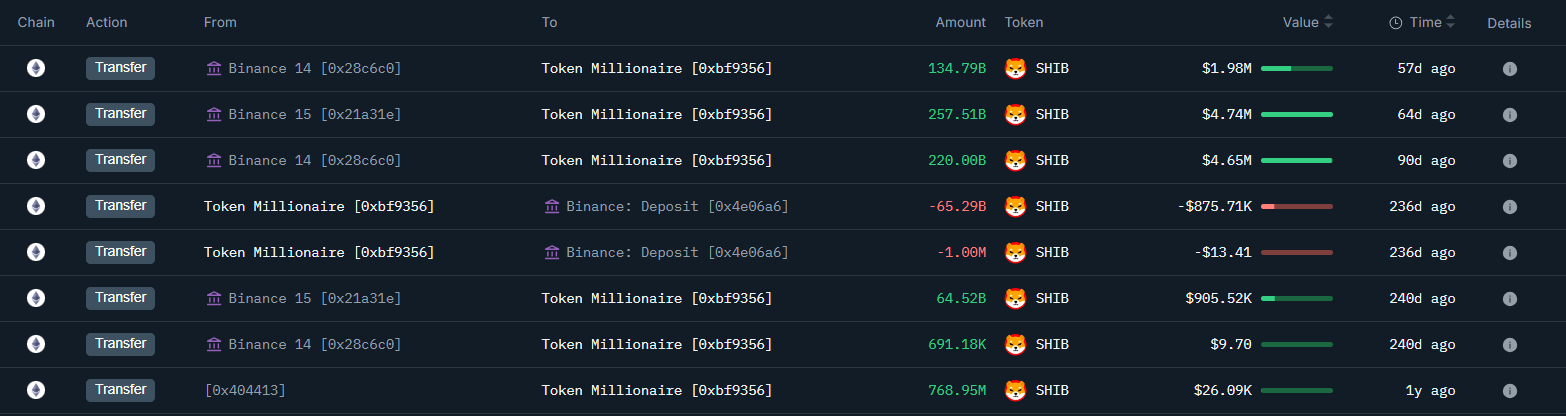
In a tweet yesterday, Onchain Lens revealed that a crypto whale had incurred substantial losses on their Shiba Inu investment. The untagged address, 0xbf9…d38ea, currently holds 612,295,960,405 (approximately 612.3 billion) SHIB tokens worth $7.85 million. 

Notably, Onchain Lens suggested that the value of these tokens has dropped significantly since their purchase. The wallet owner has suffered a loss of $4.125 million on their Shiba Inu investment compared to the amount originally paid to acquire the tokens. 

SHIB Transactions 

Onchain data from Etherscan shows that the owner of this blockchain address is a Binance user who majorly used the exchange to acquire SHIB tokens. 

The address received its first SHIB tokens from an unlabeled address on March 10, 2024, when SHIB surged to a daily high of $0.00003527. At the time, the unlabeled address sent 768.95 million SHIB to 0xbf9…d38ea. 

On August 4, 2024, the whale withdrew 64.52 billion SHIB tokens from Binance. A few days later, it deposited another 65.28 billion SHIB into the leading crypto exchange, selling all its SHIB holdings. 

However, since the beginning of this year, the address has purchased approximately 612.30 billion SHIB, which remains untouched. So far, the value of the SHIB holdings has dropped significantly since their acquisition, losing over $4 million. 

Image

Other Shiba Inu Investors Incur Losses 

Besides 0xbf9…d38ea, most Shiba Inu investors have also suffered significant losses following SHIB’s recent collapse. This coincides with a major drawdown across the broader crypto market. 

Currently trading at $0.00001219 per token, SHIB is down 42.3% since the beginning of this year. The token has also plunged 16% in the past 30 days and 16.3% over the past week. 

At the current price, 84.89% of all on-chain addresses holding a combined 835.87 trillion SHIB ($10.19 billion) are in losses, according to data from IntoTheBlock. 

However, only 12.31% of Shiba Inu on-chain addresses with a holding of 121.25 trillion SHIB ($1.48 billion) are seeing gains on their investment. The remaining 2.79%, holding 27.5 trillion SHIB valued at $335.43 million, are at breakeven.

Xaman Processes $1B+ in XRP Payments in Q1 2025

0

Leading XRPL wallet Xaman recorded impressive transactional and user-related figures in Q1 2025 amid growing traction toward the XRP Ledger.

The buzz around XRP and the XRP Ledger has only spiked since its November price outburst. User participation and liquidity have surged within the ecosystem, spilling to applications building on the network.

Xaman, a prominent self-custody wallet developed by XRPL Labs, has benefited immensely from these activities. Specifically, the web3 wallet processed over a billion dollars in XRP payments in the year’s first quarter.

$1B Worth of Transactions in Three Months

In an X post, Xaman, formerly Xumm, disclosed impressive figures in its brief Q1 round-up on April 1. Per the tweet, the wallet processed over $1 billion in XRP payments alone in the first three months of the year.

Robert Kiuru, XRPL Labs’ COO, stressed that the staggering figures are a testament to the serious traction toward Xaman. He further revealed that certain users shifted eight figures in a single transaction for meager fees, as the XRP Ledger enthusiasts show a level of trust for the self-custody wallet.

Meanwhile, Xaman also saw a new user influx in the last quarter. Over 100,000 new users registered with the leading web3 wallet, expanding its coast. Notably, Xaman is well-placed for such astronomical adoption as it supports over 8,300 cryptocurrencies across the XRP Ledger and Xahau network.

New Xaman 4.0 Roll-Out Further Boosts Adoption

Among other achievements, Xaman rolled out v.4 of its crypto wallet, adding new and attractive features. The March 10 upgrade introduced seamless swap features, allowing users to choose a UI provider for any asset on the XRP Ledger.

Xaman further simplified onboarding, claiming it made the process 10 times faster. The upgraded software allows instant account setup or import and optimized interaction with the Tangem card. Meanwhile, users can now seamlessly switch between the XRPL and Xahau.

Since rebranding from Xumm to Xaham in December 2023, the wallet has sealed its position as the leading self-custody wallet for the XRPL blockchain. Xaman partnered with Mastercard’s Immersve in August 2024 to roll out web3 cards and rounded off the year strong, recording payments worth over $6 billion.

Analyst Shares Timeline for Cardano to Hit $50.48 if it Follows This Ascending Channel Pattern

0

Analysts predict a potential rebound for Cardano price, with an ambitious two-digit target price if it follows a weekly ascending channel.

Cardano has shown a steady decline in price over the past week. After reaching a high of about $0.77 on March 26, ADA has consistently fallen, now standing at $0.6676. 

This downward trend, marked by a 0.9% drop in the last 24 hours, has raised concerns among investors. Despite this, analysts remain cautiously optimistic, believing that ADA could follow an established pattern and see a rebound soon.

Cardano’s Ascending Channel Pattern

Specifically, a weekly chart shared on TradingView, which spans several years, reveals ADA’s price pattern within an ascending channel. 

This channel represents an upward trend where ADA has historically bounced between boundaries, occasionally breaking out, as seen in previous years. Notably, the coin surged from $0.2 to $2.7 in August 2021 before returning to a downward trend.

Cardano Weekly Ascending Channel

The analyst’s chart suggests that Cardano’s price could rise again if it follows its established pattern. Green lines on the chart mark potential price levels for ADA, with $2.7567 identified as the first resistance level should the price break out.

However, should the pattern persist, the analyst has set an ultimate target price of $50.4821 for ADA, marking a 7,398% increase from current levels. Drawing from the price action within the ascending channel pattern, the analyst suggested that this price target could materialize by the end of Q3 2025.

Support Levels and Market Risk

Meanwhile, concerns persist over the region between $0.70 and $0.80, which previously served as support. ADA recently broke below this support. According to crypto analyst Ali Martinez, the recent pullback in Cardano’s price could lead to a major breakdown.

If ADA fails to recover and reclaim this support level soon, Martinez suggests that it could face further declines. Drawing from past patterns, he warns that the price may drop to as low as $0.31 to $0.24, which has been a common trend following breakdowns from this support area.

Cardano Sees Institutional Interest 

Despite these risks, ADA has not seen a decrease in interest from institutional investors. A CoinShares report highlight that Cardano experienced $0.6 million in inflows into exchange-traded products (ETPs) in the period ending 31 March, pushing its total monthly inflows for March to $63.3 million. As of now, the total institutional inflows for Cardano in 2025 stand at $70 million.

Crypto Investment Products Flows CoinShares
Crypto Investment Products Flows | CoinShares

Cardano’s institutional appeal remains strong, with total assets under management for ETPs tracking the altcoin now at $121.2 million. While the crypto’s inflows have been steady, they have been less volatile compared to some other major altcoins. 

For instance, XRP saw $4.8 million in weekly inflows, while Solana and Ethereum garnered $7.8 million and $15 million, respectively.

Bitcoin Now Targets $100K as Daily Candle Recovers Losses

0

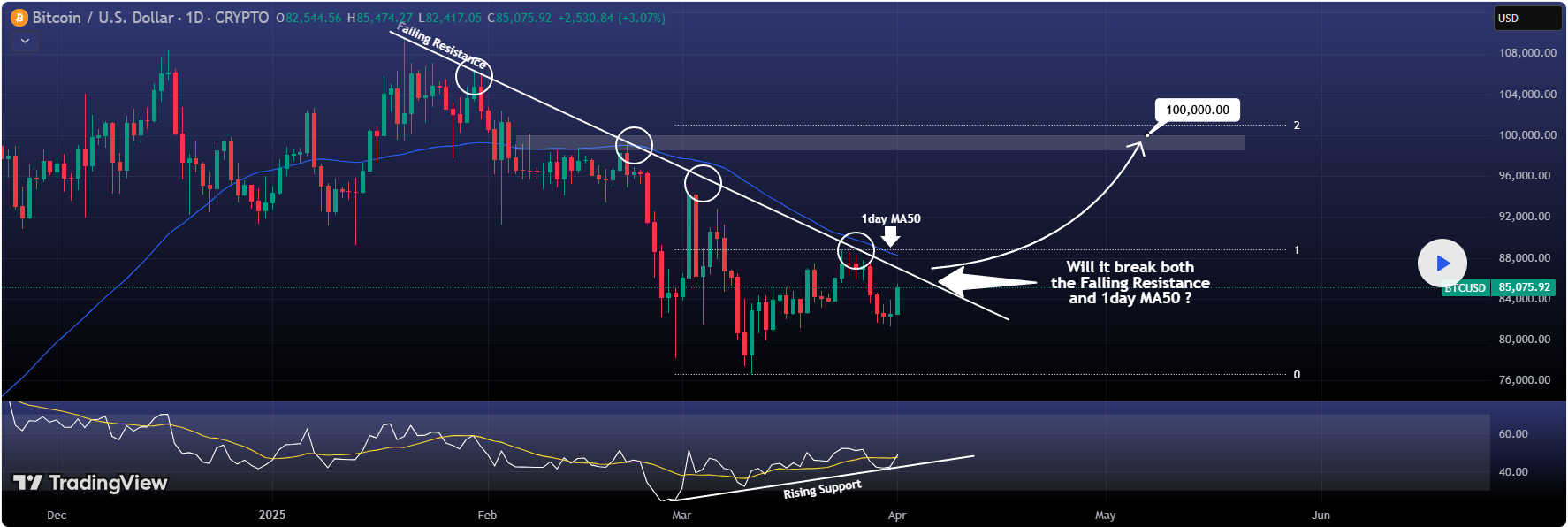
As Bitcoin recovers after a recent downturn, it is now challenging a resistance trendline from its January peak, with a price target of around $100,000.

Bitcoin’s price has increased significantly over the past 24 hours. As of the latest data, it is trading at $84,289. Bitcoin has risen by 1.2% today, contrasting with the trend from the past week, which saw a 3.5% decline.

Additionally, looking at the 30-day view, Bitcoin still nurses a loss of 9.4%. Amid this struggle, an analyst on TradingView has noted a powerful 1-day candle that has recovered the losses of the previous three days.

The RSI on the chart has bounced on its rising support, indicating momentum toward a potential upward move.

However, according to the analyst, Bitcoin now faces significant resistance. The most crucial obstacle is the falling trend line that began on January 20 after BTC created an all-time high at $110K. This trendline coincides with the 50-day moving average (MA50), marking the fifth test of this resistance level.

According to the analyst, if Bitcoin successfully breaks through this resistance, it could signal a shift toward a long-term bullish trend. The next technical target is set at the 2.0 Fibonacci extension. A key price target is set just below the $100,000 mark, near the top of February’s resistance zone.

Bitcoin Price Prediction | TradingView

Bitcoin Whale Wallets Show Confidence 

Amid this confidence about Bitcoin’s rebound, whale are increasing their holdings. In particular, wallets, which hold between 1,000 and 10,000 BTC, have continued to grow, providing a potential signal of increased market confidence.

According to Santiment data, as of March 31, there were 1,993 such wallets, the highest number since December 2024. In just five weeks, the number of whale wallets increased by 2.6%, with 50 additional wallets entering the market.

This trend is significant because when large holders accumulate Bitcoin, they tend to reduce the supply available in the market. This decrease in supply can often lead to increased demand, potentially pushing the price higher.

Short-Term Bullish Sentiment

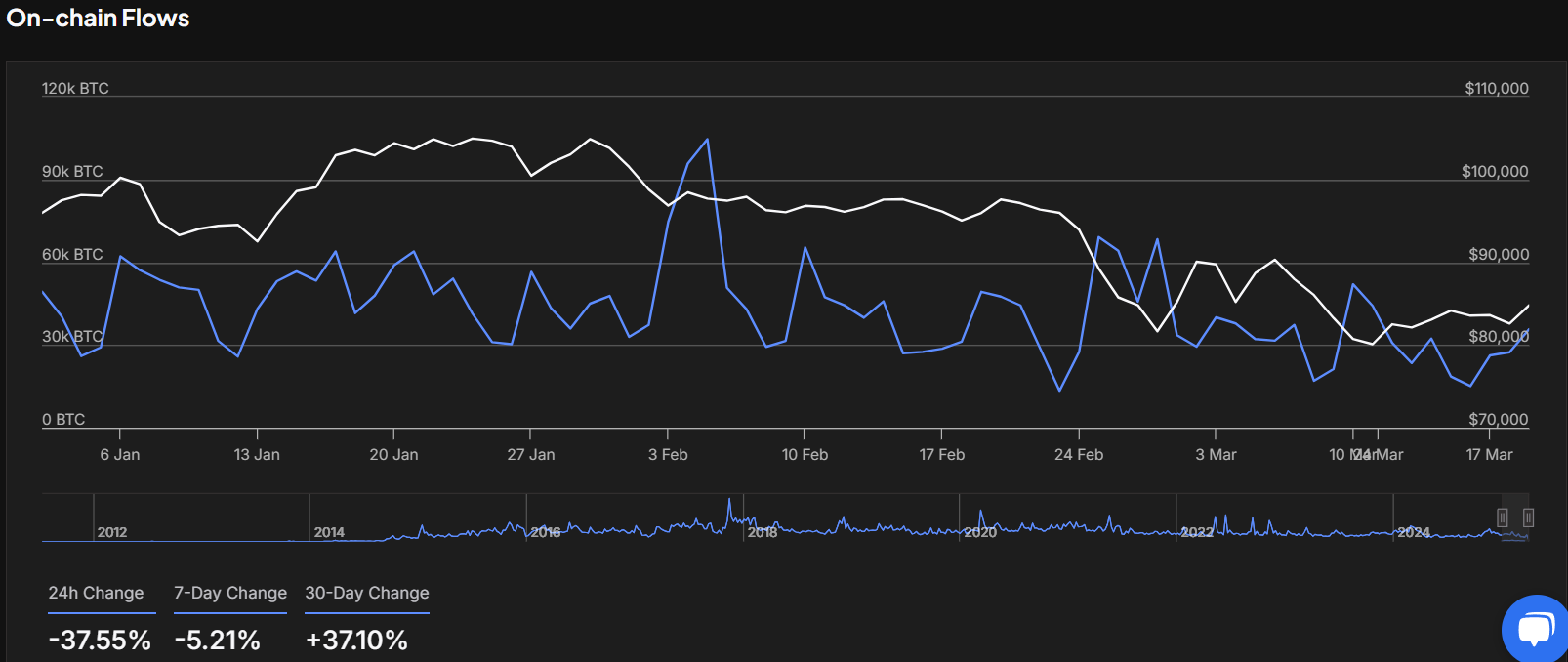
Elsewhere, recent data from exchange net flows further support the growing bullish sentiment. Over the last 24 hours, there has been a notable outflow of Bitcoin from exchanges, with a 37.55% decline in net flows. 

Bitcoin Total Flows | IntoTheBlock

This suggests that traders may be holding onto their Bitcoin rather than selling, which could indicate confidence in a price recovery. Additionally, over the past seven days, the netflow change stands at -5.21%, further reflecting the trend of Bitcoin moving off exchanges.

While the 30-day exchange netflow data shows positive movement (+37.10%), indicating some selling possibility in the longer term, the recent shorter-term data points toward bullish momentum. Notably, this 30-day exchange flow data coincides with a drop in Bitcoin price in the same time frame.

No Escrow Release for April Yet as Ripple Moves 1B XRP, Sends 700M to Escrow

0

Ripple has moved a substantial amount of XRP tokens across different wallets, locking up half of the volume despite witnessing no escrow release for April yet.

The Ripple escrow system is observing an anomaly in April, a trend that has persisted since last year. Specifically, the system has not triggered the release of any tokens from escrow, a deviation from the usual pattern that sees 1 billion XRP released on the first day of each month.

However, despite not witnessing any escrow release for April, Ripple has carried out its typical whale movements for the month. Specifically, Whale Alert confirmed that Ripple moved 500 million XRP across different wallets this morning.

Ripple Moves 1B XRP Worth $2.1B

For context, the first transaction saw the Ripple (26) wallet transfer 300 million XRP worth $629 million at the time to the Ripple-affiliated address “rBg…91m” today at 03:06 UTC. Three minutes later, Ripple (26) transferred an additional 200 million XRP worth $420 million to another Ripple-affiliated wallet “rKD…2op.”

Whale Alert on X
Whale Alert on X

While Whale Alert indexed the initial 500 million XRP movements, it failed to track a subsequent fund flow that saw Ripple transfer another batch of XRP tokens with a separate address. Notably, a few minutes after the initial transactions, another wallet, Ripple (27), sent out 500 million XRP.

The wallet first moved 170 million XRP worth $357 million to the address “rkD…2op” at 03:28 UTC. It bears mentioning that this was the same address that received the 200 million XRP from the first batch of transactions.

Three minutes after the 170 million XRP transaction, Ripple (27) transferred 330 million XRP valued at $693 million to a third Ripple-affiliated wallet, “rDd…eCK.” This was the wallet’s first XRP transaction since March 1. Overall, Ripple moved a total of 1 billion XRP this morning.

Ripple Re-locks 700M XRP in Escrow for April

Interestingly, Ripple’s agenda for these high-value transfers appears to have been a consolidation of assets and movements to escrow accounts. First, “rKD…2op,” which received 200 million XRP and then 170 million XRP, proceeded to lock up all 370 million XRP in escrow at 03:33 UTC.

Further, the “rDd…eCK” wallet, which received 330 million XRP during the second batch of transactions, also re-locked all 330 million XRP tokens in escrow at 03:36 UTC. This brought the total amount of XRP re-locked today to 700 million, out of 1 billion tokens moved by the payments giant.

Now, address “rBg…91m,” which received the 300 million XRP during the initial transaction batch, has held onto its tokens since then. The wallet’s balance now stands at 400 million XRP, which the blockchain payment firm could leverage for business operations.

While Ripple often engages in these fund movements each month, the latest ones have taken a deviation due to the absence of a preceding escrow release. Notably, the firm typically witnesses the release of 1 billion XRP from escrow and then locks up 700 million.

The absence of the escrow release is likely a result of a delay in the release schedule. It bears mentioning that Ripple does not trigger the release manually, and the system could initiate the unlock later in the month. Meanwhile, amid the recent movements, XRP price has dropped considerably, down 1.87% this morning to $2.09.