Home Blog Page 841

Brandt Agrees As Wyckoff Analysis Targets Bitcoin Drop to $70,000

Amid the ongoing market uncertainty, Bitcoin might be at risk of dropping to new yearly lows, according to a Wyckoff analysis.

Renowned Netherlands-based cryptocurrency analyst HTL-NL has forecasted a potential decline in Bitcoin’s price to the $70,000 mark, according to a recent chart analysis. 

Leveraging the Wyckoff Method, a framework for identifying market cycles through supply and demand, HTL-NL’s commentary calls attention to important patterns and structures that signal an impending correction for the leading cryptocurrency.

Wyckoff Analysis Shows Bitcoin is Currently Bearish

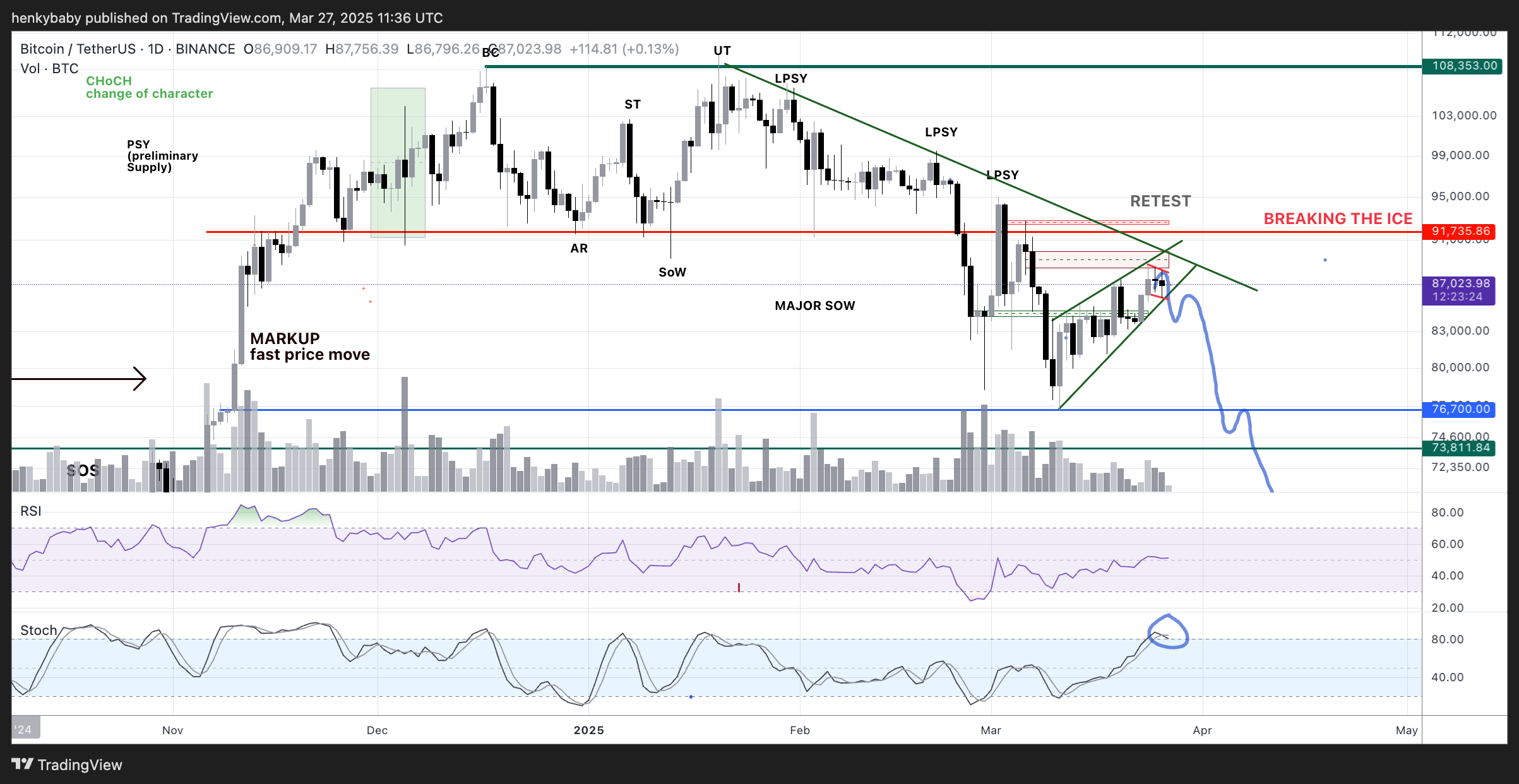
Data from the accompanying daily chart reveals that Bitcoin embarked on a robust uptrend, or markup phase, starting around $67,000 in late 2024. This phase began on the back of the November 2024 elections in the United States.

The upward trajectory pushed the price to a peak of $108,000 in December 2024, marking a 61% gain. Despite witnessing its buying climax (BC) at this level, which led to sharp declines, BTC recovered to reach a new peak above $109,000 during an upthrust (UP) in January 2025.
Bitcoin Wyckoff Analysis HTL-NL
Bitcoin Wyckoff Analysis | HTL-NL

Notably, in Wyckoff analysis, such an upthrust (UP) typically represents a false break above a major resistance. Accordingly, the chart indicates that Bitcoin has since entered a critical juncture, with the price pulling back to the $80,000 range at press time. 

Following the upthrust, Bitcoin formed several Last Points of Supply (LPSY) as it retested previous support regions that acted as resistance on Jan. 30, Feb. 21, and March 2. Due to the LPSY and the formation of the Major SOW, data indicates BTC has entered the Bearish Phase D.

Bitcoin Forms Descending Trendline and Rising Wedge

One major structure in HTL-NL’s chart is the descending trendline that has formed since Bitcoin hit $109,000 during the upthrust. Notably, this bearish setup features lower highs along a downward-sloping resistance line.

Notably, amid the ongoing recovery effort that began in mid-March, Bitcoin formed another bearish structure in the form of a rising wedge as it pushed toward retesting the resistance at the downward trendline.

Moreover, the condition of the Stochastic Relative Strength Index (Stoch RSI) points to a bearish setup. For context, the K line recently dropped below the D line, indicating that the short-term momentum is currently weakening. This typically points to an imminent pullback.

This momentum oscillator suggests that Bitcoin’s rapid ascent has left it vulnerable to a correction, particularly as it struggles to break through the resistance line. A failure to surpass this barrier will likely drive the price down to the $70,000 support zone, representing a new yearly low which BitMEX founder Arthur Hayes had projected.

Other Market Veterans Agree

Responding to the recent analysis, veteran commodities trader Peter Brandt stressed that the projection seems logical. 

According to Brandt, a prediction of a Bitcoin drop is not an “unreasonable expectation,” given the current market conditions. Earlier this month, Brandt had confirmed that Bitcoin’s chart was bearish following the formation of a double top pattern.

Meanwhile, in a more simplified analysis, market veteran Benjamin Cowen, founder of Into The Cryptoverse, also suggested a potential Bitcoin drop. He called attention to a potential death cross on the daily chart where the 50-day MA moves below the 200-day MA. 

Potential Bitcoin Bearish Cross Benjamin Cowen
Potential Bitcoin Bearish Cross | Benjamin Cowen

According to Cowen, BTC typically forms local lows whenever a death cross emerges. Currently, Bitcoin changes hands at $86,000, down 1.42% over the past 24 hours. Despite the bearish outlook, the asset maintains 2% weekly gain.
Gemini Introduces 4% XRP Cashback Rewards for Its Credit Card Users

0

Gemini crypto exchange announces a special offer that allows users of its credit card to earn up to 4% cashback rewards in XRP anytime they make purchases.  

Tyler Winklevoss, the co-founder of Gemini, recently took to X to call on the broader XRP community to take advantage of the special offer. This initiative allows users to earn XRP cashback rewards whenever they swipe their Gemini Credit Card for purchases. 

Recall that Gemini launched its rewards credit card in 2022 following a partnership with Mastercard the previous year. Besides functioning as a traditional Mastercard, the credit card also offers crypto cashback on purchases. 

The cashback reward initiative supports Bitcoin, XRP, and over 50 other cryptocurrencies. Notably, Gemini Credit Card users can choose XRP as the asset they want to earn back whenever they make purchases at any Mastercard-powered merchant. 

It bears mentioning that Gemini initially supported XRP for the cashback program in August 2023. Tyler’s announcement appears to be a reminder to the XRP community members that they can still earn XRP cashback rewards when they use the Gemini Credit Card to make purchases.  

How to Participate 

To participate, users must first check whether they qualify for the offer. Qualification is based on users’ credit scores. Once they do, users can apply for the credit card and potentially secure approval by June 30, 2025. 

Once qualified, new cardholders will earn up to $200 cashback rewards in XRP when they spend a minimum of $3,000 within the first 90 days (or 3 months). 

Gemini deposits the XRP rewards directly into users’ trading accounts, allowing them to benefit from the asset’s potential price appreciation. 

Rewards Category 

The crypto exchange offers different reward categories based on credit card usage. 

Users can earn 4% back in XRP when they purchase gas at the pump and EV charging, with this offer available on up to $200 in monthly spending.  

Upon reaching the $200 monthly threshold, users will earn 1% back in XRP on other gas purchases at the pump and EV charging stations within the month. Gemini offers 3% XRP cashback on their dining expenses, 2% on grocery shopping, and 1% on other purchases.  

Besides Gemini, several exchanges, including Uphold, WhiteBIT, and Bit2Me, have also launched similar initiatives for XRP in the past. 

This development underscores XRP’s growing utility. It also drives XRP’s adoption, as more people can easily receive XRP back on their everyday purchases. 

Here’s When Shiba Inu Will Reach $0.001, If SHIB Gains 100% Yearly

0

Shiba Inu could reach the 0.1 cent price target in less than a decade if it maintained a consistent annual price growth of 100%.

Shiba Inu (SHIB) has struggled in recent months due to a broader market downturn. Despite a five-day winning streak that pushed its price to $0.00001567 on March 26, the meme coin remains more than 27% down from its February high. 

The $0.001 Price Target

After hitting the resistance at $0.00001567, SHIB lost momentum and dropped back to $0.00001379, signaling continued weakness. The meme coin has slumped by nearly 4% since the close of March 26.

However, despite these setbacks, many investors believe a recovery is inevitable. While some expect SHIB to surge in the coming months, others argue that its long-term growth will take years, especially if the goal is to reach $0.001. This target has taken center stage in the community, with one analyst LuckSide projecting it last year.

Nonetheless, how long it will take SHIB to claim it remains to be seen. Notably, Shiba Inu recorded a 104% gain in 2024, despite experiencing volatility throughout the year. If this trend continues and SHIB sustains a 100% annual growth rate, we can estimate when it might reach $0.001.

How Long It Will Take to Hit $0.001 if Shiba Inu Rises 100% Each Year

At this pace, SHIB’s price would double each year. By March 2026, the price would be around $0.00002758. Another year of similar growth would bring it to $0.00005516 by March 2027. 

As this pattern continues, SHIB would trade at about $0.00011032 by March 2028, before climbing to $0.00022064 in March 2029. By the start of 2030, the price would rise to about $0.00044128, and a year later, it would reach roughly $0.00088256. 

Following this trajectory, Shiba Inu would surpass the long-awaited $0.001 mark in mid-to-late 2031. This is approximately 6 years from now, representing the conclusions of two market cycles.

Although these projections rely on a steady growth rate, SHIB’s path will depend on sentiment, adoption, token burns, and broader market conditions. While reaching $0.001 by 2031 is mathematically possible if the current growth rate holds, the crypto market remains unpredictable.

Interestingly, analysts at exchange platform Changelly hold a less bullish stance. They believe Shiba Inu will only trade at a maximum price of $0.000238 by the end of 2031. To them, the meme coin will not see the $0.001 price until 2040, when they expect a rally to $0.00144 by January of that year.

Shiba Inu Price Prediction Changelly
Shiba Inu Price Prediction | Changelly

Last September, market analyst Krao discussed Shiba Inu’s potential path to the $0.001 mark, citing a descending trendline that had persisted since October 2021 on the monthly chart. While he predicted a breakout to occur in Q1 this year, he failed to present any targeted timeline for the run to $0.001.

How to Turn $44K into $5.5M with XRP: Alpha Lions Founder

Edoardo Farina, the founder of Alpha Lions Academy, has shared an ambitious prediction on how a strategic investment in XRP could lead to life-changing profits.

In a post on X, Farina outlined a scenario where an initial investment of $44,000 in XRP could balloon into $5.5 million. He suggested committing over 50% of one’s annual income to position for this hypothetical windfall.

The Math Behind the Potential XRP Windfall

Specifically, Farina noted that someone with an annual salary of $80K could invest $44K of that sum in XRP. Purchasing $44,000 worth of XRP at its current price of $2.40 per token would give investors 18,333 XRP.

Interestingly, he speculated that XRP’s unit price could rise to $300 in 10 years. This projection suggests an astonishing 12,400% price growth from the current level. As a result, those 18,000 XRP would be worth $5.5 million—an increase of over 120 times the original investment.

Putting things into perspective, Farina highlighted that this windfall could provide the equivalent of nearly 69 years’ worth of an $80,000 annual salary with just a one-year $3,600 monthly investment.

Interestingly, while Farina proposed a decade timeline for this to materialize, community members suggested it could happen much sooner than ten years.

“10 years? Come on, you know it’s coming quicker than that,” one commenter said, to which Farina replied, “I totally agree.”

Bold Prediction Faces Resistance

It is worth stressing that these claims are speculative, and there’s no guarantee that XRP will trend upward over the next decade. Yet, they highlight the immense potential returns some XRP enthusiasts continue to hope for.

Some have even suggested that in five years, investors will wish they had bought more XRP. However, such ambitious outlooks continue to face resistance from critics, even within the XRP community.

Prominent XRP community figure David accused Farina of being paid to spread disinformation about XRP. David claims that people like Farina deliberately withhold the truth or twist facts.

Notably, popular price predictions from sources like Telegaon and Changelly do not believe XRP could reach $300 by 2035. Their analysts mostly settle for values below $100.

US Senators Vote to Repeal Controversial IRS DeFi Broker Rule

0

U.S. Senators have voted to repeal an Internal Revenue Service tax rule that crypto advocates had argued imposed impossible tax obligations on decentralized finance protocols.

On Wednesday, March 26, Senators voted 70-28 to pass a joint resolution to repeal the IRS rule. This is the second time that Senators voted to repeal the rule, as there was an initial vote on March 4. However, the process had to be redone due to a procedural issue.

Following Wednesday’s vote, the resolution now moves to President Donald Trump’s desk, where he is expected to sign it, with backing from crypto czar David Sacks.

Reacting to the development, Blockchain Association CEO Kristin Smith asserted that the crypto industry was looking forward to permanently eliminating the rule. She also thanked the resolution’s drivers, Senator Ted Cruz and Representative Mike Carey, for their efforts.

The DeFi Broker Rule

The rule in question was an amendment to income tax regulations passed during the tail end of the Biden administration that crypto industry participants have since dubbed the “DeFi broker rule.” This is because the IRS expanded its definition of a broker to include “front-end service providers” for digital asset transactions.

As a result, the IRS required DeFi projects to adhere to the same transaction reporting rules as traditional Wall Street brokers. These projects would have been required to send users tax forms to ensure compliance with taxes on transactions.

However, many in the crypto space quickly argued that this would be burdensome and nearly impractical for DeFi projects.

For one, it would have required these projects to tie every wallet address to real-world identities, which, beyond being burdensome, would have irked privacy advocates in the space. At the same time, the functions of most DeFi projects are automated by smart contracts with little to no human supervision.

US Senator Bernie Moreno Calls for Bitcoin Reserve Bill to Pass In August

0

According to Ohio Senator Bernie Moreno, the US Bitcoin Strategic Reserve bill could pass in the United States as early as August.

Moreno made the call at the 8th annual Digital Chamber Blockchain Summit on March 26, urging the US to hastily pass the proposal. He insisted that Bitcoin and digital assets would be a crucial ingredient in the country’s financial dominance around the world and urged lawmakers to implement the reserve bill.

Notably, a BITCOIN Act looking to adopt a Bitcoin Strategic Reserve (BSR) has gained momentum lately amid bipartisan support for the national adoption of the pioneering cryptocurrency. The proposal seeks for the United States to create a national stockpile of 1 million BTC over five years.

Senator Calls for August Establishment

For context, US Rep Nick Begich and Senator Cynthia Lummis introduced the Bitcoin Act of 2025, which requires Congress approval to pass. The proposal builds on US President Donald Trump’s recent executive order creating a Strategic Bitcoin Reserve and a US Digital Asset Stockpile.

With the bill gaining momentum, Ohio Senator Moreno has called on Congress to push for the bill’s approval in August. On Wednesday, he laid out a gauntlet at the Washington, DC, summit, urging the Senate to move on propositions around market structure, the SBR, and stablecoins in the next five months.

Meanwhile, Moreno reiterated his optimism that the bill would pass in a follow-up tweet, stating that the United States will be the world standard for cryptocurrencies under current US President Trump.

Will the United States Buy Bitcoin This Year?

While the bill has gained bipartisan support and Trump’s blessing, the chances that the US would buy Bitcoin this year have grown increasingly slim. Notably, there are no guarantees that the bill will pass that quickly, and the nation has failed to pursue other mechanisms to stack the pioneering cryptocurrency.

According to a Bloomberg legal analyst, these chances are just 30%. This pessimistic view comes from Trump’s lack of proactive measures in his latest reserve announcement. The legal analyst noted that if the president wanted to buy Bitcoin, he would have done so already through means like the Exchange Stabilization Fund.

Meanwhile, VanEck’s head of crypto research, Mathew Sigel, raised the odds to between 50% and 60%. Nonetheless, reports show substantial progress in funding the US Bitcoin purchase through “countless ideas.”

Sam Bankman-Fried Transferred to Oklahoma Facility Following Controversial Tucker Carlson Interview

Sam Bankman-Fried, the disgraced founder of FTX, has been moved to the Oklahoma City Federal Transfer Center (FTC) as part of the next steps in serving his fraud sentence. 

The move follows a controversial incident earlier this month when Bankman-Fried conducted a remote interview with Tucker Carlson while being held at the Metropolitan Detention Center in Brooklyn. 

The interview, which aired without prior approval from prison officials, resulted in the resignation of his crisis manager, Mark Botnick.

Notably, the FTC is a central hub in the U.S. federal prison system and temporarily houses inmates before they are transferred to other facilities. The move is an early step toward his permanent placement at a lower-security prison, potentially in California’s Bay Area, closer to his family.

Bankman-Fried’s Controversial Claims

In the interview with Carlson, Bankman-Fried reiterated his belief that he was wrongfully convicted. He boldly asserted, “I don’t think I was a criminal,” downplaying the severity of the charges against him. 

Furthermore, Bankman-Fried claimed that FTX was solvent and could have reached $93 billion in assets had it not collapsed. In his words:

“Had nothing intervened, today FTX would have about $15 billion in liabilities and approximately $93 billion in assets. There was enough money to pay everyone back in full at the time.”

In addition to his defense, Bankman-Fried has attempted to align with right-wing political figures. He hinted at a shift in his political views, possibly to gain political favor and leverage potential clemency options as the wave of presidential pardons continues to sweep through the U.S.

The Road Ahead for the FTX Founder

Last year, a jury convicted Bankman-Fried of seven counts of fraud and money laundering related to the $11 billion collapse of FTX and its sister company, Alameda Research. He is set to serve a sentence that could stretch until November 2044.

During his interview with Carlson, he voiced concerns about his ability to endure the full term, suggesting the possibility of suicide. He pointed out that the suicide rate in prison is three times higher than average, citing the psychological toll the environment can take on inmates.

Senator Warren Raises Concerns Over Trump’s SEC Pick Atkins as He Reveals $6M Crypto Holdings

0

Senator Elizabeth Warren has raised ethical concerns over President Donald Trump’s pick for Chair of the U.S. Securities and Exchange Commission (SEC), Paul Atkins. 

In a letter to Atkins ahead of his Senate confirmation hearing, Warren highlighted potential conflicts of interest from his financial ties to the crypto industry.

Recall that Trump picked Paul Atkins as SEC Chair last December, a month after his election victory. Atkins, who previously served as a commissioner for the securities regulator between 2002 and 2008, has substantial holdings in the crypto sector. 

Atkins Holds $6M in Crypto-Related Investments

According to a report from Fortune, his financial disclosures reveal that he holds between $250,000 and $500,000 in equity in Anchorage Digital, a major crypto custodian, as well as call options in the BlackRock-backed firm Securitize. 

Additionally, he has a stake valued between $1 million and $5 million in Off the Chain Capital, an investment firm specializing in crypto assets.

In her letter, Senator Warren argued that these financial interests alongside Atkins’ history of advocating for pro-crypto policies could compromise his ability to enforce regulations impartially. 

She pointed out that the SEC chair must prioritize investor protection and market integrity, and questioned whether Atkins could do so while maintaining such significant personal stakes in the industry.

Atkins and Wife’s $588M Portfolio

Concerns over Atkins’ financial portfolio extend beyond the crypto sector. A Reuters report of his ethics documents revealed that Atkins and his wife Sarah Humphreys Atkins hold over $328 million in joint assets, with their combined fortune potentially exceeding $588 million. 

A large portion of their wealth comes from his wife’s family, which co-founded Tamko, a major roofing materials company. Additionally, Atkins disclosed 32 positions in various entities, including family trusts, LLCs, and nonprofits.

Warren also raised concerns about Atkins’ professional background. His firm, Patomak Global Partners, has consulted for major corporations and government agencies, and is among the creditors in the bankruptcy filings of the failed crypto exchange FTX. 

Warren asked Atkins to provide details about his firm’s work related to FTX and other crypto companies, given that the SEC has been investigating fraudulent activities within the industry.

Role as Witness in SEC Legal Cases

Warren’s letter also called to attention Atkins’ role as an expert witness in legal cases involving companies targeted by SEC enforcement actions. 

As Reuters reported, he has provided testimony for firms such as JPMorgan and Virtu Financial, which have faced regulatory scrutiny. Warren argued that this history raises more concerns about whether he would act in the public’s best interest or favor industry players with whom he has professional ties.

Notably, to address the ethical concerns, Atkins has pledged to divest from Off the Chain Capital within 120 days of his confirmation, according to a filing with the Office of Government Ethics. 

He has also resigned from positions at the Digital Chamber of Commerce and the Token Alliance of the Chamber of Digital Commerce. His spokesperson stated that he would consult the SEC’s ethics officer and comply with all governing regulations if confirmed.

However, Warren has maintained skepticism, asserting in her letter that divestment alone does not eliminate the appearance of impropriety. According to her, “the SEC chair must serve the public, not their own financial interests.” 

She also called for additional transparency regarding Atkins’ past involvement with crypto firms, arguing that “Americans deserve an SEC that is free from undue influence and conflicts of interest.”

Atkins is set to appear before the Senate for his confirmation hearing on Thursday, where lawmakers will scrutinize his financial disclosures and policy positions. Senator Warren had also raised concerns about Crypto Czar David Sacks regarding his crypto portfolio.

Meanwhile, the SEC, now temporarily overseen by Mark Uyeda, has been rather favorable to the crypto industry, dismissing several cases against crypto firms like Coinbase and most recently, Ripple. Most industry experts expect Atkins to continue in this manner. 

Expert Predicts Timeline for XRP to See Major Breakout, Issues Bold Target

XRP could be on the verge of a major bullish breakout, according to a widely followed analyst.

XRP has continued to show lackluster performance week in and week out while enthusiasts eagerly await a new uptrend. The token dipped over 4% today, trading near $2.30, further worsening its two-month performance, which now shows a 23% loss.

Amid this disappointing showing, some analysts believe XRP is nearing the end of its consolidation phase. Analyst “CryptoBull” recently shared this perspective in a post.

In particular, he has projected that a breakout could occur in a week. The post highlighted that XRP has been trading within a symmetrical triangle pattern since February, after its four-month uptrend peaked.

The technical formation shows that the price fluctuations in XRP on the daily chart have continued to compress, with the asset maintaining values within a tight range. Essentially, as XRP continues to hover around $2.40, the coin is nearing the apex of this consolidation, suggesting a breakout is imminent.

Image
XRP chart showing imminent breakout

XRP Price Target Upon Breakout

CryptoBull believes the breakout above the triangle formation could occur as early as next week. Accordingly, he set a bold price target of $5.30 as XRP’s potential destination should the bullish momentum occur.

As XRP trades at $2.36 at press time, CryptoBull’s price target suggests an imminent 125% gain for holders.

Other market watchers have also spotted technical patterns on XRP’s chart that suggest an imminent continuation of the earlier uptrend.

According to YouTuber Levi Rietveld, XRP has hit a golden MACD cross. He argues that a massive breakout with life-changing upside could follow.

The accompanying chart suggested a similar occurrence in November 2024, which preceded the nearly 600% price surge that followed. Rietveld expects a renewed uptrend soon, but he did not suggest how high XRP could go.

Image

Likewise, in a separate commentary, analyst Steph similarly cited the recurrence of a historical pattern in XRP’s current structure that saw the price move from $0.49 to $3.40 in a few months.

Veteran Analyst Warns of Massive Dump

While these analysts are optimistic about XRP’s next move, veteran analyst Peter Brandt believes market participants should be cautious about XRP’s upcoming movements.

Brandt has identified a head-and-shoulders pattern on XRP’s daily chart, signaling a potential decline. He suggests XRP could drop to $1.07, marking a 55% correction from current levels.

Analysts like Ali Martinez have also forecasted this correction, warning of a potential dip below $1.

ETFStore President Predicts BlackRock and Fidelity to ‘Be Involved’ in XRP ETF as Ripple Lawsuit Nears End

0

ETFStore President Nate Geraci expects BlackRock and Fidelity to file for XRP ETFs in the U.S. as the Ripple lawsuit nears its conclusion. 

This week, the multi-year Ripple lawsuit saw a major development after the crypto payments company dropped its cross-appeal against the SEC. 

This decision came a few days after the SEC had also agreed to dismiss its appeal, a move confirmed by Ripple CEO Brad Garlinghouse. Despite these decisions, the parties still need the SEC’s commissioners’ approval and court processes to finalize the resolution of the lawsuit. 

Previously, several experts, including Geraci, believed that the lawsuit could hinder the approval of XRP ETFs in the U.S. and deter top asset managers from participating. 

This is evident in BlackRock and Fidelity staying away from filing for XRP ETFs despite other financial institutions like Franklin Templeton and WisdomTree submitting respective applications.  

BlackRock and Fidelity to Participate in XRP ETF 

With the lawsuit nearing its end–potentially clearing up regulatory uncertainties surrounding XRP–Geraci argued that BlackRock and Fidelity will participate in the XRP ETF initiative. 

These multi-trillion-dollar asset managers already have spot Bitcoin and Ethereum ETFs trading on major exchanges. However, they have not filed for an XRP ETF even though it ranks as the third-biggest non-stablecoin crypto in the market. 

Geraci expects this to change now that the Ripple lawsuit is coming to an end. 

SEC to Approve XRP ETF 

Further, he asserted that the SEC will definitely approve XRP for an ETF, noting that it is only a matter of time before this happens. Recall that Ripple CEO Brad Garlinghouse shared a similar opinion earlier, expressing confidence in the potential launch of XRP ETFs. 

Ever since, several institutions, including 21Shares and Grayscale, have filed to launch XRP ETF in the U.S. The SEC has also acknowledged multiple XRP ETF filings submitted by exchanges. 

Earlier this month, prominent technical expert Vincent Van Code forecasted that the SEC would approve multiple XRP ETFs by May 22, 2025. It remains uncertain whether this prediction will come to pass. 

In the meantime, investors are anticipating the SEC’s official statement regarding its decision to drop the Ripple appeal, ending the regulatory uncertainties surrounding XRP. The commission is expected to vote on the decision today during its closed-door meeting.