Home Blog Page 899

Shiba Inu: Pectra Upgrade Could Allow Ethereum Users to Pay Gas Fees in SHIB

0

Ethereum is gearing up for a major upgrade that could allow users to pay fees in ERC-20 tokens like Shiba Inu (SHIB). 

This will be made possible through the upcoming Pectra hard fork, a significant upgrade that combines 11 Ethereum Improvement Proposals (EIPs) into a single package.

Pectra’s Account Abstraction Feature  

Scheduled for March 2025, Pectra is expected to usher in significant improvements to staking efficiency, wallet usability, and scalability. 

At the core of the upgrade is the account abstraction feature, which aims to improve wallet usability by making them more intuitive. With this feature, Ethereum users can pay for gas fees using alternative ERC-20 tokens, specifically stablecoins, rather than being restricted to the network’s native token, ETH.  

Shiba Inu as Gas Fees on Ethereum?

This initiative initially supports ERC-20 stablecoins like USD Coin (USDC) and Dai (DAI). Interestingly, speculation suggests that the Ethereum development team could support other ERC-20 tokens, including Shiba Inu ecosystem tokens like SHIB, BONE, and TREAT. 

If this happens, Ethereum users can pay gas fees using Shiba Inu for token transfers, NFT trading, and decentralized application (dApp) usage transactions.  

It is worth mentioning that besides stablecoins, the Ethereum development team has not confirmed plans to support other ERC-20 tokens for gas fee payments. 

Last year, Shiba Inu’s marketing lead Lucie emphasized that Ethereum users cannot pay gas fees with SHIB, citing technical and compatibility reasons.

However, the upcoming launch of Pectra and the account abstraction feature creates an opportunity for Ethereum users to pay transaction costs in SHIB, BONE, and TREAT.  

Besides account abstraction, Pectra is expected to introduce other notable upgrades, such as raising Ethereum validators’ staking limit from 32 ETH to 2,048 ETH. 

It will also enhance smart contract functionality, optimize storage and validation, and make Layer-2 rollups like Shibarium more competitive. 

Status of Pectra Hard Fork 

Meanwhile, the Pectra hard fork is gearing up for its highly anticipated launch. Ethereum’s development team rolled out the upgrade on the Holesky testnet this week, on February 24. However, the upgrade failed to finalize as expected, marking a rare occurrence for the network. 

In a follow-up statement, the Ethereum development team revealed that Pectra’s finality issue on Holesky was severe but manageable. Despite this, the team is pushing forward with the upgrade, with Pectra’s next testnet on Sepolia expected to launch on its scheduled date, March 5. 

Sources suggest that Pectra might launch on the Ethereum mainnet in early April 2025 if the upgrade encounters no significant glitches. 
Here are Three Bearish XRP Targets as XRP Falls 23% to $2.03

0

A market pundit has outlined three bearish targets for XRP amid the latest slump on the back of the market-wide downtrend.

For context, this prevalent downtrend pushed Bitcoin (BTC), the leading crypto asset, below $80,000 for the first time since early November. Currently, BTC is down 16.48% this week, and the rest of the market has collapsed alongside, with XRP also suffering major losses.

In particular, XRP has dropped 23.23% over the past week, having given up several crucial support levels around $2. With the asset down by another 7.5% this morning, the bears are now knocking at the lowest end of the $2 mark, a hair’s breadth away from pushing XRP below the pivotal region.

Temporary Relief for XRP?

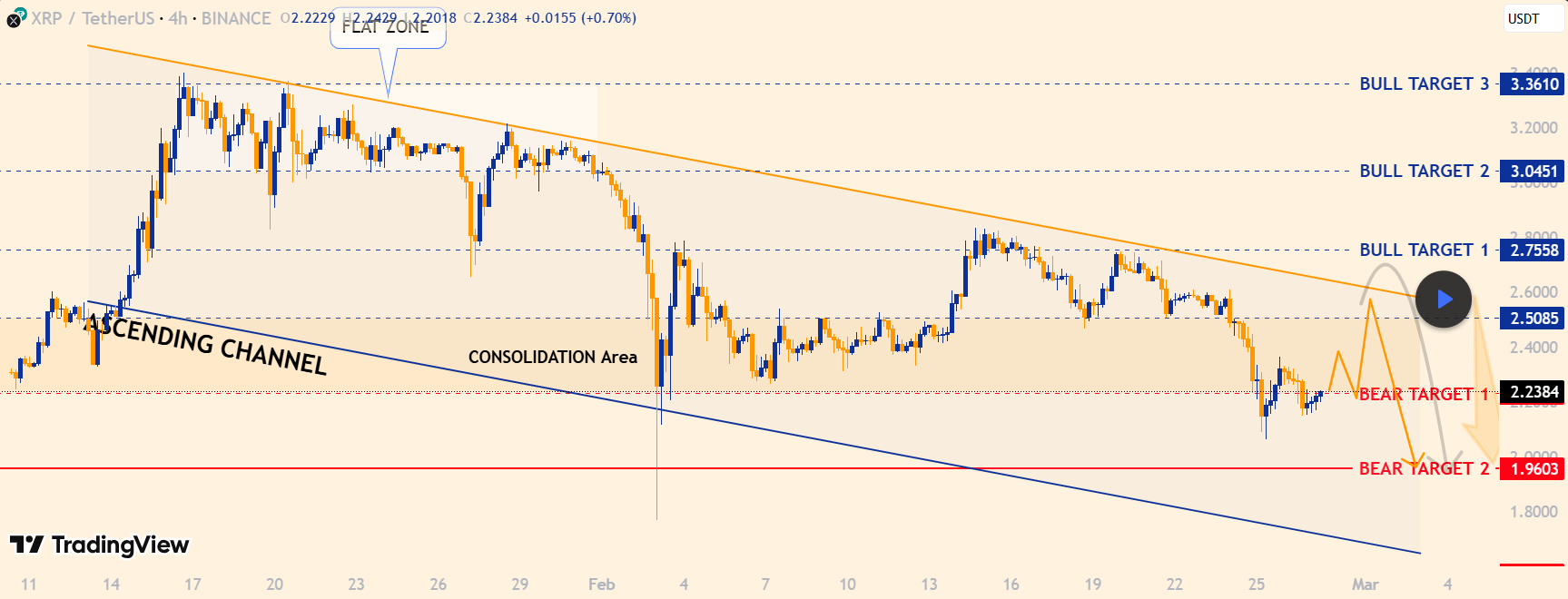
At this critical moment, market analyst Arina Karayi has presented three bearish targets for XRP in a TradingView analysis. Interestingly, the asset appears to have already moved below the first bearish target at $2.23. The bears decisively retook this level on Wednesday, Feb. 26.

However, Karayi predicted in her report that the bulls might take over, albeit for a moment. According to the analyst, XRP is likely to witness a short period of bullish recovery, which could push its price above $2.5085. She cited historical data, with XRP witnessing similar recoveries at this level in the past.

Three Bearish XRP Targets
Three Bearish XRP Targets | Arina Karayi

Nonetheless, the analyst believes this recovery would be short-lived. For context, XRP is likely to rise to the upper trendline of a descending channel that has dictated its price action since mid-January. If the projected recovery retests the upper trendline at $2.6, Karayi expects another pullback.

Bearish Targets for XRP

According to the analyst, sellers would regain control of the scene, bringing the other two bearish targets into play. Notably, below the first bearish target at $2.23 is a second one around $1.96, which would translate to a drop underneath $2. Recall that analysts believe XRP remains bullish as long as it holds above $2. 

With XRP currently changing hands at $2.02, a mild 2.97% drop from this area would trigger a slump to the second bear target. It is important to note that the bears have already defined Karayi’s projection of a short-term recovery and have instead bypassed this rebound to push the asset to lower regions.

Below $1.96 is a third bearish target at $1.57, representing a low last witnessed in late November 2024. Such a target represents a 22% drop from current values and a 54% collapse from the yearly peak of $3.4.

However, Karayi admits that the bulls could invalidate this bearish projection if Bitcoin’s dominance drops. After a massive slump earlier this week, the BTC market dominance has continued to increase since yesterday, now at 60.84%. A drop in this metric could translate to more capital entering altcoins, giving them an opportunity to demonstrate resilience.

XRP Could Target $5 to $8 As XRP Nearly Done with ABC Correction: Analyst

0

A prominent analyst expects XRP to reach a price discovery phase upon the completion of Elliott Waves 3 to 5 on the daily timeframe.

The bullish commentary comes despite XRP’s current bearish situation. Notably, XRP has collapsed 13.61% over the past four days, dropping from the $2.6 region to around $2.22. This bearish turn is largely due to a broader market downturn, as Bitcoin (BTC) slumps to $85K for the first time this year.

XRP Nearly Done with ABC Correction

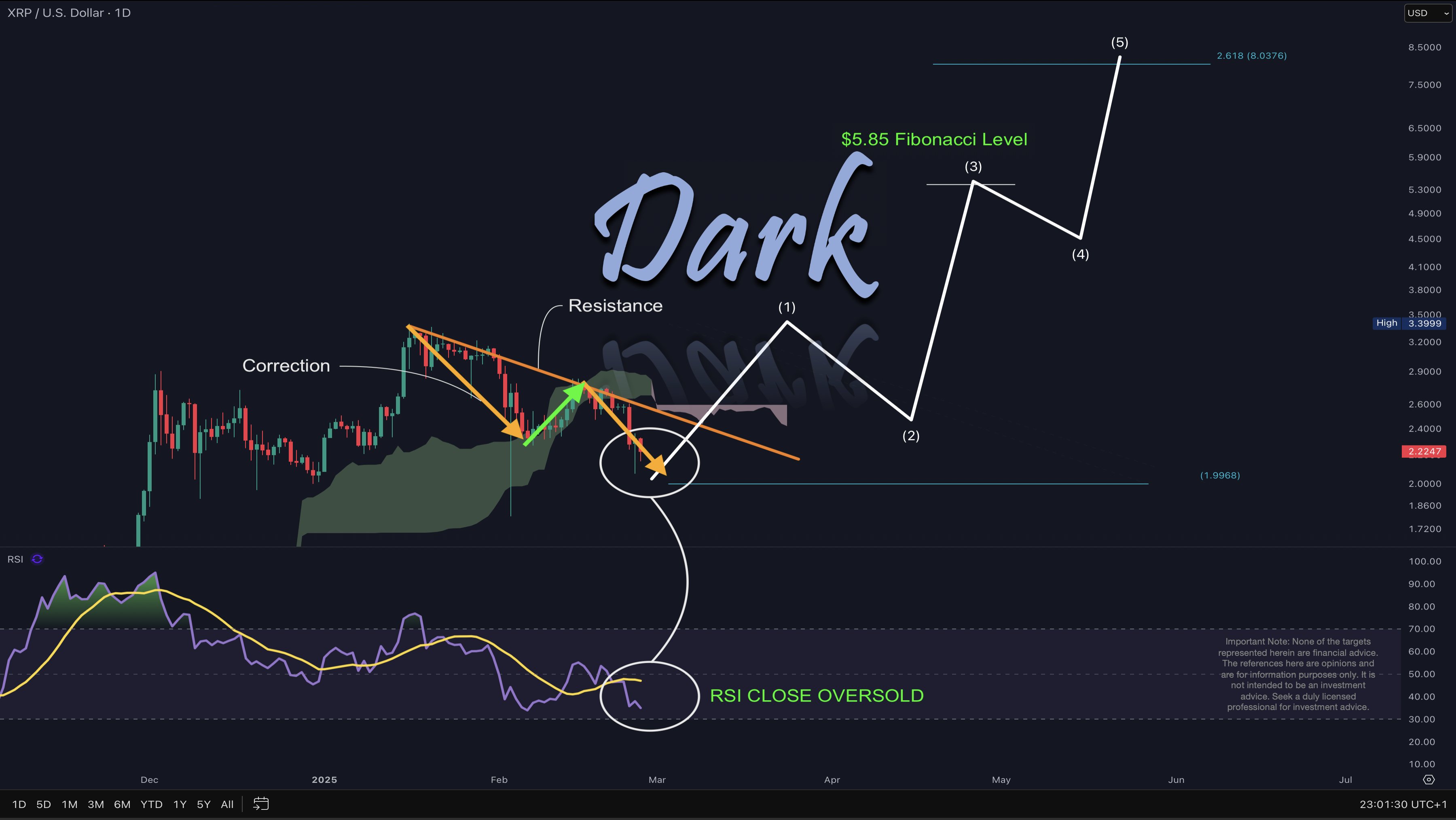
However, analysts like Dark Defender believe the pullback is only temporary, and an XRP rebound could lead to greater heights. In his latest analysis, Dark Defender confirmed that the ongoing price drop is part of a larger ABC correction that XRP has been facing since it reached a seven-year top of $3.4 in mid-January.

For context, after reaching $3.4 on Jan. 16, XRP witnessed a collapse in the days that followed. The general direction was downward, reflecting Wave A of the ABC correction. This Wave A ended with a drop to $2.27 on Feb. 6, and the B Wave saw a mild upsurge.

This upsurge pushed XRP to a high of $2.83 on Feb. 15, culminating in the end of Wave B. Notably, Wave C resumed the correction and has now taken XRP to a current low price of $2.23, representing a 34% drop from the mid-January peak of $3.4.

XRP Elliott Wave Structure Dark Defender
XRP Elliott Wave Structure | Dark Defender

According to Dark Defender, XRP is still within the Wave C of the ABC correction, and is on the verge of completing it. He called attention to the daily RSI, which has dropped below the mid band to a current value of 36.27. He stressed that at this level, the RSI is close to the oversold region.

XRP Targets $5 to $8

Once XRP completes the ABC correction, Dark Defender predicts the start of a new Elliott Wave structure. He expects the first wave to lead back to the January highs before Wave 2 would trigger another massive correction.

Interestingly, the analyst believes Wave 3 would push XRP to a new all-time high of $5.85, with the fourth wave triggering a mild correction below $4.5. Meanwhile, Dark Defender sees the fifth and last wave taking XRP to $8.03, aligning with the 2.618 Fibonacci extension.

The market watcher also presented crucial levels to watch as XRP navigates these waves. According to him, the asset could witness an important support region from $1.88 to $1.91. However, major resistance lies at $2.44, $2.99 and $5.85.

Meanwhile, another notable analyst, EGRAG, shared deeper insights into XRP’s monthly RSI, currently at 66.74. He noted that the RSI must hold above the support mark at 65 as it looks to form a double-top pattern. EGRAG says this structure typically leads to a price explosion.

In addition, the market analyst stressed that the Bollinger Bands are within a wide range, with the top presenting resistance at first attempt. However, historical data indicates that the RSI usually breaches the top of the range in the second attempt, a sign of a price explosion.

MetaMask Plans Bitcoin and Solana Integration in New Roadmap

0

MetaMask has unveiled a new roadmap focused on enhancing its wallet’s capabilities, including support for Bitcoin and Solana.

Notably, the integration of the Bitcoin network is slated for the third quarter. Meanwhile, Solana will become the first blockchain outside the Ethereum Virtual Machine (EVM) ecosystem to gain support on MetaMask, with its integration planned for May.

Additionally, the wallet provider is enhancing its user experience by launching a redesigned home screen. This update will allow users to view all their assets across multiple blockchains in one place, eliminating the need to switch between networks manually.

This recent shift also moves away from the current Externally Owned Account (EOA) model, which depends on private and public keys, towards a more secure and flexible system.

Enhanced Security Through Smart Contracts

MetaMask presently operates as an EOA, requiring users to manage private keys to access their funds. However, this approach presents a major risk—losing the private key results in permanent loss of assets. To mitigate this, MetaMask plans to introduce Contract Accounts (CAs), which function through smart contracts rather than traditional key-based access.

Unlike EOAs, CAs offer advanced security measures, including transaction verification layers and built-in recovery options. These features minimize the risks of human error.

At a major Ethereum conference in North America, MetaMask representatives explained that CAs provide greater flexibility and security. Users can enforce predefined transaction conditions by implementing programmable accounts, granting more customized control over their assets.

ERC-5792: Optimizing Transaction Efficiency

Among the major improvements, MetaMask is set to implement ERC-5792, a feature that streamlines transaction processes. This upgrade enhances the wallet’s smart transaction system by allowing multiple actions to be completed in a single step, cutting both execution time and associated gas fees.

With ERC-5792, users will be able to combine operations such as approving and swapping tokens into one transaction. This reduces the required steps, ensuring a single gas fee covers the entire process.

SEC Drops Lawsuit Against MetaMask’s Parent Company

This development came just after the U.S. SEC dropped its enforcement lawsuit against Consensys, the parent company of MetaMask. On February 27, 2025, Chief Executive Officer Joseph Lubin confirmed this regulatory shift in a tweet.

The lawsuit accused MetaMask of operating as an unregistered securities broker by facilitating staking and token-swapping services. The SEC claimed MetaMask Staking enabled the sale of unregistered securities using third-party liquid staking cryptos, while MetaMask Swaps functioned as an unregistered broker by processing trade routing.

US SEC Reaches Agreement With Consensys to Drop Securities Lawsuit

0

Consensys founder Joseph Lubin announces an agreement between the blockchain firm and the US SEC to end ongoing securities litigation.

In a tweet late Thursday, the Ethereum co-founder announced that the Securities and Exchange Commission has consented to closing its case against MetaMask. Lubin disclosed that the regulatory top dog would drop all securities investigations into the decentralized crypto wallet.

The litigation dismissal is subject to approval by the US SEC, which has yet to officially comment on the claims. According to Lubin, the agency will file a stipulation with the court in the coming days to end the 8-month-old case.

Consensys Sees Breakthrough with Reformed SEC

For context, the US SEC filed a lawsuit against blockchain firm Consensys in June for operating as an unregistered broker. The litigation claimed the Web3 developer offered unregistered securities through its wallet, MetaMask.

Notably, the Gary Gensler-led agency classified third-party staking services as securities as they constitute investing money in an enterprise in expectations of returns. As a result, the SEc claimed MetaMask offered unregistered securities to US investors.

However, the new dispensation in the US SEC hierarchy views the enterprise differently. Earlier reports show that the Mark Uyeda-led agency has already enquired about staking from industry leaders, seeking a detailed understanding of how the venture fits into the securities laws.

Lubin welcomed the impending case withdrawal, lauding the SEC’s pro-innovation disposition under its new leadership. While acknowledging that the developer was willing to defend itself in all capacities, the Ethereum co-founder appreciated this new outcome.

Notably, Consensys earlier sued the SEC for its regulatory overreach, particularly towards the Ethereum network. However, a court dismissed the case in September, calling it moot.

XRP Community Clamor Intensifies Amid Growing Dismissal

The Consensys dismissal adds to the growing list of cases the US SEC recently dropped. For perspective, the Wall Street watchdog dismissed its litigation and investigation into Coinbase, Robinhood, Gemini, and OpenSea in the past week.

Meanwhile, the XRP community has intensified its clamor for the end of the Ripple vs. SEC case. A reaction noted that the lawsuit precedes others the regulator recently dropped, asking for a quick end to the litigation.

The Ripple case is among several other high-profile ongoing cases. The SEC has yet to dismiss legal actions against Binance and Kraken.

XRP Derivatives Trading to Go Live on No. 1 Bitcoin Exchange in Japan

0

Japan-based crypto exchange bitFlyer has announced the addition of XRP leveraged trading on its bitFlyer Crypto CFD platform.

In the announcement, the exchange noted that XRP leveraged trading will go live soon. It will allow traders to take advantage of XRP price movements with up to 2x leverage. This provides greater capital efficiency and the ability to profit from both rising and falling markets.

According to the announcement, this addition is part of bitFlyer’s strategy to expand and diversify its product offerings, providing more opportunities for customers to engage in the crypto market.

XRP on bitFlyer Crypto CFD

Notably, bitFlyer’s Crypto CFD platform enables users to trade with leverage by depositing margin and then speculating on crypto price movements without owning the underlying asset. This product enables up to 2x leverage, allowing for efficient capital usage.

Additionally, the ability to take short positions means traders can profit even when prices decline. Previously, bitFlyer supported BTC-CFD/JPY trading. Now, it is expanding its offerings with XRP-CFD/JPY and ETH-CFD/JPY pairs.

The exchange is proud to have held Japan’s No. 1 Bitcoin trading volume for nine consecutive years. It aims to strengthen its position in crypto derivatives by offering traders a fee-free trading experience. However, additional leverage points and funding rates will be charged separately.

Rising Interest in XRP in the Japanese Market

The move to add XRP to the leveraged trading platform aligns with the growing interest in XRP in the Japanese crypto market.

The Crypto Basic reported two weeks ago that Japanese energy company Remixpoint purchased XRP and Dogecoin worth $3.9 million as part of its strategy to enter the crypto market. 

The company now holds $2.63 million in XRP and $1.31 million in Dogecoin. Accordingly, its total crypto holdings reached $59.1 million, a significant increase from March 2024, when it was just $446,500.

In December, GAM Investments proposed an XRP buyback program to SBI Holdings. The proposal suggests that SBI use its cash flow to buy back XRP from the market. GAM believes this would unlock significant shareholder value and better reflect SBI’s true net asset value, estimated at JPY 3.9 trillion.

Meanwhile, in 2023, SBI Remit launched a remittance service that uses XRP for countries like Vietnam and the Philippines. The initiative aims to reduce costs and improve scalability, with plans to expand to more countries and transaction types.

SEC Confirms Meme Coins Like Shiba Inu and Dogecoin Aren’t Securities

0

The U.S. SEC Division of Corporation Finance issued new guidance stating that meme coins like Dogecoin, Shiba Inu, Official Trump, and Official Melania are not securities. 

The division made the assertion in a statement yesterday, emphasizing that meme coins are not securities under federal securities laws. Instead, it categorized these assets as collectibles due to their speculative nature. 

According to the statement, meme coins are tokens inspired by cultural events, internet memes, or trends purchased mainly for entertainment and social engagement purposes rather than investment. 

Additionally, it notes that since meme coins lack inherent utility, their values are driven by speculation and market demand. 

Meme Coins Fail Howey Test 

Consequently, the commission emphasized that meme coins do not meet the requirements of the Howey Test, a longstanding securities test.

In particular, the statement notes that meme coin purchasers are not investing in an enterprise. Hence, they cannot expect profit from the efforts of others.

Since meme coins are not securities, the SEC emphasized that related transactions do not require registration. Therefore, U.S. federal securities laws do not protect meme coin holders and purchasers. 

Notably, the SEC clarified that its assertion does not apply to meme coins that do not meet the above description. Despite acknowledging that meme coins are not securities under federal law, it warned that fraudulent activity relating to the offer and sale of these assets may be subject to enforcement actions by other state and federal agencies. 

Previous Stance on Meme Coins 

The statement clarifies the SEC’s stance on meme coins, such as SHIB, DOGE, TRUMP, and MELANIA. This marks a shift from Gary Gensler’s broader view of crypto assets, which saw him classify all cryptocurrencies—except Bitcoin—as securities. 

Although the SEC has not classified meme coins as securities in its past enforcement actions against the industry, Gensler’s statement casts regulatory uncertainty over these assets. 

The SEC’s clarification comes a month after U.S. President Donald Trump launched the TRUMP meme coin. His wife also followed suit and launched her own meme coin, MELANIA. 

These meme coins have plunged heavily from their peak prices over the past few weeks. While TRUMP is down 84.89% from its ATH of $75.35 to $11.35, MELANIA is currently down 94% from its peak price of $13.73 to $0.8096. 

Potential Approval of Meme Coin-Related ETFs Soar

Meanwhile, the SEC’s position on meme coins indicates they have a better chance of being approved for an ETF. Notably, the previous SEC administration refused to acknowledge ETF filings relating to assets classified as securities. 

This was observed last year when Gensler’s SEC refused to acknowledge Solana ETF applications due to the securities tag given to SOL in the Binance and Coinbase lawsuit. 

Prospective issuers seek to launch ETFs around meme coins like DOGE and TRUMP. The SEC has acknowledged some of these applications, including Grayscale’s DOGE ETF filings. 

Now, the SEC’s recent clarification that meme coins are not securities bolsters the chances of these assets being approved for ETFs. 

Speculations Links XRP to US Fort Knox Reserve: Details

0

Edoardo Farina, founder of Alpha Lions Academy, has made bold speculations about potential XRP ties to U.S. gold reserves.

In a recent post on X, Farina highlighted an unsubstantiated theory that XRP might secretly serve as a digital counterpart to the gold stored at Fort Knox, the heavily guarded U.S. Army base in Kentucky.

The commentary comes amid discussions around XRP’s potential inclusion in the proposed digital asset reserve by President Donald Trump. While the ideas surrounding possible XRP links to Fort Knox gold appear interesting, they remain speculative, lacking concrete evidence. 

Plans to Verify Fort Knox’s Gold Reserves

For context, Farina first referenced Fort Knox, home to an estimated 147.3 million ounces of gold currently worth about $425 billion at $2,891 per ounce, and often considered a cornerstone of America’s wealth. 

Notably, amid efforts to substantiate government disclosures, Elon Musk, who now heads the Department of Government Efficiency (DOGE), proposed a livestreamed tour of the vaults to verify the gold’s presence, looking to confirm that someone had not swapped it for painted lead. 

Farina used this to weave a narrative connecting the physical gold to XRP’s digital framework, though he presented no direct proof of any link.

XRP Linked to Fort Knox Gold?

Discussing XRP’s origins, Farina pointed out that the XRP Ledger launched in June 2012 but faced early technical hiccups, resulting in the erasure of its first 32,570 ledgers. This left the initial week of transactions untraceable, with the ledger as we know it officially stabilizing in December 2012. 

Farina implied this mysterious reset might actually hide deeper secrets, though Ripple attributes it to routine technical adjustments, a less sensational explanation. Interestingly, the Alpha Lions Academy CEO’s theory centered on the “genesis wallets” from XRP’s early days. 

He zeroed in on one wallet, dubbed “X.FortKnox.b,” which initially held 6 billion XRP, directly traceable to Ripple. Another wallet, “X.Distributor.1,” once controlled 80% of the total XRP supply and, in January 2013, dispersed nearly all of it across nine transactions to wallets with “Fort Knox” labels, such as “Fort Knox.a” and “X.Fort.Knox.2” through “X.Fort.Knox.9.” 

Farina asked if these names suggest a hidden design tying XRP to a digital gold standard, but he stops short of proving intent or official backing.

To add fuel to his speculation, Farina pointed to Rosie Rios, a former U.S. Treasurer whose signature can be found on the $100 bill. Rios joined Ripple’s Board of Directors and, during her tenure as Treasurer, oversaw Fort Knox’s gold reserves. 

Farina emphasized that this connection was “shocking” and suggested a grander scheme, though no documentation ties her role to XRP’s creation or purpose.

Historical Transaction Trail

The pundit also traced a transaction trail from the “X.FortKnox.b” wallet, detailing how 1.84 billion XRP moved through multiple wallets between 2013 and 2017, eventually landing with Ripple. 

Interestingly, one transfer included a strange memo, which he interpreted as possibly referencing Ripple Trade, a version number, a build number, and then an unclear code. He invited others to decode it, but whether or not it is important remains unclear.

However, despite Farina’s narrative, no official records or statements from Ripple, the U.S. government, or Rios corroborate his claims. Notably, the “Fort Knox” wallet names could simply be a reflection of creative labeling by early developers.

Pundit Explains How XRP Will Benefit from Upcoming US Stablecoin Regulation

0

XRP community researcher SMQKE has outlined how upcoming U.S. stablecoin regulations could boost XRP’s adoption, utility, and market value.

The analysis highlights how Ripple’s USD stablecoin, RLUSD, will directly benefit from the new regulatory framework. It projects that RLUSD could drive increased usage on the XRP Ledger and raise demand for XRP in the process.

Regulatory Clarity Opens Doors for RLUSD

The GENIUS Act, which mandates reserve requirements, audits, and licensing for stablecoins, will bring much-needed regulatory clarity to the market. Experts argue that this will increase RLUSD’s credibility and ensure its regulatory compliance.

As a result, RLUSD could become more attractive to institutional investors looking for a stable, regulated digital asset for transactions. Proponents believe this outcome will likely drive greater adoption and activity on the XRP Ledger.

XRP’s Key Role in RLUSD Transactions

Regarding how RLUSD’s increased usage benefits XRP, proponents point out that every time RLUSD is transacted, a small XRP-denominated fee is charged. Notably, that fee is burned, reducing the total supply of XRP in circulation.

The theory is that as RLUSD grows in popularity, especially for cross-border payments and remittances, the demand for XRP as a bridge asset will rise. In turn, this phenomenon will lead to an upward push in the value of XRP.

Strengthening XRP’s Legal Standing

Furthermore, SMQKE noted that the regulatory clarity provided by the GENIUS Act will also help solidify XRP’s legal status.

While XRP is not a stablecoin, its operation within a regulated framework will strengthen its position as a utility token rather than a security. This will provide greater legal certainty for investors, businesses, and financial institutions.

Competing with CBDCs

Another major advantage SMQKE highlighted is the positioning of RLUSD against Central Bank Digital Currencies (CBDCs).

Notably, the U.S. government has banned the creation of a federal CBDC. Meanwhile, President Trump’s executive order emphasized the importance of USD stablecoins, like RLUSD, in promoting the dollar’s dominance globally.

Ultimately, SMQKE’s commentary suggests that the regulatory changes brought about by the GENIUS Act could usher in a new era for XRP, even though XRP itself is not a stablecoin.

It is worth mentioning that under the proposed GENIUS Act, only stablecoins with over $10 billion in market value are subject to federal regulation. Currently, Ripple’s RLUSD stablecoin is well under the $10 billion cap. As a result, it can opt for state-level regulation if it meets federal standards.

Here’s When the Bitcoin Bull Run Could End According to CryptoQuant CEO

0

The CryptoQuant CEO has shared when he believes the current Bitcoin bull run could end, suggesting this might be the longest one yet.

As Bitcoin battles the bears below the $100,000 mark, Ki Young Ju recently asserted that the current bull run might extend longer than any in history, though he cautions that the coming months will prove decisive. 

When the Bitcoin Bull Run Could End

While examining on-chain indicators, he noted that Bitcoin teeters on the edge between a bullish surge and a potential bearish downturn. Ju predicts that this extended rally could persist until at least April 2025, a forecast he first made in May 2024, citing the Bitcoin growth rate difference metric.

Bitcoin Growth Rate Difference CryptoQuant
Bitcoin Growth Rate Difference | CryptoQuant

However, he emphasized that the next one to two months will reveal whether demand rebounds or fades, potentially pushing indicators into a full downtrend.

Despite the downtrend, Ju has maintained his optimism, highlighting that Bitcoin dropping below $77,000 seems unlikely. Even in a worst-case scenario, he expects the asset to consolidate around that level for several months before climbing again, as previously reported by The Crypto Basic.

In his latest commentary, the CryptoQuant founder advised against aggressive leveraged bets in either direction, as he urged traders to exercise patience amid this decisive moment in the market. 

Bitcoin in a Manipulation Phase, but Rebound Imminent 

Meanwhile, market analyst Cas Abbé noted in a report today that Bitcoin currently lingers in a manipulation phase amid the bearish price action. He pointed out that bullish developments fail to spark upward momentum, with even positive stock market trends leaving Bitcoin unmoved. 

Abbé called attention to last September, when the asset hovered at a similar juncture before launching into its next significant climb. He asserted that there might be a brewing opportunity, as market forces may be setting the stage for a breakout, provided traders can navigate the current stagnation.

With BTC down 16.37% this month, February 2025, Bitcoinsensus, a market resource, called attention to the fact that the asset has closed February on a bearish note only twice since 2013, with March typically delivering bullish results over the past four years. 

Bitcoin Monthly Performance

As the asset looks to close its third bearish February in history, Bitcoinsensus emphasized that March often defies early-year dips, presenting the opportunity for a potential turning point for Bitcoin’s price.

Meanwhile, an analyst known as Master of Crypto observed that past bull cycles followed significant drops—around 35% in 2017 and 33% in 2021—with explosive rallies of 320% and 280%, respectively. 

With Bitcoin recently shedding about 20%, he sees a similar setup unfolding. According to him, the market is largely volatile. Yet, there might be hope in whale activity, with over 26,000 BTC recently moved to long-term investment addresses, as disclosed by The Crypto Basic two days back.

He also noted that the stablecoin index, an indicator of fresh capital inflows, is starting to rise. Notably, this is due to an injection of fresh capital in the form of stablecoin mints, which could bolster demand. Currently, Bitcoin trades for $85,432, down 2.75% in the past 24 hours.