Home Blog Page 107

Ripple Execs Celebrate XRPL 14th Anniversary, Credit XRP Holders for Network’s Success 

0

Ripple executives took to X to celebrate the XRP Ledger’s (XRPL) 14th anniversary, reflecting on the network’s success over the years.

Yesterday, the XRP Ledger community marked 14 years since the network’s early foundations were established. To commemorate the milestone, Ripple CTO Emeritus David Schwartz shared a reflective message highlighting the collaborative journey behind the XRP ecosystem’s growth.

Meanwhile, Ripple CEO Brad Garlinghouse also joined the celebration, emphasizing the enduring strength of the XRP community. 

Key Points

  • The XRP Ledger community recently celebrated the network’s 14th anniversary.
  • Ripple CTO Emeritus emphasized that XRPL’s success was driven by its community members and developers. 
  • Ripple CEO Brad Garlinghouse also joined the anniversary, describing his support for XRP as an honor of a lifetime. 
  • Since launch, XRPL has processed over 4.41 billion transactions, including roughly 1.92 million transactions in a single recent day. 

Ripple CTO Emeritus Celebrates XRPL’s 14-Year Anniversary 

In his statement on X, Schwartz revisited the original vision behind the XRP Ledger. According to him, the project began with a simple goal, which revolved around building a better system for moving value globally.

However, he stressed that the project expanded beyond the contributions of its founders. In his view, XRP and the XRP Ledger did not succeed solely because of the three XRPL founders—Arthur Britto, Jed McCaleb, and Schwartz himself. Instead, he credited the broader ecosystem that formed around the network over the years, including developers, validators, businesses, and community members.

Schwartz praised the community for “helping to shape XRP into what it is today.” Notably, his comments resonated across the XRP ecosystem, with many supporters reflecting on XRPL’s resilience and longevity within the rapidly evolving crypto industry.

Ripple CEO Joins Celebration

Reacting to the post, Ripple CEO Brad Garlinghouse also commemorated the milestone, describing his longstanding support for XRP as “the honor of a lifetime.”

His remarks further reinforced his deep connection to the XRP ecosystem, which he has consistently highlighted over the years. Beyond making bullish remarks about XRP, Garlinghouse also famously has the XRP logo tattooed on his right upper arm.

Additionally, he continues to reassure the community that Ripple’s initiatives aim to strengthen XRP’s long-term growth. These efforts include strategic partnerships, acquisitions, and new product launches designed to expand the ecosystem.

Anniversary Revives XRPL’s Early History

The anniversary also reignited discussions surrounding the XRP Ledger’s earliest development history. Popular XRPL dUNL validator Vet highlighted one of the first known code contributions made by Jed McCaleb on October 14, 2011, with the network eventually launching in June 2012.

According to Vet, McCaleb used a variable called “Faith” alongside a comment that stated: “You have to accept the First Ledger (Genesis) on Faith.”

He described the moment as symbolic of the belief required during XRPL’s earliest stages. Referencing the comment, Vet emphasized that the project simply required “a leap of faith.” 

Jed McCaleb first XRPL code
Jed McCaleb’s first XRPL code

XRPL Continues to Expand After 14 Years

Fourteen years after its creation, the XRP Ledger remains one of the crypto industry’s longest-running blockchain networks.

Over time, the network has expanded far beyond its original payment-focused vision. Today, the network supports cross-border payment infrastructure, institutional blockchain applications, and even tokenization. 

As a result, the network has attracted major institutions that continue to leverage its technology. One notable example is Japan’s financial giant SBI, which launched a fully regulated token issuance platform on the XRP Ledger.

XRPL Transaction Volume Surpasses 4.4B 

Meanwhile, XRPL’s network activity continues to demonstrate significant adoption. According to Dune Analytics, XRPL has processed more than 4.41 billion transactions since inception, with 1.92 million transactions processed yesterday alone. 

XRPL Transaction Metric
XRPL Transaction Metrics

At the same time, XRP remains one of the world’s largest cryptocurrencies by market capitalization. The asset currently ranks fifth globally, with a market valuation of approximately $76.02 billion and a unit price of $1.22.

Bitcoin and Ethereum Tell a Different Story from Traditional Assets In 2026

0

Bitcoin and Ethereum have struggled to keep pace with traditional financial markets in 2026, recording losses while major traditional assets thrived.

The year-to-date performance data shows a clear divergence between the two cryptocurrencies and more established broader market assets. BTC and ETH, the two largest digital assets by market cap, are having a year to forget so far in terms of price performance, while oil, gold, and major equities are performing exceptionally.

Key Points

  • Bitcoin and Ethereum have struggled to keep pace with traditional financial markets in 2026.
  • Bitcoin has dropped over 16% and Ether by over 32% since the start of the year.
  • In contrast, oil is up 63%, the S&P 500 by 9.2%, and the Nasdaq by 13.8%.
  • Precious metals have also outperformed Bitcoin and Ether, with gold up 1.2% and silver by 0.5% YTD.

Major Traditional Assets Up Significantly YTD

An analysis from J.A. Maartunn, a prominent market watcher, highlighted the stellar performance of typical traditional assets.

Brent crude oil has emerged as one of the strongest-performing assets since the start of the year, with gains exceeding 63.3%. The commodity benefited from the US-Iran conflict, which drove scarcity following the blockade of the Strait of Hormuz.

Major stock indices such as the Nasdaq and S&P 500 have also posted notable growth.  The former is up 13.8% year-to-date, and the latter has increased by 9.2%, reaching new all-time highs.

The 10-year US Treasury yield has also increased by 6.9%, and the US dollar index by a moderate 0.6% since this year.

Precious metals have also outperformed Bitcoin and Ether. Gold, the largest asset globally by market cap, is up 1.2%. It reached new all-time highs earlier in the year, peaking at $5,597, but has dropped significantly to near $4,500. Still, it is slightly higher than its opening price this year.

Silver followed a similar trajectory of pumping earlier in the year, then dropping to its current price. Despite this, it is up 0.5% YTD.

In contrast, both Bitcoin and Ethereum are telling a different story.

Bitcoin Trails Traditional Markets

Bitcoin (BTC) has declined over 16% since the start of the year, making it one of the weaker-performing major assets in the current market environment. The pullback stands in sharp contrast to the resilience seen across equities, commodities, and even the U.S. dollar.

It also had a decent start to the year, reaching $98,000 in early January. Even a recent resurgence to $82,000 in May ended up as a lower high, and the asset has now dumped below $69,000.

Bitcoin and Ethereum Performance Against Major Assets/J.A. Maartunn

Meanwhile, the performance gap highlights a shift in investor sentiment. Earlier cycles often saw Bitcoin outperform traditional markets during periods of strong risk appetite. This year, however, capital has largely favored sectors tied to energy and equities, leaving Bitcoin unable to match their momentum.

Despite the decline, Bitcoin continues to hold its position as a prominent asset in the global financial market. Moreover, it is currently in the middle of its typical four-year market cycle, where it retests lower prices. As such, optimism remains high that Bitcoin will rally considerably in the coming years, with one analysis citing historical patterns.

Ethereum Faces Even Greater Downward Pressure

Ethereum (ETH) has experienced an even more challenging year, falling over 32% on a year-to-date basis. The decline places it among the weakest-performing major assets in the broader financial landscape.

The larger drop suggests that investors have been more cautious toward assets perceived as carrying higher risk. While Ethereum remains a dominant network for decentralized applications and tokenized assets, its market performance has lagged significantly behind both traditional markets and several other asset classes.

Ethereum also serves as a higher beta play to Bitcoin, often mirroring BTC but in greater measure, explaining the larger decline. The downtrend reflects the current state of the broader crypto market, which has struggled so far this year, with the exception of a few.

Despite the YTD performance, the long-term outlook for Ether remains optimistic. When the current de-risking conditions reverse, analysts expect the asset to recover rapidly, amid growing institutional adoption of its technological infrastructure. However, this remains speculative.

SBI CEO Reveals Plans to Invest $1.25B in Ripple IPO, Predicts Timeline for Ripple to Go Public

SBI Holdings CEO Yoshitaka Kitao confirms plans to invest up to $1.25 billion in the Ripple IPO, predicting a possible timeline for the firm to go public. 

He shared this during SBI’s latest Information Meeting, where he explained how the company plans to spread its investments over time. According to Kitao, Ripple could eventually go public over the next 12 years.

Key Points

  • SBI CEO plans up to $1.25B investment in Ripple IPO and predicts a possible public listing within 12 years.
  • SBI has been Ripple’s key partner since 2016, holding about a 9% equity stake.
  • Ripple says it has no IPO plans, citing strong finances and the ability to fund growth privately.
  • Ripple raised $500M at a $40B valuation and launched a $750M buyback targeting a $50B valuation.

SBI CEO Plans $1.25 Billion Investment in Ripple IPO

In an official SBI video shared on June 1, Kitao said he plans to use about 70% of any amount he’s able to save for the next stage of investments before moving into a second phase. 

According to him, if SBI decides to invest everything at once, he would “go all in” on Ripple Labs when the company eventually becomes public. Japan-based XRP community figure Eri called attention to these comments.

Kitao noted that a full one-time investment could fall between 100 billion yen ($626 million) and 200 billion yen ($1.25 billion). According to him, this would allow SBI to complete its investment plan in one move. 

He also suggested that he believes that once all this is done, Ripple could go public within 12 years. The SBI Holdings CEO stressed that the Ripple IPO could be an important step for the company’s growth.

Kitao mentioned Circle as an example, noting that its move into the public market has gone well so far. He mentioned a cycle where companies go public, adjust their capital, reinvest, and improve their structure. Kitao believes this kind of cycle can help businesses grow stronger over time.

Strong SBI-Ripple Partnership Continues to Grow

SBI Holdings and Ripple have built a strong relationship over the years, starting in 2016. Their partnership focuses on cross-border payments, the use of XRP through On-Demand Liquidity, and joint business efforts across Asia.

The relationship began in early and late 2016 when SBI invested in Ripple during its Series B funding round, which raised about $55 million in total. SBI went on to become the largest external Ripple shareholder, with about a 9% stake.

In May 2016, both companies launched SBI Ripple Asia. In this joint venture, SBI held 60% while Ripple Labs held 40%, with an initial capital of 350 million yen. The goal was to roll out RippleNet across Japan, South Korea, and Southeast Asia, allowing fast cross-border payments in over 40 currencies and across more than 70 countries.

In 2021, SBI moved into live use of XRP. Through SBI Ripple Asia, SBI Remit became the first service in Japan to use Ripple’s On-Demand Liquidity for transfers between Japan and the Philippines, enabling real-time payments using XRP.

The partnership has continued to grow since then. Last year, SBI signed an agreement to help distribute RLUSD, Ripple’s stablecoin, in Japan through SBI VC Trade, with a planned launch in the first quarter of 2026. Now, Kitao is planning an investment in a possible Ripple IPO.

Ripple Says It Still Has No IPO Plans

Despite SBI’s interest, Ripple has made it clear that it does not plan to go public anytime soon. The company says it is in a strong financial position and can fund its growth without turning to public markets or dealing with extra reporting requirements.

This position is supported by recent financial activity. In November 2025, Ripple raised $500 million through a share sale that valued the company at $40 billion. Soon after, in early 2026, Ripple launched a $750 million share buyback program. This move aimed to raise its valuation to $50 billion.

Ripple President Monica Long also confirmed this stance in a January 2026 interview with Bloomberg. She said the company still plans to stay private and explained that Ripple has enough funding to support its growth. Long noted that companies usually go public when they need more capital or liquidity, which Ripple does not need right now.

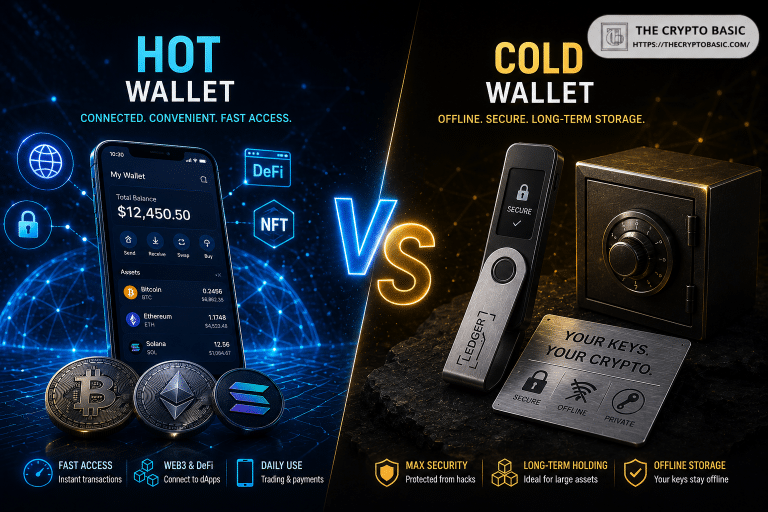
Hot Wallet vs Cold Wallet: Differences, Security & Which One Is Better

0

In 2026, crypto hackers stole over $2.5 billion from digital wallets — and 80% of those losses could have been prevented with the right wallet setup.

Here’s the hard truth: your crypto isn’t safe just because you “have a wallet.” Where you store it, how you protect your keys, and whether you’re using hot or cold storage make the difference between keeping your life savings and losing it all in seconds.

This guide shows you exactly which wallet type to use, when to use it, and how experts structure their wallets to stay safe while still accessing DeFi, NFTs, and trading opportunities

What Is a Crypto Wallet and Why Does It Matter?

A crypto wallet is a digital tool that helps users store, access, send, and receive cryptocurrencies safely. However, a crypto wallet does not physically store coins like a normal wallet stores cash. Instead, it stores digital keys that provide access to crypto assets on the blockchain.

Every crypto wallet works using two important keys:

1. Public Key

A public key works like a wallet address. It can be safely shared with others to receive cryptocurrency.

2. Private Key

A private key works like a secret password. It proves ownership of the crypto assets and allows transactions to be approved. This key should never be shared because whoever controls the private key controls the funds.

This is why crypto wallet security is extremely important.

In 2026, crypto wallets are used for more than just storing Bitcoin or Ethereum. Investors now use wallets for:

  • Crypto trading
  • DeFi platforms
  • NFT buying and selling
  • Staking rewards
  • Web3 apps and gaming
  • Daily crypto payments

Many users are also moving toward self-custody wallets to gain more control over their assets instead of relying completely on exchanges.

Modern wallets now support multiple blockchains, NFT storage, stronger security parameters, and direct access to decentralized applications, making them an essential part of the growing crypto ecosystem.

What Is a Hot Wallet in Crypto?

A hot wallet is a crypto wallet that stays connected to the internet. It is designed for quick access, making it easy to send, receive, and trade cryptocurrencies anytime. Because of its online nature, it is commonly used by active traders and DeFi users.

How It Works

  • Instant transactions
  • Easy access to DeFi and NFT platforms
  • Fast token swaps


Types of Hot Wallets

  • Mobile wallets (apps on smartphones)
  • Browser extension wallets (like MetaMask)
  • Desktop wallets (installed on computers)
  • Exchange wallets (stored on crypto exchanges)
  • Web wallets (accessed through browsers)


Advantages of Hot Wallets

  • Fast and easy access to funds
  • Useful for trading and DeFi activities
  • Simple setup for beginners
  • Supports NFTs and Web3 apps
  • Convenient for daily transactions


Risks of Hot Wallets

  • Higher risk of hacking and phishing attacks
  • Vulnerable to malware or fake websites
  • Private keys are exposed to internet risks
  • Exchange wallets may face account freezes or restrictions
  • User errors can lead to irreversible loss of funds


What Is a Cold Wallet in Crypto?

A cold wallet is a crypto wallet that stays offline most of the time. It is primarily used to store cryptocurrencies securely over the long term. Since it is not connected to the internet, it offers stronger protection against online threats.

How It Works

  • Create a transaction online.
  • Sign it inside the offline device.
  • Broadcast to blockchain


Types of Cold Wallets

  • Hardware wallets (Ledger, Trezor, etc.)
  • Paper wallets (printed keys or QR codes)
  • Air-gapped devices (offline computers)
  • Offline backup storage systems


Advantages of Cold Wallets

  • Strong protection from online hacking
  • Ideal for long-term crypto storage
  • Private keys stay offline and secure
  • Reduced risk of phishing or malware attacks
  • Preferred for large crypto holdings


Risks of Cold Wallets

  • Can be lost or physically damaged
  • Requires careful backup of seed phrases
  • Less convenient for daily trading
  • The setup can be slightly complex for beginners
  • Recovery is impossible without backup keys


Hot Wallet vs Cold Wallet: Key Differences

Parameters Hot Wallet Cold Wallet
Private Key Storage Keys stored online on device (phone, browser, computer) Keys stored offline on a physical device (hardware or paper)
Security Level Medium — vulnerable to hacking, phishing, malware High — protected from online attacks
Convenience Fast and easy access; instant transactions Less convenient; requires device connection
Transaction Speed Instant access and trading Slower; must connect the device first
Cost Free (no hardware required) $50–$200+ (one-time hardware purchase)
Best For Regular transactions, frequent trading, beginners, small amounts (<$500) Long-term storage, large holdings (>$1,000), maximum security
Risk Type Online attacks, malware, exchange breaches, phishing Physical loss/damage, seed phrase mismanagement
Types Mobile apps, browser extensions, desktop wallets, web wallets, exchange wallets Hardware wallets (Ledger, Trezor), paper wallets, air-gapped devices
Control Can be custodial (exchange controls keys) or non-custodial Full self-custody (you control keys)
Use Case Daily trading, DeFi, NFTs, quick transfers HODLing, savings vault, long-term investments


Hot Wallet vs Cold Wallet: Which Is More Secure?

When it comes to security, hot wallets and cold wallets are built for completely different purposes. One prioritizes convenience and speed, while the other prioritizes maximum protection. So the answer to “which is more secure?” depends on how and where you store your crypto.

Let’s explore which one is more secure: 

Hot Wallet Security

Hot wallets offer moderate security, but they are more exposed to risk because they stay connected to the internet.

Key security points:

  • Vulnerable to phishing attacks and fake websites
  • Risk of malware, spyware, and browser exploits
  • Private keys stored on internet-connected devices
  • Security depends heavily on user behavior
  • Exchange-based hot wallets may face account freezes or breaches

Hot wallets are secure enough for small balances and daily use, but not ideal for storing large amounts of crypto.

Cold Wallet Security

Cold wallets are designed specifically for strong security and long-term storage.

Key security points:

  • Private keys stored offline in hardware devices
  • No direct exposure to internet-based hacking
  • Transactions require physical confirmation
  • Protected from malware and remote attacks
  • Industry-standard choice for long-term holding

Cold wallets are widely considered the safest method to store cryptocurrency.


So, Which One Is More Secure?

Cold wallets are clearly more secure because they eliminate internet exposure, the biggest risk factor for crypto theft. However, security also depends on how carefully users manage their recovery phrases and devices.

Hot wallets, while less secure, are still important for active crypto usage.

Why Most Crypto Experts Use Both Wallets

Most crypto experts don’t rely on just one wallet. Instead, they use both wallets together to separate risk, improve security, and organize their crypto activities. This approach, called a multi-wallet or hybrid wallet strategy, is widely recommended in 2026 because it reduces the risk of losing all funds in a single attack or mistake.

The main idea is simple: never keep everything in one place. If one wallet is compromised, the rest of the portfolio stays safe. This “segmentation” approach is now a standard security practice in crypto investing.

This is how experts structure both wallets together- 

Cold Wallet (Vault Storage)

  • Used for long-term holding/ HODLing ( Hold On for Dear Life )
  • Stores 80–90% of total crypto funds
  • Kept completely offline in hardware devices
  • Used rarely, only for major transfers
  • Highly secure against hacks and phishing attacks

Think of this as your digital savings bank.

Hot Wallet (Active Use Wallet)

  • Used for daily trading and DeFi activity
  • Holds small amounts of crypto only
  • Connected to dApps, NFT platforms, and exchanges
  • Fast and easy transactions
  • Higher exposure to online risks

Think of this as your spending or trading wallet.

Key Reasons Why Investors Use Both Wallets

1. Protection from total loss

  • Experts keep most funds in cold wallets
  • Only small amounts are exposed in hot wallets
  • Even if a hot wallet is hacked, the full portfolio is safe

2. Fast access to trading opportunities

  • Hot wallets allow instant buying, selling, and swapping
  • Useful for volatile markets where timing matters
  • Supports DeFi, NFTs, and Web3 apps without delay

3. Long-term security for savings

  • Cold wallets store crypto offline, away from hackers
  • Private keys never touch the internet
  • Best option for long-term “HODLing.”

4. Better control of risk exposure

  • Investors separate “active funds” and “stored wealth.”
  • Reduce the impact of phishing or smart contract scams
  • Limits damage from human mistakes like wrong approvals

5. Safer interaction with DeFi platforms

  • Only small amounts are used for testing new apps
  • Protects main holdings from risky or unknown protocols

6. Industry-standard security practice

  • Exchanges and institutions also use hot + cold storage systems
  • Cold wallets store reserves, hot wallets handle transactions
  • This layered system reduces single-point failure risk

This hybrid wallet approach works because it follows a simple rule used across the crypto industry:

“Use hot wallets for activity, and cold wallets for storage.”

Which Crypto Wallet Should You Choose?

No specific cryptocurrency wallet can be considered the “best” option. Users’ unique cryptocurrency needs dictate which wallets they should use. 

Take a look at this quick comparison to help you select the best wallet for your needs.

Quick Comparison

Use Case Best Wallet Choice Wallet Type Key Advantage
Beginners Zengo / Coinbase Wallet Software (Hot) Easy setup, simple interface, beginner-friendly recovery options
Day Traders Kraken Pro / OKX Web3 Wallet Exchange / Hybrid Fast execution, high liquidity, quick trading access
Long-Term Investors Ledger Nano X / Trezor Safe 5 Hardware (Cold) Maximum offline security, strong protection from hacks
DeFi & NFTs Users MetaMask / Phantom / Rabby Software (Hot) Full Web3 access, supports dApps, NFTs, and multiple chains

In short-

If You Need Quick access & trading, choose Hot Wallet, and for Maximum security for savings, pick Cold Wallet. However, for the best balance, you can choose both (hot for spending, cold for storage)

Common Crypto Wallet Mistakes That Can Cost You Money

In 2026, most crypto losses are not caused by blockchain failures, but by simple user mistakes and scams. Hackers are increasingly using phishing sites, fake wallet apps, malicious token approvals, and even fake hardware wallet letters to trick users into giving away access. Because transactions are irreversible, even a small mistake can permanently drain funds.

Here are the most common crypto wallet mistakes investors should avoid:

1. Sharing seed phrase or private keys

    • No real wallet or support team ever asks for it
    • Phishing sites often pretend to “verify” or “recover” wallets

2. Falling for phishing websites and fake apps

  • Fake wallet apps appear on search ads and app stores
  • AI-generated scam sites now closely copy real platforms

3. Signing unknown or unlimited token approvals

  • Malicious smart contracts can drain wallets after approval
  • Many users lose funds without realizing they gave permission

4. Storing seed phrases digitally

  • Saving in screenshots, cloud drives, or notes apps increases risk
  • Malware can scan devices and extract recovery phrases

5. Connecting wallets to untrusted dApps

  • Fake DeFi or NFT sites can trigger wallet drain transactions
  • “Approve” clicks can give full access to assets

6. Using fake wallet apps or browser extensions

  • Counterfeit apps often mimic MetaMask, Trust Wallet, or others
  • Some even steal keys instantly after setup

7. Ignoring hardware wallet phishing 

  • Scammers now send fake letters and QR codes asking for seed phrases
  • Real companies never request recovery phrases

8. Not verifying transaction addresses

  • Clipboard malware can replace wallet addresses during transfers
  • One wrong address means permanent loss

9. Keeping all funds in one wallet

  • If one wallet is compromised, everything is at risk
  • Experts always split funds between hot and cold storage

Conclusion 

Hot wallets and cold wallets both play important roles in managing cryptocurrency, but they serve different purposes. Hot wallets are fast and convenient for trading, DeFi, and NFTs, whereas cold wallets provide offline security for long-term storage.

Most experienced investors employ both options to balance security and flexibility. Knowing the latest crypto wallet security, storage, and blockchain technologies may help investors secure their assets and make safer investments.

For more crypto news, market updates, analysis, and educational insights, stay tuned to The Crypto Basic, a platform that covers the most recent developments and information from the crypto and blockchain industries.

XRP Back in a Zone It Has Entered Only 4 Times in 13 Years: What Happened The Last 3 Times

0

XRP has slipped back into an oversold zone it has visited only four times in its 13-year history, with each prior entry leading to a significant move.

Well-known market analyst Cryptollica was first to call the public’s attention to this development, confirming that the XRP RSI on the monthly timeframe has dropped to an extremely rare undervalued region.

Key Points

  • XRP has collapsed more than 31% this year amid the market-wide downtrend.
  • This decline has now pushed the monthly XRP RSI below 43, representing a rare oversold area.
  • XRP has only visited this RSI bottom three times in the past: in February 2017, March 2020, and June 2022.
  • Each time XRP revisited this area, what followed was a significant move.

XRP Battling Bearish Pressure

Cryptollica’s recent market exposition comes as XRP continues to battle bearish pressure alongside the rest of the crypto market. Notably, after recovering to around $1.55 in mid-May, XRP succumbed to the market-wide downtrend, dropping to $1.36 by May 28.

As May came to a close, the broader market saw a rebound campaign, and XRP leveraged this to recover above the $1.36 area. However, this campaign’s momentum has declined in recent times, with XRP crashing back to $1.26 at press time as it nurses a 5.17% decline in June.

With this decline, XRP’s RSI has now slipped into an oversold level that Cryptollica believes may serve as a precursor for a significant move in the near future. For context, this region refers to the area below the 43-mark on the monthly RSI timeframe.

XRP RSI Slips Back to Rare Oversold Zone

Data from the analyst’s chart confirms that this zone remains incredibly rare, as XRP has only visited it three times in the past, with the latest occurrence making it the fourth time throughout the asset’s 13-year history.

XRP RSI Monthly Chart Cryptollica
XRP RSI Monthly Chart | Cryptollica

Specifically, the first time XRP entered this area was in January 2017, when its price dropped to a floor of $0.003. Another occurrence played out in March 2020, as the monthly RSI crashed to 43.75 amid a price collapse to $0.1140. This price marked the bottom of the 2020 bear market for XRP.

The third time XRP visited this region was during the 2022 bear market, as prices slumped to a bottom of $0.2870 in June of that year. During this period, the monthly XRP RSI dropped to 43.91. 

Now, the monthly RSI has crashed again to this zone after exactly four years. This comes as XRP’s price hit the $1.26 low, indicating that each time XRP reaches this level, the floor price is higher than the previous time. Currently, the monthly RSI sits at 43.72, lower than the figures recorded in June 2022 and March 2020.

What Happened Each Time?

The interesting bit is that each time the monthly RSI dropped to this oversold level, XRP’s recovery effort eventually led to a massive price upswing, although it may take some time to achieve this.

For instance, after the January 2017 incident, XRP’s price shot up more than 110,000% to a peak of $3.31 by January 2018. Following the decline in March 2020, the price rallied 1,628% to a high of $1.96 by April 2021. Meanwhile, the June 2022 incident preceded a 1,084% rise to $3.4 by January 2025.

Considering this pattern, Cryptollica suggested that each of these past occurrences played out right before the XRP market saw a bullish reset. “The previous three were not normal pullbacks. They appeared near major cycle reset zones,” the analyst said.

Despite the consistent pattern, investors should note that past performance does not guarantee future results. It remains to be seen if XRP will replicate the upsurge witnessed during the last three times. However, if it does repeat the pattern, its price could push past the $3.66 all-time high.

Why RLUSD Could Be One of the Biggest Catalysts for XRP Adoption

0

Jake Claver recently suggested that Ripple’s stablecoin RLUSD could become one of the strongest drivers of XRP adoption.

Claver, who serves as the Chairman of Digital Ascension Group (DAG), insisted that RLUSD actually benefits XRP despite concerns that the stablecoin competes with XRP as a bridge asset.

Key Points

  • Jake Claver suggests that the Ripple stablecoin RLUSD could become one of the biggest catalysts for XRP adoption.
  • He expects thousands of stablecoins and tokenized assets rather than one dominant global stablecoin.
  • Multiple stablecoins may lead to fragmentation and create a need for a neutral bridge asset.
  • XRP acts as this neutral bridge asset, posing no counterparty risk with no central issuer.
  • RLUSD is not competing with XRP but helping institutions enter the XRP Ledger ecosystem.

RLUSD and XRP Working Together, Not Competing

According to Claver, many people misunderstand the purpose behind RLUSD. Some believe Ripple launched the stablecoin because XRP was unable to fulfill its role. 

However, Claver suggests that the opposite is true. He believes RLUSD could help expand XRP’s use by bringing more institutions into blockchain-based financial systems.

To him, the future of finance will depend less on retail investors and more on how banks, governments, payment companies, exchanges, and large businesses use digital dollars and other tokenized assets. 

Claver noted that as those organizations enter the space, XRP may have an important role to play by helping move liquidity between different networks and financial products.

Tokenization Could Change Global Finance

Claver noted that tokenization is one of the biggest financial infrastructure changes. He expects a wide range of assets, including real estate, U.S. Treasuries, stocks, private equity, commodities, insurance products, carbon credits, and debt instruments, to move to blockchain networks.

The market pundit mentioned a forecast from the Boston Consulting Group that estimates tokenization could become a $16 trillion market by 2030. Claver believes this figure could end up being too low because tokenization solves several long-standing problems in traditional finance.

Today, real estate transactions can take between 60 and 90 days to settle. Cross-border payments often take several business days, private equity investments can lock up funds for years, and securities markets still rely on delayed settlement processes. He also highlighted the roughly $27 trillion held in Nostro and Vostro accounts to support international liquidity.

According to Claver, tokenization can improve these systems by allowing near-instant settlement, fractional ownership, global access to liquidity, and better connections between markets. It also makes capital programmable. This can lead to new financial applications.

Major institutions such as BlackRock, Franklin Templeton, JPMorgan, Visa, and Mastercard are already exploring tokenization in 2026. However, as more assets become tokenized, liquidity will become fragmented across different stablecoins, tokenized deposits, money market products, tokenized Treasuries, and regional settlement assets.

Why XRP Could Benefit from a Growing Stablecoin Market

Claver noted that he does not believe the future will be dominated by a single stablecoin. Notably, he expects thousands of stablecoins and tokenized deposits to emerge as banks, governments, fintech firms, and exchanges create products that suit their own needs.

For instance, Bank of America is issuing one stablecoin while Citi launches another. Meanwhile, tokenized Treasury funds and regional payment networks could operate on separate systems. With more of these products emerging, it becomes important to move value between them efficiently.

Claver believes interoperability will become one of the biggest challenges in this environment. Since institutions generally prefer to use their own assets rather than those issued by competitors, they will need a neutral way to move value between systems.

That is where he believes XRP can play a major role. Instead of replacing stablecoins, XRP could help connect them by acting as a neutral bridge asset that routes liquidity between different networks.

RLUSD Could Help Bring Institutions into the XRPL Ecosystem

Claver said Ripple launched the RLUSD stablecoin because institutions often prefer stable and predictable assets over more volatile cryptocurrencies.

Many institutions must follow strict compliance rules, accounting standards, and audit requirements. As a result, they feel more comfortable holding dollar-backed stablecoins than holding digital assets with fluctuating prices.

Claver says this makes RLUSD an important entry point. It allows institutions to begin using blockchain infrastructure without immediately taking on crypto market risk. Once they start operating within the XRP Ledger ecosystem, they can gradually explore additional services and opportunities available on the network.

RLUSD launched in December 2024 and has already reached approximately $1.6 billion in market capitalization within about a year and a half. Claver called it one of the fastest-growing stablecoins in the industry.

He stressed that this growth did not come mainly from retail traders, meme coin speculation, or yield farming programs. Instead, institutions, enterprise settlement systems, and regulated liquidity use cases have driven much of the stablecoin’s expansion.

How RLUSD and XRP Could Create a Long-Term Growth Cycle

Claver suggested that if RLUSD continues growing and compounds at 100% annually over the next five years, its market capitalization could reach roughly $48 billion to $50 billion.

However, he argued that market cap is not the most important measure for institutions, as transaction volume matters more. A stablecoin with a $50 billion supply can support trillions of dollars in annual transactions when institutions continuously reuse the same liquidity.

If RLUSD becomes used for tokenized securities, cross-border payments, treasury management, derivatives collateral, institutional decentralized finance, foreign exchange settlements, and payment corridors, transaction activity on the XRP Ledger could become much larger than the stablecoin’s market cap.

Notably, institutions may first use RLUSD for settlement and treasury purposes, but they could later expand into tokenized securities, debt issuance, tokenized funds, instant trade settlement, and real-time collateral management.

According to Claver, this process creates an important cycle. In this cycle, RLUSD adoption brings more institutions to the XRP Ledger. As more institutions arrive, more assets become tokenized, and more stablecoins enter the network. This growth increases liquidity fragmentation, which raises demand for interoperability.

As interoperability becomes more important, XRP’s role as a bridge asset grows. Greater XRP liquidity can reduce slippage, improve efficiency, and support larger transaction volumes. These improvements can attract even more users and institutions, creating a cycle that repeats over time.

10 Best Crypto Wallets for Beginners in 2026

0

Cryptocurrency adoption continues to accelerate in 2026, bringing millions of new users into the crypto space for the first time. As more investors buy Bitcoin, Ethereum, stablecoins, and emerging altcoins, one question has become increasingly important: where should you store your crypto safely?

This is where crypto wallets play a critical role. A crypto wallet allows users to securely store, send, receive, and manage digital assets. However, not all wallets offer the same experience. While some prioritize maximum security, others focus on simplicity and ease of use for beginners.

For a first-time investor, choosing the right wallet can determine whether your crypto journey is smooth and secure or filled with costly mistakes. In this guide, we explore the 10 best crypto wallets for beginners in 2026. We also examine the top wallets for Bitcoin and Ethereum, while explaining how to choose between hot and cold wallets.

Why Choosing the Right Crypto Wallet Matters in 2026

The crypto sector has evolved over the past few years. In 2026, digital assets extend far beyond Bitcoin trading. Users are now actively participating in decentralized finance (DeFi), NFT ecosystems, tokenized real-world assets, blockchain gaming, and crypto-based payment systems.

At the same time, cyber threats and scams are becoming sophisticated, with billions of dollars siphoned yearly. Hackers frequently target inexperienced users through phishing attacks, fake wallet applications, and other malicious tactics. Consequently, wallet security has become very important.

A reliable crypto wallet helps users:

  • Safely store digital assets
  • Maintain full ownership of funds
  • Protect private keys and recovery phrases
  • Access decentralized applications securely
  • Reduce exposure to exchange hacks

For beginners, the ideal wallet should balance strong security with a simple and user-friendly interface.

What Beginners Should Look for in a Crypto Wallet

Before selecting a crypto wallet, beginners should understand the features that matter most. With thousands of wallets available in 2026, new investors may feel overwhelmed by the options. Nevertheless, focusing on a few key factors can simplify the decision-making process.

Security

Beginners should focus on security when choosing a crypto wallet. Since cryptocurrencies operate on decentralized networks, users bear full responsibility for protecting their funds. Therefore, a reliable wallet should include features such as two-factor authentication (2FA), encrypted private keys, biometric login, and secure backup recovery phrases. In addition, compatibility with hardware wallets provides an extra layer of protection for long-term holdings.

Ease of Use

Simplicity is equally important, especially for beginners. Some wallets include advanced trading tools and technical features that can confuse first-time users. As a result, beginner-friendly wallets should provide clean interfaces, intuitive navigation, and straightforward setup processes. Clear instructions and simple designs help users manage crypto confidently without unnecessary complexity.

Multi-Asset Support

Today, many investors hold more than one cryptocurrency. Alongside Bitcoin and Ethereum, users often invest in meme coins, gaming tokens, and emerging altcoins. Therefore, wallets that support multiple blockchains and digital assets offer greater flexibility and convenience.

Reputation and Trust

Not all wallets share the same level of credibility. Beginners should prioritize wallets with strong reputations, positive community feedback, and proven security records. Researching reviews on crypto forums and social platforms can also help users understand the experiences of existing customers. Furthermore, wallets backed by active development teams and large user bases are generally considered more trustworthy.

Customer Support

New crypto users may encounter issues during wallet setup, transactions, or recovery processes. In such situations, responsive customer support becomes extremely valuable. Wallets that provide live chat, detailed guides, and extensive knowledge bases are often better suited for beginners.

Compatibility

The best crypto wallets work seamlessly across multiple devices and platforms. Mobile apps, desktop versions, and browser extensions allow users to access their assets conveniently from anywhere.

10 Best Crypto Wallets for Beginners in 2026

Choosing the right wallet is essential. It helps users secure funds and perform basic crypto activities such as sending and receiving assets. In 2026, these ten wallets stand out for their strong security, beginner-friendly interfaces, and powerful feature sets.

Trust Wallet

Many users count Trust Wallet among the best crypto wallets out there. Launched in 2017 by Viktor Radchenko and later acquired by Binance, Trust Wallet provides a secure, self-custodial, and mobile-friendly experience.

The wallet allows beginners to store, buy, send, and receive millions of cryptocurrencies and NFTs across more than 100 blockchains. In addition, users can interact with decentralized applications (dApps) through both mobile and browser versions.

Key Features:

  • Multi-chain support
  • Built-in staking options
  • NFT storage
  • User-friendly mobile design
  • Mobile and browser compatibility

MetaMask

Launched in 2016, MetaMask initially served as the default wallet for the Ethereum ecosystem. Over time, it expanded to support EVM-compatible networks such as BNB Smart Chain and Polygon.

Like Trust Wallet, MetaMask enables users to interact with dApps while accessing DeFi services such as staking and yield farming. It also supports a wide range of digital assets, including cryptocurrencies and NFTs.

Key Features:

  • Browser and mobile support
  • Easy access to DeFi platforms
  • Custom network integration
  • Large developer ecosystem

Phantom Wallet

Phantom Wallet has become one of the most recognized self-custodial wallets in the crypto industry. Originally launched for the Solana blockchain in 2021, the wallet later expanded support to Ethereum and other networks.

Phantom allows users to store, send, receive, swap, and manage cryptocurrencies and NFTs through a clean and intuitive interface. As a result, it has gained popularity for its speed, ease of use, and seamless NFT experience.

Key Features:

  • Mobile and web support
  • Fast transactions, especially on Solana
  • Multi-chain support
  • Biometric authentication
  • Non-custodial control

Ledger Wallet

Unlike software wallets such as MetaMask and Trust Wallet, Ledger focuses on hardware wallet solutions. Since its launch in 2014, Ledger has become one of the most trusted names in crypto security.

Ledger devices pair with the Ledger Live application, allowing users to store, send, receive, and swap digital assets securely. Moreover, Ledger keeps private keys completely offline through cold storage technology. Popular models include the Ledger Nano S, Ledger Nano X, and Ledger Flex.

Key Features:

  • Cold storage security
  • Physical transaction verification
  • Multi-asset and multi-chain support
  • Portfolio management through Ledger Live
  • DeFi and dApp integration

Trezor Safe 5

The Trezor Safe 5 is a premium hardware wallet designed for secure offline crypto storage while maintaining a modern user experience. The device features a vibrant touchscreen protected by Gorilla Glass, along with haptic feedback for smoother navigation.

In terms of security, the wallet includes a certified EAL6+ secure element that protects against both physical tampering and digital threats. Additionally, users can choose between a Bitcoin-only version and a broader multi-asset model.

Key Features:

  • Cold storage security
  • CC EAL6+ certification
  • Multi-chain and multi-asset support
  • Physical transaction confirmation
  • Offline key protection

SafePal S1 Pro

Launched in 2023, the SafePal S1 Pro is a premium air-gapped hardware wallet designed for maximum security. The wallet keeps private keys offline while enabling users to manage, trade, and stake assets through the SafePal mobile app.

Unlike many competitors, the device avoids Bluetooth and Wi-Fi connections entirely, relying instead on QR-code communication for enhanced protection. It also supports more than 200 blockchains and unlimited tokens.

Key Features:

  • Air-gapped security mechanism
  • Enhanced 500mAh battery
  • Physical button verification
  • Mobile and PC compatibility

Tangem Wallet 2.0

The Tangem Wallet 2.0 introduces a unique approach to hardware security through smart cards and the wearable Tangem Ring. Released in late 2023, the device improved upon earlier versions with upgraded durability and waterproof protection.

Users can store, swap, send, and receive crypto assets by connecting the card to smartphones through NFC technology. Moreover, the wallet uses an EAL6+ certified secure chip for advanced protection.

Key Features:

  • Military-grade durability
  • Passport-grade EAL6+ secure chip
  • Seedless security
  • User-friendly interface

Coinbase Wallet

Owned by Coinbase exchange, Coinbase Wallet operates as a self-custodial software wallet separate from the Coinbase trading platform. Since launching in 2017, the wallet has evolved into a fully integrated Web3 gateway.

The wallet gives users complete control over their private keys while supporting several cryptocurrencies, NFTs, and decentralized applications across multiple networks. Importantly, users do not need a Coinbase exchange account to use it.

Key Features:

  • Web3 and dApp access
  • Self-custodial storage
  • Multi-chain and multi-token support
  • Hardware wallet integration

Ellipal Titan 2.0

Launched in 2023, the Ellipal Titan 2.0 is a premium air-gapped hardware wallet focused on maximum security. The device uses QR-code-based offline transaction signing, eliminating internet exposure.

Built with a sealed metal body and a 4-inch touchscreen, the wallet integrates a CC EAL5+ secure element alongside self-destruct protections against physical tampering.

Key Features:

  • Air-gapped design
  • CC EAL5+ certification
  • Anti-tamper and self-destruct protection
  • Multi-asset support

NGRAVE ZERO

The NGRAVE ZERO is a high-end non-custodial hardware wallet built for maximum cold storage protection. Since launching in 2020, it has gained recognition for its advanced security architecture.

The wallet operates fully offline and communicates with external wallets such as MetaMask exclusively via QR codes. Notably, it has EAL7 certification, which is considered to be the highest security standard in the industry.

Key Features:

  • Fully air-gapped security
  • EAL7 certification
  • User-friendly interface
  • Multi-layer tamper protection
  • Large touchscreen

The Safest Wallets for First-Time Crypto Investors

For first-time crypto investors, hardware wallets remain the safest option because they store private keys offline, significantly reducing exposure to online threats.

Leading security-focused choices in 2026 include the Ledger Nano X and the Trezor Safe 5, both known for institutional-grade protection. However, these devices require an upfront purchase. For example, the Ledger Nano X costs around $150, while the Trezor Safe 5 sells for $205.

Meanwhile, software wallets like MetaMask and Trust Wallet provide strong security features while maintaining convenience for mobile-first users. Regardless of the wallet chosen, beginners should always keep recovery phrases offline, protect private keys, enable all security settings, and carefully verify wallet downloads to avoid phishing scams.

Best Wallets for Bitcoin, Ethereum, and Emerging Altcoins

Different wallets perform better depending on the blockchain ecosystem and intended use case.

For Bitcoin storage and management, top choices include Ledger Nano X and Trezor Safe 5. Notably, Trezor even offers a Bitcoin-focused version of the Safe 5.

For Ethereum and Layer-2 ecosystems, MetaMask remains the most suitable wallet because it was originally designed for Ethereum. Additionally, Trust Wallet and Coinbase Wallet also provide users with access to dApps, DeFi protocols, and Web3 services.

For altcoins and multi-chain ecosystems, popular options include Trust Wallet, SafePal, and Phantom because they support a broad range of emerging tokens across multiple blockchains.

Hot Wallets vs. Cold Wallets: Which Is Better for New Users?

Hot wallets and cold wallets serve different purposes, so beginners should understand how each option works.

Hot wallets remain connected to the internet, making them ideal for everyday transactions and active trading. MetaMask and Trust Wallet are popular examples of hot wallets. Since they offer quick access and convenience, many beginners prefer them. However, their online connectivity also increases exposure to cyber threats, making them better suited for smaller balances.

On the other hand, cold wallets store assets offline for maximum security. Devices such as the Ledger Nano X and Trezor Safe 5 protect private keys from online attacks, making them significantly safer for long-term storage. Nevertheless, they are less convenient for daily transactions and require a hardware purchase.

Ultimately, many beginners achieve the best balance by combining both options: using hot wallets for everyday activities while storing long-term holdings in cold wallets.

Final Thoughts: Which Crypto Wallet Is Right for You?

The best crypto wallet for beginners in 2026 depends on your individual needs, experience level, and investment goals.

Users seeking simplicity may prefer Trust Wallet or SafePal. Meanwhile, those exploring DeFi and Ethereum ecosystems may benefit more from MetaMask. Investors prioritizing long-term security should strongly consider hardware wallets such as Ledger or Trezor.

Regardless of the wallet chosen, understanding crypto security fundamentals remains essential. The safest investors are those who learn how wallets operate, protect their recovery phrases, and remain cautious of scams.

As the crypto industry continues to evolve, choosing the right wallet will remain one of the most important decisions for every new investor entering the digital asset market.

For the latest updates on crypto wallets and security tips, follow The Crypto Basic for timely insights and expert guidance on protecting your digital assets. 

Major XRP Announcement Next for DTCC: Analyst

0

Analysts are betting on DTCC to release an XRP announcement soon, as previous events seem to already suggest close collaboration between the two ecosystems.

Specifically, Xaif Crypto shared on X that the XRP announcement is next following DTCC’s disclosure around Stellar. The market watcher highlighted the close relationship between Ripple, the XRP Ledger, and the Depository Trust & Clearing Corporation (DTCC) as confirmations that the event could happen imminently.

Key Points

  • Analysts are betting on DTCC to announce XRP soon, as previous events seem to already suggest close collaboration between the two ecosystems.
  • The $114 trillion firm confirmed earlier in the year that its tokenization service will operate across multiple blockchain ecosystems.
  • A 2025 DTCC patent document referenced the XRP Ledger among the blockchain networks capable of supporting tokenized asset workflows.
  • Ripple Prime has already established integration within the Fixed Income Clearing Corporation (FICC), one of DTCC’s key subsidiaries.
  • In a hypothetical scenario where XRP follows a similar trajectory to XLM if DTCC announces it, the coin could hit $2.56.

XRP Likely Option as DTCC Confirms Multi-Chain Support

The post first highlighted DTCC’s decision to support multiple blockchain networks for its tokenization platform as a strong point.

Notably, the $114 trillion firm confirmed earlier in the year that its tokenization service, expected to launch in the second half of 2026, will operate across multiple blockchain ecosystems rather than relying on a single network.

While the organization has not disclosed all the blockchains that could participate, the disclosure has fueled speculation about which networks may play a role as tokenized finance continues to expand.

For Xaif Crypto, the development stands out because of several connections that have emerged between Ripple, XRP Ledger, and DTCC-related infrastructure in recent years.

Much of the discussion centers on a 2025 DTCC patent document that references the XRP Ledger among the blockchain networks capable of supporting tokenized asset workflows. Although a patent mention does not guarantee future adoption, the analyst views it as evidence that the DTCC considers the XRP Ledger an option for its broader tokenization push.

This narrative further strengthens as the DTCC has already publicly announced Stellar as part of its tokenization initiative. Recall that Stellar, alongside the XRP Ledger, appeared in the documentation as the two assets that can act as digital liquidity bridges for cross-border settlements.

Existing Ripple Financial Infrastructure Connections

Another reason for Xaif Crypto’s growing XRP optimism is the relationship of Ripple with parts of DTCC’s broader ecosystem. Ripple Prime has already established integration within the Fixed Income Clearing Corporation (FICC), one of DTCC’s key subsidiaries responsible for processing and settling fixed-income transactions. This became possible through the acquisition of Hidden Road in April 2025 for $1.25 billion.

While this connection does not directly involve the XRP Ledger, the close relationship between Ripple, the Ledger, and its north star, XRP, is very glaring. As a result, the analyst believes XRP has positioned itself well to be part of the chains that DTCC could expand to in the future.

For now, however, no official announcement links XRP Ledger to DTCC’s upcoming platform. The company has only confirmed that the service will support multiple blockchain networks when it launches, with Stellar being the first official announcement.

Still, the combination of DTCC’s multi-chain strategy, previous references to XRP Ledger in patent filings, and Ripple’s existing ties to financial market infrastructure has kept speculation alive.

Possible Price Implication for XRP

Notably, DTCC announced last week that it would tokenize assets on Stellar, and its price implication was massive. Its native token, XLM, has surged by an impressive 54% in the past seven days, bringing its YTD price action back to the green zone. The asset had more than doubled from its opening price of $0.147 to $0.298 following the news before giving back its gains.

In a hypothetical scenario where XRP follows a similar trajectory to XLM if DTCC announces it, the coin could hit $2.56. This scenario hinges on XRP trading at its current price of $1.26 at the time of the announcement.

Crypto Taxes in 2026: Everything Investors Need to Know

Crypto taxes in the United States have entered a new phase in 2026. For years, filing relied more on investors tracking and reporting their own transactions with fewer enforced rules. That has now changed.

Notably, the 2026 tax filing season is the first one in which the government’s new reporting system is fully in place. This gives the Internal Revenue Service (IRS) much more visibility into crypto activity.

The basic tax filing treatment of crypto assets has not seen a drastic change in recent years. In March 2014, the IRS issued Notice 2014-21, which classified cryptocurrencies as property rather than currency. Since then, investors have been required to pay taxes when they sell crypto for cash, exchange one cryptocurrency for another, or use digital assets to pay for goods and services.

While that core rule remains the same, many other parts of crypto taxation have changed over the years. Reporting requirements are now broader, compliance rules have become stricter, recordkeeping is now more important, and enforcement efforts have increased. 

Investors who still follow reporting habits from the early years of the crypto market now face a very different tax environment.

As a result of these changes, understanding crypto tax rules is now extremely important for American traders. Essentially, investors need to know how gains and losses work, what activities trigger taxes, what reporting requirements apply, and what legal strategies can help reduce tax bills.

Major Crypto Tax Changes Investors Should Know in 2026

One of the most important crypto tax changes for 2026 is the rollout of Form 1099-DA. Starting with transactions made during the 2025 tax year and reported in 2026, covered U.S. digital asset brokers must provide transaction details to both investors and the IRS.

Most centralized cryptocurrency exchanges now fall under these requirements. Now, the IRS will receive information about crypto assets directly through Form 1099-DA instead of relying mainly on taxpayer disclosures. This gives tax authorities direct access to transaction data from regulated exchanges.

Another important change involves cost-basis tracking. Here, investors must track their cost basis separately for each exchange and wallet instead of combining holdings across different platforms.

For instance, someone who bought Bitcoin on both Coinbase and Robinhood can no longer combine these purchases into a single cost-basis calculation. Each platform must now be tracked separately.

This requirement comes from the IRS Revenue Procedure 2024-28. Beginning Jan. 1, 2025, investors must move away from universal cost-basis tracking and use a wallet-by-wallet approach instead. Under these rules, each wallet acts as its own separate cost-basis account.

Further, in 2026, tax rates also remain an important part of crypto tax planning. Notably, short-term capital gains are still taxed as ordinary income, with rates ranging from 10% to 37%.

Investors with higher incomes may also have to pay the additional 3.8% Net Investment Income Tax if their modified adjusted gross income exceeds $200,000 for single filers or $250,000 for married couples filing jointly.

Meanwhile, long-term capital gains continue to receive more favorable tax treatment. For 2026, single filers pay:

  • 0% on taxable income up to $49,450.
  • 15% on taxable income between $49,450 and $545,500.
  • 20% on taxable income above $545,500.

Although the long-term capital gains rates remain at 0%, 15%, and 20%, inflation adjustments have pushed the income thresholds slightly higher than they were in 2025.

How to Calculate Crypto Gains and Losses Correctly

Every taxable crypto transaction comes down to two important numbers: proceeds and cost basis. Your gain or loss is simply the difference between these two amounts.

Specifically, cost basis generally includes what you paid for the asset plus any eligible transaction fees. Meanwhile, proceeds represent the value you receive when you sell or dispose of the asset.

For instance, if you buy 1 Bitcoin (BTC) for a price of around $72,000 and later sell it for $120,000, your taxable gain is $48,000. Also, any transaction fees paid when purchasing the asset can be added to the cost basis, which lowers the amount of taxable gain.

Further, how long you hold an asset also affects how the system taxes you. 

In most cases, investors report income when they receive cryptocurrency and report capital gains or losses when they later sell, trade, or otherwise dispose of the crypto asset.

Holding an asset for more than 12 months allows investors to qualify for long-term capital gains rates instead of ordinary income tax rates. For larger positions, the difference can result in massive tax savings to the crypto investor.

Starting with tax year 2025, brokers issue Form 1099-DA showing the gross proceeds from crypto sales, and the IRS receives a copy of the same information. The IRS then compares what investors report on their tax returns with the information reported by exchanges through its Automated Underreporter system.

A common issue occurs when investors transfer cryptocurrency from one exchange to another. The receiving exchange often does not know the original purchase price of the asset. In some cases, it may report a cost basis of zero.

Without proper records, a sale can appear to be entirely profit, even if the investor originally paid a substantial amount for the asset.

As a result of this, investors have the responsibility of maintaining accurate cost-basis records and making sure the records match the information reported on Form 1099-DA.

Common Crypto Tax Mistakes That Can Cost Investors More

A lot of investors continue to make tax-reporting mistakes, and several errors seem to appear repeatedly across multiple reports.

One of the most common mistakes involved crypto-to-crypto trades. 

Notably, some investors believe that swapping Bitcoin for Ethereum or exchanging one cryptocurrency for another is not a taxable event. However, U.S. tax rules treat these transactions as disposals.

Each swap requires investors to calculate the cost basis of the asset they gave up and the fair market value of the asset they received at the time of the trade. 

Stablecoin transactions also cause confusion. 

Most investors assume that converting crypto into a stablecoin delays taxes until they later convert the stablecoin into U.S. dollars.

In reality, any gain becomes taxable at the moment the investor exchanges the original cryptocurrency for the stablecoin.

Cost-basis reporting errors can create problems as well.

Although Form 1099-DA reports transaction proceeds, forms issued for 2025 transactions do not include cost-basis information. As a result, investors must calculate that information themselves using the wallet-by-wallet tracking method required by the current IRS rules.

Large differences between tax software calculations, unusually large gains or losses, inconsistent accounting methods, and missing cost-basis information often come from reporting mistakes.

If investors fail to report their cost basis correctly, the IRS may assume a basis of zero, making the entire sale amount appear taxable. This increases the tax rate for the investor.

Another area of reporting challenge comes from DeFi transactions.

Many investors fail to report income earned through staking rewards, liquidity mining, yield farming, and similar decentralized finance (DeFi) activities. 

These rewards usually become taxable income at their fair market value when received, not when they are sold later.

Some investors assume that DeFi activity remains hidden because they do not receive traditional tax forms. However, blockchain analytics tools can track on-chain activity and connect transactions to exchange accounts that have completed Know Your Customer (KYC) verification.

Best Crypto Tax Strategies to Reduce Tax Liability Legally

Tax-loss harvesting remains one of the most useful tax strategies. It involves selling underperforming crypto assets at a loss to offset the capital gains you would receive from the assets performing well.

Unlike stocks, cryptocurrency is still not subject to wash-sale rules. For context, this rule is an IRS regulation that disallows a tax loss deduction if you sell an asset at a loss and buy the same or a substantially similar one within 30 days before or after the sale.

The fact that the IRS has not yet placed crypto under this rule means investors can sell their underperforming crypto assets at a loss and immediately buy the same asset again without losing the tax benefit from the loss.

This allows investors to lock in losses for tax purposes but maintain exposure to potential future price gains from the same asset, especially if they remain convinced that the asset will recover.

Tax-loss harvesting has multiple advantages. For one, realized losses can offset capital gains from cryptocurrency and other investments. 

If losses are greater than gains, investors can generally deduct up to $3,000 from ordinary income each year. Married taxpayers filing separately can generally deduct up to $1,500. Any unused capital losses usually carry forward to future tax years.

Meanwhile, investors should still pay attention to possible regulatory changes. Notably, lawmakers introduced several proposals during 2035 and 2025 that would have applied wash-sale rules to cryptocurrency. As of press time, Congress has not approved these rules, but future changes remain possible.

Another effective way to reduce taxes is to hold your crypto investment for a longer duration. Keeping an asset for more than 12 months changes the tax treatment from ordinary income rates, which can be as high as 37%, to long-term capital gains rates of 0%, 15%, or 20%, depending on income.

On a $100,000 gain, the difference from long-term holding can save investors more than $17,000 in taxes.

Meanwhile, accounting methods can also affect tax outcomes. Investors can generally choose from:

  • FIFO (First In, First Out)
  • HIFO (Highest In, First Out)
  • Specific Identification 

For context, these are methods used to determine which assets are sold for tax purposes. Each method can produce different gain and loss results depending on the makeup of a portfolio.

Specifically, FIFO assumes the earliest purchased assets are sold first, which can lead to higher taxable gains if older purchases were cheaper. Meanwhile, HIFO assumes the most expensive assets are sold first. This typically reduces taxable gains by maximizing the cost basis.

Specific Identification allows the investor to choose exactly which units to sell. This gives the taxpayer the most control and flexibility to manage gains and losses. However, it demands detailed record-keeping to track each asset individually.

Whatever method investors choose, they should apply it consistently across wallets and tax years.

What Happens If You Don’t Report Crypto Taxes?

Failing to report cryptocurrency activity carries much greater risk today than it did just a few years ago.

If the IRS determines that a taxpayer acted negligently or significantly understated their tax liability, it can impose penalties equal to 20% of the unpaid tax amount. Cases involving intentional wrongdoing can lead to even steeper consequences. Civil fraud penalties can reach 75% of the unpaid tax.

Reporting violations related to foreign financial accounts can also be costly. Non-willful FBAR violations may result in penalties of up to $10,000 per year. Meanwhile, willful violations can lead to much larger penalties.

In more serious cases, repeated failures to comply or deliberate attempts to avoid taxes may lead to criminal investigations. 

When determining whether a taxpayer acted willfully, federal authorities look at whether the individual knowingly ignored a legal obligation.

Some common warning signs include:

  • False statements
  • Nominee accounts
  • Unreported offshore exchange activity
  • Hidden wallets
  • Altered records
  • Repeated non-compliance after previous warnings

During 2025, reports indicated that thousands of crypto investors received enforcement letters from the IRS. The agency sends these notices to taxpayers it believes may have underreported income, avoided taxes, or failed to pay what they owe.

Receiving one of these letters requires action. Ignoring it could eventually result in an audit. For taxpayers worried about possible criminal exposure, the IRS recently updated Form 14457 as part of its Voluntary Disclosure Practice.

The updated form now includes a section for virtual currency. This allows eligible taxpayers to come forward and report previously undisclosed crypto activity. In many cases, individuals who fully disclose their activities and pay outstanding taxes, interest, and penalties can avoid criminal prosecution.

What Counts as Taxable Crypto Activity in 2026?

The IRS generally treats every disposal of a digital asset as a potentially taxable event. However, not every crypto-related activity creates a tax obligation.

Taxable activities include:

  • Selling cryptocurrency for fiat currency 
  • Trading one cryptocurrency for another 
  • Spending cryptocurrency on goods or services 
  • Earning yield farming income
  • Receiving airdropped tokens 
  • Receiving liquidity mining rewards
  • Accepting cryptocurrency as payments for services or work
  • Receiving block mining rewards
  • Earning DeFi-related returns
  • Receiving staking rewards

There is no minimum reporting threshold. Even a transaction involving only $10 worth of cryptocurrency or NFTs must be reported. 

Meanwhile, some crypto activities remain non-taxable. These involve:

  • Buying cryptocurrency with U.S. dollars
  • Holding cryptocurrency
  • Moving crypto between wallets that you personally own

However, transfer fees paid in cryptocurrency can still create taxable disposals. 

Also, it is important to note that gifts receive favorable treatment in many situations. For 2025 and 2026, the annual gift tax exclusion is $19,000 per recipient. 

People who receive gifts within this timeframe generally do not owe taxes when they receive them. However, donors may need to file Form 709 if their gifts exceed certain limits.

Buying, Selling, and Swapping Crypto: When Taxes Apply

Buying cryptocurrency with U.S. dollars establishes the asset’s cost basis and starts the holding period. The purchase itself is not taxable.

Taxes generally come into the picture when the investor disposes of the asset. 

Specifically, selling cryptocurrency for cash creates a capital gain or loss based on the difference between the sale price and the original cost basis. Also, trading one cryptocurrency for another receives the same tax treatment.

This rule applies whether the trade takes place on a centralized exchange (CEX), a decentralized exchange (DEX), or directly through a blockchain protocol.

Meanwhile, gas fees also complicate the situation. When investors pay gas fees using ETH or the native token of any underlying blockchain, they are effectively disposing of the asset. As a result, the gas fee payment may create a separate capital gain or loss.

Most tax professionals recommend tracking gas fees separately and adding them to basis calculations when appropriate. Because of this, a single crypto swap can create two separate tax calculations: one for the asset being exchanged and another for the token used to pay the gas fee.

NFT transactions generally follow the same rules. Notably, selling or trading an NFT counts as a disposal and may result in either short-term or long-term capital gains, depending on how long the investor held the NFT. 

Further, using cryptocurrency to buy an NFT also creates a taxable disposal of the cryptocurrency the investor used in the purchase.

Taxes on Staking, Mining, Airdrops, and DeFi Earnings

The IRS generally treats staking rewards as ordinary income when investors receive them. In this case, the amount of taxable income equals the fair market value of the reward on the date the investor received it.

Mining rewards also get the same tax treatment. The American tax agency also considers airdropped tokens as ordinary income when investors receive them.

This principle applies to DeFi earnings, including yield farming rewards, liquidity mining rewards, and lending income. These earnings become taxable based on their fair market value at the time of receipt.

In most cases, these activities create two separate tax events. First, investors owe capital gains tax, or claim a capital loss, when they later sell those assets. 

For instance, if an investor receives staking rewards worth $3,000 and the tokens later rise in value and are sold for $4,000, the investor must first report $3,000 as ordinary income when they receive the rewards. Later, when they sell the tokens, the investor must report a $1,000 capital gain.

Most individuals report crypto-related income on Schedule 1 of Form 1040. Self-employed individuals whose crypto activities qualify as a business generally report the income on Schedule C.

If mining activities qualify as a trade or business, taxpayers may also deduct ordinary and necessary business expenses through Schedule C.

Notably, IRS Notice 2024-57 introduced another important issue for crypto investors. With this, a lot of DeFi transactions currently fall outside broker reporting requirements. 

However, that does not mean those transactions are tax-free. Investors still have the responsibility of tracking and reporting all taxable DeFi activity, even if they do not receive Form 1099-DA. Not receiving a reporting form does not remove the obligation to report income.

FAQ Section

Do I Pay Taxes If I Only Hold Crypto?

Just holding cryptocurrency does not create a taxable event even if the asset increases in value.

Investors generally recognize gains or losses when they sell, trade, or otherwise dispose of the asset.

However, if an investor earns staking rewards, lending income, airdrops, or similar crypto income while holding assets, the income from these rewards must be reported when received, even if the investor has not sold the underlying cryptocurrency.

Are Crypto Losses Tax-Deductible?

Yes.

Realized crypto losses can offset capital gains on a dollar-for-dollar basis.

If losses are greater than gains, investors generally deduct up to $3,000 per year against ordinary income and carry forward any remaining losses into future tax years.

As cryptocurrency is not currently subject to wash-sale rules in the U.S., investors can sell an asset at a loss and immediately buy it back without losing the deduction.

Is Moving Crypto Between Wallets Taxable?

No.

Transferring cryptocurrency between wallets that belong to the same person does not create a taxable event.

However, using self-custody wallets such as MetaMask does not remove a taxpayer’s responsibilities. Blockchain transactions remain publicly visible, and taxpayers must still report any taxable activity from those wallets.

While transferring assets between your own wallets is not taxable, transfer fees paid in cryptocurrency can still generate taxable gains or losses because they involve disposing of the asset you used as the gas or transfer fee.

How Much Crypto Income Must Be Reported?

All taxable crypto income must be reported.

There is no minimum threshold.

Whether the income comes from trading, staking rewards, mining, airdrops, or other crypto-related activities, taxpayers must report it regardless of the amount involved.

The IRS Form 1040 includes a digital asset question asking taxpayers whether they received, sold, exchanged, or otherwise disposed of digital assets during the year. Providing an incorrect answer can lead to additional penalties.

Can Tax Authorities Track Decentralized Wallets?

In many cases, they can.

The IRS continues to expand its ability to monitor blockchain activity.

Notably, the agency works with companies such as Chainalysis to analyze blockchain data, identify possible tax evasion, and uncover unreported crypto income.

As most blockchains remain public, authorities can often connect wallet activity to specific individuals. While networks like Monero, Zcash, and Dash can make transaction tracking difficult, the tax agency could leverage on/off-ramp tracing.

Although self-custody wallets such as MetaMask do not issue Forms 1099, the IRS can still trace transactions through partnerships with companies including Chainalysis and Palantir.

These tools help authorities identify wallet owners, follow transfers across different blockchains, and connect spending activity to real-world identities. 

Any cryptocurrency that passes through a KYC-verified exchange can potentially be linked back to the person who owns it, even if that interaction happened years earlier.

As a result, complete anonymity in cryptocurrency is much less common than many investors assume.

Top Exchange Shares Cardano Price Prediction for 2026 and 2030

0

Leading crypto exchange platform ChangeNOW has dropped its Cardano price prediction for 2026 and 2030, discussing the different factors that could drive prices.

The analysis first highlighted the current state of the Cardano (ADA) ecosystem, discussing how the network has advanced its technology yet lags in key on-chain metrics and price. Furthermore, it shared how its price will develop this year and the next four years.

Key Points

  • While Cardano remains the most active layer 1 network by development metrics, this progress is not reflecting in ADA’s price or network activity.
  • ChangeNOW has dropped its Cardano price prediction for 2026 and 2030.
  • The firm projects an ADA price range of $0.25 to $1.25 in 2026, depending on bearish or bullish developments.
  • Cardano could hit $30 by 2030, hinging heavily on ecosystem growth in more important metrics.

The Current State of Cardano

The recent projection from ChangeNOW highlights that Cardano has reached a critical stage in its development journey. The network now operates with on-chain governance through the Voltaire era, while several major upgrades remain in development.

ChangeNOW cited data from Chainspect, which shows that Cardano had 3,700 developers and 283,481 commits. While it remains the most active layer 1 network by development metrics, this progress is not reflecting in ADA’s price or network activity.

User activity and decentralized finance participation have struggled to keep pace with its development progress. Its price has also underperformed significantly, a move that partly reflects the broader crypto market trajectory.

That disconnect between ecosystem development and price change sits at the center of ChangeNOW’s Cardano outlook for the coming years.

Cardano Price Prediction for 2026

According to ChangeNOW, the bearish case remains relatively straightforward. If ADA loses major support levels, DeFi activity continues to decline, and broader market sentiment weakens, prices could fall into the $0.18 to $0.22 range.

Under this scenario, Cardano’s ongoing development efforts would struggle to generate sufficient network activity, while capital continues flowing toward competing ecosystems.

The base-case scenario places ADA between $0.45 and $0.70. This outlook assumes planned upgrades are delivered on schedule, governance initiatives begin producing tangible results, and network activity stabilizes after a prolonged period of weakness.

The bullish case is considerably more ambitious. ChangeNOW predicts ADA could rise toward $0.95 to $1.25 if major scalability upgrades deliver meaningful improvements, new applications attract users, and capital rotates back into large-cap layer 1 networks.

The firm noted that a move beyond those levels would likely require stronger institutional participation, a significant increase in decentralized finance activity, and sustained user adoption across the ecosystem.

Cardano Price Prediction for 2026/ChangeNOW

What Others Are Saying About Cardano Price in 2026

The analysis also highlighted how divided market expectations are for Cardano heading towards the end of 2026. While most analysts agree ADA is approaching a key turning point, their forecasts vary significantly depending on adoption, network activity, and broader market conditions.

In the conservative case, CoinCodex and Benzinga project Cardano could remain between $0.28 and $0.50 throughout 2026. This outlook assumes network activity remains relatively slow and adoption fails to accelerate despite ongoing protocol upgrades.

Meanwhile, Bitpanda outlines a much stronger bullish scenario. The platform suggests ADA could reach between $1.50 and $2.50 if Cardano successfully expands its ecosystem, attracts greater on-chain participation, and benefits from a broader market recovery.

InvestingHaven also points to the importance of key resistance levels, particularly around $0.35. According to the firm’s analysis, a sustained move above that level could improve the technical outlook and potentially open the door for higher targets over time.

Cardano Price Prediction for 2030

The long-term forecasts for Cardano become even more divided. ChangeNOW highlighted some analysis from prominent firms projecting the asset’s price in the next four years.

Benzinga predicts ADA could reach approximately $1.89 by 2030 under a steady adoption scenario. This forecast assumes Cardano continues expanding its ecosystem while maintaining its position among the industry’s leading blockchain networks.

CoinPedia presents one of the most optimistic outlooks, placing its bull-case target between $9 and $10.25 by the end of the decade. Such a scenario would require a substantial increase in adoption, network usage, and capital inflows across the Cardano ecosystem.

Meanwhile, Bitpanda’s long-term forecast is even more aggressive, suggesting ADA could potentially reach between $20 and $30 if Cardano becomes a major player in decentralized finance, institutional adoption, and real-world blockchain applications.

ChangeNOW notes that such projections depend solely on ecosystem growth in more important metrics. While the network continues to rank among the most actively developed ecosystems, long-term price appreciation will likely depend on whether user activity, liquidity, and adoption eventually catch up with the technology being built today.