Home Blog Page 1615

Uphold Relists Nine Altcoins in Canada, Including Shiba Inu, Cardano, Dogecoin, and Others

0

Roughly one month after disabling the trading of certain assets for Canadian investors, Uphold has relisted some of these assets, excluding VET.

In December, leading crypto exchange Uphold delisted ten cryptocurrencies for Canadian users on its platform. Uphold noted that the move was designed to comply with regulatory requirements set forth by the Ontario Securities Commission (OSC), the country’s financial markets regulator. 

At the same time, Uphold noted that it was working hard to obtain registrations in Canada and was delisting certain assets as part of a pre-registration undertaking it signed with the OSC. Fast forward to roughly a month later, Uphold appears to have cleared some of the hurdles and has now relisted nine assets through its Topper platform. 

Following the relisting, customers can trade the assets through the Uphold widget or any of Uphold’s Topper partners. The relisted assets include Shiba Inu (SHIB), Cardano (ADA), Dogecoin (DOGE), Stellar XLM), XDC Network (XDC), Hedera (HBAR), Injective (INJ), Kaspa (KAS), and Casper (CSPR). 

VeChain (VET) Excluded, with Shibaswap Likely in Contention for New Listing

It is noteworthy that the newly relisted assets come from Uphold’s Tier-3 cryptocurrencies list from which they were removed. However, the exchange did not relist VeChain (VET), which was among the earlier delisted cohorts. Uphold did not disclose a reason for this decision or whether it plans to relist VET anytime soon.

Meanwhile, Uphold responded to the Shiba Inu community’s call for the listing of the ecosystem token, Shibaswap (Bone). The governance token, which also doubles down as a gas token for the Shibarium network, has earned some popular listings in recent times. 

When quizzed on when it would list BONE, the Uphold handler responded with a sticker and then an emoji of a bone, coupled with a question mark. These cryptic replies may be an indication that Uphold could list BONE soon or at least have it on their radar. 

Hoskinson Reacts To Statement That Cardano Cannot Advertise Like Solana

0

Cardano founder Charles Hoskinson has taken to X to explain how decentralized protocols operate.

Charles Hoskinson has reacted to a recent criticism by an ADA enthusiast regarding the Cardano team’s failure to run ads to bolster the network’s adoption.

ADA Enthusiasts React After Seeing Solana Ads

For context, a Cardano enthusiast named Bradford Rich shared a screenshot of a recent Solana ad on the X platform. The ad, which explained the growing adoption of Solana over the past years, aimed to lure more devs into adopting the Proof-of-Scale network for their projects.

Commenting, the user asked whether the team behind the Cardano network is also advertising like Solana.

Another ADA enthusiast with the username @alf47985561 slammed the team for playing “hide and seek” when asked to invest $10 million to bring Circle’s stablecoin (USDC) to the Cardano network. 

Cardano Founder Reacts 

Reacting, Hoskinson stated that the suggestion exemplifies what is wrong with running an ecosystem.

The prominent American entrepreneur pointed out that Cardano uses a different approach in contrast to what the X user suggested.

According to Hoskinson, Cardano employs a treasury and community governance model. This model involves five crucial steps such as establishing a working group, engaging with relevant parties, determining prices and requirements, having the community vote for approval, and executing the plan.

Interestingly, Hoskinson compared Cardano’s decentralized model with an approach adopted by an unnamed individual who spent $10 million in 2021 to develop a project while doing all the work.

Although Hoskinson did not mention any name, the crypto entrepreneur could be referring to Ardana, a Cardano-based stablecoin protocol that raised $10 million in seed capital in 2021. Notably, the investment round was led by Ascensive Assets, CFund, and Three Arrows Capital.

Decentralized Protocols Require Active Participation

Meanwhile, Hoskinson emphasized that decentralized protocols require active participation from community members while using Circle’s USDC as an example of this concept.

“It’s the same for marketing, partnerships, growth hacking, roadmap, and other concerns. That’s the point of decentralization,” Hoskinson noted.

Growing Adoption of Cardano

Despite not running ads like Solana, Cardano has continued to attract the attention of top crypto projects. As reported this week, nine crypto projects started building on Cardano in the past month.

This increased the number of projects building on Cardano to 1319 as of January 19. Additionally, the number of projects launched on Cardano surged to 157 within the same timeline.

CBDCs and Stablecoins Like USDC Eye XRP Ledger Amid Clawback Amendment Consensus

0

The XRP community has begun touting the arrival of CBDCs and stablecoins like USDC on the XRP Ledger (XRPL) as the Clawback amendment reaches validator consensus.

Validators on the XRP Ledger have voted to pass the XLS-39 amendment, which seeks to introduce the Clawback feature on the blockchain network. The amendment attained validator consensus four months after it was introduced.

Data from XRPScan, a leading XRPL explorer, shows that the amendment has reached 85.71% validator consensus, surpassing the required 80% threshold.

For context, an amendment on the XRPL can only pass if it achieves 80% validator consensus for two consecutive weeks.

XRPScan data reveals that 30 out of 35 validators voted Yea to the XLS-39 amendment, while 5 validators opted for Nay.

Among the most notable validators that voted in favor of the amendment are Ripple, XRPL explorers Bithomp and XRPScan, and crypto exchange Bitrue.

Despite crossing the required validator consensus threshold, the XLS-39 amendment is still not live on the XRP Ledger. Notably, the amendment is expected to be implemented on Feb. 8 at 14:32 (UTC).

What is the Clawback Feature?

The Clawback feature, introduced by RippleX developers last October, gives more control and security to the developers who create and issue tokens on the XRP Ledger.

The feature allows the developers to take back tokens from users in some situations, such as when there is fraud or when a user forgets their password. This feature is optional, and developers can choose to use it or not, depending on their needs and the laws of their countries.

It interacts with Trustlines by adding a flag to them. The flag indicates to the users if the token issuer can use the Clawback feature or not. Users can check the flag for this information before they decide to use the token.

Difference Between Clawback and Freeze

RippleX noted that the Clawback feature is similar to Freeze, which already exists on the XRP Ledger. The Freeze feature allows the token issuer to stop the users from using their tokens if there is any illegal or harmful activity. 

While both features are meant to protect the token issuer and the users from scams and attacks, they do this through different means. Freeze only stops the users from accessing the tokens in their balance, while Clawback completely takes the tokens off their balance.

The Ripple CTO David Schwartz previously emphasized the similarity between both features, noting that he initially thought Clawback was redundant since the XRPL already had the Freeze feature. 

However, he confirmed that he supports the Clawback feature because it is more surgical than Freeze, which he likened to a “nuclear option” when combatting fund misuse. He also noted that Clawback could be preferable in some legal instances.

Significance of the Clawback Feature

As the Clawback feature inches closer to implementation, members of the XRP community have expressed excitement due to the implications. Notably, with the feature, banks looking to issue CBDCs on the public XRPL can do so safely, as they would now have control of their tokens.

Notably, while the XRP Ledger is home to several CBDC projects, including those of Palau and Bhutan, these projects reside on private ledgers and not the public XRPL. The Clawback feature could pave the way for the leverage of the public ledger for CBDCs.

In addition, stablecoin issuers such as Circle, the firm behind USDC, can also issue their stablecoins on the XRP Ledger. David Schwartz noted that all the blockchains that are home to mainstream stablecoins have some features similar to Clawback.

Another Big Shuffle of 981 Billion Shiba Inu: Here’s What’s Happening

0

Leading European crypto exchange, Bitvavo has been moving a significant amount of SHIB, including a recent 981 billion token transfer.

Ethereum addresses belonging to the popular Europe-based cryptocurrency exchange Bitvavo have been involved in some eye-catching Shiba Inu transfers. Earlier this week, the exchange shuffled 4.2 trillion SHIB tokens valued at around $38 million.

Most recently, over the past 24 hours, the exchange also transferred another 981 billion SHIB (approximately $8.6 million) between two wallet addresses.

According to on-chain data, a Bitvavo wallet with the initials 0xcb6 received the amount from another address with 0xBcD as initials.

Following the initial deposit, the Bitvavo wallet shifted the funds in two tranches involving  215 billion Shiba Inu tokens ($1.89 million) and 766 billion Shiba Inu tokens ($6.74 million). The larger transfer was spotted by the popular whale transaction tracker, Whale Alert.

Purpose Behind Large Shiba Inu Transfer by Bitvavo

While the transparent nature of blockchains makes it easier to spot large transfers such as the one involving Bitvavo, it does not provide an indication of the motive behind the transactions. However, a few options may be lined up, given the move involves a centralized cryptocurrency exchange.

For instance, the large Shiba Inu transfer may be linked to Bitvavo’s liquidity needs. In other words, the fund transfer may be used to fulfill customer withdrawal requests either for a single high-profile investor or a large group of users.

Such an outcome would be good news for SHIB investors as it means more SHIB is being taken off exchanges, making fewer tokens available for trading and potentially boosting the token’s value.

Another possibility is that the exchange was simply performing routine wallet maintenance and moved funds between addresses to improve security.

In either case, it is noteworthy for the SHIB faithful that one of Europe’s largest exchanges ($136 million in daily volume) and perhaps their customers regularly interact with the cryptocurrency.

At the time of writing, Shiba Inu is trading at $0.000008854, representing a mild 0.14% loss on the day. The cryptocurrency’s price has stabilized alongside the rest of the market after a recent sell-off and appears to be in a consolidation phase.

Matrixport Predicts Bitcoin to Dip to $36,739, But There’s a Catch 

0

According to a new Matrixport Research report, Bitcoin could dip to the support level of $36,739, but its price would rebound if overall liquidity and the macro environment remain supportive.  

Bitcoin has endured a tough week, plunging below $40,000 for the first time since December. Things recently became worse for the top asset as it plummeted to around $38,680 on January 23, 2024. 

However, Bitcoin has rebounded ever since, surging above the $40,000 mark. At press time, the world’s largest cryptocurrency was changing hands at $40,070, up 0.3% over the past 24 hours. Bitcoin’s recent rally above $40,000 has reignited investor confidence in the top asset.

Bitcoin to Dip to $36,739 and Rebound 

However, despite the recovery, Matrixport Research predicted today that Bitcoin could plunge further to the support level of $36,739.

Like the recent price action of BTC, Matrixport also forecasted that Bitcoin could rebound from this support level as long as the overall macro environment and liquidity remain supportive. 

The latest Matrixport report was revealed today in an X post by prominent crypto journalist Colin Wu. 

Rationale Behind BTC Upcoming Dip 

Commenting on the rationale behind the upcoming dip, the pro-crypto journalist said TradFi’s interest in the recently approved Bitcoin spot ETFs has not been as strong as expected. 

Additionally, he mentioned that the upcoming dip could stem from Grayscale Bitcoin Trust (GBTC) investors continuously making a profit. Grayscale was among the asset managers approved to launch spot-based Bitcoin ETFs in the U.S. 

Following the approval, Grayscale has been moving huge amounts of Bitcoin to Coinbase Prime, the custodian platform of San Francisco-based exchange Coinbase. 

Yesterday, Grayscale deposited another 9,434 BTC to the custodian platform, bringing its total deposit since the ETF approval to 103,134 BTC ($4.23 billion). 

Grayscale’s BTC movement to Coinbase has sparked mixed reactions in the crypto community. Some crypto enthusiasts see the outflow as Grayscale dumping its BTC holding. Apparently, Grayscale has sent the BTC from its trust for safekeeping. 

Matrixport Previous Predictions

Meanwhile, Matrixport’s recent prediction about Bitcoin comes weeks after it predicted that BTC would surge to $50,000. According to the analysis, the approval of Bitcoin Spot ETFs will be the significant factor that would drive BTC to the $50,000 price level. 

Despite the SEC approving multiple Bitcoin ETFs on January 10, BTC is still changing hands at $40,000, with Matrixport predicting that the top asset class could plunge to $36,739 before rebounding. 

Report Shows 42% Surge in XRP Payments to Global Merchants: Details

0

XRP emerged among the most used crypto assets for payment transactions on BitPay in 2023, recording a 42% volume increase.

BitPay, a leading crypto payment facilitator, has released a report highlighting the substantial volume of global merchant payments processed via cryptocurrencies like XRP throughout 2023.

In the report, BitPay noted that in 2023, more than ever, users utilized multiple blockchain networks to conduct payments. Among the top-ranking cryptocurrencies used for global payment purposes to merchants was XRP.

XRP Saw a 42% Increase in Spending Volume

According to the crypto payment processor, crypto enthusiasts used XRP to facilitate 7,310 payments to businesses across 113 industries. 

Furthermore, BitPay remarked that the recorded XRP-based payments amounted to a significant 42% increase compared to the transaction volume of the previous year. As a result, BitPay dubbed XRP a “Comeback Kid,” stating: 

“The XRP community rallied with a 42% increase in spending volume over last year.”

XRP Payment volume increase BitPay
XRP Payment Volume Increase | BitPay

Most Used Crypto For Payment Trades

Meanwhile, while XRP was among the top 10 most used tokens, Bitcoin (BTC), the most valuable cryptocurrency, emerged as the top choice for BitPay users.

In particular, crypto enthusiasts used BTC for 296,689 payments. Surprisingly, Litecoin closely trailed Bitcoin in settlement transactions, with 213,647 payments, while Ethereum (ETH) recorded far lower payment volume.

Specifically, ETH facilitated 81,619 payments, nearly three times short of the volume recorded for Litecoin.

Other top ten most used cryptocurrencies for payment purposes through BitPay in 2023 were Dogecoin (DOGE), Bitcoin Cash (BCH), and Polygon (MATIC). Stablecoins such as Binance USD (BUSD) and DAI also featured, while Tether USD (USDt) failed to rank among the top ten despite its prominence.

BitPay Welcomes Gucci and Ferrari

Remarkably, BitPay observed that crypto payments occurred in nearly every corner of the world, spanning 175 countries. However, BitPay noted that spenders in the USA made more payments than any other country.

Significantly, companies across 113 industries accepted crypto payments in 2023. The top ten sectors included Precious Metals, Sports, VPN/Hosting, Retail Industry, Luxury Goods & Jewelry, Automotive, Internet, Information Technology, Computer Networking, and Gaming.

Besides, BitPay welcomed new merchants into the fold of accepting crypto payment transactions, including renowned brands such as Gucci and Ferrari.

XRP Removal From NYDFS Greenlist: Legal Expert Seeks Answers with FOIA Request

0

Following the delisting of XRP from the NYDFS’ greenlist, prominent legal expert James Murphy filed a FOIA request with the New York regulator to ascertain the rationale behind the decision.

According to Murphy, he filed the FOIA (Freedom of Information Act) request to understand why the regulator delisted XRP from its greenlist two months after the coin was declared a non-security by a federal judge.

NYDFS Delists XRP From Its Greenlist 

Recall that the New York Department of Financial Services (NYDFS) sent shockwaves into the crypto market in September following an update of its list of approved tokens for custody and listing.

In the update, the New York regulator removed XRP alongside two dozen crypto assets, including LTC and DOGE, from the so-called greenlist.

The removal of XRP from the NYDFS’ greenlist stirred reactions from crypto enthusiasts, given that a New York federal judge ruled in July 2023 that XRP in and of itself is not a security.

MetaLawMan’s FOIA Request

Consequently, Attorney Murphy, popularly known as MetaLawMan, said he filed a FOIA request with the NYDFS to obtain information leading to the removal of XRP from the greenlist.

Attorney Murphy made this known in a recent interview with Digital Perspective, a pro-XRP YouTube channel. Specifically, Murphy made two requests via the FOIA, including requesting every record that involves the decision to delist XRP.

“All I said [in the FOIA request] was, ‘I would like to have every single document, slip of paper, text, voicemail, video, chats, or anything else that involves the decision to delist XRP from the greenlist,” Murphy remarked.

In addition, the lawyer said he also requested any communication regarding the delisting of XRP between the NYDFS and any government agency at any level, including the federal government.

He mentioned that his second request was to unravel whether the SEC influenced NYDFS’ decision to delist XRP.

“[…] It makes no sense at all to delist [XRP] when it is clearly not a security, and a federal judge in this town where you work in Manhattan said it is not a security,” he added. 

MetaLawMan Threatens to Take Legal Action Against NYDFS

Furthermore, he revealed that the NYDFS has missed two deadlines for compliance so far. The pro-crypto legal expert disclosed that the next deadline is January 31, 2024.

Interestingly, Attorney Murphy, who has a license to practice in New York, suggested that he could sue the New York regulator if they miss the next deadline.

“While I am a lawyer and I have a license to practice in New York, I have retained a lawyer who is an expert in Freedom of Information Act cases. I’m not gonna let it go because what was done here is quite bizarre,” he added.

Market Analysts Predict XRP to Clinch $10 After Breaking Bullish Triangle

0

Three market analysts anticipate that XRP may reach the $10 threshold soon, with two citing a breakout from a triangle formation as a contributing factor.

XRP, being one of the victims of the ongoing market correction, has faced a price relegation to the $0.51 price level. The asset is down 16.4% this year despite breaching $0.63 three days into the new year. XRP has also collapsed 19.6% from its yearly peak of $0.6394.

The market turbulence has intensified in the past few days, resulting in steeper declines for XRP. The crypto token has now recorded five consecutive intraday losses since Jan. 21, with the bears engineering a drop to $0.5084 in an attempt to seal a sixth losing day.

Despite quickly recovering $0.51 this morning, XRP is still down today when most assets are in the green. However, this bearishness has not had much impact on the confidence of market watchers, who remain confident of the asset’s potential for substantial gains.

XRP to $10: Bullish Triangle Breakout

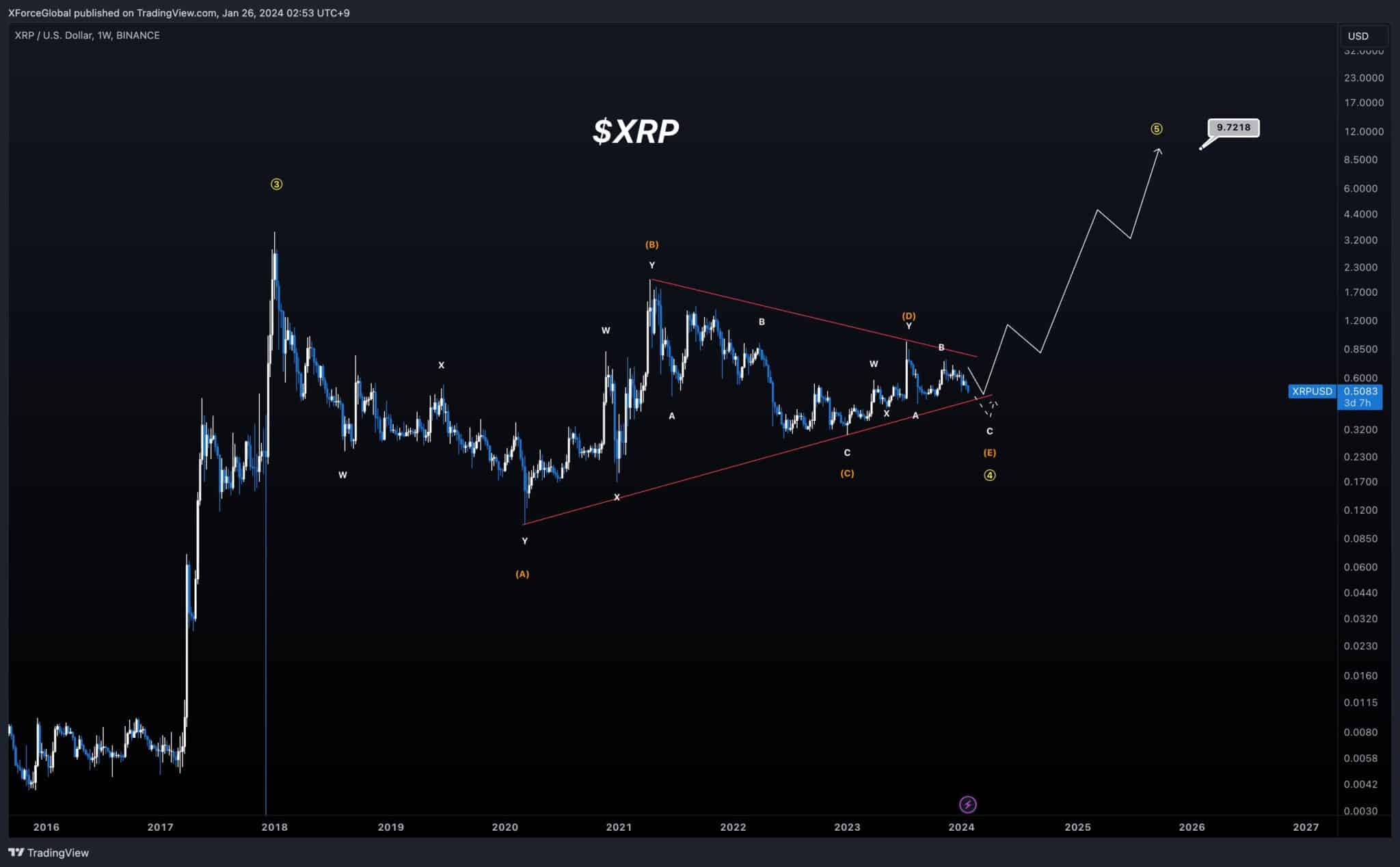
In a recent slew of separate unrelated analyses, three market watchers have projected XRP to reach the $10 territory. One of these analysts, XForceGlobal, a prominent TradingView educator, cited a symmetrical triangle formed by XRP since 2021.

Data from the analyst’s weekly chart shows that XRP formed the lower ascending trendline of the triangle after collapsing to a low of $0.1013 in March 2020. However, the asset did not form the upper descending trendline until the drop from the $1.96 high in April 2021.

The lower ascending trendline and the upper descending trendline essentially resulted in the formation of the symmetrical triangle.

XRP has failed to break above or below the triangle since then. An attempt to do so in July 2023 met resistance at the $0.93 high.

XRP 1W Chart XForceGlobal
XRP 1W Chart | XForceGlobal

As XRP inches closer to the zenith of the triangle, XForceGlobal believes the crypto asset would first decline further to retest the lower trendline. The analyst then predicts a massive uptrend that would result in an upward breakout.

According to him, the triangle’s endurance for three years is a metric that would further compound the rate of the upward surge.

He contends that if this breakout occurs as predicted, his conservative price target is between $9 and $11, an average of $10, in the coming years.

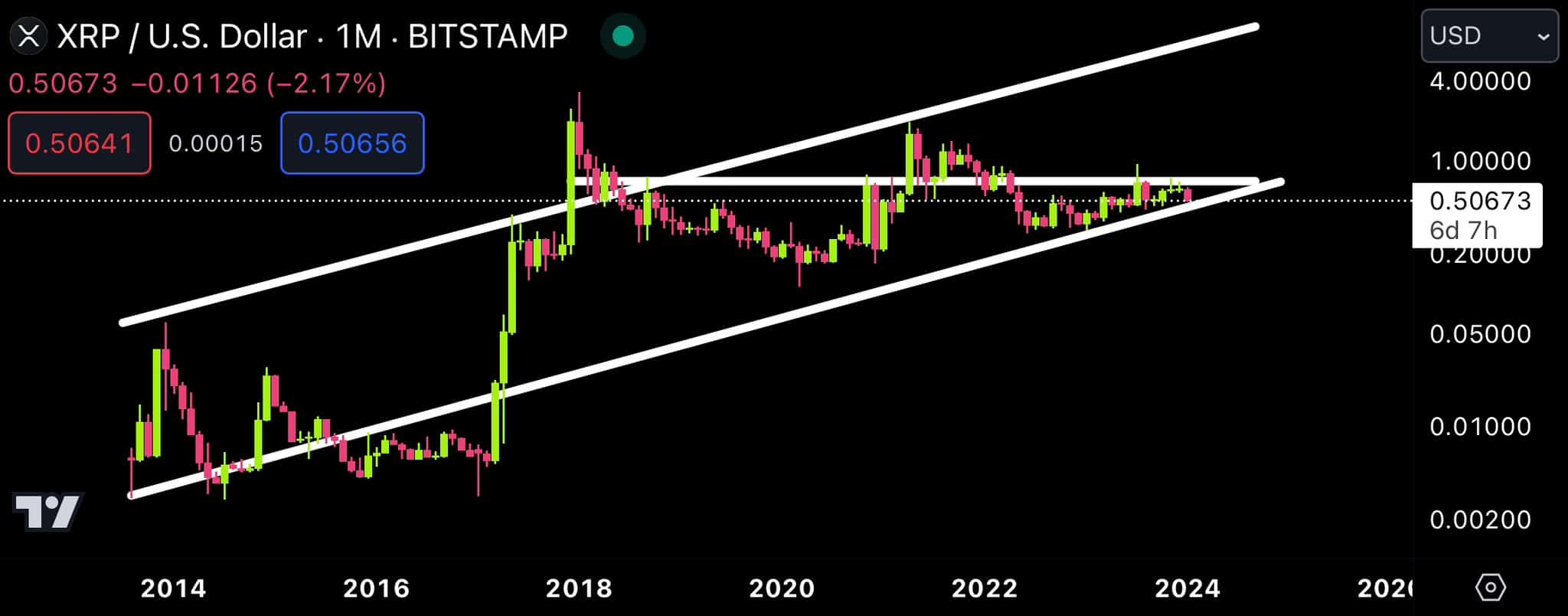
CryptoBull, another notable analyst, also discussed XRP’s potential in an analysis yesterday. CryptoBull pointed out that XRP’s monthly chart features the formation of an ascending triangle within a broader ascending channel. 

XRP to $10 1M Chart CryptoBull
XRP 1M Chart | CryptoBull

The broader ascending channel has persisted since 2014. However, the smaller ascending channel began after XRP dropped from the $3.3 all-time high in January 2018. The analyst expects XRP to break above the triangle soon, hitting a price range of $10 to $13 this year. 

XRP to $10: Elliott Wave Structure

The third forecast came from Capt. Toblerone, a crypto market educationalist. Unlike the other two who leveraged triangles for their analyses, Capt. Toblerone used an Elliott Wave pattern to predict an imminent price upsurge for XRP in the near future.

The market watcher believes XRP is about to follow a 5-wave structure during its next price movements. Data from his chart suggests XRP could rise to $0.90 in the first wave, and then drop below the psychological threshold in the completion of Wave 2.

He expects Wave 3 to then take XRP close to the $7.5 price level, marking a new all-time high. However, the correction coming with the fourth wave could bring XRP down to the $3 level. XRP is then expected to hit the $10 to $11.5 price during the fifth and final wave.

Capt. Toblerone notes that this trajectory is his mid-cycle run dream for XRP, suggesting that this is the last chance to see this materialize. XRP trades for $0.5135, requiring a 1,847% price surge to clinch the $10 target.

Here is When Shiba Inu Can Reach $0.0001, $0.005 and $0.02

0

While the price of Shiba Inu has struggled to impress in recent times, the most popular predictions predict that cryptocurrency will reach new highs in the coming years. 

One of the most widely owned cryptocurrencies, Shiba Inu, ranks within the top cryptocurrencies by market capitalization, outperforming coins launched way before it. However, the grueling 2022 bear market pushed Shiba Inu to its lowest point, around $0.0000082. 

Since then, the altcoin only managed a recovery to $0.000012 and instead returned to the $0.000008 range following the most recent decline in crypto prices. Many wonder if there is still hope for Shiba Inu to return to its glory days or at least erase the losses inflicted by the bear market.

Although there is no guaranteed way to predict Shiba Inu’s potential recovery, analysts consider a combination of market dynamics and ecosystem growth to forecast SHIB’s future price. A closer look reveals when SHIB can reach $0.0001, $0.005, and even as high as $0.02, according to two major sources.

Shiba Inu to Hit $0.0001 Within Three to Six Years

The price of Shiba Inu will go as high as $0.0001 within the next three years, according to prediction platform Telegaon. The forecast affirms that Shiba Inu will eventually break its previous all-time high of $0.00008845 sometime in 2026 before hitting an average price of $0.000153 one year later.

In a related development, analysts at popular crypto exchange Changelly expect Shiba Inu to hit that milestone much later. In their most recent prediction, Changelly forecasted that SHIB will cross $0.0001 sometime in 2030 while breaking its previous high one year before that (2029).

Shiba Inu on Course for $0.005 and $0.02

Beyond the initial removal of two zeros from Shiba Inu’s current market value, predictions have it that Shiba Inu will eventually end up with double zeros and a single zero decimal. According to Telegaon, SHIB will take more than a decade to hit the $0.005 mark, touching that price sometime in 2040.

Changelly also agrees with the prediction, seeing Shiba Inu crossing $0.005 in the same 2040. However, the exchange platform does not predict that Shiba Inu will reach $0.02 even after 2050. However, Telegaon foresees such an outcome in 2040, too, and even puts a high threshold of $1.06 by 2050.

It is noteworthy to mention that these predictions are not guaranteed to take place. Especially with Shiba Inu’s large supply of 589 trillion tokens, the project team will have to burn a considerable amount of the circulating supply for SHIB to reach such meteoric predictions.

For instance, Shiba Inu, with its current total supply of 589 trillion tokens, would have a market of $2.945 trillion if it crosses the $0.005 price. This market cap would be worth almost twice as much as the current crypto market capitalization of around $1.6 trillion.

Initiatives such as periodic token burns and the adoption of the Shibarium network will have to reach peak levels for Shiba Inu to stand a chance of seeing such substantial price jumps. In either case, Shiba Inu holders remain one of the most patient investors and may be rewarded if the project sees its value rise even halfway or a quarter way near the current predictions.

David Schwartz Explains How Liquidity Pools Work Using XRP Price Movements

0

David Schwartz, the Ripple CTO, recently explained how liquidity pools work, leveraging an illustration with XRP price movements amid the upcoming XRPL AMM.

Liquidity pools are a mechanism that boosts the availability of funds in a market by securing two assets within a smart contract. The upcoming XRPL AMM feature on the XRP Ledger will allow users to both establish and participate in these pools.

Panos Mekras, founder of Anodos Finance, recently ignited a discussion surrounding the upcoming AMM. Amid the conversation, an XRP community member requested an illustration of the workings of liquidity pools in the XRPL AMM.

Ripple CTO Explains How Liquidity Pools Work

David Schwartz granted this request, using a straightforward example to illustrate price volatility. He presented a scenario where the XRP price drops from $0.50 to $0.40 and then rises back to $0.50.

In this scenario, Schwartz introduced a 0.5% pool spread. A pool spread represents the difference between the pool’s price and the market price. Suppose XRP trades for $0.5, and then someone puts 2 XRP (worth $1) and $1 into the pool, this would total $2.

The trader who puts this $2 would receive liquidity tokens reflecting their share of the pool, amounting to the $2 they invested. Schwartz then detailed the changes in the liquidity token’s value as XRP’s price fluctuates. 

Should XRP drop to $0.40, the tokens would be valued at about $0.896 and 2.234 XRP ($0.8936), totaling $1.79. Although this represents a loss, it’s better than holding $2 as XRP. Notably, if the trader had held $2 in XRP when XRP dropped to $0.40, the tokens would be worth $1.60. 

Now, after the drop to $0.40, when XRP returns to $0.50, the value of the liquidity tokens would rise from $1.79 to $2.0007, split between $0.999 and 2.0033 XRP. This final value results in a gain of 3.5 basis points (0.035%) despite XRP returning to its initial price of $0.50.

A More Volatile XRP Market

Schwartz underscored that liquidity pools capture market volatility. According to him, if the price movement of XRP is more volatile, with more ups and downs, the liquidity pool would perform better.

He cited a more volatile example where instead of dropping in a straight line to $0.40, XRP drops by two cents to $0.30 and then rises by one cent to $0.40. From this $0.40, the asset increases by two cents to $0.60, and then drops by another one cent to $0.50. 

In this case, the asset dropped, increased and returned to its initial value. Schwartz noted that when XRP returns to $0.50, the liquidity tokens would be worth $1 and 2.005 XRP, totaling $2.0025. This represents a gain of 12.5 basis points, higher than the 3.5 BP when XRP moved in a straight line.

Existing Conditions

He clarified that these examples assume the liquidity pool captures all market volatility, engages solely with arbitragers seeking minimal profits, and operates under the condition that people pay the pool’s spread. 

Despite their advantages in mitigating risk associated with volatile assets like XRP, Schwartz cautioned that liquidity pools are not risk-free and may incur losses if asset prices fail to return to their initial values. Mekras also emphasized this, noting that becoming a liquidity provider carries risk.