Home Blog Page 1716

SEC Upcoming Closed Door Meeting Sparks Expectation of Possible Settlement in Ripple Case 

0

XRP enthusiasts are keeping a close tab on the upcoming SEC’s closed-door meeting and expect the event will lead to a potential settlement in the Ripple lawsuit. 

While the SEC has not officially signaled its intention to end the multi-year legal battle via settlement, the community expects things to change due to the agency’s recently scheduled closed-door meeting. 

SEC Upcoming Closed Door Meeting 

The United States Securities and Exchange Commission has scheduled to hold a closed-door meeting on November 30, 2023, by 2:15 PM. According to the announcement, the meeting will be held remotely or at the commission’s headquarters in Washington, D.C. 

Top SEC commissioners, counsels, secretaries, and other key staff members are expected to attend the meeting. 

The critical points of the discussion in the meeting include the settlement of injunctive actions and administrative proceedings. 

XRP Enthusiasts Expect SEC v. Ripple Settlement

Based on the highlighted key points, the XRP community hopes the commission will consider settling with Ripple to end the multi-year legal tussle. 

Prominent XRP influencer Amelie is among those expecting the SEC’s closed-door meeting to result in a settlement in the Ripple lawsuit. 

Expectedly, other top XRP enthusiasts share a similar settlement, as seen in the comment section. 

SEC v. Ripple Lawsuit Update 

Notably, the end of the lawsuit is in sight as the court has already issued its summary judgment decision. In a July ruling, the court declared that XRP and most Ripple transactions, including programmatic sales and other distributions, are not securities. 

However, it ruled that Ripple’s past sales to institutional clients constitute an investment contract. 

In the meantime, the court recently issued an order regarding the remedies phase of the suit. The Remedies phase will determine the appropriate penalty Ripple may face for violating the law via its institutional sales of XRP. 

Even though the court is expected to issue a decision in the remedies phase by the summer of 2024, there are indications that the SEC could appeal the decision on Ripple’s programmatic sales of XRP and other distributions immediately after the remedies proceeding. 

The court denied the SEC’s initial attempt to appeal the ruling, as the agency was ordered to wait until all pending issues were resolved. The only pending issue in the case is the remedies. After that, the SEC has the full right to appeal the court’s July 13 ruling. 

However, with the SEC expecting to discuss the settlement of injunctive actions and administrative proceedings, there is a tendency for the regulator to discuss settling its ongoing litigations with Ripple. 
Cardano Foundation Backs Move to Further Decentralize Network with 11.4M ADA Vote

0

The Cardano Foundation is at the forefront of a move to further decentralize the Cardano network and will vote “YES” in an ongoing poll to that effect.

Efforts to introduce decentralized governance on the Cardano blockchain are well underway, with the independent Cardano Foundation throwing its weight behind CIP-1694. The landmark proposal, among other things, allows ADA holders to play a key role by voting on major developments involving the network.

In the latest move to make CIP-1694 a reality, the Cardano Foundation announced Tuesday that it will vote “YES” in a poll event that seeks to weigh public interest in the proposed adjustments. The Cardano Foundation will leverage a wallet with 11,429,000 ADA (approximately $4.2 million) to vote in the poll.

It is notable that the results of the current poll are non-binding and only seek to gauge public sentiment. Meanwhile, the poll is conducted using the Cardano Ballot solution developed by the Foundation. 

Other ADA users can vote using a browser extension wallet that supports CIP-30 and would have had at least 1 Lovelace staked before November 21st to be eligible to vote. Lovelace is the smallest unit of Cardano’s ADA coin, with the low requirement indicating the Foundation’s intent to involve as many voters as possible.

As revealed on the official voting website, the poll is expected to open to the public on December 1 and will be live until December 11. The outcome of the event will help the Cardano Foundation prioritize “governance activities and development” going into the year.

Cardano Blockchain Ecosystem Advances

Beyond the move to adopt on-chain governance, the Cardano blockchain ecosystem has made other significant strides in recent times. For instance, the network is set to welcome its first privacy token protocol by the end of November.

The Cardano network has also topped the list of blockchains by development activity, and also reached a milestone of 78 million lifetime transactions.

Such consistent innovations and longevity have helped ADA cement its position as one of the most valuable crypto assets, further paving the way for the current move to adopt a more efficient governance mechanism.

Binance CEO Steps Down, Pleads Guilty to Criminal Charges, Released on Huge Bail After $4.3B Settlement, and More

0

Binance’s once-famous CEO Changpeng Zhao (CZ) has stepped down from the reins as U.S. authorities bring a multi-year investigation into the business to a climax.

It’s the end of an era. Binance’s enigmatic CEO Changpeng Zhao announced Tuesday that he has stepped down from the role. The company has replaced Zhao with Former Global Head of Regional Markets, Richard Teng.

However, the leadership change in Binance is more than just a switch of corporate roles. Rather, it marks the closing stages of what has been a multi-year investigation into its operations by U.S. authorities.

As announced by the U.S. Department of Justice (DoJ) on Tuesday, Binance and CZ pleaded guilty to charges of facilitating money laundering, sanctions violations, and unlicensed money transmission. The total settlement for the offense is northward of $4 billion, with several reports putting the total sum at $4.3 billion.

The significant settlement sum will be split between the U.S. Financial Crimes Enforcement Network (FinCEN), the Commodity Futures Trading Commission (CFTC), and the Office of Foreign Assets Control (OFAC). These agencies are all parties to the lawsuit against Binance, having judged that the company had at one time or the other violated financial laws that fall under their purview.

Among other things, the CFTC alleged that Binance operated its exchange without acquiring the requisite licenses. FinCEN and OFAC, on their part, claim that Binance implemented loose anti-money laundering and know-your-customer (KYC/AML) measures, allowing the platform to serve as a hub for terrorist financing and bad actors.

The offenses were notably carried out during Binance’s formative years (2017-2019), with popular terrorist groups such as Hamas funding their operations using accounts on the exchange.

Binance and CZ Pleads Guilty, CEO Released on Bail

Binance and its CEO have pleaded guilty to the allegations, with eyes firmly set on turning the page on what is described as a “challenging […] chapter of learning and growth” for the business. 

In its official statement announcing the resolution, Binance admitted to having loose compliance policies in its early years. However, the exchange also reassured users that it has since beefed up compliance with significant hires and implementation of several industry-leading measures.

Additionally, the allegations raised against Binance do not include that it misappropriated user funds or committed any market manipulation. Instead, they are mainly compliance-related and have served as a learning curve for the company going forward.

Meanwhile, Binance’s now former CEO, who was formerly arrested by U.S. authorities as part of the plea deal, has been released on a $175 million bail bond. The release allows Changpeng Zhao to enjoy relative freedom until he reappears in a U.S. court for sentencing on February 23, 2024. The former Binance CEO would be allowed to return to the UAE and come back to the U.S. 14 days before his sentencing.

CZ Bail Terms
CZ Bail Terms

CZ would have originally faced up to 10 years in prison, but that sentence was cut to 18 months as part of the plea agreement. He also paid a $50 million fine, while the judge in the case may also decline sentencing based on jail time and instead impose additional fines.

BNB Drops 9% Amid Uncertain Future

The plea agreement between Binance and the U.S. government allows the company to continue operating. Yet, with government officials keeping a close eye on its operations, it is uncertain whether Binance native BNB coin will continue to play a crucial role in the ecosystem.

Traders and investors have speculated on this development, causing the price of BNB to drop 9% in the hours following news of the Binance settlement. After reaching a high of around $272, BNB dropped as low as $224 and traded at $234 at the time of writing.

In the meantime, the asset remains the fourth largest crypto by market capitalization, valued at $35 billion.

GameStop: From Meme Stock To Money Maker

0

In January 2021, a seemingly obscure video game retailer, GameStop Memes (GSM), captured the attention of the financial world in a way that no one could have predicted. What started as a speculative frenzy fueled by online communities like Reddit’s WallStreetBets, quickly turned into a phenomenon that challenged traditional notions of investing. GameStop transformed from a struggling brick-and-mortar business into a symbol of retail investor power and a potential money-making opportunity.

The evaluation of Meme stock

GameStop’s journey from a forgotten mall store to a meme stock began when a group of individual investors on Reddit noticed that hedge funds were heavily shorting the company’s stock. In simple terms, shorting involves betting that a stock’s price will go down. These Redditors saw an opportunity to collectively buy GameStop shares and create a short squeeze, forcing the hedge funds to cover their positions by buying back shares at higher prices.

The online community rallied around the cause, using humour, memes, and a shared disdain for institutional investors to fuel their campaign. This grassroots movement turned GameStop into a symbol of resistance against Wall Street’s perceived manipulation of the stock market.

The Short Squeeze and Wall Street Shock

As more individual investors piled into GameStop, its stock price soared to unprecedented heights. The short squeeze worked, and some hedge funds faced significant losses. The financial media, initially dismissive of the online movement, was forced to take notice as GameStop’s stock became a mainstream news story.

The surge in GameStop’s stock price also exposed flaws in the traditional financial system. The debate over market manipulation, the power of retail investors, and the role of social media in financial markets became hot topics. Regulatory bodies and lawmakers started scrutinizing the events surrounding GameStop, leading to a reevaluation of market practices.

Transition to a Money Maker

While GameStop’s meteoric rise began as a speculative and somewhat anarchic movement, the story didn’t end with a crash. Surprisingly, GameStop managed to transition from a meme stock to a potential money maker, showcasing resilience and adaptability.

One key aspect of GameStop’s transformation was a change in leadership. The company brought in new executives, including Ryan Cohen, the co-founder of online pet supply retailer Chewy. Cohen’s vision involved shifting GameStop’s focus from physical retail to e-commerce, aligning with the changing landscape of the gaming industry.

Investors who initially rallied around GameStop for symbolic reasons began to see the company’s potential for a turnaround. The strategic shift towards digital sales, e-sports, and other online ventures presented a viable path to profitability. The meme stock was no longer just a speculative bet; it became an investment in a company undergoing a strategic evolution.

Furthermore, GameStop capitalized on its newfound popularity to raise capital. The company issued additional shares, leveraging the high stock price to bolster its balance sheet. This move provided GameStop with much-needed funds to accelerate its transformation and navigate the challenges posed by the evolving gaming industry.

The Lessons Learned

The GameStop saga offered several valuable lessons for both retail and institutional investors, as well as regulators. First and foremost, it underscored the power of the individual investor, particularly those congregating on social media platforms. The democratization of information and the ability of retail investors to organize effectively challenged the established order of Wall Street.

On the flip side, the incident raised concerns about market manipulation and the need for regulatory oversight. The rapid and unpredictable movements of meme stocks prompted discussions about the need for updated regulations and safeguards to ensure market stability.

For retail investors, the GameStop saga highlighted the importance of due diligence and understanding the dynamics of the stocks they invest in. While the community-driven rally proved successful for GameStop, not all meme stocks experienced the same fate. Many retail investors face losses, emphasizing the risks associated with speculative trading.

GameStop’s journey from meme stock to money maker is a unique chapter in the history of financial markets. What started as a rebellion against Wall Street turned into a story of corporate reinvention and adaptation. GameStop’s ability to capitalize on its newfound popularity and transform its business model demonstrates the resilience of companies in the face of adversity.

The legacy of GameStop extends beyond its stock price. It ignited a broader conversation about the nature of investing, the power dynamics within financial markets, and the role of retail investors in shaping the future of finance. As the dust settles, the GameStop saga serves as a reminder that the world of investing is evolving, and traditional models are being challenged by new forces, driven by the collective power of individual investors.

Find Out More At

Website

Twitter

Telegram

Congressman Pushes to Fire SEC Chair Gensler Amid Critique by Pro-XRP Attorney

0

Congressman Warren Davidson has reiterated his push to fire U.S. SEC Chairperson Gary Gensler following sharp criticism by pro-XRP attorney John E. Deaton.

The latest enforcement action from the SEC has triggered a series of reactions from the broader crypto community. Kraken, the latest victim, joins Binance, Coinbase and Ripple as one of the crypto-focused entities targeted by the regulatory agency.

Deaton Blows Hot

Reacting to the lawsuit, Deaton, the founder of CryptoLaw, accused Gensler of being a despicable and dishonorable regulator. According to Deaton, Gensler knew that Kraken believed it was escaping the SEC’s enforcement by willingly settling the agency’s earlier charges.

Recall that the SEC charged Kraken in February for offering its staking-as-a-service program, a project the agency believes represents an investment contract, without proper registration. Kraken agreed to pay a $30 million fine to settle the charges.

Amid the SEC’s recent enforcement against Kraken, several industry commentators have criticized the exchange for settling the earlier charges.

Deaton noted that he understands the reason behind Kraken’s decision to settle those charges. According to him, fighting the SEC would have cost more for Kraken.

Deaton remarked:

“I wanted them to fight as well. But when you decide to fight, $30M takes you only so far, like maybe only 1/3 of the way – if you’re lucky. Ask Ripple and Brad Garlinghouse, who spent $150M plus so far, and is STILL paying millions in legal fees.”

He acknowledged that he is not aware of the motivation or mechanics involved in the settlement decision. However, he expressed confidence that the firm discussed actions such as staff layoffs.

“When the belief is $30M buys you peace and keeps good people employed, I understand why a company makes it. Unfortunately, Gensler doesn’t give a shit about those same employees or investors. He’s a disgrace and I can’t wait to see him go down,” Deaton concluded.

Rep Davidson Wants Gensler Out

Reacting to Deaton’s comments, U.S. Rep. Warren Davidson brought back attention to the SEC Stabilization Act he proposed in June. According to Davidson, the agency’s latest enforcement against Kraken suggests that now is the time to fire Gensler.

Recall that Davidson introduced the Stabilization Act in the House of Representatives on June 12. The act seeks to carry out a reform of the Securities and Exchange Commission, with one of its provisions looking to remove Gensler as Chairperson.

As The Crypto Basic reported in June, shortly after the introduction of the bill, Deaton expressed concerns that it might not pass.

Despite stressing that Gensler’s ideology aligns with the status quo in the U.S. government, Deaton emphasized that the SEC Chair’s days are numbered. Five months later, Davidson continues to advocate for his sack.

‘The SEC Are No Hobbits,’ Pro-XRP Attorney Reacts as Congress Looks to Strip SEC of Its Powers

0

Pro-XRP lawyer Jeremy Hogan has argued that the U.S. Securities and Exchange Commission (SEC) could be unwilling to relinquish its regulatory powers over the crypto industry.

Hogan’s sentiment comes amid a disclosure that the U.S. Congress now seeks to step into the crypto space, thereby limiting the authority of the SEC. “The SEC are no Hobbits,” the attorney submitted, implying that the agency would not be humble enough to let go of their power.

U.S. Congress Limiting SEC’s Powers Over Crypto

In particular, the lawyer’s remark follows a recent statement from Hester Peirce, the SEC commissioner, about the U.S. Congress considering a more prominent role in regulating cryptocurrency.

Peirce mentioned that Congress’ move into the crypto market indicates that the SEC would lose most of its regulatory authority over the industry. 

Meanwhile, prior to this conclusion, Peirce lamented the SEC’s failure to provide timely guidance for the crypto space. She criticized the prevailing “wait and see” approach the SEC adopted, asserting that it led to enforcement actions in an arbitrary manner.

Emphatically, the SEC commissioner highlighted the missed opportunities where the SEC could have provided rules or guidance to assist businesses in navigating the intersection of their activities with securities laws.

In this context, she acknowledged the current challenge with Congress’ planned involvement in the crypto industry. She believes it would make it more difficult for the SEC to take decisive actions. 

In her words:

“Now we’re in a bit of an awkward position because Congress has expressed a clear interest in stepping into this space and has suggested that maybe the SEC will not be the primary regulator for much of this stuff. And so it’s a little bit harder to do now.”

Pro-XRP Lawyer Reacts

On the other hand, lawyer Jeremy Hogan offered his perspective on the potential of the SEC’s weakened power of the crypto. He drew an analogy to the iconic fantasy series “The Lord of the Rings.” 

In his commentary, Hogan remarked: 

“It takes a humble and pure spirit to voluntarily relinquish power. That’s why Gandalf entrusted the ring of power to the Hobbits. The SEC are no Hobbits.”

Notably, Hogan suggests humility and a selfless spirit are essential when dealing with power. Hogan’s analogy implies that the SEC, unlike the Hobbits, may not be characterized by a similar inclination toward humility and voluntary relinquishment of power. 

Terra Luna Classic Surges 30% Amid Ongoing Efforts to Revive USTC and LUNC Prices  

0

The price of Terra Luna Classic surged 30% in one month as the team intensified efforts to revive the values of LUNC and USTC back to $1. 

In a recent tweet, Derek, a prominent Terra Luna Classic (LUNC) trader, disclosed that the 115th largest cryptocurrency by market capitalization recently hit a major milestone.  

According to Derek, the crypto asset hit a significant bullish divergence by breaking the 200 Moving Average (MA), which has been depressed for over a year. 

The trader pointed out that while this feat is commendable, it is imperative for LUNC to have some support above the 200MA line. However, Derek notes that it is not much of an issue if the 200MA line dips slightly because the indicator has a strong RSI (Relative Strength Index) support at 58.  

LUNC Surges 30% in One Month 

This significant breakthrough is reflected in LUNC’s current price, which has amassed over 30% gains in 30 days. Additionally, the cryptocurrency has been up 13% over the past two weeks. 

However, the price of LUNC is down 3.2% and 4.8% over the past 24 hours and seven days, respectively. At the time of writing this line, LUNC was changing hands at $0.00007443, according to data from CoinGecko. 

Community Not Relenting in Efforts to Revive LUNC and USTC Values 

It is worth mentioning that the Terra community had yet to achieve major success in reviving the value of LUNC and USTC back to their former glory. However, the community is still resilient in revitalizing the network to restore LUNC and USTC to their past glory days. 

As reported earlier, the community initiated a new proposal that could help revitalize USTC and LUNC prices to $1, with an emphasis on safely re-enabling the market module. It bears mentioning that the market module was disabled in May 2022 following the collapse of the Terra ecosystem. 

According to the proposal, developers aim to increase rewards and mitigate risks, especially the heightening of the USTC and LUNC supply via unintended minting.  

The development comes days after the development team revived a critical function in Terraport, a decentralized application used to stake supported assets on the network. 

In the meantime, leading blockchain security company CertiK announced that it is currently auditing the service and will release the report soon. 

Ripple and Coinbase Lead Crypto Lobbying Efforts in the US: CoinGecko Report

0

A new report from CoinGecko just showed that crypto lobbying efforts in the U.S. have gobbled up $20M thus far, with Coinbase and Ripple making headlines.

The CoinGecko data shows the crypto industry has spent a total of $56 million in lobbying efforts from 2019 to date. The spending for this year, which is likely to surpass the $23 million spent in 2022, saw participation from Coinbase, the Blockchain Association, and Ripple Labs.

‘Lobbying’ is an advocacy term that describes a situation in which an individual or a group persuades members of Parliament to support a defined policy or campaign. 

With the clamor for crypto regulations growing in the past few years, injecting cash into lobbying seems right as Congressional support can help the industry achieve its goals faster.

The Crypto Lobbying Statistics

According to the data presented, a total of 78 ‘non-individual entities’ including 66 companies and 12 organizations participated in the US lobbying efforts in the past 5 years.

The effort took $2.99 million in 2019 but the spending dropped to $2.45 million in 2020, with the breakout of COVID-19 the plausible explanation for the drop.

Crypto lobbying efforts regained momentum in 2021 with $8.49 million spent. This figure skyrocketed to $22.23 million in 2022.

Per individual company participation, Coinbase has spent $7.51 million in its lobbying efforts from 2019 to date. This spending is reasonable considering its status as a publicly listed US firm with obligations to keep the company attractive for the benefit of its investors.

Masked by the SEC’s lawsuit, Coinbase needs allies and lobbying remains one of the more viable ways to achieve it.

Blockchain Association spent $5.23 million to rank in the second spot while Ripple Labs, a firm with multiple legal victories against the SEC, spent $3.46 million. According to Coingecko, the top three spenders have participated in lobbying efforts in the past 5 years.

This year, Coinbase’s spending sits at $2.16 million, closely followed by Crypto.com’s $1.535 million, Blockchain Association and Binance have spent $1.47 million and $1.19 million while Ripple Labs have spent $710,000 in its lobbying efforts thus far this year.

Other top 10 spenders include Kraken, the exchange currently facing its second SEC lawsuit, Andreessen Horowitz (a16z), Tether, Crypto Council for Innovation, and DeFi Education Fund.

Future of Crypto Lobbying Efforts

Considering how dynamic the digital currency ecosystem is, crypto lobbying efforts have come to stay. This crypto lobbying trend might persist even when the industry gets the much-needed robust regulatory clarity.

According to the Coingecko report, crypto spending this year accounts for 19.6% of Wall Street lobbying cost thus far, with projections that this rate might soar in the coming years.

Analyst Identifies Next XRP Resistance and Support Levels to Watch as XRP Slumps to $0.61

0

Amid the recent XRP decline to the $0.61 territory, EGRAG, a prominent crypto chartist, has called attention to the next crucial XRP resistance and support levels to watch.

XRP is currently trading for $0.6105, down 1.8% over the past 24 hours. The asset is witnessing growing interest despite the ongoing slump, with trade volume up 24% in the last 24 hours to $1,258,720,817. 

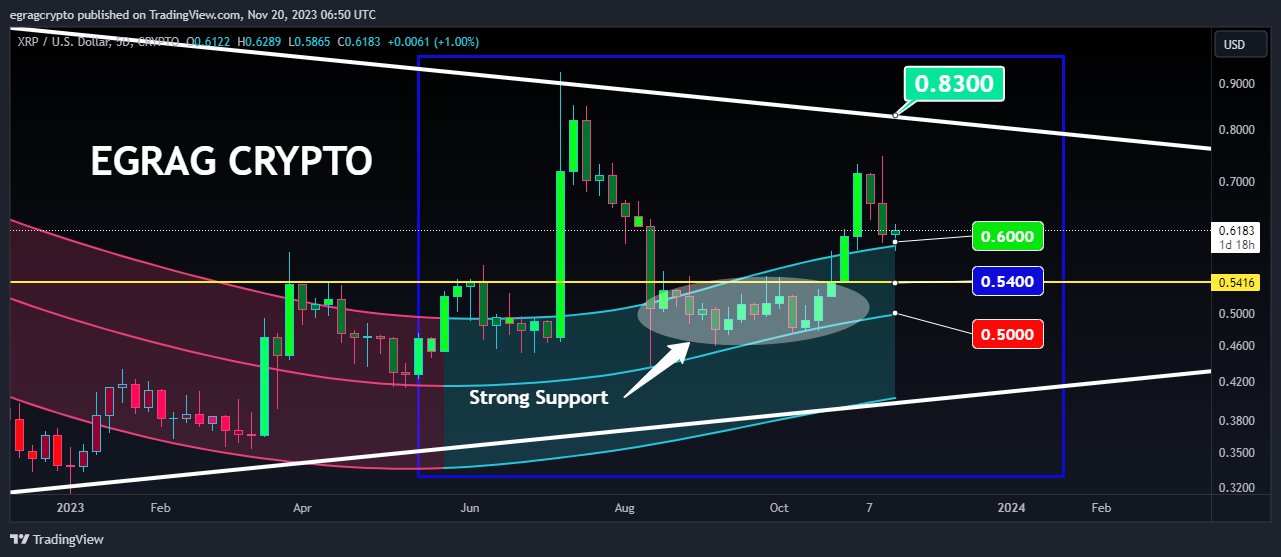
As XRP trades at the current position, EGRAG took to X to unveil the significance of the Gaussian Channel and Symmetrical Triangle in understanding XRP’s price movements. The analysis brings attention to pivotal support and resistance levels on the 5-day chart.

Key Support and Resistance

EGRAG identified $0.60 as a critical support threshold. Breaching this level could signal a shift in sentiment, possibly triggering increased selling pressure. 

The market exhibits resilience within the firm support range of $0.54 to $0.55. This is a zone where buying momentum tends to intensify. It is important to closely monitor any price actions within this band for potential trade decisions.

XRP 5D Chart EGRAG Crypto
XRP 5D Chart | EGRAG Crypto

He further emphasized a robust support level at $0.50, indicating a significant threshold where buyers have historically shown increased interest. This level is crucial for maintaining XRP’s stability.

In addition, EGRAG pointed to a macro resistance point, a level where historical price movements have encountered notable obstacles. This signifies a challenging zone for XRP to surpass, requiring a substantial bullish push. This territory represents the symmetrical triangle barrier at $0.83 to $0.85.

XRP Might be Oversold

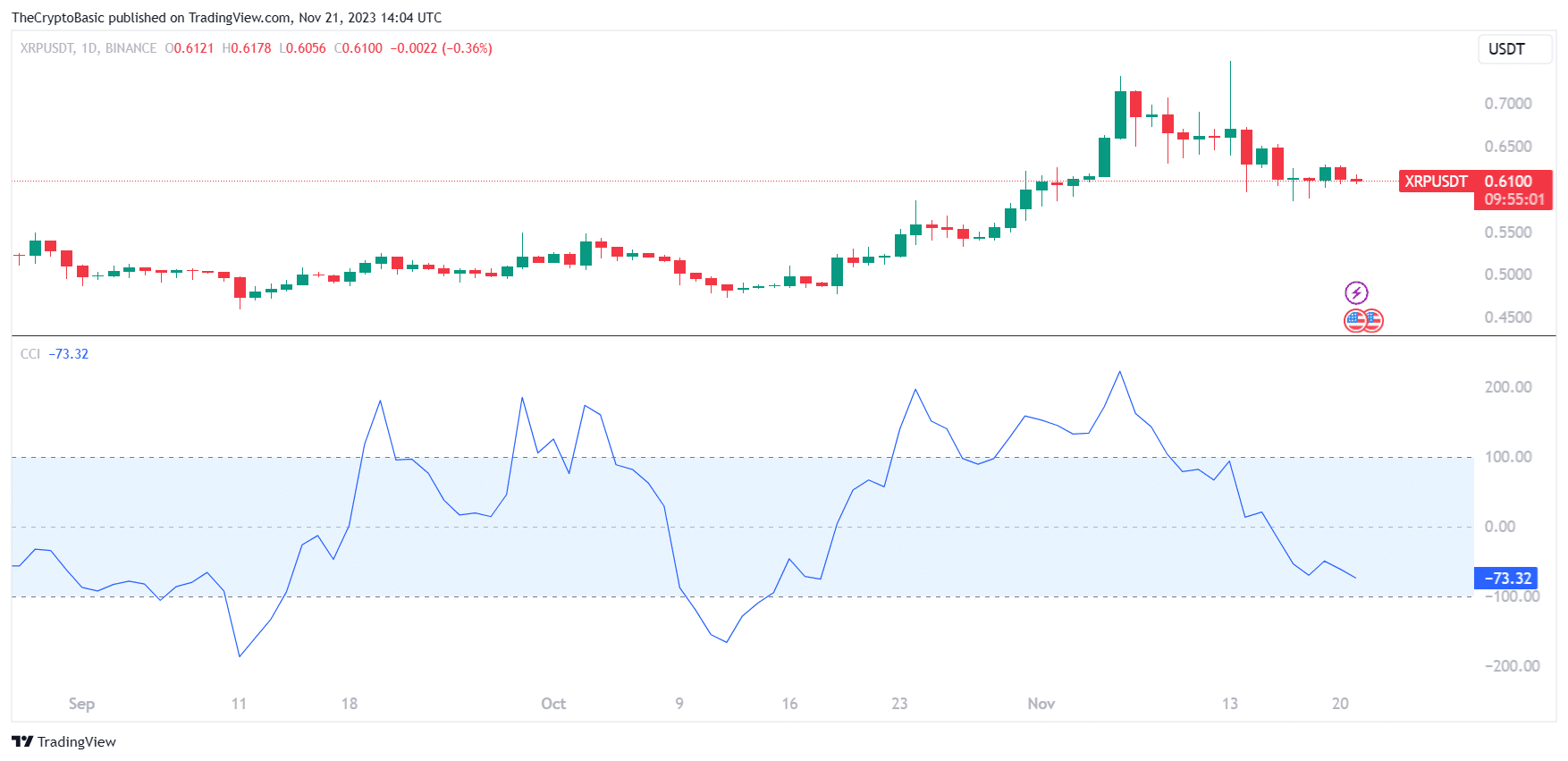
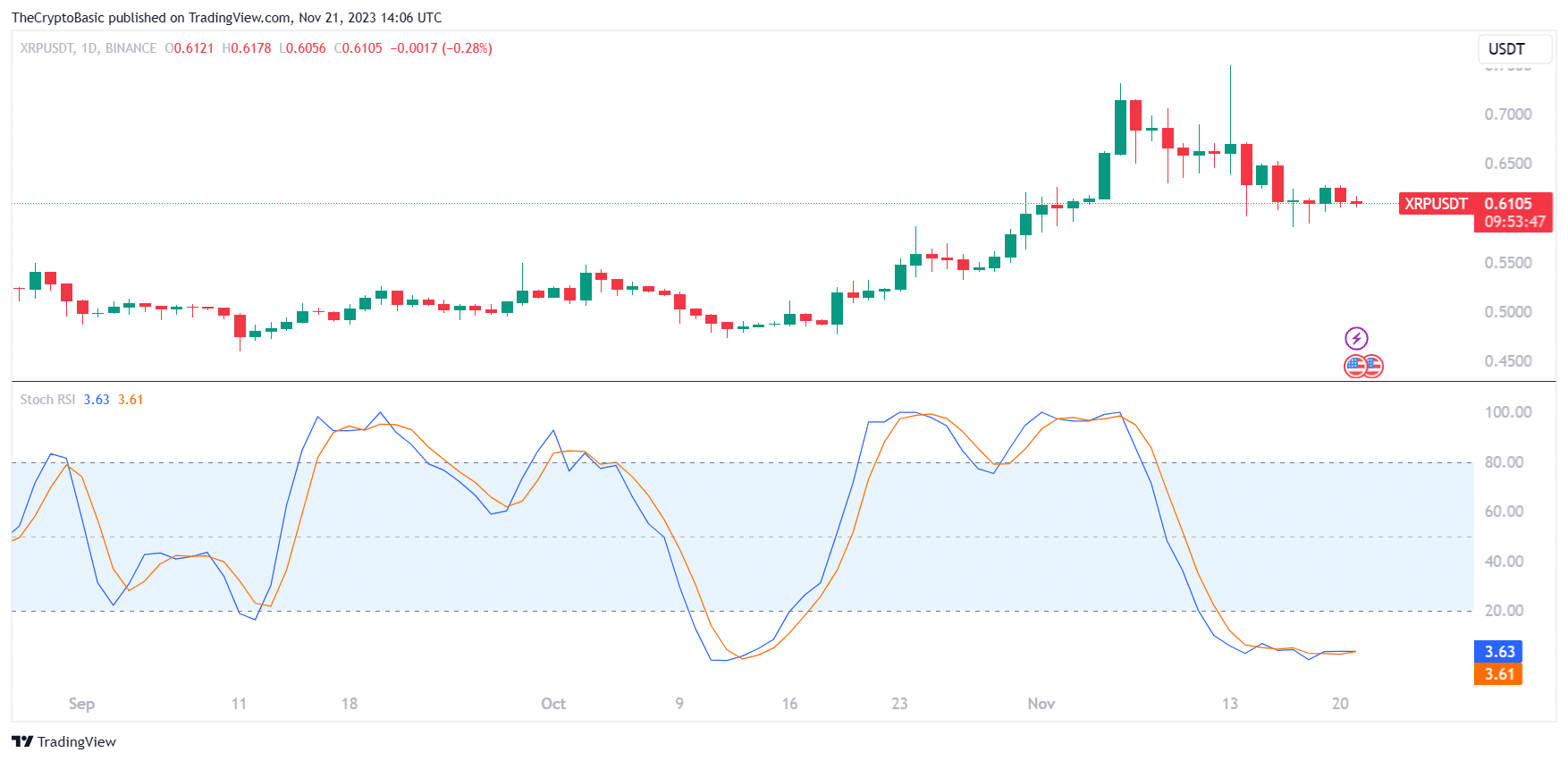
Furthermore, current metrics suggest XRP is undersold, hinting at a potential reversal of the prevailing bearish trend. Notable indicators include the CCI at -73.32 and the Stochastic RSI at 3.63.

The CCI, or Commodity Channel Index, currently standing at -73.32, indicates an oversold condition. This implies that XRP may have reached a point where selling pressure is excessive, potentially paving the way for an upward momentum in price.

XRP CCI 2 033458
XRP CCI

The Stochastic RSI at 3.63 also signifies an oversold market. This reading suggests that XRP’s recent downtrend might be reaching a saturation point, increasing the likelihood of a rebound.

XRP Stoch RSI 2 033502
XRP Stoch RSI

Moreover, The Crypto Basic recently called attention to the formation of a bullish pennant pattern on the daily chart for XRP. A pennant typically signifies a period of consolidation after an upward or downward momentum. The formation of the pennant suggests that XRP could resume the previous upward trend.

Shiba Inu: Thousands of BONE Move to Binance Wallet, Triggering Speculation of Imminent Listing

0

The transfer of thousands of BONE tokens to a Binance-linked wallet has fueled speculation that the leading exchange could list the Shiba Inu ecosystem asset.

A listing on the world’s largest cryptocurrency exchange by trading volume is one of the most coveted milestones for any blockchain-based project. The Shiba Inu project already enjoys this status with the SHIB token listed on Binance.

However, speculations have arisen that an additional milestone for the Shiba Inu ecosystem may be in the pipeline, this time involving BONE. BONE is the governance token of ShibaSwap, a decentralized exchange developed by the Shiba Inu ecosystem team. 

Eagle-eyed investors have spotted the movement of large amounts of BONE tokens to an address linked to Binance.

Specifically, an unknown user transferred 17,000 BONE tokens (approximately $10,000) to an address tagged by blockchain explorer Etherscan as belonging to Binance. At the same exact time, another address moved 507.2 BONE (approximately $322) to the same Binance address. 

The nature of the transfers and the amount involved have fueled speculation within the SHIB community that Binance is potentially gearing up to list the asset.

Is Binance Set to List BONE?

Several factors may be behind the recent transfer of thousands of BONE to Binance’s wallet. The transfer may remotely be considered evidence that the exchange is gearing up to list the asset. 

However, such a case seems less likely as the current transfer is not the first involving this specific Binance address and BONE tokens. The blockchain trail shows that the address has previously received and transferred BONE several times since its initial interaction with the token roughly two years ago.

Meanwhile, the transfers may also be a case of Binance users erroneously transferring BONE tokens to Binance, hoping they can trade the asset on the platform.

In most cases, such transfers could be lost as the exchange will not credit the deposit and simply remind users that they do not support trading on the asset. In rare cases, the exchange may choose to credit the deposit anytime in the future that they list the asset.

The latest BONE transfers show that Binance actively interacts with BONE. Even though the asset is not listed for trading on its platform, such an interaction could pave the way for a listing in the future, but this remains speculative as of press time.